All posts by admin
05
DGCA certifies 1st small drone built by city startup
First Flight

Insight, an enterprise-grade drone built by a Bengaluru-based startup Aarav Unmanned Systems’ (AUS), has emerged as the first to be certified by the Directorate General of Civil Aviation (DGCA) under the ‘small drones’ category.
The category is part of the No-Permission No-Takeoff (NPNT) regulation laid down by the DGCA in its recently released Civil Aviation Requirement (CAR) for drone operations in India.
Drones weighing between 250g and 2 kg are categorised as ‘micro.’ These have fewer compliances to meet and are limited by performance and capability to carry payloads for commercial operations.
Small category drones weigh between 2 kg and 25 kg. These are capable of long endurance and could carry heavier, more advanced sensors. They also need to meet additional compliances laid down by the CAR.
So far, three Indian drone startups have obtained certification under the micro category, while AUS is the first to get the certification under the small category.
Drones were permitted to legally operate in India following a draft proposal by DGCA in October 2017. AUS, the city-based startup founded by Vipul Singh, Suhas Banshiwala and Yeshwanth Reddy in 2013, had jumped into the fray seeking approvals for practical applications for drones.
Mining, where land patterns are constantly changing, is a key area for drone application. AUS cofounder Vipul Singh contends that the amount of data captured through drones can be up to two million times more than the information gathered through other techniques.
source: http://www.deccanherald.com / Deccan Herald / Home> City> Bengaluru Infrastructure / by Rasheed Kappan / DH News Service / September 04th, 2019
Shorthand writers to hold centenary celebration
The Shorthand Writers’ Association of Karnataka (SWAK), will hold its centenary programme on September 14 and 15. Featuring a group discussion on English and Kannada shorthand, the release of a souvenir, honouring of Kannada and English shorthand writers who have rendered yeomen service, and more, will be done at the event at Karnataka Government Employees’ Association Auditorium, Cubbon Park. S. Ramanathan, former Secretary to GoI, and chairman, Indian Institute of Public Administration, Karnataka Regional Branch, will inaugurate the event.
Members must enrol to attend. Stenographers working in Central, State, Public and Private sector organisations and are not members may also participate by enrolling either as donors or RC members. High speed shorthand competitions both in English and Kannada will be held on August 13. Call 080-22225462 or reach the Association Secretary A.M. Muralinath on 9740285462 for details.
The association offers training in English and Kannada shorthand between 11 a.m. and 7.30 p.m. Those interested can enrol at SWAK, 3rd Floor, Right Wing, Kandaya Bhavan, K.G. Road, Bengaluru – 560029. For details, mail swakbangalore@gmail.com
source: http://www.thehindu.com / The Hindu / Home> News> States> Karnataka / by Staff Reporter / Bengaluru – September 04th, 2019
100 to get Kempegowda award
Despite a self-imposed limit on the Nadaprabhu Kempegowda Award 2019 to only 70 people, the BBMP announced 100 recipients of the same on Tuesday.
Senior Kannada writers Chandrashekhar Patil, Keshavareddy Handrala, Abdul Rasheed, Pratibha Nandakumar, actor-politician Mukhyamantri Chandru, singer Manjula Gururaj, educationist Gururaj Karjagi, Dalit activist Mavalli Shankar and senior advocate Ravi Verma Kumar are among the awardees. IPS officer M.N. Anucheth, the chief investigation officer in the Gauri Lankesh murder case, and six members of his team, have also been given the award for the successful probe that eventually led to breakthroughs in three other murder cases.
Another IPS officer D. Roopa is also on the list of awardees.
While 10 women, including social activist and JD(S) leader Leeladevi R. Prasad, have been awarded the Nadaprabhu Kempegowda Sose Mahatyagi Lakshmidevi award, five organisations including Bosco Mane, that helps children, have been awarded the Paramapoojya Dr. Shivakumara Swamiji award.
Chief Minister B.S. Yediyurappa will present the awards on Wednesday, observed as the 508th Nadaprabhu Kempegowda Jayanti.
source: http://www.thehindu.com / The Hindu / Home> News> States> Karnataka / by Staff Reporter / Bengaluru – September 04th, 2019
Team from Cresarc wins #ABetterHebbal Design Challenge

10 teams pitched their solutions at an event organised at Mount Carmel College on Saturday
More than a hundred citizens took part in the challenge to provide solutions to the problem of public transport in and around Hebbal, as part of a crowd-sourcing initiative by Citizens for Sustainability (CiFoS), in association with the DULT and transport corporations. Of the 109 registrations for the #ABetterHebbal Design Challenge, 10 shortlisted teams pitched their solutions at an event organised at Mount Carmel College on Saturday.
Hebbal was chosen for this pilot challenge as it is a fast-developing suburb with one of the worst traffic problems. A team comprising architects from Cresarc took the first place with their idea ‘Through the Park’. According to Naveen Mahantesh of Cresarc, their idea is a three-pronged approach to deal with traffic congestion: an underground route, an overhead route to dilute the traffic coming in from all sides and a park.
The park will be a space for the free movement of pedestrians. The team also pitched ideas to control traffic, increase the use of public transport and improve last-mile connectivity. “It’s a brilliant platform. You can present your ideas to people who can make a difference. As an initiative, we need such challenges for the city. We hope we can connect with the authorities to make this idea come to fruition,” said Mr. Mahantesh.
The runner-up was Suman Paul, an architect from DKP Architects, for his idea of connecting the bifurcated Hebbal lake and build a loop around it with four outlets to reduce commute time. The second runner-up was Priyanka R., an architecture student from M.S. Ramaiah College.
The jury panel included BBMP Commissioner Anil Kumar, Police Commissioner Bhaskar Rao, Directorate of Urban Land Transport (DULT) Commissioner Ponnuraj, BMRCL MD Ajay Seth and urban expert Ashwin Mahesh.
Public transport
At a panel discussion, the focus was on the involvement of the public in government decisions and the popularisation of public transport. Anil Kumar said, “Agencies need to reach out, as people are always willing to make suggestions. But government agencies need to act on the suggestions.”
On road congestion, Bhaskar Rao said, “Bengaluru doesn’t have a traffic problem; it has a transportation problem. We are all victims of our urban planning. I can only regulate traffic. I cannot come up with plans to make our mobility easier. There are 13,000km of roads in the city, 44,000 intersections, 800km of arterial roads, 600km of main roads. I have 4,000 policemen to manage these junctions. The city needs a planning body to make plans every year.”
source: http://www.thehindu.com / The Hindu / Home> News> Cities> Bengaluru / by Nived Uthaiah P / August 31st, 2019
This government school science teacher wins hearts by his unique teaching method
Shashikumar BS gets his students to jot down their own notes based on what they have learnt in the laboratory instead of dictating.

Bengaluru :
The distance and extended hours of teaching after school hours have not dampened his dedication towards his students. Shashikumar BS (42) travels 60 km to and fro each day from his home in Tumakuru to Yelekyathanahalli village in Nelamangala taluk on his two-wheeler to teach at the Government High School.
Fondly called ‘Shashi sir’ by students, he is among the two from Karnataka who will receive the national award for teachers from the Union Human Resource Development Ministry on September 5. Shashikumar, along with 45 other teachers, will also be meeting PM Modi and President Ram Nath Kovind on September 3 and 4.
Hailing from Tumakuru, Shashikumar is an MSc, MPhil and BEd graduate and has previously worked at the Morarji Desai Residential School and other government schools. At present, he works as an assistant teacher at the school in Yelekyathanahalli village. Shashikumar not just inspires his students to do well in Science, but was also instrumental in setting up a Science lab.
His speciality is that he does not dictate notes to students, but instead gets them to jot down their own notes based on what they have learnt in the laboratory. This helps them in exams. He also tells his students to make presentations on particular topics and uses technology aids. “Mere textbooks will not interest students,” he said. After school hours, he not just takes special classes for Class 10 students, but also drops them home.
Shashikumar organises Science-themed rangoli competitions. “I make my students draw kidneys, heart, lungs and other diagrams. The students’ creativity comes to the fore,” he said. For instance, while teaching the process of osmosis, he uses potato and water mixed with sugar. “I set up everything and show them videos too,” he said.
Shashikumar also creates awareness on plastic usage, water management, etc, among the students.“After school hours, we take special classes for Class 10 students. At present, we have 16 students in the class. I drop off those who come from far-off places or pay for the autorickshaw ride as classes go on till 6.30 pm. Ever since I joined this school about eight years ago, we have got close to 100 per cent results in SSLC. I am proud that my students are scoring 92 to 95 marks in Science. All these students are from economically-weak backgrounds. My school teacher kindled an interest in Science in me and I am just passing it to the next generation,’’ he added.
Dr Nareshachari, who is studying MD in Emergency Medicine at Mysuru, was his student at the Morarji Desai school. “Shashi sir was the one who inspired me to take up Science. The manner in which he taught Science was inspiring. I am happy and proud my teacher is getting the award, he deserves it,’’ he said.
source: http://www.newindianexpress.com / The New Indian Express / Home> States> Karnataka / by Ashwini M. Sripad / Express News Service / August 30th, 2019
43
How artist Ravi Kashi pushes the frontiers
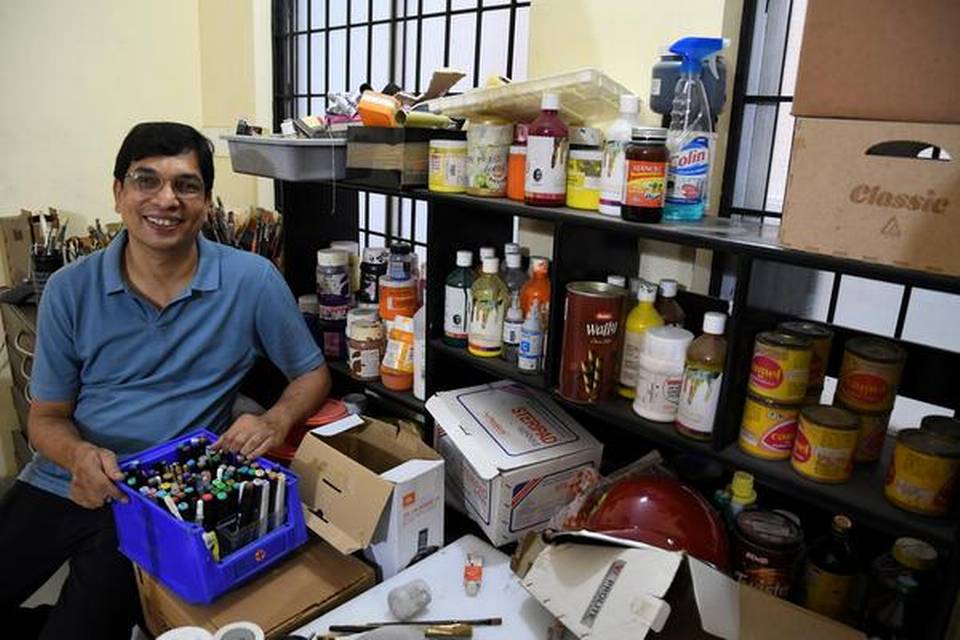
Acclaimed artiste Ravi Kashi says he responds to his times with imagery that is poetic and suggestive, he does not believe in being direct
Order and chaos meet here. Pragmatism and innovation walk parallel to each other. Ideas are researched, moulded, shaped, changed and rethought. At times, concepts work and at others, they remain unresolved. It is for a good reason that Ravi Kashi calls his studio a working lab. It is a space where he invites students and young artists generously for sharing of knowledge and to even try their hand at paper-making. A rented three room house in Nagarbhavi that functions as his studio, has a mini pulp-beater, ready paper pulp in several containers, a variety of handcrafted papers, his books, book objects, catalogues, colours, brushes, and all other paraphernalia needed by an artist. And of course, paintings, what he trained to be in the 90s, after pursuing BFA and MFA from Chitrakala Parishath in Bengaluru and MS University Baroda, respectively.
We enter his studio to find a painting in progress along with a few paper sculptures that have been put to dry. It is almost after a decade that Ravi has come back to paintings. All this while, the paper kept him preoccupied. “My paintings had become predictable. Now when I have my show of paintings, most probably next year, they will be different,” says Ravi.
For someone who is acutely conscious of stagnation and repetition, Ravi has always strived to push the frontiers so much so that he chose a niche medium like paper. The lure to sell and pander to the market was way less stronger than the urge to “enjoy the process”. Even with the medium of paper, Ravi didn’t stop at any one thing. Over the years, he has experimented with art books, book objects, and photo-books. His studio is filled with papers made with an array of fibres – Abaca, Daphne, Montbretia, Arecanut, Banana, Daphne bark, Hanji paper of Korea and tea-stained paper.
The tactility of paper fills him with joy him but more than that it is the challenge of working with what seems like a flat surface. “I make sculptural forms, objects, and installations out of it. Paper seems like a flat surface, but it is not. Paper is so versatile. I keep discovering different aspects to it,” the artist expresses.
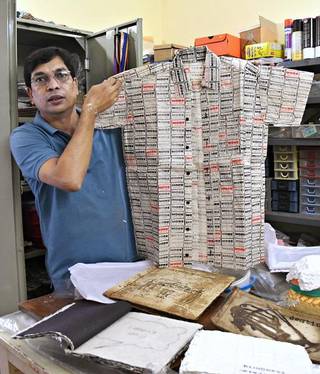
Invitation to an artist’s studio is exclusive and even more special is the opportunity to try your hand at an artistic process. Ravi encourages me to make sheets and discover the joys of paper-making for myself.
In large rectangular containers floats the paper-pulp. A window-screen attached to a wooden frame is dunked into the container and lifted out. This frame is usually referred to as mould and deckle. On a table is spread a fine white cloth. After detaching the wooden frame, the window screen is pressed against the cloth. The sheet transfers on to it. Another white cloth is kept over it and water is drained out with the help of sponge wipes. The paper is most malleable at this stage so you can create impressions and textures with the help of different objects. Ravi hands me colourful tassels and threads which I cut and sprinkle over the wet sheet. A roller is moved embedding them all.
Learning the ropes
Ravi first came across paper-making at Visvesvaraya Industrial and Technological Museum in Bengaluru as a 12-year-old, and found himself drawn to it. Later, at Kanoria Centre for Arts in Baroda, he saw a paper-making workshop in progress. Back home in Bengaluru, Ravi discovered ‘Vishwaneedam’, a Khadi handmade paper making unit near his house. He would buy ready pulp from there and use it in his work. “Around 1997-98 I started using this recycled pulp for casting various objects/forms. One such work called ‘Encounter’ got me the National Academy award.”
Ravi considers his visit to Glasgow School of Art on a Charles Wallace Grant, a turning point in his career. “My teacher Jacki Parry, a printmaker, and fibre artist was a faculty member in Printmaking Department and the paper-making unit was attached to the sculpture department, which was far away. So, every week we would fix a time when she could come and teach me the intricacies of the medium. At the end of the term, I had a show in the faculty. After returning, I continued using the medium and had several shows of paper-based works.”
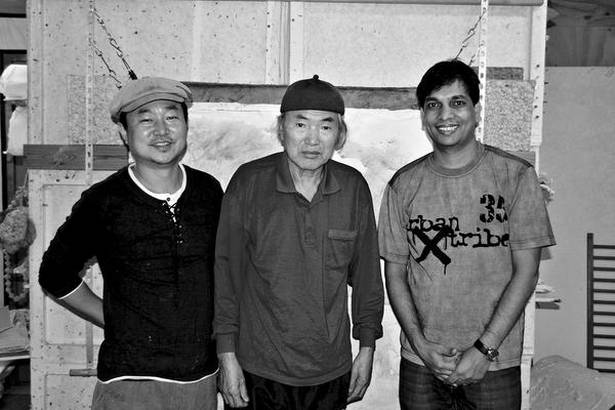
That wasn’t enough. After discovering the Hanji Paper during the Korean International Art Fair, Ravi decided to learn the technique. After much research, he zeroed in on a practitioner, Seang Woo residing in a small remote village Jang Ji Bang, located on the border of North Korea. Ravi lived there for a month learning not just to make Hanji but also Washi, the Japanese paper. “Hanji is a special paper out of Mulberry bark and it’s made organically. The sheet making is very different. Like here, I took out the sheet in one go but in Korean technique, you make six different and very thin layers. That becomes one part of the sheet. There are 12 layers in one Hanji sheet. It was quite strange for people there that someone from that far has come to learn papermaking. TV channels came to interview me,” recalls the artist.
Booked for life
Ravi wasn’t aware of the format of artist’s books until he saw it abroad. Today, he participates in artists’ book fairs and triennials across the world and a few of his works have been acquired by important collectors, foundations and museums. He makes his books using his own handmade paper. The books are either sheets bound together or cast in the shape of a book. “In my books, images and text are sometimes drawn; many times a relief image is created in clay and later converted into pulp, casting from a prepared mould and occasionally transferred from a photocopy. In some of my books like ‘Banana and the sword’, I have tried to reinterpret the palm leaf manuscripts format from ancient India. In other works like ‘This is the way the world ends’ I have adopted the accordion format along with a few unconventional approaches to bookmaking, but most of my artists’ books retain the form of a book.”
In a book done in the watermark technique, he shows two people arguing. Sometimes, they become a victim and at other times, aggressor as they play the game of blaming and defending. His minimalistic artistic books often draw from more intimate aspects of life like human relations. Even Ravi’s book objects, photo-books, relief work arouse philosophical concerns that borrow from punch cards used in the earliest computers; grids, unfocused photos in terms of imagery.
Reclaiming to find newer meanings
There is also a penchant for words. They first appeared diligently in his paintings and remain an integral part of his paper works too. The reason for this is rooted in Ravi’s fondness for literature. The artist makes use of words, phrases, sentences and alters them to find new meanings just like the images he would reclaim from popular culture, particularly in his earlier paintings.
Small glass cabinet, boat, and several other found objects go through the same ritual. The references are made cleverly with metaphors and personal and universal are ensconced in layers. A take on power and aggression is portrayed by painting an array of loudspeakers, big and small, suspended from a ceiling.
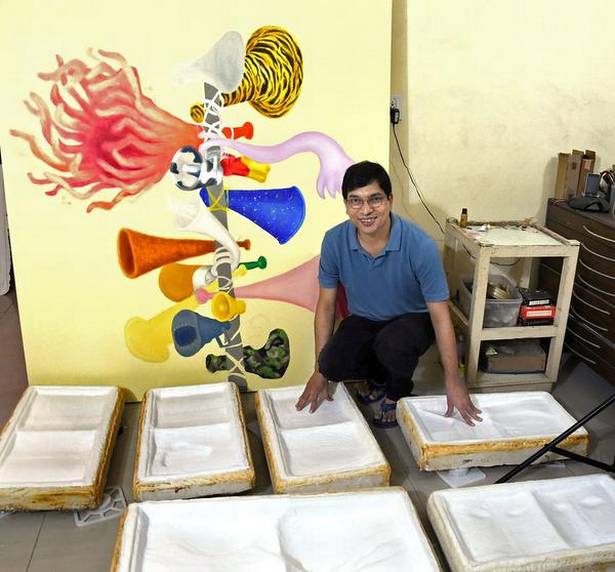
“Even if there is political content, it is suggestive. I am not an activist artist in that sense. I respond to my times but the imagery is poetic and suggestive and it is not so direct that the minute the event is over, my work will be irrelevant. Any artwork has to first succeed as an artwork because they have to survive longer cycles.”
Teaching and writing
After art making comes the other two loves of his life teaching and writing. According to the versatile artist, the strands connect to complete the narrative.
After completing his MFA from Baroda, Ravi pursued Masters in English from Mysore University. He is probably the only visual artist to have got a Sahitya Kala Akademi award for his writing. His two books written in Kannada, Anuktaand Kannele were seminal writings on Indian art that won him acclaim. Kannele got fetched him the Karnataka Sahitya Kala Akademi Award in 2015.
His third book “Flexing Muscles”, published by Reliable Copy, is an observation of the culture of flex banners in the city through an essay in Kannada/English and images. It will be released in September.
He has been a visiting faculty at RV College of Architecture where he teaches visual design, and visual creativity. In 2015, he also taught one semester open course in Art Appreciation at Azim Premji university.
Teaching helps him in several ways – firstly, keeping in touch with the younger generation keeps him updated and also supplements his income. “The kind of work I do doesn’t sell much, but I need resources in order to practise. Teaching also helps because when you have to tell someone else you need to be doubly sure. It enriches my art too. Something, I am trying in my studio will go to the classroom and vice-versa.”
source: http://www.thehindu.com / The Hindu / Home> Entertainment> Art / by Shailaja Tripathi / August 29th, 2019