All posts by admin

I want to provoke a happy, heady conversation among people: Artist Paul Fernandes

Paul01BF29aug2019

Paul’s lovely sketches of Bengaluru’s Swinging Seventies have been chosen by the Department of Posts for postcards and a special cover

A cartoonist, illustrator or an artist equipped with a brush for story telling? As one walks into Paul Fernandes’ studio and gallery, aPaulogy in Richards Town, one comes across several examples of his talent.

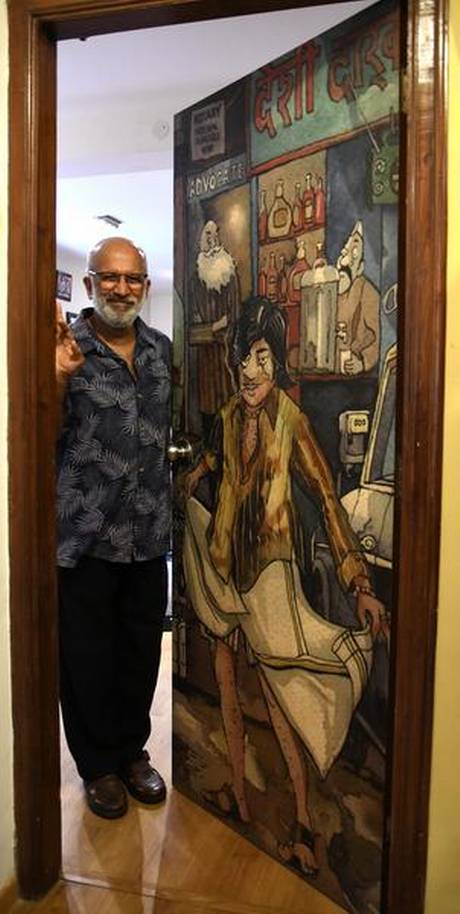
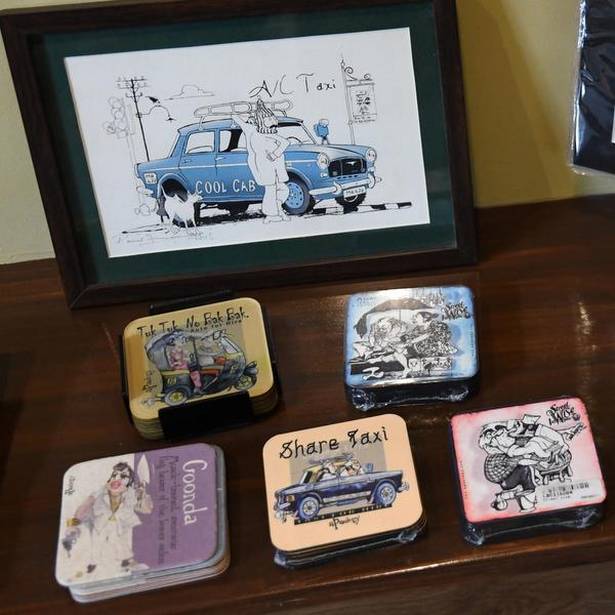
The outer walls has a series tracing Bengaluru’s transition from a pensioner’s paradise to the garden city and then the overcrowding thanks to the IT boom. In another corner his art is tucked into old window frames picked up from a junk yard in Shivajinagar. Inside the gallery, one is overwhelmed with the range of Paul’s works displayed on walls, racks and tables. Doors, mugs, coasters and bags sporting prints of his cartoons and illustrations are aesthetically showcased.

A resident of Bengaluru since 1948 when he was born, Paul highlights the city and its life in his works. The artist uses colours to enhance his story telling.

Beyond black and white

“I don’t keep my illustrations in black and white. I use colour and words to strengthen and communicate. My style is an extension of not only art that I studied at the Faculty of Fine Art Baroda but also sensibilities I absorbed from my mentor Peter Colaco, a musician and writer, who chronicled Bengaluru in his book,” says Paul as he takes you through his drawings.

For 71-year-old Paul, showcasing the city through art was more about highlighting the lives of the people who make up Bengaluru. “I work towards a style that can adapt, grow and be refreshing. It is a process where a cartoon looks like a painting. One has to look at the painting longer to enjoy their perspective. This bridging of space makes the cartoon a story-telling exercise,” says Paul whose illustrations are known for their descriptive clarity.
Works of Paul Fernandes   | Photo Credit: SAMPATH KUMAR GP
Works of Paul Fernandes | Photo Credit: SAMPATH KUMAR GP

His art works cover the coast of Mangalore and parts of Kerala and Goa too.

There are thousands of illustrations in watercolour that depict not just a languid, sleepy Bengaluru but hangouts in a gentle city – essentially the swinging 70s, unpolluted, dreamy in its outlook, with tree lined roads.

“I want to provoke a happy, heady conversation amongst people. I hope people come up with their own stories after they see my art,” says Paul.

Paul owns a studio in Mumbai too as people’s response to art he says is equally forthcoming there.

“I travelled from Mangalore to Kerala by scooter to observe people in the outskirts. The chemistry in Bengaluru, Mumbai or Goa has its own flavour. Looking to bringing them all out is what makes my illustrations different,” he says.

Paul’s illustration of the old BRV Theatre or the Bangalore Rifle Volunteers Canteen on Cubbon Road has multiple images that collectively bring out the mood of the era. “Ideas have to be drawn into compositional poetry,” he says. In the 1970s Paul found Ulsoor Lake and Vidhana Soudha giving him the required peace and quiet to work. “When you draw Vidhana Soudha, it is good, but when you add ‘built in 1956,’ it gets friendlier.”

Other memorable illustrations include those of MG Road with Chit Chat ice cream parlour and the photo studio, EGK & Sons, a horse-drawn tonga at on South Parade, the bustling Koshy’s of 1952, Plaza Theatre and Victoria Hotel.

“Be it Chor Bazaar in Mumbai or Airlines Hotel in Bengaluru, every space has its ambience. Sometimes I prescribe myself ‘people-less’ days to reflect, recharge and focus,” says Paul.

What defines his art? “Humour that I see in every situation, even in dry buildings,” says Paul explaining that this mood helped him zero-in on the name aPaulogy for his gallery.

source: http://www.thehindu.com / The Hindu  / Home> Entertainment> Art / by Ranjani Govind / August 28th, 2019

Art school turns 100

Founded in Bengaluru in 1919 by A N Subba Rao, Kalamandir pioneered art education in Karnataka, produced distinguished artists, and encouraged experimentation.

Kalamandir School of Arts is now located in Hanumantha Nagar.

Kalamandir, Karnataka’s first fine arts school, was founded in Bengaluru in 1919. It entered its centenary year on August 12, and marked it with a two-day cultural festival at Ravindra Kalashetra.

Founded by A N Subba Rao, a farmer’s son who developed sophisticated artistic skills, Kalamandir is now run by his grandchildren A M Prakash and Gowri Dattu. Many generations of the family are immersed in the arts, with Subba Rao’s great granddaughter M D Pallavi being a well-known singer and actor.

The school has evolved into a premier institution offering art, literature and drama courses.

Prakash heads the art section while Gowri takes care of Abhinaya Taranga, the school’s theatre wing.

For art and people 

Gowri remembers Subba Rao’s ceaseless energy. “I had never seen him sitting idle at home,” is the first thing she says when Metrolife asks her what she remembers of his days.

Distinguished people, such as writer Masti Venkatesha Iyengar, used to visit the school and discuss ideas with him.

“Masti used to bring along chocolates, while grandfather had chakli and kodbale with him. They used to give it to us,” she says.

Founder A N Subba Rao

Subba Rao was inspired by Gandhian ideals, and on one occasion, helped a prostitute marry. Back in the day, the police used to shave off the heads of prostitutes they had caught.

“My grandfather helped one such woman. He gave her a place to stay and found her a groom and got her married. He helped many people and artists this way; he was a people’s man,” she recalls.

But he could also be short-tempered. “That was probably because he used to add so much salt to his food,” Gowri says, laughing.

School’s philosophy

In 1918, Subba Rao was a drawing teacher at Bishop Cotton School. He didn’t like the syllabus. On the advice of legendary engineer M Visvesvaraya, he resigned and started Kalamandir.

Kalamandir was founded at a time when art wasn’t seen as an academic discipline.

Gandhi’s Swadeshi movement was everywhere, and job opportunities were few and far between.

The thought of helping people turn art into a profession occurred to Subba Rao, and he began his school with just four students.

Start with Signboards

Since painting wasn’t popular as a profession, he started off by teaching students to paint signboards in an artistic way.

“Painting signboards was a source of income since every shop needed one back then. He used to teach art through that,” says Prakash.

Subba Rao believed art had to be pursued as a livelihood and not just for art’s sake. “The concept of earn while you learn is picking up now, but my grandfather pioneered it in the 1920s,” he says.

Subba Rao encouraged many young women to take up art. One of them, Kanaka Murthy, is now a world-renowned sculptor.

“He felt they shouldn’t just be in the kitchen, and this was 1919,” Prakash says.

Subba Rao was also firm on teaching the basics to help students develop an aesthetic sense. “You could say the foundation for visual arts as an academic subject were laid by him,” Prakash says.

Subba Rao came to Bengaluru on a cycle and built Karnataka’s first fine arts school. He fought for the inclusion of art in primary education.

“He never bribed the government for the school’s smooth functioning. All the funds came from his friends and art enthusiasts. Now, we just follow his footsteps to promote art,” Prakash told Metrolife.

Subba Rao (extreme right) with his students.

About the school

Kalamandir is affiliated to Kannada University, Hampi.

The school offers a four-year bachelor’s degree course in visual arts that covers drawing, painting, life study, sculpting, graphic design and digital art.

Kalamandir School of Arts is located on A N Subba Rao Road, 5th Cross, Hanumantha Nagar. Phone 080 2660 6861; email kalamandirschool@gmail.com

Alumni

Rumale Channabasavaiah, Venkatachalapathi, B K S Varma, S S Kukke, S R Swamy, Venkatachalapathi, Rajeev Taranath, Kanaka Murhty, and M S Murthy are among the many distinguished students of Kalamandir.

At the event

Kalamandir hosted a two-day event to mark the 100th year milestone last weekend. Artists and art students thronged to the Ravindra Kalakshetra to catch the celebrations. Panel discussions and plays were presented. The lobby had an  exhibition on the life and times of Subba Rao and Kalamandir.

First arts magazine

Between 1930 and 1934, Subba Roa published ‘Kala’, the first-ever magazine in Kannada to cover art, music, painting, dance and theatre.

School locations

– Sugreeva temple, Balepet, in 1919

– Moved to Sharada talkies in 1938

– DVG Road in Gandhi Bazaar in 1944

– Hanumatha Nagar 1978-present

First to host all-India art shows

For the first time in Karnataka’s history, Subba Rao organised the All India Exhibition of Art, Photography and Handicrafts, featuring the works of students and artists from all over the country. He organised it thrice—in 1921, 1927 and 1932.

“He was the first around here to consider photography a visual art form,” says Prakash.

Sir Mirza Ismail, dewan of the erstwhile Mysore state, inaugurated the first exhibition. The second and third editions were inaugurated by Raja Jai Bahadur Singh of Nepal and Durrusehvar Sultan of Hyderabad respectively.

The current generation is still amused by how Subba Rao got in touch with royalty and high officials to invite them to the school’s events. “His invite was a simple handwritten postcard. His handwriting was beautiful. Dewan Mirza Ismail was impressed by his handwriting and attended the event. He also made a speech and granted Rs 50 to the school,” he says.

Gandhi Bazaar of the 1970s

For many decades, Kalamandir functioned from the first floor of a building on DVG Road in Gandhi Bazaar. The school was a cultural hub.

“Girish Karnad read his first play there. P Lankesh’s plays were practised here. Kalamandir was a rehearsal space for them,” says Gowri Dattu, granddaughter of founder Subba Rao.

Kalamandir was a space for healthy discussions on art and literature. “We grew up in a culturally rich environment, even though we didn’t understand everything they were talking about,” she says.

Gandhi’s visit

Also a promoter of khadi, Subba Rao taught block printing on khadi, along with his fine arts courses.

When Gandhi was visiting Bengaluru, the well-known Kannada writer Gorur Ramaswamy Iyengar and Subba Rao wanted him to visit Kalamandir.

Subba Rao painted a piece on khadi woven by Gandhi with his own hands. He displayed it at a khadi art exhibition.

Annie Besant, a leader of the freedom struggle, inaugurated the exhibition. On her insistence, Gandhi visited Kalamandir, which was in the Majestic area then.

“This is how he showed the power of art. It wasn’t a fancy school, but he made big names come to this simple school,” says Prakash.

Challenges

Finance and space are the constraints the school faces today. “It is not a commercial institution. We try to provide our students with everything. If the government takes note of our history and helps us, it would be great,” says Prakash, who now helms Kalamandir.

source: http://www.deccanherald.com / Deccan Herald / Home> Metrolife / by Malini Raghu, DH News Service, Bengaluru / August 27th, 2019

Scholar B.V. Mallapur passes away at 96

B.V. Mallapur
B.V. Mallapur

He has several works to his credit

Eminent Kannada scholar, author and academic B.V. Mallapur (96) died at a private hospital here on Monday.

Mallapur served as professor at the R.C. Hiremath Kannada Study Centre of Karnatak University, Dharwad.

A native of Itagi village in Ron taluk of Gadag district, he had graduated from Osmania University, Hyderabad, and obtained Ph.D for his thesis on Nayasena.

Then, he served as lecturer at Karnatak College and Gulbarga University. He retired as reader from Karnatak University.

Later, he wrote and edited several works of academic and intellectual interest.

His major works are Nayasena, and his works (Karnataka University 1978), Jagatika Kelavu Darshanekaru – Basavanna (2011), Vimarsha Sampada (2011), Anupama Charita Sampada (2010), Janapada Sampada (2010), Samshodhana Sampada (2010), Sri Kumareeshvara Purana in prose (2010), Sudharnava – 3 (2007), among others.

His final rites were held at the Karnatak University graveyard here in the evening.

source: http://www.thehindu.com / The Hindu / Home> News> States> Karnataka / by Staff Reporter / Dharwad – August 20th, 2019

Bags IARDO Award

DRannmaryBF28aug2019

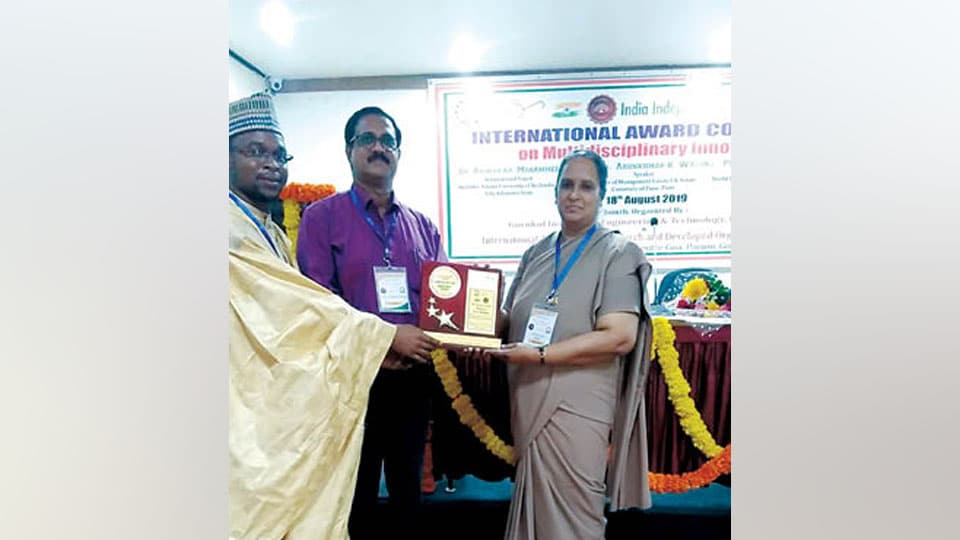
Dr. Sr. Ann Mary, Head, Department of History, Teresian College, Siddarthanagar, receiving IARDO (International Association of Research and Developed Organisation) Award for Best Researcher in Social Science at the International Award Conference on ‘Multidisciplinary Research and Latest Innovation’ (India Education Charitable Trust, Ghaziabad) held in association with Gurukul Institute of Engineering and Technology, Kota, in The International Centre, Panjim, Goa, recently.

source: http://www.starofmysore.com / Star of Mysore / Home> Gallery> Photo News / August 27th, 2019

City sculpts its way into Guinness book

The event was organised by Shree Vidyaranya Yuvaka Sangha in a bid to promote the use of clay Ganesha idols this year.

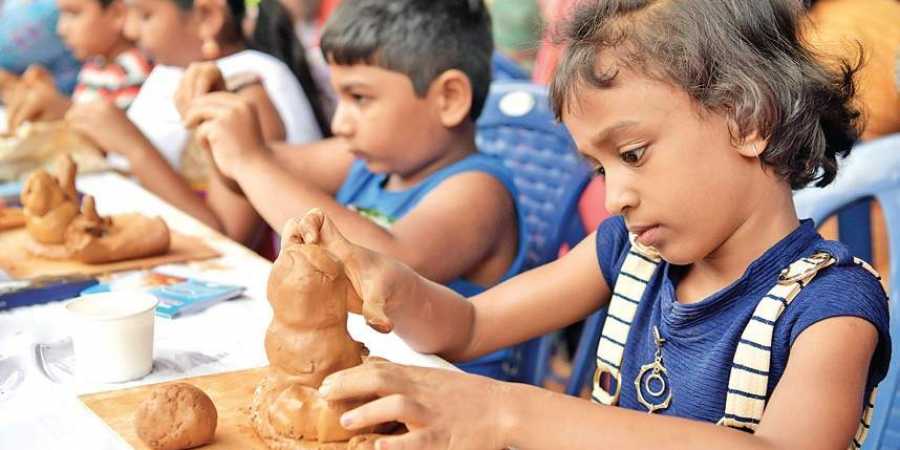
Children try their hand at moulding a Ganesha idol at National College Grounds in Basavanagudi, on Sunday. People from various walks of life and all age groups participated in the event to create a new record of the most number of people sculpting with model clay | Meghana Sastry

Bengaluru :

A new Guinness World Record has been created in Bengaluru. Giving a massive boost to an eco-friendly Ganesha festival, 2,138 people gathered at the National College Grounds to sculpt their own clay Ganesha and created the new record on Sunday.  The event was organised by Shree Vidyaranya Yuvaka Sangha in a bid to promote the use of clay Ganesha idols this year.

Adjudicator Swapnil Dangarikar from Guinness World Book of Records, said, “The previous record was of 589 people sculpting with model clay. This event has broken all the records with 2,138 people gathering and the category which it comes under is ‘Most people sculpting with Model Clay’. We have certified the record. This is a great achievement and this initiative should continue as this is the need of the hour.”
People of all age groups from various areas in Bengaluru gathered to make their own clay seed Ganesha idols. Once the immersion of the clay idol is complete, the seeds will germinate and plants will grow out of it.

Seven-year-old Jeevitha Shree from SR Nagar said, “Though it is a Sunday, we came to participate in this because we wanted to make our own clay Ganesha. I will take the idol home and perform pooja on Ganesha Chaturthi.”

Two sculptors taught the participants how to make Ganesha which was streamed on 5 LED screens. There were 50 volunteers from Fine Arts College of Bengaluru, Mysuru and Chikkamagaluru who helped the people in sculpting. About 800 kgs of clay was bought from Pottery Town for the event with 5 kg of Tulsi seeds from Chikkamagaluru.

Chinmayer C from BMS College of Women who has spastic paralysis also participated. “We got to know about this event from our college. I enrolled myself as I wanted to learn how to make clay Ganesha so that every year I can do it myself. We must go eco-friendly on every festival,” Chinmayer said.
Director of  Shree Vidyaranya Yuvaka Sangha Nandish S M said, “We have been celebrating Ganesha Utsav from the past 57 years and each year we make sure no plastic is used. I’m so glad we got such huge numbers and that Bengaluru made a record.

Mayor Gangambike 

Mallikarjun and Karnataka State Pollution Control Board (KSPCB) Chairman K Sudhakar attended the event and also sculpted an idol. “It is my first time at making a clay Ganesha and I really enjoyed making it. We even start feeling connected to it once we make our own.”

source: http://www.newindianexpress.com / The New Indian Express / Home> Cities> Bengaluru / by Iffath Fathima /Express News Service / August 26th, 2019

IIHR develops light trap suction method to get rid of tomato pest

We have been popularising the technology among farmers by training them in it. We’ve had farmers from Kolar, Andhra Pradesh border, Maharashtra and other states as well.

The light trap method that was developed by the Indian Institute of Horticultural Research to kill pests that ruin tomato crops | Express

Bengaluru :

The Indian Institute of Horticultural Research, established by the Indian Council of Agricultural Research (ICAR-IIHR) recently developed ‘light trap’, a method to kill or get rid of a relatively unknown pest called Tuta Absoluta, that affects tomatoes.

Studies were conducted in a tomato polyhouse and the method proved successful in trapping insects. Tuta Absoluta is a South American moth that rapidly began spreading in India in 2014. It can lead to loss of 100 per cent yield of tomatoes.

“When we conducted studies, we found that these insects get attracted to the colour yellow. We designed a system where an incandescent light bulb is placed above the plant to attract both male and female insects. Soap water or water containing pesticide is placed at the bottom. Alternatively, a suction is placed with a mesh below, instead of the soapy water bowl. The insects get attracted to the light, hit the surface, lose balance and fall into the mesh or bowl,” said Dr V Sridhar, principal scientist and secretary, Division of Entomology and Nematology, IIHR.

“We applied for a patent a few days ago but have already shared the technology with farmers from across the country,” Sridhar said, adding, “The same technology can be used in open conditions with a few modifications. For one acre, four or five light traps are enough. Tuta is more active from 7-11pm. The light-cum-suction trap is being patented. Suction mechanism enhances the trapping efficiency of adult insects.”

Though tomato is the main host, Tuta can also attack other hosts, like potato, eggplant, tobacco etc. Young larvae mine into tomato leaves, apical buds, stalks or fruits. Feeding results in blotches and pinholes on fruit which are generally covered with the frass (excrement of larvae). In one to two months, the technology will be commercially available. This method is part of a larger Integrated Pest Management (IPM) module developed by the institute.

“We have been popularising the technology among farmers by training them in it. We’ve had farmers from Kolar, Andhra Pradesh border, Maharashtra and other states as well. As this is an emerging insect, not many farmers are aware of it. It can multiply in lakhs within one week. This can cut down cost and affect chemical sprays used by farmers,” said another scientist from the institute.

source: http://www.newindianexpress.com / The New Indian Express / Home> States> Karnataka / by Ranjani Madhavan / Express News Service / August 26th, 2019

Karnataka farmer sprouts a new idea – grows paddy in paper cups

Vishwanath Ganiga from Kundapura taluk feels that by this method, the flow of saline water from nearby ponds is stopped.

Paper cups used for paddy cultivation

Udupi :

While researchers in labs around the world work on solutions to the world’s garbage problem, a humble farmer, in a tiny Kundapura village, is doing his bit to save the environment and adapt to a changed ecological scenario in his fields.

Meet Vishwanath Ganiga, a paddy farmer in Katbelthoor village in Kundapura taluk, who has come up with a novel solution — using paper cups to aid paddy cultivation this Kharif season.

Ganiga faces the problem of saline water intruding into his fields. Aware that traditional means of paddy cultivation, which would involve planting saplings in a prepared field, would not succeed, Ganiga skipped a step and now nurtures the seedlings in paper cups, which he then places in the field.

“Saline water from nearby prawn culture ponds was entering my field. I was worried as all paddy I transplanted was getting a brown hue to their stems. I thought of going in for this method,” he told The New Sunday Express. While the method itself is simple, he is unique because no one else in the region dared to give it a try, not being able to believe that paddy seedlings could be nourished in paper cups.

To begin with, he put 50 grams of soil into a paper cup and dropped five to six paddy seeds, covering them with 50 grams of soil. He kept the paper cups out in the open and rains caused the seeds to sprout and grow in 16 days. He then kept these cups in the field and the roots of the seedlings did not come in contact with the soil initially.

However, as they grew, the paper cups started dissolving in the soil and the roots, stronger now, started spreading into the soil, able to handle the salinity in the water. “Even if it does not rain, there is no issue. Just sprinkling some water on the paper cups will help the seeds germinate,” he says.

After experimenting on 15 cents of his paddy field, he now plans to extend the method to the entire 1.5 acres that he owns by next year. His unique method even earned him praise from Kundapur Assistant Commissioner Madhukeshwar who visited his field and praised his efforts. “Saline water intrusion is a problem but Vishwanath Ganiga’s spirit to grow paddy in paper cups deserves appreciation,” the official says.

Ganiga has now kept 1,200 cups in the field without taking on any help. His neighbour- Charlie Mendonsa, a farmer too — has decided to go for paper cup paddy cultivation from next year as he too faces the same problem of saltwater intrusion.

There is nothing special about the cups. They are the same used to drink coffee or tea by others. “I purchased new cups at Rs. 150 for 100 pieces from Kundapur. It is a manageable price. I save on money that would otherwise be spent on labourers for transplanting the saplings. I saved around Rs. 2000 with this method,” he says.

A water-intensive crop, paddy has a little resistance to saltwater but the soil in the cups provides the right environment for the roots to grow strong.

Ganiga, who also runs a grocery shop in Kollur road, uses the paddy cultivation to supplement his income. “It is my own idea. After having suffered for years from saline water intrusion, I thought it was time to experiment. I had seen the forest department officials use a similar method for their nurseries with plastic covers. I thought if plastic covers work for them, why not paper cups for me?” he says.

The Method

Ganiga put 50 grams of soil into a paper cup and dropped five to six paddy seeds, covering them with 50 grams of soil. He kept the paper cups in the open and rains caused the seeds to sprout and grow in 16 days. He then kept these cups in the field and the roots did not come in contact with the soil initially. However, as they grew, the paper cups started dissolving and the roots started spreading into the soil, able to handle the salinity in the water.

source: http://www.newindianexpress.com / The New Indian Express / Home> States> Karnataka / by Prakash Samaga / Express News Service / August 15th, 2019

This museum in Bengaluru is dedicated to the journey of communication

The exhibits range from one of the oldest phone models to the newest postal covers and stamps. | Photo Credit: G_P_Sampath Kumar


It is situated in the old Postal Divisional Office building on Museum Road

There are museums for technology, artefacts and music. The latest addition to this list is one that is dedicated to the journey of communication. From one of the oldest phone models to the newest postal covers and stamps, ‘Sandesh’ has it all.

Touted to be India’s first museum dedicated to postal communications, the Department of Post, Karnataka Circle’s initiative also honours the moniker for Museum Road as the museum is situated in the old Postal Divisional Office building on the same road.

The museum, which was inaugurated on Thursday, coinciding with Independence Day, has been divided into six rooms. The first room, ‘Sandesh’ has stamps on three themes: birth of the nation, Indian culture and Mysore anche.

The second room, ‘Samparka’, exhibits various items of modes of communication of the yesteryears, such as Morse Code, Petromax light, mail bomb detector, stamps and seals imprest with army postal uniforms.

The third room, ‘Samputa’, exhibits old order books, bags and sorting cases. The fourth room, ‘Samvahana’, showcases the VSAT apparatus.

‘Sanghathi’, the fifth room, exhibits brass weighs and raincoats. The sixth room, ‘Sangraha’, displays philately frames and is an activity room.

Apart from these, special covers and stamps, letter boxes and stamp cancellation machine are also on display.

Charles Lobo, Chief Postmaster General of Karnataka Circle, said north Karnataka has an interesting history with regard to postal services. “Bijapur (Vijayapura), Belgaum (Belagavi), Dharwad and Karwar belonged to the Bombay Presidency, Bidar and Raichur were with Hyderabad Nizam Presidency, Bellary (Ballari) was with Madras Presidency and Chitradurga and others were with Mysore Presidency. We have collected all the four postal services systems and have displayed it here in the museum.”

He explained how postal services have changed since the first postal stamp was released in 1854, prior to which postage was paid in the form of cash.

The building housing the museum — which is a combination of Madras terrace, Mangalore tile roofing and Dravidian style architecture — dates back to 1804. Boasting of historical importance, it finds mention in T.P. Issar’s book ‘City Beautiful’. The Government Museum was located in this building, which is how the road got its name.

Special cover

The Department of Posts also released a special cover during the event, which has renowned artist Paul Fernandes’s cartoon of the Museum Road Post Office.

“Even though I studied in St. Joseph’s School, which is right across the street, I never really gave a thought about the postal services. But as I grew up and Bengaluru started changing rapidly, I started drawing these buildings to remember them,” he said.

Well-known diplomat Pascal Alan Nazareth,who inaugurated the museum, said, “I have gone down this lane and always wondered why it was called Museum Road. I discovered the reason now.” On the impact of postal services on the lives of people, he added, “I think that the most loved government office in India is the Department of Post.”

source: http://www.thehindu.com / The Hindu / Home> News> Cities> Bengaluru / by Staff Reporter / August 16th, 2019

Areca tea product from Shivamogga village nominated as ‘Prestigious Brand of India’

The clinical tests for Areca Tea proved to be benefiting the diabetic patients and that is when the product became popular globally.

Areca Tea (Photo | EPS)

Hubballi :

A tea brand from a village of Shivamogga is all set to make its mark at global level. The Areca Tea of Mandagadde village of Tirthahalli taluk of Shivamogga has been nominated as the Prestigious Brands of India 2019. The nomination has been done by the Brand Advertising Research And Consulting Pvt Ltd (BARC) Asia and its the only product from Karnataka on the list this year.

The Areca Tea has already made its mark in global markets and is also stepping in domestic market as a health product. Considered as the best remedy for diabetes, the product has also played a large role in the lives of areca nut farmers of Karnataka.

“It’s a proud feeling that a village startup is now making its name globally. Areca Tea is a proven product and helping people deal with health issues. The clinical tests for Areca Tea proved to be benefiting the diabetic patients and that is when the product became popular globally. In the last four years, we have modified our product, added flavours based on the feedback received by our customers,” Nivedan Nempe, Founder and CEO of Areca Tea, told TNIE.

The company has a production house in Udupi district and has a unit at Mandagadde in Shivamogga. Already several local populations are working for Areca Tea and farmers are being benefited through sales of their produce.

“Quality is the most important aspect of tea production. We chose first quality areca nuts grown in Shivamogga and other areca nut growing districts of Karnataka. We have developed a patented method to make tea out of areca nut and slowly the product is getting popularised in local markets as well,” he said.

The company is also involved in employing specially-abled persons and elderly citizens in working such as packing. “The manual packing work is outsourced from the people who are usually at home. We picked elderly persons and specially-abled persons and today they are making a life out of packing our products. And this is the most satisfying thing,” he added.

What next? The Areca Tea will now expand its business in sugarcane and rice sectors. “We are coming out with a product to help the sugarcane farmers and soon we shall launch the programme. Currently, we are involved in developing a new variety of rice which is more healthy in nature. We want our farmers grow the rice which will have health benefits. The rice variety has been developed locally in collaboration with a German company,” Nivedan said.

source: http://www.newindianexpress.com / The New Indian Express / Home> States> Karnataka / by Amit . Upadhye / Express News Service / August 21st, 2019

Mysuru salutes late Sally Raulston Walker, zoologist who brought wildlife closer home

Several posts, tweets and blogs were dedicated to the woman who spent almost 36 years of her life in India as a zoo professional, and was an ardent advocate of rational zoo reforms.

Sally Raulston Walker was a part of Mysuru city for many years, and inspired dreams of alternative careers in the wild | Express

Bengaluru :

Dressed in shorts and T-shirt, chatting up lions inside their cage in Mysuru Zoo, she once inspired many young Mysureans to just be Sally Raulston Walker.  The zoologist and conservationist who brought wildlife closer home, passed away in her hometown in the United States of America, on Thursday.

Several posts, tweets and blogs were dedicated to the woman who spent almost 36 years of her life in India as a zoo professional, and was an ardent advocate of rational zoo reforms. She was the driving force behind many innovative programmes in not only the Sri Chamarajendra Zoological Gardens, Mysuru, and was also director of Zoo Outreach Organisation (ZOO) in Coimbatore.Sally was a part of Mysuru city for many years, and inspired dreams of alternative careers in the wild.

Sangeetha Rajanath, a retired banker from Mysuru, remembers watching Sally interact with animals in Mysuru Zoo, and her style of working.

She said, “There were days when my friends and I would tell our parents we didn’t want to be doctors or engineers, but wanted to be Sally. She inspired many of us with the way she interacted with animals and how she ensured that we, as children, maintained the plants and trees in the zoo but also knew how not to tease animals but be friends with them.”

Sally was a critic of wild animals in captivity. She was a name to reckon with in zoo circles, and had been a member of the Central Zoo Authority of India. A US citizen, she came down to India in the 1970s to study yoga and Sanskrit with Pattabhi Jois, a Master of Ashtanga Yoga, and Sanskrit Professor in the University of Mysore.

Sally lived in Mysuru for seven years. Her friends say that a visit to Mysuru Zoo and a single meeting with newborn tiger cubs, resulted in many years of dedicated service to zoos and conservation in South Asia.

Ramesh Kumar, who has interacted with her, says, “She was a very inspiring person. There were a few who didn’t agree with her ideology. Her passion for animals and opposition to causing them harm was evident in her talks, and she would gently teach us how to behave with animals.”

Observing the misbehaviour of visitors at Mysuru Zoo, she founded ‘Friends of Mysore Zoo’ in 1981, which is now relaunched as ‘Mysuru Youth Club’ in the zoo. According to her colleagues from ZOO, she had been suffering from Alzheimer’s for the past three years.

source: http://www.newindianexpress.com / The New Indian Express / Home> Good News / by Chetana Belagere / Express News Service / August 24th, 2019