All posts by admin

Christian Missionaries used Panchatantra translation to convert Japanese: expert

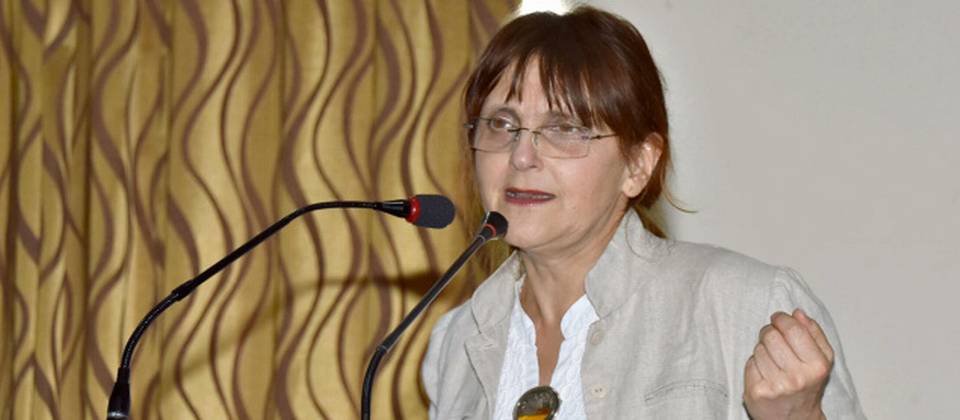
Monika Zin, KHK Visiting Research Fellow 2015 and Associate Professor, Indian Art History in the Department of Asian Studies, Institute of Indology and Tibetology at Ludwigs-Maximilian Unversitat Munchen in Munich in Germany, delivering a lecture at the Central University of Karnataka at Kadaganchi in Aland taluk on Tuesday.— PHOTO: ARUN KULKARNI

‘They, based on the Jataka Tales, claimed that the Buddha was originally a Christian’

Research Fellow and an authority on Buddhist art and architecture Monika Zin has traced the root of a beautiful, early third century Buddhist relief found during excavations in the Amaravathi sites to the Jataka Tales in the Panchatantra and how the Christian Missionaries, who used the translated version of the Panchatantra from Persian, Arabic and other languages, converted a large number of Japanese to Christianity with the claim that the Buddha was originally a Christian.

Delivering a lecture at the Central University of Karnataka at Kadaganchi in Aland taluk in Kalaburagi district, Prof. Zin, who is a KHK Visiting Research Fellow 2015 and Associate Professor, Indian Art History in the Department of Asian Studies, Institute of Indology and Tibetology at Ludwigs-Maximilian Unversitat Munchen in Munich in Germany, said that the relief found at the Nagarjunakonda Museum in Telangana has striking similarities in the figures shown in the Panchatantra translated into Pahlavi language and later into Arabic and other languages.

The beautiful relief

Prof. Zin said that the beautiful relief, which is still intact, shows an unidentified king, initially looking angry, being prevented by a couple of women from attacking a sage and later, paying obeisance to the sage. It has an interesting scene of a man hanging over a well holding onto two branches of a tree over which are a tumbling elephant and a white and black mice. In the well below, there are four figures of serpents creeping up and another with its fangs open.

She said that this picture of a man hanging from two branches of a tree over a well and all the other details is found in all translations of the Panchatantra in other languages. The Panchatantra tales were first translated for the Persian royals in Pahlavi language in the sixth century and later, into Arabic in the eighth century. In both these translations, the sequence of this relief is brought out in a pictorial form with all the details. It was the translation of the Panchatantra first to Pahlavi language and later to Arabic language that led to the translation of the tales into other languages.

However, the translation of the Jataka Tales by John of Gapna in the 13th century to Latin language was significant as it also carried the details of the relief in pictorial form.

The Greek translation in the 10th century of the Panchatantra titled “Barlaam and Josephat” was used by the missionaries working in Japan to claim that the Josephat in the tale was the original Buddha and that he was a Christian, leading to conversion of a large number Japanese to Christianity.

source: http://www.thehindu.com / The Hindu /Home> News> States> Karnataka / by Special Correspondent / Kalaburagi – January 13th, 2016

This app connects patients to doctors almost instantly

The app mfine connects patients with doctors almost instantly, cutting down on the time spent in-clinic and money spent in-transit

Imagine you are stuck in traffic and you have a doctor’s appointment. You have either missed it and are going to have to reschedule or just see another doctor. It is these kind of bumps that mfine aims to conquer, through their app, with a back-end system that runs on Artificial Intelligence.

Front-end functions

The app has tie-ups with about 375 doctors, 80 hospitals, across 20 specialisations, with on-ground services in Bengaluru, Hyderabad, Chennai, Pune, and Delhi. You log in and put in the symptoms. This will lead you to the doctors’ listing page, where you can opt for a particular specialist, if you like. This choice may depend on experience, testimonials, and place of operation (in case you need offline help). The idea is to put you in touch with a doctor in a minute. If you are unsure though, the system will assign a specialist to you.

 Ajit Narayana, co-founder of mfine app and Chief Technology Officer
Ajit Narayana, co-founder of mfine app and Chief Technology Officer

Alternatively, you may be very specific about which doctor you’d like to see, especially if you’re coming back to check about something. “Most often, you’ll get connected within 30 to 40 minutes,” says Ajit Narayanan, a co-founder and the Chief Technology Officer, based out of Bengaluru. “The whole idea is that you access care when you need it,” he says. Once you enter the symptoms or even return with a doubt, the query goes to a ‘care team’ of doctors that looks at it before a senior specialist does.

You get an appointment and pay up — every service is payable, and every interaction is seen as a consultation, though follow-up treatment within a week, whether online or offline (if you choose to visit the doctor at his location) is not charged.

A shot of the mfine app

Prescriptions may be given, even conditions diagnosed, unless the doctor feels he needs to see you. Dosages may be tweaked, uncomfortable questions answered, and a second opinion offered. “It’s better than Dr Google, because you can reach a doctor just to clarify what to do for a headache, rather than popping pills or assuming you have a particular problem,” says Dr Manjula Anagani, Managing Director and Chief Gynaecologist, MaxCure Suyosha Hospital, Hyderabad, who is one the senior-most doctors on the app. Gynaecology, dermatology, and general medicine are the three specialisations that see the most traction.

If the doctor asks you to take a test or some medication, the system will remind you to do so. You can then upload the reports. Past medical records too can be uploaded, so it is all consolidated.

There is now a medicine delivery service in Bengaluru and Hyderabad (they deliver within 60 minutes), as well as a lab-test service that ensures someone comes home.

The anatomy

The app runs on artificial intelligence (AI), which means that it is learning as it goes along. For starters, when the app went live in December 2017, data was fed in from publicly-available medical literature. There was some tweaking to incorporate customisation with doctors’ inputs. Then, as conversations are had, prescriptions made, and more medical research fed into the system, the system keeps evolving. “The quality (of advice) improves, because the knowledge is built up,” says Ajit.

So when you key in your symptoms, say cold, sore throat, low-grade fever, the AI system will auto-suggest to the care team what the possibilities are. This ensures that human error is minimised.

“In a month or so, the system will be able to read and capture information from lab reports,” says Ajit. There will be a photo snippet of the key findings, in case the doctor wants to refer to it. The company is also working on the system’s ability to ‘read’ X-rays as well.

All this cuts down on commute time to the doctor and cost per doctor visit. The app generally charges ₹450 for a consultation, which may be what you pay when you make an in-person visit in Hyderabad and Bengaluru; if you’re accessing it from say, Delhi, it is a huge difference. You can also subscribe at ₹2,000 for six months, for upto six family members.

It also helps bust myths during pregnancy (women can reach out to the doctor without a family member). Baby- and child-related doubts can be quickly addressed, especially if you don’t have a paediatrician who is easily available.

source: http://www.thehindu.com / The Hindu / Home> Sci-Tech> Health / by Sunalini Mathew / March 18th, 2019