All posts by admin

Sanjana gets a big boost

Sanjana Ramesh...set for bigger things.
Sanjana Ramesh…set for bigger things.

She was named the MVP of girls’ division at Basketball Without Borders Asia

Indian teenager Sanjana Ramesh has signed for the Northern Arizona University women’s team, becoming the second India-born female player to receive a North American Division I college basketball scholarship.

Sanjana, 17, will be an incoming freshmen for the 2019-20 season. The Bengaluru player captained the Indian team in the 2017 FIBA U-16 Asia Cup. Averaging 6.5 points and seven rebounds per game in the tournament, Sanjana helped India win Division ‘B’ and earn promotion to Division ‘A’.

Sanjana caught the eye of college recruiters when she was named the Most Valuable Player of the girls‘ division at Basketball Without Borders Asia. The three-day development camp had featured top male and female prospects from Asia.

“Everything is managed professionally in U.S. colleges. Every day there will be training with the Indian senior team. The competition is very tough, so this will help improve my game. The aim is to get a WNBA professional contract, and to also represent India at the highest level,” Sanjana said.

Improvement

A 12th standard student of Delhi Public School (South) here, Sanjana said her game has improved considerably in the last couple of years.

“The 2017 u-18 Nationals was the turning point for me. I played well for Karnataka, which gave me great confidence. Before that, I was not part of the starting five,” she said.

Northern Arizona University women’s basketball coach Loree Payne said: “Sanjana is an athlete who has international and national experience. We’re trying to get our foot in the door of the international recruiting scene. So for us, Sanjana is everything we’re looking for. Her potential is limitless.”

In 2017, Chhattisgarh hoopster Kavita Akula enrolled at Grand Canyon University, and became the first India-born female basketballer to receive a full scholarship from a Division 1 college.

source: http://www.thehindu.com / The Hindu / Home> Sport> Other Sports / by Ashwin Achal / Bengaluru – November 15th, 2018

KVS temple in Kalasipalya documented for conservation

Kote Venkataramana Swamy temple on KR Road in Bengaluru   | Photo Credit: Bhagya Prakash K
Kote Venkataramana Swamy temple on KR Road in Bengaluru | Photo Credit: Bhagya Prakash K

All aspects of the temple have been recorded, including body and columns

Before it became an important religious place for Vaishnavas, the place where the over five-century-old Kote Venkataramana Swamy temple stands today in Kalasipalya, housed a small shrine with a Basava (idol of a sacred bull).

This shrine was in a dilapidated condition and the Basava is believed to have been shifted to Mamulpet, and an idol of the main deity (Lord Venkataramana) installed there.

This and many other historical details about the temple, which is a heritage tourist destination, are not very well known.

In an attempt to document the history, patronage and the architectural style of the 17th century temple, historian and architect Yashaswini Sharma has prepared a detailed report, which will be released by Yaduveer Krishnadatta Chamaraja Wadiyar, scion of the erstwhile royal family of Mysore, on November 19.

According to Ms. Sharma, very little has been written about the temple in history and architecture books. But, the temple is significant because it is the first example of Wadiyar-style architecture in the city.

“The temple has not been documented as a heritage structure; it should have been. This lack of documentation can hamper preservation and future restoration of a heritage structure,” she said, adding that the documentation will be a preliminary step in its conservation.

Ms. Sharma has taken up the documentation under the EA Samrakshaney project through her architectural firm ‘Esthetique Architects’ in association with the Archaeological Survey of India, the Muzrai Department and the temple trust.

“This is a community initiative. Under this, we have taken up projects such as Janata Bazaar darshana, and this is our third work for the community,” she said.

All aspects of the temple have been documented, including the plinth measurement, body, and the columns.

Along with the documentation, a replica of a Kottanur inscription of Kanteerava Narasaraja Wadiyar II, which credits his father, Chikkadeva Raja Wadiyar, with installing the deity, will be unveiled. “The stone replica will be placed on the temple premises,” she said.

source: http://www.thehindu.com / The Hindu / Home> News> Cities> Bengaluru / November 15th, 2018

Indigenous species make their way into kids’ store

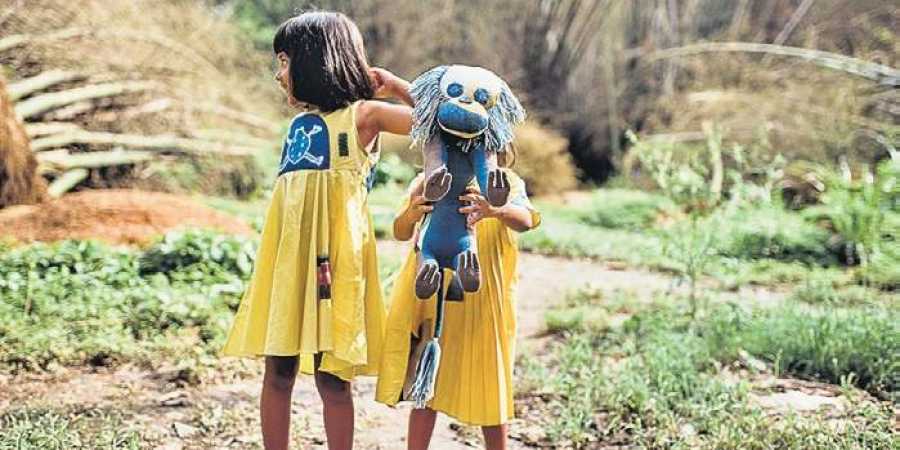
The same bird, along with seven other species, then featured in her company Muuyee’s maiden collection of toys and textiles for kids.

MuyuueeBF14nov2018

Bengaluru :

About two years back, Shweta Pai took a trip to the jungles of Kerala and Karnataka. At dawn, while soothing her crying infant, she heard a distinct whistling sound. That was her first introduction to the whistling thrush bird. Her curiosity about indigenous species of the Indian jungles was further aroused when she learned more about the unique characteristics of the bird and the other animals in the area.

“I was instantly drawn to their stories and felt a need to document it. Moreover, many of these species may not even be there in the near future, and I wanted their stories to reach out to more adults and kids, through a new medium,” says Shweta.

The same bird, along with seven other species, then featured in her company Muuyee’s maiden collection of toys and textiles for kids. The collection, My Darling Earth, was launched in October this year and focuses on clothes and toys that feature some of the lesser known creatures of the Indian jungles, such as: The Malabar Whistling Thrush, Stone Sucker Fish, The Lion Tailed Macaque, The Cane Turtle, and The Draco Lizard.

“Before jumping into the actual making process, I had to research the animals first. I got in touch with ecologists who helped me understand the animals’ characteristics and habitats,” says Shweta. Each toy comes with a tag that explains who the animal is, where he comes from and what his characteristics are. “We got ecologists to vet this information as well,” she adds.

Each product also comes with a fun ‘surprise’ element: For example, the kurta has a pocket at the back, the cane turtle has a detachable shell, the thrush has a colourful plume of feathers that is unique to each piece.
These clothes and toys, Shweta says, are also free from gender stereotypes. “Most toys for girls seem helpless. The ones for boys seem too violent or aggressive. So, we particularly strayed away from making toys with specific male/female angles to it,” explains Shweta. The clothes too, incorporate more neutral silhouettes and colours, so as to not restrict kids within predefined boxes.

The name Muuyee comes from the Konkani word for ‘ant’. Shweta explains that though small, ants can be powerful in what they can achieve. “There’s strength when you create in a community, which is what we do here at Muuyee. There’s care for everyone involved: from our makers and artisans across India to our users,” she says.

Since its launch, Muuyee has received about eight orders a month The products retail between `300 and `3,000. For Pallavi Kini, a city-based lawyer, the uniqueness of the animals was an instant winning factor. She says, “My child is three and is inquisitive of everything. With the help of Muuyee, I can introduce her to more Indian species and hope that she will take a greater interest in Indian wildlife because of this,” she says.

To buy, log onto muuyee.com.

source: http://www.newindianexpress.com / The New Indian Express / Home> Cities> Bengaluru / by Simran Ahuja / Express News Service / November 14th, 2018

Six professors win Infosys Prize 2018 for science and research

InfosysPrizesBF13nov2018

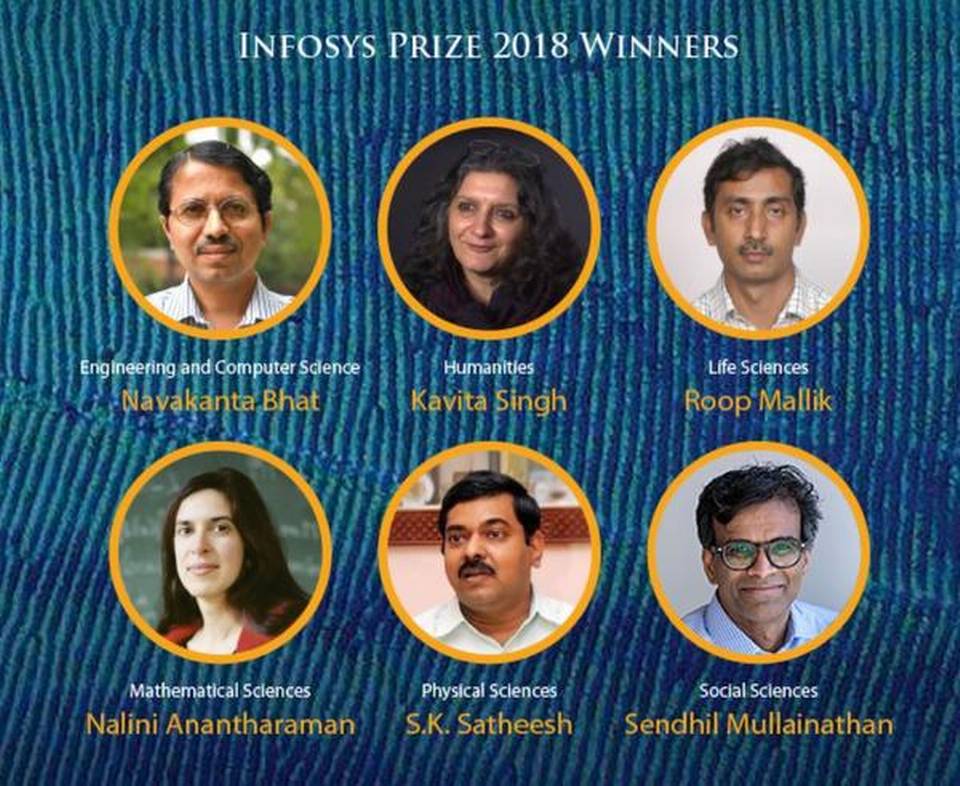
Navakanta Bhat, Kavita Singh, Roop Mallik, Nalini Anantharaman, S.K. Satheesh and Sendhil Mullainathan are the winners out of the 244 nominations received in six categories

Six eminent professors have been awarded the Infosys Prize 2018 across different categories of science and research the software major’s science foundation announced on Tuesday.

The annual award includes a pure gold medal, a citation and a prize purse worth $100,000 (or its equivalent in Indian rupees), the Infosys Science Foundation (ISF) said in a statement.

“India needs to cement its place as a hub for innovations across various fields of science,” said Narayana Murthy, Trustee ISF and Founder, Infosys.

“The Infosys Prize seeks to honour the efforts of some of the brightest scientists and researchers and highlight the country’s ongoing quest for science excellence,” Mr. Murthy said.

A six-member jury of renowned scientists and professors selected the winners from 244 nominations received in six categories, ISF said.

By recognising these researchers and celebrating their achievements, the Infosys Prize aims to inspire young minds to explore science as a career option and advance innovation in the country, the foundation said.

“With improving synergies between the scientific community and industry we are poised for cutting-edge science and research innovation. The science of today is, after all, the technology of tomorrow,” said K. Dinesh, President of ISF.

Engineering and Computer Science

In the field of Engineering and Computer Science, Navakanta Bhat, Professor, Indian Institute of Science, Bangalore was awarded for his work on the design of novel biosensors based on his research in biochemistry and gaseous sensors that push the performance limits of existing metal-oxide sensors.

Mr. Bhat has devised gas sensors with ultra-precise detection accuracies necessary for space and environmental monitoring, especially useful for India’s growing space, atomic energy and security programmes, ISF said.

Humanities

In the Humanities category, Kavita Singh, Professor and Dean, School of Arts & Aesthetics, Jawaharlal Nehru University, New Delhi was awarded for her study of Mughal, Rajput and Deccan art.

Ms. Singh’s work shows the significance of museums in highlighting the social impact of art, and thereby relates visual culture to large contemporary questions of secularity, modernity, and political conflict, the foundation said.

Life Sciences

The prize for Life Sciences was awarded to Roop Mallik, Associate Professor, Department of Biological Sciences, Tata Institute of Fundamental Research, Mumbai for his work on molecular motor proteins, which are crucial for the functioning of living cells.

Mr. Mallik has identified and measured forces needed to transport large particles inside cells, and demonstrated their role in fundamental processes such as targeting pathogens for their destruction and moving lipid droplets for fatty acid regulation in the liver.

Mathematical Sciences

Nalini Anantharaman, Professor and Chair of Mathematics, Institute for Advanced Study, University of Strasbourg, France was awarded the prize in Mathematical Sciences for her work related to “Quantum Chaos”.

The quantum world is the one of the deepest secrets of the universe and mathematics is the language that helps us understand this world, ISF said.

Mathematicians and physicists have been trying for decades to unravel the mysteries of this subatomic world.

Physical Sciences

In the field of Physical Sciences, S.K. Satheesh, Professor, Centre for Atmospheric & Oceanic Sciences, Indian Institute of Science, Bangalore, was awarded for his pioneering scientific work in the field of climate change.

His studies on black carbon aerosols, the dark, light absorbing, microscopic particles in air which greatly influence the energy balance of the atmosphere over the Indian subcontinent, have enabled a better understanding of the role of these particles on climate change, precipitation, and, human health in the Indian subcontinent.

Social Sciences

The Infosys Prize 2018 for Social Sciences is awarded to Sendhil Mullainathan, Professor of Computation and Behavioral Science, the University of Chicago in the U.S. for his path-breaking work in behavioural economics, ISF said.

Mr. Mullainathan’s research has had substantial impact on diverse fields such as development, public finance, corporate governance and policy design.

A significant part of this work is relevant to India, ISF said.

“We hope the work of all our winners bears fruit and helps improve societies and economies across the world,” said Mr. Dinesh.

source: http://www.thehindu.com / The Hindu / Home> Science / by PTI / Bengaluru – November 13th, 2018

Seva Rathna awarded to Bhujang Shetty

The award was presented by Kadamba Cultural Association for the Disabled as part of their state level cultural programme.

Bengaluru :

Recognising his significant contribution to the field of ophthalmology and eye donation, Dr. K. Bhujang Shetty was conferred with the Seva Rathna award in memory of Helen Keller by drama writer Dr. K. Marulasiddappa. The award was presented by Kadamba Cultural Association for the Disabled as part of their state level cultural programme.

Dr. K. Bhujang Shetty, Chairman and Managing Director, Narayana Nethralaya, said, “There are two types of blindness – curable and incurable. We as doctors cannot do much for incurable blindness. But if there is even a single person with curable blindness, it will be our fault. Our vision is to work towards eradicating curable blindness. As Helen Keller once said ‘If there is anything worse than blindness it is to have sight and no vision’.”

“In the last two years, Narayana Nethralaya has given over `9.35 crore in subsidy and free surgical care for the poor throughout the state. Our KIDROP programme, a Public Private Partnership with the National Health Mission (NHM), Government of India, is a telemedicine programme to prevent and treat blindness in infants caused by Retinopathy Of Prematurity in rural areas,” Shetty added.

In less than a decade, the hospital has screened over 1 lakh infants and prevented blindness in over 1,900 pre-term babies, saving `450 crore in blind-person-years. Narayana Nethralaya has an eye bank with over 65,000 donors who have pledged their eyes.

“In the past five years, over 750 camps have been conducted across the state, close to 1.75 lakh people screened and over 8,000 free surgeries have been performed. In the same period, over 250 camps have been conducted in schools,” added Shetty.

source: http://www.newindianexpress.com / The New Indian Express / Home> States> Karnataka / by Express News Service / November 12th, 2018

The word Karnataka has existed since 1336, say historians

Historian and iconographist Vasundhara Filliozat at her residence in Mysuru. | Photo Credit: Special Arrangement

While former Chief Minister D. Devaraj Urs is credited with renaming the Mysore State as Karnataka  on November 1, 1973, according to historians, usage of the word ‘Karnataka’ was in vogue some six centuries ago. They say all of southern India was united under one banner called Karnataka at that time.

They are arguing with empirical evidence that what is referred to as the Vijayanagara empire (1336) was actually called Karnataka Samrajya (empire), with Vijayanagara only being the capital.

Underlining the need to reconstruct post-colonial history, they say there is a tendency to blindly follow Robert Sewell’s (1845-1925) A Forgotten Empire, Vijayanagar, despite Sewell actually mentioning that the empire was called Karnataka.

Jnanpith recipient and playwright Girish Karnad refers to the Vijayanagara region as “Karnataka desha” in his recent play ‘Rakshasa-Tangadi’, which is based on A Social History of the Deccan1300-1761 by Richard M. Eaton of the University of Arizona. “Vijayanagara was not in vogue at that time; the region was referred to as Karnataka,” says Mr. Karnad in no uncertain terms.

Historian, epigraphist and iconographist Vasundhara Filliozat, who has a few significant historical works to her credit, including VijayanagarAlidulida Hampe, and Hampi-Vijayanagar: The Temple of Vithala, says the empire was given its present nomenclature by Sewell and Kannada historians such as B.A. Saletore and P.B. Desai only to placate Telugu scholars.

She says inscriptions show that the Karnataka empire was founded in 1336, with scholar Vidyateertha — the teacher of Vidyaranya — instrumental in it. Inscriptions also reveal that Vidyaranya did not exist at the time. The last great Hoysala ruler, Ballala III (1292-1342), started attempting to bring all of south India together, and the move yielded results in the time of Harihara I. “My historical conclusions are based on inscriptions and iconography I studied for nearly a decade. I don’t know why colonial historians glossed over the fact that the region was known as Karnataka and why post-Independence historians blindly followed Sewell. None of them is ready to take the truth head-on,” Ms. Filliozat says.

Srinivas Ritti, another historian, says the empire was never called Vijayanagara. According to him, historians chose the name as it was better known. He, however, believes that historians and scholars in the days to come should think of using the correct names — Karnataka for the empire and Vijayanagara for the capital.

Tipu’s role

Ms. Filliozat also says that Tipu Sultan should be given due credit during Hampi Utsav, which is celebrated yearly by the State government. She says the Nizam of Hyderabad was eyeing Hampi, which was in his dominion, but Tipu wanted Hampi to remain in Karnataka. Because of monetary help extended by Tipu, the Maharaja of Anegundi, who was surviving on a meagre revenue, stayed in Karnataka. “Hampi is now in Karnataka because of Tipu. The Karnataka government has to remember Tipu for what he did during Hampi Utsav.”

source: http://www.thehindu.com / The Hindu / Home> News> States> Karnataka / by Muralidhara Khajane / Bengaluru – November 10th, 2018

From Turkey to Bengaluru

Zuhair Fiyaz, who is in his mid-20s, discovered this ice cream parlour and fell in love with it.

TurkishIceCreamBF10nov2018

Bengaluru :

I scream, you scream, we all scream for ice cream! Meet your sweettooth cravings here at The Maras, south India’s first Turkish ice cream parlour that opened recently on the busy Jyoti Nivas College Road in Koramangala.

MarasicecreamBF10nov2018

There are a variety of flavours that one can try here. A Turkish flavour, Saada, originated from the Turkish word Saadee, is also available here. Other flavours include the popularly-sold almond honey, chocolate brownie, kiwi (they claim to use the kiwi fruit for its rich flavour), pistachio, caramel and strawberry-banana, that tastes like a bubble gum.

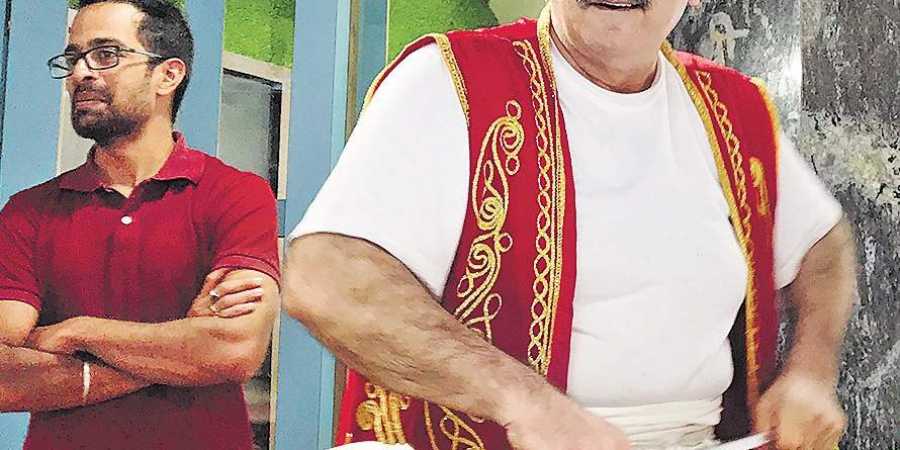
It’s a joint venture by Nikita Agarwal, her husband, Vinay Agarwal and brothers in-law Manish and Nikhil Agarwal. They say they wanted to start something unique and hence, came up with this idea. “Our tagline – Serving cones with happiness – is in par with the way we serve Turkish ice creams to people. Our happiness ‘delivery man’, Mustafa, is from Turkey and the way he plays with the ice cream before handing it over is unique and exciting to watch. People, especially children, queue up in front of the shop and watch him prepare the ice cream for two minutes. It’s fun to watch him serve scoops of ice cream on the cone,” says Nikita.

But, why the name Maras? “Dondurma, the Turkish ice cream, as is originally called, is believed to have been found in the city of Maras in Turkey. Hence, we decided to just name it The Maras (pronounced Marash),” says Manish.

Apart from ice creams, they also sell Turkish sweets such as baklava and bulbul, and their sale shot up during the festive season. “We are open on all days, from 12.30 pm to 12 am. We were a hit during Diwali as people were looking for unique sweets for gifting purposes,” says Nikita. “We recently added the Matcha flavour, originally from Japan, which tastes similar to green tea, for diet-conscious people,” she adds.

Zuhair Fiyaz, who is in his mid-20s, discovered this ice cream parlour and fell in love with it. He says, “I have visited this ice cream parlour thrice and my aim is to try out all their flavours one by one. Mustafa is a delight to watch every time I buy an ice cream from him. They gave me a loyalty card which offers my 10th ice cream for free.” Approx. cost for two: Rs 150
Customers say watching Mustafa make the ice creams is a delight.

source:http://www.newindianexpress.com / The New Indian Express / Home> Cities> Bengaluru / by Sudeshna Dutta / Express News Service / November 10th, 2018

Omprakash Kanagali passes away

The former Minister Omprakash Kanagali died in Belagavi on Tuesday. He was 68. He served as Irrigation Minister in the S.M. Krishna Cabinet.

He is survived by wife, a son and a daughter.

The final rites were held in his native village of Kanagala in Belagavi district on Wednesday. Kanagali was the son of B. Shankaranand, former Union Minister. Kanagali, who was an advocate, organised the Kannada Dalit writers’ meet in Belagavi in 1992, according to family sources.

source: http://www.thehindu.com / The Hindu / Home> News> States> Karnataka / by Special Correspondent / Belagavi – November 09th, 2018

‘Work on Krumbiegel memorial to start in two months’

The Krumbiegel hall before it was razed.

Archaeology Department says the tender process is on

A year ago, Krumbiegel Lecture Hall inside Lalbagh Botanical Garden was razed after a portion of the 100-year-old building collapsed following heavy rains. Facing criticism from all sides for failing to restore an important piece of the city’s heritage, the Horticulture Department, which is entrusted with maintaining the garden, decided to erect a memorial for Gustav Hermann Krumbiegel, the man who gave the city its green cover. However, a year later, the land where Krumbiegel hall once stood still remains vacant.

In his time, Krumbiegel used the lecture hall to practise his speeches. Over the decades, however, it fell to disuse and conservationists despaired over its neglect. Now the city and Krumbiegel’s family in U.K. are waiting for the memorial to come up.

The State Archaeology Department was roped in, and a plan and an estimate prepared. Officials in the Horticulture Department said that all necessary approvals for rebuilding the memorial are in place and that the Archaeology Department has initiated the tender process. “The tender process is taking long. Once finalised, the work can be completed in six months,” said M.R. Chandrashekar, Deputy Director, Lalbagh.

The Department of Archaeology, Museums and Heritage said it had presented an estimate of the project, which has been approved. “The tender process is on and is likely to take over a month. Meanwhile, we are getting technical approval for the project. The work is likely to start in two months,” said Venkatesh T., Commissioner, Archaeology Department.

Cost estimated at ₹98 lakh

As per the plan, a structure similar to the old Krumbiegel hall is to come up at an estimated cost of ₹98 lakh. “The Archaeology Department will keep the old design in mind to create the new space. The new hall will serve as a space to learn about the history and horticultural richness of Lalbagh. There will be audio-visual aids for tourists. Short films on the Botanical Garden will be played in both Kannada and English,” Mr. Chandrashekar added.

Alyia Phelps-Gardiner Krumbiegel, the great granddaughter of Krumbiegel, said she was eagerly waiting for the memorial to come up. “I’m so pleased to hear that at long last the new Krumbiegel hall is coming to realisation. Karnataka still owns the legacy of my great grandfather. He designed and landscaped his way from Baroda, Ooty, Bombay, Coochbehar, Jamshedpur, Delhi, Hyderabad, Trivandrum,Madras, Mysore and above all Bangalore. He found his home in Bangalore. He and the other four heavyweight superintendents of Lalbagh – William New, John Cameron, Rao Bahadur H.C. Javaraya and M.H. Marigowda – all deserve their own special monuments for their contribution.”

source: http://www.thehindu.com / The Hindu / Home> News> Cities> Bengaluru / by Sarumathi K / November 08th, 2018

Bengaluru student to get USD 400,000 prize for self, teacher, school

Breakthrough Junior Challenge is a global science video competition designed to inspire creative thinking about fundamental concepts in the life sciences, physics, and mathematics.

Bengaluru :

Sixteen-year old Samay Godika, a city school student, will receive USD 400,000 in educational prizes for himself, his teacher and his school, as he emerged the winner in the fourth annual “Breakthrough Junior Challenge”, a global science video competition.

The US-based Breakthrough Prize announced Godika, a junior at the National Public School-Koramangala here, as the winner of this year’s ‘Breakthrough Junior Challenge’ for his video submitted in the life sciences category on circadian rhythms, which are physical, mental, and behavioural changes that follow a daily cycle.

Breakthrough Junior Challenge is a global science video competition designed to inspire creative thinking about fundamental concepts in the life sciences, physics, and mathematics.

“As the winner, Samay will receive USD 400,000 (approx Rs 2.92 crore) in educational prizes for himself, his teacher and his school,” Breakthrough Prize said in a release posted on its website Sunday.

Samay will receive a USD 250,000 college scholarship while his ninth and tenth grade science teacher Pramila Menon will get USD 50,000 prize.

Additionally, his school will receive a state-of-the-art science lab valued at USD 100,000.

Menon had encouraged his interest in life sciences and tutored him after school to encourage his curiosity about scientific ideas.

Recognising him as a Boston native who now lives in India, Breakthrough said, Samay’s video, submitted in the life sciences category, focused on circadian rhythms, the 24-hour biological processes that can affect simple daily experiences such as waking up for school or jet lag.

Because he has family members who suffer from Parkinson’s and other neurological diseases, Samay is particularly interested in the correlation between circadian rhythms and the effectiveness of medical treatments, it added.

“Participating in and now winning the BreakthroughJunior Challenge is life-changing, thrilling and such an honour. I’m so grateful for this opportunity to be recognised alongside so many of the world’s top scientists and tech industry leaders,” Samay said.

Breakthrough Junior Challenge is a global initiative to develop and demonstrate young people’s knowledge of science and scientific principles, generate excitement in these fields and engage the imagination and interest of the public-at-large in key concepts of fundamental science, it said.

www.newindianexpress.com/ The New Indian Express / Home> Cities> Bengaluru / by PTI / November 05th, 2018