All posts by admin

Infosys Foundation to fund IRs.200 crore for metro station

Chief Minister H.D. Kumaraswamy and Dr. Sudha Murty, chairman, Infosys Foundation, in Bengaluru on Saturday.

It will maintain the tracks and station for 30 years after completion of the project

The Infosys Foundation is looking to fund ₹200 crore for the proposed Konappanna Agrahara Metro station at Electronics City under the Bangalore Metro Rail Corporation Limited’s Phase-II project.

A memorandum of understanding between the Infosys Foundation and BMRCL will be signed on July 19, said Chief Minister H.D. Kumaraswamy on Saturday. Infosys Foundation chairperson Sudha Murty met him at his home office Krishna. Apart from donating a huge amount to Kidwai Memorial Institute of Oncology, the foundation also has played a major role in the Education sector.

On the occasion, Ms. Murty said her foundation would also take up maintenance of the metro rail tracks and the station for a period of 30 years after the completion of the project.

“It is a win-win situation for the both the company and the BMRCL. A concourse from the metro station to the IT park will give a hassle-free access to the metro station,” said Ajay Seth, managing director, BMRCL. Infosys will reportedly also provide the land for the metro station.

“Linking the metro with IT corridors like Electronic City is very crucial as it will help people commuting to tech parks for work. The State government had given the green signal to raise funds for the project under the innovative financing scheme where companies reach an agreement with BMRCL to fund the project to build a the metro station near their campus,” Mr. Seth added.

In the past the BMRCL had reached an agreement with companies — such as Intel Technology India Pvt. Ltd., Embassy Group — to fund the construction of metro stations at Kadubeesanahalli and Bellandur on the ORR line (Silk Board to K.R. Puram). The companies also get naming rights, commercial and advertisement spaces at the metro station for certain period and others. However, the terms of references may differ for each company funding the project.

source:http://www.thehindu.com / The Hindu / Home> News> Cities> Bengaluru / by Special Correspondent / July 08th, 2018

Champion for change

NiharikaBF07jul2018

Bengaluru-based YouTube content creator Niharika Nm on representing India in YouTube’s Creators for Change initiative for the second year in a row

Amidst the sea of entertainers on the global platform that is YouTube, Bengaluru-based Niharika Nm has made it to the forefront. The third-year engineering student was recently chosen as one of the global ambassadors of Creators for Change — a YouTube initiative, which uses influencers to generate awareness and engage their audience regarding relevant social issues.

This is the second time she has been chosen for the initiative, and this year Niharika will be representing India alongside three other big names in the industry — All India Bakchod (AIB), MostlySane, and Girliyapa. Her first experience with Creators for Change involved her being flown to London by YouTube to attend their Social Camp. “It’s basically a camp in which influencers from around the globe are trained on how to make an impact with their content; to create videos that make a difference,” says Niharika, adding that being in such an environment pushes creators to learn about different cultures and helps them realize that the same problems exist in every country, just to varying extents.

But why make videos on YouTube? Niharika says she has always had a love for theatre. Growing up, she had always been attracted to plays and movies, but the idea of being a part of such productions seemed too wishful. She recollects having been introduced to YouTube when she was in Class 10, but it was nearly three years later that she started expressing herself on the Internet through her videos. She gained popularity through short, funny skits, entertaining viewers with her own brand of observational comedy. Two-and-a-half years later, she has amassed 136K followers.

When asked at what point she realized she had made it big, she answered, “I remember going to the mall and having fans run up to me, asking to take pictures. It was surreal, mostly because a lot of them were my age, or slightly younger.” This incident occurred after her second video, ‘Types of Students Before an Exam’, went viral, garnering her 10,000 new subscribers in just one week. “My dad was even sent a link to one of my videos through Whatsapp by a friend. That was when I knew I had made it,” she says.

Niharika02BF07jul2018

The Creators for Change initiative, which was launched in 2016, aims to tackle problems such as xenophobia, hate speech, extremism, and destroy social stigmas. It allows YouTubers to stay true to themselves while addressing issues, sometimes those that they have faced themselves. The social impact videos made by the chosen creators have garnered over 60 million views, and camps connected to the initiative have trained nearly 15,000 young people at over 200 locations across the globe, according to the official YouTube Creators website. The initiative’s mission includes teaching young Internet users how to tackle hate speech, identify fake news, break stereotypes, and spread positivity in their communities through workshops.

Niharika is no stranger to hate herself. “Hate is a by-product of becoming an influencer. I almost quit when I first started on YouTube, because the hate was that intense; it definitely got to me.” The overwhelming support from family, friends and fans motivated her to keep going. She was also greatly supported by Tanmay Bhat of AIB during the early stages of her channel. “I couldn’t believe that someone so influential in the industry was rooting for me, it was unfathomable.”

____________________________

Hate is a by-product of becoming an influencer. I almost quit when I first starter on You Tube ____________________________

Niharika says balancing college and her online persona is a challenge. “I essentially have no time to hang out with my friends. If anything, I get to spend quality time with them once every few months between my college schedule and YouTube. It is harrowing, but on the other hand, so worth it.” She is now looking forward to completing her degree so she can commit herself to creating videos and use her influence in the right way..

Niharika’s video with Creators for Change, 2017, titled ‘Things People Should Stop Saying to Women’, tackles everyday sexism and has garnered over 408K views.

Her next video for the initiative is set to release sometime in September, 2018.


Information centre to create awareness on conservation

The nature information centre near M.M Hills and Cauvery Wildlife Sanctuary.

First such facility to benefit local communities; to be inaugurated today

A nature information centre, focused on creating awareness among local communities as against the conventional practice of catering to tourists, is set for inauguration at Yellemaala village of Kollegal taluk in Chamarajanagar district.

Established by the Nature Conservation   Foundation, it is the first such facility that will benefit local communities, school and college students living on the fringes of the protected areas and forests.

Apart from creating awareness among the public, it will help educate local political and social leaders who have an influence on wildlife conservation, according to Sanjay Gubbi, a wildlife biologist from NCF and the one who has envisaged the concept.

The information centre is named after the tree Terminalia arjuna, called Holematthi in Kannada, and is located on the edge of the M.M. Hills and Cauvery Wildlife Sanctuaries, and is also close to the Biligirirangana Tempe (BRT) Tiger Reserve.

Mr. Gubbi said the centre will have information in Kannada about local flora and fauna, different kinds of wildlife habitats found in M.M. Hills Wildlife Sanctuary, all of which are depicted in an artistic form.

Apart from information on plant-animal interactions, threats to wildlife, relationship between insects and food plants, and other scientific information presented in simple understandable language, it also has games about nature, targeted at children.

As Chamarajanagar district has the highest number of tigers and elephants in Karnataka there are dedicated sections that provide information about these species, in addition to facts about otters, East Indian satinwood tree, edible plants found in the forests and other such interesting information. Behaviour and life cycle of wildlife species are explained in a story format to make it more interesting.

Nature artist Sangeetha Kadur has designed and curated the centre, and many local youths were involved in the project. Chamarajanagar MP R. Dhruvanarayan will inaugurate the centre on Friday.

V. Yedukondalu, Deputy Conservator of Forests, M.M. Hills Wildlife Sanctuary, said the centre will also be used by the Forest Department to promote conservation through outreach programmes.

Since the local community co-exists with animals, share the same landscape, and are dependent on natural resources for their survival, educating them on such issues also makes them stakeholders in conservation which will augur well for environment and wildlife protection, said the official.

This is reckoned to be important as conservation efforts by the forest department cannot succeed without local support.

source: http://www.thehindu.com / The Hindu / Home> News> States> Karnataka / by R. Krishna Kumar / Mysuru – July 06th, 2018

First double lung transplant surgery in the State

Doctors at Narayana Health City conducted the first double lung transplant surgery in the State, giving a new lease of life to Sudeesh M.V., a 28-year-old construction worker from Thrissur, Kerala. The patient had suffered severe bronchiectasis leading to lung failure and was dependent on oxygen support.

Mr. Sudeesh said, “After a long struggle with infections and hospitalisation, I am extremely thankful to the team of doctors at Narayana Health City for giving me a new lease of life. I can now lead a normal life and get back to my work.”

The donor was from Sparsh Hospital, Yeshwantpur.

source: http://www.thehindu.com / The Hindu / Home> News> Cities> Bengluru / by Staff Reporter / July 04th, 2018

The chronicles of Hatworks

HatworksBoulevardBF04jul2018

This boulevard on Cunningham Road offers a blast from the past

Do you sometimes wish the world of Narnia were real? That there was an ordinary door you could walk through into an strange, wonderful world? Well, something similar happens on Cunningham Road. The Hatworks Boulevard seems nothing more than a billboard on the outside but when you walk in, you discover a whole new world.

Hatworks01BF04jul2018

Initially, the home of the Maneckjee family, now a cottage and a commercial space for various stores which deals in clothing, beauty, crafts, desserts and art, this bungalow is over 200 years old. Stone pathways paralleled with luscious greenery, high roofs of Burma teak, French windows, tall original wooden door frames, Italian floor tiles moulded into fleur patterns are some of the architectural elements that makes this place a walk to remember.

Hatworks02BF04jul2018

Rishad Minocher, oldest grandchild and one of the owners of the colonial-era house, says: “This is my family’s ancestral home. The property belongs to my grandfather who went to the UK to study hat making and returned to set up the business.” The imperial hatworks specialised in making hats for the armed forces, polo and horse riding, and also for the Maharaja of Mysore.

They were the pioneers in making the sola topee in India, which provide the wearer protection from the sun. They also made skull caps, velvet hats and other kinds of headwear, he adds.

“My grandfather was the first to develop the pre-tied Mysore peta donned by the Maharaja of Mysore” says Rishad. The business continued until the early 80s. In 2004 Imperial Hatworks was changed to Hatworks Boulevard.

“I am a firm believer that the house has a life of its own,” Rishad says. The Minochers have done their best to preserve the building. The original stone gate posts, high-raised Mangalore tiled roofs and a blue roof are some of the elements preserved. The tiles used here have also been used in the Mysore Palace and the Bowring Institute as well.

The house also boasts of the Poliphone, an ancient musical instrument, preserved as a show piece. There are some grand old trees at Hatworks Boulevard including mango, banana, raintrees, gulmohar and tamarind.

Where we discover hidden and not so hidden nooks and crannies of the city

source: http://www.thehindu.com / The Hindu / Home> Life & Style> Homes and Gardens> Spaces / by Beaulah Sahana A / June 18th, 2018

A desi keyboard for Indian languages

Guru Prasad with his Ka-naada keyboard for Indian languages | Photo Credit: Special Arrangement

Simulator Guru Prasad has developed a keyboard suited for Indian languages

A small room on a terrace in Uttarahalli, Bengaluru, is bursting with a big idea. It is the office of KaNaada Phonetics Pvt Ltd which has just launched their new product, ‘Ka-Naada’, in April this year.

Ka-Naada (ka-naada.com) is a patented keyboard layout available as both hardware (with a USB cable) and software. It groups letters according to phonetics, creating a more intuitive interface for languages based on the Brahmi (the common ancestor of Indian scripts) script. The keyboard is available in multiple languages: Kannada, Gujarati, Gurumukhi, Malayalam, Tulu, Oriya and more. A user can switch languages, using the keyboard of one script to type in another. The current keyboard requires QWERTY for certain commands, such as the control and function keys. The future version of Ka-Naada will have these commands as well.

A long time coming

The idea was born in 2009 when Guru Prasad — a simulator based in Orlando, Florida — saw children struggling to learn their mother tongues. With a Ph.D in industrial engineering (simulation systems) he is an expert in simulation, network architecture, distributed systems and systems modeling. The QWERTY keyboard, he determined, was unfit for Indian languages. Navigating a keyboard meant for English disrupted ‘native thinking’. He worked predominantly with linguist Professor BVK Sastry at theYoga-Samskrutham University in Florida, and a few others, to find a solution. The Ka-Naada keyboard layout was finalised by 2011, the first prototype was done by 2012 and the first full keyboard, by 2015. It was an uncomfortable square shape, and had to be redesigned to be rectangular.

KaNaada has received funding from associations such as Kannada Praadhikaara and ITBT (Department of Information Technology, Biotechnology and Science and Technology of Government of Karnataka) and design assistance from the Micro, Small and Medium Enterprises (MSME), Centre of Excellence, IISc. They received their patent in 2017.

“The response, particularly, has been very overwhelming,” Prasad says. “It is highly intuitive for users, right from the get go. Children, particularly, are thrilled to use it. I have heard comments like, Maine aankhe band karke, type kiya (I was able to type with my eyes closed), from them. For adults, there were some training issues because they are so accustomed to QWERTY. We are trying to work to come closer to that keyboard ergonomically.” While maintaining their current layout, the company is experimenting with the size and qualities of the keys and keyboard for the most user-friendly combinations.

For Prasad, the most fascinating part of his journey has been reviving the script of his mother-tongue — Tulu. “The language came alive. All of a sudden, we have a user interface for Tulu. It is the same with Kashmiri (in the Sharada script) and for all the other languages that might go out of use. This might be a boon, that we can keep them alive through our children.”

Increase accessibility

The entrepreneur lights up when asked about the potential of his product. It could open up job opportunities for those in the rural areas who do not know English. It could be a key learning device, and he plans on introducing a toy keyboard for children to use, as they learn their mother tongue. It could be used in government offices, for desktop publishing, or by visually-impaired users. It will soon be available in foreign languages, including Malay, Sinhalese, and Nepalese, which are all Brahmi-based.

As his dreams grow, so does his work. Currently, the entrepreneur is juggling production, research and development, and marketing. He receives his supplies from vendors across the country and is co-sharing a production facility in Bengaluru. However, a large machine has been ordered in anticipation of a full-scale production unit. He has now tied up with NGOs and is working with overseas students who come as part of a Youth Ambassador programme to distribute the keyboard in various rural schools in India.

source: http://www.thehindu.com / The Hindu / Home> Sci-Tech> Technology / by Priya Saraff / July 02nd, 2018

Karnataka man eats 3kg ragi balls, wins competition for 9th time

Eregowda swallowed six ragi balls.

Mandya :

Fifty-four-year-old Meese Eregowda is the talk of the town after he ate a mind-boggling three kg of ragi balls, which are also called ragi mudde. It is to be swallowed along with Nati Koli Saaru (country chicken rasam).

Ragi mudde, meaning ‘lump’ (flour) is a wholesome meal in Karnataka and the Rayalaseema region in Andhra Pradesh.

Eregowda won a trophy along with Rs 5000 prize money at a competition held at Mangala village of Mandya district in Karnataka. The event was held at Anjaneya Swamy temple premises.

Eregowda has won this competition for ninth time.

Eregowda – from Arakere village of Srirangapatna  in Karnataka – swallowed six ragi balls (three kg in total) in 20 minutes and was declared winner, while Suresh who ate 2.75 kg (5.75 balls) was declared runner up and got Rs 3000. Ramamurthy ate 2.5 kg and got Rs 2000 as prize. Nandish, Karasawadi Shankaregowda, HD Yogesh, Nagesh each ate five ragi balls and got Rs 1000 each.

Sixty-five people participated in this district-level Ragi ball eating competition, where the lone woman competitor Jayamma of Siddakalehalla ate two ragi balls.

source: http://www.timesofindia.indiatimes.com / The Times of India / Home> News> City News> Bangalore News / by Channamade Gowda / Vijaya Karnataka / July 02nd, 2018

Remembering an icon who strove for harmony in society

Santa Shishunala Sharif (right) and his guru Govinda Bhat strived hard for unity and brotherhood between the two religions.

Stage is set for the bicentenary celebrations of Santa Shishunala Sharif from tomorrow

The stage is set for the bicentenary celebration of Karnataka’s Kabir — Santa Shishunala Sharif from Tuesday. The legendary 19th century saint, mystic minstrel poet, philosopher and social reformer had strived for communal harmony and traversed across the region (which now forms part of Karnataka carrying his messages through songs accompanied by his ‘Ekatare’ (a single string instrument).

Considered to be the first sufi poet in Kannada literature, Sharif lived between 1819 and 1889, offering his ‘Tatvapada’ (moral poems) in Kannada. While historians differ over Sharif’s date of birth — some believing he was born in March while others saying it was July 3, 1819 — the celebrations are starting on Tuesday. “Though historians and researchers differ over the birth date, they are unanimous in their opinion that Sharif breathed his last on the day that he was born that is July 3. As 2018 marks the beginning of the bicentenary year (completing 199th year and beginning of the 200th), it was decided to celebrate,” said Mahesh Joshi, a descendant of saint Govinda Bhat, the Sharif’s guru.

Sharif was born in Shishuvinahala in Shiggaon taluk to Imam Hazarat Saab and took Govinda Bhat as his guru. Both strived hard for unity and brotherhood between the two religions. Even now, both Hindus and Muslims can be seen worshipping Sharif at the temple in Shishuvinahala. Interestingly, Sharif was known to compose poems in accordance with the situation and sing them to spread his philosophy. Though Sharif never wrote down his compositions, his poems were passed by word of mouth to the future generation.

Filmmaker T.S. Nagabharana made Santa Shishunala Sharif in 1990 based on Sharif’s life, whose preachings are likened with those of Kabir of north India. The film starring Girish Karnad, Sridhar, and Suman Ranganath went on to win the Nargis Dutt Award for Best Feature Film on National Integration, besides winning multiple awards at the State level.

It was the efforts of Lakshminarayana Bhatta and various sugam sangeet artists who popularised the soulful poems of Sharif in the southern part of Karnataka, where he was less known. Recently, Raghu Dixit also contributed to popularising his poems.

Programmes

The celebrations is being organised by the Saint Shishunala Sharif and Guru Govinda Bhat Foundation, in association with the Department of Kannada and Culture and other cultural organisations. Former Prime Minister H.D. Deve Gowda will be inaugurating the function. A special music and dance programme based on Tatwa Padas of both Sharif and Govinda Bhat, ‘Tatvarasayana’, will be held at Ravindra Kalakshetra. To mark the occasion, the Department of Posts will be releasing a special postal cover.

source: http://www.thehindu.com / The Hindu / Home> News> States> Karnataka / by Muralidhara Khajane / Bengaluru – July 01st, 2018

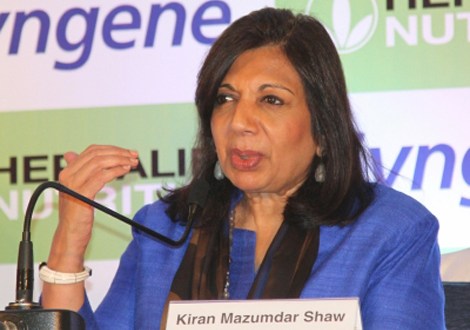
India’s biotech queen Kiran Mazumdar elected to MIT board

KiranBF30jun2018

Bengaluru:

India’s biotech queen Kiran Mazumdar-Shaw got elected as a full-term member of the MIT Corporation, the Board of Trustees of the Massachusetts Institute of Technology (MIT), her company Biocon announced on Thursday.

“I am honoured to be elected as a full-time member of the MIT Board and look forward to contributing to its journey of making a difference in solving challenges of the world,” she said. “Shaw is among the eight members who will serve the five-year term on the Board from July 1,” said the city-based biotech firm in a statement here.

She is also on the board of directors of the US-India Business Council and the board of trustees of the Keck Graduate Institute at California’s Claremont.

Shaw was elected a foreign member of the Royal Swedish Academy of Engineering Sciences in 2006.

source: http://www.nyoooz.com / Nyooz / Home> Bengaluru / by Siyasat / June 29th, 2018

IISc to boost science start-up incubation

Indian Institute of Science (IISc) campus   | Photo Credit: K. Murali Kumar
Indian Institute of Science (IISc) campus | Photo Credit: K. Murali Kumar

Plans to open research park in 3 years

The Indian Institute of Science, founded in 1909 by Jamsetji Tata and former Maharajah of Mysore Krishnaraja Wadiyar IV, plans to open a research park at its Bengaluru facility within the next three years to incubate sci-tech companies.

“Currently the Society for Innovation and Development is incubating about 15 companies,” said Prof. G.K. Ananthasuresh, chairman of the Centre of Biosystems Science and Engineering. “We want to scale it up ten times and the tenders for setting up the facility has already been issued.”

Corporate collaboration

The institute has collaborations with companies such as Tata Consultancy Services, Volvo, Google Inc., General Motors, Microsoft Research, IBM Research, Boeing, Robert Bosch Foundation and Pratt & Whitney. It also works with the Indian Space Research Organisation, Aeronautical Development Agency and Centre for Development of Advanced Computing.

The institute, spread over 400 acres, is home to more than 40 departments.

Of about 12 companies incubated by the Society for Innovation and Development arm, an inter-disciplinary body, include simulators used for endoscopy, microsatellites to access the Internet at lower costs, a medical diagnostic kit and a superwave technology to extract oil from sandalwood.

“Many of these companies employ core technology. There are deep science and deep technology involved and the impact they can create is big,” Prof. Ananthasuresh said in an interview.

“We have years of research behind us and comprehensive research is done before commercialisation.”

Pathshodh, the name for the equipment that uses superwave technology, can also be used instead of needles to inject medicine into patients, Mr. Ananthasuresh said. “It is close to being commercialised.”

“Another example is one project we did with Bellatrix where we used our knowledge to position and propel microsatellites. In Open Water, another project, we produced clean water from a contaminated [sample],” Mr. Ananthasuresh said.

An air-conditioned blanket invented by scientists in the institute enables one to cool “in cycles,” he said. “It is a layered blanket and one does not have to cool the whole room. It is a personalised air-conditioner,” he said.

The Robert Bosch Centre for Cyber-Physical Systems was established in 2011 at the institute as an interdisciplinary research and academic centre to promote research in cyber-physical systems.

Mimyk Medical Simulations, incubated at the centre, had developed the endoscopy simulator for gastroenterologists.

“This centre does works on physical networks where devices talk to each other. It is based on the Internet of Things. We also have an energy centre where work is going on in the field of solar energy. Another area we are focusing on is robotics and autonomous systems.

“A futuristic concept is flying cars. Funding comes from different sources. There are other centres which are doing work on water, agriculture, and healthcare,” Mr. Ananthasuresh said.

source: http://www.thehindu.com / The Hindu / Home> Business> Industry / by Jay Shankar / June 29th, 2018