Amreen Taj, Vishnu R., Sandeep Akash P., Anitha Raju (trainer) and Manasa Yadav K. will be taking part in the Football for Hope Festival 2018 in Russia.
Four children from underprivileged communities have been selected to participate in the FIFA Football Fest
When 16-year-old Sandeep Akash, a resident of Byatarayanapura, told his mother that he had been selected to travel to Russia to play football and watch the FIFA World Cup, his mother dismissed it as a tall tale. She asked him not waste her time with silly jokes. It was only after his trainer called and assured his parents that their son had been selected to play football in Russia were they convinced.
Sandeep will be travelling to Russia along with three other teenagers — Amreen Taj, Manasa Yadav K. and Vishnu R. — to take part in the ‘Football For Hope Festival 2018’, an official event of the 2018 FIFA World Cup.
He is the first person in his family to be travelling abroad. His father, a painter by profession, encouraged him to pursue his interest in sports, but never thought that his son’s hobby would turn out to be this eventful.
The festival brings together children from various communities across the world, with a focus on social development. Around 48 teams will be participating in the programme from June 25 to July 5. Children will get to play football with their peers from various countries and will also attend leadership programmes. They will also get to watch one of the ongoing World Cup matches.
Sandeep and his friends, who were part of the NGO Dream A Dream’s after-school life skills programme, were chosen as delegates. They are the first in their families to get the opportunity to travel abroad. While Amreen and Vishnu’s fathers work as mechanics, Manasa’s father works as a driver.
The NGO is one of the two organisations selected from India by FIFA to take part in the event.
“We selected children with great potential who lacked avenues to exhibit their capabilities. We have been helping them work on their nutrition and fitness after the selection was done. For the last four months, the children have been practising for at least three hours every day, making time for football in their school schedule,” said Anitha Raju, trainer for the children and employee of Dream A Dream. These four children were shortlisted from 2,200 candidates across 28 schools in the city.
To play football was a big step for Amreen. “Usually, girls are not encouraged to take up a sport like football. Initially, everyone was sceptical. But after watching me, my brother and sister are very proud of me. I want to help more girls in my community take up this sport,” she said.
According to Sucheta Bhat, CEO of Dream A Dream, the football match that the children will be playing will have a set of unconventional rules (which the children themselves will come up with), with the primary aim of building leadership and cooperation. “This is the second consecutive time that our organisation has been selected,” she said.
All the four children said they want to pursue football training as a career and help more children from local communities realise their potential.
“It’s not only about the game. I have benefited by improving my communication skills and overall discipline,” said Vishnu.
Manasa said that she has gained focus in life. “Earlier, I used to be lazy. I see a huge transformation in myself. I want to pass on the benefit to more youngsters,” she said.
source: http://www.thehindu.com / The Hindu / Home> News> Cities> Bengaluru / June 20th, 2018
A 14-year-old Class IX boy, Manaswith Shankar, has designed a smart chair to help techies suffering from phyical problems arising out of spending long hours before computer. His invention has also won him a prize at the INSEF Regional Science Fair in Rajkot last January.
The ‘smart’ chair
Manaswith’s ‘smart chair’ has a timer, DC motor (vibrator), buzzer and airblower. After two hours of continuous sitting, the buzzer gets on and after one-minute interval, the chair begins to vibrate and if you still refuse to get up, after one minute, the hot air blower is on forcing the person to get up from the seat. Still if the user refuses to get up, the monitor automatically shuts down.
Turbo pot
Manaswith has also developed a turbo pot prototype which fetched him a prize for ‘quick cooking’. Turbo pot is a high quality cookware that heats up twice as fast as regular cookware, saving time and LPG.
Other inventions
At 11, a tractor prototype, his first project, which runs on solar power. He has also developed a ‘armour’ a device for self-defence for women. The device has a GPS unit connected that can be monitored at nearby police station. This hand- held watch consists of retractable plug/knife/metal part which is hidden. It fits well on a wrist strap or in a purse or handbag.
Dangers of sitting long hours
Sitting for excessively long periods of time can even lead to early deaths, suggest many studies. Neck/back pain is a common problem among those who spend long hours sitting before computers. (photo for representation only)
source: http://www.economictimes.indiatimes.com / The Economic Times / Home> Business News> News> Science / June 20th, 2018
Since 1948, when SA Basheer played at the London Olympics, the city has produced some of India’s most distinguished players.
Arumainayagam (L), seen here with Brazillian football legend Pele (R) in September of 1977.
In other human trades, decline comes with old age, but a soccer player can be old at thirty. Muscles tire early: “That guy couldn’t score if the field were on a slope.” “Him? Not even if they tied the keeper’s hands.”
Or before thirty if the ball knocks him out, or bad luck tears a muscle, or a kick breaks a bone and it can’t be fixed.
And one rotten day the player discovers he has bet his life on a single card and his money is gone and so is his fame.
Fame, that fleeting lady, did not even leave him a Dear John letter – An excerpt from Eduardo Galeano’s ‘Soccer in Sun and Shadows.’
Since 1948, when SA Basheer played at the London Olympics, the city has produced some of India’s most distinguished players.
Arumainayagam aka Baby Taxi
Memories, recorded in old sepia photographs, surround the small coffee table around us. The old man’s smile widens as he points to one.
“There were only a few yards between us but it felt like an eternity.
“There were only a few yards between us but it felt like an eternity. My friend asked me to hurry up. We made our way through the sea of people. We gifted him some sarees for his wife and asked him to pose for a photograph. And that’s how I got this picture with Pele,” says Arumainayagam, one of Bengaluru’s football heroes.
My attention now wanders to the other photos. There is one with Raj Kumar, the actor, another with West Bengal Chief Minister Mamata Banerjee and yet another with Sarvepalli Radhakrishnan, India’s first vice president. He points to the last one.
Arumainayagam receiving the Durand cup from Sarvepalli Radhakrishnan, India’s first vice president and second president.
“Mohun Bagan had just won the Durand Cup back to back, three years in a row, and he was there again for the prize distribution ceremony, at the third oldest football competition in the world. ‘Arumainayagam, is that you?’ he asked. I couldn’t believe it. He remembered my name,” he says.
Arumainayagam in blazer and tie on the extreme right. The photo was taken at a party with Cosmos Team players from the USA when they played with Mohun Bagan team at Calcutta in 1977. Mr Pele also played the match and joined the party later. Mr Muthuraman, film actor third from the left is also seen. The match was played on 24th September 1977 at Eden Garden, Calcutta. The result was 2-2
Arumainayagam, aka Baby Taxi—a nickname given to him due to his small size but incredible speed—is one of Bengaluru’s most accomplished footballers.
Arumainayagam being honoured in Calcutta by Mamata Banerjee for his career in India’s oldest and most successful club, Mohun Bagan. Arumainayagam is seen here with actor Raj Kumar and his family.Arumainayagam is seen here with actor Raj Kumar and his family.
A recent picture of local footballer Arumainayagam (78).
Having played for India’s most accomplished and oldest football club Mohun Bagan for eight years and represented India during the golden era of football in the 1960s, Baby Taxi, now 78, is grateful for his fortunes. But not everyone is as lucky as Arumainayagam.
Mohan Kumar, hero now guard
Take Mohan Kumar. If you stroll across Mount Carmel College, chances are you will see him, albeit in a new kit.
With no field, opponents, no referee, no fans, no goalposts and no ball, he stands around as a security guard.
Unfazed by the ravages of time, he says: ‘I don’t look at [my job] as something beneath my dignity. It’s still a job and I enjoy it.’
Yes, it is the same Mohan Kumar, the same mighty defender of ITI who reached the Stafford Cup final in 1980 and represented India at international tournaments in Malaysia, Afghanistan and South Korea in the mid-1970s.
A year after articles in local paper wrote about Mohan, he says not much has changed in his life but he did get some recognition.
“I was invited for a local football tournament as a chief guest and about a month ago I got offers to coach football academies in Kerala and Goa but I declined. I am 68 years old and I can’t leave my family.
I am 68 years old and I can’t leave my family. I am happy working in the college and my salary is sufficient. I would like to coach football in the city but I’m not getting any offers like that.”
Mohan Kumar (68), a footballer who played for India internationally and is now working as a security guard at Mount Carmel College (PU), seen here wearing the kit of his former team, ITI.
S A Basheer, who started it in 1948
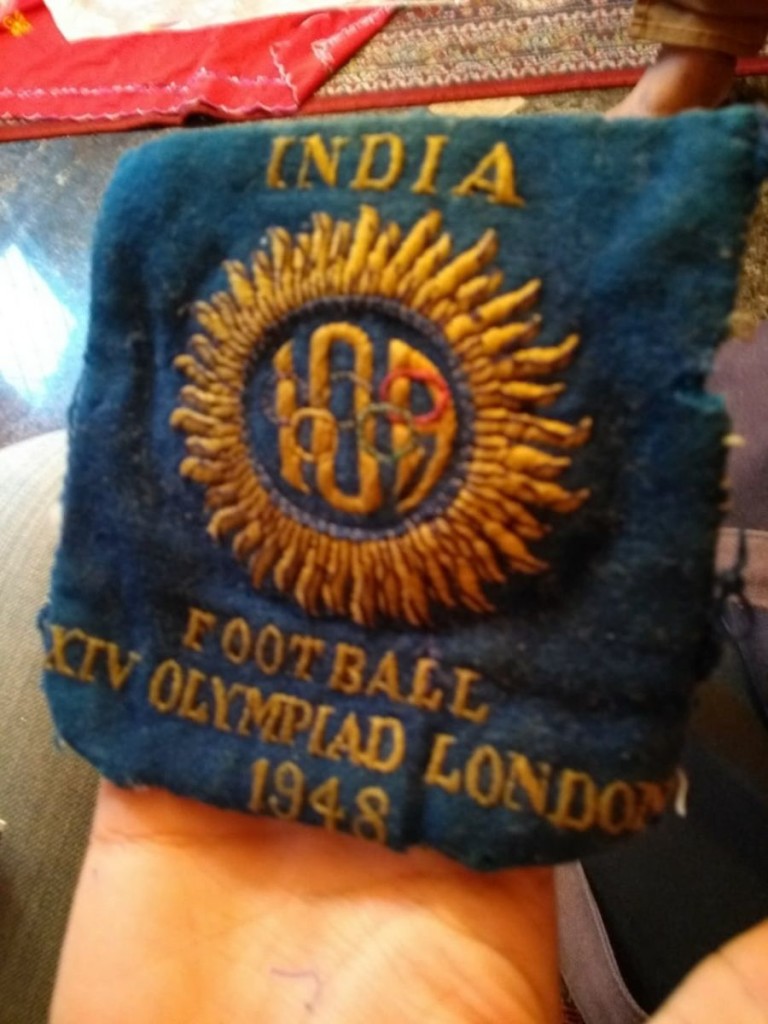
One of the oldest Olympians from the city, SA Basheer, was part of the 1948 London Olympic squad and the next Olympics in Helsinki. He may have been the inspiration for the footballing culture in the area.
S A Basheer, a footballer from Gowthampura area near Halsuru in Bengaluru who represented India at the 1948 Olympics in London and the 1952 Olympics in Helskini seen here in an undated photo.
Arumainayagam remembers standing at the sidelines of the Gowthampura field at the age of 10 to watch the seniors play. He remembers glancing at Basheer’s silverware on display and cites it as inspiration.
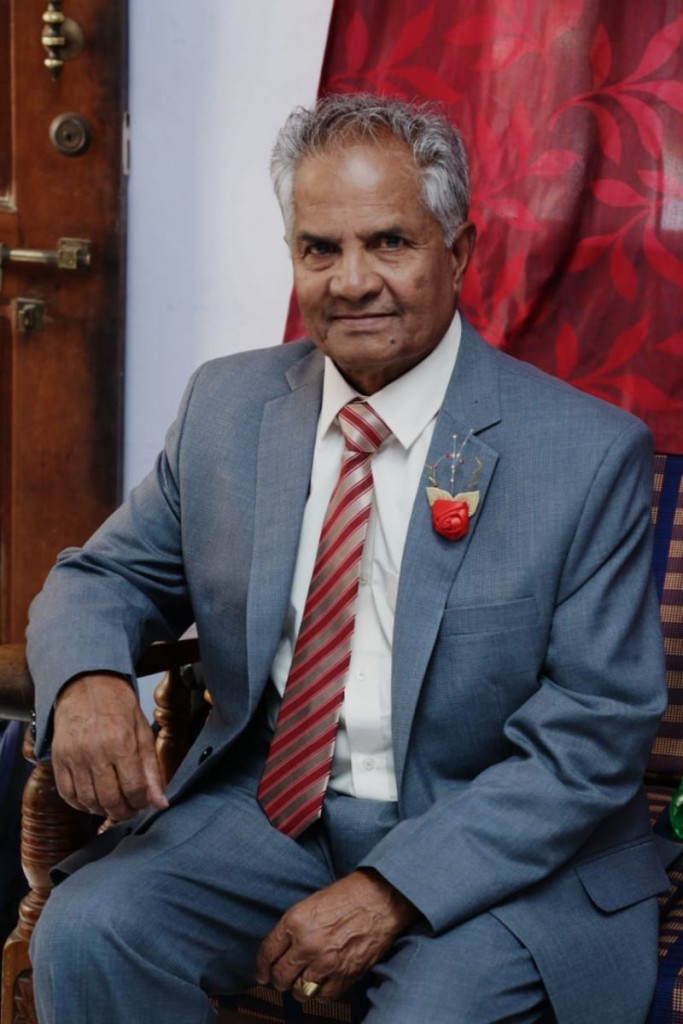
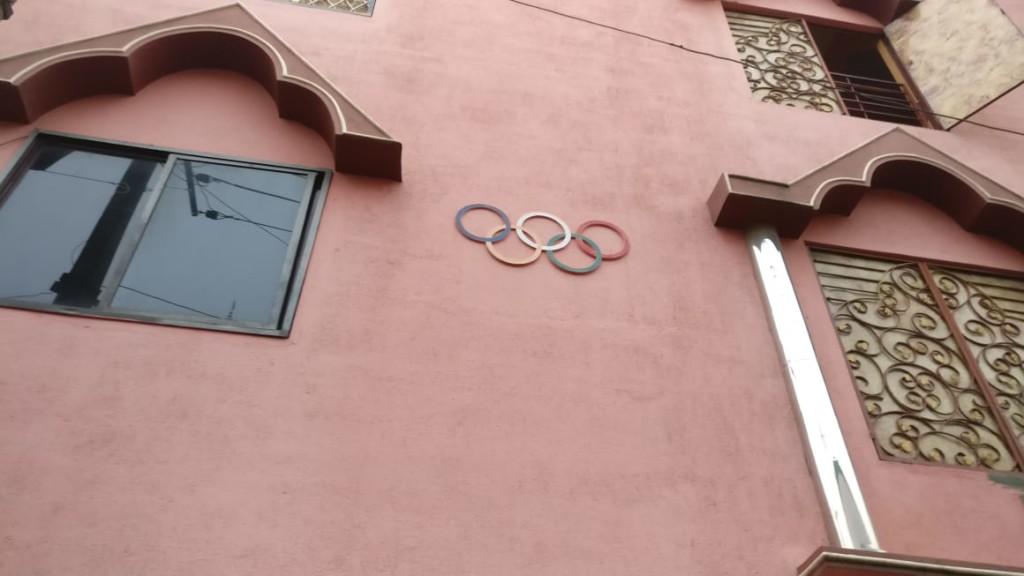
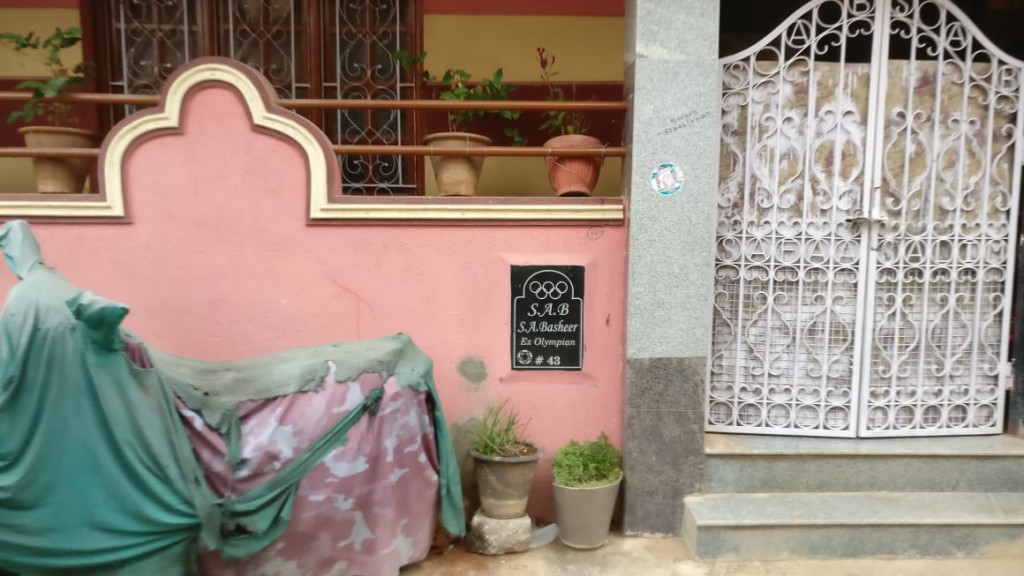
Today, walking around the streets of Gowthampura, you may stumble on a pink house with the five Olympic ring symbols carved on it. But inside, the surviving family of Basheer, Abdul Saleem, his adopted son and Akhila Begum, Basheer’s widow, Basheer’s widow, bemoan his forgotten legacy.
“My father died of a heart attack in 1987, when I was an upcoming footballer in Class 10. I played football for Reserve Bank of India and Karnataka State police during 1989-1991 and was promised a permanent job but did not get in through sports quota sports quota as the SC/ST quota had filled up the available positions; I came under the general category. As I was the only breadwinner, I quit football and moved to Saudi Arabia for work in 1994,” explains Salim, who has just travelled back for Eid with his family .
“We aren’t starving but the truth is that we got nothing. No pension, no tribute, no remembrance. Basheer baba was the light and joy of this neighbourhood and commanded immense respect from everyone,” says Saleem.
S A Basheer’s son, Abdul Saleem.
Basheer was called to play for clubs in Goa and Kolkata but remained in Bengaluru.
“He coached at the local maidan and HAL for free, even after retirement. My grandfather played for Bengaluru Mars Club but we got nothing from there either.
I still pay for a membership because I want our family to remain attached to it,” said a teary-eyed Salim.
City has produced 12 Olympians in football
Six of the historic 1948 barefoot squad in the London Olympics were from this city. In all, 12 Olympians have emerged in football from Bengaluru.
The city has regularly produced international stars. During the 1970s, football was nurtured by public sector industries like CIL, ITI, HAL and LRDE (Electronics and Radar Development Establishment).
They recruited and promoted talent and also provided job security.
With the advent of information and technology companies, the former glory of native and local footballers has largely been forgotten. A new breed of fans has emerged with the founding of the Bengaluru Football Club in 2013.
Glory of Gowthamapura,‘mini Brazil’ in Bengaluru
Three and half billion people, or half the planet’s population, is expected to tune in to watch the ongoing World Cup.
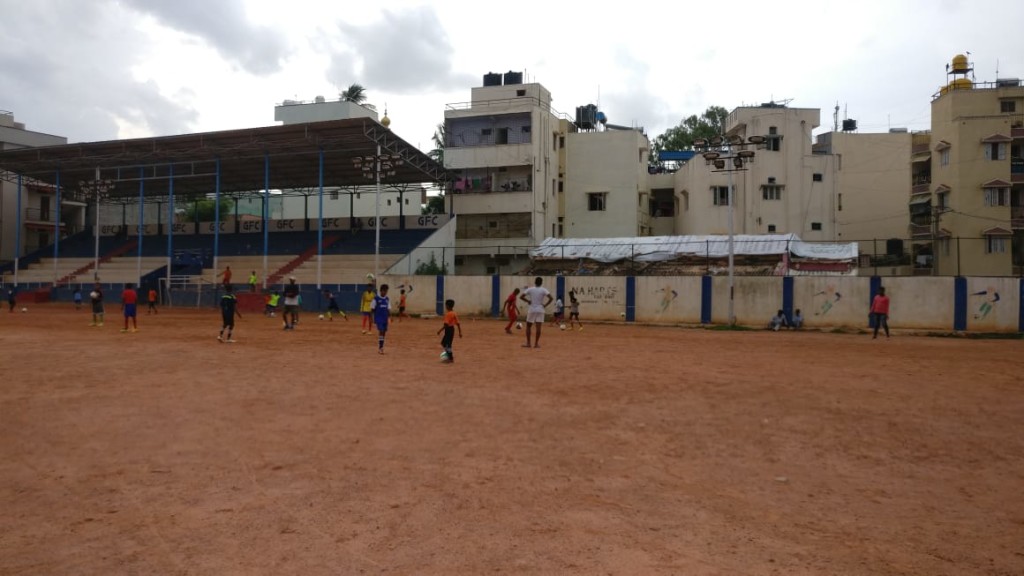
No doubt, many fans will throng the city’s pubs to catch the screenings. But at least a hundred of them, aware of Bengaluru’s old and new heroes, live in an area near Halasuru called Gowthampura.
Also known as Bengaluru’s mini Brazil, Gowthampura’s original name is Gun Troops. As you walk past the 515 Army Base Workshop and the Harris Barrick Officers’ Colony, it’s easy to spot the connection.
“In Gowthampura, every womb has a footballer inside it. Our area has produced hundreds of footballers that have competed at various levels of the game,” says Prashant Kalinga, 20, training with the BFC.
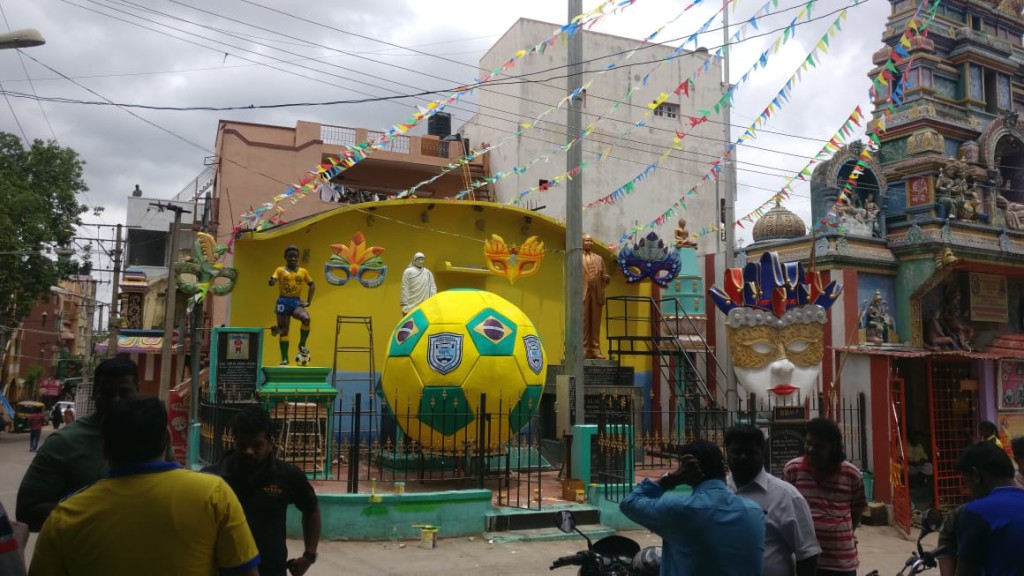
Children with unique mohawk haircuts, grown men going about their day in football kits are some obvious signs as you enter the area. But a Pele statue, selected, funded and installed by a committee of retired sports people and unveiled in the presence of India’s footballing legends Bhaichung Bhutia and I M Vijayan in 2001, is the biggest telltale sign.
A recent addition to the Pele statue, which stands alongside statues of Mother Teresa and B R Ambedkar, is a cenotaph dedicated to the memory of local football hero D Venkatesh, who collapsed and died on the field in 2012.
The area was referred to as ‘mini-Brazil’ even before the statue was installed.
Pele, the man with a thousand songs behind him, a man whose fandom once caused a temporary truce between Nigeria and Biafra, seems like a natural hero here. He had hailed from a far-off village and gone on to conquer the world of football.
source: http://www.deccanherald.com / Deccan Herald / Home> Metrolife> Metrolife on the Move / by Pranshu Rathee, Bengaluru, DH News Service / June 17th, 2018
Manisha Varun, winner, Dazzle Mrs. India Universe 2018, with her husband M.V. Varun and grandparents M.V. Suryanarayan and Chayadevi in Shivamogga on Monday.
Manisha Varun, from Shivamogga city, who won the Dazzle Mrs. India Universe 2018 pageant, has said she would like to work for the empowerment of and prevention of atrocities against women.
Ms. Varun won the title in 25-35 years category. She hails from Hosapete and is married to Varun V. Malur, an arecanut merchant from Shivamogga, who is also an active member of Round Table India organisation. They have two children. Along with her husband, she had conducted sessions on gender sensitisation and awareness programmes on providing access to education for girls at various schools and colleges in Shivamogga. The pageant’s theme was ‘Stop violence against women’.
Ms. Varun told presspersons here on Monday that external appearance alone was not enough to win beauty pageants. The comprehensive personality of the contestant, including the physical, emotional and intelligent faculties are considered. As many as 26 women from various parts of India took part in the competition. Ms. Varun was among the five selected for the final round that was held in Colombo, Sri Lanka, on June 14.
As part of the preparation for the competition, she underwent four months of rigorous training in physical fitness, communication skills, appearance, and etiquette.
source: http://www.thehindu.com / The Hindu / Home> News> States> Karnataka / by Staff Reporter / June 19th, 2019
Coconut seedlings at the Government Fruits and Horticulture Centre near Krishnaraja Sagar reservoir in Mandya district. | Photo Credit: B_MAHADEVA(Freelancephotograph
Area under cultivation for crop to be raised to wean farmers away from water-guzzling paddy, sugarcane
With scanty rainfall, and the subsequent crop loss, becoming a challenge for farmers for six straight years, efforts have been initiated in the district to expand the area for coconut cultivation.
The district, which reportedly has Asia’s largest coconut market on the APMC premises in Maddur, has been grappling with severe drought since 2012.
The failure of crops, such as paddy and sugarcane, owing to the lack of water every summer had resulted in the many farmers committing suicide. To encourage farmers to take up coconut cultivation instead of water-intensive paddy and sugarcane, the Horticulture Department has planned to increase the coconut cultivation area.
A large number of coconut seedlings have been raised at different government farms in the district and 1,65,866 of them are ready for transplanting and are available for sale.
There are plans to raise at least 2 lakh more seedlings by 2020, said senior officials at the department.
The Government Fruits and Horticulture Centre at KRS has a stock of 26,511 well-grown seedlings.
The plants are also available for sale at Mandya farm (13,662 seedlings), Pura (32,367), Dudda (11,939), Poorigali (16,500), Maddur (6,735), Mallasandra Kaval (10,494), Javaranahalli (13,959), Halebidu (8,403), Srirangapatna (3,678), Gamanahalli (10,050) and Murukanahalli farm (11,550 seedlings), officials told The Hindu. There are many private nurseries in the district, but the farmers prefer to buy seedlings from government nurseries as they are grown in a scientific method, an assistant director at the department said.
The carefully selected healthy nuts will be used to raise seedlings. Experts at the VC Farm Zonal Agricultural Research Station will identify the nuts and they will also help the department in getting healthy nuts from progressive farmers for raising seedlings, another officer said. Nearly 4 lakh coconut trees were affected owing to black-headed caterpillar infestation and beetles in the district since 2012. Thus, there are great demands for quality seedlings from the farmers.
The traditional breed ‘Tiptur Tall’ and the hybrid ‘TxD’ (Tall x Dwarf) are available at the farms. Even growers from Mysuru, Ramanagaram, Hassan and Tumakuru are buying the seedlings.
The price of Tiptur Tall is ₹52 a seedling, while TxD is being sold at a cost of ₹150. Around 40% to 100% subsidy is available and the growers can obtain it by submitting RTC (Rights, Tenancy and Crops), Aadhaar cards and other documents at the nearby horticulture department offices.
source: http://www.thehindu.com / The Hindu / Home> News> States> Karnataka / by M.T. Shiva Kumar / Mandya – June 06th, 2018
Three day-convention on the ancient language will be held at Shravanabelagola
For the first time in the century-old-history of the Kannada Sahitya Parishat (KSP), a three-day convention will be held on Helagannada, which according to linguists evolved around the 3rd century. This convention is timely, given that research and studies on the classical Kannada language are gaining momentum in various institutions.
The convention will be held at Shravanabelagola, the Jain pilgrimage centre, from June 24 to 27. “Though sessions on Halegannada were held as part of larger conventions on Kannada, this is the first time that a full-fledged convention is being in held in the history of the KSP,” said, Manu Baligar, president of KSP.
S. Settar, historian and author of Halegannada: Lipi, Lipikara and Lipi Vinyasa — a monumental study of Kannada script, literature, and scribes — has been chosen as the president of the convention. Mr. Shettar will be taken in a procession from Chandragiri Chikabetta to Chavundaraya Mantapa.
The convention will be inaugurated by former Prime Minister H.D. Deve Gowda and Dr. Shettar will deliver the presidential address. Noted scholars, including Hampa Nagarajaiah, president of the Kannada Development Authority; S.G. Siddaramaiah, sanskrit scholar; professors Mallepuram Venkatesh, Chandrashekar Patil, Baraguru Ramachandrappa, Purushottam Bilimale, and P.V. Narayan will participate in the convention.
There will be sessions on 11th century literature: Management of violence and non-violence; Revisiting of Kannada classical literature; relevance of Halegannada; and study of Adikavi Pampa and Ranna, one of the earliest and great Kannada poets. As many as 16 poets are expected to participate in the poetry reading session, which will be held on the inaugural day.
This Halegannada sammelan is an attempt to awaken the present generation to Halegannada literature. “Papers presented at the convention will be compiled into a major work in Kannada by the KSP by next year,” said Mr. Baligar.
According to noted scholar Hampa Nagarajaiah, “Kannada language has branched off from the Proto-Dravidian family of languages in as early as the 5th century BC. Making Shravanabelagola the venue is more meaningful and appropriate, as it serves as a laboratory for the evolution of Halegannada literature.” Underlining the need to make Halegannada an integral part of studies for higher education curriculum, Mr. Nagarajaiah said since historical events were documented in ancient Kannada, it becomes pertinent to read works written in that language.
source: http://www.thehindu.com / The Hindu / Home> News> States> Karnataka / by Muralidhara Khajane / Bengaluru – June 15th, 2018
To work on cutting-edge tech that drives aerospace innovation
Bengaluru :
Boeing inaugurated its Boeing India Engineering and Technology Center (BIETC) in Bengaluru. The facility, spread across 150,000 square feet and eight floors, will double Boeing’s existing footprint of 160,000 square feet and will accommodate another 1,000 employees, who will work on cutting-edge technologies that will drive aerospace innovation from India, for India and the world.
While the new facility will incorporate software technologies into design, manufacturing and service offerings, Boeing will continue to scale up its aerospace, R&D and engineering activities at its existing facilities.
BIETC is recruiting and scaling up exponentially. The centre has increased its employee count from just 100 when it was inaugurated in early 2017, to over 1,000. And, as the centre grows over the next few years, it will develop into a team of over 2,500 employees in specialised fields of IT, engineering and R&D.
From an IT perspective, key focus would be on cutting-edge areas such as Product Lifecycle Management, Enterprise Resource Planning, Internet of Things, Blockchain, Data Analytics and Software Design for aerospace. BIETC is also continuing to build teams focused on advanced aerospace research in materials and manufacturing, aircraft structures and airplane health management.
Boeing’s engineering teams continue to excel and innovate in Digital Aviation, electrical, mechanical and systems design and providing support for lab and flight testing for aircraft.
“We see India as a hotbed for path-breaking software solutions that can redefine the way the world designs, operates and manages airplanes,” said Ted Colbert, Boeing’s chief information officer and senior vice president of Information Technology & Data Analytics, while inaugurating the new facility. “The IT talent and capabilities available in India will be an enabler for Boeing’s success across the world.”
The facility will contain an integrated lab for Internet of Things (IoT), Analytics and Mobility, a 3DX lab to develop 3D experiences, a Systems Integration Lab and a Proof of Concepts Lab. Over 25 Collaboration Areas in the facility will further enable teams to work together to develop, scale and deliver aerospace innovations with agility. The new facility will also enable driving strategic initiatives like Digital Transformation.
“We are excited about Boeing’s ever expanding footprint in India. The new engineering facility at BIETC reflects an agile and driven Boeing in India, one that inspires people to collaborate and accelerate step-change innovation,” said Pratyush Kumar, president, Boeing India.
“This centre brings together engineers from the fields of aerospace, computer science and mathematics, who will collaborate to achieve next-gen breakthroughs for aircraft design, manufacturing and maintenance,” he added.
In addition to developing engineering capabilities, Boeing is actively involved in developing skills across the aviation sector by partnering with Indian vocational training institutes and industrial training institutes to train workers for the aerospace industry.
source: http://www.thehindubusinessline.com / Business Line / Home> News> Special / by Anil Urs / Bengaluru – June 15th, 2018
Author Shoba Narayan on her relationship with Bengaluru and what makes it ‘home’ for her
My first encounter with Bengaluru happened in the 80s when I was still a student. I would visit my cousins in Rajaji Nagar. At that time, Bengaluru seemed like a small town with good weather, lovely people, greenery and all the clichés. All those things that old-timers in the city hark back to are true.
I moved to the city in 2005. Even then, the city seemed liveable. My children began their schooling here. I think the drastic changes started happening when the construction of the metro began, though it is a positive step.
I find the people of Bengaluru are genteel in the sense of being welcoming. Even the auto drivers are more polite, you can walk into a shop and look around and leave, without the shopkeeper saying something rude. People have more of a ‘live and let live’ attitude, they speak multiple languages, which is good for an immigrant like me. The sad part, however, is that I am learning Kannada only now. I love the weather, parks, and flowering trees, with different blooms at different times. I love the fragrance of the Millingtonia Hortensis (Indian cork tree), also known as the tree jasmine.
The best part about Bengaluru is that it is enough of a South Indian city, for what we expect from one, with some sense of civility and cleanliness. At the same time, it is enough of a cosmopolitan city for global citizens to feel at home.
Seasonal Summer fruits for sale in Bengaluru | Photo Credit: G_P_Sampath Kumar
As an author, I find there are many Bengalurus, as it should be, in every great city. The Bengaluru that interests me is that of the vendors who walk the street. The jamun season is here and in Malleswaram, you’ll find baskets of litchis and jamuns, the way they are arranged, in pyramids, is so beautiful, as are the santhes and melas of averkkai, and the seasonal flowers in the city market. I like how when you walk into Russell market, you will find English vegetables on one side and Indian vegetables on the other. In the Dharmaraja Koil street intersection, you will find a woman who knows the benefits of different greens. This is the Bengaluru I am interested in, it provides a lot of fodder for anyone who wants to write about it.
Cubbon Park | Photo Credit: V Sreenivasa Murthy
And of course, there are the milk ladies and the milkmen. Even yesterday, I saw a man on a bicycle carrying milk in aluminium pails. They are ubiquitous in my neighbourhood, around Ulsoor . They are part of a way of life that I find hard to replicate in other cities.
The changes I have hoped to see in the city are already happening. Most writers have this element of ‘flaneur’ where they walk around the streets to get inspired. It is nice to see that public spaces such as Church Street, are being remodeled for pedestrians. I feel this is still a pedestrian-friendly city, where throngs walk on the streets. I would like this writerly aspect to grow.
A view of fruits shops at Russell Market in Bangalore | Photo Credit: Bhagya Prakash K
I began as a reluctant Bengalurean. Those who grow up in one location all their lives, leave a little bit of their hearts behind. I always thought of Chennai as home. Now Bengaluru is my home, where I take NRIs out for shopping, go to Avenue road for street food, to CTR or Vidyarthi Bhavan for good morning dosas, walk around Ulsoor lake, go birding in Lalbagh or Cubbon park. The process by which a city becomes ‘home’ is when every place is associated with a memory. I have so many associations with the city. I have spent so many afternoons at the tennis association, hanging around while my daughter learned tennis. I have gone rock climbing at the Kanteerava stadium, I have signed up for 10k runs.
What I regret is not being engaged in the vernacular circles, which I was not able to do because I can’t read and write in Kannada. On the positive side, there is enough fodder for writers (in English) in Bengaluru, from lit fests to spaces such as Atta Galatta or initiatives such as The Great Indian Poetry Collective. One has the chance to listen to inspiring talks at several venues from The Bangalore International Centre to the National Gallery of Modern Art. One can choose to be part of the community of writers if one so chooses, people here are inclusive, accepting and welcoming.
The fact that I have got by for 10 years, communicating in Tamil, until I learned Kannada, says something about the city.
As told to Harshini Vakkalanka
This column features the city through the eyes of a prominent Bangalorean
source: http://www.thehindu.com / The Hindu / Home> News> Cities> Bengaluru / by Harshini Vakkalanka / June 13th, 2018
Sharing a passion: A file photo of participants at a seed swap event organised at Cubbon Park in Bengaluru. | Photo Credit: Special Arrangement
From virtual connection on social media to physical meet-ups, urban gardeners are slowly but surely warming up to the idea
Sharing food, or even ingredients, is common. Now, however, the growing number of people who share a passion for growing their own food also share an essential component of what they produce: the seeds.
Right from virtual connection on social media to physically meeting, residents of the city are slowly but surely warming up to the idea of seed sharing.
This exercise not only ensures higher germination rates and less dependence on commercial sellers, but also gives novices in the field a chance to learn first-hand from the experienced on how to go green and organic, they say.
Good response
After organising its first Seed Swap in 2017, the Backyard Factory is back with another swapping event this month. “The first seed swap event was well appreciated. We had posted information about the event on Facebook and a good number of people turned up for the event at Cubbon Park. The idea was to let people bring excess seeds from their produce and share them with people who are interested in growing their own food. It was a mutual exchange. What was surprising was most of the participants were young gardening enthusiasts,” said Lincy Inder, who conducts kitchen gardening workshops for schoolchildren.
This time, the event will be held on June 30 at Cubbon Park, and Ms. Inder expects even better participation than the last time.
While meetings are very essential for seed sharing, another group also makes good use of social media to share seeds with the community. Members of Grow Your Own Food, a Facebook community, put up details of excess seeds available with them on social media. Others can contact the group if interested. The members meet once in two months for a seed swapping event at Lalbagh.
“Whatever we grow, we save the seeds for ourself and to share with others,” said Suresh Rao, a member of the group.
Mr. Rao said the best thing about seed sharing is that there is 100% guarantee of the seeds germinating. “It is not the case with store-bought seeds. We usually share tomato, brinjal, gourd, and all types of greens during the meets,” he said. The group also promotes heirloom seeds by sharing them.
Explaining how the members store the excess seeds for sharing, he said, “It is quite easy. From two tomatoes, 100 seeds can be obtained, which can be saved for the next season. One brinjal has around 200 seeds. Though the seed saving technique for each variety differs, it is not rocket science. During the meet-ups, we share the concepts with newcomers,” Mr. Rao said.
Another city-based group, Oota From Your Thota, which encourages people to grow their food organically, also organises seed swaps among members regularly.
A common practice
While urban gardeners are just getting used to the idea of seed sharing, the practice is common among farmers, said Hemanth, farmer and member of the Facebook group BangaloreGardening. “In our farming community, seed sharing has always been a common practice. It helps reduce farmer’s dependence on commercially sold seeds and saves a lot of money,” he says.
The Horticulture Department too gives away seedlings instead of just seeds to anyone interested. “After monsoon, we distribute the excess seedlings to interested people for free. Most are tree seedlings. In a year, at least 5,000 seedlings are given away,” said M.R. Chandrashekar, Deputy Director, Lalbagh.
source: http://www.thehindu.com / The Hindu / Home> News> Cities> Bengaluru / by Sarumathi K / Bengaluru – June 11th, 2018
The team comprised four women from Bengaluru and one from Pune. | Photo Credit: Handout E Mail
It is one of the most treacherous extreme terrain routes in the Himalayas
When it comes to negotiating extreme roads of the Greater Himalayas, Bengaluru’s Nidhi Tiwari, founder of Women Beyond Boundaries (WBB), has yet again made it to the mountain range. Nidhi recently led a crew of five women drivers on a daunting expedition to Upper Mustang in northern Nepal. They drove for 13 days from Delhi to Lo Manthang and back, covering 3,000 km.
“We have now become the first crew of women drivers to reach Lo Manthang, the erstwhile capital of the kingdom of Lo,” said Nidhi.
Desolate and rarely accessed, the road to Lo Manthang is considered to be among the top three extreme terrain roads in the Himalayan belt. The 36-year-old mother of two, an outdoor educator and adventure lover, was born in Dharwad and raised in Bengaluru. “I heard the northern Nepal terrain was challenging. That’s how we had the temerity to choose something that poses a challenge to all of us. If you have a nose to drive, love to be part of driving expeditions and a strong mind to take up challenges, this is what you should do,” she added.
With an average elevation of over 12,000 feet, the area hosts two of the higher peaks in the Greater Himalayas that stand above 8,000 metres – the Dhaulagiri and Annapurna.
“We drove from Delhi and entered Nepal via Gorakhpur, and reached Pokhara in two days. From there started the off-road section into the Mustang valley. The section from Muktinath to Lo Manthang is ambitious, located just 50 km short of the Chinese border, and offers some breathtaking views,” she said.
The other participants on this drive were Bengaluru-based Rashmi Gururaja Koppar, an academician; Suneeti Sudame, an IT professional from Pune; physiotherapist Soumya Goyal and e-commerce professional Deepa Krishnan, both from Bengaluru.
“The learning curve was simply incredible, as Mustang is famous, or rather infamous, for its non-existent and challenging roads, punctuated by numerous streams,” adds Nidhi.
source: http://www.thehindu.com / The Hindu / Home> News> Cities> Bengaluru / by Ranjani Govind / June 09th, 2018