All posts by admin

Two Indian kids to be Official Match Ball Carriers at FIFA World Cup

Sunil Chhetri, Manohar Bhat (Head - sales & marketing, Kia Motors India), Nathania John K., and Rishi Tej.
Sunil Chhetri, Manohar Bhat (Head – sales & marketing, Kia Motors India), Nathania John K., and Rishi Tej.

Ten-year-old Rishi Tej of Karnataka and 11-year-old Nathania John K. of Tamil Nadu will be two of the Official Match Ball Carriers (OMBC) at the upcoming FIFA World Cup in Russia.

One of them will carry the match ball during the Belgium vs Panama game while the other will get a chance to get onto the pitch before the Brazil vs Costa Rica match.

India captain Sunil Chhetri conducted the trials — as part of the Kia Official Match Ball Carrier (OMBC) programme — in Gurugram last month.

As many as 1600 children participated in the programme, with 50 short-listed for the final selections.

source: http://www.thehindu.com / The Hindu / Home> Sport> Football / by PTI / New Delhi – June 11th, 2018

Stamping home the message of orchid conservation

M. Lokeshwara Rao
M. Lokeshwara Rao

For many, retirement can pave away for new opportunities and give time to pursue forgotten hobbies. M. Lokeshwara Rao, retired Principal Chief Conservator of Forests in Nagaland who was the director of the Indian Council of Forestry Research and Education in the city, is highlighting the destruction of a species of flowering plant and the ways to conserve it. And he is doing this not as a forest service official, but as a philatelist.

Mr. Rao, who retired in June last year and lives in Bengaluru, always liked collecting stamps. “As a child, I used to collect whatever stamps I could. But once I got selected as an IFS officer, I had to give up the hobby as there was no time to pursue it. Now, after retirement I have all the time I need,” he said.

The theme he has chosen is orchids.

“Orchids are only found in the Western Ghats region and in the northeastern regions of the country. I am fascinated by them. It is no secret that we are losing forest cover. I wanted my stamp collection to represent this,” said Mr. Rao, who within a few months of starting his collection won a bronze medal at the IMPEX-2017 contest held by the Philatelic Society of India.

Silver medal

In May this year, he was awarded a silver medal at the Rocky Mountain Stamp Show in Denver, United States, for his exhibition on ‘Orchid distribution, its habitat destruction and conservation’.

At the exhibition, he displayed orchid stamps from 65 countries. “The first orchid stamp was released in 1909 by countries in the Caribbean Islands. Now I am collecting stamps representing national parks,” said Mr. Rao, who during his service was recognised for his efforts to save the Amur falcon.

He is now getting ready for his next international exhibition, in Macau in September.

source: http://www.thehindu.com / The Hindu /Home> News> Cities> Bengaluru / by Staff Reporter / June 09th, 2018

Jallikattu champs, born in Karnataka

Racing bull: A Hori Habba enthusiast displays a Hallikar sporting breed at Tadasanahalli, in Shikaripur taluk. | Photo Credit: Vaidya

Drought-hit farmers rescued by the popularity of their bulls in Tamil Nadu

Vishnuvardhan, Sudeep, Darshan Thoogudeepa, Yash, and Duniya Vijay are not only popular Kannada film stars – all of them are also sturdy bulls from Karnataka that are taking Tamil Nadu’s Jallikattu by storm, with some of them selling for as much as ₹12 lakh, and earning their breeders a neat profit.

The bulls, reared and trained in the semi-arid Shikaripur taluk of Shivamogga district, have acquired a reputation for agility, speed and sturdiness. They are in great demand in Tamil Nadu following the resumption of Jallikattu in the State.

Shikaripur’s racing bulls are fetching almost double the money the farmers invested on purchasing the calf, and rearing and training it.

Trained for local sport

The bulls get trained in the local bull-catching sport, ‘Hori Habba.’ In Shikaripur taluk alone, more than 120 Hori Habba events are held between Deepavali and Sankranthi. The sport involves making bulls of the ‘Amruth Mahal’ and ‘Hallikar’ breeds run in the ring. Whoever succeeds in catching or taming them wins. Mr. Kumaranna, a farmer from Gandhi Nagar village of Shikaripur said that it costs him around ₹12,000 a month to keep the bull fighting fit. Four years ago, he bought a six-month old male Hallikar calf for ₹50,000. Recently, he sold it to a Jallikattu enthusiast from Tamil Nadu’s Vellore district for ₹12 lakh. Another bull reared by Zakir Saab in Narasapura was sold to a buyer from Alanganallur in Madurai district for ₹11 lakh.

Nandan Sommananavar, who is doing research on Hori Habba in Kuvempu University said that in the past six months enthusiasts from Tamil Nadu bought more than 60 bulls from Shikaripur. The bulls are typically named after Kannada films (Mylari, Raja Huli, Tagaru, Hathavadi, Saarathi) and film stars.

source: http://www.thehindu.com / The Hindu / Home> News> National / by Veerandra P.M. / Shivamogga – June 08th, 2018

Women scale Himalayan heights

Chasing the thrill: The all-woman team of trekkers on the expedition to Mount Baradasar Pass in the Himalayas.

27 women from Karnataka trekked to Mount Baradasar Pass in a fortnight

They had heard exciting tales of trekking in the snow-capped peaks of the Himalayas, but were apprehensive whether they could embark upon one such expedition in view of the freezing temperatures and alien terrain.

But, a total of 27 women from different parts of Karnataka successfully pulled it off by completing a trekking expedition to Mount Baradasar Pass in the Himalayas recently.

Adventure groups Tiger Adventure Foundation (TAF) and Mountain Goat organised a trekking expedition to the Himalayas exclusively for women. During the fortnight-long expedition, the women – between 13 and 65 years of age – passed through various camps in the Himalayas before reaching the summit of Mount Baradasar Pass situated at a height of 14,500 ft on the border of Uttarakhand and Himachal Pradesh.

TAF’s D.S.D. Solanki, an adventure enthusiast, who has been organising trekking expeditions for more than two decades, said the recent expedition to Baradasar Pass by women was the first of its kind in the adventure history of Karnataka. After undergoing endurance training for three weeks, the trekkers – hailing from Shivamogga, Madikeri, Hassan, Chickaballapur, Mysuru and Bengaluru – assembled in Mysuru and left for the expedition on April 17. They reached Dehradun on April 20, where acclimatisation and orientation programmes were held at the Sankri base camp.

For Anitha Arunakshi, a housewife, who had only seen hailstones accompany rains in Mysuru, the huge hailstorm that rocked Dhal Dhal Ridge camp during the expedition was an experience of a lifetime. The entire camp site turned white after the hailstorm, she said. In Devabasa camp, the trekkers experienced large amount of snowfall, submerging them in knee-deep snow. “With snow all around, it was bliss,” said Pratibha Garla, a dentist from Mysuru.

The trekkers reached the summit of Baradasar Pass on April 26 at 10.38 a.m. and hoisted the national tricolour. They spent a few minutes on the peak enjoying breathtaking visuals of different mountain peaks, besides the valleys.

The team returned to Mysuru on May 2.

Suma Mahesh, past president, Inner Wheel Club, Mysore Central, said she was able to complete the expedition and experience the thrill of trekking after overcoming her initial apprehensions.

Riya Solanki, 13, who recently trekked to the Everest Base camp situated at a height of 17,590 ft, was another member of the camp.

Before embarking on the expedition, the trekkers, whose team was named ‘Nari Shakti’, took part in Josh Run and took out an awareness rally on voting rights in Mysuru.

source: http://www.thehindu.com / The Hindu / Home> News> States> Karnataka / by Special Correspondent / Mysuru – June 06th, 2018

Indian rallyists win European Rally Championship, ERC 3 category

Proud moment: Indian rallyist team comprising Ashwin Naik from Mangaluru and Amitrrajit Ghosh from Kolkata won the European Rally Championship, ERC 3 category, at Athens, organised by the Federation of Internationale de lautomobile; (right) the team during the race.

This is the first time the duo has won the coveted championship

The Indian rallyist team, comprising Amitrrajit Ghosh of Kolkata and Ashwin Naik from Mangaluru, on Sunday won the European Rally Championship, ERC 3 category, at Athens in Greece organised by the Federation of Internationale de l’automobile (FIA).

A release here said it was the first time that the Indian rally duo has won the coveted European Rally Championship. The debutantes Ghosh-Naik drove a Ford Fiesta R2.

The event for the Indian duo was sponsored by Ramakrishna Race Performance Management of Kolkata and Pana, a Mangaluru-based Educational conglomerate.

Quoting Mr. Ghosh and Mr. Naik, the release said it was the first time that any Indian team has made it to the top slot. The European rallyists and the FIA were awed by the victory. The international rally scenario for Indian drivers would not be the same any more as Amit-Ashwin duo have just raised the benchmark, the release said.

Congratulating the duo, Chairman of Pana educational group Prasad Hegde said the Amit-Ashwin team have brought laurels to the country and Pana group is extremely happy with the results.

This was also the first international event that any Mangaluru-based organisation has sponsored.

The Indian duo, who scripted début victory, were leading in their class right from the day one of the three-day rally that passed through some torturous terrain.

Mr. Ghosh, an ace driver was ably co-driven by Mr. Naik and his immense experience left no ambiguity about this victory when they started for the last leg on Sunday.

The release quoted them as saying, “We both drove with safety on top of our mind which gave us confidence right from the word go. We just had to bring the car to the ramp in one piece which we did with great aplomb.”

It quoted Mr. Ghosh as saying, “I and Ashwin knew that we were racing with an older generation of Ford Fiesta R2. Our goal was always to finish the rally with honourable points but we did it by winning the ERC 3 on the top slot which is so fulfilling.”

source: http://www.thehindu.com / The Hindu / Home> News> Cities> Mangaluru / by Special Correspondent / Mangaluru – June 07th, 2018

A peep into the past! Private heritage homes in Bengaluru are opening their doors to guided tours

Bengaluru  :

Within a radius of one kilometre in Basavanagudi are a string of old bungalows, each with a story to tell. One century-old house was built by former Mysore dewan MN Krishna Rao while another stately structure belonged to M Mahadevan of the Survey of India. Two homes nearby belonged to freedom fighter Nittoor Srinivasa Rau and HAL’s former financial director CV Srinivasa Rao.

Telling their stories and what they mean to the city are a bunch of historians who, with help from the present owners of these homes, are organising tours around them.

 “This makes people aware why it is important to conserve private heritage and what it takes to maintain them. By listening to homeowners, people connect better to the city’s past,” said Mansoor Ali, whose Bengaluru By Foot has guided over 750 people through these homes so far.

 Awareness about private heritage is much needed. According to the Indian National Trust for Art and Cultural Heritage (INTACH), private structures are among the most poorly conserved in Bengaluru. In the past 30 years, the city has lost 75% of its heritage homes, with only 129 out of 510 surviving today. While the Revised Master Plan 2031 has included and listed these buildings, the provisions are far from robust.

Malleswaram resident Vardan Chakrapani said that opening out his 82-year-old Arcot House only increases his family’s sense of pride. His grandfather AL Munirathnam was an engineer for the Shivanasamudra hydroelectric project.

Likewise, MR Narendra, grandson of dewan MN Krishna Rao, is happy to indulge tourists with stories and souvenirs of his ancestor. “These are like-minded people who appreciate the value of the old Madras-tile roof, rosewood staircase, teakwood furniture and lime-mortar building. It’s all about giving them a new perspective about old homes.”

Marvelling at a colonial home from the outside gives no glimpse of the travails of its owners, the leaky pipes and crumbling roofs, said Poornima Dasharathi, whose organisation, Unhurried, also organises walks in the city. “Most homeowners are often pestered by real estate sharks. These last-remaining structures survive only because of individual will power. Owners must have a helping hand in a robust legislative framework that recognises, protects and provides some monetary concession.”

 Arjun Chaudhary, an instructional designer at Manipal Global Education, who took a guided tour recently, said these homes also give an insight into how homes could be built in a sustainable and ecofriendly way. “Preservation legislation is easier said than done. But the government must make a genuine effort to categorise them and allocate funds.”

source: http://www.economictimes.indiatimes.com / The Economic Times / ET Home> Magazines> Panache / by Divya Shekhar, ET Bureau / June 05th, 2018

‘Tree Man’ of Channapatna spent earnings to create urban forest

Bhoohalli Puttaswamy

“How many saplings you have planted so far to build a green tomorrow? If you have planted any, it is commendable. If not even a single, plant at least one and nurture it. There is only one earth and we all should strive to preserve it for the future generations as well as our better tomorrows.” – This is the advice of Bhoohalli Puttaswamy to whoever he meets.

The 63-year-old retired history lecturer from Bhoohalli of Channapatna taluk is popularly called the ‘Tree Man of Channapatna’. In a little over 11 years, he has single-handedly planted around 4,000 saplings on barren lands, roadsides and government land. He has also involved students in planting over 500 saplings in and around Channapatna.

One of the tree parks created by environmentalist Bhoohalli Puttaswamy in Channapatna. He has planted over 4,000 saplings at different parts Channapatna taluk in Ramanagaram district since 2007.

Tree parks

The sexagenarian has converted 3.5 acres of barren land at Bhoohalli into an urban forest by planting nearly 500 saplings of varieties of native species. He created ‘Jeeveshwara Vana’ with 500 saplings next to Mahadeshwara Temple on Channapatna-Sathanur Main Road, and ‘Vidyarthi Vana’, next to Jeeveshwara Vana, with the involvement of students of various colleges. While he created ‘Kavi Vana’ near Bhoohalli with around 1,000 saplings, he increased the green cover with varieties of saplings at Kempegowda Layout in Channapatna.

It all started with an effort to prevent encroachment of a government land at Bhoohalli, he said.

Speaking to The Hindu on Monday, Mr. Puttaswamy stated that some influential elements eyed the government land at Bhoohalli years ago and began exercises to grab it. Upon learning of this, Mr. Puttaswamy rushed to the village and trying to save the land, alerted the villagers about the incident and later planted saplings. “Nearly 800 grown trees are there now,” he said.

IRs. 18 lakh

Environmentalist Bhoohalli Puttaswamy working at Jeeveshwara Vane at Channapatna of Ramanagaram district.

Mr. Puttaswamy claimed that he had spent nearly ₹18 lakh to plant saplings, and has been spending ₹15,000 a month to nurture them. “I hire tankers for watering the saplings during summer,” he said.

According to Rudreshwar, a folk enthusiast from Ramanagaram, the Tree man has spent most of his retirement benefits and earnings on planting saplings. “Mr. Puttaswamy mobilises students and volunteers, digs pits himself, plants saplings and nurtures them,” Mr. Rudreshwar, who is also a close aide of Mr. Puttaswamy, said.

Retired principal

Mr. Puttaswamy retired a few ago back as the Principal of the Government First Grade College of Channapatna, after serving for 32 years. He has penned 12 books on various issues.

source: http://www.thehindu.com / The Hindu / Home> News> States> Karnataka / by M. T. Shiva Kumar / June 05th, 2018

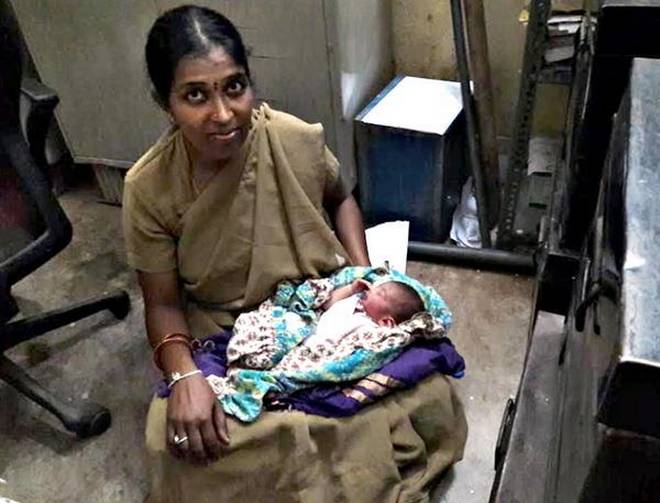
Little Kumaraswamy, ‘the government’s baby’

LittleKumaraswamyBF05jun2018

Abandoned baby gets a new lease of life as woman police constable tends to his needs

From being abandoned by his parents to becoming a representative of sorts for the new government — little Kumaraswamy, named after the new Chief Minister, is too young to comprehend the long journey he has already taken in such a short time.

The newborn was rescued by the Electronics City police, and found the warmth of a mother in a woman police constable, who breastfed him and saved him from starvation.

It was on Friday morning that a rag picker noticed a newborn child stuffed in a plastic bag under a bush near a house under construction in Celebrity Layout, Doddathoguru.

He alerted the shopkeeper nearby, who in turn informed the police control room. Assistant Sub-Inspector Nagesh R. arrived at the scene and rescued the baby. By then, a large crowd had gathered at the spot.

“The baby was in bad shape. He was covered in blood and the umbilical chord was wrapped around his neck,” recalled Mr. Nagesh, who took the baby to a nearby hospital, where doctors treated him free of cost.

Soon after, Mr. Nagesh brought the baby to the station, and handed him over to police constable Archana, mother of a three-month-old boy herself. As the baby was weak and was motionless, Ms. Archana’s heart went out to him. She picked up the baby and breastfed him. In a few seconds, the baby gave a gusty cry.

There was jubilation in the station. Mr. Nagesh ran out to buy clothes for the baby, who was then named Kumaraswamy. “It is the government’s baby now, and we decided to name him Kumaraswamy as it would be under the care of the government,” Mr. Nagesh told The Hindu.

The baby was handed over to the Shishu Mandir on Hosur Road.

source: http://www.thehindu.com / The Hindu / Home> News> Cities> Bengaluru / by Special Correspondent / Bengaluru – June 05th, 2018

Bengaluru: Hearing impaired woman covers 8,300km on bike

DRIVEN BY PASSION: Archana Timmaraju embarked on the tour to motivate the hearing impaired

______________________________

HIGHLIGHTS

  • Hearing impaired Archana Timmaraju is back in Bengaluru after completing a 8,300km bike ride to Ladakh.
  • Born with 40% hearing ability, Archana has been facing difficulties and disabilities in her speech.

_________________________________

Bengaluru :

She may be hearing impaired but that hasn’t stopped her from being adventurous. Archana Timmaraju, 33, is back in the city after completing a 8,300km bike ride to Ladakh .

Hailing from Andhra Pradesh, Archana studied in St John’s School, Bengaluru, and later did her masters in metal sculpting from Karnataka Chitrakala Parishath. Other than sculpting, Archana also teaches art at Mallya Aditi International School.

“I started riding at 21 and haven’t looked back since. The aim of this tour — Journey to Inspire — was to motivate the hearing impaired and encourage more women to ride bikes,” she said.

Archana was accompanied by her friend and colleague Daniel Sundaram, a geography teacher, on the journey that began on April 29 and culminated at Freedom Park on May 29. She rode a Royal Enfield, while Daniel was on a KTM bike.

When asked about Archana’s feat, her mother Sita Mahalakshmi said: “We were not scared at all.Archana made video calls to us every day and shared her location live so we knew where she was. I am extremely proud of her.”

Born with 40% hearing ability, Archana has been facing difficulties and disabilities in her speech. She can hear to a certain extent with help of an aid. Archana, with Daniel, has also founded a community, Silent Expedition, for bikers,with special emphasis on those with disabilities.

source: http://www.timesofindia.indiatimes.com / The Times of India / Home> News> City> Bangalore / TNN / June 02nd, 2018

Nature lessons from a school principal in quiet Chikmagalur

Homework in the forest

A teacher who wanted his students to listen to the sounds of nature. | Photo Credit: Vaishali Rawat

We’ve all gone through school with teachers nagging us to stay quiet, but when M.N. Shadakshari, principal of Model English High School in Karnataka’s Chikmagalur, asks his students to be silent, the reasons are different. He wants them to listen to the sounds of nature — “the dry leaves of autumn trees rustling in the breeze, the melody of birds’ evening tweets, chirping grasshoppers and crickets, frogs and toads croaking into the night.”

Shadakshari makes for an unusual school principal. He isn’t a strict authority figure, but more a warm, passionate teacher whose guidance is always available for students. And as much as worrying about math and history, Shadakshari is dead keen his wards learn about nature. “Growing up, children are so much more receptive, curious and inquisitive as they learn to ask questions and perceive the world around them. It is crucial that teachers recognise this and ensure that an intuitive connection to the environment is nurtured,” says the 70-year-old.

Long before it became fashionable to do so, Shadakshari was teaching his students about the natural world and climate change. He would take his students on nature walks that would be interspersed with conversations about how forests, rivers, lakes and grasslands feed into the larger ecosystem, and about the birds and animals they encountered on the paths. Inspired by ‘Shadakshari sir’, many students have taken up full-time careers in conservation.

Extra mile outdoors

Chikmagalur borders the Bhadra Wildlife Sanctuary, and it is famous for the vast Shola forests that carpet its hills, and its prominent peaks like the Mullayanagiri, Kemmangundi, Baba Budan Giri and Kudremukh. And it was to these slopes, forests and lakes that Shadakshari took his students.

D.V. Girish, a wildlife conservationist based in Chikmagalur, says it was in the 80s, in Class VI, that Shadakshari first taught him. “He would often come to school early and stay late, so he could spend time answering our questions. He invited botanists, zoologists and ecologists to come and interact with us. He encouraged us to document nature, stay curious, ask questions, and always went that extra mile.”


Shadakshri02BF02jun2018

Shadakshari’s way of making treks interesting was to incentivise the students. “I would send them on patrol and instruct them to observe the forest, write down their observations, and report back to me. Marks were allotted for every bird feather, shell, or bark they identified. It gave me the opportunity to teach more — why a certain plant they collected was poisonous, or why a xerophyte grew in regions of low rainfall, or why the leaf structure of a particular tree was unique.”

While most of his lessons were imparted outdoors, Shadakshari’s classroom lectures were far from drab, his students say. Anything interesting they picked up from their surroundings — an insect, a leaf, a lizard — was taken to ‘Shadakshari sir’ for identification, stored in formaldehyde, and discussed in detail. “While teaching biology and chemistry, there were always so many opportunities to weave in the importance of nature and our dependence on it,” Shadakshari says.

Former student Sharath Indavara, who has recently completed a degree in Science, is an ardent birder and a guide around the lakes and forests of Chikmagalur. “It was Shadakshari sir’s camps and quizzes that encouraged my passion,” he says. “I began observing and documenting birds and wildlife from that time.”

Shadakshari’s advocacy has not been limited to the classroom: as a member of several local conservation groups like WildCAT-C and Nature Conservation Guild, he has been involved in nature conservation.

As our conversation slowly winds down, he tells me about one nature trek where he saw the students’ unbridled joy as they splashed about in a river after a long walk. “I remember thinking how lucky I was to see the true nature of my students — free and unrestrained, not bottled-up like they sometimes are in classrooms.”

There might be valuable lessons for educators from humble Chikmagalur.

The writer is with Wildlife Conservation Society India.

source: http://www.thehindu.com / The Hindu / Home> Profile> Society / by Vaishali Rawat / June 02nd, 2018