All posts by admin

Carmelites celebrate 150 years of educating girls

Bengaluru :

In an era when girl children were forced to stay home while their male siblings went to school, three Catholic nuns from France started an institution — now St Ann’s High School — in Mangaluru. The nuns, of the order of Sisters of the Apostolic Carmel, spread their mission of educating the girl child to other parts of the country. Now, 150 years on, over 15 lakh students have passed out from 70 institutions of the Carmelite sisters in Karnataka alone.

DOWN MEMORY LANE: Sr Lydia Fernandes, general councillor, Apostolic Carmel with Sr Mary Susheela, superior general of the order

As the order prepares to kick off its sesquicentennial celebrations (150 years) with an event in Bengaluru on May 5, those now in charge look back with pride on the long and difficult road they have travelled. Sr Lydia Fernandes, general councillor, Apostolic Carmel, revealed the literacy rate on the west coast was abysmally low when they first started out.

“The work of the Carmelite sisters in starting institutions for girl children years ago has helped increase the literacy rate in coastal Karnataka,” says Sr Fernandes. “St Ann’s school was the first to be established in Mangaluru in 1870.”

The order was founded in the latter half of the 19th century by Mother Veronica of the Passion (born Sophie Leeves), daughter of an Anglican minister at the British embassy in Constantinople. “She recognized the need to have quality schools for illiterate girls in India,” said Sr Mary Susheela, superior general of the Apostolic Carmel.

“She founded the active Carmelite order, in Bayonne, France and trained sisters who were sent to India,” added Sr Susheela. “They didn’t know the local language, but children picked up the teacher’s language quickly. We have taught children from all communities.”

St Ann’s counts Kamaladevi Chattopadhyay, freedom fighter and social reformer, Octavia Albuquerque, former MLC, Philomena Peres, former chairperson of the Women’s Commission, and Margaret Alva, former Rajasthan governor and senior Congress politician.

“We were taught everything from needlework and gardening to debating and acting,” said Alva. “They were very good educators, taught us discipline and imparted a strong sense of nationalism. At that time, the students were very diverse and from different communities. But we never had a problem getting along.”

source: http://www.timesofindia.indiatimes.com / The Times of India / News> City News> Bangalore News / by Sunitha Rao R / TNN / May 04th, 2018

Milestone for city cyclist: 50,000 km in four years

Anil Shet
Anil Shet

April 28 will remain a memorable day for Anil Shet, Admin, Mangalore Cycling Club’s WhatsApp group. It was the day he clocked 50,000 km cycling in four years and two months.

Mr. Shet began riding on February 15, 2014, to fight issues like obesity and high BP. There was no looking back for him as he rode an average 33 km daily, starting at 5.30 a.m. His regular rides made him familiar with Mangaluru taluk’s topography.

Mr. Shet said he had done 7,800 km in 2014, 10,200 km in 2015, 12,000 km in 2016, 14,000 km in 2017 and 6,000 km so far in 2018, recorded on fitness app Strava.

A jeweller-turned-builder, the 37-year-old loves cycling for its immense health benefits. An engineering graduate from MIT, Manipal, Mr. Shet weighed 100 kg when he decided to take up cycling.

With fellow MACCers, he instituted Brevet — long distance rides of distance in multiples of 100 km that have to be completed within a specified time-frame. The group’s members have increased owing to the encouragement and guidance he provides other cyclists.

source: http://www.thehindu.com / The Hindu / Home> News> Cities> Mangaluru / by Anil Kumar Sastry / Mangaluru – May 02nd, 2018

Bangalore Times Most Desirable Woman on Television 2017: Shwetha R Prasad

ShwethaBF01may2018

She’s demure, coy and has a very welcoming personality onscreen, which appeals to most viewers of the small screen. Hence, it was natural that Shwetha R Prasad, better known as Radha from Radha Ramana, has won the top slot in Bangalore Times’ 15 Most Desirable  Women 2017.

She caught up with us, talking about work, marriage and more. Excerpts…
You’re Kannada TV’s most desirable woman. Delighted?
Yes. This means that I’m doing good on TV. The project is doing good, people are watching it and liking it — isn’t that desirable! For me, desirability is not only about the appearance, but it is the way you are inside out. That is when you are most desirable — people shouldn’t think you’re fake. When you act, you should really feel like you’re the character. Add to this the attitude you carry both on and off the screen, because everyone is so reachable and accessible through social media. So, people are watching you always.

Radha Ramana has made you one of the most popular actresses on the small screen. What does this serial mean to you?
It feels great to be recognised as Radha. I’m an architect. I never thought I would have a career in acting. I debuted with the serial Srirasthu Shubamasthu. The serial clocked 600 episodes. I didn’t know what to do next. I then decided that I needed to be associated with a channel and show that was doing better than that. I landed Radha Ramana, a serial that was slated to air on prime time and I was sure it would do really good. It has given me a good push and recognition and I owe everyone who made this happen a lot.

Is Shwetha similar to Radha?
I’m like Radha in many ways. Probably, the only thing that would be a little different is the fact that I am more intelligent than Radha in real life (laughs). Also, I don’t meddle in others’ business like Radha does.
People, especially elderly women, do not know Shwetha — they only know Radha. When I go out, these people might be strangers to me, but they know me and meet Radha every single day. I receive so much warmth and familiarity from them. They hug me and speak as if they’ve known me for long and this can be awkward, but I understand that they love my character. When people talk about fame and popularity, I’d say popularity is the love that you get from the people.

Talking about marital status, your acting career began after marriage…
People say that opportunities stop after marriage. But, I’m glad that there are people who don’t mind giving opportunities to married women. They don’t stop saying that you’re married. Ultimately, it is the talent that matters. Whether you’re married or unmarried, it boils down to whether you have what the character requires. I’ve been working with sensible people and that’s what matters
eventually.

Are films on your agenda too?

I’m doing a film now. It is an offbeat film. It might release around July. Again, people have seen me as Radha, a married woman onscreen, so I understand I won’t be offered too many roles in terms of versatility. Or, probably, I haven’t shown them that I can be seen differently. So, the offers have been limited and I’ve been choosy in that. Eventually, when I prove myself on the big screen, like I did on the small screen, I am sure more doors will open for me in recognition of my talent.

Tell us more about your debut film…

In my first film, I didn’t want to do the two-songs-and-one-dance routine. This film, titled Kalbettada Darodekararu, is based on a novel and my character, despite not being onscreen for a long time, has something substantial to offer to the script. I play Kalbettada Kamali, a de-glam role in the film. I’m already doing a de-glam role on TV, but this is much more toned down. So, it made for an interesting choice.

source: http://www.timesofindia.indiatimes.com / The Times of India / Home> News> Entertainment> Kannada> Movies> News / by Sunayana Suresh / TNN / April 28th, 2018

Farmer’s son reaps success

Mohan S.L. with his mother, Puttalakshmi, and father, Lakshme Gowda, in Hassan on Monday.   | Photo Credit: Prakash Hassan
Mohan S.L. with his mother, Puttalakshmi, and father, Lakshme Gowda, in Hassan on Monday. | Photo Credit: Prakash Hassan

Mohan S.L., son of a farmer, secured the second highest marks (595 out of 600) in in Science, in the State.

His family lives in Shantigrama village in Hassan taluk but he remained with his grandparents in Hassan town so that he could concentrate on attend classes at Masters PU College in Hassan town and focus on his studies.

He scored 100 each in Physics, Chemistry, Mathematics and Biology.

“My teachers helped me a lot. I used to study till midnight and get up early at 4.30 a.m.,” he said.

His parents were farming their tomato crop when they learned that their son was ranked second in Karnataka.

“I have studied only up to class 4. My dream is that my only son studies well,” said his father, Lakshme Gowda, who owns 33 guntas of land in Shantigrama, and grows tomatoes and potatoes for a living. Mr. Mohan wants to study MBBS and later prepare for the IAS.

“My son studies hard and supports the family in agriculture activities. He looks after our cattle, and gets hardly four hours of sleep in a day,” added Mr. Lakshme Gowda.

French Open cups debut in Bengaluru — the home of champions

Adil Kalyanpur and Abhimanyu Vannemreddy, both Bengaluru boys, made their presence felt in international tennis through Rendez-vous à Roland-Garros, a programme that brings together top junior tennis players in the boys and girls categories at the national level.

This year marks the first edition of the Roland-Garros Amateur Series, which kicks off in Bengaluru today (it is on till May 6).

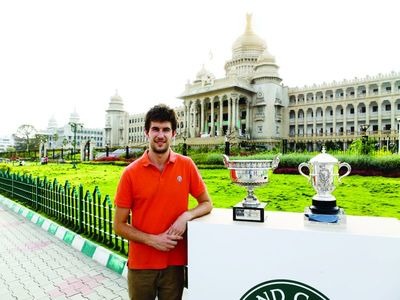
To mark this, the actual French Open trophies — lifted by many tennis greats made their maiden visit to namma Bengaluru. The trophies glistened exclusively for Bangalore Times, on a bright Saturday afternoon, as they took their place in front of the Vidhana Soudha.

AdrianBF30apr2018

Adrien Groscolas, associate international development of French Federation of Tennis, who is also the caretaker of the cups whilst in India, is the only one allowed to touch them — which he can only do after wearing gloves. Only the winners of the trophies can touch them with bare hands.

As Bengalureans gathered to catch a glimpse of the gleaming cups, Adrien filled us in on the protocol that must be followed while handling them, the significance of bringing the trophies to Bengaluru and why French Open officials are looking East.
What is the significance of choosing Bengaluru to host this tournament?
Bengaluru is an important city for us because it has a long history of racket sports and a lot of sports personalities are from here. Rohan Bopanna, last year’s Roland Garros doubles winner, is from Bengaluru, so it made perfect sense for us to come to such a sports loving city.
What is the protocol when it comes to handling the cups?
Only Roland Garros officials can touch the cups, for which we have to wear gloves. Only the actual winners of French Open can touch the trophies with bare hands. Apart from this, people cannot get too close to the cups, to ensure that they don’t get damaged in any way. Also, when we are travelling, the cups fly with me. We buy additional tickets and the cups are seated next to me on the flight, so that I always have my eyes on them. They cannot be carried as a regular luggage.


What reactions do you get from people when they see the cups?
The first reaction is like what we saw during the shoot in Bengaluru — ‘What is this? I know I’ve seen it somewhere, but why would the trophies be here in Bengaluru?’ Once we explain it to people, they realise, ‘Whoa, it’s a big deal to have the actual trophies here, this close to us’. People then think that this is the cup that Rafa has lifted, and that’s something.


How important is it to bring the trophies to Bengaluru now?
It’s an encouragement, first for the young players of the tournament, because the winners will get to fly to Paris and watch the game at Roland Garros. I think it will be an inspiration for them to see the trophies all week long while they battle it out in the tournament. Perhaps, this will be the start of the next Indian actually lifting this trophy. That’s a bit long-term and optimistic, but I am hopeful of India’s chances in the singles matches.


How conducive is Bengaluru to tennis?
In terms of facilities and infrastructure, Bengaluru is certainly one of the better cities. I will definitely speak of Bengaluru as a tennis city, especially since some of the best Indian tennis players are from here. Bengaluru has a tradition of clay courts and our choice to come here is because there are beautiful clay courts here, just like Roland Garros. It is a city that’s very important for tennis.


How important is India as a country for Roland Garros?

We are very interested in India. First, because there are definitely going to be more good players from India in the future. The country already has good players, like Sania Mirza, Mahesh Bhupathi, Rohan Bopanna and Leander Paes, who have all lifted the cup in the doubles category in the French Open. We are optimistic that an Indian will do so in the singles as well. Yuki Bhambri just broke into the top 100 and is going to be playing in Roland Garros for the first time this year. We are very optimistic about India’s chances, which is why we have taken an interest in organising so many events here, to encourage young kids to pick up rackets.


What can these young players expect to gain from this tournament?

The whole point of the tournament is to give young players the experience of playing a Roland Garros event close to their home. Kids who set foot on these courts may think that if they play well here, they have a shot at getting into a Grand Slam event. That’s pretty inspirational, I think. And that’s what gets those kids to come out on the court and give their best. The courts here are beautifully maintained and there is branding as well, just like in Roland Garros. That’s what sets it apart from other tournaments played through the year.

source: http://www.timesofindia.indiatimes.com / The Times of India / News> City News> Bangalore News / by Dhwani Desai / TNN / April 30th, 2018

Now Bengaluru’s very own Bicycle Mayor

City will join Dutch programme to promote use of bicycles among urban commuters

Come May, Bengaluru will have its first ‘Bicycle Mayor,’ or BM, with as many as 19 cycling enthusiasts in the city vying for the post.

The winner will get an opportunity to bring together the city’s cycling community and take up advocacy with the government to bring more bicycles onto the roads.

Honorary two-year position

The Bicycle Mayor, an honorary two-year position, is a global programme envisioned by the Amsterdam-based NGO ByCS. The group is targeting a world with 50% of all city trips covered by bicycles by 2030. Bengaluru will be the third city in the country to have a BM, after Baroda and Guwahati.

ByCS has joined hands with the Evangelical Social Action Forum (ESAF), an NGO, to introduce the programme in India. ESAF is one of the organisers of BCOS (the Bengaluru Coalition for Open Streets), which initiated the Cycle Day concept in October 2013.

The applicants for BM include cycling enthusiasts, activists and those who have been actively involved in making Bengaluru bicycle-friendly, said Manju George, Senior Programme Manager, ESAF, Bengaluru.

“The applications were open for ten days and closed on April 23. After May 12, we will make the announcement,” she said.

Cycling enthusiast and activist Murali H.R., involved with several bicycle projects in the city in coordination with the Directorate of Urban Land Transport (DULT), says there is a lot to be done to implement the existing regulations. “We have had DULT and BBMP for over 10 years now. We are partially successful. This [BM] will be a confidence booster for the work that we have been doing thus far.”

Nikita Lalwani, Bicycle Mayor of Vadodara. | Photo Credit: Email Handout

Nikita Lalwani, who was selected BM of Vadodara (Baroda) last year, is working to encourage corporate professionals and students to make use of bicycles regularly. Having represented India at the Bicycle Mayor summit in Amsterdam in 2017, Ms. Lalwani said, “We need to begin by changing the image that cycles have in our society.”

BM of Guwahati Arshel Akhter, who took charge recently, aims to start by working with educational institutions and corporate establishments to set up parking slots for bicycles, and encouraging more people to use bicycles regularly.

source: http://www.thehindu.com / The Hindu / Home> News> Cities> Bengaluru / by Shruthi H M / Bengaluru – April 30th, 2018

Meet the brothers who built Bengaluru’s first apartment block

Paresh apartments was build in 1974 by contractors H N Anantharaman (top right) and H N Dwarkanath

Bengaluru :

While Bengaluru today is dotted with apartment complexes and housing societies, many may not know that one of first steps in this direction was taken by H N Anantharaman, now aged 91, and his 89-year-old brother H N Dwarkanath way back in the 1970s.

FirstApartment02BF28apr2018

Having been hired as contractors by the Paresh Apartments Cooperative Society , the duo built the city’s first apartment complex in 1974, which stands tall in Malleswaram even today.

“In the early 1970s, 24 of us got together and bought this plot of land. Anantharaman and Dwarkanath were the contractors, and we all respect them for building such a solid structure,” said Sooryakanthi Madiman, who moved into her flat in 1974 at the age of 27, following her marriage to Madiman, who was a DRDO scientist.

Sooryakanthi says that while newer and fancier buildings are plagued with problems like seepage and leakage, theirs has a strong foundation. “When workers carry out repairs in our houses, they find it very hard to even drill a nail into the wall,” she added.

The complex comprises a cluster of three-storey buildings, and a majority of the original 24 families continue to live here even though the surroundings have rapidly transformed, with individual houses giving way to large apartment complexes.

Born in Hiremagalur, a hamlet in Chikkamagaluru, the brothers were brought to Bengaluru — where they studied engineering — by their older brother who was working here. After a few years, during which they worked in Tamil Nadu, the brothers decided to get into business and started building water tanks, water treatment plants and civil structures.

“They were ahead of their time. They realised that with the rising growth rate, people would start running out of land to build houses on. So, they started constructing multi-dwelling units and venturing into joint-development projects, which was rare at that time,” said Narayan Babu, Dwarkanath’s son.

“They wanted to build homes for people who had saved their hard-earned money for the purpose, unlike today when people are entering the industry purely for business gains,” said Gopinath, Anantharaman’s son.

The duo worked in tandem — while Anantharaman handled financial matters by meeting people and raising funds, Dwarkanath designed the structure and monitored the work.

The brothers, however, are unhappy with the current state of affairs under which members of lower-income groups are unable to find affordable homes within city limits and so have to live on the outskirts.

Honour for pioneer

Anantharaman was recently honoured by Rotary Bangalore Downtown, and conferred the Rotary Pioneer award in recognition of his “pioneering contributions to the field of group housing and construction by developing the first apartment block in Bengaluru, and establishing the industry association KOAPA (Karnataka Ownership Apartment Promoters’ Association), the precursor to the present CREDAI.”

source: http://www.timesofindia.indiatimes.com / The Times of India / News> City News> Bangalore News / by Niharika Alva / TNN / April 28th, 2018

The first Communist MLA

The Kolar Gold Fields (KGF) Assembly constituency in Kolar district has the distinction of sending the first ever Communist legislator to the Karnataka (then Mysore) Assembly.

Eminent trade unionist and Bharat Gold Mines workers’ leader K.S. Vasan became the first Communist MLA in the State in 1952. He represented the undivided Communist Party of India (CPI).

In retrospect

In the 1957 elections also, the CPI could get its candidate, veteran trade union leader M.C. Narasimhan elected to the Assembly. KGF became a reserved segment in 1962 and continued the tradition of electing Communists to the Assembly.

S. Rajgopal was elected from this segment in 1962. After the party split, neither the CPI nor the CPI(M) succeeded in the electoral battle in the KGF constituency for more than three decades. It was in 1985 that T.S. Mani of the CPI(M) got elected to the Assembly. That was the last time a Communist member got elected from this constituency.

source: http://www.thehindu.com / The Hindu / Home> Elections> Karnataka 2018> Karnataka 2018> A Look Back / by Vishwa Kundapura / Kolar – April 29th, 2018

It’s celebration time for them

Several candidates from Karnataka, who were gunning to make the cut in the Civil Services, had reason to celebrate when they found that they had cleared the competitive exam. The Union Public Service Commission released the list of candidates who cleared the Civil Services Exam 2017 on Friday.

For Bengalurean Swetha M. who secured the 119th rank, this was her fourth attempt. “It is a big relief and there is a feeling of satisfaction to see my name on the list,” she said. The 27-year-old had quit her job with a multinational company in 2014 to prepare “rigorously” for the exams.

Shubhamangala, ranked 147, attributed her success to “dedication” and “sustained effort”. The 34-year-old gynaecologist, who owns a clinic in Bengaluru and is a mother of a three-and-half year old, said her initial preparations were focussed on her son. “I then started reading from the laptop,” Ms. Shubhamangala said.

She managed to clear it in her second attempt. “I did not clear the prelims in my first attempt. Last year when I wrote the prelims, I was sure that I would clear it. Hence I started cutting back on my work hours and spent more time studying,” she said.

Prathiba Rani
Prathiba Rani

Prathibha Rani, an engineer who bagged the 78th rank moved to Bengaluru in 2016 to prepare for the examinations. Ms. Prathibha hails from Jharkhand and said that she decided to get into administration as she thought it was the best way to make a difference to the society. For Keerthi Kiran Poojar (rank 115), this is his second time clearing the UPSC exams. He first cleared the exam in 2015 and got into IRS (932). He is currently being trained at Nagpur. He wanted to give one more shot at IAS and hence made up his mind to write the exam again. “This was my third attempt. I had taken one year sabbatical from my training to prepare for the exam,” he said.

Sachin Gupta who secured the third rank, said that he juggled between Bengaluru and New Delhi to prepare for the examination.

source: http://www.thehindu.com / The Hindu / Home> News> Cities> Bengaluru / by Staff Reporter / Bengaluru – April 28th, 2018

English kills the creativity of a bhasha-writer, says Sahitya Akademi president

Sahitya Akademi president Chandrashekhara Kambara | Photo Credit: K. Bhagya Prakash

Sahitya Akademi’s new chief, Chandrashekhara Kambara, hopes for a multilingual and oral revolution

Kannada writer Chandrashekhara Kambara dons many hats. He is a poet, playwright, novelist and critic who has been honoured with the Padmashree, Sahitya Akademi Award, Kabir Samman and the Jnanpith Award. Kambara has been passionate in his advocacy of the regional traditions of art and literature, and of plurality in social structure. Recently elected the president of Sahitya Akademi, when I met him at its regional office in Bengaluru, he firmly defended the Akademi’s autonomy and underlined the necessity of writing in one’s mother tongue.

You are heading this institution at a time when there is a strong feeling among writers and thinkers that freedom of expression is under threat and that the Sahitya Akademi has remained a “passive, powerless body.” How do you view this?

There are many issues involved here, and I shall try to be brief in explaining them. First, the Sahitya Akademi is a non-partisan and non-political institution, and its sole function is to “develop literature and literary culture in all Indian languages and to promote through them plurality and cultural unity of the country.” You cannot expect one institution to do the job of another. Secondly, it is an autonomous and independent body…

Are you sure the Akademi will continue to enjoy autonomy and freedom in future?

I am positive, because the Akademi has inbuilt structural devices for any course-correction needed from time to time.

Can you please explain what those ‘devices’ are?

The Sahitya Akademi came into being through an act of Parliament in 1954, and any major structural changes in it have to be made by Parliament. The Akademi’s office-bearers, including the president and the vice-president, are elected by the members of the Akademi. Also, all the members are chosen by the Akademi on the basis of recommendations from different literary and cultural associations. There is no place for any kind of governmental or external influence.

You have said in an earlier interview, “Revitalising State languages is my top priority.” Can you elaborate?

You see, we have become too dependent on English to the detriment of regional languages. Hence, the priority of the Akademi is to reduce this dependence.

The Akademi organises continuous workshops for people to learn neighbouring languages; it encourages translations directly from one regional language to another rather than through English; in collaboration with universities in different regions, it will get authoritative textbooks, including science texts, in State languages; it is planning to bring out bilingual and multilingual dictionaries; as a representative body, it constantly brings pressure on State governments to make the State language the medium of instruction at the primary level… I can go on and on.

However, the Akademi alone cannot do much in this direction; we expect educationists, writers, and parents to join hands with the Akademi.

Have you ever felt that had you written in English you would have had a larger readership and greater international recognition?

Never, not even for a moment. Had I written in any language other than Kannada, I wouldn’t have been a poet or a playwright. It is as simple as that. You see, English kills the creativity of a bhasha-writer.

Can you explain please?

Think of a child. If she hears a story from her grandmother, she won’t tell the same story to others; she will create newer versions of it each time she tells the story to a brother or friend. But if the child hears the story in English in school, she will tell the same story in the same words over and over again.

In all this, where do tribal languages and oral traditions figure?

They figure prominently. The Akademi has already established the North East Centre for Oral Literature in Agartala, and a Centre for Oral and Tribal Literature in New Delhi. They are designated to preserve our heritage in a systematic way. The Centre in New Delhi launched a major series on ‘unwritten languages’ last year; it has already brought out four works on oral traditions. In addition, the Akademi proposes to archive original oral texts in audio and video formats.

However, we have to understand that orality is not a concrete object; it is a view of life and a way of living. Consequently, the concept of orality also changes with changing times. Similarly, it is impossible to save all spoken and written languages in any country. As long as there are speakers and the language fulfils their needs, it lives; once there are no speakers left, it goes into oblivion.

Who are the ‘implied readers’ of the translations published by the Akademi? How do translations fare compared to works from commercial houses?

First, the ‘implied readers’. Please remember that the Akademi publishes works in 24 languages — that is, an award-winning text in each language is translated into 23 listed Indian languages, including English. This means the translations published by the Akademi are primarily for Indians. If a Kannadiga is knowledgeable today about Mahashweta Devi or M.T. Nair, it is mostly through the Akademi’s Kannada translations. Till date, the Akademi has published over 6,000 books in regional languages.

I don’t have with me the exact sales figures, but since the Akademi’s five zonal centres have sales sections, and since many works get reprinted every year, I presume the books are reaching readers. In fact, I have recently had discussions with the UGC and the Ministry of Human Resource Development regarding Akademi publications; I have suggested that they should persuade State governments to buy them in bulk every year, and distribute them in public libraries. There are also plans to sell our books online.

Often people complain about the quality of translation (especially of English works) in the Akademi publications. True, there is a review system in place, but a reviewer cannot or does not go through every line of the script. Why doesn’t the Akademi appoint competent copy editors as private publishers do?

I haven’t thought about it, but I shall certainly discuss it with my colleagues. Let me add that the Akademi welcomes any feedback, whether suggestions or criticism.

The interviewer is a critic, translator, and former professor of English

source: http://www.thehindu.com / The Hindu /  Home> Books / by C.N. Ramachandran / April 28th, 2018