All posts by admin

Music festivals keep alive an old tradition in Mysuru

Bidaram Krishnappa’s Sri Prasanna Sitarama Mandira has a 102-year history of conducting music concerts.File Photo

City sees many music concerts during Ramanavami season

The city’s cultural scene reaches a zenith during Dasara and it’s universally acknowledged, given its royal pedigree and government patronage since the 1970s.

But there is another facet to the cultural scene of Mysuru – of organisations and individuals keeping alive the musical heritage and it comes to the fore during the Ramanavami season.

A purely voluntary initiative with individual contributions and devoid of any government patronage, the city plays host to scores of classical music concerts.

The princely state of Mysuru under the Wadiyars was a patron of classical music and great composers and artistes thrived and flourished here thanks to their encouragement.

A majority of them were court musicians of whom Mysore Sadashivarao, a composter who lived during the rein of Mummadi Krishnaraja Wadiyar (1831 to 1868), started the Ramothsava celebrations in Mysuru, according to the Mysore Gazetteer.

Among the cultural organisations, Bidaram Krishnappa’s Sri Prasanna Sitarama Mandira has a 102-year history and tradition of conducting music concerts and hence is a heritage site given its association with cultural personalities. The venue is also an important repository of classical paintings and has a rich collection of 45 works of art in the traditional Mysuru stule, Thanjavur style among others.

Its hallowed precincts has played host to legendary musicians who constitute the who’s who of Indian classical music. Built by Bidaram Krishnappa, (1866-1931), a great exponent of Carnatic music and who adorned the court of Krishnaraja Wadiyar 1V, the festival this year features 11 concerts including by Mysore M Nagaraj and Mysore M Manjunath, Malladi Brothers, R.K.Padmanabhan, Pandit Hafiz Khan among others. The Aralikatte Sri Ramamandira on the Jayalakshmi Vilas Road too has a similar pedigree but over the years, the classical music concert has paved the way for devotional singing by various bhajana mandalis of the city. This year, the cultural programmes, which began on Sunday, will be held till April 11.

Sree Ramabhyudaya Sanha, established in 1890, is one of the oldest institutions and has lined up a series of musicians for the Ramanavami music festival. To be held at the Allamma Choultry Srirampet, the line-up includes Pandit Venkatesh Kumar, Malladi Brotehrs, Ganesh and Kumaresh to name a few. The festival which commenced on Sunday, will conclude on April 4.

These apart, Sri Ramaseva Charitable Trust, whose concert series commenced on March 18 will conclude on March 27. The Krishnamurthypuram Sri Ramamandira is conducting the Ramanavami for the 89th year and its programme line-up includes both devotional renderings and classical music concerts – which commenced on March 18 – will conclude on March 29.

Sri Ramaseva Mandali established in 1954, Sri Sitarama Temple Trust at Railway Colony, Sri Rama temple, Jayanagar (52nd year) are among other places to which devotees and music aficionados will flock to satiate their appetite.

source: http://www.thehindu.com / The Hindu / Home> National> Karnataka / by R. Krishnakumar / Mysuru – March 28th, 2018
Mangalore University honours sports achievers at Darpana

MangaluruUnivMPOs30mar2018

Mangaluru :

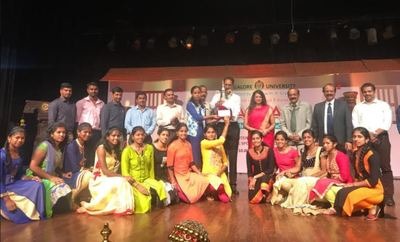
Mangalore University honoured its sports achievers – individual, colleges and its team – at Darpana, a gala event at Mangalgangothri on Tuesday. Alva’s College, Moodbidri received the overall champions’ trophy for 2017-18 in inter-collegiate events with tally of 571 points. Sri Dharmasthala College, Ujire finished runners up with 430 points and Alva’s College of Education was placed third with 333 points. K Byrappa, vice-chancellor, handed over the trophies.
Alva’s College topped both men’s and women’s section to retain permanent trophy and took home cash prize of Rs 15,000 each. Athletes from SDM College, Ujire finished second in men’s and women’s section to take home Rs 10,000 each with permanent trophies. St Aloysius College and Alva’s College of Physical Education that was placed third in men’s and women’s section respectively received cash award of Rs 6000 and permanent trophies to boot.

The university honoured athletes who set new records in inter-collegiate athletic meet, weight lifting, and power lifting competitions. Likewise, members of men’s kho-kho team that won silver medal in South zone and bronze in all India inter-university championship, women’s Kabaddi team that finished runner-up in South-zone inter-university championship, kho-kho team that won silver in South zone inter-university championships received cash awards of Rs 3000 each.

Likewise, members of women’s hockey team that bagged gold in South Zone inter-university meet received Rs 5000 each, six members of men’s cross country team that won gold in All India inter-university championship Rs 7000 each, women’s team that finished runner up in the same meet Rs 5000 each. Members of women’s ball badminton team that bagged gold for a record 14th time in All India inter-university championship received cash awards of Rs 7000 each.

The men’s netball team that bagged gold in All India inter-university meet received Rs 7000 each. Medalists in all India inter-university weight lifting – Shubham P and Usha B N and best physique championships – Vingesh received cash awards of Rs 20000, Rs 25000 and Rs 25000 respectively. Sooraj Kumar Singh, Usha and Haishnam Merina Devi who won medals in all-India inter-university power lifting meet received cash of Rs 20000, 20000 and Rs 10000 respectively.

Vaishnav Hegde who secured two gold and a silver in all India inter-university swimming meet took home Rs 70000. A total of 23 athletes including 14 men took home prize money ranging from Rs 1.10-lakh by Elakkiya Dasan to Rs 15000 for team and individual events for their performances in all-India inter-university athletics championships for men and women. Women’s netball team that won gold in all-India inter-university tournament received Rs 70000 each.

source: http://www.timesofindia.indiatimes.com / The Times of India / Home> News> City News> Mangalore News / Jaideep Shenoy / TNN / March 28th, 2018

‘Pesticide-free’ poly-houses are catching on

A farmer in Karnataka grows sensitive broccoli using biotechnologies for the first time in country

At a time when all things “organic” is the buzzword, poly-houses are becoming a cause for concern due to high pesticide residues in the produce following indiscriminate use of chemicals.

In fact, the sustainability of poly-house cultivation is facing a threat as a sizeable number of them have closed due to soil degradation and attack by nematodes — harmful soil bacteria — and fungi, which have resulted in massive devastation of crops.

The Indian Institute of Horticultural Research (IIHR) has now come out with a series of technologies and practices to reduce the use of chemicals in poly-house cultivation.

“The main focus is to turn the high-end poly-house cultivation into a sustainable farm and economic activity,” said M.S. Rao, head of IIHR’s Division of Entomology and Nematology.

“This will result in not only production of pesticide-free produce, but it will go a long way in improving the financial health of poly-houses,” he said, while indicating that closing down poly-houses would result in a loss of ₹900 crore.

What has come as a shot in the arm for the IIHR is that a 24-year-old farmer Raju in Doddaballapur taluk near Bengaluru has used this technology showing it is possible to grow broccoli, a crop highly susceptible to various pests and diseases, without pesticides.

It is the first time in the country that broccoli has been grown in a chemical-free manner in a poly-house.

Of course, the experiment is not completely organic as the farmer has used a certain amount of fertilizers. But, the produce has been selling like hot cakes to exporters at a premium price since it is pesticide-free.

Mr. Raju, who migrated to Karnataka from Andhra Pradesh, took up poly-house cultivation on about one acre of land in Doddaballapur, of which broccoli is grown on half an acre.

What has enthused scientists is that he has trounced the general perception that chemical-free farming and reduction in fertilizers would lead to drop in yield. The farmer’s yield has not only increased by about 30% by using the natural plant growth promoters as well as bio-fertilisers and bio-pesticides of IIHR, but the cost of cultivation too has dropped by about 30% as he has not used chemicals and pesticides. He was able to earn about ₹4.18 lakh in 90 days.

Dr. Rao said the farmer used bio fungicide, bio nematicide, bio bactericide, bio fertilizers, neem and pongamia soaps as well as plant growth promoters developed by the IIHR.

It has helped improve soil fertility and reduce soil-borne pathogens.

If a farmer uses these chemical-free and cost-effective applications for two to three years, there is no need for soil enrichment for the next five years, he said.

Biotechnologist-turned entrepreneur J. Gavaskar, who has taken licences from the IIHR to mass produce and also sell some of its biotechnologies, says the awareness among farmers is slowly increasing about such bioapplications. “Big farmers and some Farmer Producers’ Organisations from Pune, some cities in Andhra Pradesh, Tamil Nadu and Kerala are trying out these chemical-free applications,” he said.

Other successes

Dr. Rao said ICAR-IIHR has demonstrated similar success stories in capsicum, European cucumber, tomato, gerbera, carnations grown under protected conditions in various poly-houses and guava, pomegranate, tomato, okra, brinjal, tuberose grown under open field conditions in Karnataka, Tamil Nadu, Kerala, Andhra Pradesh, Madhya Pradesh, Punjab, Maharashtra, and Bengal.

Farmers can get details on such microbial applications and bio-pesticides from the IIHR by contacting its director or Prof. M. S. Rao Ph: 9480607571; email: msraobio45 @gmail.com s

ource: http://www.thehindu.com / The Hindu / Home> News> States> Karnataka / by B.S. Satish Kumar / Bengaluru – March 28th, 2018

BHEL gets ISRO tech to make Li-ion cells

Indian Space Research Organisation (ISRO) has signed a technology transfer agreement with Bharat Heavy Electricals Ltd. for the manufacture of space grade lithium ion (Li-ion) cells for the space programme and other national requirements.

BHEL said it would set up a facility at its Bengaluru unit to make the cells. It would use the technology developed by ISRO’s rocketry node, Vikram Sarabhai Space Centre, based in Thiruvananthapuram.

Li-ion batteries power various applications on satellites and launch vehicles. An ISRO spokesman said the requirement would go up as the number of space missions is increasing.

Currently, BHEL assembles Li-ion batteries using imported cells. “The technology can also be extended for use in the emerging areas of energy storage and e-mobility,” the public sector major said.

The agreement was signed by S. Somanath, VSSC Director, and S. Biswas, BHEL’s Director (Engg., R&D), at the headquarters of ISRO in Bengaluru last Thursday in the presence of ISRO Chairman K. Sivan and BHEL CMD Atul Sobti.

source: http://www.thehindu.com / The Hindu / Home> News> Cities> Bengaluru / by Special Correspondent / March 27th, 2018

Winkle Mathias, the apostle of plants

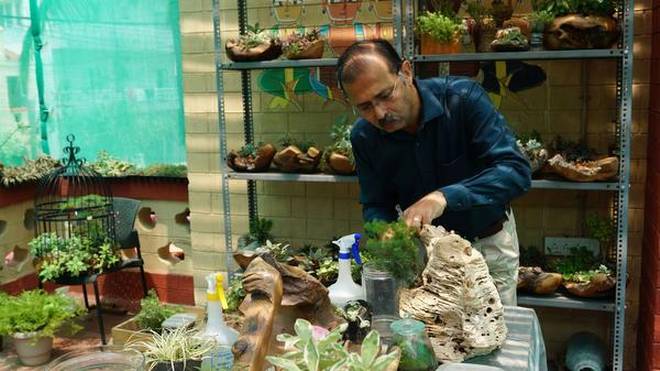
Winkle Mathias : The green warrior at work

Meet Winkle Mathias who goes that extra mile to give your home a green make over

Winkle Mathias always nurtured a soft spot for trees and plants. Originally, hailing from Mangaluru, the tree lover was brought up in Mumbai and took to carpentry for a living. It was a chance visit to Bengaluru 19 years ago that swept the man off his feet and he continued to stay on here. “I fell in love with this city at first glance. It was brimming with greenery. Today, it looks more like concrete jungle,” laments the man.

“People are selfish, they don’t realise the pain they are causing for themselves and the next generation. They are collecting logs by destroying nature and it gets burnt by somebody with a match stick. Unfortunately, it is not they who will suffer, but the next generation,” observes Winkle, who gives complete credit to his grandparents for instilling the love of nature in him at a very young age.

Winkle02BF28mar2018

“They would go into the forest foraging for food and collect mushrooms and greens. I would accompany them and would be in total awe of the greenery around me. It was fun to collect wild flowers. Little did I know those memories would trigger such passion in me one day,” recalls Winkle. He then started the Down To Earth company, in HBR Layout, Kalyan Nagar, which aims at using eco-friendly material that is easily available and is into landscaping and terrariums using plants and moss of every kind.

“Did you know that if we don’t protect the touch-me-not-plants they may soon go extinct? They are considered weeds and people are weeding them out,” states Winkle, who now cultivates these plants and talks to children about them and their benefits. “I talk to them about plants having feelings too and this plant expresses it the best. It closes its leaves and bows down when touched. What pains me most is when children and adults just pluck out a branch while playing or walking. I would love to give them a touch-me-not and tell them that it hurts the plant. None of us would like our hair to be pulled, right?”

Winkle believes we can sensitise children by exposing them to nature. “It is better to get them addicted to nature rather than gadgets,” he says. To propagate his love for nature he bought some barren land in Nelamangala 16 years ago and set out to create a green space on a two-and-half acre of rocky patch. “I picked up a few chickens and ducks and started visiting gujaris to buy a bath tub for the ducks. It was placed it in such a way that they could enter it easily. The land turned greener by the day and slowly I added a shed and planted a few trees following the sun’s patterns, so that the movement of the sun would create enough shade for the animals through the day,” beams the green warrior.

Winkle03BF28mar2018

Earthy office

Even his office is earthy. It is made from natural material such as bamboos, cane, earthen pots and jute to name a few. The terrace is dotted with terrariums of every size and even miniature landscaping. “I blend with nature and most of the projects I undertake are done with natural materials. The only problem is that these are so easily available that we have taken them for granted,” observes the man, who adds he can create anything green even if you give him stones, sand, moss or even waste.

Winkle loves to travel and observe nature, “especially the way a rock hangs out of a mountain or the manner in which water flows between rocks. These are the images that are captured in my heart and recreated in bottles and miniature landscaping in pots and bowls.”

Winkle04BF28mar2018

Landscaping is a huge part of his achievement. When he started it, he noticed that people “build their homes more for their neighbours than themselves. I want to change that notion. We will give you easy plants that will not shed leaves nor die out. And, even if it dies out, I will take it and nurture it back to life and give you a healthy plant,” assures Winkle, who has given quite a few gardens and balconies a facelift using natural light, plenty of plants and trees. “I believe a home can look gorgeous with greenery and natural material.”

Winkle plans to conduct classes with the “focus on how to use discarded pots, pans, ladles and even books to grow plants.” Winkle would also like to educate people on how to water plants. “We think we have to give a plant a head and a body bath. It is not necessary. You have to understand which plants need more water and which do not. Once you get your hands dirty, you sure are going to get hooked on to gardening.”

Call 40923565/ 9341247516 / www.d2e.ind.in

source: http://www.thehindu.com / The Hindu / Home> Life & Style / by Shilpa Sebastian R / March 27th, 2018

Made-in-India dialysis unit undergoes trials in Mysuru

Bengaluru:

A team of city-based researchers have come up with a made-in-India dialysis machine, which is expected to reduce cost of the medical procedure.
Designed by Renalyx Health Systems, the machine, RxT17, started undergoing clinical trials at JSS Medical College Hospital, Mysuru, from March 2. A 40-year-old renal disorder patient was the first to undergo dialysis on the new machine.

Dialysis machines are now imported from Germany, Sweden and China at a cost of 10-11 lakh a piece. A dialysis session costs between 2,500 and 4,000. The new machine is likely to be priced at Rs 4 lakh and it could reduce the cost of dialysis to 1,000.

The machine is cloud-enabled and can be connected to a mobile app, so that nephrologists can monitor its functioning and the patient’s response from anywhere.

” There are only 1,400 nephrologists in India and only 200 in Karnataka. There is a need to bridge the gap between patients and doctors through technological intervention. We can take the new dialysis machine to rural areas too, given its ability to connect seamlessly and its capacity to run on solar power.

Such features are not available in dialysis machines imported from Japan, the US and Germany,” says Shyam Vasudev Rao, an Indian Institute of Science (IISc) alumnus and founder-chairman of Renalyx.

Work on the machine began in 2013, driven by the vision to “create innovative and inclusive solutions for comprehensive renal care.”

Dr Lloyd Vincent, a nephrologist and co-founder of Renalyx, said the objective was to reduce the cost. “We have a project monitoring committee with alumni from Bombay and Delhi IITs as well as AIIMS, Delhi. The clinical trials are going on successfully. The product has been funded by the department of science and technology, New Delhi,” he said

 The company has patents and active collaborations with premier institutions, including IIT Kharagpur, Jawaharlal Nehru Centre for Advanced Scientific Research (JNCASR) and PESIT in Bengaluru.

Given the rising cost of healthcare, any innovation which brings down expenses is a huge relief for patients and their families. The clinical trials of a new dialysis machine are currently under way and once available for wider use, they promise to bring down the cost of treatment by a big margin. Such innovative research should be encouraged by the government through subsidies and tax breaks so that these machines become available in smaller towns and cities too. Innovative low-cost medical equipment is the need of the hour.

source: http://www.timesofindia.indiatimes.com / The Times of India / News> City News> Bangalore News> Civic Issues / by Sunitha Rao R / TNN / March 11th, 2018

City-based innovator develops device to harness wave energy

InnovatorBF27mar2018

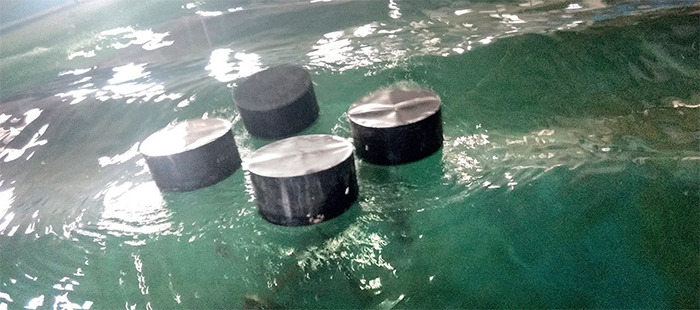
Acity-based ex-merchant navy captain and innovator has designed a device to harness energy from waves in the sea. The design of the device known as Wave Energy Converter (WEC) according to its innovator D Chandrasekar is a fresh approach to harness renewable energy from sea waves. “Ocean waves contain a lot of energy though not much work has been done to harness this energy,” said Chandrasekar.

According to Chandrasekar, the WEC has a seabed unit and a surface unit of floats. The floats move as per the waves and transmit the power to the seabed unit that converts it into usable forms of energy.

Chandrasekar who started working on the WEC in 2016 had first developed a test tank in Bengaluru to test the initial design. Subsequently, a model was developed to be tested under controlled conditions at the IIT Chennai wave basin last month. The device was also tested on land before wave basin testing. Chandrasekar said that the test results were satisfactory.

The base unit of the WEC is about six meters long and three meters wide with a height of 1.5 meters.

The WEC project has also been supported by the Department of Scientific and Industrial Research with an R&D grant of Rs 8.7 lakh for realising prototype under Promoting Innovations in Individuals, Start-ups and MSME (PRISM) scheme.

Chandrasekhar said that the WEC model which was tested can generate 5 kw electricity and that a patent application for this design is under process.
“We will soon be approaching port authorities that can use this technology to light break waters at the ports,” he said.

That apart, the WEC can also be used to power buoys at sea, light unmanned oil platforms and small islands.

Explaining WEC’s features, Chandrasekar said that the system has the flexibility to be placed at various depths and that the floats can be quickly disconnected in case of an impending cyclone.

source: http://www.bangaloremirror.indiatimes.com / Bangalore Mirror / Home> Bangalore> Others / by Bangalore Mirror Bureau / March 27th, 2018

Spastics Society director is ‘Bengalurean of the Year’

Namma Bengaluru Foundation presents awards for 2018

Rukmini Krishnaswamy, director of Spastics Society of Karnataka, has won the ‘Namma Bengalurean of the Year’ award given by the Namma Bengaluru Foundation, which is founded by Rajeev Chandrasekhar.

Sanjeev V. Dyamannanavar, an urban transport activist and one of the founders of Prajaa Raag, has been recognised as citizen of the year’, Rasheed Kappan, a senior journalist with Deccan Herald, as the mediaperson of the year, Dipika Bajpai, DCF, Bengaluru Urban, as government official of the year, Prashanth S.B., chairman of Nayonika Eye Care Charitable Trust, as social entrepreneur of the year, and Vidya Y., co-founder and trustee, Vision Empower, for her work to make education accessible to the visually impaired, as rising star of the year. These awards carry a purse of ₹2 lakh.

Citizen groups

The NBF also felicitated four citizen groups as ‘Champions of Namma Bengaluru – 2018’ for their work towards “reclaiming Bengaluru”, the theme of the awards this year. Friends of Lakes, a coalition of lake activists across the city, Save Pattandur Agrahara Lake and Save Kaggadasapura Lake, both local residents’ groups fighting to save and rejuvenate the lakes in their locality, and Project Vruksha Foundation, for its work on tree census, were the four citizen groups awarded on Sunday.

source: http://www.thehindu.com / The Hindu / Home> News> Cities> Bengaluru / by Staff Reporter / Bengaluru – March 26th, 2018

For slums, by its dwellers: A paper’s rebirth

A six-member team, led by editor Isaac Arul Selva, brings out ‘Slum Jagatthu’. | Photo Credit: Bhagya Prakash K.

20-page black-and-white magazine that was relaunched in April 2017 is slowly making waves

In a city where class divisions remain ingrained in the landscape, it perhaps did not come as much of a surprise when a Bengaluru magazine — produced for and by slum dwellers — died quietly. In 2013, Slum Jagatthu (Slum World), a monthly magazine in Kannada, ended its seemingly miraculous 13-year-run of over 135 issues.

For its editor, Isaac Arul Selva, 47, a Class IV dropout who has fought against an indifferent bureaucracy for over three decades, resilience is a virtue that is never far away. Egged on by friends in academic circles, he re-launched the 20-page black-and-white magazine in April 2017 out of a small room on the fringes of posh Koramangala. Here, glitzy pubs and towering malls are within a walking distance on the one side, while on the other is the site that once hosted the city’s largest slum, which has since been levelled to make way for a mall.

By February 2018, the reborn Slum Jagatthu with a cover price of ₹10 had a paid circulation of 300 readers — a far cry from the 2,500 it had reached earlier in this decade. “But we add more than 50 subscribers every month,” says Mr. Selva. A free online edition is put up on their blog and circulated through social media to slum leaders across the State.

A six-member team churns out the edition with a few laptops and some mainstream newspaper articles on slum dwellers stuck on the walls. Mr. Selva and Balamma K., who manages the office, are the only team members who have stuck through since the first Slum Jagatthu was published in 2000. What is constant, though, is that those working in the paper are slum dwellers.

For Hariprasad Anandpur, who works full-time with little guarantee of assured monthly pay, the magazine has allowed him to live a lifelong dream amid words and thoughts. The 34-year-old, who comes from a nomadic tribal community, was working as a helper for a wedding caterer until he attended a four-day workshop on media conducted by Mr. Selva. For over 10 years, after he had cleaned up lavish dinners in wedding halls, he jotted down his thoughts as poetry.

“When I was younger, my books were burnt to make me focus on work. Now, writing is my work and these new thought processes are my motivation,” he says, adding rather glumly, “I wasted more than 12 years of my life working mindlessly in the catering firm.”

Archiving slum history

Mr. Selva realised during the four-year break in publishing Slum Jagatthu that the larger society lacked a consistent archive cataloguing the thoughts of the urban poor. The renewed avatar of the magazine deviates from its previous form, which primarily disseminated information on slum schemes, infrastructure issues in slums, and new slum policies. It now focuses on the living history of slums, building a record of the lives and aspirations of slum dwellers, and critiques of policies such as the Smart City scheme that excludes slum dwellers.

“It isn’t enough to write that a slum doesn’t have basic amenities while neighbouring areas have developed. It is important to ask ‘why?’. Slums in cities are the products of the discriminatory thinking that sees Dalit colonies in villages remain a few centuries behind their neighbours. It is important for slum dwellers to start questioning these discriminatory practices,” says Mr. Selva.

Vision

Mr. Selva is never short of dreams. He wants the magazine to reach at least 4,500 registered slums and around 11,000 public libraries.

At an annual subscription of ₹100 — any more and it would be out of reach of slum dwellers — there is no viable business model yet for the small newspaper. Instead, it runs on ingenuity and idealism, raising funds through fellowships and consultancies.

The team dismisses the idea of approaching private enterprises for advertisements as the language of marketing would run contrary to the voice of the paper.

As a registered newspaper, Slum Jagatthu even refuses to carry ₹1,500-worth government ads it is entitled to every month. “Why waste a page on the government’s voice and sacrifice a slum dweller’s voice?” asks Mr. Selva.

source: http://www.thehindu.com / The Hindu / Home> News> Cities> Bengaluru / by Mohit M. Rao / Bengaluru – March 26th, 2018

Karnataka’s first 4G tower of BSNL commissioned

Manoj Sinha, Union Minister of State for Communications and Railways, inaugurating Karnataka’s first 4G mobile tower of BSNL in Shivamogga on Saturday.   | Photo Credit: VAIDYA
Manoj Sinha, Union Minister of State for Communications and Railways, inaugurating Karnataka’s first 4G mobile tower of BSNL in Shivamogga on Saturday. | Photo Credit: VAIDYA

The first 4G mobile tower of the State-owned Bharat Sanchar Nigam Ltd. (BSNL) in Karnataka installed in Shivamogga city was commissioned by Manoj Sinha, Union Minister of State for Communications and Railways, at a programme held at Dr. B.R. Ambedkar Bhavan here on Saturday.

Mr. Sinha said that because of the dedicated efforts of its employees, BSNL has posted operational profits in the past three years. BSNL is upgrading its infrastructure and technology to extend quality service and has plans to install 534 more 4G mobile towers in Karnataka shortly, he added.

He said while there was a decline in the number of customers of private telecom companies after the entry of Reliance Jio into the market, there was a steady increase in the number of customers of BSNL.

On the progress achieved in providing high-speed Broadband to rural areas by laying optical fibre network under the BharatNet project, he said the network had been laid in 1.09 lakh gram panchayats by December 2017. The remaining 1.5 lakh GPs will be covered soon, he said, adding that access to Broadband services would bring about a comprehensive transformation in the social and economic life in rural areas, he said.

The Core System Integration (CSI) solution, an IT modernisation initiative, and the Digital Advancement of Rural Post Office for a New India(DARPAN) project for Karnataka circle of the Department of Posts was also rolled out by Mr. Sinha on the occasion. The DARPAN project aims at digitisation of rural post offices to upgrade the quality of services offered there. The CSI will bring all services of the Department of Posts, including mail handling, insurance, banking, retail operations, and administrative operations, on a single platform.

Senior officers of BSNL and the Department of Posts were present on the occasion.

source: http://www.thehindu.com / The Hindu / Home> News> States> Karnataka / by Staff Reporter / March 24th, 2018