All posts by admin
Exhibition of products by women entrepreneurs in Udupi from tomorrow
The Platform of Women Entrepreneurs (POWER) will be organising an exhibition-cum-sale of products manufactured by women entrepreneurs of Udupi district and other places, titled “Power Parba” (Power Fest) at the Mahatma Gandhi Bayalu Ranga Manidra, Beedinagudde, here from January 11 to 14.
Addressing presspersons on Tuesday, Gayathri R., president of Power, said various items, including handicrafts, jewellery, textiles, garments, fashion accessories, cosmetics, home décor, food, and paintings, would be on display at the exhibition. Women entrepreneurs from not just Udupi but also other districts and States have already registered. A total of 170 stalls will be put up.
The theme of the fest is “Go green,” as the district administration was giving importance to cleanliness. Hence, buyers should bring their own cloth bags. Only steel and paper plates would be used in food stalls.
The objectives of the parba included providing a platform for women entrepreneurs to display and sell and thereby promote their products, bringing rural and urban women entrepreneurs under one umbrella, and promoting mutual learning and collective learning between the rural and urban entrepreneurs. It aimed at creating awareness amongst the local community about these entrepreneurs. It would disseminate marketing, management, and technical knowledge.As a precursor to the fest, a car and bike rally would be held from Rajatadri in Manipal to Udupi and back to Rajatadri. Members of Power and exhibitors will be participating in this rally. The rally will be flagged off by DC Priyanka Mary Francis at 4.30 p.m. on Wednesday. Pramod Madhwaraj, Minister for Fisheries, Youth Empowerment and Fisheries, will inaugurate the Power Parba on Thursday.
source: http://www.thehindu.com / The Hindu / Home> National> Karnataka / by Special Correspondent / Udupi – January 10th, 2018
Engineering students in Bengaluru launch 3 race cars
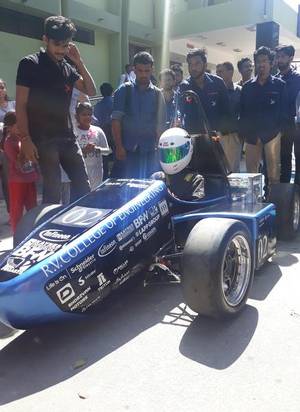
On the combustion, hybrid and electric platforms
Ashwa Racing, a brand under Ashwa Mobility of RV College of Engineering, Bengaluru, on Saturday launched three new race cars on the combustion (AMF RZX8- CO), hybrid (AMF X8-HY) and electric (AMF-RZX8 -ELE) platforms for the 2018 race season.
Undergraduate students, who conceived, designed and build formula race cars, would be competing in national and global events in the coming months.
The combustion vehicle (210 kg without driver) development is headed by team captain Sweekruth Shetty, project manager Rakesh H.N, chief engineer Prateek Bhustali. The racing hybrid vehicle (300 kg) development is headed by team captain Asfan Khan, project manager Suhas B.U., chief engineer Uday Naik and chief communication officer Tarun Kasa.
The electric vehicle (200kg) development is headed by team captain Pranave Nanda, project manager Rahul S.D., chief engineer Gautam Singh and chief communication officer Srivatsa Deshpande.
The combustion and electric divisions of Ashwa Racing would be competing in Formula Bharat, which will be held in Coimbatore in Tamil Nadu from January 24 to 28, 2018.
source: http://www.thehindu.com / The Hindu / Home> News> Cities> Bengaluru / by Special Correspondent / January 15th, 2018
GI tag for ‘Gulbarga Tur Dal’ in a month

The Kalaburagi red gram, “Gulbarga Tur Dal”, which is known internationally for its superior quality, will soon be added to the list of Karnataka producers with the Geographical Indication (GI) tag.
Dean of Agriculture College Jayaprakash R. Patil and senior agriculture scientist Raju Teggalli, addressing presspersons at the Agriculture Research Station in Kalaburagi on Wednesday, said that the University of Agriculture Sciences (UAS) Raichur and the Karnataka Red Gram Development Board, with the help of ICRISAT, Intellectual Property Facilitation Centre (IPFC), Hyderabad, filed an application with the Geographical Indications (GI) Registry in September 2017. Geographical Indication (GI) tag for “Gulbarga Tur Dal” will be awarded within a month from now.
Dr. Patil said that the red gram grown here has distinctive features having to do with this region’s unique soil and climatic conditions. The prominent characteristics of the crop grown in Kalaburagi district are good taste and aroma compared to those grown elsewhere. It consumes less time to cook when compared to tur dal grown in other regions.
Dr. Teggalli added that initially conferring of GI status may not work wonders for the farmers of the district, but in the long run, farmers and manufactures will be able to get better price for the brand in the market.
Red gram is considered to be the main kharif crop in the region. Of the total 9 lakh hectares of red gram cultivated across the State, 3.7 lakh hectares under red gram is in Kalaburagi district.
Farm scientist Muniswamy said that securing GI for the product will help farmers in getting premium price and creating international demand for produces. “The ultimate beneficiaries of this whole process are farmers,” he added.
source: http://www.thehindu.com / The Hindu / Home> News> States> Karnataka / by Staff Reporter / Kalaburagi – January 10th, 2018
Students create world record in singing ‘Vande Mataram’

As many as 4,580 students from 23 colleges sung ‘Vande Mataram’ on the shore of Malpe beach in the backdrop of the rhythmic tune provided by the jingles of waves on Saturday.
The programme by Samvedana Foundation, Malpe, organised to create a world record by reciting Vande Mataram, indeed spread the fervour of patriotism all over the surrounding. Although the aim was to achieve a Golden Book of World Record, the major goal was to create patriotic fervour among the students.
Singers, like Sangeetha Ravindranath, Malini Keshav, Suhana Sayeed and others joined the group of students. A 200 metre-long national flag was carried in a grand procession from Gandhi Shathabdhi Maidan in Malpe to the beach before the programme. More than 5,000 people, excluding students, were mute spectators to the mega event.
The uniqueness of the event was that it was held to mark the birth anniversary celebrations of Swami Vivekananda.
The record was created for the green initiative is already being considered at Udupi by the foundation which enabled the students to wear the badges carrying the slogan of saving nature for future. The students were trained for a couple of days to join the chorus of patriotism.
Speaking on the occasion, District In-charge Minister Pramod Madhwaraj said that youths should strive for building the country following the ideals of the greate visionaries like Swami Vivekananda.
The message of patriotism imbibed among the youths should send the unique message of oneness and brotherhood, he added.
Singer Suhana Sayeed said that event is an outstanding and memorable one.
It is a special experience that thousands of students joined hands to sing Vande Mataram, she added.
Golden Book of World Record, Delhi, chief organiser Santhosh Agarwal said that Udupi has created a world record wherein a large congregation has come together to sing the national song.
“This is for the first time that the maximum number of people gathered at one place and wore the badges. This is a new world record,” he added.
source: http://www.deccanherald.com / Deccan Herald / Home> District / DH News Service, Udupi / January 13th, 2018
City student wins Young Scientist Award in the field of mathematics
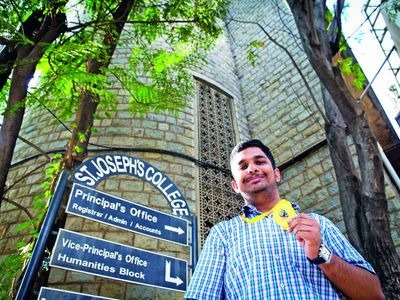
Curiosity often makes us question, and that is exactly what pushed Sebastian Thomas, a first year BSc student from St. Joseph’s College to work on his research that won him laurels recently.
Sebastian was awarded the Albertian Best Young Scientist Award and the grand prize in the model exhibition at the International Science Conference held in Kochi earlier this month.
From a group of 5,000 participants across the world, his work on the Fibonacci sequence — the golden ratio pattern and its application to five different fields — received appreciation from the panel.
Speaking to us about his achievement, Sebastian says, “The competition has a lot of place for mathematics. So, when I got to know about it, I started working towards participating in this competition. I discovered unique properties in Fibonacci numbers. The Fibonacci series has a special position in analytical number theory, basically for its pattern and golden ratio. Hence, I began exploring and thought of its application in five different fields.”
The result of Sebastian’s research can be applied in five different fields — in the field of Fourier analysis, in the growth of Hollyhock flowers (which he discovered on the college campus), in genetics where the human genes follow the golden ratio pattern), in the field of ECG and drug monitoring system.
He says, “In the field of ECG, to get an analysis done is very expensive. During an ECG, doctors mainly look at the QT interval and tell the condition of your heart. So, I thought of inter-linking my work to find the QT wave interval and I devised a new mathematical formula and the result coincided with the results of an ECG.”
Maria Thomas, faculty at St. Joseph’s College and guide for Sebastian’s research work calls him the young Ramanujan, and says, “I feel extremely overwhelmed and proud of his hard work. I am proud to say that I am his teacher. I haven’t seen such potential in anyone in the past 14 years of my career. His month-long research work is being applied in five different areas is something extraordinary. Sebastian’s research work is more about real-life applications such as in the field of ECG, which is cost-effective.”
Sebastian hopes that his findings will help the pharmaceutical industries to come up with cost effective methods in the field of research.
The next step, however, he says will be to submit his findings to Massachusetts Institute of Technology (MIT), where he hopes to have an equation named after him.
source: http://www.timesofindia.indiatimes.com / The Times of India / News> City News> Bangalore News / by Sandra Marina Fernandes / TNN / January 12th, 2018
One app to connect to all social media
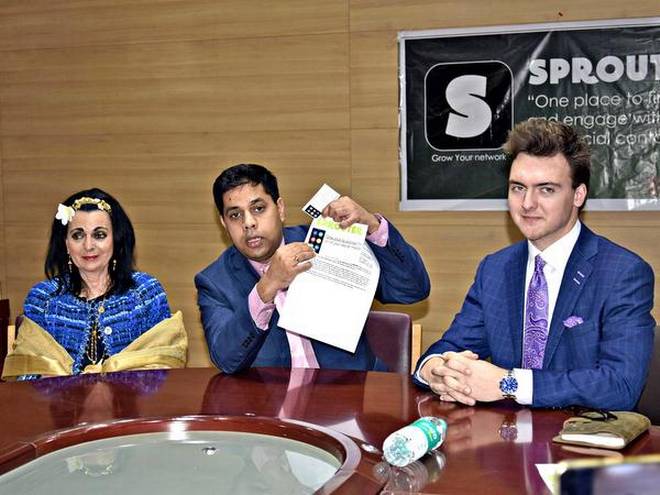
‘Sprouter’, developed by U.S. student, to be launched in Bengaluru
A new mobile application that might change the way people connect to their social media accounts has been developed by an American student of University of St. Thomas, Minnesota, U.S., Daniel Everist, and is all set to be launched in Bengaluru.
The app, ‘Sprouter’, helps one connect to various social media accounts with just one touch. Twenty-year old Everist was in Hubballi on Friday, along with his one-time teacher Manoj Patil, who is now a teacher as well as entrepreneur, to give details of the app that is already being used by thousands in the U.S.
You can access FB, Instagram etc.
Mr. Patil, a native of Hubballi, director of operations of Sprouter, told presspersons that through the new mobile app one can access Facebook, Instagram, Twitter, Snapchat, LinkedIn, Spotify, Pinterest and VSCO. “We are also in talks with other social media platform providers like WhatsApp, and want to help users log into their social media accounts with one touch,” he said. Explaining how the app works, Mr. Everist said users can synchronise their accounts with Sprouter, create one username, and on meeting someone new, they can share their Sprouter username and give access to multiple accounts.
The idea first came to Mr. Everist while in a dorm room, when as a fresher at the university, he was introduced to others. Soon each one started adding the other on social media giving the different usernames. Mr. Everist then wondered if there could be an easier way to log into all accounts at once. “The idea took an year to take shape and that’s how Sprouter was born,” Mr. Everist said.
The Android and iOS versions of the app are available on the app stores, or can be downloaded by visiting getsprouter.com.
Mr. Patil said their plan is to add at least one new feature every month and get as many social media under Sprouter as possible. After the formal launch for India in Bengaluru, the plan is to get it launched in the United Kingdom, he said.
source: http://www.thehindu.com / The Hindu / Home> News> States> Karnataka / by Special Correspondent / Hubballi – January 13th, 2018
Presidency and NPS teams bag top honours
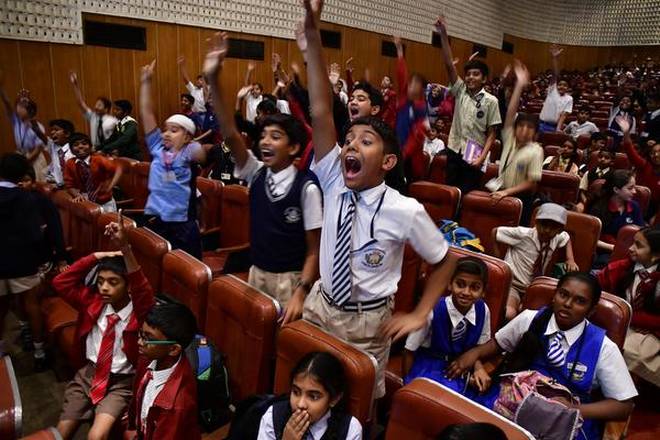
18th edition of The Hindu Young World Quiz sees huge participation from schools across the city
The regional finals of the multi-city event The Hindu Young World Quiz was held at Chowdiah Memorial Hall on Wednesday. This year’s event, presented by State Bank of India and powered by Eveready Industries India Ltd., saw huge participation of teams from schools across the city. The competition, which is an integral part of The Hindu in School (THiS) initiative, was open for students in two categories — Juniors (from classes 4 to 6) and Seniors (from classes 7 to 9).
Juniors
The team from Presidency School, Nandini Layout, led from the front and aced the competition in the Junior category. Aditya Sharath and Kushagra Agarwal, both class 6 students, won the competition with 120 points. “We never expected to make it to the final round. Last year, I had failed to qualify. But, this year we are the winners. We are extremely happy,” said Aditya. Kushagra said that they spend a lot of time in the library to gather information. “Winning at such events gives us a lot of confidence,” he said. They received trophies and certificates from The Hindu, goodies and a bicycle each from sponsors.
Aryan. A and Sahil. G. from Vidyashilp Academy, Yelahanka took the runners-up position with 70 points. Meenakshi S. V. and V. Varsha from Sishu Griha Montessori and High School, New Thippasandra were the second runners-up.
They were followed by teams from Alpine Public School, Kanakapura Road; Presidency School, Nandini Layout; and Freedom International School, HSR Layout. They received trophies and certificates from The Hindu and goodies from sponsors.
Seniors
The team from National Public School (NPS), Indiranagar, emerged victorious in the Senior category. Class 8 students Vishnu Sampathkumar and Dhyan Vyas built the lead from the beginning and scored 141 points. Vishnu and Dhyan have won at previous editions of the event.
“It feels really good. I am winning this event for the third time. I have won twice in the Junior category. We are active participants in our school’s quiz club activities. We also participate in quiz-related workshops,” said Vishnu, who aspires to a career in pharmaceutical manufacturing.
“You need to know how to analyse questions quickly. There will always be clues in the questions,” said Dhyan, who plans to do develop video games.
They received trophies and certificates from The Hindu, goodies and a bicycle each from sponsors.
Ananya Patil and Merin Scaria from Presidency School, R.T. Nagar took the runners-up position with 96 points. Sampreet and Sahana, also from Presidency School, R.T. Nagar, were the second runners-up.
They were followed by teams from NPS, Koramangala; Sri Vidya Kendra The Smart School, Machohalli; and National Hill View Public School, Rajarajeshwarinagar.
They received trophies and certificates from The Hindu and goodies from sponsors.
Prize distribution
Farooque Shahab, Chief General Manager, State Bank of India, Local Head Office, Bangalore Circle, was the chief guest at the valedictory function. He said that quiz is a mind sport and helps develop self-learning among children. Such events give opportunities to children to put their acquired knowledge to test, Mr. Shahab said. He and Devika Khare, Area Manager (Marketing), Eveready Industries India Ltd., presented prizes to winners.
Sri Aurobindo Vidya Mandir (SAVM), Mahalakshmipuram, was presented a special prize for sending maximum teams to the event. In all, 200 teams participated in the Junior category and 263 teams in the Senior category.
Quizmaster V. V. Ramanan hosted the show. Fantom Bikes is the National Gift Partner of the event. Arrow Publications is the Knowledge Partner. Naturo was the Gift Partner while Bejois was the Beverage Partner.
source: http://www.thehindu.com / The Hindu / Home> News> Cities> Bengaluru / Sudhindr A.B. / January 10th, 2018
A fruit that is sweet, sour and cost-effective
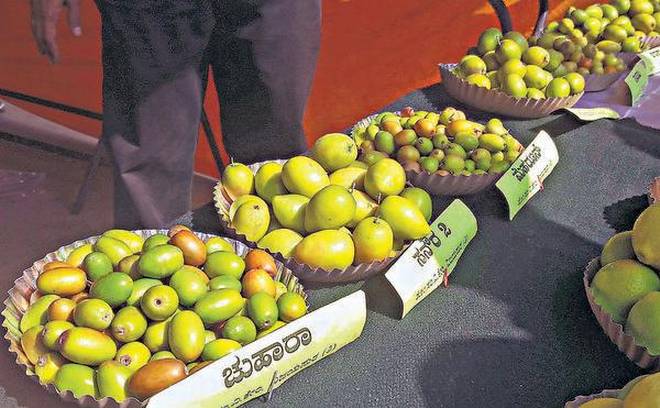
UHS-B promoting cultivation of jujube that grows well in dry areas of north Karnataka
The University of Horticulture Sciences-Bagalkot (UHS-B) is extensively promoting jujube (botanical name Ziziphus) in north Karnataka, mainly in Vijayapura and Bagalkot, because of the suitability of climate for this tasty fruit.
A blend of sweet and sour tastes, jujube is a tropical fruit and best suitable for dry land areas. Keeping this in mind, the university’s centre located at Tidagundi village of Vijayapura taluk has been promoting and popularising some eight varieties of jujubes in the region.
“This fruit is cost-effective and can be cultivated in areas that have limited water resources. Since Vijayapura and Bagalkot have limited access to irrigation, this crop comes as a boon to farmers there,” said Siddanna Thoke, Assistant Professor, Department of Fruits of the university. Having set up a stall in the Krishi Mela which started on the premises of Regional Agriculture Research Station at Hittanahalli village of the taluk on Sunday, Mr. Thoke said farmers who have limited land can cultivate this crop for higher earning. Around 110 saplings could be planted in an acre and the total cost per acre comes to around ₹20,000.
Fruit bearing starts in the first year itself but the quantity increases only from the second year.
The plant could last for at least two decades and it gives fruits till these many years. “Each acre could produce about 10 tonnes of fruits, and a farmer could earn at least ₹1.5 lakh/annum from an acre of plantation.”
Mr. Thoke said that the university is promoting varieties such as Chuhara, Mehroon, Dondon, Ilachi, Kadaka, Umran, and Apalbare. The most popular among them are Mehroon and Kadaka.
Claiming that the crop has minimum pest problem and needs limited water, that too only for the first two years, Mr. Thoke called it as a “future crop” as it does not require spaying of chemical pesticides.
source: http://www.thehindu.com / The Hindu / Home> News> States> Karnataka / by Firoz Rozindar / Viyayapura – January 10th, 2018
Bikers organise ride to help differently abled
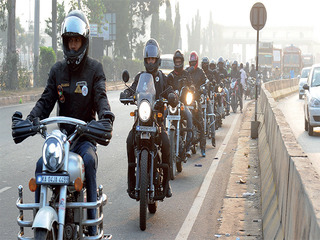
One purpose and one ride on the same day in 18 different cities – this is what the ‘We Are One’ ride was all about. In Bangalore, 200 bikers from Road Thrill, Sanchari Bikers and Gixxer Club came together to raise funds for the ‘super humans’, as they call the differently-abled people. The collected funds will be donated to Knowndisability.org that supports differently-abled people across the country.
On a cool Sunday morning, the ride started from Parle G toll gate at 7:30 and ended at Tumkur Road. Road Thrill, which is spread in many cities in India, organised the ride in 5 out of 18 cities.
Sandeep KC, one of the three admins of the Bengaluru chapter of Road Thrill, says, “I joined RT 4 years ago. This ride was a different experience. Out of the 18 cities, where the ride took place, Road Thrill organized it in Bangalore, Pune, Mumbai, Delhi and Coimbatore.”
Starting the ride on a positive note, the bikers invited two differently-abled bikers – BV Srinivas and Abhi – who rode along on their customised bikes and were honoured at the end of the ride.
BV Srinivas had polio since birth. He walks using crutches but his energy is infectious. Once when he was lured seeing a bike, the owner mocked him saying that people like him should not dream of bikes. There was no turning back for him after that. He was invited as a special guest to join the ride today.
Srinivas says, “My mantra is that nothing is impossible. I never give up. Especially when someone challenges me saying that I cannot do it, I get more motivated.
After the first incident, I went to a dealer at Bannerghatta and asked him to modify a Royal Enfield bike for me. Mine has a side wheel for support and gears and break near the handle and the petrol tank which make it easy for me to control it.”
Currently, Road Thrill has two chapters in Karnataka – Bengaluru and Shimoga – and plans to extend to Mysuru this year.
On Republic Day, 26th January, Road Thrill is organidsing yet another ride to promote road safety.
source: http://www.bangaloremirror.indiatimes.com / Bangalore Mirror / Home> Bangalore> Others / by Reya Mehrotra / Bangalore Mirror Bureau / January 08th, 2018