All posts by admin

Army pays tribute to 2 martyrs

Bengaluru :

The Army on Monday in augurated the Mahendra Nath Mulla Hall and Vasanth Block at the Selection Centre (South) in Bengaluru, dedicated to martyrs Captain Mahendra Nath Mulla and Colonel Vasanth Venugopal. Their busts were also unveiled.

According to a statement issued here, Mulla is remembered in the Navy for his sacrifice in the 1971 Indo-Pak War. He was commanding INS Khukri, a 1,200-tonne anti-submarine frigate, which was deployed to hunt down a Pakistani submarine. Vasanth was commanding the 9 Maratha Light Infantry deployed on the LoC in the Uri sector.

On July 30, 2007, upon receiving information of terrorist infiltration, he led a contingent and intercepted the terrorists. On July 31, he rallied his men to flush out the terrorists; he engaged them from close quarters killing one terrorist, but was injured and eventually died.

source: http://www.timesofindia.indiatimes.com / The Times of India / News> Chennai News> Bangalore News / TNN / December 19th, 2017

Marching to the beat of their homeland

A video grab showing a women’s battalion of KSRP at a parade in Bengaluru. | Photo Credit: Special Arrangement

Police recruits follow a novel approach of singing patriotic songs during training sessions

The catchy, invigorating opening lines of the classic Kannada film song ‘Apaara Keerthi Galisi Mereva Bhavya Naadidu’ (This is a great land glowing in its fame)rent the air at a most unlikely venue. It was being sung with gusto by 25 to 30 police trainees of the 3rd battalion of the Karnataka State Reserve Police (KSRP) as they marched with synchronised precision at a parade ground in Bengaluru.

The KSRP have adopted this novel approach as part of the rigorous training schedule of its new recruits to ease stress and enhance stamina. What’s more, it helps increase their lung power, which comes in handy in policing.

“Police training is known to be tough and rigorous and on a par with the army. Candidates need stamina and confidence to withstand the training. Music keeps them going and eases the schedule. The objective is to raise their stamina, maintain uniformity, and enhance team effort through discipline,” said Bhaskar Rao, Additional Director-General of Police, KSRP.

The exercise was first tried this October on the special women’s battalion that passed out recently. Candidates were asked to sing popular Kannada patriotic songs, which would go well with the training. The results showed that the recruits felt confident and were ready to go the extra mile, Mr. Rao added.

Singing aloud during the sessions also helped the recruits strengthen their vocal chords, a necessity for them as they are required to speak out loud while on duty to contain any eventuality, such as crowd control or during riots, he said. This practice is carried out during training in both the army and commandos.

“This gives the trainees a feel-good factor and calms the mind, and at the same time, helps in concentration,” said C.R. Chandrashekar, a city-based psychiatrist, pointing out how farmers working in the fields tend to sing songs, and women in villages hum folk songs at work.

source: http://www.thehindu.com / The Hindu / Home> News> Cities> Bengaluru / by Imran Gauhar / Bengaluru – December 19th, 2017

City students’ new creation has them representing India

CityStudentsBF18dec2017

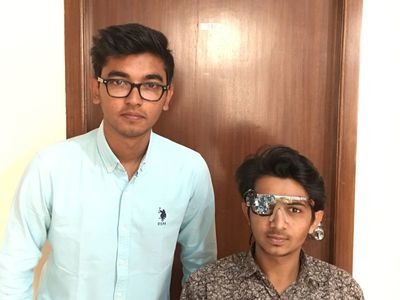
Two city-based engineering students have come up with a device that may just help people affected by paralysis to communicate with others. The duo — Mohit R Golecha and Gadhiya Abhay Dipakbhai —third year engineering students from Oxford College of Engineering, were recently selected to be a part of a competition for their innovation called V Info (Visual Information).

Speaking to us before heading for the competition, scheduled to be held in Dubai, Mohit said that the idea for having a device for patients affected by paralysis came after he saw his friend, whose relative had a stroke and couldn’t communicate at all. “When our friend visited his aunt in the hospital, we realized how traumatizing it must be for his relative and others to be unable to communicate with each other,” says Mohit, adding that that is when he thought why not have a device which such patients can wear and communicate with others. The device, V-Info, can be worn like a spectacle by the patient either on the left or the right eye. It is then that the patient, using an interface such as a computer or a TV, can communicate with others. “The device detects the motion of the pupil in the eye. Using this device, the individual using the virtual keyboard can type a message for others to read. The cursor moves as his or her eye moves to every letter,” explains Mohit.

The device, which the duo took two weeks to come up with, as of now is compatible only with a computer or a television. “Since the screen of a phone is small, there isn’t much eye movement from one side to another. However, we will keep working on it and hopefully will come up with a solution to this so that it can be paired with other devices as well. This is a very simple integration in a strong application,” Mohit sums up.

source: http://www.timesofindia.indiatimes.com / The Times of India / News> City News> Bengaluru News / by Sandra Marina Fernandes / December 18th, 2017

Chhetri, Aditi SWAB sportspersons of the year

Sunil Chhetri and Aditi Ashok bagged top honours at the ACT Fibernet-SWAB awards in Bengaluru on Saturday.

Before a star-studded gathering that included chief guest Abhinav Bindra and sporting luminaries from the city, former India hockey captain M.P. Ganesh was presented the 'Lifetime Achievement' award. - SUDHAKAR JAIN
Before a star-studded gathering that included chief guest Abhinav Bindra and sporting luminaries from the city, former India hockey captain M.P. Ganesh was presented the ‘Lifetime Achievement’ award. – SUDHAKAR JAIN

Sunil Chhetri and Aditi Ashok bagged top honours at the ACT Fibernet-SWAB awards here on Saturday. The pair claimed the ‘Best Sportsperson of the Year’ awards in the senior category while Anil Kumble was declared the ‘Coach of the Year’.

Before a star-studded gathering that included chief guest Abhinav Bindra and sporting luminaries from the city, former India hockey captain M.P.Ganesh was presented the ‘Lifetime Achievement’ award.

Bengaluru FC was adjudged the ‘Team of the Year’ while racing driver Arjun Maini and swimmer Damini K. Gowda emerged the ‘Best Sportspersons of the Year’ in the junior section.

“Bangalore holds a very special place in my heart,” said Bindra, in an eloquent address laced with humour. “I spent many days of my youth shooting at the SAI South Centre here. There is something in the air of Bangalore that makes it special for sports, and I am not saying that because I have just flown here from Delhi.”

Chhetri, whose exploits for the Indian National team and BFC saw him edge out the likes of K.L. Rahul, Rohan Bopannaand Pankaj Advani for the top prize, said: “When I started off, I was scared of journalists. Over time, I recognized the role they played and built a relationship with them.”

Ganesh, who won a bronze medal at the 1972 Olympic Games, spoke of his playing career and his transition into administration. The 72-year-old felt government officials, journalists and former athletes needed to join hands to nurture sporting talent.

Harendra Singh, coach of the Indian women’s hockey team, presented the ‘Coach of the Year’ award to Kumble, under whom India won five successive Test series between July 2016 and March 2017.

Kumble was modest in his acceptance of the award.

“I think coaches in cricket don’t have too much to say or too much to do. But nonetheless, this is an excellent recognition of all the good work that the team did over the past one year and they have continued with their winning ways,” he said.

“I’m confident that the team which we have will certainly go on to create history in South Africa and then beyond. The team under Virat certainly has the capabilities to achieve that.”

K. Sriram, a member of the KSCA’s media staff, was presented with the ‘Behind the Scenes’ award while the Karnataka Badminton Association was declared the ‘Association of the Year’.

source: http://www.sportstarlive.com / SportStar / Home> More Sports / by Team Sportstar / Bengaluru – December 16th, 2017

What do the inscription stones of Bengaluru say?

An inscription stone at Dasarahhali | Photo Credit: Uday Kumar

An early eco-friendly king, women warriors, a battle for Bengaluru: inscription stones that tell such tales and more

Last month, I was at the iconic red-brick building of the Government Museum on Kasturba Road in Bengaluru behind which an exhibition called Inscription Stones of Bangalore was under way. On display were 28 large posters of inscription stones found in various parts of the city.

I had a task to do — ‘estampage’, a process of ‘lifting’ the inscriptions from the stone on to a piece of paper for a clearer read.

Royal writ

‘Estampage’ is a purely Indian term used by epigraphists, explained T.S. Ravishankar, former director of the Epigraphy branch of the Archaeological Survey of India. He had come to attend the show. The tablet I was working on was found just two months ago in a farm near Whitefield. The inscriptions were in Tamil. Another stone tablet in front of me was from Kattigenahalli, close to Yelahanka. It had inscriptions in old Kannada or Halegannada.

Stones02BF17dec2017

Aerospace engineer and history enthusiast Vinay Kumar is part of the citizen-led project, Bangalore Nagarada Shila Shasanagalu, which had organised the exhibition. According to Kumar, inscriptions like these are records of the city’s history, its culture, economic activity, regimes and language.

The inscriptions give a very good idea of the evolution of language. “From the second half of the 5th century, the inscriptions were in Halmidi, the oldest known form of the Kannada language,” said Ravishankar. The oldest existing Kannada inscription on a Veerakallu or ‘hero stone’ from Bengaluru dates back to about 750 CE.

It was found in Krishnarajapuram, a busy neighbourhood, as part of a temple compound’s wall. The inscription lay hidden under layers of paint. Constant exposure to heat from bonfires had caused the tablet to break into pieces. Fortunately, the part of the stone with the inscription survived and was shifted to the museum.

It read: “When Sripurusha Maharaja was ruling … Mareya … pierced and fell.” This refers to the Western Ganga dynasty ruler, Sripurusha, and the veera here is Mareya. The script is notable for the long, rectangle-shaped characters from the Ganga dynasty period. In some 600 years, these characters would evolve into the artistic, rounded characters of the Hoysala period.

Going, gone

For Kannada language fanatics, Kumar has a revelation. “The existing stone inscriptions on Kempe Gowda I (feudatory ruler under the Vijaynagara empire), who established the city of Bengaluru, are all in Telugu.” And inscription stones found within an area of 20-30 kilometres in the city are in Kannada, Tamil and Telugu.

The most celebrated inscription from Bengaluru is the one dating back to 890 CE and recording the death of Buttana Setti, son of Nagatara, in a battle in Bengaluru. It is one of the earliest instances of the mention of the city. The battle it talks of — the one between the Gangas, who were Jains, and the Nolambas, who were Shaivites — is significant, as it led to the decline of the Jain kings and the founding of a new line.

Recently, there has been another discovery of tablets with Tamil inscriptions in one of the city’s oldest temple, Madivala’s Sri Someshwara temple. Dated to 1247, the Chola period, they refer to ‘Vengalur’, the Tamil name for Bengaluru. Now historians believe that when Kempe Gowda established the city, he borrowed the name from a place that already existed in the 9th century.

Stones03BF17dec2017

Then there are records of the economic activity of the times. Imagine getting tax exemption for maintaining a neighbourhood lake. That is what an inscription found at Vibhutipura says about the king who waived taxes for residents who had constructed a tank in the area and maintained it.

One of the earliest mentions of women is of the daughter of King Nagatara, Thondabbe, who took a vow to fast until death after the battle of Bangalore. A stone tablet found in Hoskote shows a woman warrior fighting and dying on the battlefield.

About 150 such stone inscriptions of Bengaluru find a mention in Epigraphia Carnatica, a set of books on the epigraphy of the old Mysore region compiled by Benjamin Lewis Rice, the director of the Mysore Archaeological Department, between 1894 and 1905.

Of the stone inscriptions he documented, barely 30 remain.

Backup plan

Whenever Kumar and other enthusiasts like Dhanpal M. reach a site after consulting Epigraphia Carnatica, the local people usually talk of having seen the (now missing) stone as recently as a decade ago.

“Development!” Dhanpal laughed, “Everywhere they have ‘developed’ sites on which people build their homes without caring about these stones.”

Dhanpal is a BMTC bus driver who is passionate about the city’s history. He decided to scour Yelahanka, a Bengaluru suburb, for inscription stones. “Superstition is the main reason why in some places the stones remain untouched and in some other places are destroyed,” he said. For many, the myth that something untoward will happen to the person who reads the inscriptions is powerful enough to get the stones destroyed. There is also the belief that the inscriptions talk of hidden treasures. In the process of unearthing the ‘treasure’, the stones are often dug up and thrown away. Hero stones have a better chance of survival since they are worshipped.

Preserving the inscriptions is a challenge. The stones abandoned on roadsides and in dump yards can be cleaned and installed in safe locations close to where they were found.

This ensures that local people don’t lose their connect with the past as recorded in these stones. Shifting the inscriptions to museums is an option only when there is a real threat to their survival.

At the museum, I met Harish Pawaskar, a jeweller who started making 3D models of inscriptions using Reflectance Transformation Imaging technology. He showed me how to scan the QR codes on the printed posters with a smartphone.

This makes the 3D models pop up with details about the inscription. “By creating 3D models, we have all the information and details required to recreate any of the inscriptions physically in case anything gets destroyed in the future,” said Kumar, also a part of the project.

In a country notoriously indifferent to preservation, such projects are reassuring. More so for a city that seems quite intent on forgetting its past.

The freelance writer believes that everything has a story waiting to be told.

source: http://www.thehindu.com / The Hindu / Home> Society> Field Notes / by Jayanthi Madhukar / December 16, 2017

Farmers rediscover organic native paddy

Rajappa, a paddy grower, with black rice variety at his farm in Huluse village in Somwarpet taluk. | Photo Credit: SpecialArrangement

Nearly 700 of them have been growing indigenous rice varieties in Hassan

A good number of farmers in the Malnad areas of Hassan district are cultivating native varieties of paddy, thanks to the encouragement by the Department of Agriculture promoting organic farming.

Nearly 700 farmers have been growing native paddy varieties and are happy with the earnings. As they are certified organic growers, their produce is attracting demand.

“When we began field work in 2007, traditional varieties of paddy were cultivated hardly in 100 acres,” recalled Jayaprasad Ballekere, chief executive officer of Bhoomi Sustainable Development Society. The Agriculture Department had involved the non-government organisation to promote organic farming in Sakleshpur, Alur taluks of Hassan and Somwarpet of Kodagu. “A majority of farmers were after hybrid and improved varieties of paddy. Following constant efforts, now native varieties are grown in more than 1,500 acres in the three taluks,” he said.

Rajamudi considered good for diabetics, Navara with medicinal value, Ghamsala a scented variety, Rathna Choodi, Netti Bilakki, Holesalu Chippuga, Kempakki (red rice), and Kappu Akki (black rice) are the native varieties of paddy.

“Holesalu Chippuga is the best variety for puffed rice. Last year, I sold paddy at ₹4,500 per quintal. Almost the entire yield goes to places like Sangli in Maharashtra and Davangere, where there are many puffed rice producing units,” said Y.C. Rudrappa, a progressive farmer of Yedehalli in Sakleshpur. He has been cultivating Holesalu Chippuga variety in eight acres of his land.

Alur, Sakleshpur and Somwarpet taluks are known for heavy rainfall, which is well-suited for traditional varieties.

Lesser duration

“Traditional varieties take 150-160 days for harvest and is suitable for this area. However, the duration of hybrid and improved varieties is about 120-130 days,” said Mr. Jayaprasad. The organic farmers of Hassan and Kodagu districts have formed a federation to market their produces. Mr. Rudrappa, who is chairman of the federation, said more than 3,500 farmers are part of it. The Agriculture Department and NABARD have helped the formation of the Farmer Producer Organisation (FPO) and promote organically grown produce. V.G. Bhat, District Development Manager of NABARD, told The Hindu: “The bank has been encouraging organic farming. We have provided ₹9 lakh for the FPO. The response has been impressive.”

source: http://www.thehindu.com / The Hindu / Home> News> States> Karnataka / by Satish G.T. / Hassan – December 15th, 2017

A festival that brings art and technology under one roof

One of the installations at the festival.

Bengaluru Fantastic 2017 opens at the Rangoli Metro Art Centre

Art and technology share a symbiotic relationship. To bring out this aspect and to showcase how the two can collaborate for sustainable solutions to some of the world’s problems, Bengaluru Fantastic 2017, an international tech-art festival, opened at the Rangoli Metro Art Centre on Friday. The three-day exhibition is being organised by Jaaga, an NGO, in association with the Karnataka Tourism Department.

Archana Prasad, founder,, Jaaga, said the intention behind organising the festival is to introduce Bengaluru to tech-art. “We wanted to bring together the two biggest influences in the city: technology and arts. What has resulted is truly phenomenal with so many artworks and artists coming altogether. We want visitors to see tech-art as an accessible means of expression. Each artwork focuses on an U.N. sustainable development goal and helps us envision a sustainable future for all,” she said.

The festival features 26 artists from across the world who are showcasing their work related to the 17 United Nations Sustainable Development Goals. The event, which is free for all, has on display 30 artworks. The next two days will see many more innovative exhibits and programmes such as 3D printing, unicycling, community drumjam, rainbow-hut, films and more. Talks, workshops and performances will also be organised.

Maskbook

Maskbook, a workshop organised by ‘Art of Change 21,’ is teaching children and adults to make masks out of waste and create awareness about the environment.

“Participants are provided with waste and they are encouraged to make it into an art piece. They will get to take home a photograph with their masks. We are trying to promote sustainable development through innovation,” said Marguerite Courtel, secretary-general, Art of Change 21.

Cubic Mirror

Gene Rogan, a software developer and artist, has created an installation that brings together photography technology and art. People can stand in front of a screen that is attached to a camera. The camera clicks a photograph and converts it into cubic art. The technology makes the otherwise expensive cubic art affordable.

Water testing

Non-profit organisation Meghashala has an installation that checks the quality of water from various parts of the city with water testing strips.

The strips are dipped into the water and grade the water across parameters such as nitrates, nitrites, pH, alkalinity and hardness.

Subham Som, implementation and partner manager, Meghashala, said, “Once the values are taken from the strip, we calculate the result with the help of a Raspberry Pi (portable single-board computer) and an app. We can test the level of water contamination through it.”

Bail Not Jail

Amnesty International India has set up an art installation by artist Ruchi Bakshi Sharma highlighting the problems faced by undertrials in the country.

“The installation specifically focuses on bail reform, which through our research, was found to be unfair. There are many poor people who have got bail, but are not released owing to the lack of money or political networks. Along with this installation we have put up a petition addressed to Law Minister Ravi Shankar Prasad, urging him to reform the bail law. We are requesting our viewers to join the campaign by signing the petition,” said Leah Verghese, senior campaigner, Amnesty International India.

source: http://www.thehindu.com / The Hindu / Home> News> Cities> Bengaluru / by Vinisha Raju / Bengaluru – December 16th, 2017

11 CFAL students qualify for Maths Olympiad

Eleven students from Centre for Advanced Learning (CFAL), Mangaluru, have been selected in the Karnataka Regional Mathematics Olympiad 2017 to represent the State at the national-level Olympiad.

A release from CFAL here stated they are among the 35 selected to represent Karnataka .

The Mathematical Olympiad is one of the prestigious examinations conducted by the Union government. Those selected at the regional level qualify for Indian National Mathematical Olympiad leading to the International Mathematical Olympiad.

A pre-regional level examination was held in August with 623 students from Karnataka qualifying for the regional level. At the regional level examination in October, 35 got selected, including the 11 from Mangaluru, all from CFAL.

The Mathematics Olympiad Program in India is organised by the Homi Bhabha Centre for Science Education (HBCSE) on behalf of the National Board of Higher Mathematics (NBHM) of the Department of Atomic Energy (DAE).

source: http://www.thehindu.com / The Hindu / Home> News> States> Karnataka / by Special Correspondent / Mangaluru – December 12th, 2017

30 artistes chosen for Janapada academy awards

Thirty senior folk artistes, one from each district, and two folk experts will be presented the Karnataka Janapada Academy awards for 2017. While the artistes will get a purse of ₹25,000 and a citation, the folk experts will get ₹50,000 and a citation.

Announcing the names of award winners here on Monday, academy chairman B. Takappa Kannuru said they had chosen these artistes at the general body meeting on October 30. The awards will be given to them at a two-day district folk convention to be held from December 28 at Sagar in Shivammoga district.

The award winners are Ganganarasamma (Ramanagaram); G. Siddanagowda (Davangere); K.R. Hosalaiah (Tumakuru); H.K. Papanna (Bengaluru city); Akkayyamma (Bengaluru Rural); Maramma (Kolar); Shanthamma (Chickballapur); D. Thimmappa (Chitradurga); K. Vasudevappa (Shivamogga); Hanumavva Walikar (Koppal); Shivamma Burrakathe (Ballari); Shivappa Hebbala (Yadavagiri); Rukmavva (Raichur); Nagappa Kashampura (Bidar); Ismail Sab (Kalaburagi); Veerabhadrappa U. Mullura (Dharwad); Jakkavva Satyappa Madara (Bagalkot); Sabavva Annappa Koli (Belagavi); Jagadeva Golavva Madyala (Vijayapura); Maharudrappa Veerappa Itagi (Haveri); Ramappa Dyamappa Koravara (Gadag); Somayya Sannagonda (Uttara Kannada); Puttaswamy (Mysuru); S.G. Jayanna (Chikkamagaluru); Krishne Gowda (Mandya); Sannashetti (Chamarajanagar); Lakshmamma (Hassan); Leela Shedthi (Dakshina Kannada); Rani Machaiah (Kodagu); and Guruva Dolu (Udupi). The folk experts are N. Huchappa Mastara (Dr. Jee. Sham. Pa. Award) and Shalini Raghunatha (Dr. B.S. Gaddagimath Award).

source: http://www.thehindu.com / The Hindu / Home> News> States> Karnataka / by Staff Reporter / Bengaluru – December 11th, 2017

How Bengaluru’s National Gallery of Modern Art has become a cultural hotspot

NgmaBF12dec2017

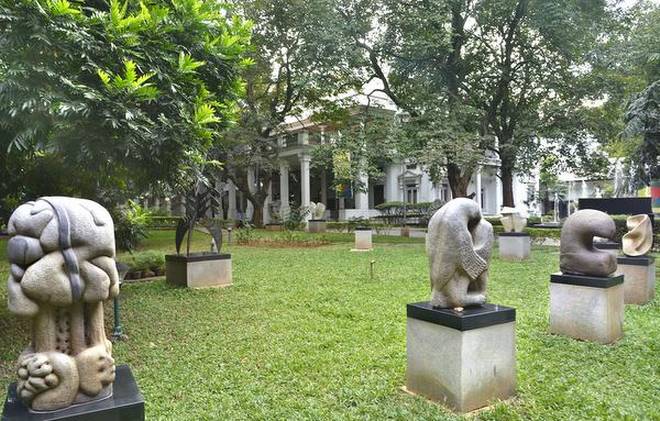
National Gallery of Modern Art (NGMA), the expansive white structure located on Palace Road, exudes a certain kind of warmth that not many government-owned cultural spaces do. It extends an invitation to a passer-by to come and discover its treasure trove of modern art. Bengaluru’s artscape deserved an institution of this stature and it took some effort on the part of cultural fraternity to convince then Chief Minister JH Patel about it. What took longer was the selection of a building. But finally, the sprawling Manikyavelu Mansion was chosen for the task. Architect Naresh Narasmihan restored this colonial style 90 year-old structure, which once belonged to Raja Manikyavelu Mudaliar, a Mysuru royalty and also added a new gallery block in harmony with its existing aesthetics. NGMA Bengaluru opened its doors in 2009 with Sobha Nambisan as its first director.

With all its greenery, the three-and-a-half acre campus is nothing less than an oasis. After you are done with seeing the massive collection on display or an ongoing exhibition, you can sit under its myriad Ashokas, sandalwood, raintrees, banyan to catch a breath of fresh air. Soak in the beauty of the place sitting on stone benches near the mirror pool. For a visitor, there is so much to experience besides the art display.

“I think, it is the best NGMA in the country. Its warm inviting appeal, the kind of events which happen here, make it a beautiful place,” says SG Vasudev, senior artist who was one of the few who rallied for NGMA’s counterparts in Bengaluru. The other two NGMAs are located in Delhi and Mumbai.

NGMA houses a permanent collection of more than 500 art works. Raja Ravi Varma, Amrita Sher-Gil, Rabindranath Tagore, Jamini Roy and other seminal names comprise the collection charting the trajectory of modernism in Indian art.

“I felt intimidated by art till I came here. I thought, I can never understand art and you need to have knowledge about it before you walk into a gallery. But here, it is different. You can get a glimpse of the evolution of Indian art,” feels Sumati R, a banker who lives in Vasanth Nagar. The art reference library, auditorium, cafeteria, sculpture garden and museum shop are other highlights of the structure.

Its permanent collection aside, it regularly hosts exhibitions of the artists from the country and across the world. Walk throughs, workshops, panel discussions, retrospectives and major career surveys of artists are regularly held here. Transforming into a cultural hub, it also hosts film screenings, other performing and cultural arts festivals. One can hope to catch rare documentaries on Rembrandt, or a famous Iranian film by Majid Majidi or just walk into a celebration of any kind.

NGMA is located at 49, Palace Road.

Entry ticket – Rs. 20

For more details visit www.ngmaindia.gov.in.)

source: http://www.thehindu.com / The Hindu / Home> Entertainment> Art / by Shailaja Tripathi / December 11th, 2017