Third-year computer science and engineering studentsof JSS Science and Technology University (Sri Jayachamarajendra College of Engineering) have won the first prize in a hackathon titled #Hackabout 2017, conducted by Royal Philips, Bengaluru.
The winners — Shashank R., Ashwin B.S. and Ajay B. and Amogha Subramanya D.A. — were mentored by Anil Kumar K.M.
Philips, which provides technology for health services and has an innovation campus in Bengaluru, conducted the hackathon based on its data science platform (DSP). Participants were given an opportunity to experience the Philips DSP to create solutions to real-world problems. The two-month-long competition concluded only recently.
#Hackabout 2017 had multiple rounds and the finale was conducted at the Philips Innovation Campus. Seventy teams, with around 300 students from colleges across India, participated.
According to a release from the college, in round one, a problem related to semantic similarities was issued. Based on the solutions, the top 20 teams were selected for the next round. In round two, the teams were given access to the Philips DSP to propose a way to predict the length of a patient’s stay in ICU.
Based on this round, the top 10 teams were selected. They included teams from IIT Madras and Manipal Institute of Technology. The final 10 were invited to the innovation campus for the final presentation.
In the final round, each team made their presentation and answered questions posed by the jury and the audience. The jury comprised Srinivas Prasad, CEO of Philips Innovation Campus, Vijayananda J., senior director, Philips Healthcare, and John Huffman, business lead, Data Science and Artificial Intelligence, Philips.
source: http://www.thehindu.com / The Hindu / Home> News> States> Karnataka / by Special Correspondent / Mysuru – October 31st, 2017
“Some people refused to go to plague camps because they would then have to mingle with other castes,” said Meera Iyer, co-convenor, Indian National Trust for Art and Cultural Heritage (INTACH). (Image source:Wikipedia)
In a way, Bengaluru owes its expansion to the plague. It was the outbreak in the late 1800s that egged people -until then averse to relocation -to settle in newly-created extensions like Basavanagudi and Malleswaram. A famous incident involving trader-philanthropist BP Annaswamy Mudaliar took place at a plague inoculation camp in the city . The crowd at the camp was leery about inoculations when Mudaliar, a progressive thinker, lectured them about the benefits, folded his sleeve and got himself vaccinated. While this crowd cooperated with the administration’s efforts to curtail the disease, widespread public resistance towards certain control measures culminated in what came to be known as the plague riots. The violence was also a mirror to the caste and cultural identity conflicts prevalent among people .
“Some people refused to go to plague camps because they would then have to mingle with other castes,” said Meera Iyer, co-convenor, Indian National Trust for Art and Cultural Heritage (INTACH), explaining that people hid in relatives’ or neighbours’ houses to avoid being forcefully segregated. Apparently , dead bodies were simply abandoned. “Caste was a big factor that hindered plague prevention and treatment. There was also strong opposition to bodies being examined for plague because the last rites would be delayed.
In their book Health and Medicine in the Indian Princely States: 1850-1950, Waltraud Ernst, Biswamoy Patil and TV Sekher state how hospitals were looked upon as jails and slaughterhouses, and how people stopped using public water taps because they believed that the purified drinking water supplied to them would actually poison them. “As an expression of hostility towards administrative measures to curtail the plague, the public set fire to plague sheds. The Health Officer of Bangalore City , Achyut Rao, had stones thrown at him by youth who disapproved of inoculation,” according to the book.
The culmination of these events came to be known as the ‘Ganjam Riots’ (Ganjam is near Srirangapatna). It started with two weavers from Bengaluru dying of the plague within a week of their arrival in Ganjam on November 02, 1898. Locals refused to cremate the second body , stating that the victim was poisoned.People threw stones at officers. The police, with full emergency powers, raided the village and arrested 55 people for the violence.Villagers retaliated with sticks, swords and guns. The police opened fire to control the mob, resulting in death and injuries.
M Jamuna, professor, department of history , Bangalore University, said that this crisis of confidence compelled the administration to focus on sanitation measures instead. “Between 1900-01, 13,223 homes were disinfected with chemicals while 47,801 were disinfected by exposure to sun, air and whitewash. In Bengaluru, 71 homes were demolished. The administration planned to remove congestion and improve drainage systems. Budget provisions were made for plague-relief and surplus revenue was also also spent for the cause.” This resulted in restoration of public confidence and greater co-operation with authorities.
source: http://www.economictimes.indiatimes.com / The Economic Times / Home> News> Politics and Nation / by Divya Shekhar, ET Bureau / November 02nd, 2017
Neelamani N. Raju is appointed as the first woman Director-General and Inspector-General of Police of the State.
Several IPS officers are elated with the appointment of Neelamani N. Raju as the first woman Director-General and Inspector-General of Police(DG & IGP) of the State.
That no woman had occupied the top post in Karnataka so far was a reminder of the glass ceiling in a predominantly male force that has in recent times seen several women IPS officers excel.
Senior IPS officer Malini Krishnamoorthy, who is posted as Additional Commissioner of Police (Law and Order, West) Bengaluru, said the appointment was extremely significant and a signal in the right direction. “Ms. Raju is the senior-most officer in the State and there is no reason why she shouldn’t be given the top post,” she said, and added that this would go a long way in increasing the confidence of all policewomen. “This is a time that we should use to better leverage women police personnel across the State,” she said.
D. Roopa, another IPS officer, said all policewomen in the State were congratulating themselves. “It was high time we had a woman chief and we have got one,” she said.
Historically, the only other woman officer who has come close to occupying the position but was denied was Jija Harisingh, a 1975 batch officer and also the first woman IPS officer of Karnataka cadre. Ms. Harisingh was in the race for the posts of the Police Commissioner of Bangalore in 2006 and DG & IGP in 2009. At that time, she had expressed her unhappiness at the top posts being denied to her. Ms. Harisingh, who retired in 2011, was not available for comment.
The second IPS officer from the State, Prabha H. Rao — a 1982 batch officer — was later absorbed into the Central Intelligence Agency and is still posted there.
Ms. Raju, the third IPS officer from the Karnataka cadre, has had a 23-year-long tenure in the Intelligence Bureau and returned to State service in 2016.
Chief Secretary
In all likelihood, a woman will be in the running for the post of Chief Secretary. The incumbent chief secretary Subhash Chandra Khuntia, a 1981 batch IAS officer, will retire on November 30. The next line of seniority has two women officers, followed by another male officer. The senior most IAS officer is Ratna Prabha K who is also a 1981 batch IAS officer and will retire on March 31, 2018. Two others in the race are 1982 batch officers Latha Krishna Rao G. and S.K. Pattanayak, both on central deputation presently.
However, it will not be the first time the State will have a woman Chief Secretary.
Sources in the government, however, said that no call had been taken on the issue, and that the Chief Minister was likely to go by seniority.
source: http://www.thehindu.com / The Hindu / Home> News> States> Karnataka / by Staff Reporter / Bengaluru – October 31st, 2017
Today is Karnataka Rajyotsava, a day celebrating the formation of the state in 1956. ‘One State, Many Worlds’ best describes our story, marked by a unification despite the pulls and pressures of socio-linguistic fragmentation
There is not a day on which Kannada, the state language of Karnataka, comes into popular focus more than every November 1. The day marked as Karnataka Rajyotsava, a public holiday, has been typically accompanied by visual symbols everywhere, of the state’s identity – like buntings of an (unofficial) flag and banners about an (official) language.
Translated literally to ‘State Festival’, Rajyotsava marks the day in 1956 when the erstwhile Mysore State was expanded to re-unify into it, some key Kannada-speaking and geographically connected regions of South India. The change of the State’s official name to Karnataka itself happened close to two decades later, with the passing of the Mysore State (Alteration of Name) Act, 1973.
The early C(K)arnatic
The term ‘re-unification’ of the State needs to be understood with some historical context. The geo-political expansion of the region had been commenced by Chikka Devaraka Wodeyar and continued by Hyder Ali, which towards the end encompassed a surprising area compared to what Karnataka State is today.
This growth of the Mysorean region was of course cut short by two key events: The Treaty of Seringapatam (1792) which ended the Third Anglo-Mysore War, and The Siege of Seringapatam (1799) which ended the Fourth Anglo-Mysore War.
The result of the former was that, about half of the Mysorean territory, was divided by the British and their allies at the time – the Mahratta Peshwa acquired territories up to the Tungabhadra River, and the Nizam of Hyderabad was granted land between the Krishna and Pennar Rivers, and the forts of Cuddapah and Gandikota. The East India Company itself retained a large integral central portion (Mysore and Coorg) and some of the Malabar Coast territories between Travancore and the Kali River, as also Baramahal and Dindigul districts. The result of the latter, which marked the final confrontation between the East India Company and the Kingdom of Mysore, was a further division of the remaining parts of the kingdom – Kanara, Wyanad, Coimbatore, Dharmapuri and Srirangapatna were retained by the British and the Nizam acquired Gooty, a part of Chittoor and Chitradurga districts. The effect on the ground was that large pockets of people were placed outside the core Mysore region, but still retained Kannada as lingua franca because of continued trade and commerce across the borders of a larger core region.
Karnataka in focus
The implication of the States Reorganisation Act of 1956 for the Kannada speaking regions at that time was of course, the re-unification of some zones that had been separated over a hundred years earlier, and the merger of other zones that were inherently Kannada speaking but were part of historical empires that had held on to them over time.
Remarkably, the name indicated by the States Reorganisation Committee for the unified state was “Karnataka”. The committee’s report provides explanatory notes
as to why the state was not proposed to be divided into two (keeping the erstwhile Mysore State separate, as was demanded by a school of thought at that time), and Section 329, which clearly states, “For these reasons, we recommend that one Karnataka State should be formed. This state should, in our opinion, comprise the, following areas…” and lists the areas proposed for unification covering the then existing Mysore State, four Kannada-speaking districts of the southern division of Bombay, namely, Belgaum, Bijapur, Dharwar and North Kanara, two districts from the princely state of Hyderabad namely Raichur and Gulbarga, South Kanara, Kollegal from Madras, and Coorg.
There were some exclusions in the recommendations, such as Bellary and Hospet taluks, as well as Kasargod, and further explanations were provided with a note “The territorial limits of Karnataka, as thus proposed, broadly cover the Kannada-speaking areas, but in the case of one or two small units, linguistic considerations have been subordinated to other compelling reasons”. The report also mentions Kolar district as an inclusion despite having a majority of Telugu speakers, for reasons of historical interest of Mysore in its industry as well as proximity to Bangalore versus Kurnool or Hyderabad. It also provides a list of over a dozen additional justifications for inclusions, exclusions, economic considerations, developmental and industrial issues, natural resources, population and administration. Finally, in Section 351, the report makes a defining statement: “Karnataka with the territorial limits which have been indicated so far will have linguistic and cultural homogeneity and geographical integrity. Barring a few dissentients, all those who have been concerned with the Karnataka problem in some form or (Aber will sooner or later recognise that this is so…”
Despite the recommended name in the SRC Report, the name of the expanded State was retained as Mysore in the SRA of 1956. Two decades later, with the passing of the Mysore State (Alteration of Name) Act, 1973, the erstwhile Mysore State officially adopted the name of Karnataka. This was in itself also due to an identity conflict where residents of northern Karnataka felt the name of Mysore reflected only the erstwhile regime, and did not represent the expanded state. Prior to the unification of Gulbarga, Raichur, Bidar and Koppal districts, the High Court jurisdiction was Hyderabad, only 200 km away, but after the unification it had moved to Bangalore, at four times the distance.
(The author is an IT professional and Bengaluru heritage enthusiast)
source: http://www.bangaloremirror.indiatimes.com / Bangalore Mirror / Home> Bangalore> Others / by Kiran Natarajan / Bangalore Mirror Bureau / November 01st, 2017
Ganesh Devy undertook 300 journeys in 18 months to explore India’s languages / ANUSHREE FADNAVIS/INDUS IMAGES
When Ganesh Devy, a former professor of English, embarked on a search for India’s languages, he expected to walk into a graveyard, littered with dead and dying mother tongues.
Instead, he says, he walked into a “dense forest of voices”, a noisy Tower of Babel in one of the world’s most populous nations.
He discovered that some 16 languages spoken in the Himalayan state of Himachal Pradesh have 200 words for snow alone – some of them ornately descriptive like “flakes falling on water”, or “falling when the moon is up”.
He found that the nomadic communities in the desert state of Rajasthan used a large number of words to describe the barren landscape, including ones for how man and animal separately experience the sandy nothingness. And that nomads – who were once branded “criminal tribes” by British rulers and now hawk maps for a living at Delhi’s traffic crossings – spoke a “secret” language because of the stigma attached to their community.
In a dozen villages on the western coast of Maharashtra, not far from the state capital Mumbai, he discovered people speaking an “outdated” form of Portuguese. A group of residents in the far-flung eastern archipelago of Andaman and Nicobar spoke in Karen, an ethnic language of Myanmar. And some Indians living in Gujarat even spoke in Japanese. Indians, he found, spoke some 125 foreign languages as their mother tongue.
Dr Devy, an untrained linguist, is a soft-spoken and fiercely determined man. He taught English at a university in Gujarat for 16 years before moving to a remote village to start working with local tribespeople. He helped them access credit, run seed banks and healthcare projects. More importantly, he also published a journal in 11 tribal languages
Languages of India
The 1961 census counted 1,652 Indian languages
The People’s Linguistic Survey of India (PLSI) counted 780 Indian languages in 2010
197 of these are endangered, 42 of them critically so, according to UNESCO
Arunachal Pradesh and Assam in the northeast, Maharashtra and Gujarat in the west, Orissa and Bengal in the east, and Rajasthan in the north have the most languages
India has 68 living scripts
The country publishes newspapers in 35 languages
Hindi is India’s most used language, spoken by 40% of Indians. This is followed by Bengali (8.0%), Telugu (7.1%), Marathi (6.9%), and Tamil (5.9%)
The state-run All India Radio (AIR) broadcasts programmes in 120 languages
Only 4% of languages are represented in India’s parliament
Sources: Census of India, 2001, 1962, UNESCO, People’s Linguistic Survey of India 2010.
It was around this time Dr Devy had an epiphany about the power of language.
In 1998, he carried 700 copies of his journal written in the local language to a dirt-poor tribal village. He left a basket for any villager who wanted to or could afford to pay 10 rupees (£0.11; $0.15) for a copy. At the end of the day, all the copies were gone.
When he checked the basket, he found a large of number of currency notes – “grimy, crumpled, soggy” – left behind by the tribal villagers who had paid whatever they could afford from their paltry daily wages.
Dr Devy and his team have recorded India’s many sign languages / ANUSHREE FADNAVIS/INDUS IMAGESA story written in Spiti language, spoken in the northern state of Himachal Pradesh / ANUSHREE FADNAVIS/INDUS IMAGES
“This must have been the first printed material they saw in their life in their own language. These were unlettered daily wage workers who had paid for something they could not even read. I realised this primordial pride and power of the language,” Dr Devy told me.
Seven years ago, he launched his ambitious People’s Linguistic Survey of India (PLSI), which he called a “right-based movement for carrying out a nation-wide survey of Indian languages as people perceive them”.
As the indefatigable language hunter turned 60, he undertook 300 journeys in 18 months across the length and breadth of India to search for more languages. He paid for his trips using money he earned by delivering lectures in universities and colleges. He travelled night and day, revisiting some states nearly 10 times, and religiously kept a diary.
Dr Devy also forged a voluntary network of some 3,500 scholars, teachers, activists, bus drivers and nomads, who travelled to the remotest parts of the country. Among them was a driver of a bureaucrat’s car in the eastern state of Orissa who kept a diary of the new words he heard during his extensive travels. The volunteers interviewed people and chronicled the history and geography of languages. They also asked locals to “draw their own maps” on the reach of their language.
The script of a language called Sakal spoken in Maharashtra / ANUSHREE FADNAVIS/INDUS IMAGESThe PLSI has already published 39 books on Indian languages / ANUSHREE FADNAVIS/INDUS IMAGES
“People drew maps shaped like flowers, triangles, circles. These were maps of their imagination on the reach of their language,” says Dr Devy.
By 2011, the PLSI had recorded 780 languages, down from the 1,652 languages counted by the government in 1961. Thirty-nine of a planned 100 books carrying the findings of the organisation’s survey have already been published; and some 35,000 pages of typed manuscripts are being vetted for publication.
India has lost a few hundred languages because of lack of government patronage, dwindling number of speakers, poor primary education in local languages, and migration of tribespeople from their native villages. The death of a language is always a cultural tragedy, and marks the withering away of wisdom, fables, stories, games and music.
‘Linguistic democracy’
Dr Devy says there are more pressing anxieties. He worries about the ruling Hindu nationalist BJP’s efforts to impose Hindi all over India, which he calls a “direct attack on our linguistic plurality”. He wonders how India’s melting-pot megacities will deal with linguistic diversity in the face of chauvinistic politics.
Dr Devy is now planning to check the health of the world’s 6,500 languages / ANUSHREE FADNAVIS/INDUS IMAGES/
“I feel sad every time a language dies. But we have suffered heavier losses in other diversities – like varieties of fish and rice,” he says, sitting in his home in Dharwad, a sleepy, historic town in Karnataka state.
“Our languages have survived tenaciously. We are truly a linguistic democracy. To keep our democracy alive, we have to keep our languages alive.”
source: http://www.bbc.com / BBC News / Home> News> Asia> India / by Soutik Biswas, India Correspondent / October 27th, 2017
When stars meet: Veteran cricketers B.S. Chandrasekhar, Syed Kirmani, E.A.S. Prasanna, and Rahul Dravid releasing senior journalist Rajdeep Sardesai’s book Democracy IX at the Bangalore Literature Festival on Sunday. | Photo Credit: Sudhakara Jain
Four Karnataka cricket legends shared the stage at the Bangalore Literature Festival on Sunday, leaving the audience spellbound.
B.S. Chandrasekhar, E.A.S. Prasanna, Syed Kirmani, and Rahul Dravid regaled the audience in the company of senior journalist, Rajdeep Sardesai. The former India internationals were present to support Sardesai’s new cricket book Democracy’s XI.
Dravid, the star attraction, stated that he was fortunate to start his career in a State that has produced several world-class cricketers. “The great thing about the cricket culture in the city is that you get to interact with international cricketers when you are young. I remember, when I was 18 or 19, we took a 48-hour train journey to Calcutta to play a Ranji Trophy match. I had G.R. Viswanath (then Karnataka chairman of selectors and team manager) and Kirmani sitting in my compartment. They were happy to share their inputs with me, and I was constantly picking their brain. As an 18-year-old, what more can you ask for,” Dravid said.
He alluded to the fact that his seniors were not averse to knocking back a few cold beverages. “Forty-eight hours is a long time, you have to find ways to pass time. There were some card sessions, and I won’t say what else happened. All I can say is that the weather was warm, and that in those days, there were no fitness tests and diet rules,” he said.
source: http://www.thehindu.com / The Hindu / Home> News> States> Karnataka / by Ashwin Achal / Bengaluru – October 29th, 2017
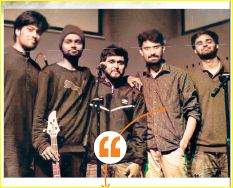
What happens when five friends from drastically different musical backgrounds, equally passionate about music, come together? Naturally, music is taken to a different level — to a supreme level. Param (meaning supreme in Sanskrit), a four-year-old Mysore-based band took Chennaiites on a joyride with their music recently. CE got in touch with Mayur GS, the band’s drummer, who lets us in on their journey so far.
“We were all in Mysore, playing for different bands when we happened to meet and realise that we have similar taste in music. We also had similar aspirations. That’s how the idea of forming a band came about. Since we all are equally serious about music, it wasn’t very difficult to get started,” Mayur recalls.
The boy band has Vijay Hegde (lead vocalist), Shreyas Urs (lead guitarist), Sanketh Kumar (bassist), Mayur GS (drummer) and Abhimanyu Menon (percussionist — tabla).
The band, which is popular for the Hindustani Progressive Rock music genre, has played at several events including Toyota India Ekiden 2015, Mysore, and has even opened for musicians like Baiju Dharmajan. One of their biggest achievements is securing sixth position in the All India Category at the Channel V India Fest held in Goa in 2014. “We were among the top three bands from South India. It was quite exciting to tour as a band, but we have stayed away from competitions ever since to focus only on live performances. Our strength is that we rely purely on our original compositions,” he explains.
It is often said that music is universal…but how is it possible to fuse two diverse and different genres at the same time? The band combines elements from Hindustani and progressive rock that are like chalk and cheese in notes, tradition, language, etc. “Vijay has been singing Hindustani music for the last 20 years. I am trained in Carnatic music; our guitarist and bassist has a blues and traditional rock sound background. Our percussionist comes from a Hindustani background. Diversity is not the problem,” he avers. “The challenge is in keeping the songs simple, yet interesting. Sometimes tunes that sound good in Hindustani, for instance, might not sound very good in rock and vice-versa. That is where we need to understand limitations of the two, and produce some great music.”
‘Param’, which takes inspiration from bands such as Shakthi, Porcupine tree, Motherjane and Avial, has a diverse fan following as well. “The youth is attracted to rock music, but sometimes we see several senior citizens at our concerts. I am not exaggerating but even my grandmother comes to our concerts,” he laughs.
Though this is their first performance in the city, the band seems quite familiar with the musical history and tradition of Chennai. “Both Chennai and Mysore have played a huge role in preserving the rich history of classical music. But the concept of live music and performances is only catching up in these cities,” Mayur opines. “We perform quite often in Bengaluru as it offers a better platform for live musicians.”
QUICKIES An embarrassing moment?
We misplaced our guitar while travelling to a gig. We realised that it was missing only few minutes before the gig. Thankfully, a friend had a guitar and we managed just fine. Musician you want to work with?
Steven Wilson Your jam song?
Away, one of our originals
Your dream stage?
Royal Albert Hall in London — long term
NH7 weekender — short term
Why are there no women musicians in the band?
It is much simpler this way, because we are all really good friends first and then musicians.
source: http://www.newindianexpress.com / The New Indian Express / Home> Cities> Chennai / by Thushara Anne Mathew / Express News Service / October 29th, 2017
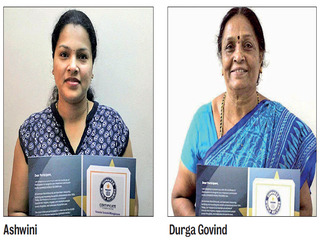
After her wedding, Ashwini Anil left her hometown Puttur and moved to Bahrain. That was 10 years ago. Despite having had a postgraduate in computer science, she found it difficult to get a job, thanks to recession. Inspired by her mother, Durga Govind, an expert in crochet designing, she decided to take up crocheting. That changed her world and now their products are being used by the poor all over the world.
Ashwini told BM, “My mother is so talented. She does knitting, crochet sewing, embroidery and many other crafts. She used to stitch all our dresses, sweaters and even school bags. I feel proud to say and my sister Anushri and I rarely wore readymade dresses. She has been an inspiration. Though I was not very active in the art world when in Puttur, crochet and art became my world, without even realising how and when. Initially, it was difficult to get the right yarn. Then I started experimenting with plastic as the raw material. I started using waste material like milk bottles and the outcome was attractive. My husband, Anil Dheraje, a project manager, has helped me in every step,” she said.
Her work became an instant hit and she was introduced to Momwise, a group on social media. They were holding an exhibition and she was surprised when she was asked to share her work. Ashwini was later introduced to Chennai-based Subhashri Natrajan who through ‘Mother India Crochet Queens’ (MICQ) was successful in making the largest crochet blanket in the world, measuring 11,148.5 sq metre.
Ashwini and her mother participated in the project along with over 1,000 participants from the country and 13 other countries.
The blankets were donated to the needy last year. The team was not satisfied with this record and they decided to create the world’s largest scarf.
To promote international peace, a group of crochet enthusiasts knitted the world’s longest scarf measuring 14.09 km. The feat was acknowledged by the Guinness World Records.
Ashwini said, for this record, MICQ created about 5400 scarves. 900 of them were sent to Secretary General of United Nations and head of states as a step towards spreading global peace.
Attempting another record, they are now working on huge crochet sculptures.
“The aim is to make the largest display of crochet sculptures and we hope to break the UK record created in 2014,” she said.
source: http://www.bangaloremirror.indiatimes.com / Bangalore Mirror / Home> News> State / by Deepthi Sanjiv, Bangalore Mirror Bureau / October 28th, 2017
20 teams to participate in the tourney slated for first week of January
Along with surfing, Mangaluru is likely to become the go-to destination of the state for lagori too. As the First Lagori Tulunadu Cup 2017 organised by Pathway Mangaluru in June this year with the participation of nearly 20 teams of 12 players each from Dakshina Kannada, Udupi and Kasargod was a huge success, the Amateur Lagori Association of India has asked the Pathway to organise the Senior National Lagori tournament for men and women in the first week of January in Mangaluru.
Deepak Ganguli from Pathway told BM, “The association was impressed by the manner in which the district-level tourney was conducted and hence asked us to hold the seventh national level tourney under the Amateur Federation of India. The event will be held in the Karavali Utsav grounds. The sixth edition was held in Rajasthan.”
He said they were expecting at least 15-20 states to participate and were hopeful that at least three players from Mangaluru will be representing the Karnataka men’s team. Before the national tourney, a selection camp will be held in Mangaluru, which will see the participation of at least 200 players (men) from across the state. In an attempt to popularise the game, plans are to hold premier league matches on beachside. “The top 15 players will represent Karnataka in the national match and our aim is to have at least one player from Mangaluru for the World Cup to be held in May next year at Mumbai,” said Ganguli.
Pathway has received queries from women players wanting to participate. “As the Association has informed that the state team (women’s) has already been finalised, we are likely to hold district level matches for women next year,” he said.
source: http://www.bangaloremirror.indiatimes.com / Bangalore Mirror / Home> Bangalore> Others / by Bangalore Mirror Bureau / October 25th, 2017
The cenotaph was demolished with official sanction on Oct 28, 1964.
Bengaluru has had a long history of renaming its roads and landmarks. This story is about a landmark which was completely destroyed because of its link to the city’s colonial history.It happened on October 28, 1964. A cenotaph dedicated to soldiers who died in the 1791 Siege of Bangalore was demolished.
“A group of Kannada activists led by Vatal Nagaraj wanted to demolish structures and statues that they considered as symbols of colonial victory over Indians,” said Mansoor Ali, founder, Bengaluru By Foot.
While statues of Queen Victoria, King Edward and Mark Cubbon were also on their radar, they zeroed in on the cenotaph as it was in the city centre (Hudson Circle).The call to pull down the cenotaph goes back to the late 1940s but it was in October 1964 that a resolution was passed by the city corporation under mounting pressure from Kannada activists. Today ,a statue of Kempe Gowda, the city’s founder, stands in its place.
The 35-feet-tall cenotaph pillar was constructed in the memory of the 50-odd soldiers and commanders who died in the 1791 Siege of Bangalore and other Anglo-Mysore wars. It had stone plaques and ceremonial urns on all four sides, similar to the one constructed in Tipu Sultan’s capital Srirangapatna.According to Ali, the cenotaph included names of not only British soldiers, but also of Indians who fought as part of the Madras Engineering Group (MEG).
During the siege, the British first captured the pete (which housed residential and commercial areas) on March 7, 1791, and then captured the stone military fort on March 21.The event put Bangalore on the British map. Subsequently , the British used the Bangalore fort as a base for the Siege of Seringapatam in 1792, which forced Tipu to concede defeat.
Initially, officers who died during the Siege of Bangalore were buried in the Fort’s Cemetery .Robert Home’s book `Select Views in Mysore, the country of Tipoo Sultan’ illustrates graves of soldiers and indicates that the land was filled with cypress trees, rose bushes and flowers. In the early 1910s, the records of these officers were transferred to the Cenotaph that was raised in the British cantonment.
After the demolition, the stones from the cenotaph were thrown away . One remnant was a bench in the corporation office until recently , while a some others were at the nearby Abbas Khan College.The Cenotaph Road on which the structure stood was renamed Nrupathunga Road. “Instead of eliminating a heritage structure that marked a turning point in the history of Bengaluru, we could have constructed another monument of Mysoreans who lost their lives in war. Both could have coexisted,” said Ali.
source: http://www.economictimes.indiatimes.com / The Economic Times / ET Home> Magazines> Panache / by Divya Shekhar, ET Bureau / October 26th, 2017