All posts by admin

Eternally yours: a rare women’s museum in Bengaluru

Shashwati01BF27jul2017

We have a rare women’s museum in the city. Read on to find out the interesting story behind its birth and its even more intriguing collection

The city nurtures in its womb, little known spaces and unknown treasures an inhabitant can only discover if suitably armed with time and curiosity. Shashwati Women’s Museum is one such gem which needs to be discovered. Its location — nestled inside NMKRV Degree College for women in Jayanagar — makes it even more rare. Shashwati is a word derived from the Sanskrit word Shashwat which means eternal and Chi.Na. Mangala, educationist, journalist, author, visionary wanted to create something for posterity. The founder-principal of NMKRV Degree College for Women in 1973, with her colleagues undertook a padayatra in Bengaluru and Mysuru collecting women-related artefacts. That is how Shashwati Women’s Museum was born.
Shashwati02BF27jul2017

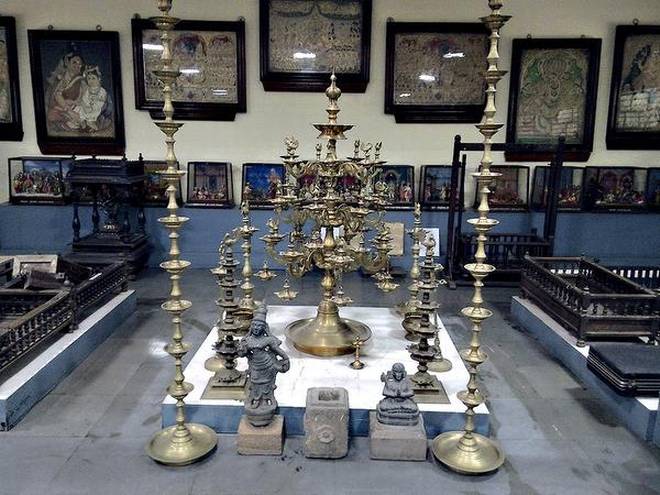
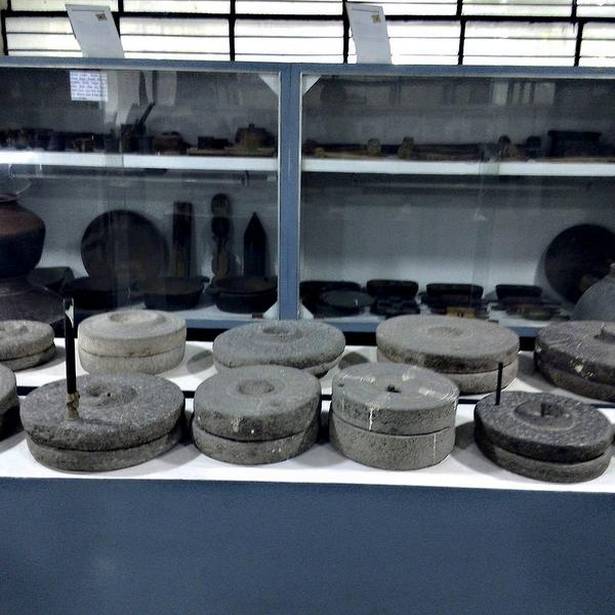
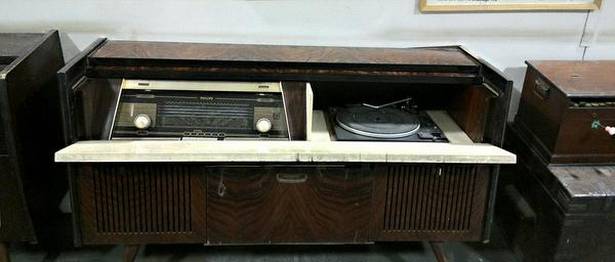
Dioramas, grinding stones, wooden troughs, vessels, radios, typewriters, old gramophones, wooden cradles, objects handcrafted from plastic, paddy, fabric, crochet, jute, photographs, paintings, sculptures in copper, brass and stone make up this museum. “All the items that you see were made and used by women and that is what makes it so rare,” says Vani M.N, one of the oldest serving teachers in the college.

The museum can introduce one to Nanjanagudu Thirumalamba, Karnataka’s first woman writer, journalist and publisher. As soon as visitors enter, they can find a display section dedicated to the iconic personality with her handwritten articles, letters and a few of her personal belongings. “Mangala once wrote an article for a magazine claiming that Thirumalamba was dead. But she later found out that Thirumalamba was alive. Mangala took it upon herself to find her. She eventually found her living in a small house in a village in Chennai. Chi.Na.Mangala felt she had committed a sin and to atone for it, she needed to build something for eternity. She went door to door collecting these items,” reveals the senior teacher.
Shashwati03BF27jul2017

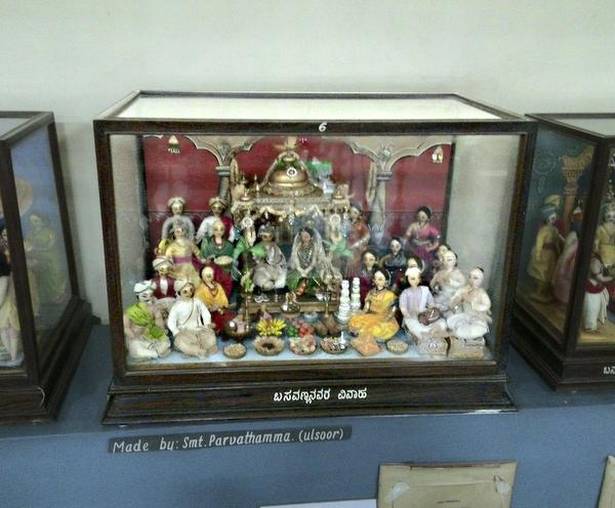
Vani picks a wooden sieve, nut crackers,and dioramas depicting saint-poet Basavanna’s life as well as a 100 year-old paddy tray and a 120 year-old saree with gold threads worn by Mangala’s mother on her wedding, as highlights of the museum.

The nut crackers are truly a delight, especially the ones styled as a Yaksha-Yakshi, or a fish. The dioramas lined at the fag-end of the museum, depicting important episodes from Basavanna’s life, are also significant. With each object clearly stating the name of the donor and creator, the collection becomes credible.
Shashwati04BF27jul2017

If the display and curation were better, the museum could have transformed into an extraordinary space. But the fact is that it is dealing with practical challenges of space.

“The collection hasn’t stopped growing so we have to figure out how to accomodate it. There is a museum committee which has been formed and we have to take certain important decisions regarding these issues, soon it will be a better place. When it comes to a curator, we need someone who will be there with us for a long time. We need a committed person; what we do now is train and pass on the information to a present staff member,” explains Vani, who heads the Department of Journalism and Mass Communication.
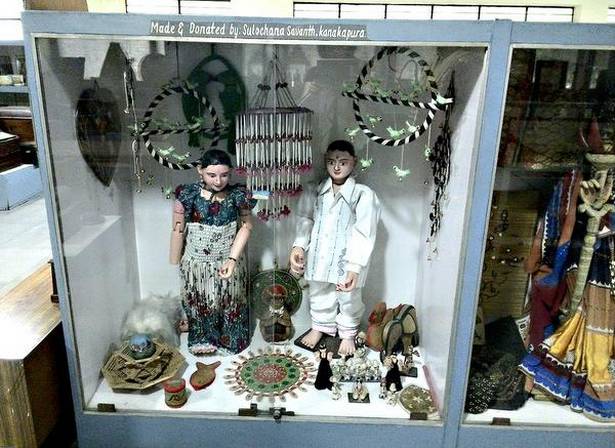
Shashwati05BF27jul2017

The museum is not like other museums where visitors can just walk in. One needs permission from the college to visit the space. “It is inside the college and that’s why one needs to be a little cautious but whoever wants to come can call us and see it.

The museum is particularly relevant to the students of the Department of Women’s studies and outsiders undertaking research on gender or anthropology,” adds Vani. The museum is currently closed to visitors due to some construction work.

Shashwati Women’s Museum,NMKRV Degree College of Women,3rd block, Jaya Nagar East, Near Uphara Darshini, Banashankari

Call: 080 2663 7042

source: http://www.thehindu.com / The Hindu / Home> Entertainment> Arts / by Shailaja Tripathi / July 26th, 2017

U.R. Rao, genial genius of ISRO

URRaoBF26jul2017

He gave the country its first spacecraft

Udupi Ramachandra Rao, former chairman of the Indian Space Research Organisation, acclaimed space scientist acknowledged as the father of Indian satellite technology, is no more.

The celebrated cosmic ray scientist with an MIT scholarship and experience with early NASA projects in the 1960s is best remembered as the man who gave the country its first spacecraft Aryabhata from out of modest un-space-like industrial sheds of Peenya in Bengaluru.

His demise at age 85 somewhat brings the curtain on the starry era of pioneering space troika of Vikram Sarabhai, Satish Dhawan and U.R. Rao.

Regulars at Antariksh Bhavan, the headquarters of ISRO and the Department of Space, will miss the gentle genius. A workaholic, Dr. Rao was active until about two weeks back in his office at Antariksh Bhavan, recalled ISRO Publications and Public Relations Director Deviprasad Karnik.

Guided by Sarabhai

When Dr. Rao returned in 1966 to India from stints in the US, the Americans and the Russians were flying their spacecraft of their rockets and had reached Moon. Over here, they were the days of low budgets, small human resource but high spirits and goals.

Dr. Rao’s space journey blossomed under the tutelage of Vikram Sarabhai, his doctoral guide and later boss at ISRO: in 1972, Sarabhai tasked the young Rao — fresh from MIT and the only Indian then who had worked on NASA’s Pioneer and Explorer satellite projects — with building an Indian satellite.

Then Prime Minister Indira Gandhi had come down to see the assembled satellite — Aryabhata — which was launched on a Russian rocket in 1975. Indian satellites had started sprouting.

As the first director of what is now called ISRO Satellite Centre, Dr. Rao was responsible for 18 early satellites including the landmark Bhaskara, APPLE, the Indian Remote sensing Satellites or IRSs. His mantra was – ‘If others can do, we can do better’.

In 1984, Dr. Rao succeeded Satish Dhawan as ISRO Chairman and Secretary, Department of Space, going on to have the second longest tenure in the high post – ten years. (Dr. Dhawan headed it for 12 years.) Dr. Rao was the chairman of the governing council of Physical Research Laboratory until the end, apart from many science ad technology bodies.

Shaped many a project

At ISRO, there has not been a planetary mission that has not been touched or tweaked by Dr. Rao. As the chairman of overseeing body ADCOS or the Advisory Committee on Space Sciences, he finalised, shaped, refined or designed the Chandrayaan-1 lunar mission of 2008; the Mars Orbiter Mission of 2013; and the upcoming Chandrayaan-2 set for 2018.

“I look for excitement in any field,” he had said. One of the current unfinished projects of the cosmic ray scientist is Aditya L1 mission – India’s upcoming solar observatory, so to say. Aditya was earlier planned as a near-Earth mission looking at Sun. However, Dr. Rao – close associates say – convinced ISRO to greatly enlarge its feature and scope. For him, the spacecraft must gaze at Sun from an apparently stable point called L1 or Legrangian point. He prevailed and now Aditya-L1, as it is now renamed, will travel million km to do its job from a point undistubed by either Earth or Sun.

Associates recall that he was always updated of developments in his field and related sciences. He was forthright, had a “sharp, analytical mind, enormous intellectual ability and [could] quickly make back of the envelop computations for complex solutions,” recalled V.Jayaraman, his doctoral student and erstwhile Director of ISRO’s Earth Observation Systems and later National Remote Sensing Agency, in an article in Current Science titled Living legends in Indian Science.(Vol. 106, No.. 1588 11, 10 June 2014.)

The same article recounts how Dr. Rao ensured that a remote sensing satellite was launched from a Soviet spaceport amidst extraordinary conditions: “Even as [then Soviet] President [Mikhail] Gorbachev resigned as general secretary of the Communist Party of Soviet Union on 24 August 1991, and the mighty Soviet Union collapsed in the next few days, IRS-1B was launched without any hitch on 29 August 1991 from Baikonur. The presence of Rao [in spite of advices to stay back] served as a balm, not only for the ISRO team at the launch pad and helping them to stay focussed and keep a high morale, but also as a great relief for their families back home. For us associated with that historic event, it will remain as [a] lesson as to how a leader should behave in times of crisis and to be with his team, … whatever be the hurdles.”

Two years back, he was down with cough and fever, yet drove 15 km to his ISRO office to keep his engagements – one of them an appointment with this reporter. When he was told that he could have postponed the meeting, Dr. Rao typically said, “Some people prefer to rest, I prefer to work.

All through my life I have worked when I am sick – to forget the sickness. Or else I will be a nuisance to others.”

As chairman, Dr. Rao accelerated the rocket development programmes but with mixed luck. He presided over the fruition of the ASLV early rocket, much of the development of the now-famous PSLV. He laid the foundation for the GSLV by signing a pact with the Russians in 1991 for the cryogenic engine technology for its third stage. Dr. Rao’s joy was blunted as the PSLV clicked after his tenure while the Russians reneged on the cryogenic pact.

The credit for kickstarting the now working GSLV, however, is undeniably Dr. Rao’s, say ISRO oldtimers.

U.R.Rao was born on March 10, 1932, to Lakshminarayana Acharya and Krishnaveni Amma in Adamaru near Udupi – a small town that hosts one of the eight famous `Madhwa math’s sacred to Kannada Brahmins. He studied in Udupi’s Christian High School and later did his intermediate course in Bellary’s Veerashaiva College. A B.Sc at the Government Arts and Science College, Ananthapur, then under Madras University. He completed his M.Sc in Physics from Banaras

Hindu University 1953 and briefly taught in Ahmednagar and Mysore. But space sicence was beckoning and he enrolled for a PhD under none other than Vikram Sarabhai at the Physical Research Laboratory, Ahmedabad, and got the doctoral degree in 1960 from Gujarat University.

The article by Dr. Jayaraman says the story of a small-town boy’s rise “to a lofty position as Chairman of ISRO, a prestigious organisation and of international fame, should be a motivational force to many young aspirants in our country.”

source: http://www.thehindu.com / The Hindu / Home> Sci-Tech> Science / by Madhumathi D.S / Bengaluru – July 24th, 2017