A joint initiative of HKRDB and Calcutta University to document an Ashoka Circuit for Karnataka from Sannati to Siddhapura has been launched.
Head of Ancient History Department of Calcutta University Prof Susmita Basu Majumdar is the Principal Investigator. As part of this expedition, a documentary will be filmed and a pictorial Pali-English-Kannada dictionary will be compiled.
Karnataka has perhaps the largest number of Ashoka sites and those dating back to the 3rd century BC are the earliest legible records found from Afghanistan in the northwest, Andhra Pradesh in the south, Odisha in the east to Girnar in the west. The project will first document all the Ashokan sites in Karnataka and then establish the full circuit from Afghanistan.
A team of three, Prof Susmita Basu Majumdar, artist Rajib Chakraborty and film maker Ranjay Ray Choudhury visited the Chandralaparameshvari temple at Sannati on Sunday, to document the spot where the Ashoka edict was found. They found the original idol of deity Mahakali broken into four pieces lying on the western side of the temple on the banks of river Bhima.
Prof Basu Majundar took the initiative to re-join the idol and narrated the interesting story behind the discovery of the Ashoka inscriptions. In 1986, a portion of the roof of the temple collapsed and caused damage to the 12th century seated four handed figure of goddess Mahakali wearing mundamala and holding damaru, trishula, kapala and sword.
Presently, this beautiful piece of sculpture only shows the trishula and kapala and the other two hands are broken but the temple authorities informed that the present image of Chandraparameshwari which is worshiped in the temple is a replica of the previous Goddess.
The khandita pratima of the deity lying on the banks of Bhima was almost awaiting the visit of this team and when the sculpture was joined it looked as if the beautiful Goddess had reappeared.
The idol base had a protruding pillar like hinge which was fitted into a stone socket. The stone on which the Ashoka inscription was engraved was used to form the base of this deity. When the idol was damaged, the inscription was discovered.
This inscription carried the separate edicts one and two and rock edits 12 and 14 of Ashoka (274-232 BC). Karnakata was the southernmost boundary of the Ashoka’s Mauryan Empire.
This inscription was discovered in 1989. Now the original idol which is about 600 years old is also restored to the temple. The matter is being reported to the ASI for further action.
source: http://www.newindianexpress.com / The New Indian Express / Home> States> Karnataka / by Express News Service / March 02nd, 2016
To mark National Science Day, the Centre for Science Education and Research and KS Hegde Medical Academy (Kshema) will honour two clinician scientists, Dr VI Mathan and Dr Minnie Mathan, for their contribution to medical research on Monday.
Prof Mathan, who superannuated from Christian Medical College, Vellore, as professor of medicine and gastroenterology and director, has a number of awards to his credit. This includes the Ambedkar Award of the Indian Council of Medical Research for his lifetime contributions to health research. Prof Minnie was the head of the department of gastrointestinal sciences at the college till her superannuation in 1997.
At the event Prof Mathan will speak on the challenges of clinical research and Prof Minnie on integrated research.
source: http://www.timesofindia.indiatimes.com / The Times of India / News Home> City> Mangalore / TNN / February 29th, 2016
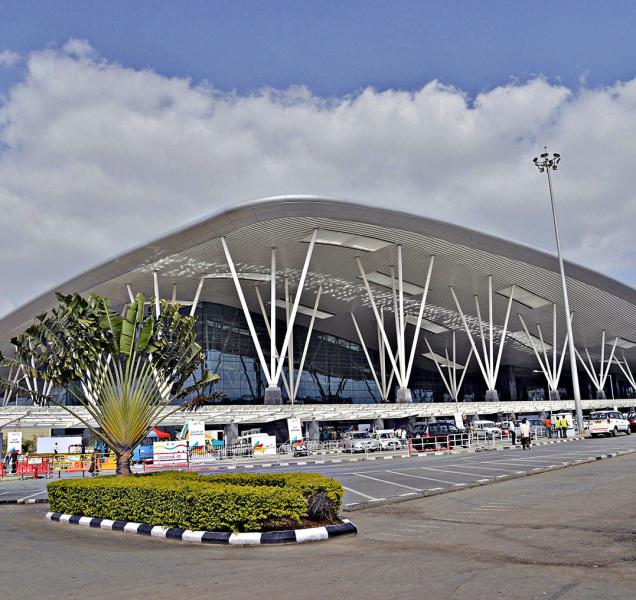
Kempegowda International Airport has become the first and only airport in the country to obtain a ‘GreenCo Platinum’ rating from the Green Building Council (GBC).
In a statement on Sunday, Bangalore International Airport Ltd. (BIAL) said the rating, given by the Confederation of Indian Industry (CII), reflects the environmental strategies adopted at the airport, which include water conservation, adoption of biofuel for ground operations, and use of solar energy, among others. The airport had received the ‘GreenCo Silver’ rating in 2012, becoming the first in the country to receive the rating after its launch by the Union Minister for Energy in 2011.
“We see this rating from the CII’s Green Building Council as a testimony towards our efforts in building an energy efficient and green airport,”said Hari Marar, president, Airport Operations, Bangalore International Airport Ltd.
source: http://www.thehindu.com / The Hindu / Home> News> Cities> Bengaluru / Staff Reporter / Bengaluru – February 29th, 2016
My friend Dr. L.R. Kadiyali died on 17th instant in Delhi at the age of 83. He is from Karnataka and his father Ramabhatta was a teacher in Kodagu.
He leaves behind his wife Bharathi and two daughters, Vrinda and Vasuda. Dr. Vrinda is an Associate Dean for Academic Affairs and Professor of Marketing and Economics in Cornell University.
Dr. Kadiyali graduated from Poona Engineering college securing first rank. He took premature retirement and established his own firm called Kadiyali Associates. It was a consulting firm which did work in the field of Highways all over India. This Kannadiga was a shining star in the firmament of engineering profession and has left many footprints in Karnataka’s prestigious Highway projects.
It is not merely a personal loss because he was my colleague in the Ministry and later became my boss and mentor when I worked in Orissa. We were also family friends. In his death India has lost an outstanding engineer.
He has left an indelible imprint with his works and also with two important books titled ‘Traffic Engineering’ and ‘Transportation Planning and Highway Engineering’ which are like a bible for engineers. They were the reference books for doctoral thesis for many students. Dr. Kadiyali has also done monumental research work funded by the World Bank titled ‘Road User Cost Study,’ which specifies the optimum speed for various types of vehicles to consume minimum amount of fuel. He was passionate about concrete roads and an authority on concrete technology. He was given the Life-time Award by Vizag Engineering College and in 2015 he got Life-time Award from the Indian Road Congress also. His firm, Kadiyali Associates, did not grow nor survive because he followed the strict principle of not bribing to get contracts.
He was soft spoken, simple and lived a spartan life. Dr. Kadiyali donated one of his kidneys to his relative when he was alive. And after his death he had asked his people not to do any havan or other ceremonies including shraddha. He had also instructed that nobody needed to come for his last rites but wanted his daughter Vrinda to press the button at the electric crematorium.
Later his daughter Vrinda sent me an e-mail which said: Thank you uncle.
He had a great life and a great end, we should all be so lucky to go this way.
NOTE: I must immensely thank Bapu Satyanarayana for sending this tribute for publication. Very thoughtful of him in these days of ‘blind-liberal democracy’ where every other Tom, Dick and Harry gets an award sponsored by the State and the State-funded Cultural, Sports and Academic institutions but not those like Dr. L.R. Kadiyali.
Reading this mere pen sketch of a profile of Dr. L.R. Kadiyali, I am wowed. People like him are the patriots, they know the real meaning of ‘Nationalism,’ unlike those leaders who visited JNU to cheer those who are still in the dark even after 69 years of independence to understand what ‘Nationalism’ means for India.
Nationalism should not be equated with secularism. In Hindu majority India, specially after partition on the basis of religion alone, Nationalism means simply loving your land first, then your religion or whomsoever (your party leader and the family, for example). Therefore, for all Indians, Nationalism should simply mean Bharat Mata ki Jai or Jai Hind or Vande Mataram.
No doubt Dr. Kadiyali is one gem among many, with purest ray serene stuck in the dark caves of unfathomed ocean called India and a flower born to blush unseen wasting its sweetness on the vast merciless Indian desert air, to add my voice to Thomas Gray’s regrets in a poem quoted in the beginning of this tribute. Which is why he did not even get a Padma Shri.
Looking at our roads, I wonder how many road building engineers might have read his books!
As in life, in death too Dr. Kadiyali has kept his ‘sacred’ sense of understanding life in its natural state and equanimity seen in the manner he wanted his mortal body’s disposal. Everything to the furrow, nothing to the grave. Even in death this man only thought about common good to all. To speak the language of Shakespeare:
His life was gentle, and the elements
So mixed in him that Nature might start up
And say to all the world, “This was a man.” — KBG
source: http://www.starofmysore.com / Star of Mysore / Home> Feature Articles / Monday – February 29th, 2016
Roller skating is a popular sport in Mysuru city and many roller skaters have gone on to do well in the National and International levels. Our city’s talented skater Rea Elizabeth Achaiah has done everyone proud with her performances in the National and International level in roller skating and Ice skating championships. Recently, Rea represented India in the tri-series Ice skating championship held at Singapore from Feb. 18 and performed well. She is our ‘Star This Week.’
Rea, daughter of K.N.Achaiah and Priya Achaiah, is a student of St. Joseph’s Central School, Vijayanagar.
Rea has represented India in the Pre-winter Olympic Camp held at South Korea in 2015 and has represented Karnataka in the National ice-skating championship held at Gulmarg, Srinagar in January 2016 and won 2 golds. She also represented Karnataka in the National Roller skating championships and won 4 golds and 1 silver medal in her age category.
This talented skater has so far won 15 golds, 2 silvers and 2 bronze medals in National championships and has emerged as the Individual champion twice.
This year, she was awarded the Pratibha Puraskar by the Governor of Karnataka for her achievement in the sport of skating.
Rea is coached by Ekalavya Awardee K.Srikantha Rao at Rao’s Roller Skating Club in Mysuru. Encouraged by her parents, her school and her coach, Rea intends to work hard in the days to come and bring more laurels for her State and country in both roller skating and ice skating.
source: http://www.starofmysore.com / Star of Mysore / Home> Sports News / February 28th, 2016
Senior Konkani litterateur Rev, Fr. V.J. Menezes seen interacting with writer and poet Valli Vagga (right) during the Konkani Literature Fest at Konkan Bhavan in city this morning.
Mysuru :
“The crave for English among younger generation has resulted in the age-old Konkani language, which has close links with Marathi, reaching a stage of extinction and there is a need to revive Konkani by creating awareness among children on the use of the language to preserve it,” opined President of Konkani Christian Association, Mysuru, Vincent Crasto, here this morning.
He was speaking after inaugurating the one-day All-India Konkani Literature Festival, organised by Konkani Christian Association (KCA), Mysuru, in association with All India Konkani Writers Organisation (AIKWO), Mangaluru, at Konkan Bhavan in Vijayanagar here which was attended by more than 400 persons from Mysuru, Mandya, Bengaluru and Mangaluru among other places.
Regretting a steep fall in the usage of Konkani even at homes, Vincent Crasto suggested that all efforts should be made to revive the language by organising seminars and other programmes which would not only help preservation of the language but also its growth.
AIKWO General Secretary, Dr. Edward Nazareth, speaking on the occasion said that publication of articles in newspapers and other forms of media would help in restoring the glory of Konkani, which needs to be preserved for future generations.
During the festival which began at 11am, Rev. Fr. V.J. Menezes interacted with Konkani Writers after which Dr. Rocky Miranda conducted a symposium on ‘The Old Konkani Bharatha’ after which participants from Mumbai, Bengaluru, Mangaluru and Mysuru participated in a ‘Poet’s Meet’.
A short play titled ‘GULIYO,’ written by Richie John Pais of Mangaluru and Directed by George William D’Souza of Mysuru was staged and winding up the day’s programme was Cultural programme in Konkani by the members of the association.
Earlier, before the commencement of the festival, a ‘Konkani Mass’ was held at the premises under the supervision of Rev. Fr. V.J. Menezes
KCA General Secretary John William D’Souza, Treasurer John Leo Rebellow, AIKWO President Vincy Quadras, Treasurer Richard Moras, Literature Festival Coordinator Valli Vagga were among those present.
source: http://www.starofmysore.com / Star of Mysore / Home> General News / February 28th, 2016
The kit comes in three languages — Kannada, English and Urdu
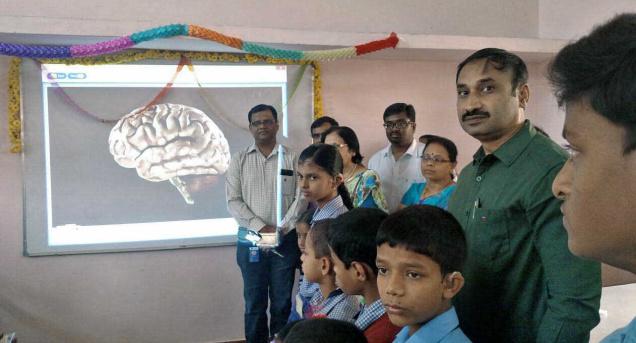
Vidwath Innovative Solutions, a city-based company, has developed a smart class kit for students of Classes 1 to 10. One of the features of the kit is digitalised, animated versions of all subject material. The kit comes in three languages — Kannada, English and Urdu — in order to cater to more students across the State.
Rohit M. Patil, managing director and chief executive officer of Vidwath, and Venugopal Rangaraju, the chief operating officer, told The Hindu on Friday that after working for three years straight with a team of over 35 software engineers, technicians and subject experts, they had managed to prepare digitalised and animated versions of all the lessons.
The lessons have been designed in such a way that students can easily grasp the ideas by actually seeing their representation instead of having to imagine them. For example, if a science teacher wants to explain the human heart or a rocket to students, he or she can just show them on screen and teach.
The kit includes a multi-touch interactive board, which is just like a touchscreen monitor. Even students can use the interactive board and open math tools like compass to draw diagrams on the screen.
According to Vidwath, there is great demand for their product and over 700 schools across Karnataka have already bought it. Of the 700 schools, 500 are Urdu schools.
Besides this, for many schools in rural areas, where backward class students are in large numbers, Vidwath has not only supplied the kit free of cost but has also appointed a tutor to teach the concept of ‘smart teaching’ to the teachers.
Mr. Venugopal said they have used high-end software and hardware to make the kits, which has all the lessons in 3-D. Mr. Patil said he plans to hold discussions with the higher-ups in the Education Department soon to make this “first-of-its-kind” kit available in all government schools. They also said Vidwath had supplied smart class kits to schools in Mysuru with children with hearing and speech disabilities.
source: http://www.thehindu.com / The Hindu / Home> National> Karnataka / by H.S.Narasimha Kumar / Mysuru – February 27th, 2016
Her interest in gardening, which she inherited from her father, led her to do something different — both as a passion and as a way of caring for the earth. When she found that the market is dominated by plastic and cement pots, neither of which are good for plants, she started making terracotta planters about seven years back.
‘Maati Terracotta’ is the brainchild of Shashi Bagchi, who started creating terracotta products before she decided to specialise on terracotta gardening pots.
“I was working with an advertising agency but left the job because boredom seeped in. I was always into gardening and over the years, I noticed that the pots available in the market are only the plastic and cement ones, both of which are not good for plants. That’s when the idea of making terracotta pots came to my mind. It was a part of my course back in college, but I also took a short-term course on terracotta before I took the leap,” says Shashi.
However, due to the non-availability of a physical unit in her initial days, she started off by going to Pottery Town, which didn’t work out for her as it was a difficult task to carry the completed works. Today, she has a studio where the entire process takes place.
She says, “I have my own studio where the complete process, right from designing and manufacturing to retailing and supplying takes place. I work with landscapers, corporates, individuals and architects. The entire process of creating terracotta pots involves a lot of physical labour and I solely work towards the upliftment of potters. Currently, we are concentrating on supplying our products to Coimbatore, Hyderabad and Chennai.”
Her forte lies in making large planters (standing as tall as four feet), animal-shaped planters, garden accessories like garden sculptures, bird feeders and bird baths, lamp shades, name plates and cooking utensils. Some of her popular items, she claims, are the ‘walking legs’ pot, wall murals, the kettle-shaped wall clock and the frog garden sculpture. Shashi’s main motive, she says, is to make people aware of the eco-friendly nature of these products.
While on one hand, terracotta products are gaining popularity among people these days, on the other hand, the younger generation of potters has stopped working in this business, resulting in a decline of the pottery industry.
She reasons, “The younger generation of potters is rarely seen carrying this forward. The
reason being that they are getting educated, which is a good thing, but these youngsters also don’t want to get their hands and clothes dirty. Though they will sit and admire the works, when it comes to doing it themselves, they will move away. I believe that the support they deserve and the physical space terracotta products require (during the entire process) is limited.”
But she says that ordinary pots don’t have any aesthetic value attached to them. When it comes to terracotta pots, the scenario is different — there is demand because there are different designs that one can find, the quality is better and a terracotta planter can stay up to 12 to 15 years, carrying an aesthetic importance with it. However, the easy availability of cement and plastic pots is what hampers this business.
As for the support and feedback she gets, she says, “I am blessed to have the support of my family. They are always curious to see what I am creating next. That inspires me to constantly keep creating unique products. Many people have come back to me saying that they like the finish I give to each item. Moreover, they are also fond of the innovative designs and the expressions I give to each creation. If one notices, they can clearly see that all my animal planters have a happy face. That attracts the attention of many customers.”
source: http://www.deccanherald.com / Deccan Herald / Home> Supplements> MetroLife / by Surupasree Sarmmah, Bengaluru / DHNS / February 27th, 2016
RSN Memorial Awardees – Music Director A.S. Prasanna Kumar, Sugama Sangeetha singer G. Pushpalatha and Composer Sunitha Chandrakumar – are seen with the guests and organisers.
Mysuru :
RSN Memorial Awards were presented to three doyens of music at a programme organised by R.S. Naidu Art and Cultural Welfare Trust at Nadabrahma Sangeetha Sabha on JLB Road here yesterday.
The event was held in commemoration of 30th death anniversary of Freedom Fighter and sculptor R.S. Naidu.
The awards were presented to Music Director A.S. Prasanna Kumar, Sugama Sangeetha singer G. Pushpalatha and Composer Sunitha Chandrakumar of Raghuleela School of Music in city.
Speaking as the chief guest, Visiting Professor of Mysore University Prof. C. Naganna lauded the services of late R.S. Naidu and his simplicity.
Bar Association President B.R. Chandramouli presided. Trust President Ramesh, Secretary Srinivas and others were present.
Later, Prasanna Kumar, leading a group of young singers, presented a music programme.
source: http://www.starofmysore.com / Star of Mysore / Home> General News / February 27th, 2016
Her muse might be centuries old, having lived and survived long enough to label it ordinary. But paper is central to designer Jenny Pinto’s life and keeps her enthralled, excited by what one can do with it. Right now, she is busy in designing a structured light in veneer and paper to be fit into a pitched ceiling for a client in Chennai. A few months ago, the Bengaluru-based artist had a particularly good showing at ‘The Amethyst’ in Chennai where she showcased her art in all its uniqueness, especially the hand-made elegant lamps in all shapes and sizes. Pinto puts to good use this meaningful, tactile and versatile medium as she dubs it by fashioning life-size book sculptures as well as quirky paper art.
Pinto’s sense of design goes back to the time she was a successful ad film-maker based in Mumbai. “Ad film-making requires one to have a wider design sense involving musical, visual and art direction. But it is different from a craft which is about materiality, form and function,” says Pinto, who moved to Bengaluru in 1996 to pursue a different career path.
Papers may have served as her vehicle of creative discovery but to explain the connection is not easy, says she, insisting that one cannot pin down the why of any artform or craft which is individualistic. Also, she is delighted by what one can achieve through this medium, as her art found an outlet in the products she designed, ranging from lights to home accessories and stationery including paper and sculptures.
The lighting designs—be it the flame of the forest table lamp, the oyster mushroom wall lamp or the sea urchin ceiling lights, blending in both aesthetics and functionality—seem to find their inspiration from nature. “I feel everything a person does is inspired by nature in essence, which is very wide and all-encompassing. It is about form, colour, light and randomness,” she says. As she takes us through the designs, she points to her favourite one, the passion flower chandelier inspired by dried flowers on a wild creeper. “I love the randomness of a creeper. It goes towards the light with the flowers usually lasting a day or two only for the creeper to have dried and fresh flowers to have bloomed at the same time,” says Pinto.
Sustainability is a key component of Pinto’s art. She makes her own paper using only natural fibres that are waste from agriculture like banana, sisal, mulberry, pineapple, kora grass and jute, preferring banana fibres over the rest. Her studio located off Sharjapur Road is an example of sustainable architecture. “All the paper is made in the studio which has been built from mud blocks. It recycles all water, grey water and the water from paper making,” reveals Pinto.
source: http://www.newindianexpress.com / The New Indian Express / Home> Magazine / by Sunita Raghu / February 20th, 2016