All posts by admin

Belagavi foundry cluster bags one more UNIDO project

Belagavi :

One more project has been sanctioned to the Belagavi Foundry Cluster (BFC) on behalf of United Nations Industrial Development Organization (UNIDO) and Bureau of Energy Efficiency (BEE) in the union power ministry.

Project is about promoting energy efficiency and renewable energy in energy intensive foundry units in Belagavi. Project aims at implementing energy efficiency practices and technologies, besides providing renewable energy options to help achieve higher energy performance to foundry industries.

In this regard, team from UNIDO will be visiting BFC on Friday. The team lead by Ayumi Fujino, representative of UNIDO and regional director for South Asia.

source: http://www.timesofindia.indiatimes.com / The Times of India / News Home> City> Bengaluru / by Ravindra Uppar, TNN / September 24th, 2015

A first of its kind

Naanu Avanalla, Avalu by B.S. Lingadevaru Halemane, which bagged two-national awards, is claimed to be the first such film for the Kannada film industry.

“Of course there were films on transgenders. But they dealt their issues as a sub-text, not a main-text. Our film is inspired by I am Vidya, a transgender’s journey , an autobiography of Living Smile Vidya”, said Mr. Lingadevaru.

Sanchari Vijay, who essayed the role of the protagonist, won the best actor award, which came to Kannada after a gap of 27 years. For the first time in the history of Kannada cinema, the film got the award in the make-up category.

Initially, he thought of casting a transgender for the role of Madesh, who transforms later as Vidya in the film, but that did not materialise. Many transgenders have acted in various roles, including that of Sharada Nani and Danamma.

source: http://www.thehindu.com / The Hindu / Home> News> Cities> Bengaluru / by Muralidhara Khajane / Bengaluru – September 24th, 2015

‘Nooru Rupayi’ made by city’s architects to be screened at fest in Washington DC

‘Nooru Rupayi’ is directed by architect Prashanth Raj.

Directed by Prashanth Raj, the 20-minute film with a budget of Rs. 2 lakh

Why do you think a group of young Bengaluru architects are rejoicing? Not an award for one of their best designed projects, but global appreciation for a well-made short film in Kannada, Nooru Rupayi(‘Hundred Rupees’) with English sub-titles.

The 20-minute film, directed by architect Prashanth Raj of Arch Venture in Sanjaynagar, has been selected to be screened at the Washington DC South Asian Film Festival on September 27, after bagging the Runner Up Award at the 5th Bangalore International Short Film Fest last month, and Special Awards at Mumbai, Calcutta, and UK Short Film Fests earlier.

Nooru Rupayi , with a budget of Rs. 2 lakh, was made by Prashanth Raj (director), Shilpa Patel (art director), Nitin (cinematographer), Guruswamy (Editor) along with the production team Raghav, Abhilash Pallaki, John Joseph, and Pramod Chandru (sound recording) and Abhijeet (music) — architects and engineering professionals who have a passion for films beyond their drawing board. The film, which revolves around a message to stand up against corruption and make a social change, was conceived and written by Prashanth, whose passion for “short films with a strong message” became easier after he took up a course at the Indian Institute of Moving Images.

The film took nearly four months to shape up, and has been entirely shot in the pastoral Thimmanahalli near Tumakuru, at the Chikkanayakanahalli hamlet, a four-hour drive from Bengaluru. “While I was raring to handle this subject of corruption revolving around a story of ‘puppy love’, a struggling village family and socially relevant issues of corruption that seem an accepted norm, it is the protagonist primary school boy Arvind’s (played by Srinivasa Murthy) early realisation of the gloom of dishonesty that makes him comprehend the power of the Hundred Rupees which sports Gandhi on it. When the young are made to realise that straightforwardness and sincerity maketh a good man, it’s a strong message,” says Prashanth.

The film’s endeavour is not just in its message, but the team’s effort in having the entire cast of 25 taken raw from the innards of Thimmanahalli. “We went to the village to uncover bundles of raw talent during child auditions. Finding a lady for the mother’s role was a challenge as local conservative women shied away from the camera. Our acting coach, John Joseph, helped them overcome inhibitions,” says Prashanth.

The film’s aesthetics also brings in Karnataka’s folk Veeragase showing intense energy-sapping dance movements to represent expressions of conflict and resolution for the young hero. That Prashanth is interested in his potent message is evident when you consider that his first short film Psycho’s Jury — which brings out the travails of an architect to practice what he preaches — bagged the Indian Institute of Architects Award.

source: http://www.thehindu.com / The Hindu / Home> News> Cities> Bengaluru / by Ranjani Govind / Bengaluru – September 24th, 2015

Manipal university team help discover four exotic atomic nuclei

Manipal :

Researchers from Manipal Centre of Natural Sciences (MCNS) at Manipal University in collaboration with GSI-Giessen, Germany have discovered four new atomic nuclei to be added to the chart of the nuclides. The study focuses on developing new methods of synthesis for super heavy elements. The newly discovered, exotic nuclei are one isotope each of heavy elements berkelium and neptunium and two isotopes of the element americium.

H M Devaraja, a PhD student at MCNS, participated in experimental work along with an international team of researchers at GSI Helmholtzzentrumfur Schwerionenforschung. Other participants included scientists from Justus Liebig University Giessen, Germany, Japan Atomic Energy Agency, Lawrence Livermore National Laboratory, USA and the joint Institute for Nuclear Research in Russia. The results are published in Physics Letters B.

Apart from discoveries themselves, first proof of the new technique for production of these exotic nuclides will pave way for a new generation of exciting experiments at the frontiers of experimental physics. It is a proud moment indeed for the team and the collaboration. I expect that continuing investigations will uncover many more surprises as our team explores previously unknown areas and extends the chart of the nuclides, Dr Bhat said.

Gottfried Munzenberg who initiated the Giessen-GSI-Manipal collaboration together with Mohini Gupta expressing happiness at the discoveries, said “Synthesis of new isotopes in nuclear transfer reactions is milestone in search for new methods for SHE synthesis, the principal research goal of our collaboration”. Mohini Gupta, director, MCNS said, “Now that we know this method is viable, interpretation and prediction is two other important aspects of the discovery.”

Newly discovered isotopes have fewer neutrons and are lighter than previously known isotopes of the respective elements. To date, the known Periodic Table comprises over 3,000 isotopes of 114 chemical elements. According to scientific estimates, more than 4,000 additional, undiscovered isotopes should also exist. “By using this method, we have succeeded in generating many different atomic nuclei at once,” says Dr Sophia Heinz who headed the experiment at GSI.

source: http://www.timesofindia.indiatimes.com / The Times of India / Home> City> Mangaluru / TNN / September 16th, 2015

A green house in the urban jungle

SolarBF18sept2015

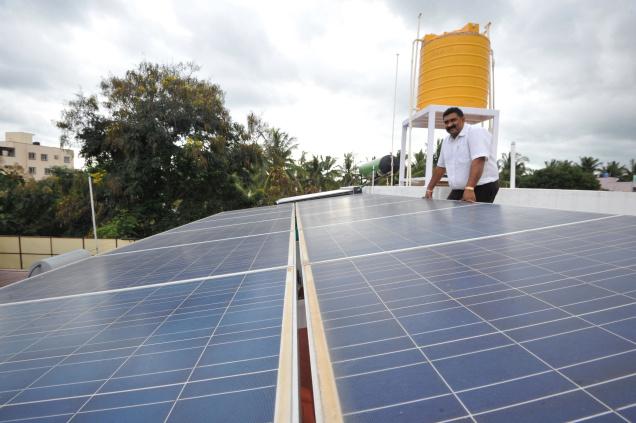
At the first look, this house looks like any other. But it is different from other houses in ways more than one. That is why its occupants were neither affected by the power cuts last fortnight nor do they remember when it was the last time that they cooked on LPG-fuelled stove.

S.S. Raghunandan, a renewable energy technologist, adopted a green way to build his three-bedroom house in Vidyaranyapura. In an attempt to reduce carbon footprint, he installed a solar power generation unit. The unit produces enough energy to meet the needs of the household, and Mr. Raghunandan also manages to earn around Rs. 20,000 a year by selling additional power generated to Bangalore Electricity Supply Company.

The rooftop solar power unit generates 10 to 12 units of electricity every day, while the household requires only around 4 units a day. All appliances, including lights, fans, washing machine and refrigerator, run on solar energy.

Besides that, the solar power panels prevent direct sunlight from falling on the building, thus reducing the need for air-conditioners.

Mr. Raghunandan’s house also has a rooftop garden. Using bio-waste, organic manure is produced and used in the garden to grow plants. To top it all, the rain-water harvesting system adopted by the occupants makes the house an ideal eco-friendly one that is worth emulating by people in the urban jungle.

source: http://www.thehindu.com / The Hindu / Home> News> Cities> Bengaluru / by Tanu Kulkarni / Bengaluru – Friday – September 17th, 2015

Cultivation of red cabbage turns lucrative

Hubballi :

Streetside Chinese snack makers would struggle to find red cabbage, which is not grown in the district, and the cost of the leaf flower is high, too, because it would be imported from neighbouring districts and states.

To cover this deficit, local farmers are beginning to grow red cabbage, having discovered that it is lucrative. There are other such crops, too, which are attractively priced. Snack stalls use red cabbage extensively to garnish Chinese dishes like gobi manchurian, noodles and salads, and in its absence, looked for alternatives.

Anitha Golappanavar, a resident of Managundi of Dharwad, has taken up cultivation of this infrequently grown vegetable, with technical aid from the horticulture department. “I studied the marketing strategy of red cabbage and learnt the mechanisms of growing it with their assistance. It can be easily grown as we grow common cabbage in the Dharwad climate,” she said.

She added that it has limited marketing network, so she found a way to market it online, because it has a good market in Mumbai, Mangaluru and Delhi. “I was inspired by a documentary on a private TV channel and got information on the internet. It’s an experiment in our land; my husband is also an employee of the horticulture department, and technically supported me to grow it with drip irrigation. The seeds were brought from Mysuru.”

Arun, food manager at Denissons Hotel, said red cabbage is used for garnishing salads and snacks, and is costlier than the regular green-white cabbage. “We used to bring them from Bengaluru, Belagavi and other parts of the state. If it’s available in the local market, it is helpful for us, especially street vendors,” he said.

Saralamma, senior assistant director of the horticulture department, said details of the grower and supplier, contractor and user of the flower are easily available on websites. The crop could a get good a price in the market and the climate of the district is suitable for growing it, too.

source: http://www.timesofindia.indiatime.com / The Times of India / News Home> City> Hubballi / TNN, September 07th, 2015

City girl bags Gold Medals in Naturopathy Sciences

Dr. Jasmine D’Souza is seen receiving the certificates from Dharmasthala Dharmadhikari Dr. D. Veerendra Heggade at the convocation ceremony held at Dharmasthala as Delhi Chief Minister Arvind Kejriwal and Health Minister U.T. Khader look on.

Mysuru :

City girl Dr. Jasmine D’Souza, a student of SDM College of Naturopathy and Yogic Sciences, Ujire, affiliated to Rajiv Gandhi University of Health Sciences, has won two gold medals for academic excellence and Best Outgoing Doctor for the Year 2014-15.

She received President’s gold medal and Sitaram Jindal Foundation gold medal from Delhi Chief Minister Arvind Kejriwal at the convocation ceremony held at Srikshetra Dharmasthala on Sept. 9.

Dharmadhikari of Dharmasthala Dr. D. Veerendra Heggade and Health Minister U.T. Khader were present on the occasion.

Jasmine had bagged 2nd rank in 1st and 2nd year cousre, 1st rank in 3rd year and now being the University gold medalist in the final year. She has been honoured with Dr. M. Gayathri Silver Medal, Dr. B. Narayana Rao Endowement Cash Prize, Dr. J.V. Chandrika Cash Prize and Dr. Ashok Kumar Memorial Cash Prize.

She is the daughter of John William D’Souza (BEML employee and Secretary of Konkani Christian Association, Mysuru) and Florine D’Souza, residents of KHB Layout, Hootagalli, Mysuru. She completed her schooling at Notre Dame School securing 87.6% in 10th ICSE board exam (topper of Notre Dame school in 2007-08) and PU from Sri Raghavendra Gurukula, Mysuru, with 94.3%.

source: http://www.starofmysore.com / Star of Mysore / Home> General News / Tuesday – September 15th, 2015

Nominated as Advisory Panel Member of Finance Ministry

NarasimhmurthyBF15sept2015

Mysuru :

The Ministry of Finance, Department of Economic Affairs (Currency and Coinage Division), New Delhi, has nominated Star of Mysore columnist Prof. A.V. Narasimha Murthy (AVN), former Head, Department of Ancient History and Archaeology, University of Mysore, as a member of its newly-constituted Advisory Committee.

The Committee will advise the government on various matters including the shape, size, weight, metal, face value of the money, cost of production of the coins, etc.

Prof. AVN is an expert in ancient Indian coinage and has written many books on the subject. He was the Chairman of the Numismatic Society of India (Varanasi) and General Secretary of South Indian Numismatic Society (Chennai) and has been honoured with many awards for his contribution to Indian coinage.

Currently the Chairman of BVB, Mysuru, Prof. AVN was recently honoured with the title Karnataka Puratatva Ratna by Chief Minister Siddharamaiah.

source: http://www.starofmysore.com / Star of Mysore / Home> General News / Tuesday – September 15th, 2015

Strategic crude oil caverns await their day in the sun

CrudeOilBF14sept2015

Mangaluru, the only port city in Karnataka, is already in the world map for its educational institutions, medical colleges, birthplaces of five banks (including four nationalised banks), the only refinery in Karnataka, and for the lone urea manufacturing facility in Karnataka — among many other firsts.

Now, as the work on the underground rock caverns for strategic storage of oil is almost complete, coastal districts Dakshina Kannada and Udupi are in the news again.

While oil major Royal Dutch Shell is said to be in talks to lease India’s new strategic oil caverns at Permude (near Mangaluru in Dakshina Kannada district) and Padur (in Udupi district), the authority concerned — Indian Strategic Petroleum Reserves (ISPRL), a wholly owned subsidiary under Oil Industry Development Board (OIDB) of the Union Ministry of Petroleum — is taking all steps to speed up the work on both the projects to meet the December 2015 deadline.

In fact, out of the three underground rock caverns in India, one is in Visakhapatnam (9.75 million barrels capacity, which is ready for commissioning), while the other two are in Permude (11 million barrels) and Padur (16.12 million barrels). In all, 36.87 million barrels of crude (five million tonnes). The three facilities will be able to store crude for 12 days in case of emergency.

As on date, if all refineries in India are put together, they will be able to store crude oil for only three days of consumption. Hence, when the three facilities are commissioned, India will be able to store crude for 15 days of consumption, much less compared with developed nations which store crude oil for up to 90 days of consumption in their underground caverns.

At both the sites, underground work is almost over. What remains are electrification and laying of pipelines. Awaiting completion are pipeline work extending to nearly 4 km (of the 12 km) from shore to Permude, and 34 km (of the total 36 km) from Permude to Padur. The existing, 17-km-long  pipeline from mid-sea mooring system to seashore, presently being used by Mangalore Refineries and Petrochemicals (MRPL), will be used for shipment of crude oil to ISPRL caverns as well.

The beginning

It may be recalled that the government of India proposed to construct the underground cavern storage at Mangaluru based on the detailed feasibility report prepared by Engineers India (EIL) along with Geostock Engineers, France. SKE&C, part of the $138.7-billion South Korean SK Group, with vast experience in the construction of such caverns, tied up with Karam Chand Thapar (KCT) for the execution of the project worth Rs 403.5 crore.

In case of Padur, there are two underground rock cavern divisions, each with 8.6 million barrel capacity worth Rs 375 crore each. While one is being constructed by SKE&C-KCT, the other is being constructed by Hindustan Construction Company (HCC). Work on both cavern divisions is complete and has been sealed a few months ago.

While the work on the underground rock cavern in Mangaluru began in April 2009, the work on the Padur caverns began in May 2010.

tnam, Mangaluru, and Padur are Rs 1,178.35 crore, Rs 1,227 crore and Rs 1,693 crore respectively, and the total cost of all three projects is Rs 4,098.35 crore.

The compensation bug

When contacted, Karnataka Industrial Area Development Board (KIADB) Special Land Acquisition Officer Dase Gowda said that nearly 1,250 notices have been issued to provide compensation for owners of the land through which the 48-km-long pipelines would pass through.

Though 1,250 notices have been issued, the affected persons/families are only 600 (400 in DK from 17 villages, and 200 in Udupi from seven villages) as notices have been issued to all the persons whose name appears on RTC (rights, tenancy, and crop inspection) documents in the proposed land through which the pipeline passes. Interestingly, only 40 persons/families have availed the compensation in DK and 12 persons/families in Udupi district so far, amounting to Rs 55 lakh (out of the Rs 2.5 crore released in the first phase).

“While many could not claim compensation due to lack of documents, improper documents, or lack of documents on inheritance, others want more compensation,” Gowda said. He claimed that the compensation provided in the case of ISPRL pipeline is 10-fold of what is usually paid in such cases. This was done to expedite the pipeline work, he said.

“Under Right of Use (RoU), landowners are free to grow any crop, including paddy, ragi, vegetables, or do any other activity except construct permanent structures (homes) and plant saplings which could grow into huge trees. Though only 10 per cent of market value is given as compensation for RoU, it has been now raised 10-fold. Despite this, many are not coming forward, perhaps due to misguidance by a few leaders,” he rued.

To another query, Gowda said that if the persons concerned fail to accept the compensation, the only other option was to deposit the amount in court as it is a national project. Owners can move court whenever they want settlement, he said.

When contacted over phone, ISPRL Chief Executive Officer Rajan K Pillai said the special purpose vehicle (SPV) is trying its best to complete the project by December 2015. When pointed out that as on date, hardly 10 per cent of persons/families have availed the compensation and work on the pipeline could be started only after that, he said he is trying his best. “We have given the deadline to the contractor and we hope to complete the project by December 2015,” he said. Sources in the district administration, however, said that the completion of the pipeline may be delayed by a few more months, though nothing is impossible.

Once all the work is completed, attention would turn to filling up these three caverns with 36.87 million barrels of crude oil. By some estimates, it will cost more than Rs 25,000 crore. Considering the fact that oil prices are ruling low at present, the speedy completion of the project and quick purchase of crude oil would save a tidy sum for the exchequer.

source: http://www.deccanherald.com / Deccan Herald / Home> Supplements> Economy & Business / by Ronald Anil Fernandes / DHNS – September 14th, 2015

SJCE students win prize at PACE Forum, Brazil

 From left: Prof. V. Basavaraj, SJCE- PACE Coordinator and Dr. K. Chandrashekara, SJCE - CIC Project Mentor, along with the students of SJCE, seen receiving the award from Dr. Delia J. Valles Rosales (extreme left), Professor & PACE- CIC Coordinator, New Mexico State University
From left: Prof. V. Basavaraj, SJCE- PACE Coordinator and Dr. K. Chandrashekara, SJCE – CIC Project Mentor, along with the students of SJCE, seen receiving the award from Dr. Delia J. Valles Rosales (extreme left), Professor & PACE- CIC Coordinator, New Mexico State University

Mysuru :

The “iREACTOR” project by the students of Sri Jayachamarajendra College of Engineering (SJCE), Mysuru, won the II prize in Pace Global Annual Forum held in Sao Paulo, Brazil. It was a Collaborative Innovative Challenge competition in University of São Paulo, Brazil.

The students involved in this project were Aniketh Mohan Rao, Abhiram Madenur Venkatesha, Suraj Handithavalli Purushothama and Vadiraja Mysore Nagendra. This project was guided by Dr. K. Chandrashekara and mentored by Prof. V. Basavaraj.

“A Comparative FEM Analysis of Tribological and strength characteristics of composites of PF and ER matrices reinforced with GF and other filler materials with commercially available Brake pads” won the III prize for outstanding poster preparation and presentation. The students involved in this project were M.N. Vadiraja and Mohan Kumar. This project was guided by Dr. K. Chandrashekara and mentored by Prof. V. Basavaraj.

In addition, 1 CIC project, 2 CIC poster presentations and 2 Technical paper poster presentations were presented by SJCE in the Global Forum, which consisted of 65 globally recognised PACE institutions from all around the world, five of which are located in India. A total of 5 students participated in the Siemens NX Basic certification training programme in the Forum and Srikanth of I&P and Mohammad Anshad of Mechanical Engineering cleared the NX Certification exam and they were awarded the Basic NX trainer certificates by Siemens PLM software, USA.

Further, the students of SJCE who participated in RSMS (Reconfigurable Shared use Mobility System) project as TEAM 6 with other Universities — PES University, Bangalore, MSRUAS, Bangalore, Wuhan University of Technology, China, Michigan Technological University, USA and ITAM, Mexico — prepared a prototype model of RSMS which is a four -wheeler vehicle with the provision of reconfigurable and shared use mobility system.

SJCE students Srinidhi Bukkapatanam, Nikhil Somashekar Murthy, Vijayeendra Rao Harnall Padmanabh, Suraj Handithavalli Purushothama and Srikanth Nanjundaswamy participated in this project. RSMS project was sponsored fully by General Motors and PACE consortium. This project was guided by Prof. V.Basavaraj and Dr.R.Srinidhi and mentored by Dr. V. Ramesh.

SJCE PACE Coordinator Prof. V. Basavaraj along with project mentor Dr.K. Chandrashekara with 13 students of SJCE attended the PACE Global Forum and received these awards.

This is the 5th consecutive time that SJCE has excelled at the Forum.

source: http://www.starofmysore.com / Star of Mysore / Home> General News / Monday – September 14th, 2015