
All posts by admin

Roving on glorious wheels

Vintage pride

LandroverBF04aug2015

Omar Kaiser jokes that had he not been married, he would have been in the Andamans now with his prized possessions — three classic Land Rovers. Hailing from Bengaluru, Omar runs an adventure tourism company, owns lounges and recently started a garden store in the City. “My plan is to go back to adventure tourism where these vehicles play an important role. It was with this intention that I started collecting these Land Rovers. These vehicles have a rich history due to their capability and reliability. More than speed, it’s the capability of the vehicle that is important and the Land Rovers are the best when it comes to being reliable even in the most difficult conditions,” he says.

He remembers his father as an adventurous person, who was not only a mountaineer, horse rider and badminton player, but also a two-wheeler and four-wheeler rallyist.
“At a young age, I was introduced to the outdoors. I took part in various rallys and activities like camping and now, I make sure that my children are also exposed to them,” he says.

Ask him about how he developed a passion for vintage and classic cars and he says, “In 2007, my friend Narayan introduced me to the Land Rovers. Those days, they were not expensive and people did not value them much. So I thought it was a great opportunity to collect them. I bought three for myself and picked up four more for my friend.”

The classics, according to Omar, are tough and not meant to be driven fast. All the three vehicles he owns came to India as ambulances or health care vans, either donated by the WHO or individuals.

The rarest among them is the 1966 Land Rover, an open-top vehicle that belongs to the II A series. It had come from Kulu Manali Mission Hospital as an ambulance. “The surprising part about this Land Rover is that it still has the original engine and gearbox. Razak, the previous owner, had taken a lot of effort to maintain it,” he adds.

The second in the collection is a green Land Rover from Kerala, which belongs to series III 109. It is a 1973 model that belonged to Caritus India, an NGO in Thrissur and was used as an ambulance. The third one in the collection is the white 110 petrol Land Rover, which belonged to the National Tuberculosis Institute, Bengaluru and was used to transport X-ray machines. “All the three vehicles I own are 4×4’s. I also bought a Willys jeep two years ago, which belonged to the Indian Army in 1981.” He adds, “Finding a Willys with a trailer is very rare and I was lucky to have found this one in a small village in Thirthahalli on the outskirts of Bengaluru.”

Omar and his children consider these vehicles as family and like to call them by the names that they have given to each one of them.

Omar explains, “It was the 1966 model that made me start collecting Land Rovers. The effect that she had on me was so magical that I named her Maya. I call the one from Kerala — Kairali. She was used as a school bus, ambulance and civil bus before she came to me. Incidently, I found her without a gearbox and an engine and restored her. The last one in the collection is a petrol vehicle and I like to call her Laaila — she is the fastest and most efficient. We call the Willys — Billy, the goat.”

On how he maintains his collection, he says, “I understand vehicles and have been maintaining them for a long time. So I do all the work myself. I source parts from Mumbai and Siliguri and have not imported a single part. Till date, I have never towed any of them to the garage. I have always driven them as they have been in a working condition.”
He adds, “These cars are built to last — the Land Rovers have aluminium bodies and their chassis are made of galvanised steel. This vehicles will live longer than everybody alive today. It is said that 70 per cent of the Land Rovers, that have been manufactured since 1947, are still running.”

Speaking of his love for these vehicles, he says, “After my family, I love my cars the most! I personally want to go to the Andamans. I tell my wife a lot of times that if I was not married, I would have been in the Andamans with Maya, Laaila and Kairali and would have never come back,” he laughs. For details, call 9845581829.

source: http://www.deccanherald.com / Deccan Herald / Home> Supplements> MetroLife / by Surupasree Sarmmah , DHNS / August 04th, 2015

Hubballi’s jowar rotis now make it to Oz, US

Hubballi :

The humble jowar roti — the North Karnataka staple — is now crossing the seas to reach homesick Kannadigas yearning for its chewy wholesome goodness.

Growing demand from Australia, England, West Asia and the US has spawned a small-scale industry in Hubballi, a busy commercial hub 400km north of Bengaluru, with dealers and agents spread across the region. Exported in its kadak (crisp) avatar, the jowar roti has a shelf life of 6-9 months.

Poorva Food Products, run by the Patil family, discovered this niche global market and has now gone online.

Lingangowda Patil, who runs the family unit with wife Pushpa and son Girish, says they realized the demand for the roti was going up, as more people migrated from this tier-2 city to other parts of the country and world.

Started in a mess with a paying guest facility in Vidyanagar in 2011, Poorva Food Products has swiftly expanded from 2-3 women making 500-600 rotis, to around 35 women patting out 10,000-12,000 pieces a day. With sales touching 1.5 lakh to 2 lakh rotis a month, the monthly turnover of the 3,800-sqft unit, set up in the city’s industrial area, is pegged at Rs 6-8 lakh.

“We started with an investment of Rs 15-20 lakh. Now, we’ve installed a flourmill, grain-cleaning machine, and other infrastructure,” Patil says.

Business is channeled through dealers who buy rotis in bulk to sell at their own outlets and to customers spread across Karnataka, India and abroad. Like Arun Torgal, who exports rotis to Australia every three months. “Last week, I exported 16,000 rotis. Natives of North Karnataka form a major market in Australia. With the rotis, I also export flax (alasi) seed and niger seed (ramtil) chutney,” he says.

Pushpa Lingangowda Patil takes care of the quality and supplies. “We need 30-40 quintals of jowar every month to meet the demand. We also sell sajji (bajra) roti, ragi roti, half-baked chapatti, senga (groundnut) chutney, flax seed and niger seed chutney. But the demand is highest for kadak jowar roti.”

“There are many who have jumped into this business today, but they often mix other grains with jowar, which changes the taste. We use only jowar,” Pushpa Patil says.

Each roti costs Rs 3.50. About 10-12 rotis are packed into a food grade packet and placed into boxes to be exported without breakage — with three layers of packing for transport within India, and seven layers for export. “Packing and transport cost extra. Our packing ensures the nutrition value of the roti is retained,” she says.

The highest demand is from Bengaluru, Bidar, Kalaburagi and Vijapayapura in Karnataka, besides Gurgaon, Mumbai, Hyderabad, Surat and the states of Himachal Pradesh and Gujarat. Demand peaks during festivals like Sankranti and the marriage season, touching 3-4 lakh rotis a month. Online booking and payment are pushing up sales, with orders being sent to the customer’s doorstep.

“We export to Dubai, Muscat and some parts of America, besides Australia and England. A few days ago, we sold 600-800 rotis to families leaving for England and the US,” says Lingangowda Patil.

Poorva does not have an export licence yet, and is exporting through its agents. Patil has applied for one and is putting in place norms laid down by the Food Safety and Standards Authority of India. “Gloves, caps and uniforms are a must for workers. The unit must be equipped with filtered water facility and have high hygiene standards. We are adopting all these norms. Once we get the licence, exports will be more regular,” Patil says.

SS Reddy of Tirumala Foods, Bidar, buys 40,000 to 45,000 rotis from Hubballi every month. “Every day, we export 200 rotis to America and 200 to England. We send rotis to Hyderabad and Tandur in Telangana, and Latur in Maharashtra, by air.”

source: http://www.timesofindia.indiatimes.com / The Times of India / News Home> City> Bengaluru / by Basavaraj Kattimani, TNN / August 01st, 2015

Karnataka lauded for promoting classical music

N. Murali, President, Music Academy, Chennai, and Co-chairman of Kasturi and Sons Ltd., with Mysore V. Subramanya (right), violinist M. Chandrasekaran (left), and vocalist M.S. Sheela at Veeneya Bedagu 2015, at Bangalore Gayana Samaja in Bengaluru on Saturday. Photo: K. Murali Kumar

The occasion saw the Swaramurthy V.N. Rao Memorial Trust confer two national awards to violinist M. Chandrasekaran and M.S. Sheela.

Lauding Karnataka and Bengaluru for promoting classical music, particularly for keeping alive the Mysore traditional school of stylistics in Carnatic music for future generations, N. Murali, president of the Music Academy, Chennai, has said that if Chennai is hosting a big December fare with classical melody, Bengaluru equally scores with its several festivals connected to classical music throughout the year.

Mr. Murali, Co-chairman of Kasturi and Sons Ltd., publishers of The Hindu , was taking part in the 12th edition of ‘Veeneya Bedagu’ at the Bangalore Gayana Samaja on Saturday. The annual music festival is held in memory of Veena Sheshanna. The festival also coincided with the centenary celebrations of V.N. Rao, the vainika who took forward the time-honoured Sheshanna school of play. “Sheshanna was a musician, teacher and a significant post-trinity composer. We at the Music Academy in Chennai have also had the privilege to release his compositions in Tamil,” said Mr. Murali.

The occasion saw the Swaramurthy V.N. Rao Memorial Trust confer two national awards — Veena Sheshanna Memorial National Award on violinist M. Chandrasekaran and Swaramurthy V.N. Rao Memorial National Award on vocalist M.S. Sheela.

“Both Mr. Chandrasekaran and Ms. Sheela, who have held the flag of Carnatic music aloft in their career spanning a few decades, richly deserve the awards,” said Mr. Murali. Mysore V. Subramanya, managing trustee of the trust, said several CDs of Veena Sheshanna’s compositions by renowned musicians have been released by the trust.

source: http://www.thehindu.com / The Hindu / Home> Cities> Bengaluru / by Ranjani Govind / Bengaluru – August 02nd, 2015

Shipping ministry launches Sagarmala Project in Karnataka

Mangaluru :

Union Ministry of shipping launched the NDA government’s ambitions Sagarmala Project in the state at Hotel Taj West End, Bengaluru in the presence of Kaushik Mukherjee, chief secretary, government of Karnataka; additional secretary, union ministry of shipping, principal secretaries and senior officers from the state and central governments, stakeholders and representatives from chamber of commerce, railways, FKCCI, FIEO, and so on.

Sagarmala has been envisioned to provide ports and shipping the rightful place in Indian economy and to enable port-led development. The prime objective of the project is to promote port-led direct and indirect development and to provide infrastructure to transport goods to and from ports quickly, efficiently and cost-effectively, noted P C Parida, chairman, New Mangalore Port Trust, while briefing about the importance the union government attached to the project.

Kaushik urged the centre to include vital projects like four laning of Mangalore-Hassan NH and linking of Hubballi-Ankola railway line in the project so as to ensure seamless movement of cargo to and from the Port. He also emphasized need for one more major port in North Karnataka for overall development of that region. According to him early completion of fisheries harbour here and relaxation of CRZ regulation for developing tourism should be part of Sagarmala.

R K Agarwal, joint secretary to government of India (Sagarmala), Ministry of Shipping gave a presentation on overall vision of Sagarmala project and its benefits to the state. This was followed by stakeholders’ session that deliberated the role of Sagarmala Development Company [SDC] and funding pattern of projects to be undertaken under Sagarmala. A K Saran, deputy secretary, government of India, ministry of Shipping proposed the vote of thanks on this occasion.

source: http://www.timesofindia.indiatimes.com / The Times of India / News Home> City> Mangaluru / by Jaideep Shenoy, TNN / August 02nd, 2015

Portable washing machine needs no power, little water

It’s a portable washing machine, or rather, a washing drum. It needs no electricity, running on power generated by operating a pedal. It uses just 50 litres of water and detergent to wash 5kg of dry clothes, and best of all, can be ridden to the water source.

This invention by a team of three scientists -Amaresh Chakrabarti, Manish Kumar and Pulin M Raje -from the Centre for Product Design and Manufacturing (CPDM) of the Indian Institute of Science (IISc) – prom ises to be a boon to rural areas, where electricity is scarce and piped water is still a pipe dream. The CPMD is largely perceived to lack such innovations or inventions for the common man.

Conceived in 2008, the washing drum has gone through many processes and is patented. The Society for Innovation and Development (SID), within the IISc campus, is now liaisoning with industry to take it to the market.

A senior SID official told TOI: “The primary objective of IISc is research. We also have such products and technologies and the SID and incubation centre try to push them.”

He, however, conceded there is no aggressive marketing. “There are many companies that come scout ing for talent and ideas, we showcase these things to them. Otherwise, there is no advertising or media publicity for these inventions,” he said.

Amaresh Chakrabarti said: “I ideally wanted to find a startup partner, with students involved in the project. A patent has been granted, but the students left for other jobs. I’m seeking an appropriate person to in cubate the startup, as part of the MHRD-funded programme called Design Innovation Centre (or DIC) that was approved by the Sam Pitroda committee of the National Innovation Council. We hope to start incubation in the coming year.”

“Our invention is a substantial improvement over hand washing, which requires about 200 litres of water and takes two hours, while conventional machines also need 200 litres of water and take 65 minutes,” say the scientists, and claim that hand washing using similar brushes leads to greater damage to clothes.

11 inventions wait for funds

Eleven other inventions from IISc are ready and waiting for incubation. It’s a pointer to the fact that the institute is working to get its collective intellectual property to benefit the common man. Among the inventions is a mechanized harvest device specially suited for tea and herbs, which require meticulous selection of the shoot. Scientists claim this enhances productivity three-fold.

The list also has a device that enables visually challenged individuals to accurately construct geometric figures, like circular arcs and straight line segments, in a manner that can be equally understood by able individuals.

source: http://www.timesofindia.indiatimes.com / The Times of India / Home> News> City> Bengaluru / by Chethan Kumar, TNN / July 31st, 2015

SVYM of Mysuru adjudged Best NGO in India

Mysuru :

Swami Vivekananda Youth Movement (SVYM), a city-based development organisation engaged in building a civil society through its grassroots to policy-level action in health, education and community development sectors, was adjudged as India’s Best NGO at an event organised by ‘The Resource Alliance’ and sponsored by the EdelGive Foundation and The Rockefeller Foundation to honour NGOs.

SVYM was chosen from among 300 NGOs across India. The award was given to SVYM for adhering to highest standards of resource mobilisation, accountability and transparency in day-to-day functioning, thus setting an example worth emulating for other non-governmental and non-profit organisations.

On July 23, Dr. R. Balasubramaniam, Founder & President, SVYM, had given a presentation before the final jury round.

On July 24, the Indian NGO award was presented to SVYM, which was received by Dr. M.R. Seetharam, Vice-President, SVYM.

source: http://www.starofmysore.com / Star of Mysore / Home> General News / Saturday – July 25th, 2015

IGRMS to host National Seminar on ‘Museum Movement’ in city

Mysuru :

Indira Gandhi Rashtriya Manav Sangrahalaya (IGRMS), Mysuru, in collaboration with Regional Museum of Natural History (RMNH), is organising a two-day National Seminar on ‘Museum Movement in South India’ on July 27 and 28 at RMNH premises in Siddarthanagar here.

The seminar will be inaugurated by Prof. Sarith Kumar Chauduri, Director, IGRMS Bhopal.

Prof. P.K. Misra, President, Anthropological Association, Mysuru, will be the chief guest.

The seminar will emphasise on: Museum and Sustainable Society; Curatorial experience linked with exhibition making or making of new museums; Collection and display of objects linking with a conceptual/ideological frame; Museum and vernacular art and architecture; Museum and the emerging social reality; Museum, State and Communities in the digital age.

About 25 delegates and museum professionals will present their papers during the meet. Those who are interested to participate in this seminar may contact Sh. V. Ashok Vardhan, Museum Associate on Mob: 09036373618 or Ph: 0821-2448131.

source: http://www.starofmysore.com / Star of Mysore / Home> General News / Saturday – July 25th, 2015

Wobbling, but still standing

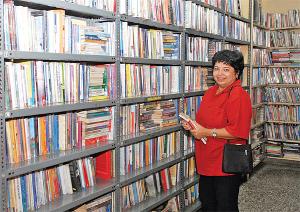
EloorLibraryBF31jul2015

Eloor, the 27-year-old city library, continues to ward-off competition from e-portals with a satisfied reader base of 17,000 members

Sixty three-year-old Meera Khanna comes to Bengaluru from her farm in Nandi Valley, Sultanpet Village in Andhra Pradesh once every two weeks — “to pick up a few books from Eloor Libraries” on the ground floor of Blue Cross Chambers on Infantry Road. In this world swamped by ebooks, online libraries and new-age libraries like JustBooks, “Eloor” as it’s known by everyone in Bangalore boasts of 17,000 members. This was the place where once you would find Girish Karnad or Ramachandran Guha standing with titled heads, reading quietly by the book shelves — Eloor has no reading room. There’s just a “private room” where “old books” are stored.
Khanna was introduced to Eloor by her son, who now lives in the US. “He became a member of the library when he was a teenager.” And why she crosses borders to borrow books? “There’s no better feeling than picking an old book with yellowed-pages.” And also Eloor has any book that she wants and “a very good layout”.

Eloor was first established in 1979 by Luiz John in Ernakulam, Kerala. According to their website it was because “the government libraries had not been able to satisfy the hunger for books; plenty of new titles were getting published, but there were only very few readers who could buy the books they wanted. Readers truly needed a library like Eloor”. The Bangalore branch was opened 1988. Its shelves stack rows of English books across various genres such as fiction, non-fiction, autobiographies, biographies, thrillers, business and children books. In Bengaluru alone they have a collection of about 1.5 lakh books. They also have outlets in Chennai and New Delhi, and their most recent store was opened in Kolkata in 1994. The one-time refundable deposit of Rs 800 (and you can borrow books/magazines worth Rs.1200.The library charges its members a tenth of the price of the book as reading charges.) Of course they have a few “regular and faithful members” who borrow 30/40 books at a time. “We lend it to them based on trust,” says the N Gopal Rao, the library manager. Ideally, the book has to be returned in a span of two weeks, “but we don’t really insist because some people might take much longer to complete a book. They can simply call and extend the return-date,” says the genial Rao.

Priya Mohanraj (52) is intently flipping through the pages of Sufi by Idris Shah in the religious section at the Library. The books she has borrowed – Shamans Mystics and Doctors by Sudhir Kakar and Sufi – were suggested Rao who has worked at Eloor for the past 15 years. “The people here know the taste of every reader (member) and suggest books accordingly. This really spoils you. But it saves you a lot of time too. I like reading about religion, philosophy and psychology and they just seem to pick the right books for me,” says Mohanraj, a former economics professor and emotional counsellor for adolescents.

Rao himself was a voracious reader who enjoyed library hopping, when he signed on to be a librarian at Eloor in 2000. At the time, they had about 100-120 members coming in on a daily basis and the numbers would double during weekends. Today, however, the numbers have dwindled at about 40-60 people on weekdays and increases by 10-15 by weekend. Eloor had its hey days in the 90s when they saw a surge in membership. In 2000 they had 12,000 members. Between then and now they have only 5000 new members. Still, 27 years since its inception in Bengaluru, the library remains a hub for serious readers and continues to cater to different generations of its 17,000-odd members. “For someone who likes reading, there’s no better feeling than holding the book, feeling its weight and enjoying that ‘old book smell.’ Something e-commerce giants like Amazon or Flipkart cannot match,” says Rao (36).

Books have inspired serious competition here, he recounts. When the fifth book in the Harry Potter series – The Order of the Phoenix – released in 2003, there was about 100m long queue outside Eloor even before they had opened the store at 10am. The store had bought 20 copies from distributors and those on the waiting list were called when the book became available. But of course there is no such rush in the recent times, what with pre-ordering available on many online stores. “Members let us know much in advance what book they are looking to read and we place orders accordingly with the five distributors we have,” says Rao. Eloor adds books to their shelf every month when the distributors send the latest releases and Rao hand picks books based on their readers’ liking.

EloorImagesBF31jul2015

Krishna Murthy, at 83, is the oldest member here. The octogenarian loves reading thrillers, “and whenever he visits I ensure I give me the latest arrivals in that genre. Usually members tend to stick to the authors they like and don’t explore others so I recommend something is worth a read and is of their liking,” says Rao. The youngest include a bunch of six-year-olds who come in to borrow Marvel comics and superhero gen-next books. In fact, there are a few parents, mostly in their 30s, who bring their kids, as young as three, to read out children’s books to them. “They just want the kids to feel the library, you know,” says Rao with a smile.

It has been tough, he admits, surviving the onslaught of online stores. “The youngsters like to read on their Kindles, phones and rarely have the time to come visit a library.” But he is optimistic. “The advent of newer libraries such as Just Books and Easy books have not really dented our business, mainly because of the collection we have,” he adds. However, Eloor too will have to keep up with the times. “We will start an online portal soon where readers can select the books they want and we can home deliver them,” Rao says.

source: http://www.bangaloremirror.com / Bangalore Mirror / Home> Bangalore> Others / by Nandini Kumar, Bangalore Mirror Bureau / July 30th, 2015

He greens land as he arranges jobs

‘Kayaka Bandu’ Sadashiva at the site where planting of saplings has been taken up under the MNREGA at Honna Kiranagi village in Kalaburagi district.— PHOTO: Arun Kulkarni

Sadashiva is man Friday for the villagers of Honna Kiranagi and neighbouring villages. He is looked upon as saviour by the landless farm labourers who find it difficult to get employment, as agricultural operations have come to a standstill owing to the failure of rains.

Mr. Sadashiva, who is in his twenties, has enrolled himself as ‘Kayaka Bandhu’ in Honna Kiranagi Gram Panchayat. He was instrumental in persuading the officials of the panchayat to use Mahatma Gandhi National Rural Employment Guarantee Act funds to take up large-scale planting of the saplings of trees along the boundary of the 1,600-odd acres acquired for the proposed supercritical thermal power plant.

10,000 saplings

The gram panchayat has completed planting nearly 10,000 saplings with these funds. While planting along 50 per cent of the boundary was completed last year, the villagers have now taken up planting of 10,000 saplings along the remaining 50 per cent of the boundary, stretching more than 10 km.

Chief Executive Officer Anirudh Sravan said of Mr. Sadashiva, “I have rarely come across such an enthusiastic person who has taken such an initiative to help so many people who badly required employment.”

When this correspondent visited the site, more than 550 workers, a majority of them women, were digging trenches for planting saplings and for tapping rainwater. Mr. Sadashiva, who was a farm labourer, told The Hindu that he knew the difficulties faced by people to get work and that was what inspired his initiative.

He also helps those who do not have bank accounts to open savings accounts in a bank in the village by filling applications with introductions. He also helps people get Aadhaar cards and runs a night school for landless agricultural labourers in the village. Now, nearly 50 landless agricultural labourers who were unlettered can write their names and affix their signatures.

Sadashiva is looked upon as saviour by landless farm labourers of Honna Kiranagi and neighbouring villages in Kalaburagi district

source: http://www.thehindu.com / The Hindu / Home> National> Karnataka / by T.V. Sivanandan /Kalaburgi – July 30th, 2015

‘I don’t measure success by money’

Family music

Want to wake up to the birds of Munnar or watch the beauty of New Zealand’s glaciers without leaving your seat? With their second album ‘Nature and Places’, the father-son duo ‘Instrumental Conversations’ takes listeners through a global musical tour. But what’s unique is that an untrained IT professional became a recording artiste, and the family worked tirelessly to turn dreams into reality.

RaviBF30jul2015

Multi-instrumentalist Ravi CA started the band with his son Rahul. His journey started in his school days, when he taught himself to play the guitar and harmonica. As a teenager, his first exposure to rock music was ‘Sultans of Swing’ by ‘Dire Straits’. He spent hours mimicking Mark Knopfler’s rhythmic solos. Since he was self-taught, he was not limited by terms such as ‘Western’ and ‘Indian’ music. He began playing publicly while at Christ University.

He loved music, but in the 1980s music was a limited career option. So, as he transitioned into the corporate world and got married, music remained a hobby. As years passed, he realised that he was ready to make music a full-time endeavour. “I don’t measure success by money or titles. If you have a roof over your head and fulfill your responsibilities, you can pursue your passion,” he says.

But he had real responsibilities towards his wife and two children. “They were supportive, but guarded. Your family has to be comfortable with your plan,” he says. Ravi worked for four more years, saving every extra rupee. “The key to following your dream is planning and management,” he adds.

In 2008, Ravi left his job, giving himself a one-year deadline for success or failure. While his ultimate dream was to record music, he and his wife first started the ‘RaGa School of Music’, partly as an income-generator, partly to share music with others. They started the ‘Music Gear’ shop a few years later, where he indulges his love for carpentry by repairing broken instruments. After the year passed, Ravi knew there was no looking back.

His teaching style is built on his own experience with music. He teaches “the instrument, not a style”.

While he never doubted his purpose, there were many strenuous moments. The family overcame financial struggles, personnel issues and the stress of running two businesses. But finally, Ravi and Rahul were able to start ‘Instrumental Conversations’. Inspiration for the album ‘Nature and Places’ came to him one early morning in Munnar, when he recorded bird calls and decided to build a song around the sound. Every track on the album has authentic sounds from different locations.

“I want to recreate places close to me, and places that others find special,” he says. Ravi uses gentle guitar solos, sound effects and ambient keyboard melodies to mimic the atmosphere of each area. The songs also weave in reflections on life, like his tribute to Bengaluru, which reflects his concern over the City’s changes. Although Ravi has many other plans for the future, including writing and teaching, he plans to focus on music for now. At the very least, he hopes to leave a legacy that convinces others to not waste their potential.

“People today rush to achieve goals, but they don’t know what those goals are. I want to help people understand a balanced view of life and success. I see life as a journey where I keep going and keep learning,” he says.

source: http://www.deccanherald.com / Deccan Herald / Home> Supplements> MetroLife / by Lisa Pauline Matackal, Bengaluru / DHNS – July 30th, 2015