All posts by admin

Crochet still rocks

Archana Acharya and her mum Viraja. / by Special Arrangement / The Hindu

Meet the mother-daughter duo who create and sell crocheted products

Gone are the days when most of the women you saw doing crochet or knitting were grandmas in their rocking chairs. Crocheting has now become an obsession with the younger generation too and chances are you would never find a crotchetier, who says she has enough yarn!

This is pretty much the tale of how Viraja and her daughter Archana Acharya took their passion to the next level and set up Knotty Nest, a haven for all things crocheted.

This mother-daughter venture is a hand-made lifestyle and accessories brand . Viraja started crocheting at the tender age of six and has perfected her craft over the years, while Archana is an IT professional. They bring in the element of modernity by creating products that appeal to the younger crowd and those that draw from themes best loved by them. They also take on customised orders for which you can log on to (www.facebook.com/ KnottyNest).

Vijara, who used to crochet “till Archana was born” says bringing up two children took up her time and she stopped this craft.

“In the meanwhile, I learned baking, stuffed-toy making, and fabric painting. So I never really stopped learning. However, it was only when my daughter moved to Bangalore for her higher studies that she motivated me to start my crochet and embroidery work again. She inspired me to create more products. I received support from my family and that helped me turn my passion into a lucrative business. That’s how Knotty Nest was started in May 2012. It has been the best thing my daughter has gifted me with.”

At Knotty Nest, one can order a wide range of lifestyle accessories. “Through our products, we illustrate various cartoon characters. We sell everything from hand-crafted magnets, key chains and bookmarks to hair clips, sling bags, brooches, baby dresses, and earrings. We also make home décor products like canning jar lids and coasters, among other items,” the entrepreneur informs.

The duo enjoy what they do. “It has been a great learning experience so far. We participate in flea markets held in the city and have a good customer base here and in Mangalore. On the flipside, we still need to build a strong and viable market for our products. One of the turning points for us has been that we are now online on Junglee and Indibazaar where we get to showcase our work,” beams Archana.

In the coming days, Viraja informs: “We will be working on creating new and unique products and expanding our product line. We are looking at tying up with retail brands and are also interested in teaching this art to the younger generation.”

This column features those who choose to veer off the beaten track.

source: http://www.thehindu.com / The Hindu / Home> Features> MetroPlus / by Neeti Sarkar / June 23rd, 2015

Resurrecting Roerich

The first phase of Roerich Estate restoration work has been completed. Bangalore Mirror has the first pics of the internationally renowned artist’s dwelling

A few metres away from the house are the huge  tombstones place
A few metres away from the house are the huge tombstones place

Russian ambassador Alexander Kadakin’s primary concern when he landed in the city in January was the beautification of tombstones of Russian artist Svetoslav Roerich and actress wife Devika Rani. His visit to Tataguni Estate – the residence of the couple on Kanakapura Road – came at a time when the state government was restoring a part of the property.
And now the first phase of Roerich Estate restoration work that kicked off about a year ago has been completed. The tombstones are spruced up, the quaint cottage where the couple lived has been restored without disturbing the aesthetics, a five-acre rose garden has been laid and the property has come alive. The Phase I work has cost the government Rs 2 crore.

Abode of an artist
The stone building has been restored along with its old charm with the stone left exposed in its original state. Some repairs on the flooring, painting of the building, a fresh coat of polish on the red-oxide flooring, etc gave the house the traditional look.
A few metres away from the house are the huge tombstones placed. The couple’s names are written in Russian apart from English and Kannada.
The pathway leading up the tombstones is done up with granite, with steps. The walkway along the estate and into the wild has been cleaned up. The lake, that once was alive is dead now and the Lake Development Authority is taking up work on clearing out the natural vents to the water body from the adjacent catchment, that have been blocked.
“Due to rampant constructions in the adjacent areas and reckless earth filling up, water from the natural source has been blocked and the lake has dried up. LDA is now opening up the blocked channels and this monsoon, the lake should see some water,” says Manu Baligar, the chief executive officer of the Roerich and Devikarani Roerich Estate Board, which functions under the state government’s revenue department.
On the bund of this lake Roerich couple spent their evenings, Baligar said. The bench has not been altered, unlike the other fancier benches on the bund. The five acre land opposite the house has been turned into a beautiful rose garden.
The 468.33 acre estate is rich with fauna, has sandalwood trees and Bursera plantation from which the couple extracted linoloe aromatic oil. The sprawling plantation regularly has elephants and leopards as its uninvited guests. So much so, Kadrappa, one of the labourers is always armed with a sickle and escorts the guests into the wild with his weapon. Kadrappa, has been a loyal at the estate since 25 years and has seen Svetoslav and Devikarani in their last stages, before they shifted out of the estate and moved into a five-star hotel following ill health.

With a touch of Van Gogh

After a long drawn legal battle at the Supreme Court, against property encroachment, the state government set up the Board in 1996 to protect the heritage left behind by the renowned artist. While a lot of antique jewellery reportedly went missing from the house after the death of the couple, the government moved Roerich’s 241 paintings from his studio in the house to Venkatappa Art Gallery which is now under lock and key. “In the second phase of work, there is a project to set up a world-class art museum on the lines of the Van Gogh Museum in Amsterdam. We have asked the archaeology and museums department to come up with concepts. This will be a cultural centre and once the work is completed, all the Roerich paintings from Venkatappa Art Gallery will be shifted here,” Baligar told Bangalore Mirror.

source:http://www.bangaloremirror.com / Bangalore Mirror / Home> Bangalore> Others / by Kushala S, Bangalore Mirror Bureau / June 23rd, 2015

State ranking Table Tennis : City girl Spoorthy bags triple crown

Bengaluru :

City’s M.V. Spoorthy continued her fine run in the State circuit by winning the women’s singles and youth girls singles title on the concluding day of the State Ranking Table Tennis Tournament 2015 conducted at the Canara Union Prakash Courts in Bengaluru yesterday.

Spoorthy had won the junior girls singles title on Sunday and this completed a fine treble. In the women’s singles final, M.V. Spoorthy beat Swetha Kumaravel (AGORC) 11-7, 9-11, 11-7, 3-11, 0-11, 11-7, 11-3 to clinch the title.

Spoorthy got the better of A. Samyuktha 12-10, 7-11, 7-11, 12-10, 11-3, 11-9 and won the Youth girls singles title.

Anirban Choudhary (SWR) won the men’s singles title beating Mysuru lad Akshay Mohanta 11-7, 11-9, 8-11, 11-4, 10-12, 11-7 in the final.

The results: Men’s singles: Final: Anirban Roy Choudhary (SWR) bt Akshay Mahanta (MYS) 11-7, 11-9, 8-11, 11-4, 10-12, 11-7; Semi-finals: Anirban Roy Choudhary bt Anirban Tarafdar 10-12, 11-9, 12-10, 13-15, 15-13, 5-11, 11-7; Akshay Mahanta bt R.B. Rakshith 11-9, 11-9, 3-11, 11-9, 11-8.

Women’s singles: Final: M.V. Spoorthy bt Swetha Kumaravel 11-7, 9-11, 11-7, 3-11, 0-11, 11-7, 11-3; Semi-finals: M.V. Spoorthy bt A. Samyuktha 11-9, 13-11, 13-11, 11-9; K. Swetha bt Koumudi Patankar 11-6, 11-6, 11-5, 11-8.

Youth Girls: Final: M.V. Spoorthy bt A. Samyuktha 12-10, 7-11, 7-11, 12-10, 11-3, 11-9.

source: http://www.starofmysore.com /Star of Mysore / Home> Sports News / Tuesday – June 16th, 2015

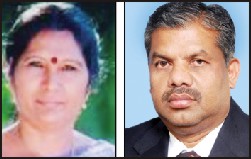
Prof. Padma Shekar of Mysure is Sanskrit University VC

Dr. S.R. Niranjana Gulbarga Varsity VC

PadmaShekharBF22jun2015

Bengaluru :

Governor Vajubhai Rudabhai Vala on Monday approved the names of six Vice-Chancellors for State Universities. They are Pramod B. Gai (Karnatak University, Dharwad), S.B. Hosamani (Rani Channamma University, Belagavi), S.R. Niranjana (Gulbarga University, Kalaburgi), Jogan Shankar (Kuvempu University, Shivamogga), M.S. Subhas (Krishnadevaraya University, Ballari) and Padma Shekar (Sanskrit University, Bengaluru).

Dr. S.R. Niranjana and Prof. Padma Shekar are from Mysuru. While Prof. Padma Shekar is Head of the Department of Jainology, University of Mysore, Dr. S.R. Niranjana is serving as Professor and Chairman, Department of Studies in Biotechnology, University of Mysore.

The appointments came after Chief Minister Siddharamaiah on Monday evening met Governor Vajubhai Vala, who is also the Chancellor of Universities and explained to him that the State Government had followed all norms and procedures on the issue of appointment of VCs to six State Universities.

source: http://www.starofmysore.com /Star of Mysore / Home> General News / Tuesday – June 16th, 2015

Indian origin scientist to get Russia’s highest tech award

St Petersburg :

B Jayant Baliga, a US-based Indian-origin scientist, is being awarded Russia’s top technology award in recognition of his work as a major development in energy management which brought about huge increase in efficiency and major savings.

B Jayant Baliga, a US-based Indian-origin scientist, is being awarded Russia's top technology award. (Representative image)
B Jayant Baliga, a US-based Indian-origin scientist, is being awarded Russia’s top technology award. (Representative image)

The award will presented to Professor Baliga and Shuji Nakamura on Friday by Russian President Vladimir Putin at a ceremony here.

Nakamura, a Nobel Laureate, is being recognised for his work on blue light emitting diodes (LEDs). In Russia, the Global Energy Prize is known as the electronics equivalent of the Nobel Prize.

Professor Baliga invented the digital switch or the insulated gate bipolar transistor (IGBT) while working at General Electrical research & development centre in New York state in the US in 1983. The IGBT switches energy hundreds of thousands of times a second, raising the efficiency of any equipment manifold.

“Every equipment from your refrigerator to lights to motor vehicles has the need to use energy efficiently. If you take away the IGBT today, almost everything will come to a standstill,” Baliga told a visiting IANS correspondent on the eve of receiving the award.

Scientific American magazine called him among the ‘eight heroes of the semiconductor revolution’, and President Barack Obama awarded him the highest American technology prize last year and he is the 2014 recipient of the IEEE Medal of Honour, a rare distinction.

Professor Baliga, who now teaches to the North Carolina university as ‘distinguished university professor’, said that the IGBT that his invention combines two streams of electronics and electrical engineering and has possibly saved the world around $24 trillion dollars by raising efficiency, according to one detailed calculation.

“I got zero out of it. But then I did it all for humanity.”

Of course, says Prof Baliga, that he did make some money when he started three companies, but these were financed by venture capitalists who exited with enormous profits at the right time.

He says every motor today is at least 40 percent more efficient, the light bulb like the CFL better by almost 75 percent and a motor vehicle saves over 10 percent fuel because of his invention. He has written 19 books and over 500 papers in peer-reviewed journals.

Baliga passed out of IIT Madras before going to the US for his MS and PhD after electrical engineering after which he joined GE where he spent over 15 years.

After his ‘switch’ was invented, several of his colleagues told him that it would not work, and many scientists said he would fall “flat on his face”. But he said it stood the test of time.

The chairman of GE at that time, Jack Welch flew down especially to meet him when he heard what it could do. GE used the switch in the several of the equipments it sold, including medical devices.

A US citizen since 2000, he now has very little connection with India and does not travel to his home country much, especially after his parents and parents of his wife passed away. But, says Prof Baliga, an invention like his is unlikely in India, because it needs huge research infrastructure to be in place from universities to industries.

He feels, that India has a potential which has not been fully used, although in software “it has made great strides”.

Could a Nobel be on its way in the future? “I used to say no way,” but with so many recognitions and this “global prize where I am being feted with a Nobel Laureate, who knows”, he says. His regret though is that India does not know much about him.

“Top scientists that I meet always ask me, why has India not recognised your achievement?” And with characteristic modesty, Baliga told IANS, “I tell them that perhaps my country does not know about what I did.”

source: http://www.timesofindia.indiatimes.com / The Times of India / Home> NRI / IANS / June 18th, 2015

This Samaritan Contributes 5kW Solar Power to HESCOM

Sirsi :

A house in Gurunagar has become a solar power-generating station with the owner contributing power to HESCOM. ‘Shreyas’, the residence of Shrikant Hegde, an entrepreneur, has a 5 kW-capacity solar rooftop power unit, linked to the power grid.

The state’s solar energy policy encourages individuals, societies, institutions and companies to set up grid-connected rooftop solar units, and for ESCOMs to buy power from these units. The houses have to install a two-way meter to measure the flow of power in both the directions. The scheme is administered by respective ESCOMs, including registration, approval, metering protocols, standards and safety protocol.

Hegde has signed a 25-year agreement with HESCOM to export excess solar power to its grid. He is able to contribute a surplus of 500-600 units of power per month to the HESCOM grid at Rs 9.56 per unit.

In the first five years, HESCOM will purchase power at Rs 9.56 per unit (later at revised rates fixed by Karnataka Regulatory Energy Commission). “I will earn at least Rs 60,000 per annum,” Hegde said, adding that he will recover his investment in about seven years.

On the technical side, Hegde got the support from Apollo Power Systems Private Ltd, Bengaluru, and Tejas Energy,

Sirsi. The rooftop unit has been installed at a cost of about Rs 5 lakh. Gurucharana, executive, Apollo Power Systems Private Ltd, said the project was started in November 2014 by the state government on a power-purchase agreement (PPA) for 25 years.

Sunilkumar, head of the Renewable Energy of Appollo Renewable, said that even in rainy season like in Sirsi and Malnad area, 4-5 units of power could be generated daily.

Nagendra Honnalli, assistant commissioner of Sirsi, said that he would send a proposal to the government to provide finance through cooperative societies to farmers who want to take up this project. It costs about Rs 1 lakh per 1kW capacity.

He said this project would reduce transmission losses and dissemination costs. Panduranga Pai, general manager, Sirsi Urban Cooperative Bank, has offered to provide a loan of up to 75 per cent of the cost of the project at 2 per cent interest.

source: http://www.newindianexpress.com / The New Indian Express / Home> States> Karnataka / by Shripad Bhat / June 21st, 2015

Bengaluru becomes a magnet for MNCs, startups again

Traffic can be a nightmare at peak hours. Many roads are pot-holed. Experts warn of an inevitable water crisis. But still companies and people are moving to Bengaluru like never before. Some estimate that an investment of over $1 billion has been proposed in the past 18 months.

The availability of a young, technologically skilled population is driving not just many of the world’s biggest brands but many of India’s tech-based startups to move or expand into Bengaluru. The trend is accelerating as the world gets redefined by new technological phenomena such as smartphones, social media, artificial intelligence, et al.

Bengaluru accounts for more than a third of the over 1,000 global inhouse centres (GICs) – facilities that combine technology development with back-office functions – of MNCs in India. But the spate of new announcements of GICs over the past 18 months suggests a fresh urgency. Some of the proposed investments are massive.

US oil and gas major Exxon Mobil, one of the world’s biggest companies, is making a $400-500 million (Rs 2,500 crore-Rs 3,150 crore) investment in Bengaluru to establish a technical and business support services centre. Derivatives marketplace CME Group, which handles 3 billion contracts worth approximately $1 quadrillion (that’s 1 followed by 15 zeros) annually, is said to be setting up a GIC in Bengaluru.

JCPenny, the leading American apparel and home furnishing retailer, L Brands, makers of lingerie brand Victoria’s Secret, and Lowe’s, the US-based home improvement and appliance store chain, have established technology captive centres here recently. Payments technology company Visa is establishing an inhouse R&D centre in Bengaluru that will hire 1,000 people over the next three years. Payments solutions major Network International, wholly owned by Emirates NBD Bank, is looking to hire 300 people in the city to set up a GIC.

British Telecom is leasing out 1.2 lakh sqft of office space in the city and is expected to hire 600 engineers over the next 18 months. Wells Fargo, the largest US bank by market cap, is said to be expanding its technology back office in Bengaluru with a fresh lease deal for 1 million sqft.

It’s been no different with many domestic startups. Entrepreneurs who started their ventures elsewhere in the country, are making Bengaluru their new home. Others, like Snapdeal, may not have shifted their base, but their big new R&D expansions are in Bengaluru. As Snapdeal says, for the scale of hi-tech talent they now need, there’s no option but to come to Bengaluru.

Lalit Ahuja, co-founder of ANSR Consulting, a firm that’s helping Fortune 500 companies establish strategic offshore captive centres in India, says Bengaluru has the right mix of talent, and contextual business expertise.

Sejal Shah Gulati’s tryst with Bengaluru has turned out to be longer than she expected. The managing director of Time Inc India – publisher of over 90 magazine titles including Time, People, Sports Illustrated, InStyle, and Real Simple – moved to Bengaluru from New York to set up a wholly owned subsidiary of Time that would do circulation, web and tablet analytics, among other things. It has 550 employees, and Gulati says the plan now is to more than double the headcount to 1,000-1,200 in the next 12-18 months. The focus is on technology and analytics talent. Despite the broken infrastructure and traffic snarls, Gulati felt welcomed in this city of immigrants. “I didn’t expect to stay so long. It was a very soft-landing for me. And how can I not mention the ideal weather,” she says.

Nasscom Product Council chairman Ravi Gururaj says: “E-commerce and consumer internet firms, technology back-office and R&D centres of MNCs, apart from the IT services firms and the plethora of startups, make the city very unique.”

Aditya Rao of Localoye says he faced problems in hiring when he was in Mumbai, and he found it difficult to get Bengaluru folk to shift to Mumbai. So, when the startup secured funding from PE firm Tiger Global, he shifted his base to Bengaluru.

Harshvardhan Lunia, cofounder and CEO of Lendingkart, an NBFC that lends short term working capital to sellers on e-commerce platforms, says there is no good pool of big data talent outside of Bengaluru. Hence his shift from Ahmedabad, though he continues to spend time in that city too.

Bengaluru has talent gaps, in areas like product management, software architecture, and user design. And this is pushing some companies to import talent from Silicon Valley. But Sharad Sharma, cofounder of software product think-tank iSpirt, says Bengaluru will be the first city to close the demand-supply gap in these areas. “The Institute of Product Leadership and IPMA (India Product Management Association) are attacking the product management gap.

Hasgeek and Zinnov are addressing the architect gap. And a number of players, including Shristi, are addressing the user design expert gap. MNC R&D captives are rapidly building technical career tracks for these specialists,” he says.

There are also signs that road infrastructure – the bane of Bengaluru – is improving. Chief minister Siddaramaiah on Saturday launched the first of the new high-quality TenderSure roads, built in collaboration with external expertise. If this governmental spirit sustains, Bengaluru could look forward to a remarkable hi-tech future.

source: http://www.timesofindia.indiatimes.com / The Times of India / Home> Business> India Business / by Shilpa Phadnis & Anand J,  TNN / June 21st, 2015

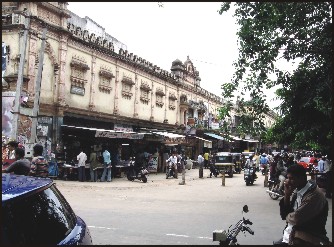
The Mysore that was … Part 30: Lansdowne building , The oldest shopping complex of Mysuru

LandsdowneBF21jun2015

by M.L. Krishnaswami

Heritage — The Oxford Dictionary meaning is Nation’s Historic Buildings or Countryside. The Government’s definition is a building which has completed its life for over 100 years; this naturally excludes private person’s buildings which have no historic value or have no significance to public interest. Public building built at public cost and being used for general or public purposes like music halls, shopping arcades, colleges, etc. which have put their physical weight on Mother Earth for hundred years or more will naturally be named as heritage structures. In any country it becomes the bounden duty of the State to preserve and maintain in good shape such buildings. In this category, Lansdowne Building, the oldest shopping complex in Mysuru built a hundred years ago, eminently qualified for this sobriquet.

In addition to the above description, even houses built and lived by eminent figures in the fields of culture and arts, literature and drama also fall under this definition. This category includes houses of Kuvempu, R.K. Narayan, Bendre, Karanth and others. When it comes to a large linear shopping complex like the Lansdowne Building, some of the owners and tenants of individual shops have made enormous contribution to the growth of their particular brand of trade or avocation over this period. They had established their brand names in Mysuru State and beyond also. In this sense they have added their own glamour to the total heritage tag of the building. An attempt is made here to highlight a few samples in this category. Now read on:

Lansdowne Building was a much longer one before 1956, extending at an angle upto the junction of the Dufferin Clock Tower on the South of Devaraja Market, when a portion was pulled down to facilitate construction of the K.R. Circle and making a through road from there westwards upto DC’s Office. This road is now called Devaraja Urs Road.

1. Phalamrutha Products, Founded by the late venerable Gundappa: Gundappa originally came from Chamarajanagar and after great initial hardships, established his industry and trading outlet for fruit juices, essences, ice creams and the like. His working place was in Ittigegud and the factory was mainly manned by his three sons and their families including the ladies. He had made such meticulous work in detail by distributing the work schedule among his sons and daughters-in-law, in shifts like an experienced works manager in a large factory. Besides, he had also employed a few people for outside work. Some of the processes were mechanised also. Utmost importance was given to maintaining the quality tag of the product. So much so, for people visiting Mysuru on vacation, both local and outside, a jaunt to the Phalamrutha outlet in Lansdowne Building was a must.

2. Late Hari Rao and his two sons ran “Brahmins Soda Factory” three or four shops towards North. The specialty of this unit was they used to make the essences of fruits at their house and bring them to their shop. Hari Rao used to trickle three or four drops of the particular essence in a glass, mix it with water or soda as per the client’s demands and serve it. This shop came under the portion of Lansdowne Building demolished in 1956 and thereafter his sons shifted the same to Old Bank Road. Another not so popular joint was the Padaki Soda Factory.

3. Khaddar Co-operative Society had occupied two adjacent shops and used to sell quality Khadi cloth. It had a large clientele comprising freedom fighters and lawyers. A small departure here: One experienced and Khadi clad tailor by name Bagare Narasingarao, popularly known by his nickname ‘Bachu,’ had occupied a part of the frontage of one of the shops here and people who bought Khaddar cloth in the Society gave him business to stitch their ware. He had good business.

My father who was a staunch Gandhian lawyer wore Khadi all his life and his sons, five in number, were perfect Khadiites. When we were school-going kids, we were taken there for measurement of knickers and pants. Bachu, the tailor, would invariably ask us which side right or left, we would hang our tool, as if he would make suitable provision for the same accordingly!! We would give a very wry small at his joke.

4. J. Nanumal and Son was another popular bookstall, selling stationery as also textbooks. They were Sindhis and the senior father was always in mill-dhoti worn with two identical pants like partitions fitting tight on both legs. His son Bhagwandas was a normally dressed person with two sons, all of whom shifted their shop up North near Chamundeshwari Talkies in 1956 when that portion of Lansdowne Building was demolished.

5. Other miscellaneous shops included a book shop (Venkateshwara), a photo frame unit and most importantly, a rubber stamp making venture, M.V.N. & Sons run by late M.V. Narasimhachar. A typing centre run by three Raju brothers had occupied two shops in a vantage location where half-a-dozen people were ready with their typewriters. The first floor portion of this linear building was occupied by auditors, lawyers, consultant engineers, who ran their professional practices there successfully for many years. A major portion of the first floor was occupied by Sarada Vilas Institutions who ran their primary and middle school sections there for a long-time.

The people who ran the above enterprises had become great hallmarks in their particular ventures and professions and had silently enhanced the heritage quotient of the brick and mortar building they occupied for a long time. Architecture adds looks to the building and enhances its livability value, but the people who live and work inside the four walls of the same breathe life into the edifice. Thus, we have ‘Stratford on Avon’ where Shakespeare’s memorial is housed and R.K. Narayan’s house in our own city which have the heritage tag not because of the buildings but because of the persons who lived there and added eternal value to the world by their works and life.

Post script: Lansdowne Building is now in a comatose state after a roof slab in a typing shop in the Southern wing collapsed on Aug. 25, 2012, and the entire building is barred for human dwelling and is earmarked for renovation. Sooner this work is taken up and completed the better as a few of the original tenants may not live to see the light of day when the renovation is completed. I am told this building is the property of the City Corporation and it is not out of place here if a request nay, appeal, is made to the Honourable Mayor and Commissioner to taken up restoration work.

Six months passed…

Whatever happened to Rs. 6 crore restoration work?

The restoration work of Lansdowne Building is being taken up as per the specifications given by the Heritage Department at an estimated cost of Rs. 6 crore — Rs. 3 crore for strengthening the building, water proofing the roof, wooden works and painting; another Rs. 3 crore for providing toilets, road and drain works and concreting. The work is yet to start as the two persons, who took part in the tender process, could not produce proper documents. Hence, the MCC has called for a re-tender. It may be recalled, Chief Minister Siddharamaiah had launched the restoration work of the Lansdowne Building and performed the ground-breaking ceremony in city on Jan. 11, 2015.

e-mail: mlkswami@yahoo.in

source: http://www.starofmysore.com / Star of Mysore / Home> Feature Articles / Monday – June 15th, 2015

Two friends join hands to spread Bicycle culture in city

Vikas Hosahalli & Mahesh Siddegowda

Mysuru :

‘If passion can take you places, then Mysuru is the place to polish your passions till perfection.’ This seems to be the collective conscience among the young in city who are leaving behind fat-pay cheques from multi-national corporate companies to follow their hearts.

Like Rohan Abijith and Dhruva Rao, who gave up their lucrative jobs to start the ‘Science Ashram’ at Jayalakshmipuram, there is a rising trend among the young in the city to innovate, collaborate and start ventures that are benefiting the society on the whole.

Now two friends have joined hands to inculcate bicycle culture among Mysureans that can not only save the environment from pollution but can also keep individuals fit!

Nowadays in the fast paced modern world, man is totally dependent on petroleum products to keep moving about in his two and four-wheelers. The gasoline-run vehicles not only pollute the environment, but have also been cause for numerous accidents and deaths in the world. People suffer from breathing problems after inhaling the air polluted by the carbon dioxide emission from these vehicles.

Before it is too late, human beings must realise the importance of clean air and environment and in this context, several environmentalists and naturalists have come forward to work for a people-friendly environment.

The city is not lagging behind on such environmentally conscious matters and is fortunate to have two young men namely Vikas Hosahalli, a resident of Kuvempunagar and Mahesh Siddegowda, residing at Kesare, the founders of ‘Green Wheel Ride’ who have been trying to instill ‘Cycling Culture’ among Mysureans. In the first phase of cycling promotion, the duo have opened centres near State Bank of Mysore in Chamundipuram, near Gnanaganga School in Kuvempunagar, near Vikram Nursing School in Gokulam and near Corporation Bank branch in V. V. Mohalla.

Green Wheel Ride has plans to open 75 to 100 franchise points at various locations in city. The unique feature of this ‘Cycling Concept’ is that one may hire a bicycle from one centre and hand over the bicycle at the nearest destination centre.

Speaking to SOM, Vikas said that the duo was looking for places to set up their franchisees and are happy to engage in partnerships with institutions and environmentally conscious corporate houses.

“There are lots of un-used spaces in government office buildings and they are perfect to have these e-bikes installed there. The officials can use these bikes for their transport, but we are not getting any positive response from them,” says Vikas.

After having relinquished their plum positions in MNCs, Mahesh, a mechanical engineer by profession, has been engaged in altering the bicycles and Vikas is into the maintenance work of these bicycles.

Battery operated bicycles: We may be wondering how to pedal on these bicycles especially during summer, relax; these bicycles operate on eco-friendly batteries. ‘Lithium Ion’ technology is used for these bicycles and once the battery is charged, the bicycle runs for 70 kms at 20 km per hour. The cost for 3-hour charge will be less than a Rupee.

Triple mechanism on bicycle: An individual can ride the bicycle by pedalling if he or she wants to exercise; the bicycle can also be operated with pedals and accelerator on battery. The bicycle has the option of being operated only on accelerator.

The spare parts for these bicycles are manufactured by Green Wheel Ride at their Hootagalli unit in city. Bicycles are assembled at the Vidyaranyapuram unit, here, and the brand name for these bicycles is ‘Made in Mysuru.’

These bicycles may be hired at 50 paise per minute for members and Re. 1 per minute for non-members. Bicycles are available for hire between 8 am and 6 pm at the designated bicycle centres in city.

Riders who wish to avail these bicycles on hire should submit a passport sized photograph, identity card, address proof and give their thumb impression on biometric machine. The firm has its own App for registration of members and to identify the path travelled by the bicycle rider.

E-Bike: The battery-operated bicycle was launched only 18 days ago in Mysuru and has been christened ‘E-Bike’ for its eco-friendly mechanism. Our aim is to save the environment from pollution and reduce the dependency on petrol, diesel operated vehicles. Even if 10 percent of our population uses these bicycles, the country would save lakhs of rupees on petroleum products import. Ten bicycles have been made available at the Karanji Kere premises for the convenience of the public. A fee of Rs. 25 will be charged for 30 minutes use. About 3,500 people have used 10 bicycles which were operational at Karanji Lake during the last 10 months covering a distance of 15,000kms.

Green Wheel Ride has plans to open such Bicycle Centres in other cities too and those interested to join the organisation may contact: 95358 50001 or visit the website: www.ecobike.rentals

source: http://www.starofmysore.com / Star of Mysore / Home> Feature Articles / Sunday – June 14th, 2015

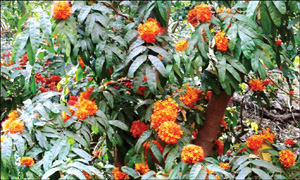
‘Sita Ashoka’, The sacred tree with medicinal values

SitaAshokaBF20jun2015

by Dr. Mahadeswara Swamy, Scientist, Mob: 97429-91057, e-mail: swamy_clri@hotmail.com

Ashoka’ or ‘Sita Ashoka,’ one of the most beautiful indigenous trees, looks marvellous when fragrant, pale apricot (scarlet) Ixora like blooms are fashioned amidst the deep green shiny foliage. It is a sacred tree for Hindus and Buddhists. Therefore, it is widely grown in gardens adjoining temples and monasteries. According to one belief, Lord Buddha was born under an ‘Ashoka tree.’ According to Ramayana, it is associated with chastity. Sita, after being abducted by Ravana, spent her days grieving for Rama in Ashoka Vana. A quaint Hindu belief is that the tree will flower only in places trodden upon by a woman’s foot!

In West Bengal, women eat the flower buds on ‘Ashoka Shanthi’ day. The scientific name is ‘Saraca asoca’ belonging to Fabaceae (pea family). ‘Saraca’ is derived from Western Indian vernacular name for the tree; ‘asoca’ means ‘sorrow – less’ in Sanskrit. It is native to India, Sri Lanka, Burma and Malaysia. It is found wild in forests of Khasia Hills in Assam and Western Ghats and grown all over India.

It is a medium-sized, evergreen, hardy tree with erect trunk, rounded crown and drooping foliage. The bark is distinguished by the presence of warty protuberances on its outer surface. The compound leaves are arranged alternately on the stem; leaflets, 3-6 pairs, opposite, deep green, elliptic oblong in shape with wavy edges; surface is glabrous and shiny.

Young leaves are coppery red and flaccid — the distinguishing feature. Large clusters of golden yellow fragrant flowers appear on trunks and old branches, 4-6” across. The flowers have no petals and the sepals form a tube at the base and open up into 4-6 petal like lobes, first orange and later turn to scarlet. The stamens are orange near the base and scarlet upwards.

The fruit is a dehiscent pod with 4 to 8 seeds. They are fleshy and red when young and closely resemble the young tamarind pods.

Uses: The tree has immense medicinal value. The bark is astringent and used in uterine infections, menorrhagia (scant menses), dysmenorrheal (painful menses, menstrual cramps), leucorrhoea, as a uterine sedative and tonic. The bark powder is also used for improving skin complexion. The flowers are used in diabetes and dysentery. Seeds are chewed as a substitute for betel-nuts. Ayurvedic medicines ‘Ashokarishtam’, ‘Ashoka Ghrita’ and ‘Chandranadi Thailam’ contain ingredients from this tree. The timber is used for house building in Sri Lanka.

Other related species: S. cauliflora: Yellow and orange flowers (yellow turning red) on thin woody branches, but not on trunks; S.declinata (red asoca): Large clusters of red flowers on old branches and twigs; S.thaipingensis (yellow saraca): Large clusters of golden yellow flowers on trunks and old branches.

Note: Polyalthia longifolia is often planted in many places in the name of ‘Ashoka’ tree. This is a misnomer. At best, it can be labeled as ‘Madras Ashoka’ or ‘False Ashoka.’

Useful tips: Suitable for small avenues, parks, big gardens as well as home gardens.

Prefers shady situation and a porous, moist soil.

Needs shelter from dry wind in hot places.

Easily propagated from seeds.

Looks beautiful when planted in the corner of a lawn.

Peak flowering season: February to June.

This beautiful tree can be seen in Curzon Park, park adjacent to B.M. Hospital on Hunsur Road and many other places.

source: http://www.starofmysore.com / Star of Mysore / Home> Feature Articles / Sunday – June 14th, 2015