All posts by admin

KA Hospitality to open Yauatcha Dim Sum restaurant in Bangalore

KA Hospitality which has pioneered introducing international luxury dining restaurants in the country is to open Yauatcha in Bangalore.

The company in short span has brought Hakkasan and Yauatcha, the Michelin Starred restaurant from London in to India. The first restaurant opened in Mumbai, a couple of years ago and now company has ventured into Bangalore. “Yauatcha is a Michelin-starred Dim Sum restaurant from London and the uniqueness of the restaurant is the very concept of being a tea and dim sum house with a modern interpretation of the traditional Chinese teahouse,” Nitin Motwani, CEO, KA hospitality told Business Line.

The restaurants specialises in offering over 50 different types of dim sums, special vegetarian delights and an array of desserts. Motwani said “The uniqueness of the restaurant is the very concept of being a tea and dim sum house with a modern interpretation of the traditional Chinese teahouse which offers over 50 different types of dim sums, special vegetarian delights and an array of desserts. Yauatcha a 150 seat restaurant offers an all-day dining with dim sums, wok preparations, macaroons and petit gateaux. The restaurant is located at 1 MG Road Mall, MG Road.

anil.u@thehindu.co.in

source: http://www.thehindubusinessline.com / Business Line / Home> News> National / by  Anil Urs / Bangalore – September 15th, 2014

Making their mark in stone

King Edward VII statue installed (1919) at the North-Western point of the Queen’s park at Cubbon Park . Photo:G R.N. Somashekar / The Hindu

The statues of Cubbon Park bear testament to conquerors who left more than just a memory in the country

They came. They saw and they conquered. But ironically, the conquests and achievements of many great people are only but a memory. People rise and people fall. Only their memories remain buried in the annals of history. However, some are more fortunate and are remembered better – thanks to monuments and places named after them or in this case – having a statue erected for them.

The city of Bangalore boasts an array of interesting statues of phenomenal people and one of the prime locations to spot them is the historic Cubbon Park. The large lung-space in the heart of the city bears testament to five of the most remarkable personalities to have etched a mark in Bangalore and India’s histories. With a history of its own – the park is home to the statues of Queen Victoria, King Edward VII, Major General Sir Mark Cubbon, Rajya Dhurandhara Sir K. Sheshadri Iyer and Sri. Chamarajendra Wodeyar.

The Hindu
The Hindu

The Queen Victoria statue welcomes visitors to the park near the corner of Mahatma Gandhi Circle. Sculpted by Thomas Brock in England and shipped to India in 1905, the 11-foot statue was inaugurated by George Frederick Ernest Albert, the Prince of Wales (later King George V), on February 5, 1906. The Queen, who used the additional title of Empress of India, is the most notable sight in the garden.

Victoria statue at Cubbon Park. Photo: K. Murali Kumar / The Hindu

A noble tribute to the member of the royal family of Great Britain to hold the prestigious crown for the longest time from the age of 18 for almost 64 years, the statue has the Queen holding a scroll and an orb. Alexandrina Victoria was given the title Empress of India after the dissolution of the East India Company following which she took reign of the administration of the subcontinent. Marked for restoration, the statue has a finger missing while the orb has lost its cross.

On the other corner of Queen’s park is the King Edward VII statue. Often ignored due to the stagnating Metro construction that has overridden the park’s beauty, the statue of the King of the United Kingdom and the British Dominions and Emperor of India between 1901 and 1910, lies neglected in a layer of dust and dirt. The statue was unveiled by Frederic John Napier Baron Chelmsford, the Viceroy and Governor General of India, in November 1919.

The bearded king, who was responsible for modernisation of the British Home Fleet and reorganisation of the British Army, was known to be a peacemaker. But with the World War I beginning just four years after his death, many believe the Germans paranoia increased because of the British King’s massive transformation of the forces. He toured the subcontinent while being the Prince of Wales in 1875 but King Edward VII never visited India after he took over the throne. His short reign and subsequent passing over of the mantle to his second son George V saw only a time of peace, often credited to be the golden age for the upper class in Europe and America. He was also one of the first Kings to become social with people believing in the seeing and being seen by the people.

The statue of Major General Sir Mark Cubbon adorns the terrace garden and is part of the Karnataka High Court. The British Army officer who became the British Commissioner of Mysore state moved the capital from Mysore to Bangalore and is respected for creating a prosperous government here. The statue of Sir Cubbon seated on a horse was unveiled by the Commissioner of Mysore Lewin Bowring.

A fading tribute to these foreigners who left a lasting impression on the destiny of the country, these statues may not stand the test of time, but they will remain in the weathered memories of Bangalore’s residents.

source: http://www.thehindu.com / The Hindu / Home> Features> MetroPlus> Society / by Allan Moses Rodricks / October 31st, 2014

Centre clears change in names of Karna cities, Belgaum now Belagavi

Eight years after it received a proposal from Karnataka government, the Centre today cleared renaming 12 cities and towns of the state including Belgaum as Belagavi and Bangalore as Bengaluru.

BelgaumBF31oct2014

Union Home Minister Rajnath Singh gave his approval to the proposal of the Karnataka government made on October 27, 2006 to change the names of the 12 towns and cities in consonance with their pronunciation in Kannada language.  Karnataka and Maharashtra, where the Assembly elections had just concluded, are locked in a boundary row over Belgaum.

The Karnataka government had taken the decision to rechristen these cities on the occasion of the golden jubilee of formation of the state of Karnataka on November one, 2006.

The Home Minister’s nod came after Survey of India, Ministry of Railways, Department of Posts, Ministry of Science and Technology and Intelligence Bureau have given their No Objection and clearance for the change in the nomenclature of the identified cities.

Besides Bangalore and Belgaum, the other cities and towns which will be known by new names(which are in brackets) are Mangalore(Mangaluru), Bellary(Ballari), Bijapur(Vijapura), Chikmagalur(Chikkamagaluru), Gulbarga(Kalaburagi), Mysore(Mysure), Hospet(Hosapete), Shimoga(Shivamogga), Hubli (Hubballi) and Tumkur(Tumakuru).

Instructions have also been issued for rechristening the post offices and Railway stations, a Union Home Ministry oficial said.

source: http://www.deccanherald.com / Deccan Herald / Home> State / PTI / New Delhi – October 17th, 2014

Of Libraries and Books

by D. Lalitha Rao

When I was studying for my Library Science degree, we had a professor who would teach through anecdotes that often had us in splits. To stress how important it is for a librarian to know the location and appearance of every single book on the shelves he would narrate how a student came to him once and asked him, “Sir, please give me the red book with four authors.” Only the librarian’s years of experience plus the fact that, the particular book was most in demand among the students of B.Com prevented him from throwing the student out.

We librarians are used to the strangest demands, believe me. I have always felt that a library should be the friendliest place, where you can curl up in a corner with your book or browse shelves undisturbed by time or crowds.

I have always loved cataloguing books. To determine the subject of a book, and to give it the appropriate numbers in the cataloguing system and then place it correctly in the shelves — it gives me a sense of joy. The circulation desk is, of course, where all the activities go on in a library, with people coming and going constantly, borrowing or returning books, and searching for particular volumes. However, the stacks — the shelves where books are stored — is where the heart of the library resides.

The simplest arrangement of books is by subject matter and the world’s libraries use mostly what is known as the Dewey Decimal System of cataloguing created by Professor Melvil Dewey in America in the 19th century. You may have seen in libraries like The British Council numbers on the spine of any book: a set of 3 numbers followed by a decimal point and then further sets of numbers. The first number is the code for the subject and can be from 0 to 9. Thus 954 is the number classification for Indian History. Anyway, to get a librarian started on the Dewey Decimal Classification (DDC) system is asking for trouble, so I will spare you the details.

At first this whole classification business was confined to ten subjects and a hundred sub-categories. Now, as the frontiers of knowledge become ever distant, there is no limit to subjects. The DDC is already in its 23rd edition and has 4 volumes compared to the 4-page pamphlet published in 1876 by Dewey.

In the 1930s, Dr. Ranganathan of Madras University invented the Colon Classification, an extremely complex system but one which could include many more subjects than the Western-centric DDC. Madras University Library and then Delhi University Library were among those catalogued according to the Colon Classification (CC). The system has now fallen into disuse as there are not many people proficient enough to teach it to students of Library Science. Even the very old Nilgiris Library in Ooty which used CC is now digitizing its catalogue as per the DDC.

Sooner or later one has to make way for new ideas, improvements and new versions of the old. Browsing in my personal library some days ago, I unearthed the Agatha Christies that I own, and was happily leafing through them. Coincidentally, I found in an online bookstore a brand new mystery that I ordered right away. It so happened that I read two newly published books which I must share with you.

The first book I read was the mystery I have mentioned above, by British author Sophie Hannah, in which she brings back to life the legendary Agatha Christie detective Hercule Poirot. This is not the first time that fictional icons that died with their creators have been revived. Anthony Horowitz a few years ago wrote The House Of Silk, a riveting story of Sherlock Holmes, and has now written Moriarty, which I am eagerly waiting for.

So, Hercule Poirot in The Monogram Murders. Was it an interesting read? Most certainly. Was it Hercule Poirot? To my mind, and I feel most Christie loyalists will feel the same, Poirot as presented by Hannah lacks a certain gentleness that Christie’s character possessed. This Poirot is more egotistical, rather boastful, as brilliant as ever, but perhaps not as endearing. The humour is not Christie’s, naturally but then the plot has more complexity. In fact, in terms of complexity it compares with some of the classic cases that are solved by Miss Marple and Hercule Poirot. Sleeping Murder comes to mind as also The Murder of Roger Ackroyd. I think this is probably the reason that for the first time the heirs of Agatha Christie’s estate have given permission to publish a book containing her characters, so I assume Miss Marple will also reappear some time. To read The Monogram Murders, you must forget that Hercule Poirot existed before (very difficult) and just go with the story. The only way to enjoy it.

The other book was Chetan Bhagat’s latest, called Half Girlfriend. Set in Bihar, New Delhi and New York, the story takes us through several years in the life of a boy from rural India, as he falls in love with a typically wealthy Delhiwali but has neither the social skills nor the smarts to deal with it. The same goes for his super rich girlfriend as she leads him a merry dance. Even though you can sense that our author has a soft corner for her, perhaps more than for the hero, I found it difficult to feel much sympathy for her. Supposedly she has psychological issues that we get to hear about much later in the story.

At another level the story of rural India is sensitively told, with the clash of feudalism, local politics and corruption sharply defined. All ends well, but I was left feeling slightly irritated at the end of the saga and several times I felt that both protagonists needed a good smack on the head. No, I haven’t forgotten what it was like to be in love, but why has Mr. Bhagat forgotten that he can write better? Where is the superb timing of Five Point Someone, the humour of Two States? You should read this because it’s a Chetan Bhagat quick read, but don’t expect too much.

I am myself working on a modern revamping of a very ancient and much loved story and will share it with you when done. Till then happy reading.

[e-mail: raolalitha@hotmail.com]

source: http://www.starofmysore.com / Star of Mysore / Home> Feature Articles  / Sunday,  October 26th, 2014

Dr.Dharanidevi Malagatti’s epic ‘Elabharatham’ to be released on Oct. 30

Dr.DharnadeviBF310ct2014

Mysore :

Deputy Director of Karnataka Police Academy Dr. Dharanidevi Malagatti has come out with her epic ‘Elabharatham’ focussing on Mahabharatha viewed from a different angle by women.

Her epic has been published by Kannada Sahitya Parishat and will be released on Oct. 30 at 10. 30 am at Kuvempu Institute of Kannada Studies in Manasagangotri here.

Speaking to the press here recently Dr. Dharanidevi said that it took 10 years to come out with the epic. She added that the epic was written in a different perspective which would be welcomed by literary lovers.

Dharanidevi has obtained Ph.D. in Management Science after. She has also done M.A. (Kannada) through distance education. Her grand father Ramaiah Nayaka and father Dhoomanna Rai too have literary prowess. Her grandmother Lakshmi Alva reads Bhagavatha even now. She is ably supported by her littérateur husband Dr. Aravind Malagatti.

source: http://www.starofmysore.com / Star of Mysore / Home> General News / Sunday,  October 26th, 2014

Of snakes and women

Nagamandala PHOTO: BHAGYA PRAKASH K.

Neelam Mansingh Chowdhry’s Nagamandala earned appreciation from the playwright Girish Karnad itself – you have really understood my play, he said

One story and so many tellings. A.K. Ramanujan told this folktale and it became three plays – Nagamandala, Siri Sampige and Haavu Hokka Manegalu by Girish Karnad, Chandrashekar Kambar, and Hooli Shekar respectively. Girish Karnad’s Nagamandala, when compared to Kambar’s Siri Sampige is less complex, but makes for good theatre. His plays are a reflection of contemporary Indian cultural and social life. For this, Karnad makes use of folk tales, myths and historical legends.

Nagamandala was first produced in Kannada in 1989 by the late actor Shankar Nag. A grand and ambitious production, the play had B. Jayashri, Padmavathi Rao, Arundhati Nag and Shankar Nag himself in the play. Music was composed by C. Ashwath and the stunning song, “Maayada Manada Bhara” written by Gopal Vajpeyi. Recalling those days, Padmavathi Rao says: “Those were not days of theatre workshops. Much of our association with theatre was fuelled by our own personal passion and the willingness to work with ourselves. Aru, Shankar and me would discuss every little detail. For me, the most intense part of the play was Rani’s loneliness. It’s the story of most women in India. They come from loving families and don’t know the world is going to change dramatically for them. I would think that this is the world’s best kept secret. There is a duality between ‘said’ and ‘unsaid’ and throughout history and mythology one sees this happening to women.”

Much later the play was taken up by Neelam Mansingh Chowdhry. The play which drew from several theatre traditions dazzled for its aesthetics. Nagamandala was Neelam’s first major work. For the first time, writes Chaman Ahuja, speech, narration, recitation, songs, dances, costumes, props, movements, stood unified. In a sense, she did not just direct the play, she recreated it- a recreation that earned full approval from the playwright Girish Karnad: ‘You are the only person who has really understood my play.’

Neelam’s Nagamandala is based on a fine translation in Punjabi by poet Surjit Patar. In fact, Neelam took up this same play some time in the late eighties and it proved to be a turning point in her journey as a director. Speaking of her later Nagamandala, which Neelam calls a recreation, she says: “I wasn’t very excited to begin with. I didn’t know if I wanted to do a tale about snakes and women all over again. The Manto festival at Lahore got cancelled and I just started reading Nagamandala again. The story had the power to grip her again and so I picked up the same script and most of the same actors and started work on it all over again.”

The Company presents Nagamandala (Punjabi) directed by Neelam Mansingh Chowdhry, will be staged at Ranga Shankara on November 2, 7.30 p.m. For tickets, bookmyshow.com and Ranga Shankara box office.

source: http://www.thehindu.com / The Hindu / Home> Features> MetroPlus / by D.G. / October 30th, 2014

Many facets of a child prodigy

We have all heard and known that if kids are encouraged towards doing a certain thing, they will go on to learn and implement the same to the best of their abilities. And a few kids are lucky enough to even get encouraged extensively towards achieving great goals in life.

NihalBF30oct2014

One such fortunate child is 9-year-old P.N. Nihal, whose parents are ready to go to any extent towards encouraging their multifaceted son for the little one turns to be an achiever in everything that he tried his hands on. At nine, the kid is already a karate champion, a melodious singer, dancer and a good artist as well.

The kid has already won quite a few State-level awards for different categories given away by various organisations in recognition of his talent. A few of them include awards like the Balashree award given away by the Mysore Sahitya Mattu Samskrutika Pratisthana; Kalachitra award by Bharatiya Lalithakala Academy, Bangalore; Kannadashree award given by Sirigannada Vedike, Mysore; Mysoru Ratna by Sneha Sinchana, Mysore and Ganashree given away by Gana Mandara Trust, Bangalore. He has also taken part in several drawing, colouring and handwriting competitions for which he has been awarded with the first place constantly.

What’s more, while the prodigy was selected to present a 14-minute talk on Akashavani even when he was just a LKG student. Academically too, Nihal is a bright student. He has also won gold ranking in the International Mathematics Olympiad and National Science Olympiad for the year 2014.

A student of Rainbow Public School in city, he receives good encouragement at his school as well, says his mother Rashmi. “While we encourage him towards doing things of his interest, his school staff is equally encouraging too. They encourage him to partake in various contests and events, which is of great help for us,” she says.

And having seen him show so much interest in all these extracurricular activities winning numerous prizes and awards, parents Naveen Kumar and Rashmi have made the child’s goal their own goals too.

Says the proud mother: “It feels wonderful to see him having turned out be such an achiever at such a young age. In a month or so, he will soon be getting awarded with the black belt in Karate which he is learning from trainer K.P. Johnson at the Okinawa Shorin Ryu Shori-Kan Karate-Do and Kobudo Association. He was awarded 6 belts in just 1.4 years of time which is an achievement in itself. Hence, seeing his enthusiasm, I have made his aims my goal for life. I never go anywhere and not even to family functions several times, just to stay by his side and support him in achieving whatever he wants to. As he is an achiever in many areas, he still not too sure what exactly he aims to be but whatever he wishes to do, we will be by his side. Be it academics, cultural or sports, we will let him make it big in the field he chooses.” —AN

source: http://www.starofmysore.com / Star of Mysore / Home> Feature Articles  / Saturday ,  October 25th, 2014

Freedom fighters celebrate 67th anniversary of Mysore Chalo

Official celebrations by District Administration on Oct. 28

Mysore ChaloBF30oct2014

Mysore :

Freedom fighters in the city, on Friday, celebrated the 67th anniversary of ‘Mysore Chalo,’ the Independence Day of erstwhile princely Mysore State.

The freedom fighters, under the auspices of Mysore City and District Freedom Fighters Association, decided to go ahead with the celebration yesterday even as the District Administration that had, for the first time decided to celebrate the occasion, decided to organise the ceremony on Oct. 28, on account of Deepavali festival.

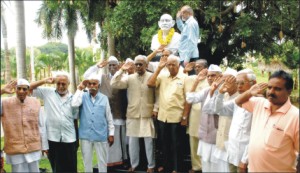
The freedom fighters, who assembled at Subbarayanakere Ground, the nerve centre of Independence movement in those days, reminisced the freedom of the State by garlanding the bust of Mahatma Gandhi at the ground along the Chamaraja Double Road, which is also called the Freedom Fighters Memorial Park. They also hoisted the Tri-colour.

Addressing the freedom fighters, the Association Secretary M.R. Ramasesh recalled the moments associated with ‘Mysore Chalo’ movement that eventually bore fruits with the independence of the princely State.

Pointing out that the princely State, which earlier comprised nine districts — Mysore, Mandya, Bangalore, Kolar, Tumkur, Chitradurga, Shimoga, Chikkamagalur and Hassan — has now risen to 13 with the formation of Chamarajanagar, Chikkaballapur, Davanagere and Ramanagar districts. Ramasesh said, the government has decided on official celebration of ‘Mysore Chalo’ from this year.

Accordingly, the District Administration has organised the celebration on Oct. 28, with many programmes scheduled to take place at Subbarayanakere Ground. Mayor R. Lingappa will flag off a procession at Subbarayanakere at 10 am, which will pass through Chamaraja Double Road, Ramaswamy Circle, Sanskrit College, Sayyaji Rao Road, K.R. Circle, D. Devararaj Urs Road and Narayana Shastri Road, before returning to the Subbarayanakere.

District Minister V. Sreenivasa Prasad will inaugurate the stage programme at 11.30 am, MLA Vasu will preside. Later, cultural programmes will take place at Kalamandira at 2.30 pm, during which freedom fighters will be honoured, he said.

The government has sanctioned Rs. 10 lakh for ‘Mysore Chalo’ celebration, out of which Rs. 1 lakh has been given to the Kannada and Culture Department for bringing out a book on the Movement, he added.

Association President D.S. Jagadish, Vice-President M.N. Jayasimha and others were present on the occasion.

source: http://www.starofmysore.com / Star of Mysore / Home> General News   / Saturday ,  October 25th, 2014

Kasturba Hospital pioneers yet another landmark — bone marrow transplantation

Mangalore :

The first Bone Marrow transplantation at Kasturba Hospital, Manipal was performed on a patient with Multiple Myeloma.

The advanced oncology treatment medical procedure – Autologus Bone Marrow transplant – was performed by Medical Oncology department under the leadership of Dr Karthik S. Udupa..

Kasturi, 28 (name changed) from Raichur district, was suffering from multiple myeloma and was being treated at Shirdi Sai Cancer Hospital and Research Centre, Kasturba Hospital, Manipal for the same. She underwent high dose chemotherapy and Autologus stem cell transplant from September 29 to October 15. The various indications for Autologous stem cell transplant includes multiple myeloma, relapsed Hodgkin’s lymphoma, relapsed Non-Hodgkin’s lymphoma and also paediatric tumor like Neuroblastoma.

Autologus Bone Marrow transplant involves three steps: First step is Apheresis – mobilisation of stem cells from the bone marrow into the bloodstream and circulating stem cells are then harvested or collected. In the second step, the patient is given High dose chemotherapy dose to wipe out the problematic cells. And the third phase is the stem cell infusion phase where the stem cells are given back to the patient to reconstitute the immune system. Apheresis also was performed for the first time in the entire coastal belt of Karnataka under the guidance of Dr Shami Shastry, Associate Professor – Transfusion Medicine.

Dr (Col) M Dayananda, Medical Superintendent and COO, Kasturba Hospital, Manipal claimed: This facility was previously available only at Oncology Centres in Bangalore.

He congratulated the Team from Medical Oncology Department for making a major step in providing care to the needy patients. From now onwards, patients from coastal belt, Malnad and plains and the other nearby districts will be able to get this treatment of Bone Marrow transplantation at Kasturba Hospital, Manipal. Dr Dayananda added that this advanced medical procedure for cancer treatment is offered at a just a fraction of the cost than that available in Bangalore.

source: http://www.timesofindia.indiatimes.com / The Times of India / Home> City> Mangalore / by Stanley Pinto, TNN / October 24th, 2014

R.K. Narayan’s Lakshmipuram residence

Sir,

While the picture of R.K. Narayan’s own residence in Yadavagiri dominates popular imagination (Star of Mysore dated Oct. 10), a 70 to 75-year-old building, which houses precious memories of the earlier life of RKN in Mysore, remains largely hidden from public view.

It was in Lakshmipuram, R. V. Krishnaswamy Iyer (father of R.K. Narayan and R.K. Laxman) and his extended family were tenants of this building for a number of years.

A matchless depiction of RKN by R. K. Laxman. Picture right shows Former residence of R.K. Narayan at # 963, III Main, Lakshmipuram, Mysore.

Krishnaswamy Iyer was a renowned Head Master of Maharaja’s High School and his children grew to become distinguished alumni of his own school, as well as Lakshmipuram Middle School and Maharaja’s College.

— S. G. Seetharam /Gita Road /12.10.2014

source: http://www.starofmysore.com / Star of Mysore / Home> Voice of the Reader  /  Thursday ,  October 23rd, 2014