All posts by admin

A devastating famine

famineBF08aug2014

Errant rainfall, lack of proper government policies and general ignorance resulted in the Great Famine of 1867-68. S Narendra Prasad looks back in time and deconstructs the misery and loss that affected a major part of South India.

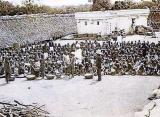
The Great Famine of 1867-68 was a famine that befell many parts of southern and western India, before it spread to the north. Various reasons – social, economic, geographic and climatic have been attributed to the cause of this famine.

Two years prior to the first signs of famine in 1876, there was heavy rainfall in Bangalore and Kolar districts. This had destroyed ragi crops. The following year, there was only scanty rainfall and in some areas, it was much below the average rainfall due to which, by the end of 1875, most of the tanks had dried up. This highly affected the cultivation of paddy and other crops.

C B Saunders succeeded R A Dalyell as the Commissioner of India during the time. It was during the regime of Saunders, that the famine was tackled. Since the famine had occurred in most regions of the Deccan, it had severe repercussions at all levels, even in Mysore.
Loss in human population

In his address on October 7, 1881, in the Dasara Representative Assembly at Mysore, C Rangacharlu, the Dewan, put forth the losses incurred.

The address read as follows: “A general census was taken on the night of the February 17 under careful arrangements. The results which are being tabulated in great detail will furnish interesting statistics when completed. The population as returned by this census numbers 41,82,000 and shows a loss of 8,74,000 as compared with the census taken in 1871, but, allowing for the usual rate of increase in the intermediate good years, the loss of population by famine may be assumed to be fully a million or 20 per cent.”

Along with the loss in population, a great portion of livestock perished. Cattle, especially milching cows and bullocks starved to death due to lack of fodder. The procurement and marketing of crops declined and there was also a steep fall in the supply of food crops from neighbouring regions which were also famine-stricken.

According to statistics found in the government records during the fiscal years of 1874-75, Rs 109 lakh was collected as revenue. But during 1876-77, it stood at Rs 82 lakh and at Rs 69 lakh during 1877-78. And during 1880-81, it crossed the 10 million mark.

Relief measures
To tackle famine-related problems, the administration used all its machineries. For instance, it opened famine relief kitchens to feed people, whose numbers began to swell in towns, especially Bangalore.

The small town of Bangalore became a heaven for the huge influx of people who migrated for food and work from other parts of the state. These people were engaged in civil works and in turn were paid in grains. Around 20,000 migrants were employed for construction of the Bangalore-Mysore railway line.

The government gave its permission for grazing of cattles in forests, which resulted in a man-animal conflict. New tanks were constructed and renovation and repair of old tanks were also taken up in a war footing manner.

Large quantities of grains were imported from the neighbouring Madras Presidency. Separate officials were appointed to distribute the stock. Since the famine related conditions were same in major regions in the Deccan, the severity alarmed the officials in Calcutta. As a result of this, a separate Commissionerate with attached officials was created to supervise the famine relief works in Mysore.

The famine commissioner

The increase, both in the loss of human population and the death of livestock alarmed the government. Initially, Sir Richard Temple was sent as special Commissioner to begin the early relief works.
The visit of Lord Lytton to Mysore State in September 1878 resulted in the deputation of several experienced officials from other parts of British India. Hence came in Elliot who took over as Famine Commissioner. Surveyors, engineers and suboverseers were appointed to channelise famine relief work.
The statistics, related famine relief works and their outcomes are to be found in The Report on the History of Mysore Famine, 1876-1878. The report was submitted to the government. This report is considered to be of much historical value as it throws light on the different dimensions of the famine and its effects.
Likewise, the administrative reports published by the Government of Mysore annually starting from 1870 onwards are also extremely informative and valuable.

Consequences
The census figures in Mysore during later years showed an increase in population figures. The state incurred a debt of Rs 80 lakh. In Mysore, the famine severely retarded the agricultural process.
It reflected upon the gradual commercialisation of agriculture, increase in agriculture debt and the hand-to-mouth existence of nearly 40 per cent of the peasants in Mysore.

Inconsistency in the affairs of administration and in delayed tactics adopted to tackle the famine caused more concern. Added to this, the officialdom and the apathy of bureaucracy aggravated the situation.
But, looking at the second half of 19th century in India, many major famines have occurred after the 1860s. But Madras, Bombay, Mysore and Hyderabad regions which were affected by this great disaster had to wait for years to get over these setbacks and cope with the situation.

The Dewan in his speech in the 1881 Dasara Representative Assembly admitted, “As you are aware, the conditions of the Province has been very much affected by the great calamity which recently struck us. The ruinous effects of the famine are so fresh in your minds that I need not dwell on them.

It will suffice for me to say that it cost the state 160 lakhs of rupees. It also involved the government in a debt of Rs 80 lakh and withal deprived the province of a million of it. It also adversely affected the population and crippled its resources for years to come.”

source: http://www.deccanherald.com / Deccan Herald / Home> Supplements> Spectrum / S. Narendra Prasad / DHNS – August 05th, 2014

Wielding a scalpel and strings

Thomas Chandy. Photo: Bhagya Prakash K.

Dr. Thomas Chandy has a collection of over 400 musical instruments from around the globe.

Meeting Dr. Thomas Chandy is not easy. The chance to see the orthopaedic surgeon’s collection of over 400 musical instruments was cancelled twice as the good doctor is called away for emergency operations. Finally when we do meet up, the musician-doctor takes us through his collection, which is arresting not just for its variety, but also for the insight it offers into Dr. Chandy’s interests. Walking through his house, is like stepping back in time.

A range of antique swords are on the ground floor and a host of musical instruments, including an ancient harp, occupy vantage points in his drawing room.

“I would advise everyone to be associated with music from a young age,” says Dr. Chandy, who first sang in a church choir when he was barely seven. He was later trained to play the guitar, saxophone and the piano. “Learning an instrument is a bonus for surgeons. Like musicians, brain-eye-hand co-ordination is vital for us.”

Dr. Chandy is Chairman and Managing Director of HOSMAT, and has done 30,000 operations in 30 years. After graduating from St. John’s Medical College, Bangalore, he moved to the U.S. in 1976 for his residency and returned to India in 1993 to start an orthopaedic, neuro and accident-trauma hospital.

“I am spiritual and worship my music,” says Dr. Chandy as he leads us into the humidity-controlled space that houses his instruments. Neatly stacked and labelled, he picks up each to play and explain. As he plucks on the strings of the harpsichord, he explains that it usually has two keyboards with two or more strings for each note. The concert harp and the 100-year-old lute from Germany have their sounds intact.

The U.S-based Society of Musical Instrument Collectors has recognised his collection as the biggest in Asia. Amongst his priced possessions are the South American Marimba (a large wooden percussion instrument with resonators;) a pedal steel guitar, a Steinway piano; a vibraphone; the stringed Chinese koto and the oldest 14th century keyboard clavichord from Germany. “I also made an electric guitar while I was in PUC.”

Thomas Chandy. Photo: Bhagya Prakash K. / The Hindu

Plucking on the psaltery that looks a giant violin, the doctor says: “I have nearly 70 guitars, more than a dozen saxophones and western flutes, several clarinets and host of percussion instruments including drums, marimba, xylophone and the Indonesian Anklung.”

Dr. Chandy, is a jazz vocalist, and heads the 14-year-old ensemble, Jazz Revival Band. The deep-toned native Australian Didgeridoo is an aboriginal wind musical instrument that looks like a straight wooden trumpet. Dr. Chandy remembers the instrument being confiscated by airport authorities as it looked like a missile!

He has travelled 15 times around the globe for his instruments that are from the U.S., Africa, China, Japan, S. America and Europe. Growing up in a family interested in music, young Thomas was warned by his strict father that music could be pursued, but not at the cost of studies. St. Germain High School at Frazer Town provided opportunities for weekly jam sessions at 3 Aces and Gaylords restaurants. “The pocket-money we earned made us enjoy our singing much more,” says Chandy, who nurtured his vocals and tried his hand on the guitar during his college days at St. Joseph’s College days. “Being part of music groups helped me develop team-spirit apart from being noticed by girls!”

Chandy moved from rock to folk music during his third year at St. John’s Medical College forming the Barbershop Harmony group. Later moving over to the U.S. was a boon not just for his post-graduate studies, but for his formal study of Western music at the Brooklyn Conservatory of Music in New York. On his return to India, Dr. Chandy joined the Bangalore School of Music and built the Cecilian Choir. “Music is therapeutic and invigorating.”

source: http://www.thehindu.com / The Hindu / Home> Features> MetroPlus> Society / by Ranjam Govind / Bangalore – August 05th, 2014

Marimallappa wins overall championships

South Zone Sports Meet

MarimalliappaBF07aug2014

Mysore :

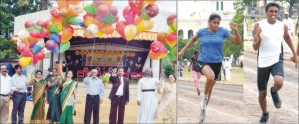
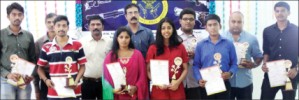
A day-long south zone II Athletic Meet (2014-15) for students of high schools coming under BEO, South Zone jurisdiction, was organised at Oval Grounds, near the DC’s office in city on Sunday. The meet was jointly organised by city’s St. Thomas Institutions, Vishweshwarnagar, in association with Mysore Zilla Panchayat, Department of Public Instructions and BEO, South Zone, Mysore.

Dr. C. Krishna, Director of the Department of Physical Education, University of Mysore (UoM), inaugurated the meet by releasing balloons.

Speaking on the occasion, he said that taking part in sporting events boosts the mind and body and called upon everyone to get involved in sports for better health.

Rev. M.O. Oommen Jr., Vice-President, Mar Thoma Education Society, Presided. B.N. Shivarmegowda, BEO, South Zone, was the chief guest.

M.P. Nabhiraj, former Varsity Swimming coach, Sarojini, Co-ordinator, Physical Education, BEO South Zone and others were present.

Nearly 150 students, representing different High Schools falling under South Zone BEO jurisdictions, took part in the Athletic Meet, which featured events such as 300 mt. running race, shot-put, high-jump, discus throw, long-jump, triple jump and javelin throw.

Results:

Women Category

Running Race – 100 mts: Jahnavi of Marimallappa High School (first), Supriya Raj of CKC High School (second), Bhuvana of Geetha Bharathi High School (third); 200 mts: Jahnavi of Marimallappa HS (1st), Bhuvana of Geetha Bharathi HS (2nd), Bindu of St. Mary’s HS (3rd); 400 mts: Jahnavi of Marimallappa HS (1st), Harshita of Geetha Bharathi HS (2nd), Meghana of Avila HS (3rd); 800 mts: Bhavana of Geetha Bharathi HS (1st), Nikhita M. Gowda of Avila HS (2nd), S. Kavya of Srikanth HS (3rd); 1500 mts: Jahnavi of Marimallappa HS (1st), Chandana of Sadvidya (2nd), Alisa Mary of Avila HS (Third); 3000 mts: Jeevita of St. Mary’s HS (1st), S. Divya of Geetha Bharathi HS (2nd), T.M. Divya of Avila HS (3rd).

Long-jump: Avijna D. Nayak of Marimallappa HS (1st), T. Kanchana of Avila HS (2nd), Soma Kumari Sharma of Nalanda HS (3rd).

Triple-jump: Avijna D. Nayak of Marimallappa HS (1st), Kanchana of Avila HS (2nd), Bindu of St. Mary’s HS (3rd).

High-jump: Vidya of Marimallappa HS (1st), T. Monisha of Nalanda HS (2nd), Aishwarya of CKC HS (3rd).

Shot-put: S.G. Soundarya of Sadvidya HS (1st), R. Chaitra of CKC HS (2nd), Apoorva of Geetha Bharathi HS (3rd).

Discus-throw: Maria Supriya of CKC HS (1st), Ananya Bhat of Marimallappa HS (2nd), R. Vaishnavi of Avila HS (3rd).

Javelin-throw: D. Lakshita of Srikanth HS (1st), N. Shakti of SBS HS (2nd), Surabhi R. Gowda of Teresian HS (3rd).

400 mts Relay: Marimallap High School wins.

Men’s Category

Running Race – 100 mts: D. Sharan of Marimallappa HS (1st), Rahul of SBS HS (2nd), C.S. Nagarjuna of Sadvidya HS (3rd); 200 mts: Rahul of SBS HS (1st), P. Sharan of Marimallappa HS (2nd), C.S. Nagarjuna of Sadvidya HS (3rd); 400 mts: Vishnu of St. Thomas HS (1st), S. Praveen of Gopalaswamy HS (2nd), Syed Yasin of Sadvidya HS (3rd); 800 mts: C. Chandu of D. Banumaiah HS (1st), Girish of Marimallappa HS (2nd), Sujat of Kanakagiri Govt. HS (3rd); 1500 mts: Harshavardhana of Geetha Bharathi HS (1st), H. Sukshit of Maharaja HS (2nd), Lakshimnarayan of St. Thomas HS (3rd); 3000 mts: R. Sharat of Geetha Bharathi HS (1st), T. Niranjan of Sadvidya HS (2nd), Sharat Gowda of Maharaja HS (3rd).

Long-jump: D. Deepak of Sadvidya HS (1st), B. Rajesh of Lakshmipuram Govt. HS (2nd), B. Rahul of Gopalswamy HS (3rd).

High-jump: D. Manoj of Marimallappa HS (1st), Rahul Raj of Nalanda HS (2nd), K. Rakesh of Kanakagiri Govt. HS (3rd).

Triple-jump: Santosh of JSS HS (1st), Aditya R. Nayak of St. Thomas HS (2nd), Goutam of JSS HS (3rd).

Shot-put: Mohamed Shaklin of Geetha Bharathi HS (1st), B. Rajesh of Lakshmipuram Govt. HS (2nd), Chetan of St. Thomas HS (3rd).

Javelin-throw: Praveen of Gopalswamy HS (1st), Prajwal Kumar of Nalanda HS (2nd), Mohamed Shaklin of Geetha Bharathi HS (3rd).

400 mts Relay: Marimallapa HS (1st), Sadviddya HS (2nd), Geetha Bharathi HS (3rd).

Overall Championship: Marimallappa HS.

source: http://www.starofmysore.com / Star of Mysore / Home> Sports l News / August 01st, 2014

HISTORY OF WHITEFIELD – Once an Anglo-Indian village, now an upmarket suburb

Whitefield’s history dates back to 1882 when David Emmanuel Starkenburgh White decided to set up ‘a self sufficient Anglo-Indian village’. 

Whitefield – what kind of images would this name evoke? most likely IT – a glass and steel building, the Technology Park or maybe even the Sai Baba Ashram, anything but a village. Well, Whitefield or rather the old settlement of that name certainly qualifies as a village and a lost one at that.

I first visited the old settlement more than a year ago in connection with another research project and was fascinated by its circular planning and wished to know more about its history. My starting point was of course, Lewis Rice’s 1887 Mysore Gazette. In it he describes Whitefield as, ‘the principal of the Eurasian and Anglo-Indian settlements in the east of Bangalore taluq’, named after D S White…‘it is 2 miles south of the railway station of the same name and 12 miles east of Bangalore’. I pursued my interest a bit further and finally with the aid of Indian National Trust For Art and Cultural Heritage (INTACH) the first phase of my research into tracing the origin and evolution of the settlement is nearly complete.

The view of Whitefield from Kaolin Hill, with new high rise buildings in the distance./  Pic: Meera K
The view of Whitefield from Kaolin Hill, with new high rise buildings in the distance./ Pic: Meera K

Whitefield’s history goes back to 1882 when David Emmanuel Starkenburgh White decided to set up ‘a self sufficient Anglo-Indian village, one where everyone would work towards the common good and no man would own property. White, himself an Anglo-Indian, was founder and first president of the Anglo-Indian Association of Madras and instrumental in setting up the Coorg and Mysore branch. This branch petitioned the Government on behalf of the Association for land and was granted nearly 4000 acres of it by the Maharaja of Mysore on ‘very favourable terms’! White’s vision was that the settlers would take to agriculture and gradually develop into a community of self sustaining farmers.

Ten years after its establishment, the 1897 edition of the Gazette states that, ‘as of 1889 the settlement had 25 families of which 6 were non-resident, numbered 115 people in total, 12 cottages built on the village site and 14 farmhouses built on the surrounding land. It mentions ‘a Roman Catholic Chapel and parsonage, a Protestant Church and parsonage under construction, a school with 31 pupils with residence for the Head-master and wife, who assisted him in the teaching’.

So did the idea of a farming village succeed? There appears to have been doubts about this even way back then. At the least, did any physical remains of the village survive? Yes and no, but first, the route to get us to the place. When I visit the settlement, I prefer to drive past International Tech Park, Bangalore (ITPB), take a right turn at Hope Farm junction, go past the Coffee Day and turn right onto the road opposite the Reliance Fresh outlet and there you are! Why this route, well, the stretch from Hope Farm to the settlement was also the historical route when you could ‘arrange for a bullock cart or tonga for 8 annas to get you to the settlement from the railway station of the same name’. In the late 1800s you had to write to Rose White to make arrangements for the same but today I guess you can make it on your own steam.

Further, you would be following the footsteps of a number of historical visitors including Lord Connemara, who visited the place in 1890, when he was the Governor of Madras. It is written that he rode on horseback and stopped at the pass between Kaolin Hill on the right and Hamilton Hill on the left to get his first view of the settlement in the valley below. Kaolin Hill still survives as part of the Roman Catholic Church property, housing the Stations of the Cross, while its opposite number has been cut up for some development (probably apartments).

Inside the Memorial church, Whitefield.  / Pic: Meera K
Inside the Memorial church, Whitefield. / Pic: Meera K

Moving on, the road you turn onto abuts the Memorial Church property – the original Protestant Church, which is still pretty much as it was originally. The road leads to a central circular open area, currently sub-divided into a park and a playground. This central area was the original ‘village green’ with the village pond to one side, which was filled up sometime in the early 2000’s and replaced with a concrete ornamental fountain! Thus regularly flooding all the houses on the low lying side of the settlement, where earlier all the storm water was diverted into the pond in a planned manner. Margaret Lunel, a long time resident, remembers dangling her feet in the muddy water of the pond while sitting on a tree branch that spread right across it. The pond held other memories too and briefly the Memorial Church organ! But that’s another story.

J E Giddens, probably one of the oldest residents, who has been here since the 1930s, remembers that the central ‘village green’ was overgrown with lantanas and jackals and hyenas would roam through it, where kids now play cricket.

As you walk along the Inner Circle road you would be struck by the contrasting picture it presents. To one side most of the old bungalows have been knocked down, the plots sub-divided and apartment blocks towering well above the treeline have come up. While, further along the same stretch you could still imagine yourself in the past as tall mature trees continue to shade the avenue and the large plots with their bungalows set right back. These bungalows are generally characterised by their symmetry, a driveway leading to a covered porch, verandah and living areas beyond, all roofed with Mangalore tiles on timber trusses.

However, few of these bungalows remain and the ones that do have generally been altered one way or another. White, visiting today would not be able to recognise the place. In a little more than one hundred years his Utopia – a self sufficient village has transformed into an upmarket suburb of the city, one that generally does not recognise the existence of this unique enclave – the price of ill planned urbanisation. Thankfully, memories remain unaltered and some very long ones abound in the settlement, each linked to an interesting anecdote.

Paul D Souza, who lives in one of the few remaining bungalows, swears the tree stump in his garden was the one Winston Churchill used to tether his horse when he came to the Inn in Whitefield to court Rose Hamilton, the Inn Keeper’s daughter! (A telephone pole fell on the tree stump and brought it down. Paul rescued the stump from the Inn garden before it became firewood. The Inn still stands).

One of the residences, which was once Waverly Inn, where Winston Churchill stayed. . Pic: Meera K.

Further, close to the RC Church where now stand villas, once stood some rocks with the initials WC and RH carved within a heart! These rocks were blasted to make way for the villas.

Whether you believe these stories of the intangible heritage of Whitefield, the stories that are related by people with the ability to transport you back in time.

Development is inevitable especially in a locality like Whitefield with its present day ‘desirable tag’.  So should we be happy to just live with these memories or should we make some efforts to retain the last vestiges of tangible heritage as well?

However, as long as legislation does not exist to protect heritage, tangible or otherwise, coupled with present day demand for rapid urbanisation and lack of public cooperation, you will only be left with stories, which again will only remain as long as the story teller.

______________________________________________

Krupa Rajangam, Architect specialised in Heritage Conservation from the internationally reputed University of York, UK, principal ‘Saythu…linking people and places’. Krupa is interested in the adaptive re-use of places and makes time for her research interest in the role of community in conservation.
______________________________________________
www.bangalore.citizenmatters.in / Citizen Matters, Bangalore / Home> Features> Whitefield> /  by Krupa Rajangam / March 04th, 2010

SACRED TREES OF BANGALORE – Tradition helps protect sacred trees in old Bengaluru areas

Even in the highly commercialised old Pete area of Bangalore, there remain some pockets of greenery that provide some fresh air to the locality. How did they survive? Here’s a study that explores reasons.


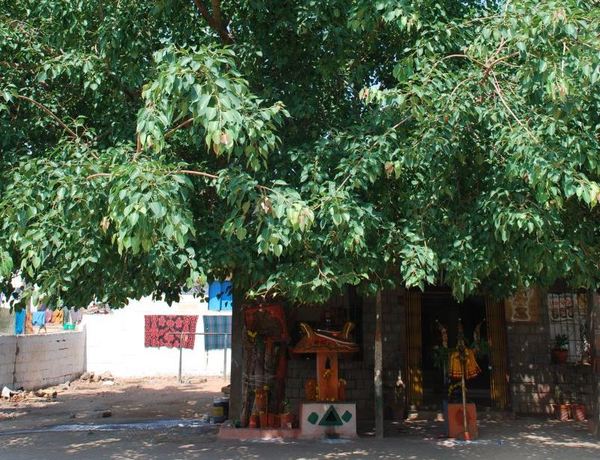
A sacred fig tree used as a place of worship. Pic: currentconservation.org

It is a common sight to see a tree protruding onto a pavement, often onto the street and sometimes even acting as a divider in the centre of the road. These are trees that have survived the axe-happy city-planning authorities just by their nature of being classified culturally as Sacred Trees.

Divya Gopal, Harini Nagendra elaborate on the importance of these trees and the reasons they have survived the onslaught of development in the city, in an article, Sacred trees in the urban landscape of Bangalore, India, published in Current Conservation, Maria Tengö.

_______________________________________________

About the authors

Maria Tengö is a researcher at Stockholm Resilience Centre and co-theme leader of the Stewardship theme. Divya Gopal is a researcher at the Institute of Ecology, Technische Universität, Berlin. Harini Nagendra is Professor at School of Development, Azim Premji University, Bangalore.

_______________________________________________

Sacred trees include sacred fig or peepal (Ficus religiosa), neem tree (Azadirachta indica), coconut tree (Cocos nucifera), banyan (Ficus benghalensis), Indian blackberry (Syzygium cumini), banni (Prosopis cineraria) and bael (Aegle marmelos). These trees are found around temples, heritage sites or the Ashwath Kattes and often as a single tree or group of trees on roadsides and other areas.

Sacred figs are tall, with huge trunk areas and large canopies. One can see sacred figs growing even in crevices of buildings! They have many medicinal properties and are biodiversity hotspots nurturing insects, birds, squirrels, bats and monkeys.

__________________________________________________

What is Ashwatha Katte?
The Ashwath Katte is an area with a slightly raised platform, generally with sacred fig (Ficus religiosa) and neem tree (Azadirachta indica) planted together under which one often finds idols of serpent gods. Other sacred species, specifically the Ficus species, may also be found in a Katte.

 __________________________________________________

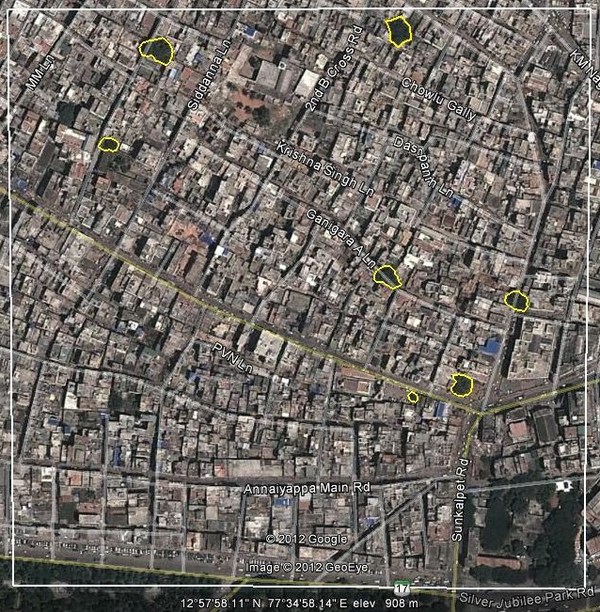
The authors had done a sample survey to map the tree cover of the Pete in Bengaluru – the quadrangle from Town Hall to Briand Square to Tank Bund Road to Avenue Road. Established in the 16th century, the Pete was the city centre and hub of commercial commercial activity that was interlaid with residential layouts. Today the Pete that has undergone several political, social, economic and geographic changes appears congested to us. However a small numbers of trees were found to be surviving – most of them sacred trees, predominantly sacred figs forming tiny islands of green!

Places of urban greenery remaining in old Bangalore Pete area. Pic: currentconservation.org

Slum settlements were other areas where there was a large presence of sacred trees, here the area around the trees were multifunctional in nature. In addition to being worshipped these were hotspots of social activities, livelihood activities like selling flowers and vegetables and the canopies were playgrounds for children.

The article also elaborates on the importance, biodiversity values, cultural and religious beliefs and medicinal values around the various sacred trees, that maybe the reason they have survived in the city. For example, peepal tree is a symbol of fertility among the majority of locals.

Clue for BBMP on greening the city?

As the city continues to lose its green cover and the authorities take up greening drives, wrong choices of trees are often made. However, sacred trees, heritage trees and other culturally protected trees have so far managed to resist the pressures of urbanisation.

As the authors point out, these examples can help BBMP learn how to design parks and green spaces that engage people in their protection and management – for a ‘green infrastructure’ of trees, parks, and other green spaces is required to sustain our well-being.

Cultural ecosystems across the world are some of the best-protected areas, securing biodiversity values as well as spiritual and other cultural values for humans. If we can recognise such values and practices that protect trees, we can better secure pockets of nature!

______________________________________________

Josephine Joseph researches and writes on urban governance, civic and environmental issues in Bangalore City, from a ‘citizen’ point of view.
_______________________________________________
www.bangalore.citizenmatters.in / Citizen Matters, Bangalore / Home> Environment> Trees> City News / by Josephine Joseph / August 04th, 2014

Bringing wiki home

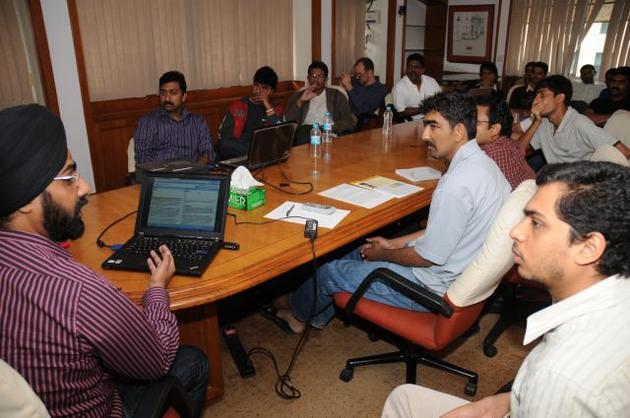
A great forum to meet and share knowledge. Photo: K. Murali Kumar / The Hindu

The free online encyclopaedia has many contributors in Bangalore

Apart from the everlasting enslavement to Google, another website that netizens cannot do without is Wikipedia, the free online encyclopaedia that allows users across the world to post entries and carry out edits on the articles posted on the site. Right from challenging and getting your facts checked in a bet with friends, to getting last-minute nuggets of information before a research paper, Wiki is the go-to resource. Didn’t ‘Lungi dance’ in Chennai Express, have the lines urging you to read up about thalaiva on Wikipedia? The resource is also used to check the authenticity of information and wild rumours that inundate the net at regular intervals. Being the tech capital of the country, Bangalore leads the way as far as wikipedians in India are concerned. Metroplus talks to a few prominent wiki contributors for the lowdown on how they joined and participated in the wiki movement.

K.Ravichander

IT professional

There were many Wikipedians in Bangalore. Some of us were born and brought up in Bangalore while many others made it home since our jobs were based in the city. The Centre for Internet and Society based in Bangalore helped us organise various wiki meet-ups that helped build relationships and extend the wiki community online. I contributed articles on South Indian history, politics and culture.

I used to debate regularly in Orkut communities and found people referring to Wikipedia articles to prove their point. That’s how I first came across Wikipedia. It was in September 2006 that I started to write for Wikipedia and I have spent many years as a Wikipedia editor.

From my childhood, I’ve always loved to write and Wikipedia gave me an opportunity to be read. For a good Wikipedian, all you need is passion and perseverance. Common folk like me could write for Wikipedia, interact with other Wikipedians, some of whom were experts in the field and gain expertise ourselves. It has been a fulfilling experience

Ramesh NG

IT professional

I have been active in Malayalam Wikipedia (ml wiki) since 2008. I have made some 16K + edits in ml wiki.

I learnt about ml wiki from blogs and friends, I started with making some minor edits in 2006 but became active only in 2008 after I discovered new tools that made it easy to work in Malayalam.

Tinu Cherian

PR and digital media consultant

I am one of the most active Wikipedians in India and one of top six Indian editors on English Wikipedia by number of edits.

I am one of very few Indian administrators on English Wikipedia and have over 53,000 edits. I have started more than 2,000 articles.

I am very passionate of building Wiki communities in India and have been very successful in starting various Wikimeetups across the country. I am a member of Wikimedia Foundation Communication Committee and have worked as a volunteer for media relations for Wikimedia for more than six years. I have represented India in various Wikimania and Wikimedia Conferences in Poland, Germany, Israel and Hong Kong. Bangalore has a large Wikipedia community Almost till a year and half ago, we used to have regular Wikimeetups in Bangalore.

It is great that apart from English Wikipedia, there are 20 other Indian language Wikipedias and another 20 are in incubation.

source: http://www.thehindu.com / The Hindu / Home> Features> MetroPlus / by Nikhil Varma / Bangalore – August 04th, 2014

Sagar wins Air Rifle shooting competition

AirRifleBF05aug2014

Mysore :

Mysore District Rifle Association (MDRA) conducted its first .177 Air Rifle Shooting Competition on July 19-20.

M.S.R Sagar emerged as the winner in senior men’s category. He was followed by D. Punith Kumar and B.G. Den Thimaiah.

In junior men’s category Deeraj Prabhu won the first prize. While, M. Harshith Kuttappa emerged runner up. Neeraj Belliappa emerged victorious in sub junior men’s category. While, T.P. Gagan and Athish Aaj secured second and third place respectively.

In senior women’s category, S. Raksha won the first prize, while, Sheethal and Geetha secured second and third place respectively.

source: http://www.starofmysore.com / Star of Mysore / Home> Sports l News / July 30th, 2014

City’s Cycle Pure Agarbathies wins Mysore KPL team bid

Arjun Ranga (third from left) and Pavan Ranga (extreme right), partners of NR Group receiving the Franchisee Certificate for Mysore KPL team from KSCA President Ashok Anand at an event held in KSCA Bangalore this morning. Also seen is KSCA Treasurer Dayanand Pai.

Mysore :

Strengthening its continuous endorsement of the game of cricket, City’s Cycle Pure Agarbathies, world’s largest incense sticks manufacturer and part of the Mysore-based NR Group, announced that they have won the franchisee for the Mysore team in the upcoming Karnataka Premier League (KPL) 2014.

Announcing the win, Arjun Ranga, Partner, NR Group said, “We are extremely delighted to have won the franchisee for the Mysore team. Apart from Mysore players, the team will be a platform to promote grassroot talent from the region. It will have young upcoming cricketers from Kodagu, Chamarajanagar, Nanjangud, T. Narsipur, Hassan and Mandya districts.”

“Apart from winning the tournament, our vision is to ensure that in the next 3-5 years at least 2 players from the team should be making it to the national cricketing arena. With continuous support from the mentors and public, we are confident that we will be able to reach there,” added Arjun Ranga.

Pavan Ranga, Partner, NR Group, was also present.

Modelled on the lines of IPL, the T20 tournament is organised by the Karnataka State Cricket Association (KSCA) and will witness competition between eight teams representing six cities.

Started in 2009, the Karnataka Premier League is now in its third season, which will be held from August 23 to September 13. The first phase of the tournament will be held in Hubli and will be followed by Bangalore. The finals will be held in Mysore on September 13.

KPL renamed Wadiyar KPL

The Karnataka State Cricket Association (KSCA) will name Karnataka Premier League (KPL) after its former KSCA President Srikanta Datta Narasimharaja Wadiyar who initially put forward the idea to start the KPL.

Wadiyar was keen to revive the KPL which was stopped after two editions. With the sudden demise of Wadiyar after a month of being elected as KSCA President, the KSCA authorities decided to name the tournament after its former President.

source: http://www.starofmysore.com / Star of Mysore / Home> General News / July 30th, 2014

Princess of the paddle


PASSION Propels Archana Kamath to achieve more. Photo: Shreedutta Chidananda
Archana Kamath, the reigning national sub-junior table tennis champion, is set for greater things

There’s a spontaneity about young Archana Kamath that is endearing. It is fear, she says, quoting Vivekananda impromptu, that brings misery, death, and evil.

“And what causes fear? Ignorance of our own nature.” As a devout student of the Swami’s teachings, this spirit she has embraced fully, Archana says; it is how she plays her table tennis and does much else: with freedom.

The 14-year-old is the reigning National Sub-Junior table tennis champion (the first to emerge from Karnataka since B.M. Ashwini in 1999) and finished 2013 as the state’s top-ranked player in four age-groups (Sub-Junior, Junior, Youth, and Women). Last year, out of the 42 competitions Archana entered across categories, she made the final in 40. And won 32.

“I feel no pressure about delivering results,” she says. “I enjoy playing. I just go and play and come back. I ask my mother if she is happy with my effort. If she says yes, that’s good enough for me.” Against older, taller, stronger opponents (and it must be noted that a girl of 18 holds a massive physical advantage over one of 14) there is no fear whatsoever.

“My approach is that I have nothing to lose. They, on the other hand, don’t want to lose to a small girl.”

For all the abandon that it appears Archana wields the paddle with, she is driven by a fervid devotion to the game. Her day begins by 6 a.m., with fitness work squeezed in before school, and winds down after some five hours of training . Her coach at the Cantonment Rail Club, Bona Thomas John, calls her focus and work ethic “brilliant”.

It is Thursday and he tells a story from this morning, when the evening’s training was brought forward on account of the bandh. “Archana was one of the last to leave and she came up and asked me what time to report in the evening. That’s the kind of girl she is.”

At tournaments, Archana has her mother tape her matches, to be reviewed later. At the China Junior and Cadet Open Table Tennis Championships in Taicang last month, where she finished a creditable ninth in the Cadet singles event, Archana filmed Chinese players she was impressed by. “It’s just so great watching them,” she gushes. “The amount they train, it seems as if they have 48 hours each day.”

The stated absence of pressure from any quarter is due, in no small part, to the atmosphere her ophthalmologist parents – Girish and Anuradha Kamath – have enabled. “It’s only her passion for the game that keeps her going,” says Anuradha, who gave up her practice three years ago to support her daughter’s blossoming table tennis career. “It is she that asks me to take her to practice. She’s making us do what she wants – not the other way round.”

It’s an important distinction. Her school, Poorna Prajna Education Centre (Sadashivanagar), where Archana is a class nine student, has also been hugely supportive, Anuradha says. “We know how much of a difference this makes.”

Archana started playing as a nine-year-old, when her parents installed a table in the basement of their RMV Extension home. She improved in a hurry, winning in just over a year’s time an under-12 state-level tournament.

Her subsequent rise has been nothing short of staggering; it has pleased although not surprised Anuradha. “One thing I can say is that she gives 100 per cent of her attention to anything she does, whether it is academics or table tennis. Sometimes when I watch her at the table, I can’t believe she is a 14-year-old. She’s so focussed.”

The future looks undeniably gilded but there is still a long way to go. “We must not forget,” reminds Bona, “that she’s only 14.”

source: http://www.thehindu.com / The Hindu / Home> Features> MetroPlus / by Shreedutta Chidananda / Bangalore – August 03rd, 2014

Commonwealth bronze sweetens life for Sakina Khatun

Sakina khatun with the bronze medal she won at the Commonwealth Games in Glasgow. /  The Hindu
Sakina khatun with the bronze medal she won at the Commonwealth Games in Glasgow. /
The Hindu

Her success is all down to her hard work: coach

Life has not been kind to Sakina Khatun, who won a bronze medal at the Commonwealth Games on Saturday.

In Glasgow’s Clyde Auditorium, the 25-year-old Bangalore-based para-athlete lifted a weight of 88.2 kg to finish third in the women’s powerlifting event (Lightweight Group A). It was a success that came after prolonged hardship.

“My parents cried when I broke the news to them on the phone,” she told The Hindu from Glasgow.

Her coach and mentor Farman Basha, who also competed at the Games, faltered in his event on account of an injury, but his delight was enormous. “She has been through a lot. So I’m very happy for her,” he said.

Sakina hails from Basirhat in West Bengal’s North 24 Parganas district. Her mother is a farm labourer while her father, ailing with a serious back condition, is unable to work. “He can’t even walk,” Sakina said. “We don’t have the money for his treatment.”

Afflicted with polio at a young age, she took up swimming on her doctor’s suggestion, learning in ponds in her village before a teacher in school noticed she had an aptitude for it. “Despite steady success at the national level, I was ignored for the 2010 Commonwealth Games team. It left me disheartened and I quit the sport,” she said.

Sakina switched over to powerlifting on the advice of one of her swimming coaches, and in 2010 was directed to Basha. “She wanted to come over to Bangalore to be trained by me,” he said. “She had no money and I couldn’t afford to spend a rupee on her.”

But Sakina found a benefactor in Dilip Majumdar, a businessman who volunteered to support her training. “I’m a girl and my parents were against my leaving home,” she recalled. “But my sponsor managed to convince them.”

“At first, she could only lift around 25 kg,” recalled Basha. “But gradually she improved. Her success is all down to her hard work.”

source: http://www.thehindu.com / The Hindu / Home> News> Cities> Bangalore / by Shreedutta Chidananda / Bangalore – August 04th, 2014