All posts by admin

Three Jaina temples at Halebid

Pages from History

JainaTemplesBF 01aug2014

by Prof. A.V. Narasimha Murthy

Hundreds of tourists visit the famous temples at Halebid which was also known as Dwarasamudra.It was their capital and when they changed the capital to Belur, this place became famous as old capital or Halebidu. Normally, tourists visit the famous Hoysalesvara temple here and enjoy the beauty of the delicate sculptures. Generally people do not even know the existence of three Jaina temples in the same place. Though these three Jaina temples do not exhibit that enchanting beauty of the Hoysalesvara temple, they present another facet of Hoysala art.

Many may wonder how Vishnuvardhana, a devoted Vaishnava was able to build these three temples in his capital Halebid. To understand this we have to just go back to some incidents that happened in the early life of Vishnuvardhana. His original name was Bittideva and was a staunch Jaina by religion. After coming into contact with the great Sri Vaishnava Saint Ramanujacharya, he became a Vaishnava and changed his name Bittideva to Vishnuvardhana. There are no historical records to support these incidents but these legends are very strong and make us believe them. One such legend states that Vishnuvardhana had a daughter by name Hariyaladevi and she was a problematic child physically and mentally from her birth itself. The physicians of the Palace could not cure her and make her normal. At that time Vishnuvardhana who had heard of Ramanujacharya paid a visit to him and narrated him the plight of his daughter. The saint by uttering some mantras cured the daughter of Vishnuvardhana and the latter was greatly imp

ressed by the spiritual power of Ramanujacharya and became his disciple and consequently he changed his name to Vishnuvardhana.

There is another slightly different legend to explain the name Vishnuvardhana. Bittideva had many wives among whom Lakshmidevi was the most beautiful and charming. She was a follower of Sri Ramanujacharya. She used her influence on her husband and converted him to Vaishnavism from Jainism. Naturally Bittideva changed his name also and began to be known as Vishnuvardhana. All these legends have no historical basis but they are strong in the minds of the people and the historians. Though Vishnuvardhana was a Jaina in the beginning and got converted to Vaishnavism, he was tolerant of Saivism which was one of the major sects of the period. This is evidenced by many Siva temples built by him.

The Jaina architecture is based upon Hindu architecture itself but the Jainas made some innovations and changes to suit the needs of their religion. They followed the usual pattern of Garbhagriha, Sukhanasi, Navaranga and Mandapa in a row. They added a pillar in front of the temple and it became unique as Manastambha. The Jaina art can be studied on dynastic pattern as Ganga, Chalukya, Hoysala, etc. That shows their inclination for adaptability. The double storeyed sanctum was an innovation of the Jains. But this did not become popular. The uniqueness of the Jaina sculptural style is the highly glossy polish of the Tirthankara images, even if the structure was built of granite. Another unique feature is the presence of tall metallic images found in many Jaina temples.

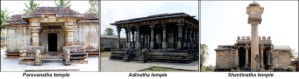
The three Jaina temples in a row at Halebid are dedicated to Parsvanatha (west), Adinatha (central) and Shantinatha (east) Tirthankaras. Parsvanatha was the 23rd Tirthankara (Jaina guru) and many people consider him as the real founder of Jainism. He was the son of Asvasena of Kashi. He lived as a housholder for 30 years and later became an ascetic. After deep meditation for 83 days, he attained the highest spiritual knowledge. He had a huge following of 1,64,000 men and 3,27,000 nuns who were highly devoted to him. He died at the age of 100 years on the summit of mountain Sammeta. Scholars have placed him in 8th century BC.

The temple dedicated to Parsvanatha was built by Bopparaja, the son of the famous Hoysala General Gangaraja. It was built in memory of Gangaraja. At this time the news of the victory (vijaya) over Bankapura was conveyed to Vishnuvardhana and he named the deity as Vijaya Parsvanatha. The temple is built of soapstone and consists of garbhagriha, sukhanasi and a navaranga and a detached enclosure. The square garbhagriha and the walls of the navaranga are decorated with pilasters at intervals. The most important attraction of this temple is the image of Vijaya Parsvanatha which is imposing by its height of 14 ft. The deity has a seven-hooded serpent over his head. The Tirthankara is a perfect yogi or a realised soul with sympathetic and benign smile on his lips. The lathe-turned elegant pillars in the navaranga are highly polished and exhibit mirror-like glossy surface.

The next temple is dedicated to Shantinatha. This is also similar to the first temple. It was built in 1192 AD during the reign of Ballala II (1173-1220). He was the next great king in Hoysala dynasty after Vishnuvardhana. He was born in 1154 AD and was appointed as a Yuvaraja as a child. He began taking interest in administration from his eleventh year. He was ruling for sometime with his mother Echaladevi and subsequently as an independent king. His father Narasimha was weak and was immersed in worldly pleasures. Ballala rebelled against him and after his father’s death, he assumed full powers and defeated many kings including Chalukya and Yadava kings. He was a patron of art and architecture also. He built this Jaina temple dedicated to Shantinatha. It consists of a garbhagriha, sukhanasi, navaranga and a mandapa. The first three parts were built during the Hoysala period while the mandapa was added during the Vijayanagara period. The sanctum has a fine image of standing Shantinatha which is 14ft in hei

ght. The navaranga pillars do not exhibit the glossy quality. Perhaps it was not finished at all.

The frontal mandapa contains granite pillars which are tall but are not artistic as those of the hoysala pillars. But they provide good support to the roof of the mandapa. Before the temple is a tall pillar referred to as manastambha which is similar to garudagamba or nandi kamba of vaishnava and saiva temples respectively. The manastamba is very elegant and indicates the special feature of jaina temple art, and can be seen in all Jaina temples. They can be seen in Sravanabelagola in plenty which is a great Jaina architectural centre not only in Karnataka but also in India.

Sravanabelagola is not only an ancient Jaina centre but also has a large number of Jaina monuments including temples and an evolution of Jaina architectural and sculptural art can be traced. Infact, its history starts from the Chandragupta basadi. The present structure is of a later period but scholars have opined that at that very spot existed the ancient Chandragupta basadi almost contemporary to the migration of King Chandragupta and the sage Bhadrabahu. Even at this great centre we do not come across three Jaina temples in a row close to each other. Thus it is unique feature here at Halebid.

The last temple is slightly smaller in dimension. It is dedicated to Tirthankara Adinatha. It was built in 1138 AD during the reign of Vishnuvardhana. He had a minister by name Mallayya and this temple is his initiative. An inscription is available and it records some historical details. Thus the three temples built by hoysala kings in their capital Halebid gives a hint to the importance given by them to jainism in addition to other religious of the State. This religious harmony of the hoysala period is specially noteworthy. This reminds us of a hoysala inscription which enunciates the equality of all Gods like Siva, Vishnu, Brahma, Budda, Jina, Karta etc. That this was not an empty boast and a lofty idea in theory but was practised in daily life is proved by the temples built by hoysala kings to all the religious faiths of their kingdom. That was the greatness of the hoysala dynasty.

source: http://www.starofmysore.com / Star of Mysore / Home> Feature Articles  / July 26th, 2014

Snake Shyam featured in UK tabloid

Reaches 28,000 mark yesterday

SnakeShamBF31jul2014

Mysore :

City’s noted snake rescuer and wildlife conservationist popularly known as Snake Shyam who has been elected as the Corporator of MCC Ward No. 17 was featured in Daily Mail, a UK tabloid on July 23.

The article in the tabloid says that Snake Shyam, despite being allergic to most anti-venom, catches some of the deadly species in Mysore every day.

It also says that this serpent-lover had been bitten four times and the doctors discovered that their treatments were prompting a severe allergic reaction which could kill him.

That means that Snake Shyam’s next call-out could be his last – but despite the dangers, he refuses to give up.

The article also features photographs of Shyam catching snakes, documenting them, his Maruti Omni Van and video of him catching a snake.

Reaches 28,000 mark yesterday

With the rescue of a Rat Snake at a steel godown in Bannimantap here yesterday, Shyam has so far rescued 28,000 snakes.

Snake Shyam speaking to SOM said that he began catching snakes in 1980 and had not documented them till 1997. He further said that on the advice of some, he began to document the snakes he had rescued from 1997 and has so far rescued 28,000 snakes and released them into their habitat far from urban areas.

He has called upon the people not to kill them, but instead call him on Mob; 94480-69399 and keep a watch on the snake till he arrives.

source: http://www.starofmysore.com / Star of Mysore / Home> General  News  / July 25th, 2014

Three horse riders from Bangalore for Incheon Asian Games

Ajai Appachu, Fouaad Mirza and Nadia Haridass, three of Karnataka’s senior show jumpers, would take part in the equestrian event of the 17th Asian Games to be held in Incheon, South Korea, from September 19 to October 4.

Appachu, Mirza and Haridass train in Bangalore’s Embassy International Riding School (EIRS) and have qualified through five trials, qualifiers and competitions which were held from October last year to April this year, said a media release today.

There were five jury members involved in making the selections for each of the competition’s disciplines – jumping, dressage and eventing.

Appachu has earned several equestrian accolades at events world-wide and recently placed second at the Hopetoun Commonwealth Cup in Scotland and is also the chief instructor for budding equestrians at the school.

Mirza, 22, placed fourth at the Hopetoun Commonwealth Cup earlier this year while Nadia has been a consistent performer in the dressage category – representing the country at international meets, the release said.

The equestrian sport has been featured in the pan-Asian sports spectacle since the New Delhi Games in 1982 and to date, Japan leads the honours list, followed by South Korea and India in that order.

source: http://www.business-standard.com / Business Standard / Home> PTI Stories> National> News / Press Trust of India / Mumbai – July 24th, 2014

This Woman from Srirangapatna is the Queen Bee Among Entrepreneurs

Chayaa nanjappa National Best Entrepreneur Award From the Confederation of Women Entrepreneurs of India was presented toher in Hyderabad on Monday. |EPS

Bangalore :

From Srirangapatna to Europe, it has been a long and difficult journey for 42-year-old Chayaa Nanjappa. But she has battled the odds and today heads a rural enterprise which produces high-quality honey that sweetens many a home even in Europe and the United States.

As a reward for her hard work, Chayaa was on Monday awarded this year’s ‘National Best Entrepreneur Award’ in food processing by the Confederation of Women Entrepreneurs of India.

Her path to success has not been a smooth one; she had to overcome many an adversity, physical abuse and traumatic relationships. But now, this gentle, self-made woman provides a livelihood for not only many illiterates of Mysore and Mandya districts, but also some tribals across the state. She is also the largest buyer of forest honey from Malayalis and tribes like Siddis and Jenu Kurubas.

She began her journey by setting up a small unit at Bommanahalli with the help of a `10-lakh loan. She then shifted operations to Nanjangud and later, to Srirangapatna.

Today her enterprise Nectar Fresh, which produces monofloral honey, has a capacity of 200 tonnes and is worth `6 crore. It is one of the largest bulk suppliers and packers of honey in the country and falls in the top five bulk exporters of raw as well as processed honey. Nectar Fresh also has the ISO 22000:2005 certification.

Chayaa told Express, “With no work experience or exposure, I started a rural industry in 2007 that could be identified with my hometown, Coorg. After doing a basic course from Central Bee Research and Training Institute (CBRTI), I jumped into the industry completely, sourcing honey from tribes and farmers.”  She has 20 mobile apiary vans across the country.

Going International

To earn her brand a significant international presence, she decided to market it as a basket of products, including jams and sauces. The result: it found a place in the European market. “I added jams and sauces to my basket by purchasing pulp from sick units run by women in places like Bangalore and Mangalore, and sourcing fruits like papaya and tomato directly from farmers,” she said.

With exports to Germany and France, Nectar Fresh has broken the monopoly of global companies like Bereenberg, Darbo and Bonne Maman. “We met the stringent standards necessary for approval to export to Germany and made a strong impact by packaging our honey and jam in polypropylene sachets for high quality and shelf life. The European competitors feel threatened by our presence,” said Chayaa, who is now busy tying up with a Saudi Arabian company for the production of jams from dates.

She credited the Karnataka Village Industries Board (KVIB), CBRTI, the Horticulture Department, the Central Food Technological Research Institute (CFTRI), Le Meridien, ITC Foods and a host of others who supported her. “Any small and marginal farmer in Karnataka producing quality honey can contact me. My sole aim is to promote rural products and help women in distress by providing employment opportunities,” she said.

source: http://www.newindianexpress.com / The New Indian Express / Home> States> Karnataka / by Meera Bhardwaj / July 31st, 2014

Tata Solar Power announces expansion of manufacturing facility

SUMMARY

Tata Solar Power (TSP) announced expansion of its manufacturing facility from 125 MW TO 200 MW at Bangalore.
_____________________________________________________________

Anticipating policy support from the Modi government at the Centre, Tata Solar Power (TSP) announced expansion of its manufacturing facility from 125 MW TO 200 MW at Bangalore.

The TSP officials also praised the Commerce Ministry’s initiative of levying Anti-Dumping Duties (ADD) and Domestic Content Requirement (DCR) of solar cells on US, Malaysia and China, as a positive move to level the playing field for the domestic producers.

Ajay Goel, the CEO of TSP, said, “This substantial expansion, in an extremely competitive and price-sensitive sector, is a testimony to the superior quality and global competitiveness of our products. Though the Jawaharlal Nehru National Solar Mission (JNNSM) originally intends to promote domestic producers in the Solar power manufacturing industry, there are barely few takers for such schemes as the cost of capital will still remain high in the presence of cheap flowing from the Chinese market,” he said.

Incidentally, the company officials maintained that it has not received any expression of interest from the Karnataka government, which in recent day has been actively in news for promoting roof-top solar panels for domestic users under Karnataka Solar policy.

source: http://www.indianexpress.com / The Indian Express / Home> Cities> Bangalore / Express News Service / Bangalore – May 28th, 2014

Bank initiative for women entrepreneurs

Bangalore :

Canara Bank has lanched a unique skill development programme of making stationery and gift items with pressed flowers, craft paper bags designed for women inmates of central prison, Parappana Agrahara, here.

The three-day skill training programme at the women’s block of the central prison was organized under the CSR initiative of the bank. It was meant to engage the women to generate income while within the prison wall as well to equip them to make their livelihood on release.

Canara Bank DGM K Virupaksha assured the women further training support and added that the bank will support in marketing the products made by the women through the high-tech mobile sales van “Nammura Santhe” which is a unique initiative of the bank for helping micro women entrepreneurs in the City of Bangalore.

source: http://www.timesofindia.indiatimes.com / The Times of India / Home> City> Bangalore / M.K. Madhusoodan, TNN / July 30th, 2014

Mangaloreans win top honours at ‘Beat Down’ national-level karate championship

Media Release

Bangalore :

Members from the Institute of Karate and Allied Arts (IKAA), headquartered in Mangalore, won the top honours at ‘Beat Down 2014’ a two-day national level martial arts extravaganza organised by Wakayama Karate-Do India at Sree Kanteerava Stadium, Bangalore recently.

MangaloreanBF28jul2014

As many as 22 students from the institute took part in this competition, led by senior instructors Sensei Derick Kishan (Malpe), Sensei Clement Sequeira (Puttur), Sensei Ashok Suvarna (Karkala) and Sensei Dayananthan (Bangalore). Over 2,500 competitors from all over India in different styles of Karate, Tae Kwon do, Wushu, Kung fu and so on participated in the competition.

JuniorKarateBF28jul2014

IKAA bagged 18 prizes which included 16 individual events and two team events. In the team events, two teams from Banaswadi emerged victorious by bagging the first place in the men’s team Kumite and the third place in Black Belts Team Kumite.

The uniqueness of the winning team is that most of its members are Mangaloreans who moved to Bangalore a few years ago for pursuing their careers in different fields, but their passion for karate and martial arts still continues to be very strong. In spite of being occupied and busy with their full time jobs in multi-national companies, they make it a point to continue their training on a regular basis and not lose touch with the art they learnt in Mangalore during their college days.

Derick Kishan runs a full time karate institute in Bangalore while Clement Sequeira, Ashok Suvarna and Daya conduct karate classes during their free time and weekends, assisted by other black belts and senior instructors in Bangalore. They also conduct several self defense and safety awareness workshops and sessions for corporates, schools and general public specially focused towards women and children’s safety.
The winners in the competition are as follows:

Team Kumite (Fight) Colour Belts – First Place

1. Deviprakash Bhandary
2. Suraj Acharya
3. Bhavish Kumar
4. Arkodeb Chakraborty
5. Merwin D’ Almeida
Team Kumite (Fight) Black Belts – Third Place

1. Clement Sequeira
2. Gopal V
3. Amarnath PV Shetty
4. Sunil Rai
5. Roshan Rao
6. Sukesh P Gowda
Individual Kata: First Place

1. Sanvi
2. Ayush
Individual Kumite (Fight)

First Place
1. Kushal Babu
2. Sharan Kumar
3. Shreyas
4. Deepika
5. Bhavish Kumar
6. Deviprakash Bhandary
Second Place

1. Merwin D’ Almeida
2. Roshan Rao
3. Sunil Rai
4. Sukesh P
5. Arkodeb Chakraborty
Third Place

1. Gopal V
2. Suraj Acharya
3. Madhusudhan

source: http://www.daijiworld.com / DaijiWorld.com / Home> Top Stories / Monday – July  23rd, 2014

Sri Veena Vani Music School might get into Guinness Book of World Records

City based music institute, Sri Veena Vani Music School (SVMS) located in Banahankari has received a green signal from Guinness Book of World Records’ for its dream of gaining the title of Guinness.

The SVMS is planning for a Carnatic classical keyboard performance in the month of October 2014 and enter the Guinness Book of World Records . The program is to ensemble about 500 key board players, collectively performing the national anthem, national song and a Carnatic piece of music in a western instrument on one stage.

The committee of Guinness Book of World Records has communicated with the city based music school and confirmed the participation of its judges and members and they will be arriving to city in October.

B Gireesh Kumar, president of the school told dna,”We have received the official confirmation of participation from Guinness Book of World Records and asked us to pay the registration and judge fee of 8,700 US dollars. Committee has also confirmed the time for the event and it would be in October,” he said.

After getting inspired by the prestigious Guinness Book of World Records as largest keyboard ensemble created involving 175 keyboard players in USA on July 2013, the city based music school Sri Veena Vani Music School in Banashankari has been aiming to enter the Guinness Book of World Records by playing the western keyboard by over 500 keyboard players and singing Carnatic Classic Music by over 500 singers on the same stage.

Speciality of the event is, an attempt is made to adapt keyboard a full fledge western musical instrument to Carnatic Music and for the first time over 500 keyboard players and 500 Carnatic classical singers will perform on the stage by singing only swara for about 40-45 minutes during the third week of October.

The largest keyboard ensemble consisted of 229 participants and was conducted by M.S. Martin and organized by Sangeetha Sriram at Chennai Trade Centre in Chennai, India, on 16 January 2014. And now Sri Veena Vani music school wants to break that record and want to create such a record in Bangalore with over 1000 musicians including singers and musicians.

Now the school has started this unique model for all keyboard music aspirants who would want to be a part of the event and providing training for age groups from 7-60 years. The lessons are imparted via video, through online modules including Skype and Offline classes and also in the Institute premises, Gireesh added.

source: http://www.dnaindia.con / DNA / Home> Bangalore / Place: Bangalore, Agency: DNA / Monday – July 21st, 2014

Sudharma : City’s sanskrit newspaper launches website

Sanskrit scholar Bannanje Govindacharya is seen launching the website as Prof. Bhashyam Swamiji, Vid. Seshadri, Vid. H.M. Shingappa and Sudharma editor K.V. Sampath Kumar look on.

Mysore :

The country’s first Sanskrit newspaper Sudharma launched its website www.sudharmasanskritdaily.in to mark its 45th anniversary celebrations at a function held at Vidyashankara Kalyana Mantapa near Gun House here on Sunday.

The newspaper was conceived by K.N. Vardaraja Iyengar in 1970 with the objective of reviving the language by bringing current events to readers in Sanskrit. The daily is now being managed by his son K.V. Sampath Kumar, who doubles up as a reporter-cum-proof-reader and editor.

“The launch of the website marks a major milestone in the annals of our newspaper, which has a print subscription of 3,000 copies, but over 1,00,000 people access the e-paper from all over the world,” said Sampath Kumar and added the e-paper could now be accessed through its website.

Renowned Sanskrit scholar Bannanje Govindacharya, who was the chief guest, launched the website. Prof. Bhashyam Swamiji, Principal, Maharaja’s Sanskrit College, was present.

On the occasion, a set of books in Sanskrit were also released.

Vid. H.M. Shingappa, retired professor of Maharaja’s Sanskrit College and Vid. Seshadri of Sri Lakshmivenkataramanaswamy temple were felicitated.

source: http://www.starofmysore.com / Star of Mysore / Home> General  News  / July 21st, 2014

Postal trainees explore the heritage of city on cycles

Dr. C.G. Betsurmath, Commissioner, Department of Archaeology, Museums and Heritage, is seen leading a team of postal trainees in front of Kote Anjaneya Swamy Temple during the Heritage Cycle Rally which began from Town Hall premises here yesterday morning.

Mysore:

The trainees of the Postal Training Centre (PTC), Mysore, explored the heritage of the city on cycles yesterday.

The cycle rally, organised by the Department of Archaeology, Museums and Heritage, was flagged off by Veena Kumari, Director of PTC from the Town Hall premises at 7 am. It was led by Dr. C.G. Betsurmath, Commissioner, Department of Archaeology, Museums and Heritage.

The participants covered Clock Tower, Chamaraja Circle, K.R. Circle, Lansdowne Building. Banumaiah’s College, Mysore City Corporation, Jaganmohan Palace, Parakala Mutt, Commercial Tax Office, Lokayukta Office, Oriental Research Institute, Crawford Hall, Maharaja’s College, Yuvaraja’s College, Maharani’s College, Metropole Hotel, Railway Station, Divisional Railway Office, K.R. Hospital, Govt. Ayurveda College, Central Library, Devaraja Market and the Dufferin Clock Tower on cycles.

Speaking on the occasion, Dr. Betsurmath said that yesterday’s rally was the second with the first being the rally conducted for the staff of Indian Overseas Bank.

He said that there were demands for such rallies from other institutions and offices and added that trainees of Administrative Training Institute (ATI) would participate in the next rally on Sunday.

Resource persons in the rally included retired professor of the Department of Ancient History, University of Mysore, Dr. N.S. Rangaraju, Deputy Director and Heritage In-charge Gavi Siddaiah, journalist Echanur Kumar and Curator in the Archaeology Department L.L. Gowda.

source: http://www.starofmysore.com / Star of Mysore / Home> General  News  / July 21st, 2014