All posts by admin

For this Artist, ‘Pain is Inevitable, Suffering Optional’

Bangalore :

Rohini Sen, the Bangalorean artist whose first solo show in the city opens today, suffered a foot injury a couple of years ago. It left her in extreme, chronic pain. A Chitrakala Parishath graduate, she was teaching arts and running when the pain overtook her life, and marathon plans.
RohiniSenBF19jun2014

Her exhibition of drawings at Five Forty Five (from June 7 to 14), tells the story of her emotions as she grappled with the negativity surrounding her. She tells City Express how the pain changed her life and art:

You have titled your show ‘The Efficacy of Exquisite Pain’. Why do you describe pain as exquisite? And are you talking about its efficacy in making you see the world differently?

My drawing The Choice Between Freshness and Decay deals with how I began to look at pain as an exquisite gift when my injury posed an emotional dilemma—to look at myself as a person decaying from inside or to celebrate the discovery of a new lens with which to look at myself. And so, pain for me was exquisite in terms of the observations it facilitated. The efficacy of my injury perhaps culminates in these 20 drawings — which otherwise would have  been stories I would have never known to tell.

Are you free from pain now? Does your show reflect ’emotion recollected in tranquillity’?

While I think I am free from physiological ‘real’ pain now, anyone who has had a chronic injury will tell you that one is never free from the peripherals that pain leaves in its wake. The fear of the injury relapsing comes back to me every time I am at the gym, training for a run or coming down a staircase. My doctor, Dr KMK Varma of Manipal Hospital, first introduced me to this idea of associations when he sat with me and some of my drawings, trying his best to understand what I was going through!

To reflect on any situation, perhaps quietude is paramount. At the beginning of my injury I was hell bent on looking for a quick fix. Several cortisone shots later (I would get a Cortico steroid shot and get back to training!), I came to realise that it was not about conquering my own body and proving to my injury, “Hey, see? I still finished a 25 km run, so you lost and I won”. Patience, a sense of calm and nurturing my dysfunctional foot really helped me reach a space of acceptance. The drawings Learning to Listen and The Acceptance Conference deal with this idea.

What artistic strategies helped you deal with the pain? Were you drawing and painting through the pain? Any particular works of art that you drew strength from?

I do not think I have ever looked at my drawings as a catharsis of any kind. I was drawing through the second half of my injury: the series started when I was admitted in an ayurvedic hospital. At I-iam Hospital (Yelahanka, Bangalore), between yoga and treatment sessions, I began to reflect on what this injury taught me. More than works of art, I drew great strength from the other patients admitted there. They had come with the determination to transform themselves and begin the process of healing. The 15 days I spent there taught me a certain meditative discipline with which I now approach my art  practice, running and training.

What is the status of your marathon dreams?

While I am now ‘back’ on the running scene and successfully finished the TCS 10k in May with the help of my coach Mutie Mohammad and my extraordinarily supportive running team Jayanagar Jaguar, I do not think I nurture serious marathon dreams any more! I am now grateful for whatever little distance my body grants me.

Your paintings portray a wide range of animal characters, from parrots to emus to rats. What explains the absence of human characters?

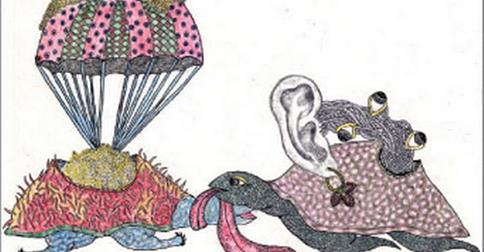
I made a conscious artistic decision not to make literal representations of situations, but to find visual metaphors. My animals allowed me to say it so much more beautifully because each animal stands for a certain characteristic. My rats talk about the plague that a painful association gives rise to, my emu and other ratites express the frustration I faced when people who did not run kept giving me ‘advice’, and my turtles represent being alive for long—their slowness allows them to absorb the experiential ambit of life in a profound way.

Tell us about your art training.

I was taught Madhubani art by national award-winning master craftsperson Sasikala Devi while I was at Rishi Valley School. I completed my Bachelor’s in visual art from Karnataka Chitrakala Parishath in 2010. I then went on to become an art and running teacher for middle school children at the Mallya Aditi International School. In 2012 I went to do my MA in Art Education at the Rhode Island School of Design, USA, which was a turning point in my artistic approach. Between 2012 and 2014, I have exhibited at quite a few internationally acclaimed galleries such as The Awagami Gallery, Japan, and the Drawing Box, Belgium. I am now represented by Cade Tompkins Projects in the US. This is my first solo show in India.

What advice would you offer people with chronic pain, and sufferers who want to use art as a way out of pain?

I personally do not subscribe to the idea that art is a way out of pain and injury!

My process of drawing allowed me to reflect and make observations.

What do you do when you aren’t drawing and painting?

I am currently adjunct faculty at Srishti School of Art, Design and Technology, where I offer courses on reflective praxis, drawing as a thinking tool, and narrative form and structure.

How did you deal with other people’s comments about your pain?

They were at times comforting and at others unkind, but most often not useful. Using birds that cannot fly, I wanted to say this kind of advice comes often from a feeling of not being able to help. When a person is injured like the way I was, it is really the whole family that suffers sleepless nights, so a lot of the advice was from my loved ones experiencing a sense of helplessness. I also faced a lot of unkind remarks about the weight gain as a result of my injury.

Anything else you would like to share?

More than anything else, I would like for the running fraternity of Bangalore to engage with my work and recognise that this was one runner’s way of reflecting about injury. As Haruki Murakami says in his book What I talk about when I talk about running, “Pain is inevitable, suffering is optional.” I wish to share this with  every runner and fitness enthusiast who has faced the obstacle of a sports injury.

source: http://www.newindianexpress.com / The New Indian Express / Home> Cities> Bangalore / by S. R. Ramakrishna / June 07th, 2014
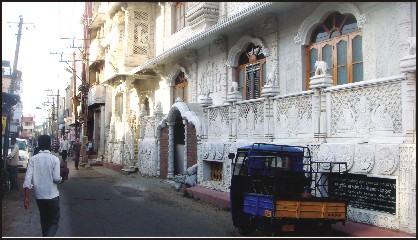
Bangalore’s own Tudor Taj Mahal

For those who regularly cross the Queens Road-Cunningham Road junction in the heart of the city, this stone building, halfheartedly bordering the road leading towards Shivaji Nagar, is not a rare sight. A few may even know that it’s called the Lady Jehangir Kothari Memorial Hall, but what marks it out as special is the fact that it is dedicated to a Pakistani woman who died in 1923 in Bangalore.

Goolbai, better known as Lady Jehangir, was the wife of Sir Jehangir Hormasji Kothari, a rich merchant of the Parsi community, who was born in Karachi. Sir Jehangir was famous for his philanthropic ways and was the first Indian from the provinces of the Punjab or Sindh to be knighted. A globetrotter, Sir Jehangir visited Bangalore with his wife as part of their south India tour in 1923. The journey ended on a tragic note with his beloved wife taking ill in Bangalore, where she breathed her last. She was interred at the Parsee Aramgah or burial ground in the city.

At that time, Bangalore only had a handful of Parsis. The Iranian Zoroastrians started migrating to Gujarat from their homeland Persia (now Iran) following the Arab invasion in the 8th century AD, says Yezdi N Unvalla, a member of the Bangalore Parsee Zoroastrian Anjuman, tracing the earliest days of the community in the country. “After his wife’s death, Sir Jehangir visited Bangalore again and decided to build a memorial in her name. He felt Bangalore’s Parsis need a place to get together and celebrate community functions,” adds Unvalla. The hall today belongs to the Bangalore Parsee Zoroastrian Anjuman.

The distinctive feature of the building is its archaic Tudor architecture. Even the ceiling is made of granite slabs. Sir Jehangir, who was an unofficial world ambassador for the British Empire, had good contacts with the officials who were in charge of the Bangalore Cantonment. The construction of the hall started in 1931 and it was declared open in 1932. Today, the community pays tribute to the Kothari couple by celebrating Annual Club Day with a prayer ceremony.

“The building is now used for community functions and recreational purposes and is given on rent for conducting exhibitions and annual fairs,” the Parsi association’s president Dinshaw Cawasji says.

Though the once tranquil place has now been engulfed by the expanding city, the community’s timely repairs have ensured that the decades-old building has withstood the vicissitudes of time.

Parsis arrived in Bangalore in view of increasing business prospects and settled in the Cantonment area by the end of 18th century. They maintained good relationship with the Europeans and the hall might have been built in old English Tudor style to suit their cultural taste. Bangalore Palace built by the Mysore royal family is another fine example of this style.

Dr. SK Aruni, Indian Council of Historical Research (ICHR), Bangalore

source: http://www.timesofindia.indiatoday.com / The Times of India / Home> City> Bangalore / by M. Ashtitha, TNN / April 07th, 2014

The Mysore that was … Part 21


 Sri Suvidhinath Rajendrasuri Jain Temple in Halladakeri.
Sri Suvidhinath Rajendrasuri Jain Temple in Halladakeri.

by M.L. Krishnaswami

The old Halladakeri is now renamed Mahaveernagar and all the broken tiled roof houses have been demolished and in their place, modern constructions of two or more storeys have come up. The whole area is inhabited by Rajasthani and Sindhi Merchants and gives an entirely new look. A Jain temple has also come up in the area and during early mornings, one can see worshippers — both men and women in their traditional religious dresses — making a beeline to the temple.

A month or so back, in the early morning hours, a having dropped my wife in the suburban bus stand, I decided to park my car on the eastern wing of Irwin Road, opposite the Wellington Lodge and then proceeded to take a stroll along the stretch of road in between the Suburban Bus Stand on the East and Ashoka Road on the Western side. It is about a kilometre or a little more long and was way back called by a peculiar name “Halladakeri” or a street with lot of pits, I do not know why and how?

This Halladakeri, about 60 years or so ago, was dotted on both sides by old tiled roof houses and some of them nearing dilapidation with broken walls, ramshackled in nature, and with low doorways of wood with very small openings in the walls — an apology for windows also of wood. Most of these houses were inhabited by Brahmins and some of them were occupied by a few other people who sold butter, oil etc.

Towards the Circle near the Mysore Bank and Central Police Station — now called Nehru Circle — there was a Choultry by name ‘Jaggulal Chathra,’ a very big building (single storey) built of thick mud brick walls and with tiled roof, I do not remember exactly. If I am not mistaken, this Choultry belonged to members of the Sindhi Community who were a small minority in Mysore in those days. This Choultry building is still there — unused and unkempt — like an ageing elephant in distress. Let it be. If my memory is correct, the small by-lane housing the Jaggulal Dharmashala — that was its real name — was called ‘Hamsarajagalli’, whatever it means or refers to I do not know.

Apart from the above, the old Halladakeri is a remnant of the past. It was early morning when I strolled through — about 7.30 am — and not many people were on the move. There used to be a Ganeshothsav celebrated in a grand scale for about a fortnight or so and, if I remember correctly, one gentleman by name Murthy was in charge of the arrangements for the festival which included very good music programmes in the evenings by well-known musicians of the day who were specially called from Madras, Andhra and, of course, a few local luminaries. Orchestral music was not much in vogue those days and it was perhaps due to the patrons who lent their ears to classical variety and encouraged it.

The Brahmin houses were mostly occupied by Palace Priests who were held in high esteem by the community. Along the road was living one family which was related to our family by four generations backwards. I remember visiting this family for taking part in some ceremonies in those houses. I also remember one old lady by name Kuppa Chikkamma living there and who happens to be the grandmother of the famous Kannada poet K.S. Narasimhaswamy of Mysore Mallige-fame.

The above are only memorabilia now:

The old Halladakeri is now renamed Mahaveernagar and all the broken tiled roof houses have been demolished and in their place, modern constructions of two or more storeys have come up. The whole area — or practically the whole — is inhabited by Rajasthani and Sindhi Merchants and gives an entirely new look. A Jain temple has also come up and early mornings, one can see worshippers — both men and women in their traditional religious dresses — making a beeline to the temple. The road, small in width — hardly 20 to 25 feet or so — reminds me of the Girgaum Road or Kalbadevi Road, both very busy commercial centres of Bombay, with the only difference, this is more a residential area, with only a few business outlets here and there. Strangely and to my utter surprise, in the midst of all the above developments on either side of the road, I saw the old business establishment of Someshwara Steel Traders run jointly by M/s Somanna and Brother. This is like an oasis in a vast desert. May I say, ‘Hold on, Mr. Somanna’ who is a good friend of mine?

On another day, I took a stroll in a locality enclosed in a quadrilateral shape made up of Hundred Feet Road in the North, Thyagaraja Road on the East, Vanivilasa Road in the South and lastly D. Subbaiah Road on the West. This area is intersected into two parts as Chamundeshwari Road and Narayana Shastri Road. Incidentally, Narayana Shastri Road is named after the grandfather of the famous T.P. Kailasam and a fairly big building belonging to the above Narayana Shastri has since been demolished and a multistorey structure is in place now.

The area between Thyagaraja Road and Soppinakolada Beedhi (the road that runs North at right angles to the K.R. Police Station on V.V. Road) is dotted in the north by two or three Agrahara’s which are endless housing schemes built and gifted by the late Maharaja to needy citizens and these are intact even now with more or less the successors of the original owners in occupation.

Beyond this is the Sunnadakeri which has also maintained its original shape with small houses and shops with independent water and electricity connections. Only Soppinakolada Beedhi (now called Renuka Temple Street) is slowly undergoing change with neat housing complexes coming up in place of old houses.

The stretches between N.S.Road as above and Diwan’s Road from double tank side to Chamaraja Double Road has a cluster of housing appendages, very small in size and with poor ventilation and with a majority of housing units depending on street water taps for their water needs. Just behind the now closed (perhaps) Kiran’s Nursing Home, I saw a group of houses where the womenfolk have to make do with street water taps for washing utensils and clothing, as also bathing their small kids in the open. This is really a miserable sight and reflects poorly on our civic responsibilities. The population in this section is composed of backward class Hindus and Muslims living side by side since generations. The situation above needs redressal urgently.

Muharram is a great festival of the Muslims and a number of pendals used to come up in the area where the deities were kept and worshipped. Even Hindus would participate in this festival and the last day function saw the bon-homie of the two major communities in a large measure.

In the above quadrilateral area the redeeming feature is that Hindus and Muslims are living together for generations and I know this as I was a resident of V.V. Road for a long time. It is heartening to know that there is a small unit manufacturing sandal sticks or agarbathies in this locality and founded by the late M.R. Jattappa, a pioneer in this line and his brand name was ‘Premaleela Agarbatti’, emanating a romantic fragrance to the passers-by all around. This is like a rose flower in the midst of a thorn.

There was also a hair-cutting saloon jointly owned by two brothers by name Shivaram and Govindaraju and this used to be visited by the big-wigs of those days like Professors, Doctors, Lawyers, etc. The major attraction was Shivaram who happened to be the hair dresser of the Palace and who used to talk about his experiences there. This saloon is still there and must have passed on to the third generation now. Half a rupee was the charges for a hair cut and affluent people could shell out a rupee for the same.

Note: My humble suggestion in this connection is that educated and enlightened citizens should abandon the use of their vehicles once in a while and take a walk in the lanes and bylanes of the city, to get a real feel of the development that has taken place over a period of time. This will certainly go a long way in improving the lot of the poor and underprivileged citizens by addressing their problems before the powers that be.

source: http://www.starofmysore.com / Star of Mysore / Home> Feature Articles / June 17th, 2014

I want to turn Professional : Aditi Ashok

AditiBF14jun2014

Aditi Ashok, the soft-spoken Bangalore girl who has been making waves with her brand of golf in the International and Indian golfing scene, represented India as a Junior at the age of 15 years at the Duke of York Young Champions Trophy in 2013. Aditi played in the 2nd Asian Youth Games 2013 at the age of 15 years. Aditi is the youngest amateur in the World at 13 years and 5 months to win the Hero WGAI’s Clover Greens Ladies Professional championship in 2011. Aditi has to her record as the best finished Indian Lady golfer and tied 8th at the Hero Women’s Indian Open 2012.

In December 2011, Aditi became the youngest Amateur (also equalled the record), at the age of 13 years, to win the 95th All India Ladies Amateur Open Golf Championship 2011 at Chandigarh Golf Club, Chandigarh. Aditi is the first junior girl in the country to have chosen to compete in the higher category. Aditi is the first Indian Amateur at 12 years to have represented India at the Asia-Pacific Invitational, 33rd Queen Sirikit Cup 2011.

Aditi won her maiden International junior title at 13 years (Individual Girls U-14 and Team India) at the 100 Plus Malaysian Junior Golf championship 2011 and won the Asia Pacific Juniors 2012 (U15 girls). Aditi is the National Junior champion and won the Toyota Etios Player of the Year 2012 (Junior Girls). Presently Aditi is ranked No 3 in the IGU Ladies Merit List and No.1 Junior in the country.

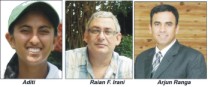
Aditi Ashok is currently taking part in the N R Group IGU Ladies & Junior Girls Amateur Golf championships at JW golf course from June 7-10th 2014, and she shared her views with SOM Correspondent. The writer also spoke to Raian F Irani, President, Indian Golf Union (IGU), who is responsible for bringing the National Ladies and Junior tournament to Mysore. Arjun Ranga, Managing Director, N R Group of Companies have given patronage by supporting golf in a big way and have sponsored the tournament in Mysore.

Below are the excerpts of the interviews with all the three of them.

SOM: How do feel taking part in the N R Group IGU Ladies & Junior girls Amateur golf championships played at the J W Golf course here in Mysore ?

Aditi: I have not played in this course for the last five years. I have been playing in different tournaments and did not have a chance to play in Mysore. Now the greens are good and the course is much better and the club authorities have done a lot of good work to keep the course in good playing condition.

SOM: You have achieved many firsts- the first amateur golfer at 13 to represent India and also to win the All India Ladies championships. What do you attribute your success to?

Aditi: I really liked golf and am a very focused person. I put in a lot of hard work and played really well and that yielded results. Hard work and practice helped me to achieve success at all levels.

SOM: You are currently ranked No.3 in the IGU Ladies merit list and No.1 in the country in the Junior girls section. What are your future aims?

Aditi: I definitely want to turn professional and become one of the top golfers in the World. I will decide in the next two years as I have to finish my schooling before turning a professional.

SOM: How did you take up to playing golf and who inspired you to do so?

Aditi: Nobody inspired me into playing golf. I accompanied my father to KGA and liked the game and took up to playing the game when I was 6 years old. My parents Ashok and Maheshwari encouraged me and I started playing tournaments when i was 7 years old at the Karnataka Golf Course (KGA) in Bangalore.

SOM: Which are the future tournaments you are going to take part?

Aditi: By playing well on the National circuit, I will get to play for India. I aim to represent India in the forthcoming Asian Games, the World amateur championships. I will also be taking part in the Junior Open in United Kingdom in August 2014 and in the Duke of York tournament in September.

SOM: How do think is the present Indian golfing scene?

Aditi: Golf in India has become more famous. Many girls have taken up the game which is a good sign. There are lot of golf courses coming out in the country which in turn will help lot of people to take up to play golf. The myth that golf is a old man’s game has been broken with more and more youngsters and girls taking up to the sport in the country.

SOM: How do you balance your studies with playing golf?

Aditi: My school-Frank Anthony’s Public school, Bangalore have been very supportive and have helped me a lot in perusing and excelling in golf. They let me take leave to play in tournaments and the teachers are supportive and take extra classes to help me cover the portions. That’s how, I could manage studying as well as playing in the higher level.

SOM: Who is your present coach and how has the coaching helped you in improving your golf?

Aditi: I train under Australian Steven Giuliano at Malaysia. I go often to Malaysia to train under him. I am in constant touch with him and when in Bangalore, I practice at the KGA. His coaching methods has helped me to improve on my game and since September 2012.

I would like India to be a power house in Golf: Raian F. Irani

SOM: As President IGU, how has been your stint so far?

Raian: Excellent. A lot of good things are happening. The IGU team is putting in lot of hard work to develop the game in the country. We have started different programmes to popularise the game and have introduced golf to children in schools in order to increase the base and attract and spot fresh talent.

SOM: How do you feel bringing bigger tournaments to two tier cities like Mysore and who will it help in popularising the sport?

Raian: Definitely it will help the stature of golf and in the longer run. Two tier cities will benefit with these type of exposure and tournaments. Local sponsors like N R Group, headed by Arjun Ranga, coming in to sponsor the IGU Ladies & Junior Girls Amateur tournament in Mysore also goes a long way in promoting the sport. It indirectly helps the clubs in Two-tier cities who lack in certain facilities, but they make it up with hundred percent commitment to the game.

SOM: How do you think is the future for Indian golf in the days to come?

Raian: The golfing scene in the country is vibrant. It is a positive sign. We are going step by step and trying to give more exposure to the players by sending them to play in as many international tournaments as we can. In 7-10 years we would like India to become a power house in golf.

SOM: Tell us on the future plans of IGU?

Raian: We are presently laying more emphasis on training and upgrading the quality of coaches and tournament directors. IGU intends to increase more number of golf courses in the country and are in talks with the respective state governments to allot lands for golf courses and academies.

NR Group will continue to help sports activities: Arjun Ranga

SOM: Your views on N R Group of Companies promoting golf by sponsoring the IGU Ladies & Junior amateur golf tournament in Mysore?

Arjun: We are lucky to have Mysorean Raian Irani, as the President of IGU, who went a long way getting this tournament to Mysore.

N R Group has always supported sports in a big way. As our organisation is also into women empowerment with the Agarbathis manufacturing, we found it fit to sponsor the tournament.

SOM: NR Group has always been supporting sport in Mysore. How do you think this venture of yours will help the upcoming golfers in Mysore?

Arjun: This in one way where-in we could provide more opportunities for local golfers to get the needed exposure in taking part in such tournaments. With the IGU allotting the tournaments to Mysore it will benefit the youngsters a lot and will be an annual affair. N R Group will be sponsoring this event annually.

source: http://www.starofmysore.com / Star of Mysore / Home> Sports News / June 09th, 2014

Florence Nightingale Award presented to Nurses

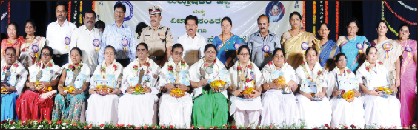
 The Florence Nightingale award recipients are seen with dignitaries at the award presentation ceremony organised by the District Wing of Karnataka State Government Nurses' Association to mark the Nurses' Festival at Jaganmohan Palace here yesterday.
The Florence Nightingale award recipients are seen with dignitaries at the award presentation ceremony organised by the District Wing of Karnataka State Government Nurses’ Association to mark the Nurses’ Festival at Jaganmohan Palace here yesterday.

Mysore :

“Private hospitals have become extortion zones where deliveries are being deliberately done under caesarian section,” alleged MLA M.K. Somashekar.

He was speaking after inaugurating a function organised by the District Wing of Karnataka State Government Nurses’ Association at Jaganmohan palace here yesterday to mark Nurses’ Festival and presentation of Florence Nightingale Awards for the 6th year.

Somashekar lauded Cheluvamba Hospital where normal deliveries were common, thanks to the good doctors and nurses. He said that an appeal has been made to the Chief Minister to establish a District Government Hospital in K.R. Constituency.

Speaking on the occasion, Police Commissioner Dr. M.A. Saleem said that nursing profession was a noble one and asked nurses to emulate Florence Nightingale. The Association General Secretary Vijaya Nayak presented a charter of demands to the MLA.

The Florence Nightingale award for 2014 was presented to nurses Uma H. Bellary, Indiramma, Sunandamma, Winfred, V. Sowbhagya, Elizabeth Saralakumari, Susheelamma, D.K. Leelavati, R. Leela, Jayanandakumari, Sumitra Bai and Tanuja. The Best Service Award for 2014 was presented to T.M. Meenakshi, B.P. Ghanavati, B.M. Anita, S.V. Padmalata, P.P. Kamini of K.R. Hospital, Dhanalakshmi of Lakshmidevamma Hospital in Jayalakshmipuram, lecturer Pushpalata and student Lingarajamma.

DHO Dr. H.T. Puttaswamy, MMC&RI Dean and Directo Dr. B. Krishnamruthy, K.R. Hospital Medical Superintendent Dr. B.G. Sagar, Cheluvamba Hospital Medical Superintendent Dr. S. Radhamani, ESI Hospital Medical Superintendent Dr. Ramesh Jevur, Association District President Shivamma, State President B.S. Bhyramma and others were present.

source: http://www.starofmysore.com / Star of Mysore / Home> General  News / June 08th, 2014

Pandit K.S. Hadapada award presented

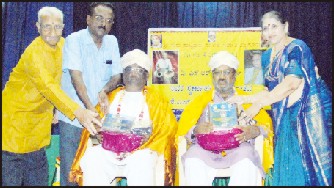
Vocalist Dr. Ashok Huggannavar and tabla maestro Pt. Allammaprabhu Kadakola being felicitated with ‘Pandit K.S. Hadapada Award’ at a function organised by Guru Puttaraju Sangeetha Sabha at Nadabrahma Sangeetha Sabha on JLB road in city yesterday.

Mysore :

Dr. Ashok Hugganna of the Dept. of Music of SDM College, Honnavar and tabala artiste Pandit Allammaprabhu Kadakola of Dharwad were presented with Pandit K.S. Hadapada Award instituted in the memory of Late S.R. Krishnamurthy at a function organised by Guru Puttaraju Sangeetha Sabha held at Nadabrahma Sangeetha Sabha on JLB road in city yesterday.

Inaugurating the programme, Karnataka State Dr. Gangubai Hangal Music and Performing Arts University Vice-Chancellor Dr. Sarvamangala said that from time immemorial music has remained a major attraction among people of all classes and added that the awards were being presented to artistes for their outstanding contributions to Hindustani and Karnatak music.

Corporator and Hon. President of Sri Guru Puttaraju Sangeetha Sabha M.V. Ramprasad presided over the function in which retired Director of Archaeological Survey of India (ASI) Dr. K.M. Badri and others were present.

Today at 6 pm, there will be a solo tabla performance by Bheemashankara Bidanur of Mysore accompanied by Gurubasava Mahamane of Dharwad on Lehar.

At 6.45 pm, Dr. Ashok Huggannavara from Honnavara will present a vocal recital, accompanied by Pt. Allamaprabhu of Dharwad on tabla, Gurubasava Mahamane of Dharwad on violin and H. Mrityunjaya of Mysore on harmonium.

source: http://www.starofmysore.com / Star of Mysore / Home> General  News / June 08th, 2014

NR Group to host ‘ IGU Ladies Amateur Golf Championship ‘ in city for the first time

NR Group is bringing to Mysore for the 1st time ever the National-level Ladies Golf Tournament. The Golf Tournament is called NR Group All India IGU Ladies Golf Championship. The Tourney will be conducted by the Indian Golf Union (IGU) at the JW Golf Club Mysore. The 1st Tee Off is on June 8 at 8 am and the prize distribution ceremony will be held on June 10 at 1.30 pm.

The three-day tournament will witness 70 amateur golfers from across the country vying to be crowned as champions. The Championship will have Top national-level golfing ladies such as Seher Atwal, Gaurika Bishnoi and Aftha Madan.

The event will feature competition in four categories — Ladies Open for women who are 18 years of age and above; Junior Girls Category-A for young girls between 15-18 years of age; Junior Girls Category-B for girls aged between13-14 years of age and Sub-Junior for girls aged 11-12 years.

Speaking about the tournament, Arjun Ranga, Managing Partner, NR Group said, “NR Group has legacy of supporting and nurturing sporting talent. We are confident, that the NR Group IGU Ladies Amateur Championship will offer amateur golfers a platform to display their golfing talent. This national event will present the golfers of Mysore an excellent opportunity to treat their golfing spirits as well.”

For details, contact Mob: 97422-79654 or 97422-72210, according to a press release.

source: http://www.starofmysore.com / Star of Mysore / Home> Sports News / June 07th, 2014

Pages from history : Memorials to household animals

by Prof. A.V. Narasimha Murthy, former Head, Department of Ancient History & Archaeology, University of Mysore

Setting up memorials has been an ancient practice in India including Karnataka. Of the large number of memorial stones found in Karnataka which are generally referred to as hero-stones (Viragallu), the more interesting and rare ones are those dedicated to pet and household animals. Of all the household animals, dog occupies a prominent place because of its faithfulness in serving the man in addition to its use in a variety of ways. In fact, often dogs are treated as a part of the family, with the exception of cows which attained an eminent position because of its sacred character. Naturally, memorials to dogs are available in greater number as compared to other animals. Some instances may be referred to here.

The most interesting memorial to a dog is from Atkur in Mandya district dated 950 AD, belonging to the Rastrakuta period. A battle was fought between the Cholas and the Rashtrakutas in which Ganga King Butuga’s general Manalera took part. The King was pleased by the valour of Manalera and the latter requested the dog Kali as a present. He was given the dog Kali. It was taken to his native place and it became his pet dog.

One day Manalera went for hunting along with his dog. Boars came to attack Manalera and on seeing this, the dog attacked the boars and saved his master’s life. But in the process the dog died of injuries sustained. Manalera was overcome with grief over the death of his pet dog Kali. He erected a huge memorial stone with a long inscription which narrated the entire incident and the heroic part played by his dog Kali. He also carved the scene of Kali fighting with the boar. Not satisfied by this, he appointed a Gorava priest to worship this memorial stone daily before taking food and made provisions for all these things. Thus Manalera elevated the dog to the level of a divinity and that is why this is considered as a rare memorial to a pet dog.

The story of other two dogs by name Dhalaga and Loga is recorded in an inscription of 971 AD from village Melagani in Kolar district. The two dogs were taken by their master for hunting in the local forest. Dhalaga killed 26 boars and Loga killed 75 boars and saved their master. Unfortunately both the dogs succumbed to the injuries. The grief-stricken master decided to erect a suitable memorial to both the dogs. He carved the entire hunting scene on a stone slab which has two friezes. The first frieze depicts the dog Loga killing 75 boars while the second frieze shows Dhalaga killing 26 boars. Thus this is a fitting sculptural memorial to the heroism of two dogs by a grateful master. Incidentally the above two instances show that naming dogs was an ancient practice and at least as old as one thousand years.

Another memorial stone from village Nelavagilu (Bangalore district) depicts vividly a hunting scene in which a hero is assisted by two dogs. One of the dogs is charging against the boar almost tearing its front portion while the other dog is shown as attacking from the top. The hero is shown as piercing the boar from his long and sharp weapon.

Yet another inscription of the eleventh century refers to Pallavagauda who took his dog named Madakesari on a hunting expedition to a forest in which the dog killed many boars but it was also killed in the encounter.

One more memorial may be referred to here: A fine memorial stone has been found in Balligave in Shimoga district. It is dated 1183 AD. It has three friezes. The bottom most frieze depicts a fight against a boar by three dogs. The dogs are shown as attacking the boar. The second panel depicts the celestial nymphs carrying the hero. The third shows the hero enjoying heavenly pleasures.

Memorial stones of other types may also be referred to now. A tiger entered into a village called Tavarekere. The people were scared of this. A hero by name Kambaladana immediately took action. He asked his pet dog to fight against the tiger. It fought bravely but was killed by the tiger. But the tiger ran away to the forest. Immediately Kambaladana erected a memorial stone in which is shown a fight between the dog and the tiger. The inscription records the heroism shown by the dog.

A dog attacking an elephant is carved on a memorial stone found in Yelahanka, Bangalore. On the upper frieze is shown the fight between the dog and the elephant and the second panel shows the death of the dog. It is interesting that the dog chose to attack a huge elephant.

Horses are generally used in battles and also as a means of transportation in the ancient period. We have a large number of memorial stones depicting soldiers sitting on horses and fighting the enemies. Even some of the hero-stones depict such scenes in sculpture. Such panels have to be carefully examined if they were really meant to be memorials to horses or soldiers sitting astride them. There are some which are really meant for horses. Kumararama of Kammatadurga was a great hero. He had a horse name Bolla to which he was greatly attached as it carried him in all types of battle-fields successfully. Naturally he developed great love and affection for this horse. There is a sculptural panel in the vicinity of Kumararama temple in which a horse is shown and this has been identified as Bolla. Thus it is a fine memorial erected by Kumararama himself to his pet horse.

There is a bronze sculpture of a horse in the temple at Bilikere in Challakere taluk of Chirtradurga. It is a representation of a horse used by the soldier Vira Chikkanna. There is another temple at Nagavageri in Kolar district. It has a bronze horse which is being worshipped by the people. A sculptural representation of a horse is seen on a boulder in the village Talaganavara in Kolar district. Obviously this is a memorial by a couple whose sculptures are seen in the same place. There are many horses carved on the boulders of Chitradurga fort and they are taken to be memorials.

Erecting memorials to cows was a common practice in ancient Karnataka. Stealing of cows became a practice of political significance. They are referred to as Gograhana. There are hundreds of such cow memorial stones in ancient and medieval Karnataka. At such times local heroes fought against the thieves and protected the cows and perhaps some of them died. In such cases memorial stones were erected with the pictures of heroes accompanied by cows. For example an inscription of 1140 AD from Shimoga states that the hero fought against the robbers, rescued the cows but he himself died. Another hero-stone from Soraba informs the sacrifice made by Kamagauda while saving the cows. Even a woman taking part in such fights is seen from a hero-stone from the village Sarakanur in 1041 AD. Lakshamma killed the miscreants who stole the cows but she died in the process.

Rarely do we find memorials to elephants also. The best example is a small silver sculpture of an elephant now kept in the Igguthappa temple at Padi in Kodagu. It has an inscription which refers to the hunting by King Lingaraja II who is described as having caught 34 elephants and 8 young ones alive. To commemorate this event, he gifted a silver image of an elephant to the temple. Thus people showed their love, affection and respect for household animals and erected memorials. This shows how they cared for the pet animals in the ancient times.

source: http://www.starofmysore.com / Star of Mysore / Home> Feature Articles  / by  Prof. A.V. Narasimha Murthy / June 07th, 2014

Bankers Recreation Club fetes merit students

MeritStudentsBF12jun2014

Mysore :

“Children should be allowed to pursue education in the subject of their choice instead of their parents forcing them to choose a course,” opined Dr. M.R. Ravi, Addl. Regional Commissioner.

He was speaking at the Prathibha Puraskar award presentation function organised by Bankers’ Recreation Club at its premises in Sharadadevinagar here last evening.

Dr. Ravi said that during earlier days only a few students used to score high marks in examinations and used to go unnoticed. However, he pointed out that many students excel in examinations because of good parental support and encouragement.

SBI Deputy General Manager S. Ramesh Rao advised the students to widen the scope of their learning as competition was prevalent in every sector.

Totally, 25 students who had excelled in SSLC exam were presented with Prathibha Puraskar. They are: Nithyasurabhi (622 – MMHS), daughter of Roopasri and Ananthashayanam; Hymavathi (620, SVHS), daughter of Gowramma and B.K. Udayashankar; Gaurav (619 – VVHS), son of Aparna Dattatri and Dattatri; Sumitha S Rao (618 – SVHS), daughter of B.S. Suchetha and B. Suresh Rao; M. Aashik Narayan (618 – RKVS), son of Ashabharathi and M. Ganapathy Prasad; Monisha Gowda (617 – SVHS), daughter of Mamatha and Dr. Ankegowda; Chandana Shravani (617 – CKC), daughter of N. Shobha and Mahadevegowda; H. Parikshith (617 – SVHS), son of Shobha and Honnegowda; Aashritha (617 – SVEI), daughter of J. S. Poornima and S. Dinesh; M. Ganavi (617 – BVB), daughter fo Rohini and T. N. Harish; Ancia D’ Souza (617 – SVEI), daughter of Dr. Alphonsus D’ Souza and Dr. Veena D’ Almeida; Y. K. Sai Supreth (616 – RKVS), son of Divyaraj and Y. B. Kuppuraju; Praneetha (615 – SVHS), daughter of Dakshaynini and Thammaiah; B. Namratha (615 – SVHS), daughter of D. L. Savitha and T. V. Bhanuprakash; B. Niranjan (614 – SVHS), son of Rajamma and Gangadharaiah; Mohammed Faidh (614 – SVHS), son of Razia Sultana and Mohd. Aslam; L. Sangeetha (614 – SVHS), daughter of Nagasulochana and B. Lingaraju; Ravi Kiran (614 – SVHS), son of Gowramma and Doddaswamy; B. S. Raveesh (614 – RKVS), son of Dr. H.R. Nalina and B.T. Suresh; Sanjay N. Shastri (614- Gnagaganga), son of Sujatha and D. Shankar Narayana; Shamitha Shekar (613 – SVHS), son of Shubhada Shekar and K. L. Rajashekar; P. Samhith Sharma (613 – CFTRI), son of Dr. K.S. Bharathi and Dr. P. Ramesh Kumar; Apoorva (613 – VVHS), daughter of Swaroopini and T. Ramesh; Amitha (613 – VVHS), daughter of Roopasri and Gopalakrishna; Sahid Nehal (613 – MMHS), son of Shahida Begum and Aleemullah Khan.

Club President M.S. Umesh, Vice-President H. Balakrishna, General Secretary P. Suresh Nayak and others were present.

source: http://www.starofmysore.com / Star of Mysore / Home> General News / June 06th, 2014

Rare surgery performed at JSS Hospital

Doctors remove mass and also half of the left lung.

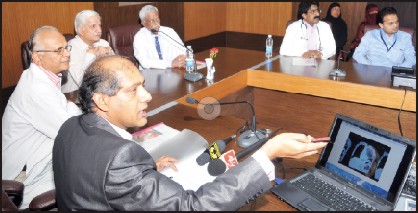
Dr. Shyam Prasad Shetty is seen explaining about the procedures involved in the surgery performed on the woman at the press meet at the hospital yesterday, as the team of doctors who were involved in the surgery and the management of the hospital look on.

Mysore :

Doctors at JSS Hospital, Mysore have performed a rare surgery on a 24-years-old woman from Channarayapatna with a three months history of intermittent episodes of cough, difficulty in swallowing, difficulty in breathing, coughing out whitish material along with hair.

The woman had few episodes of blood in the sputum and had lost 3 kgs of weight over a period of three months.

Dr. Shyam Prasad Shetty, Cardiothoracic Surgeon, speaking at a press meet at the hospital in city yesterday, said that the woman was initially treated at a local hospital and was referred to him for expert care. The chest X-ray and CT thorax showed a large mass in the left side of the chest very close to the heart.

The large mass was abutting (closely adjacent to) the main blood vessels coming out of the heart. A scope was inserted into the airways by Dr. Jayaraj, Prof. of Pulmonology and these revealed long tufts of hair and whitish material coming out of the left main branch of the lung, confirming that this mass was communicating with the left lung.

The patient and her family were explained about this unusual large mass in her left lung, about its approximation to the heart and the great vessels and about the risks involved in surgically removing it.

A multidisciplinary team of specialist doctors comprising of Dr. Shyam Prasad Shetty, Dr. Umesh Nareppa Cardiothoracic and Vascular Surgeons, Dr. Jayaraj and Dr. Mahesh- Pulmonologists, Dr. Dinesh Kumar and Dr. Murugesh Wali- Cardiac Anesthesiologists was formed and a plan of care evolved. Surgery was done under general and epidural anaesthesia by ventilating only one of the lungs. The left side of the chest was opened and a large mass measuring about 8 cm x 9 cm adjacent to the main pulmonary the left pulmonary arteries, invading into the left upper lobe of the lung was found.

This was a difficult and technically challenging surgery. The doctors removed the mass also had to remove half of the left lung also since this mass was connected to it. After the surgery, she was in the intensive care unit for five days and was discharged two weeks after the surgery.

If the mass was left unattended, this would have become life threatening by rupturing into the lung and its air ways, into the heart and its major blood vessels.

Dr. R K Chaturvedi, Director, JSS Hospital said, “This case was a challenge to the cardiothoracic surgeons, pulmonologists and cardiac anesthesiologists. A multi-specialty team equipped with high end infrastructure which is available at JSS hospital-Mysore made it possible to carry out this major surgery on a very rare and unusual mass in a young lady. Since the patient was a beneficiary of Vajpayee Aarogyashri Scheme (BPL), the patient was not charged any money.”

The team comprised of Dr Shyam Prasad Shetty, Dr Umesh Nareppa Cardiothoracic and Vascular surgeons, Dr. Jayaraj and Dr. Mahesh Pulmonologists, Dr. Dinesh Kumar and Dr. Murugesh Wali- Cardiac Anesthesiologists.

source: http://www.starofmysore.com / Star of Mysore / Home> General News / June 06th, 2014