The fair is open to public free of cost from 10 am to 8 pm
: Models of Bull and Squirrel created by artist Ilyas Ahmed (inset) using scrap materials on display at the two-day Automotive Technology Fair-2014 being held at NIE Diamond Jubilee Sports Complex on Mysore-Manandavadi in city. Picture right shows artist Baadal Nanjundaswamy with his 3D painting of a car at the venue.
Mysore :
A two-day Automotive Technology Fair-2014 organised jointly by NIE-Eicher Centre for Automobile Technology (NECAT) and Society of Automotive Engineers of INDIA (SAEINDIA) Collegiate Club of NIE commenced this morning at the NIE Diamond Jubilee Sports Complex on Manandavadi Road here.
The fair features an exhibition of old and new models of two-wheelers and four-wheelers. A scrap art by Ilyas Ahmed is an added attraction where models of horses, squirrels, bulb and an army tank created of scrap materials are exhibited at the venue.
The old two-wheeler models of Rajdooth, Yezdi and Vespa and latest arrivals of Yamaha, Suzuki, Harley Davidson are also on display. Similarly the old cars featured Fiat, earlier models of Landrover while the new ones from Mercedes Benz, Volvo, Ford and many more were seen at the exhibition. The cynosure of all eyes was a 3D painting of a car by artist Baadal Nanjundaswamy at the premises. JK Tyres Vice-President (Works) U.K. Shenoy inaugurated the fair by releasing the balloons. NIE Board of Management Hon. President M. Sreepada Rao was the guest of honour. NIE Principal Dr. G.L. Shekar, Centre for Advanced Studies Chairman S.K. Lakshminarayana, NECAT Director Dr. T.N. Sridhar, Programme Convenor Manjunath and others were present.
source: http://www.starofmysore.com / Star of Mysore / Home> General News / April 12th, 2014
City based Mysore Polymers and Rubber Products Limited (Mypol) for first time manufactured and supplied a key rubber component known as the ‘Linear Bellow’ to the Indian Space Department which was used in the rocket PSLV C24 launched on April 4, 2014 from Satish Dhawan Space Centre in Sriharikota, Andhra Pradesh.
Linear Bellow, the critical component, was developed over a period of three years in close co-ordination and direction between Design and Development (D&D) Departments of Mypol and Vikram Sarabhai Space Centre, Trivandrum. The product performed in copy-book style enabling a flawless launch.
Headed by C. D. Nagarajan since its inception in 1981 to manufacture Butyl Automotive Inner tubes, Mypol is also India’s leading manufacturer of Technical Rubber products with supplies to major companies in India, USA and Europe. Mypol D&D Department has developed more than 500 different products for use in industrial, automotive, medical, space and defence requirements, according to a release from Mypol.
source: http://www.starofmysore.com / Star of Mysore / Home> General News / April 12th, 2014
– Innovative Mobile Application Enhances User Experience for Zain Bahrain Subscribers –
Zain Bahrain, the most innovative telecommunications operator in Bahrain and Infosys, a global leader in consulting, technology and outsourcing have co-created Zain Self-Care, an application that is radically transforming user experience for Zain’s subscribers, through self-service. Zain Self-Care is an innovative mobile application for smart phones and tablets that is built using Infosys AssistEdge, a product that transforms customer experience across channels. The application functions on all operating systems including iOS, Android, Windows and Blackberry.
Launched in February 2013,Zain Self-Care is a first-of-its-kind mobile telecom application from an operator in Bahrain. It currently enjoys wide-spread adoption across the company’s customer base and offers Zain’s subscribers unparalleled convenience in managing their telecom service needs.
Upendra Kohli, Vice President, Regional Head-South East Asia, Middle East & Africa, Infosys said, “The increased adoption of smartphones across the Middle East is driving demand for new digital experiences and services. The Zain Self-Care application, built using Infosys AssistEdge, is helping Zain expand its range of offerings and improve user experience. We will continue to bring our deep understanding of the global telecommunications industry and technology to enable Zain to meet the changing needs of its subscribers.”
The intuitive interface of Zain Self-Care allows customers to access their account information, subscribe to new services and make use of a range of value-added and self-help services.
Mohammed Zainalabedin, General Manager, Zain Bahrain commented, “We are committed to leveraging technology to deliver the best experience to our customers and provide superior service. We chose Infosys as our partner since they have demonstrated a thorough understanding of the evolving needs of our customers. We value their ability to provide a solution which addresses our needs around scalability and speed, with an eye on the future.”
Application Highlights:
-- The application uses the mobile self-care capabilities of Infosys
      AssistEdge to provide superior service on smart devices to retail and
      enterprise customers

   -- Zain Self-Care allows users to view, control and manage their voice and
      data packages. Users can also receive personalized news updates, purchase
      value-added services, and make bill payments in a secure environment

   -- The interactive features of Zain Self-Care  allow  customers to better
      understand their usage patterns and manage their accounts and spends

   -- It is available on all popular mobile platforms and can be downloaded
      from app stores

   -- Android
      - https://play.google.com/store/apps/details?id=com.infosys.zain.selfcare

   -- Apple - https://itunes.apple.com/bh/app/self-care/id594243362?mt=8

   -- Blackberry
      -http://appworld.blackberry.com/webstore/content/21748371/?countrycode=IN
//
source: http://www.onlinewsj.com / The Wall Street Journal / Home> India Edition / Press Release / PRNewswire / March 27th, 2014
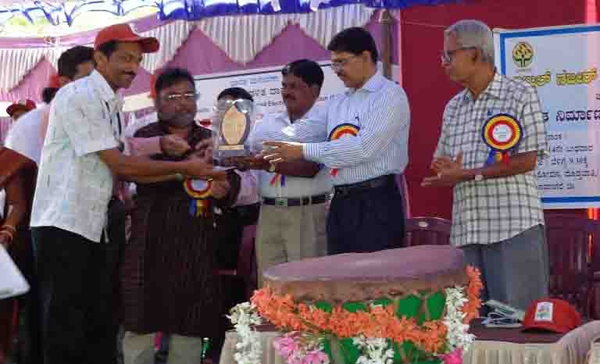
K R Patkar, Shirva gram panchayat Nav Bharat Nirman Vedike president and gram panchayat member was honored by presenting Top Bharat Nirman Volunteer Award, during two-day state level Bharat Nirman volunteers’ convention held at Davanagere, recently.
Davanagere district Deputy Commissioner S T Anjan Kumar presented the honor on the occasion.
The zilla panchayat CEO D B Hemachandra, litterateur Professor B V Veerabhadrappa, Mysore Abdul Nazeer Saab, state rural development organization officer Wilfred D’Souza were present at the dais.
source: http://www.bellevision.com / Bellevision.com / Home> News / by Pundalika Marate, Bellevision Media Network / Udupi – March 28th, 2014
K. Chinnappa, who has painted cutouts of politicians and almost every actor over the course of his career, at his workshop in Bangalore on Friday. / Photo: Bhagya Prakash K. / The Hindu
K. Chinnappa brings to an end an illustrious career of hand-painted posters
Hand-painted life-size images of film actors and famous personalities will be a thing of the past soon, with Rajkamal Arts, the only surviving company that paints posters and gigantic cut-outs of artistes and personalities in Bangalore, all set to shut shop.
A life size image of Nandamuri Balakrishna in Legend, an upcoming Telugu film, is perhaps the last painted work of 77-year-old artist K. Chinnappa, the man behind Rajkamal Arts. A 46-foot cutout of BJP’s prime ministerial candidate pick Narendra Modi is his last work of a well-known political personality. Interestingly, Mr. Chinnappa had breathed life to huge cutouts of Jawaharlal Nehru and Indira Gandhi in the 1960s and ’70s.
On Thursday, when The Hindu went to meet the artist, his son Gopalakrishna, who is also a painter, was busy packing some rare works of Mr. Chinnappa at his workshop in Gayathri Nagar to transport them to London.
Mr. Chinnappa has painted nearly every major star in all four southern languages and Hindi in his career, numbering over 4,300. He has painted images ranging from MGR, NTR, Rajkumar, Amitabh Bachchan, Prem Nazir and even that of Arnold Schwarzenegger and Sylvester Stallone.
Mr. Chinnappa feels his works are not relevant in the age of digital printing. “There was a time when I used to work 18-hours a day to meet the needs of the film industry. Now the demand for hand-painted posters is almost gone. It has become difficult to pay salaries to workers, pay rent and electricity bills,” he says.
No one would want to ‘waste money’ when everything is digitised and prints could be got in a few hours, Mr. Chinnappa said.
Those working with Mr. Chinnappa have already found other jobs. Some are colouring temple Gopuras (tower) and paintings murals. Since when he started training under his guru Sri Sheenu at the age of nine, Mr. Chinappa has spent most of his life with colours and canvas. He began as an assistant, working on the iconic Mother India poster.
There is no missing the pride in Mr. Chinnappa’s tone as he talks of his work. “Keep a digital print next to a hand-painted poster and you will find a rich texture of myriad colours that is lacking in digital prints. There is no substitute to hand painting,” he says.
He is a recipient of the Indira Priyadarshini Award. The Discovery Channel has expressed interests in making a documentary film on him.
source: http://www.thehindu.com / The Hindu / Home> News> Cities> Bangalore / by Muralidhara Khajane / Bangalore – March 28th, 2014
The first meeting of newly-constituted Design & Development Management Board (DDMB) by the government to strengthen design and development in aerospace and promote self-reliance in the critical areas of India’s defence preparedness was held here today at HAL Corporate Office.
The Board comprises key members of India’s premier defence organizations involved in research, production and manufacturing activities.
“We need to have clear road map to take on the challenges in defence sector as issues concerned range from basic and applied research, involvement of academia, production, spotting and retaining talent,” Chairman of HAL and DDMB, R K Tyagi said.
The meeting brain-stormed on how to build a strong foundation for R&D by synergizing the core competency of all the organizations involved, creating conducive environment for research and support business academia collaboration.
The meeting also felt that all the concerned organizations must share the lessons learnt from the past programs and make combined efforts to ensure success of future programs with thrust on indigenization.
Acquiring of modern technology and measures to be taken to retain quality manpower were also discussed.
The forum would act as a platform for stimulating initiatives and suggest policy interventions for bringing inclusive growth. The DDMB members will deliberate at length most of these issues in their future meetings and the recommendations will be communicated to the stakeholders.
source: http://www.timesofindia.indiatimes.com / The Times of India / Home> City> Bangalore / by Chethan Kumar, TNN / March 28th, 2014
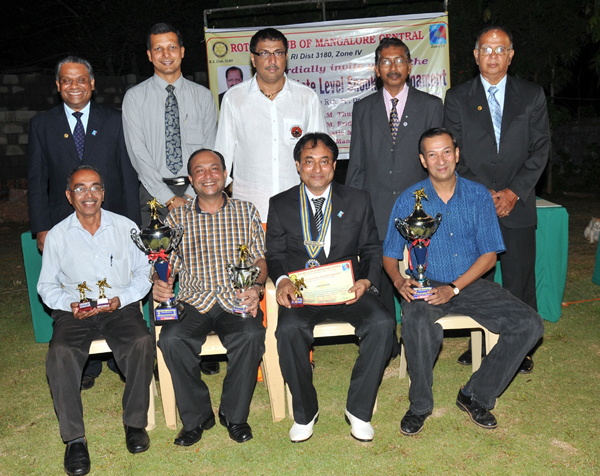
The valedictory of the late Dr K Mohandas Bhandary memorial snooker tournament that was organized by Rotary Club of Mangalore Central was held at Eden Club, here on Friday March 28 evening.
Rotary Club of Mangalore Central president Rajgopal Rai presided the programme.
Vijayanat Vittal Shetty who was the chief guest, said that the late Dr Bhandary strived to promote sports in his lifetime. He had set an example to new generation of youth to walk in his footsteps, said Shetty. He also lauded the efforts of Rotary Club in inculcating sportsmanship spirit.
Rotary Club former governor Dr Devdas Rai, Dr Nitish Bhandary, Kateel College principal Balakrishna Shetty also spoke on the occasion.
Rotary Club of Mangalore Central former president Dr Sureschandra Shetty, secretary Santosh Shet was present at the dais.
Winners
Anand D’Souza (first), Anil Gonsalves (second), Rajgopal Rai and Abdul Nazeer (third) and Anand D’Souza (highest brake).
Rotary Club of Mangalore Central president Rajgopal Rai compered the programme. Manjunat Revankar proposed vote of thanks.
source: http://www.bellevision.com / Bellevision.com / Home> News / by Bellevision Media Network / Mangalore – March 29th, 2014
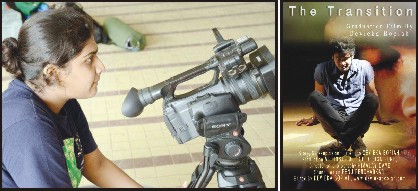
Here is another pride of Mysore — Devieka Bopiah, a specialist in Film and Video Design. Her graduation film ‘The Transition’ has been nominated for the Dada Saheb Phalke Film Festival 2014 and has also won an award in the Pune Design Festival 2014.
Devieka’s love for design began early whilst in School which was encouraged when she joined the MIT Institute of Design, Pune. Previously, in 2012 she made a music video called ‘African Tadka’ and was given ‘The Best Music Video’ award in the Mumbai Short International Film Festival.
“Though I am from Kodagu, having done my schooling from various cities around the country has made me cosmopolitan,” she says. “My love for design began when I was about 16 years old. Studying in Rajasthan, I was intrigued by the art, culture around me and got my first digital camera around the same time with which, began my hobby of photography. There was no stopping after that; my parents encouraged me to do whatever I wanted as long as it was safe and promising,” says Devieka.
Devieka has completed four-and-a-half years specialisation in Film and Video Design.
“I love what I am doing and am confident to face the future in Film Making. I fix schedules and deadlines when I work. It gives me satisfaction to complete before time and review my work before submission. With encouragement from my faculty, I have been able to complete my diploma film three months ahead of time and concentrate on my career,” she said.
“I enjoy travelling and experiencing different cultures while exploring photography along the way. The best experience I have had was in The Serengeti National Park, Tanzania. If you enjoy wildlife and you like photography, Serengeti and the other National Parks in Tanzania is the place to be,” she said.
Devieka Bopiah is the daughter of Moodera Raajeev and Kaveryh Bopiah, residents of Siddharthanagar in Mysore. She intends to pursue a career in Production or Editing.
source: http://www.starofmysore.com / Star of Mysore / Home> Feature Articles / by K. M. Chengappa / April 10th, 2014
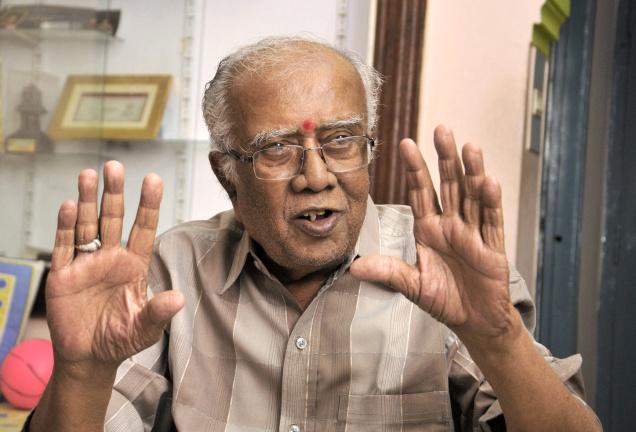
Geetapriya’s original name is Lakshman Rao Mohite; his pen name came to stay and the world knows him as Geetapriya. / Photo: K. Gopinath / The Hindu
Kannada lyricist and director Geetapriya who wrote over 250 immortal songs and directed 40 films tells Deepa Ganesh that his love for Kannada poetry brought him to the film industry. Money never came his way, but he cared more about giving his best to his work
The man who put a song on everyone’s lips, Kannada lyricist and director Geetapriya has lost his voice. Frail and weak, he walks into the living room of his house, gesturing that he has no voice to speak. With over 250 songs and 40 films to his credit, Geetapriya was a sought-after person in the Kannada film industry. In a career that spanned six decades, he directed some of the top actors of the industry and launched several others. When you meet him now, it is hard to imagine that this is the same man who filled the Kannada film industry with a charm and grace that was so unique to him. He is brimming over with memories, but when his voice pins him down, his actions overtake words.
Geetapriya’s original name is Lakshman Rao Mohite; his pen name came to stay and the world knows him as Geetapriya. His father worked for the cavalry regiment of Mysore State Troops, the imperial service called Mysore Lancers, which was stationed in Bangalore. Marathi was his mother tongue, but his love for Kannada poetry knew no bounds. “I studied in a Kannada school, and Kannada literature classes was something that I loved most,” recalls Geetapriya, as his voice tosses him between a croak and words marked by the complete absence of sound.
The great Kannada poet Pu.Ti. Narasimhachar lived in the same quarters as Geetapriya’s family did and the poet’s daughter was his classmate. Pu.Ti. Na’s poetry mesmerised Geetapriya, and till date remains his favourite poet. He read voraciously – Shivaram Karanth, Masti Venkatesh Iyengar, Ta.Ra. Su, Aa. Na.Kru… — and was inspired by them. He began to try his hand at writing right from his middle school days and sent his poems and short stories to magazines like Taayinaadu, Ramarajya and others. Bellave Narahari Shastry, the Kannada scholar was his father’s friend, and Geetapriya often went to him with his writings.
His mind may have taken solace in the creative realms, but Geetapriya’s reality hardly offered any comfort. They were a large family of eight members and there was always a paucity of resources. “I completed my CA intermediate even as I took up small writing assignments. But this wasn’t enough. I began to look for a job and found one as a clerk in Cubbon Park restaurant.” Geetapriya had a brief association with Kannada theatre in his student days and it was here that he became friends with Vijaya Bhaskar and M.B. Singh. “We all acted together in plays,” he says, chuckling. When Geetapriya got a job, all his friends came to the restaurant and since working in the film industry was their collective dream, they discussed for hours. “Kalyan Kumar, cameraman N.G. Rao everyone would be there. One day, Vijay Bhaskar said ‘give up your job, let’s work together in a film. N.G. Rao has decided to make one.’ I couldn’t do it because my salary of Rs. 35 was very crucial to the family. I worked very hard. I would leave home by 5.30 a.m. and return at 11 in the night. But Vijay Bhaskar kept insisting. I decided to tell my mother. She looked worried for a few minutes, and said ‘Do what you like most’…” Vijay Bhaskar promised Geetapriya that every month Rs. 40 would be handed over to his mother, and he lived up to it. “Till my mother passed away she would remember how Vijay Bhaskar personally came every month to hand over the money for one full year till the film was complete.” With Shri Rama Pooja in 1954 Geetapriya made his entry into the film world. “After the film, Vijay Bhaskar had told me that whenever he got a chance to compose music for a film, he would make sure that I was the lyricist….,” said Geetapriya, going into a poignant silence as words fail him.
Geetapriya, like all other artistes of the Kannada film industry, moved to Madras. He worked with Y.V. Rao for the film Bhagya Chakra, wrote dialogues and songs. Ramanjaneya Yuddha in 1963 became a super hit what with songs like “Jagadishanaduva Jagave Natakaranga”, and this was followed by the film Onde Balliya Hoovugalu for which Mohammed Rafi sang “Neenelli Nadeve Doora” and “Aadutiruva Modagale” for the film Bettada Huli.
In Koodambaakam in Madras, it was the practice of all the Kannadigas to meet and chat over coffee and snacks. Geetapriya met thespian Rajkumar, Narasimharaju, Balakrishna and others during these meetings and became good friends with them. “I had a story in my mind. One day, I narrated it to Rajkumar. He immediately said it was a very nice story and it should be made a film with him acting in it. That was a great moment for me,” recounts Geetapriya. Over the next one year, Geetapriya finalised the script for his first directorial venture Mannina Maga. But there was no money, a set would easily cost 50-60,000 rupees. “Rajkumar had said he would drop everything and come when I was ready to start. Someone told me of a house in Sadashivnagar which could be used for shooting. With trepidation, I told Rajkumar about this and he agreed without a second thought. “We also shot in a village Pichchalli and had booked accommodation in the Nandi Hills. Rajkumar wanted to stay in the village itself, and as long as our shooting schedule was on, he stayed there. The simplicity of yesteryear actors is unbelievable…,” says Geetapriya. The making of the film also got stretched because of lack of finances and when it was finally released in 1968, it ran for more than 100 days in Bangalore’s Kapali and Bharath theatres. To this day, the songs of the film “Idena Sabhyate” and “Bhagavanta Kai Kotta” remain the Kannadiga’s favourite.
Geetapriya recalls many fond moments from his industry days. Vishnuvardhan had great regard for him, and when he was making the film Hombisilu, Geetapriya had problems with Vishnuvardhan’s body language. Hesitatingly, he told Vishnuvardhan, who had already made a name for himself. “I will do as many times as you want till you like it,” the actor had said going through the rehearsals with total commitment. “The way Balakrishna, Narasimharaju and Rajkumar would practice their lines! They would try it in so many different ways before they got it right. It was a pleasure to work with them,” he remembers.
Geetapriya wrote a variety of songs. He could write romantic songs like “Premavide Manadi” and “Besuge”; equally convincingly he could write “Gopi Lola”, “Gudiyaliruva Shilegalella” and the like. “I would imagine myself as the character that was singing the song. That perhaps made it possible,” he explains. Earlier, with Vijay Bhaskar and T.G. Lingappa, a song would be composed, but with the entry of composers like Satyam, the song had to be written to a tune. “This was difficult. It curbed free flowing imagination. Eventually, we got used to it…”
With a long career, hundreds of songs and so many films, including three in Tulu, Geetapriya’s earning hardly matched his output. “They gave us Rs. 50 for a song. For direction I used to get Rs. 1000. I never asked for more, just took what came my way. It was so important to earn a good name that nothing else mattered to me. Yes, I have suffered because of that…,” he says his voice completely fading. But the next instant, as he takes me through his album his face brightens with good cheer.
source: http://www.thehindu.com / The Hindu / Home> Features> Friday Review> Music / by Deepa Ganesh / Bangalore – April 11th, 2014
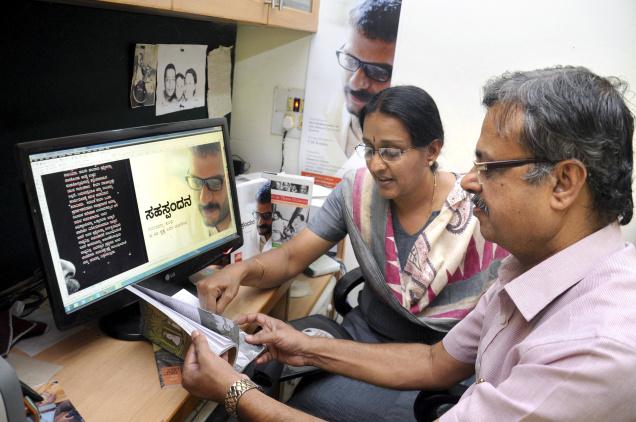
The Hindu Many resonances: Venugopal and Shylaja bring out Ragamala for the love of music./ Photo: M.A. Sriram / The Hindu
Venugopal and Shylaja run an unusual music magazine from Mysore, Ragamala. This stunningly produced publication will be out with its third volume on April 6
Venugopal teaches statistics at Maharani’s Science College, Mysore. Shylaja teaches English at Government First College, Nanjanagud. Apart from their interest in history, economics and women studies, the couple are music lovers. In 2013, the duo started a niche magazine on music, Ragamala. Stunningly produced, the magazine predominantly features articles that are translated from English to Kannada. The magazine digs into the archives of musical history and brings together a whole lot of views on music and musicology, written by musicians, litterateurs and musicologists at different points of history, apart from a rich treasure of photographs. While their first issue was on Pandit Ravi Shankar – Godfather of World Music, the second is Kelu Janamejaya, collating ideas on listenership. The third magazine will be released on April 6, which is a collection of articles by Carnatic vocalist T.M. Krishna, Sahaspandana. Ragamala, as it is evident from its content and design, is a magazine that is striving to be serious, unlike other music magazines that have walked the hall of fame and currently run on reputation.
Excerpts from an interview:
When and how did the idea of this music magazine come about?
The idea of Ragamala took shape during informal discussions with Sarod maestro Pandit Rajeev Taranath. He felt that something worthwhile about music should be brought out in Kannada. He was particular that it had to be on music and not the musician because majority of the writings are on the musician. These discussions led to the birth of Ragamala. It was exactly at this time that Sitar maestro PanditRavishankar passed away. By default the first issue of Ragamala was on him. Classical music like any other classical art form needs some initiation and training. It is important to understand what to listen for in music. With this in mind, Rajeevji conducted two sessions of guided listening – one on music in general and another exclusively on listening to instrumental music. This formed the background for the second book “Kelu Janamejaya” about music listening.
As editors what do you perceive as the problems of putting together and bringing out a niche magazine like this?
Basic problem is we are new to this type of scholarship. Creating abstraction of music through language is very challenging. Serious scholarship on music is also less in Kannada.
What kind of response has the magazine elicited? Are the readers of your magazine connoisseurs of music or has it attracted general public too? Did you have a target audience in mind?
First we thought of reaching people who are already into music and have a dialogue with them through Ragamala and its activities. It was a pleasant surprise that many from general public, who were from different backgrounds responded very positively to the book. In fact, some told that the series created a confidence in them that classical music is not beyond them. But our readership is very limited.
Your magazine deals with both Hindustani and Carnatic music. The first issue is on Pandit Ravishankar and the second deals mostly with Carnatic. Do you have an editorial advisory team? How do you decide what goes into an issue?
We don’t have a formal editorial board. Ours is a loose group. We discuss with people who are very well versed in their respective fields and in the process many ideas come. If an expert in a particular area of music is capable of editing a particular issue and willing to help us then we prefer to entrust him/her with the responsibility of that issue. For instance, one of the forthcoming issues is on the music and musical experiments of Pandit Rajeev Taranath. We have requested Dr. Krishna, a professor of English and a disciple of Rajeevji to edit that issue. This will make the book really worthy. In fact, the issue on music listening started with the idea of documenting guided listening programme. Finally it resulted in something different. Shylaja is initiated into Carnatic music formally. We are ardent listeners of both Hindustani and Carnatic music.
Your second issue, Kelu Janamejaya is about listenership. Has it undergone a major change in the recent times?
Yes, many are attracted to classical music. The question is more about the quality of listeners. Once we start learning the rules of the game, we can appreciate the game better. Musicians need informed listeners. Like culture, taste is also acquired over a period of time.
Your next issue is a collection of articles by T.M. Krishna in Kannada.
We feel that the questions T.M. Krishna has been raising can’t be ignored. They are very crucial. Definitely they will expand the horizon of our understanding of Carnatic music. His articles on GNB, Kishori Amonkar can be considered a model for music criticism. His thoughts on bhakti, dharma, gender, caste are very vital and we feel that there is an urgent need to address these issues. It is perhaps the right time too. We agree with TMK’s view that now Carnatic music is safe, it has guaranteed audience and now we can take the risk of discussing these issues.
I feel that the magazine doesn’t give details about the source of its articles and photographs. Historical details are important for us to map the movement of history itself.
We totally agree with you. Historical details are important. We are also learning in the process and trying to correct ourselves. The second book has the list of source materials at the end of each article. We need to be more meticulous. It is a process of learning for us too.