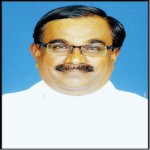
Dr Baba Adhav, veteran activist and president of Mahatma Phule Samata Pratishthan, Pune, will be honoured with the “Rashtriya Basava Krishi Award-2015”.
The award, constituted by Lingayata Panchamasali Jagadguru Mahapeetha of Kudalasangama, will be presented to Adhav at the fifth Krishi Sankranti at Kudalasangama on January 15, said Basava Jaya Mrutyunjaya Mahaswami of Kudalasangama Lingayata Panchamasali Jagadguru Maha Peetha here on Saturday. The award carries Rs 50,000 in cash and a citation. Agriculture ministers of Maharashtra and Karnataka will be present at the award presentation function, he told reporters.
source: http://www.timesofindia.indiatimes.com / The Times of India / Home> City> Hubballi / TNN /January 11th, 2015
Mohan Manoraj from Mysuru was consecrated and installed as the Bishop of the Church of South India (CSI) in Karnataka Southern Diocese recently.
He was installed at a ceremony organised by the CSI Moderator G. Dyvasirvadam at CSI Shanthi Cathedral, Balmatta, in Mangaluru.
During the ceremony, followed by a short procession, the moderator consecrated the new Bishop by presenting a copy of Bible and the Pastoral Staff. Prayers were sung and various religious rituals were performed as the new Bishop was installed. During his address, Bishop Mohan Manoraj said: “In the past, there was a belief that Bishop leads the people, now things are different. Where there are people of God, there will be a Bishop. He is for common man, who is nearer to God.”
About Mohan Manoraj:
Mohan Manoraj, born in 1954, is a postgraduate in Sociology from University of Mysore, Bachelor of Divinity KTC (SSC) and M.Th Social Analysis TTS (SSC). In his previous assignment, he was the Priest of Sawday Church in Mysuru. He has served as Vice-President of Karnataka Southern Diocese (KSD) and Convenor of Socio-Economic Concern Committee, KSD. He has worked in various posts in Synod level as well. At present, he works as guest lecturer at Karnataka Theological College in Mangaluru.
source: http://www.starofmysore.com / Star of Mysore / Home> General News / Wednesday , December 24th, 2014
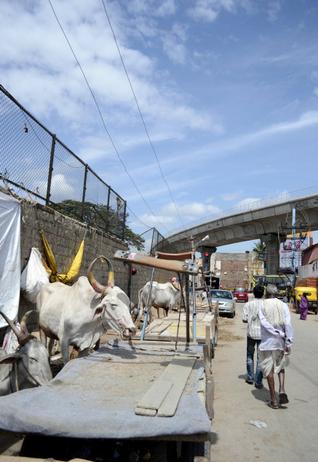
Time warp: In striking contrast to nearby Cambridge Layout, Murphy Town resists change and remains the settlement that was planned a century ago. Photo: Karan Ananth / The Hindu
Once called ‘a settlement too good for its inhabitants’, Murphy Town retains many of its century-old amenities
Sahayaraj, a 49-year-old driver, stays in a single bedroom house near Indiranagar, paying rent of Rs. 3 per month to the Bruhat Bangalore Mahanagara Palike (BBMP). So does 85-year-old Sivalingam, who works in the 125-year-old temple in his area, after having retired from the Army 25 years ago. Their neighbour pays only Rs. 0.50 a month for a slightly smaller house.
There are 37 such households living in what is perhaps the most unchanged legacy of the erstwhile Cantonment — Murphy Town. In striking contrast to the modern Cambridge Layout part of Jogupalya, Murphy Town is a settlement that stays true to its colonial past.
“My grandfather came here with the British army contingent from Vellore,” recalls Sivalingam. “Then, in 1913, Engineer Murphy, who went on to work for Binny Mills, designed this settlement for the Indian servants of the British army.”
LOADED WITH AMENITIES
Famously called ‘a settlement too good for its inhabitants’ by the colonial masters, Murphy Town retains many of its century-old amenities, which residents continue to use.
For starters, there is the Murphy Town market, well known for its meat sales all over east Bangalore. Shops assigned for chicken, mutton, fish and other meats are arranged around a square. A separated section sells beef.
35-year-old Mani has been cutting and selling meat here almost all his life. “I came here to work as a little boy. My parents were factory workers who got quarters in Murphy Town,” he narrates. Visitors to the market can also make use of the reading room set up by the State government in a stone building at the centre of the market.
“The State library is on the other side, occupying a whole floor of a corporation complex in Jogupalya,” says Kokilakshmi, the librarian. “But, many people, even the policemen who come to the grounds nearby, come here to read as the building is spacious, comfortable and well lit.”
OWNERSHIP ISSUES
“From what I remember, there is almost nothing that has changed in this area. Even the drainage system we use today was laid by the British,” Mani adds.
The rentals too stay at what was fixed by the British administration. “Once the country became independent, residents went to Murphy and demanded that they be given ownership of the houses,” Sahayaraj narrates. “Some 37 of them were left without papers and we are stuck, unable to do anything with our houses or sell them.”
But, does he want to sell his house and move out? His answer is an assertive no. “Nobody ever leaves this area. Some have built apartments on their sites and rented them out,” Sahayaraj says, pointing to a freshly painted three-storeyed building beside the row of single-storeyed houses with tiled roofs.
So, why the necessity to own a house when the rental is negligible? Karmegavannan, a political worker in the area, has a political explanation to the question. “They are still considered migrants when they go for services to government or other establishments. People treat them as if they are living on the charity of the government even though they are perhaps older residents of the city than many others,” he explains. “Getting legal documentation for their house strengthens their position.”
Karmegavannan has been living in Murphy Town since his childhood. He remembers visiting Jogupalya village to watch movies in the ‘tent theatre’ there, before Adarsha or Lido cinemas were built. He remembers a time when the Lakshmipuram graveyard was the only feature opposite Murphy Town, where CMH Road is now.
NON-STEREOTYPICAL
“People tend to stereotype the area as having a culture of only temple festivals such as ‘walking on fire’ ceremonies. But, it is actually a beautifully designed area. There are nine squares, with playgrounds in the middle, which are a riot of games in the evenings and on Sundays even today,” he says. “The roads are named after the Mudaliars who were prominent businessmen among the community here.”
“The schools used to be Tamil medium, now they have been converted to Kannada-medium schools,” he points out. One school bears the plaque ‘1913 Elementary School’. A crèche cum primary school also runs nearby. “People who go for construction or domestic work leave their children here,” says Kousalya, a teacher there.
The other school has a dilapidated stone building in the front named ‘the Evelyn Barton Welfare Centre’. Says the principal, M. Muniyappa, “This centre was closed down because the building was considered dangerous.” “Now, the appearance of the building from outside makes a bad impression on parents whose preference to put their children in the numerous English medium schools around gets reinforced.”
source: http://www.thehindu.com / The Hindu / Home> Features> MetroPlus> Society / by Niranjana Ramesh / August 08th, 2012
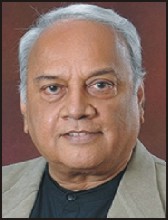
Prof. Shivaram Malavalli, ýResident Chairman of San Francisco – Bangalore Sister City Initiative, has been invited to serve on the Advisory Board of Institute for Drug Delivery and Biomedical Research (IDBR) Bangalore, along with Dr. Michael Repka, Professor and Chair, Department of Pharmaceutics, University of Mississippi, USA and Dr. Howard Maibach, Professor-Dermatology, University of California, San Francisco, CA, USA by Dr. S. Narasimha Murthy, Founder-Director, Associate Professor-Pharmaceutics, The University of Mississippi, USA.
Institute for Drug Delivery and Biomedical Research (IDBR) is a non-profit research organisation set up to conduct interdisciplinary and advanced research on innovative drug delivery and novel treatment methods. One of the goals of IDBR is to act as a platform for Industry-Academia collaborations. IDBR is open for collaborations with renowned academic institutions, industries and research organisations.
source: http://www.starofmysore.com / Star of Mysore / Home> General News / Tuesday , November 11th, 2014
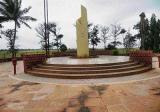
Bellary has come to acquire, in the recent years, a pleasing monument in memory of Turkish Prisoners of War (PoW) of the First World War (1914-18).
For nearly a century, hundreds of Turkish prisoners who were brought here in 1918, from the Suez Canal war zone by the British, have rested in the soil of Bellary Cantonment area. Thanks to the interest shown by the Turkish Embassy in Delhi, the
Turkish Martyrs Graveyard stands here now, commemorating their sacrifice for the nation, ten thousand miles away from their motherland.
The memorial raised over nearly two-acre site next to the Bellary Airport, and in the vicinity of Visveswaraiah Institute of Medical Science (VIMS), has a spiral column made in stone over a rectangular platform. Flags of Turkey and India flutter over high masts near the column. The memorial has been aesthetically landscaped with a number of fountains, trees, flower-beds and grass courts, lending it great charm.
Of the two marble-dressed graves in the complex, the memorial plaque on one
of them records the name of the person buried as General Agha Pasha Abdussalam. He is said to have been a prince from the Ottoman ruling family of Turkey.
The plaque mentions his date of demise in Persian as 10th Rajab 1336, of the Islamic Hijri lunar year. It is just 100 lunar years since then as the new Islamic lunar year 1436 started on October 25, 2014. [Note: The lunar century is shorter than Gregorian century by three years.
According to the old-timers, there used to be hundreds of graves of Turkish
soldiers in the area till 1980s. But they vanished as granite slabs were pilfered away and other remains were erased during the expansion of the Bellary Aerodrome.
Haji Abdussalam, a businessman of the Cowl Bazaar, wrote to the Turkish
Embassy in Delhi about the derelict condition of the graves.
Later, former municipal councilor, Haji Adam, took up the case and supervised the construction of the memorial at the direction of the Turkish Embassy in consultation with the Bellary Deputy Commissioner who allocated the site for the memorial.
Historical records say that nearly 2,000 Turkish soldiers taken captive at the Suez Canal were brought to India and lodged at Thane in Maharashtra and the famous Allipuram Jail in Bellary. But it is a mystery as to how so many soldiers died in Bellary.
According to the management of a Muslim graveyard in Banhatti locality, 2.5 km south of the city centre, dozens of graves of Turkish soldiers could be spotted in the graveyard a decade or two ago.
But over a period, granite gravestones were stolen and since the land had to be used and reused, several of these graves have disappeared and only seven or eight of these Turkish graves could still be seen surviving with mortar pillar standing over them.
Satyanarayana Rao, a retired professor of the local Veerashaiva College, says, it is a puzzle as to how such mass graves came to be located in Bellary. According to him, in normal course, so many soldiers could not have died. He says some historical records attribute these to several prisoners being mowed down by a trigger-happy British officer (like General Dwyer in the Jallianwalla Bagh) when they went on a strike at a worksite and knelt while doing namaz. Another report, according to him, links the mass deaths to a plague but adds that the plague struck the area in 1934, while prisoners died in 1918.
Whatever may be the reason, the new Memorial is seen as a picturesque locale for the local folk who come visiting the memorial.
source: http://www.deccanherald.com / Deccan Herald / Home> Supplements> Spectrum / by M.A. Siraj / DHNS-Bangalore, November 11th, 2014
The Gateway Hotel on Residency Road in Bangalore, an iconic hotel located in the heart of the city, turned 25 on October 10.
Catering to the needs of the ‘urban nomad’, the hotel is designed with a ‘green’ theme keeping with the changing trends. As a part of its silver jubilee anniversary celebrations, the hotel has lined up various interactive events and activities for the next 25 days. Ranging from eye-catching rare images of the hotel in the archival corridor to retro music tributes, from classical dance performances to an interactive workshop on movies, the Gateway Hotel celebrates the true essence of the city of Bangalore. Guests will also be treated to an extensive culinary journey featuring the 25 years special celebration menu crafted by Chef Naren Thimmaih which pays ode to the city of Bangalore.
Speaking on the milestone, Prabhat Verma, COO, The Gateway Hotels and Resorts said, “The Gateway Hotels and Resorts are full service upscale hotels and resorts in the South Asia offering consistent, quick and crisp service for travelers seeking contemporary experiences. From 1989 to today, the hotel has gone through a host of changes while remaining true to the spirit of the brand Gateway by delivering the brand promise of welcome perfection.
“As an iconic landmark in the cultural hub of the city, it is a property which has grown along with Bangalore, playing host to numerous dignitaries, film thespians and artists. Needless to say, we remain grateful to the support we have received from our guests and patrons and look forward to a brighter future,” said Albert Rebello, general manager, The Gateway Hotel.
source: http://www.timesofindia.indiatimes.com / The Times of India / Bangalore / by Saswati Mukherjee, TNN / October 10th, 2014
It seems a tale out of RK Narayan’s fictional world. When an activist trying to promote voting in Mysore’s Yadavgiri went to the legendary novelist’s bungalow, he wasn’t sure of the likely response. As the writer emerged from his two-storey house, he asked the activist the reason for his visit. The activist, who had seen Narayan while growing up in the locality, asked him whether he had enrolled himself as a voter. The writer, who had just completed his term at the Rajya Sabha, explained to him the politics of politics.
Narayan told the activist he was proud of the Indian democracy, but was sore about the way it was handled. “The writer told me people hardly have any choices,” the activist, who didn’t want to be identified, recollected. “I was afraid of approaching him as we in the neighborhood knew he didn’t like to be disturbed. But he talked to me at length about the Indian political system and offered me a cup of coffee,” he told TOI.
The novelist, who popularized Indian writing in English and is admired by many well-known authors such as Alexander McCall Smith, was often reclusive, says KC Belliappa, former vice-chancellor of the Rajiv Gandhi University in Arunachal Pradesh. But he loved to walk around in Mysore, when he would talk to ordinary people.
“I remember my guru C D Narasimhaiah telling me that Narayan looks for his characters while walking on the roads. That’s what Narayan had confided in him once,” Belliappa, who taught English literature at the University of Mysore, explained. Narayan was close to a handful of people; CDN, a celebrated literary critic, was one of them.
Narayan’s favourite haunt was Sayyaji Rao Road just across the Mysore Palace. “I’ve heard that he liked to walk on Dhanvantri Road besides Yadavgiri and Vonti Koppal, which might have fed his imagination when he created the fictional town of Malgudi, where most of his stories are set. ,” says the English professor.
“Like Thomas Hardy who set his fiction in the semi-fictional region of Wessex, Narayan’s Malgudi was extremely well-conceived,” the retired V-C explains. The novelist situated many of his works in Mysore, where he built a home in 1952.
Delectable Tribute
Nagaraj Rajgopal, who has named his restaurant in Mysore after RK Narayan’s fictional town, offered a sweet discount on Friday to celebrate the writer’s 108th birth anniversary. “As a child, I was inspired by Narayan’s characters. When I conceived this project, I thought of designing it with the Malgudi motif,” explains Nagaraj Rajgopal.
***************
Renovation after talks
The bungalow in Yadavgiri where Narayan lived will be renovated soon. The bungalow, partially pulled down in September 2011, has been declared a heritage monument. “We’ve approached Narayan’s family about the renovation and work will start soon,” heritage commissioner C G Betsurmath told TOI. He said they would take over the property and start work after further talks with the family.
source: http://www.timesofindia.indiatimes.com / The Times of India / Home> City> Bangalore / by H M Aravind / October 11th, 2014
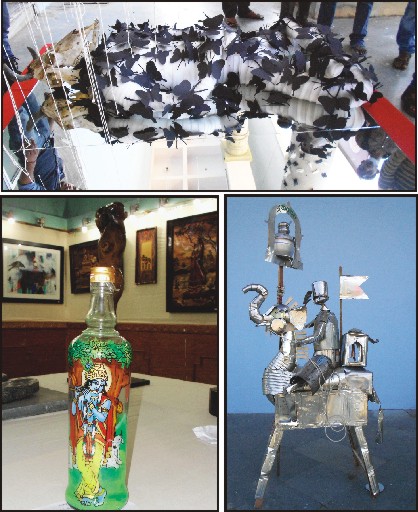
‘Life and Death’ art work created by the students of city’s Ravi Verma School of Art.
by S.N. Venkatnag Sobers
Mysore is known for its rich culture and heritage. Since decades, Mysoreans have been patronising arts of different kinds. Be it dramatics, painting, craft, music or any other fine art form, people continue to support and celebrate the artists’ creativity.
This year, Dasara Sub-Committee has given an opportunity for budding artists and professionals to display their art work at the art exhibition organised by Dasara Fine Arts and Handicrafts Sub-Committee at Kalamandira premises on Hunsur Road.
The exhibition, which was inaugurated yesterday, has already become a hit among Mysoreans and tourists. Being the centre of cultural activities, Kalamandira has been attracting a lot of visitors who have been mesmerised with the display art works. This apart, for the first time visitors to the art expo have been given a chance to the express their view through art on the 500 ft canvas which is placed outside Kalamandira building. People of all ages were seen stroking the brush on the giant canvas to express their views.
“This year the art exhibition has been of a different kind and has been organised on a larger scale. With the involvement of general public we are trying to promote the creative work of artists who have come out with some of the best art works,” said Dasara Fine Arts and Handicrafts Sub-Committee President Badal Nanjundaswamy.
Jumboo Savari: Just as one climb’s the steps of Kalamandira, he/she will get to see a unique art work created by Badal Nanjundaswamy titled ‘Jumboo Savari’, an applied art in which three cars have been placed on top of each other. There is also an art work titled ‘Life and Death’ created by students of Ravi Verma School of Art. Speaking to SOM, Arun, lecturer, Ravi Verma School of Art, said that the art work ‘Life and Death’ depicted the life which is colourful and full of activity and the other part is the life after death where the activity stops.
The art expo at Suchitra Art Gallery in Kalamandira has variety of works ranging from sculptures, hand embroidery, painting, wood inlay, photographs and others which are treat to watch. It will be open to public from 10 am to 9 pm till Oct.4.
This is for the first time that Dasara Sub-Committee has invited all the art schools in Mysore to be a part of the art expo. Speaking to Star of Mysore, V.A. Deshpande, Dean, CAVA, said that the idea of involving art schools was initiated by the Sub-Committee to provide an opportunity for students to display their art works.
“This will also provide an opportunity for the people to know about the works being done by the art school and their level of excellence. Both art and craft are two faces of the same coin. This is the reason that the Sub-Committee has involved handicrafts in the exhibition,” said Deshpande.
Students from CAVA, Ravi Verma School of Arts, Sri Kalanikethana School of Art and Vyjayanthi School of Art, all from city, are participating in this year’s Dasara art expo. With students being given a platform to display their art work, it is sure to attract more enthusiasts towards fine arts and craft.
source: http://www.starofmysore.com / Star of Mysore / Home> Feature Articles / Friday , September 26th, 2014
A group of like minded Physical Education Teachers and Coaches from the Mysore University affiliated colleges have formed the Physical Education Teachers Academy Trust in city.
The Trust was officially launched at a function held yesterday at Maharaja’s College Centenary Hall by Mysore University VC Prof. K.S. Rangappa.
Prof. Rangappa welcomed the initiative and wished that the PET Academy gets recognised as part of the Mysore University so that it can get the needed facelift. He announced that the Mysore University will come forward and help the activities of the PET Trust.
Dr. C. Krishna, Director, DPE, University of Mysore and President of the Trust, informed the gathering that the Trust has been formed with a wide objective of promoting sporting activities, physical education programmes in general, conducting cultural events, social service, helping sports-persons in need and also helping the needy Physical Education Teachers families who are in need of financial help.
In the days to come, the body aims to conduct educational, social and sports developmental related activities on a larger scale which will pave way for the improvement in sporting activities which will in turn help the citizens to lead a healthier life.
He also informed the gathering that, this year, the Trust started its activities by setting up a endowment fund to facilitate the conduct of the Mysore University Inter-Collegiate Gold Cup Football Tourney conducted in memory of late Chief Justice Hombegowda. The Trust also helped gymnast Anantha Rao, who has been paralysed due to the injury suffered during Dasara Games, with a lap-top.
Prof. Seshanna, speaking on the occasion, said that much more can be done by the Trust and its future members if they work with a vision.
Yakshagana by Mahaganapathi Yashagana Mandali, Dharmasthala, followed the inauguration of the PET Trust.
source: http://www.starofmysore.com / Star of Mysore / Home> Sports News / September 17th, 2014
A session at WorkBench projects where people explore their creativity / by Special Arrangement
WorkBench Projects, by Pavan Kumar and Anupama Prakash, aims to “put the power of innovation in every hand”
Pavan Kumar, CEO and founder of WorkBench Projects / by Special Arrangement / The Hindu
So you have a brilliant idea, a fertile imagination, but you don’t have the resources and support system to create something great. WorkBench Projects, founded by Pavan Kumar, a mechanical engineer, and co-founded by Anupama Prakash, is the answer to your dilemma. Their mission is to spark creativity and innovation among those with engineering and artistic aptitude.
Anupama Prakash, co-founder WorkBench Projects /. The Hindu
WorkBench Projects is currently a maker space in a garage in Kanakapura Road. The facility has hand/power tools and workbenches for people to explore their creativity and the ‘maker spirit’ in them by pursuing their passions from wood-working to mural making and exploring the basics of electronics and gadgetry. “People from all over the city have been coming to this space. They didn’t mind travelling a long distance to get here,” says the enterprising Anupama, who has an MA in Gallery Studies and Critical Curating from the University of Essex.
Seeing the work the duo has done in the garage, Bangalore Metro Rail Corporation Limited (BMRCL) has sanctioned a prime space in the Ulsoor Metro Station to set up a maker space. “People from all backgrounds will be able to explore their creativity in this space. The facility will be loaded with all tools and machines, from a CNC router, 3D printer, laser etching machine etc,” says Anupama. She adds that along with tools and machines, mentorship will be provided. “We will be facilitators. We will help you understand where you are heading and hook you up with the right people. It doesn’t necessarily have to conclude into something definite, but if there is potential, we will be the accelerators.”
The facility will be formally launched in November this year. As a build-up to the launch, the duo has initiated a fortnightly Maker Weekend, which will be held in collaboration with BMRCL. The first Maker Weekend will be held in the city tomorrow. There will be a panel discussion involving the maker community, a Western Classical music concert by Heart Strings and a four-hour woodworking workshop. “The focus of the panel discussion is to know what other makers are doing. The participants are from a cross-section of demographics. We have a veteran maker, who used to build RC airplanes during his free time. There is another hard-core electronics engineer who has converted his basement into a wonderful studio for making replicas of antique clocks! A lady has her own terrace garden, where she grows vegetables for three to four families. Another participant is a college student. We have a lecturer from an architecture college. He is a maker too. He finds geniuses among his students and encourages them to go beyond architecture. We want to know how he becomes an inspiration. Another participant is a lawyer on patents. He will describe what a patent is and how to validate a piece of work for a patent.”
There is a vast talent pool of innovative and creative people in the country. Anupama says the Indian education system focuses more on knowledge-based learning than on skill-based learning and that is really where the problem lies. There are thousands of graduates every year with freshly-minted degrees, but without any practical knowledge on how to convert ideas into reality. Through their initiative, Anupama and Pavan seek to nudge people into a direction. To create a successful structure, system or product, what is important, Anupama says, is ‘disruptive innovation.’ She says that one must not fear failure. “It’s about making a mistake and leading you to the next great step.”
Maker Weekend at Rangoli Metro Art Centre, from 11 a.m. to 6 p.m. For registration for the wood working workshop, the cost for which is Rs.800, call 9663090123 or mail info@workbenchprojects.com.
source: http://www.thehindu.com / The Hindu / Home> Features> MetroPlus / by Shravasti Datta / Bangalore – August 22nd, 2014