Colin de Souza and Kulamarva Balakrishna
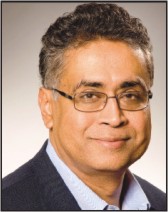
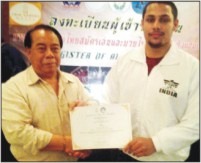
Caption: Colin de Souza (left), with the author, at Aswan, Egypt, in 2010. Picture right: Kulamarva Balakrishna (wearing Gandhi cap) and his wife Eva, with the author, at a bus station in Vienna, in 2010.
By M.P. Prabhakaran, Editor & Publisher, The East-West Inquirer, New York, USA
I lost my two lifelong friends in a span of two months. Colin de Souza left me two months ago and Kulamarva Balakrishna last week. Their deaths have created a big void in me. As those of us who are over-the-hill know, lifelong friendships are hard to come by in this world. I have been blessed with a few. My friendships with Colin and Bala, as the latter is called by his close friends, were among them. [See Abracadabra ‘Remembering my friends of Bombay days’ on page 8]
Colin and I met as journalism students, in the late 1960s, at Bharatiya Vidya Bhavan, Bombay (now Mumbai). We were also roommates in the college dorm. After we finished college and started working as journalists, we shared a chummery with another journalist who became another lifelong friend of mine. He is K.B. Ganapathy, the owner and Editor of Star of Mysore, a leading English daily published from the southern Indian city of Mysore.
We three spent most of our free time together — going to movies and plays; chatting at Irani restaurants over pani cum cha (the equivalent of what is small-size tea in the US) and kara (salty) biscuits; and doing silly things, which I am not all that comfortable recalling. We also had lots of fun together. The fun included occasional visits to “aunties’ bars.” The speakeasies of Bombay were called aunties’ bars, because most of them were run by elderly women who originally came from Goa. Time was when the Government of Maharashtra had not yet realised that prohibition was a total failure.
Colin started his career as a Copy Editor on The Economic and Political Weekly of India. Unlike Ganapathy and me, he was blessed with a boss, who, he never tired of saying, was “a pleasure to work with.” The boss was the late Krishna Raj, Editor of EPW at the time and the man who built it from scratch into the prestigious journal that it is today. Krishna Raj was one of the finest human beings I met in my life.
Blame it on our age, we were part of that West-aping crowd in Bombay. And you may blame that on Hollywood movies, which we used to be among the first to see when released in Bombay, and newspaper stories on Pentagon Papers and Watergate scandal, which journalists around the world found awe-inspiring. When things got hard, we would try to perk up one another with that hackneyed American expression, “Go West, young man,” though in a slightly different sense. To us, the West was America as a whole, not just the American West. “America is the Mecca for journalists” used to be another expression we frequently bandied about. In the India of the 1970s, things were really hard and we, I shamefully admit, were looking for ways to leave the country in search of greener journalistic pastures in the West.
I was the first to leave. After wandering around the Middle East and Europe, I ended up in New York, in 1975. Colin tried to join me, as a student, but with no success. He was collecting rejection letter after rejection letter from various American Universities when he got a chance to make his first Westward move, though not to the US. He got a job as a Senior Copy Editor on Khaleej Times, Dubai. The daily newspaper brought out its first edition on April 26, 1978, and Colin was part of the team that did it.
Other than that the money was good, he had nothing positive to say about the job. Though he had not expected the kind of journalistic freedom he enjoyed during his decade-long work in India, he found some of the editorial policies of the paper disgusting. According to one such policy, which all journalists on the paper were asked to follow, the word Israel was not to be used anywhere in the paper. Any time the word appears in a news story, it was supposed to be deleted and replaced with “the Zionist Entity.” Colin was unhappy following policies of that nature.
He was left with two options: quit the job and go back to Bombay or grin and bear the unhappiness as long as he could. He chose the latter. The attractive salary the job fetched and the free and fully furnished apartment the employer provided did play a role in making that choice. After all, he said to himself, weren’t those the factors that enticed him to accept the job in the first place? He decided to stay and take stock of his life. “We are not getting younger,” he wrote me after deciding to stay on the job. “At some point we have to get married and settle down in life. Both of us are the marrying type.”
His superiors at Khaleej Times found him very valuable. His editing was flawless. His English vocabulary was rich. He also had a photographic memory, and could rattle off facts and figures from history effortlessly. The last quality made him an asset to his fellow Copy Editors. We are talking about the pre-Google-search era when fact-checking used to be a time-consuming process.
He spent a few aZnnual vacations in India looking for the right woman to share his life with. On that front, he was not lucky. “If I can’t find the right one, so be it,” he told me over phone every time he came back from vacation, frustrated.
After the year 2000, he did another stocktaking of his life and decided that he had made enough money to be able to retire comfortably in India. Two years later, he bought a flat in Bangalore and retired there.
Nihal Singh, the veteran Indian journalist who was editor of Khaleej Times at the time, gave him a parting gift. He made him a part-time Correspondent for the paper, based in Bangalore. When a new Editor replaced Nihal Singh two years later, he took that gift back. Though he was not keeping good health — he had chronic diabetic problem — he didn’t lose the job. He died on December 24, 2012, at the age of 68.
Colin was a religious Catholic and came from a very religious family. His sister Wilma is a nun. She is now Provincial Superior of the Salesian Sisters of Mumbai Province, covering 31 convents. In our Bombay days, on Sundays when I had nothing else to do, I used to accompany him to church. On the way to church I would often say things like, “Colin, are you not risking your secure position in Heaven by taking an agnostic-Hindu to church?” He would laugh it off.
That was the secret behind our friendship being lifelong: his willingness to recognise and respect the fact that a good person is a good person, whether he is religious or agnostic. Or even atheistic. That fact, I am sure, he didn’t learn from any of the priests whose sermons he listened to on all those Sundays.
By the time I met Bala, also in the late 1960s, he was already an established journalist in Bombay. I was still a journalism student. His exposés of Bombay’s underworld, while working as a reporter on the daily newspaper Free Press Journal, had won him praise from fellow journalists and admiration from journalism students like me. He took a liking to me at the very first meeting. Later, he was instrumental in my landing in my first job in journalism — as a cub Reporter on Current, a weekly newspaper (now defunct) known for its influence among the movers and shakers of Bombay at the time.
His first book in English, A Portrait of Bombay’s Underworld, which was an expanded version of the exposés that appeared in Free Press Journal, was well received by the public. It was a remarkable achievement for a man who taught himself English. The languages he was more facile with were Sanskrit, in which he was a scholar, and his mother tongue Kannada. Until he arrived in Bombay, his journalistic work was limited to what he did in a couple of Kannada journals in his native Karnataka State. It was in Bombay, and in English journalism, that he made a mark as a fearless reporter. The fearless reporting also earned him the enmity of many in govern- ment circles.
Another exposé by Bala, published in 1970 in The Times Weekly (a Sunday supplement of The Times of India at the time), stirred the conscience of many in India and made him the bête noire of the government and media of Nepal. The article discussed how innocent Nepali girls were sold into the “cages” of Bombay. It provoked some Nepali journalists to call Bala “the Katherine Mayo of India” — an allusion to the late American writer Katherine Mayo, whose 1927 book, Mother India, was condemned by Mahatma Gandhi as “the report of a drain inspector.”
Fearless reporting and bold positions he took on controversial issues put Bala on the watch list of India’s central government, too. As long as the country remained committed to democracy and freedom of the Press, he could afford to ignore how the government reacted to his writings. But there was a brief but infamous period in independent India’s history during which its reputation as a vibrant democracy suffered a setback. I am referring to the 18 months in 1975-77, known in India as the Emergency period. The late Prime Minister Indira Gandhi declared a state of Emergency in the country, suspended all civil liberties and arrogated dictatorial powers. Most journalists in India meekly submitted to censorship regulations imposed on them in the wake of the Emergency declaration. (Remember BJP leader L.K. Advani’s famous jab at journalists soon after the Emergency was lifted? “You were asked only to bend,” he told them. “But you decided to crawl.) The few who refused to do it ended up in jail. Bala was left with the option of either ending up in jail or leaving the country. He chose the latter. The choice became easy when he got evidence that he was being followed by secret Police.
I was already in New York when this was happening in India. In a small way, I was also on the watch list of the Indira Gandhi government. The Voice of India, a monthly I published from New York, had become a forum for free expression for anti-Emergency activists in the US and in India. Open communication with like-minded people in India became difficult for me. I lost touch with Bala.
Two years later, we were able to reconnect. After wandering around Europe for a while, he reached the Austrian capital of Vienna. With help from an Italian journalist friend, he was able to settle down there.
After several months of struggle, which is the case with any new arrival in a foreign country, he landed a job as a gardener for the city administration of Vienna. His childhood experience on his family farm back in India came in handy, he told me. Though he was able to make a decent living as a city employee, the journalist in him was thirsting for an outlet. Getting a job in any of the local newspapers was out of the question, because he did not know German. He contributed to The Voice of India frequently. His last dispatch for The Voice was a three-part series, under the title “How Fascism Came to India.” The series made a critical analysis of the events in India that ultimately led to Mrs. Gandhi’s declaring Emergency. He also worked as a stringer for the Press Trust of India, the Khaleej Times of Dubai and a few other English publications around the world. Though monetary compensation was far from expectation, the work he did for all those media outlets enabled him to keep his press credentials and be a part of the press corps in Vienna.
The Emergency was lifted after 18 months and Mrs. Gandhi was thrown out of power in the election that followed. But the crafty politician that she was, she maneuvered her way back into power in the next election. Bala told me once about a funny exchange he had with Mrs. Gandhi when she was on a State visit to Austria after being reelected. At a State dinner hosted by the Chancellor of Austria in her honour, Bala was seated among the local press people. He was the only Indian among them. That prompted Mrs. Gandhi to ask: “What are you doing here?”
Bala put his journalist’s hat aside, wore his city gardener’s hat and told her (I am paraphrasing it): I sweep public gardens and parks in Vienna, I water and manure plants and trees in them, I trim their leaves and I do a lot of menial work. I am a manual laborer in Vienna.
Mrs. Gandhi’s response: How is that we Indians have no problem doing such things once we come out of the country? Back home, we have a tendency to look down upon them.
That gave Bala the opportunity for a sweet revenge. He told her: Do you think I will be invited to a party hosted by the Head of State in India, if I am a manual laborer?
The press aide to the Chancellor, who was introducing Mrs. Gandhi around, took her to the next guest.
Vienna had been on my travel wish list for a long time. Ever since Bala settled down there, and especially after he married his Austrian wife Eva, he had been persistently inviting me to visit him. The invitation that came in 1999 was in the form of an ultimatum and quite an unnerving one. “Come now,” it said. “This may be your last chance to see me alive.” He was preparing to undergo a major surgery to remove his defective pancreas.
For reasons beyond my control, I was unable to make the trip, even after that ultimatum. I sent him a letter expressing my confidence that he would surely survive the surgery and my wish that both he and I would be around many more years, paying visits to each other many times.
As I had expected, the surgery was a success. And thanks to Austria’s excellent health care system which is freely available to the rich and poor alike and to his strict post-surgery regimen and discipline, he had been able to live a life more productive than most people who have their pancreas intact. Every day, he posted two or three articles on his blog, Humans Austria. The articles were social and political commentaries, often provocative. The blog was dedicated to “promoting human oneness and unity.”
Nearly a decade after his surgery, I was able to visit him. I did it twice, first in 2008, then in 2010. On both occasions he took me around all important and interesting places in Vienna — museums, galleries, theaters, gardens and parks. He was more concerned about making my sojourn in the city comfortable than his physical condition. I had to frequently remind him that he was on medication and had been advised by his doctors not to exert much.
At the end of my 2010 visit, he and Eva came to the bus station to see me off. Eva, an artist by profession, had not been able to come around with us during my 2010 visit, because she was busy preparing for an exhibition of her paintings. She was feeling guilty about it. Handing me a bag containing breakfast she had prepared for me, she said, “I have not been a good hostess this time. Please have this breakfast on the way.” I was touched.
About two months ago, I called Bala from New York to check on his health. Towards the end of our conversation he said, “As long as I have the energy to sit in front of my computer, I will post something on my blog. But coming to the phone and talking has become more difficult than sitting and working on the keyboard.”
Since then, we had been communicating through e-mails. The last e-mail from him came on February 13. He was cheerful as ever and there was no inkling in it that his end was near. The end came on the morning of February 27. He collapsed in the bathroom and died of cardiac arrest. He was 78.
“Please come to Vienna as often as you can,” Eva told me, after I conveyed my condolences over the phone.
“I will,” I said.
And I know that I will. But Vienna won’t be the same for me in the absence of Bala. As Bangalore won’t be the same for me in the absence of Colin.
On a positive note, the deaths of these two dear friends have made me come to grip with my own mortality. I am ready.
Note: This article was first published on Mar. 6, 2013 in the author’s The East-West Inquirer. The author may be contacted on email: letters@eastwestinquirer.com.
source: http://www.StarofMysore.com / Home> Feature Articles /By M.P. Prabhakaran, Editor & Publisher, The East-West Inquirer, New York, USA / March 08th, 2013