Category Archives: Uncategorized

Nandini Mysore Pak, Cashew Burfi in 100 gm packings released

Mysore, July 17

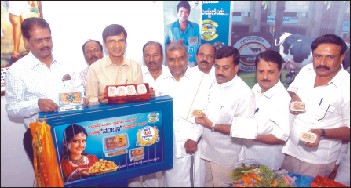
Nandini has now come out with its popular Mysore Pak and Cashew Burfi in 100 gm packings which were released by Karnataka Housing Board Chairman G.T. Devegowda at a programme organised by Mymul at the Mysore Dairy premises yesterday.

Speaking on the occasion, GTD lauded Mysore Dairy in coming out with tasty and hygienically packed milk products to the consumers.

Managing Director Dr. Suresh Babu said that the Farmers Welfare Trust was doing yeomen service for the milk producers by providing good facilities for their meritorious children. He added that a building belonging to MyMUL at Alanahalli was being renovated to a hostel for the students.

MDCC Bank President C. Basavegowda, District Co-operative Union President H.V. Rajeev, KMF Director S.C. Ashok and Mymul Chairman C. Omprakash were present.

Mymul donates dialysis machines

Mymul has donated dialysis machines to two hospitals in city. KHB Chairman G.T. Deve-gowda and MDCC Bank President Basavegowda launched the operation of the two machines at Cauvery Hospital in Siddarthanagar and River View Hospital in Hebbal yesterday.

They said that the facility would help the MyMul members suffering from renal problems by providing dialysis at reasonable rates. They announced that each dialysis would cost Rs. 600 for the members as against the usual Rs. 1,300 and assured to top up further with more people-friendly programmes in future.

source: http://www.StarofMysore.com / General News / July 17th, 2012

Rs 100 cr for renovation of monuments

The Union government has released a sum of Rs 100 crore to the State for renovation of historic monuments maintained by the Archaeology Department.

Of the 24,000 monuments in the State, 700 come under the purview of the State Archaeology Department. The money will be used to renovate them over a period of four years, said Basavaraju, Secretary to Kannada and Culture, Information Department here on Wednesday. As many as 100 temples had been renovated in association with Dharmasthala Manjunatheshwara Trust.

While the Trust and the Department have shared the expenses at 40 pc each, the temple managements and local people have contributed the balance 20 per cent, he said.  Infosys Foundation had come forward to take up renovation of the Someshwara temple at Lakshmeshwara in Gadag district at a cost of Rs three crore, he said.

The grants being given to drama companies which have completed 25 years would be increased soon. Monthly honorarium is being paid to about 1,600 artistes and around 1,000 applications seeking the allowance have been received. The Finance Department had given approval to provide honorarium to 400 more artistes this year, he said.

source: http://www.DeccanHerald.com / Home> State / DHNS, Hubli, July 04th, 2012

Vijay Mallya on cloud nine after team’s best performance of season

Ferrari’s Spanish driver Fernando Alonso, Caterham F1 Team’s Finnish driver Heikki Kovalainen, Ferrari’s Brazilian driver Felipe Massa and Force India’s German driver Nico Hulkenberg drive at the Valencia Street Circuit – AFP

Vijay Mallya was over the moon on Sunday as his Formula One team Sahara Force India enjoyed its strongest performance of the season at the European Grand Prix in Valencia. German Nico Hulkenberg finished fifth and Scot Paul Di Resta came home seventh as the Indian-owned team earned 16 world championship points.

Mallya said he was delighted to see his cars in top-10. “A thoroughly enjoyable race. It was a rollercoaster contest with many twists and turns, but I feel we have come away with the points we deserved given our performance level this weekend. Both drivers pushed hard, kept out of trouble and made their different strategies work. Paul recovered the ground he lost under the safety car and Nico had to drive most of the race without KERS, so it was an excellent performance by him,” the business tycoon added.

Mallya vowed that the team’s strong show will continue. “It has set us up perfectly for Silverstone in two weeks’ time where we will be determined to build on this momentum in our local race (the team’s factory is based in England),” Mallya added.

Hulkenberg, who posted his best rest in Formula One career, said, ” A great result for everyone in the team and for me personally. Fifth place is a great achievement after a very long and difficult race. The
two-stop strategy worked well, but the last stint was very long and it was hard to hold off the cars behind me on fresher tyres in the last few laps. So the race was a bit messy at times, but very entertaining and it feels great to come through and score such a good result for the team. We got a bit lucky with some cars dropping out, but we were in the right place to capitalise on things,” the German said.

source: http://www.DeccanChronicle.com / Home> Channels> SPORT> Motor Racing / by C. Santosh Kumar, DC / Chennai / Monday, June 25th, 2012

Hyderabad: Rs 25-lakh Bonanza from Andhra Govt for ’Golden Girl’ Mamata Poojary

Hyderabad, 24 Jun 2012:

In the middle of complaints that only cricket hogs all the limelight and only cricketers get large gifts as incentives, here is some soothing news.

Captain of the first women’s World Cup-winning India Kabaddi team Mamata Poojary and another member of the team Nagalakshmi have won prizes of Rs 25 lakh each from the Andhra Pradesh government.

The announcement was made by chief minister Kiran Kumar Reddy on Saturday, June 23.

Mamata hails from Hermunde in Karkala taluk of Udupi district and if anyone wonders what made the AP government choose her, she happens to be an employee of Railways, based in Secunderabad. Nagalakshmi hails from AP.

Recently, the AP government had announced a prize of Rs 50 lakh in appreciation of badminton star Saina Nehwal from the state. There was discontent that the government had neglected the Kabaddi achievers.

source: http://www.bellevision.com / by PTI / Hyderabad, June 24th, 2012

Fashionista in the making

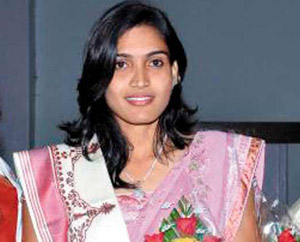
To wear lingerie that fits perfectly, is a dream come true for a woman, and this young NIFT student aims to do just that. 20-year-old Pooja Upadhyay just bagged the Triumph International Award in Mumbai and come October, she will be representing India in the finals at Shanghai.

Designing and art always inspired Pooja, who never thought about a career in fashion until a few years ago. “My father encouraged me to pursue fashion as a career and there has been no looking back ever since.” Though based in Mumbai, Pooja’s maternal and paternal grandparents hail from the state and she is enamoured by what the city has to offer to the world of fashion. “Bengaluru has a huge market for fashion and people are clued in to the proceedings. It’s just a matter of time before the city will be reckoned as a fashion hub in India,” claims the young design student.

The award came as a complete surprise to Pooja. She contested with several people across the country and was chosen in the top ten for the finals. “We had to depict duality in our design. I have combined the dragon and butterfly coming together in my lingerie design. I also had to consider the flow of the garment, since lingerie has to be well-fitting and accentuate a woman’s curves. The idea is to make the garment sensuous, not vulgar.”

Inspired by designers like Alexander McQueen, Ritu Beri, brands like Victoria’s Secret among others, Pooja too aims to launch her own fashion line one day. “Making the cut in this industry is not easy. Apart from a unique sense of design, you also need to have excellent social skills.” One particular designer who inspires her is, “Manish Arora. He was the artistic director for Paco Rabane and that’s very inspiring. Indian designers are being recognised by international brands.”

So what does it take to carve a niche in this fiercely competitive industry? “From what I’ve seen, handmade creations are deeply valued. At the turn of the millenium, trends were leaning towards the sporty side. Solid colours and bold cuts dominated the fashion preference. Now, people are inching towards surface ornamentation. It’s challenging and opens up a window of opportunties.”

Pooja has spent a good number of weeks in interior Karnataka, researching on local art and design. “My personal favourite is the lambani design. I would love to incorporate them in my work in the future.” In her spare time, Pooja loves shopping and reading up on the latest fashion trends. “I also sing, but that’s only in front of my close friends!” adds the bubbly youngster with a laugh.

source: http://www.DeccanChronicle.com / Home> Channels> Lifestyle> Fashion / by Sindhuja Balaji / DC, May 17th, 2012


Saviours of native seeds

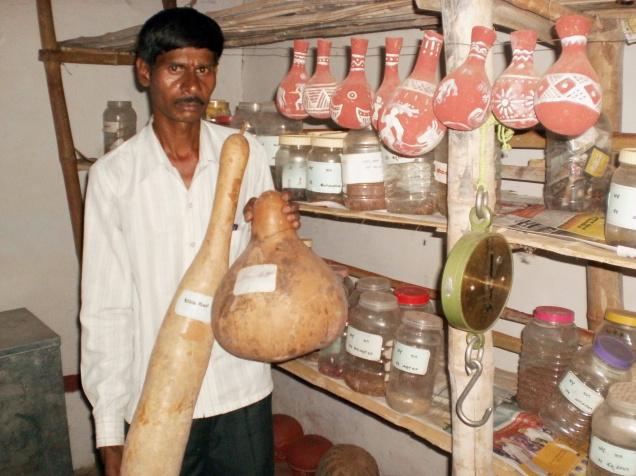
PRESERVING TRADITION: Gurusamy with his collection of native seed varieties. Photo: M.J. Prabu / The Hindu

Farmers like Gurusamy have been reaching out to their community

Inside a dingy and dark room of a house at Odayarpalayam village in Karnataka’s Chamrajnagar district, old earthen pots and worn-out plastic jars are lined up on ramshackle wooden shelves. Inside them are colourful beads and seeds, labelled neatly.

These are native seeds, painstakingly collected and documented by Gurusamy, a traditional seed collector and farmer, who has been in the business for the past 10 years.

P. Rajachar, Programme Officer of the Mysore Resettlement and Development Agency (Myrada), says that thanks to Mr. Gurusamy’s efforts, hundreds of varieties of native seeds have been collected and distributed to farmers. These varieties are now grown on nearly 25 acres.

“I think there are more than 3,000 farmers in Karnataka who grow and maintain such seed varieties. We’ve a good network of suppliers who see to it that our bank balance [read seed bank] doesn’t go down,” adds the self-effacing farmer, who has sustained his efforts creditably.

His suppliers are mainly farmers who want to grow native varieties. “Mostly my suppliers are growers who are eager to preserve native varieties. While supplying seeds, I reach an informal agreement with them to give me back a portion of the seeds after the harvest,” says Mr. Gurusamy.

Seeds, symbols of fertility and vitality, have been a part of Indian culture and heritage for long; to a farmer they personify self-respect. In fact, long before hybrid seed companies set up shop and went commercial, the traditional farmer had saved his own seeds, swapped them with neighbours or exchanged them with others.

Mr. Gurusamy said:

“Sadly, this intimate knowledge of the farmer and his traditional wisdom have been systematically devalued by several scientists, who are keen to promote technologies and seeds that are not suited to a particular area or community.

“High-yielding seed varieties and chemical fertilizers and pesticides that came with the Green Revolution destroyed several indigenous seed varieties. As farmers stopped saving and exchanging seeds, and instead started buying them from the market, their native expertise became irrelevant and crop diversity suffered. In a land that once had several thousand varieties of crops, most of them are no more to be found.

“Farmers used to grow these, swap them with neighbours and preserve them for tough times. These seeds have beaten several odds. In fact, even today we’re able to hold out against the multinational seed companies that are trying to dislodge us and our collection.

“I normally do not charge for the seeds if the farmer desires to grow it in a small area, say, in his backyard. I simply request him to return a small portion of the seeds. But for those growing the crop on four to 10 acres, I charge a nominal amount. It could be anything between Rs. 5 to Rs. 20, depending on the seed one wants.”

There are four persons who help Mr. Gurusamy in his work. They go to various places in Karnataka and Tamil Nadu to source seeds, and update and maintain a database of native growers.

“Like Mr. Gurusamy, C. Rudriah from Kadambur, C. Palaniammal from Bargur, V. Narayanan from Kottamallan, D. Mahesh from Kadatti, N. Alamma from Kottarai and B. Ambamani from Hongalvadi are some of the farmers who preserve and supply native seeds,” says Mr. Rajachar.

These people are simple farmers who cultivate on their meagre holdings. It is their interest in protecting local and native seed varieties that has turned them into seed saviours.

Mr. Gurusamy’s phone number is 09008167819; Mr. Rajachar’s is 09449203217.

source: http://www.TheHindu.com / Home> S&T> Agriculture / by M. J. Prabu / Chamrajnagar, May 02nd, 2012

 

Sparsha Trust works for the uplift of abandoned street children, beggars & drug addicts

Sanju Rao, Excalibur Foundation, Bengaluru

On a Sunday last February, in a cloister close to Ramaiah Hospital, Bengaluru, over a hundred children in green uniforms participated in Sparsha Trust’s Annual Day Function: dancing, rangoli sketching, performing acrobatics, competing in relays.

These children were the poorest of the poor: the abandoned, the orphaned, the ones wandering the streets in search of a meal or menial work or secluded pavement spaces to sleep on runaways, drug addicts or beggars.

Sparsha was founded by a handful of young graduates with master’s degrees in social work. They began in June 2006 by building a centre –  Shikshana Mitra- in the slums of the Yeshwanthpura Singh communities. The centre was imagined as a shelter where the  slum children would be safe, where they would be nurtured, tutored and transitioned into mainstream schools.

After three years, Sparsha’s first batch of seven children aced their exams and graduated from school. Today, five of them are attending top universities.

Other batches of children followed, tutored by Sparsha staff, brought up to speed with the syllabus in mainstream schools, and subsequently admitted to these school. The children attended school during the day and were tutored and mentored by Sparsha staff in the evenings.

Over time the local community came to appreciate Sparsha’s work. Sparsha encouraged them to get involved with Shikshana Mitra – to value superior aspirations for their children as they excelled in studies.

Over a few years, Sparsha was in a position to hand over the management of the centre to the community itself. Some children – products of Shikshana Mitra – also took ownership of the centre and of the responsibilities entailed with running it. They eventually made the centre their own – independent of Sparsha – and self-sufficient.

Sparsha’s staff spent days, weeks and even months entreating parents to send their children to Sparsha’s centres where children can be cared for and educated. Most parents prefer that their children work alongside them at construction sites or beg or look after their shanty homes.

After conducting awareness programmes spanning over six months among a community of pavement dwellers, Sparsha’s team convinced parents to send their children to Chinnara Thangudhamma in Shivaji Nagar – away from the streets and squalor – where children were provided de-addiction programmes, offered a clean home, fully furnished hostel with bathrooms, trunks for their belongings, smart uniforms, toys, school materials and three nutritious meals daily courtesy an immaculate kitchen and a versatile cook; essentially everything to lead a nurturing, healthy life.

They are taken to playgrounds; those requiring psychiatric treatment are admitted to Nimhans; all children receive health check-ups, medical treatment and dental care. They are also taught sex education, counselled to deal with psychological and emotional problems, motivated to equip themselves with literacy – the means to deliver them from destitution.

Like Chinnara Thangudamma, every Sparsha centre is designed to provide children their right to lead lives of dignity – away from degrading streets and hazardous construction sites where they toil under the scalding sun.

The safety, comfort and education from Sparsha inspire in them the confidence and ambition to pursue careers that empower them to climb out of poverty.

Sparsha has built a sophisticated, resourceful children’s library and a ‘Multi-Dimensional Learning Center’ for computer training. The founding members of this young  NGO, that now has over 180 children directly under its aegis,have set themselves a new target – Mission 2015 – a shelter home to house and care for up to 1,000 children.

source: http://www.articles.economictimes.com / Home> News> News by Industry> ET Cetera> Education / April 18th, 2012


Cost-effective liver transplant treatment soon

Bangalore:

Health Care Global (HCG) enterprise is planning to bring cost-effective liver transplant treatment to Bangalore soon.

According to doctors, most patients travel to Delhi, which is the hub of liver transplant. In a year, less than 30 liver transplants have been done in Karnataka, in comparison to 300 in Delhi.

Despite HCG starting the service in Bangalore in September last year, not many have come forward for the treatment.

The group plans to bring down the cost of the treatment to `14 lakh, which now ranges between `18 lakh and `30 lakh.

“The need of the hour is to create more awareness on organ donation in Karnataka, which could save many lives,” said Dr B S Ajaikumar, Chairman of HCG.

Dr Subash Gupta, Liver Transplant Surgeon, HCG, said, “In liver transplantation, the failure rate is 20 per cent because of the disease recurrence and the patient’s indiscipline in sticking to strict medication.”

Dr Gupta, said, “Liver transplant is done in anticipation of liver failure, unlike in kidney failure where people can be on dialysis for a longer time. People need to understand this difference and come out to donate liver.”

source: http://www.ibnlive.in.com / South> Southern News> Bangalore / The New Indian Express , Express News Service / Bangalore, April 18th, 2012


Business school churns out women leaders

New Delhi:

An Indian Business School has begun a novel course; one that will seek to churn out better and more women political leaders into the nation’s political arena.

The Center for Public Policy (CPP) at the Indian Institute of Management-Bangalore (IIM-B), along with the Center for Social Research (CSR) based in New Delhi, is now offering the nation’s first course in political leadership exclusively for women called the “India-Women in Leadership (IWIL) program”.

In a country whose political sphere is dominated by males and uneducated legislators, the move is seen as a huge step in the forward direction.

“IIM-B and CSR have launched this course jointly to build creative, knowledgeable and innovative women leadership. Investing in women through formal training will help in creating a pipeline of confident and successful women leaders,” Dr Ranjana Kumari the Director of CSR said.

The three month long course will include field visits to other countries such as Singapore, as well as visits to the nation’s political capital New Delhi, besides lectures. The first batch is scheduled to begin on July 16, this year.

India has a poor record when it comes to gender gap in politics. The World Economic Forum ranked India 24 out of 135 countries in its Gender Gap Index for women’s political participation.

“Not only are there too few women in Indian politics, but women also face different barriers in their quest to become leading politicians in India. Therefore, women in politics need specialized skills and strategies in order to win elections and pursue the policies that matter most to them”, said Dr Kumari.

The Indian government has been trying to pass the Women’s representation bill, which will guarantee 33% reservation to women legislators to make it to the state and central houses of people’s representatives.

The bill has however been caught up over differences between political parties.

BM

source: http://www.bikyamasr.com / Home> World> Asia / by Mayabhushan Nagvenar / April 11th, 2012

Mangoes that smell like apples

Mangoes in Sayed Ghani Khan’s farm do not merely smell like mangoes. They have the fragrance of sweet lime, apple, jeera and even fennel seeds. This 36-year-old farmer has been innovating his farm in Mandya, by organically growing over 116 varieties of mangoes.

The tale of mangoes started when Khan was 14. When his father fell sick, Khan took to farming. A few years later, he joined college and pursued BCom. However, he discontinued and studied BA in archaeology and museums at Maharaja College in Mysore.

“My grandparents used to narrate stories of Tipu Sultan, who had a small but strong army in Mandya. The ruler was highly in gardening and had ordered mango trees from all over the world. Most of these trees are now dead, but I have conserved around 116 varieties. All the trees I have are close to 200 years old,” he said.

Khan had also registered many of his mango trees with the National Bureau of Plant Genetic Resource and has code-numbered them. “I have also registered it with Indian Institute of Horticulture so that these trees are conserved,” he said.

Interestingly, all his crops are grown with absolutely no insecticide or pesticides.

However, this innovative farmer has been facing the wrath of expensive organic manure; Khan is looking out for options to help conserve his collection. “I have 450 varieties of rice. I like to collect and exchange seeds with other farmers. This way, I have collected 450 varieties of organic rice,” he said.

source: http://www.dnaindia.com / Daily News & Analysis / Home> Bangalore> Report / by Deepthi MR / Place: Bangalore, Agency: DNA / Saturday, April 07th, 2012