Category Archives: Uncategorized

An inclination for porcelain

K S Raman, a retired professor, has a passion for antique porcelain items. He has a collection of over 100 items from various countries and each piece is different from the other.
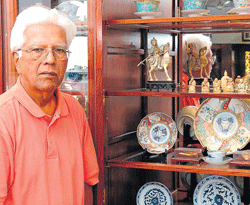

Things made out of Imari, a well-known Japanese porcelain; Nanking Cargo, the blue and white porcelain made in Nanking and Nyonya; colourful porcelain items made in China, Malaysia and Singapore; Cloisonne, a brassware and Netsuke, a miniature Japanese sculpture, form part of his collection Porcelain boxes in various sizes and shapes with colourful and intricate designs, showpieces, pots, tea jars, flower vases, tea mugs, ‘Laughing Buddha’, plates, bowls, antique Chinese chairs and many such things decorate his house. A beautiful flower vase brought from Athens in 1963 was the first item he collected.

Raman had served as a professor at the National University of Singapore from 1984 and relocated to Bangalore when he retired in 2004. “When I was in Malaysia and Singapore, I had the opportunity to travel to China, Japan, US and Europe. It helped me develop a professional, business and personal relationship with the people there and study their culture. I was attracted by their beautifully furnished houses which had decorative pieces made out of porcelain. Impressed by this, I started collecting porcelain items from various countries,” he shares.

Raman says that he used to collect matchbox labels, cigarette packs, and movie notices when he was a high school student in the 1940s. “But, my collection of artistic objects started in 1963 when I spent a few days in Athens. A replica of an ancient Greek vase had caught my attention and I bought it immediately. I bought a replica of an ancient Egyptian vase in Cairo, which is now preserved in a relative’s house. Whenever I visit her house, she shows me the vase and taunts me saying, ‘I can return this to you, but at a hefty price’!’’ he laughs.

Most of the antique items are sourced from the night markets and small shops in Malaysia (from Kuala Lumpur, Malacca, Penang, Kunsan, Kota Bharu), Singapore, Hong Kong, and China (in and around Beijing). “Some of the larger pieces are purchased from reputed art and antique dealers. I bought the Imari bowls and plates from a certified antique dealer in a shopping arcade in Tokyo,” he informs. He says that these have aesthetic value.
When Raman began collecting these items, his family members were not that supportive. “Initially, my wife and children couldn’t understand why I was spending money on such things. As I continued doing so, they accepted it as one of my vices,” he smiles.

It was not easy for him to transfer his collection from Singapore to Bangalore. “We started bringing smaller objects in hand baggage during our several visits to Bangalore for vacation. We engaged a company to ship the whole collection to Bangalore. My wife Indira had taken extra care in packing each item with utmost care. Finally, we were able to transport everything without a scratch,” he informs proudly.  As these objects do not require much care beyond occasional inspection and dusting, the couple doesn’t find maintenance a difficult task. “But, as both of us are old, it takes lot of time for cleaning. In the long run, we hope our son and daughter will look after these. Some others have also shown interest in certain items but we want to make sure that these items are kept safely,” he says.

source: http://www.DeccanHerald.com / Home> Supplements> Metrolife / by Rajani Hegde / DHNS / April 09th, 2012
Banashankari to get 100-acre park

Citizens of South Bengaluru have something to cheer about!

If all goes well, a mega park spread over 100 acres, akin to Lalbagh or Cubbon Park, will come up at the Banashankari 6th stage layout formed by the BDA, said Chief Minister D.V. Sadananda Gowda on Tuesday.

During the inspection of infrastructure projects in south Bengaluru, he said that about 100 acres of land falling under the state at the Turahalli range will be converted into a beautiful park with green cover. It will afford alternatives to Cubbon Park and Lalbagh and provide additional open pace, said Mr Gowda.

However, the blue print for the development of the 100 acres of Turahalli forest land is yet to be decided. In all probability, the BDA will be entrusted to develop such a park. South Bengaluru is developing rapidly and it needs the lung space very badly. Adjacent to the park, a sculpture park showcasing modern works of art is being readied by the BDA on eight acres of land, he said. Works of artists from New Delhi, Vadodara, Mysore, Hyderabad, Mumbai, Vishakpatnam will be displayed here.

source: http://www.DeccanChronicle.com / Home> Channels> Cities> Bengaluru / DC, Bengaluru / April 04th, 2012

The World Skills Competition organised

Bangalore:

Brigadier Adolf S Pinto, Deputy General Officer Commanding of Karnataka and Kerala Sub Area inaugurated ‘The World Skills Competition (Southern Region)’ in culinary arts, bakery and food and beverage service at the Army Institute of Hotel Management in the city recently.

Various colleges and institutes affiliated to National Council of Hotel Management and those affiliated to AICTE took part in the event. Monika Sharma and Suraj Pamar of the Army Institute of Hotel Management, Bangalore, won the first prize and second prize respectively in Food and Beverage Service category.

The winners will take part in the national-level competition to be held at New Delhi on June 30 and the finals will be held at Leipzig Trade Fair at Germany from July 2 to 7, the officials said.

Organised by the Amsterdam-based World Skills International, the competition takes place in different countries once in every two years. Gold, silver and bronze medals are presented to winners in the different categories. The competition was held earlier in Japan in 2007, Canada in 2009 and London in 2011.

source: http://www.ibnlive.in.com / South> Southern News> Bangalore / The New Indian Express , Express News Service / April 03rd, 2012


Respect the Girl Child: Prema Cariappa

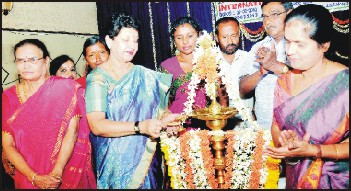
Caption: Prema Cariappa, Chairperson, Central Social Welfare Board, inaugurating the International Women’s Day celebration organised by Karnataka State Social Welfare Board at Rajendra Auditorium in JSS Hospital premises here recently. Others seen are State Board Chairperson Vinoda Nataraj and Karnataka State Women’s Development Corporation Chairperson Sarojini Bhardwaj.

Mysore, Mar. 28

“Members of the Indian society need to shed the ancient notion that only male issues can support us in our old age and that one attains ‘sadgati’ after death only if one is the a parent of a male child,” said Prema Cariappa, Chairperson, Central Social Welfare Advisory Board, New Delhi.

Speaking after inaugurating International Women’s Day celebration held under the aegis of Karnataka State Social Welfare Board at Rajendra Bhavan in city on Monday, she said that women are playing a pivotal role in the development of the nation and the country; but in spite of this, they are being discriminated.

She further said that even today, the birth of a female child is considered shameful. Even though girls excel in education they are being discriminated in the fields of higher education, professional courses and employment.

“The need of the hour is to educate girls. She said that the social evils like dowry etc. have ruined the society. Women are being burnt alive if dowry is not given. Police and judiciary seem to be helpless in stopping these crimes. Govt. is taking appropriate steps for the development of women but it is the duty of the voluntary organizations to come forward to work in the field of social work,” she said and opined that local elected representatives need to work towards eradicating this discrimination.

Board’s chairperson Vinoda Nataraj, State Women’s Development Corporation Chairperson Sarojini Bhardwaj and Women and Child Welfare Department Deputy Director N.R. Vijay were the chief guests.

source: http://www.StarofMysore.com / General News / March 28th, 2012

Tale of two cities

MULTIPLE CITY

Inscribed on the grains of sand, somewhere in the hour-glass of time, is the story of Bangalore, a story that has intrigued many. There are stories within stories of the multiple city that Bangalore is.

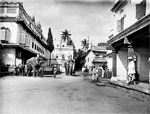
SIGHTS OF BANGALORE in the 1900’s. Clockwise from top left: A typical street with turbaned men and women ( Photo courtesy: Jane Smith, England , Missionary Fred Goodwill’s, grand daughter and Jones Ebinesan,  Western Australia).

A common thread that runs through the City’s centuries-old history is that of the constant pete-Cantonment parallel, and the story of the City’s municipal governance occupies a special place in the existence of two separate geographical entities within the map of Bangalore.

Even 150 years after the first municipal board came into existence on March 27, 1862, one can still tell the difference between the old City area and the Cantonment. Today, the cosmopolitan nature of the City, punctuated by people of many communities, occupations and ethnic origins might have masked the difference between the two areas, but not obliterated it. The dichotomy seems to be a constant through Bangalore’s history.

Although the first municipal board was already established in 1862 for old Bangalore, drawing a line of distinction, another board was formed on August 1 of the same year, to govern the Cantonment area.

State within a state

The Cantonment was a state within the state. Its demography was largely decided by the British. Historians point out that the British had, in order to cater to their various needs, brought ‘rich’ communities like the Mudaliars and Naidoos and some Muslims. They had also brought the ‘Harijan’ community to perform menial jobs.

With higher expendable income, larger budgets, special provisions, the Cantonment was elite. But the old City area could not be left out, not even if it were not the bosom of the City in the eyes of historians. Their charms were different. The Cantonment was English; the City area, notwithstanding some resembling architecture, was local.

But they were both vibrant by virtue of enjoying separate business districts, a provision the City planners post-Independence have given little importance to.

According to H S Doreswamy, the oldest (living) freedom fighter of Bangalore, the City’s business district housed all kinds of businesses, from oil producers to potters and silk weavers to bangle makers.

The Cantonment was different. It had bazaars that sold finished products, grocery and was home to a spectrum of entertainment avenues.

In 1871, a new municipal regulation saw the appointment of J H Orr as the fulltime president for the control and direction of the affairs of both the municipal. This was the first attempt at unified governance.

But the differences were not to be wiped out. The total revenue generation of the Bangalore City Municipality was Rs 43,010 while the revenue of the Bangalore Civil and Military Station Municipality (Cantonment) was Rs 92,617.

After the conclusion of the Commissioner’s administration and the beginning of the Mysore rulers’ administration, the Cantonment area was called British Cantonment.
By 1881, the differences in the administration became very apparent and caused discomfort among the locals in the City area. The administration continued, brushing aside these differences that did not last, for Bangaloreans then, like now, 150 years later, didn’t get ruffled too much by these differences.

Home to the British automatically meant more access to many provisions that the City area did not have. The ever-benevolent (British) government’s hand meant funds for development projects.

One such key priority that came the Cantonment’s way was drinking water supply. As early as 1881, Sampangi and three Millers tanks were the chief sources of water for the Civil and Military Stations. The Millers tank, constructed in 1854, was the first step taken to meet the demand for water. For the City, before the commencement of the scheme of protected (filtered) water supply to the City initiated in 1896 by Dewan K Sheshadri Iyer, unfiltered raw water was supplied from a number of tanks like the Dharmambudhi tank, Sampangi, Ulsoor and the Sankey tank.

The British officers deputed in Bangalore during the 1890s were looking for a new source of water supply. Major Grant worked at four sources––Maligal valley, Hebbal, Rachenahalli and Hessaraghatta––and M C Hutchins, the chief engineer of Mysore preferred Hessaraghatta.

More equal than others?

While people residing in the limits of the Bangalore City Municipality were levied three per cent-four per cent water tax, buildings and land used for military purpose were exempted from tax.

In 1892, for the first time, elections were conducted for these boards.
Voting rights were restricted only to male property owners and even among them, only those who have paid property tax, according to provisions of the Central rule of 1883. Both civil and military areas saw 18 members in all.

The differences between the two though, had to continue. Unlike in the City area, only in the Cantonment, women were allowed to vote. It was not until 1923, when the City board submitted a memorandum that women in the City area were allowed to cast their vote.

The differences continued even after Independence, as historians have described.
On December 8, 1949, post-Independence, both the boards were legally merged as one. But the most immediate challenge for the new administrators was to find the much needed co-operation for common administration. For the lines had to be “undrawn.”
The path taken after that needs little recalling. Bangalore has grown, it has a fresh identity. But the two separate identities that the Cantonment and City areas have given to Bangalore will continue to add to the charm of this City in its own way.

source: http://www.DeccanHerald.com / Home> Supplements> Spectrum / by Chethan Kumar / Tuesday, March 27th, 2012

Trees outside my window

CAN YOU IDENTIFY THESE TREES?

Trees outside my window

View from one’s window can be educational. Did you know for instance what we commonly call Ashoka tree is actually not Ashoka?

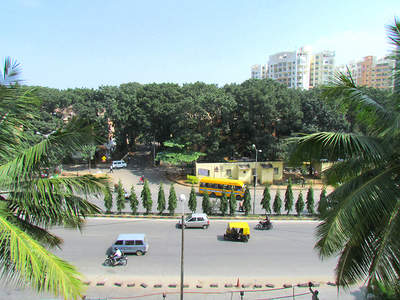
Nature is sometimes only as far away as one’s window! Here’s the view from an apartment balcony:


I can see four kinds of trees. Pic: Deepa Mohan

One can see the roads and transport and one can also see four different types of trees in the picture.

Framing the photograph at right and left, are some of the most common trees in India, the coconut palm. What a wonderful tree it is, with every part of it being useful to us…the palm fronds used for thatches, brooms and pandals for auspicious occasions; the coconuts being useful as one of the few drinks that cannot be adulterated, and is very nutritious; the trunk being used for both wood and boats!

On the median in the road are what are called Mast trees….they grow tall and straight like masts, and are often useful in breaking the force of the wind. They are often called Ashoka, too, but it is “Faux Ashoka”, since the real Ashoka trees (you can see them at Lalbagh) are spreading trees with flowers and fruit.

Across the road, next to the small Traffic Police Station is a Jungli Badam tree. It is from this tree that our Badam (almonds) trees have been cultivated. This tree, too, has the same fruits…but they are likely to be much more bitter. This tree was planted after the Rain Tree on that spot was cut down for road-widening…and already gives welcome shade, with its broad leaves and spreading canopy.

Behind the Jungli Badam are a row of beautiful Mahogany trees, which are often planted as an avenue tree in our city. The Mahogany is known for its hard, termite-resistant wood, used in making furniture.

It’s surprising how an urban scene can give us so much of information about trees! We have many kinds of trees in our city, and Lalbagh has many kinds of trees brought from all around the world, too. Trees, and the life they support, are fascinating to know about!

source: http://www. bangalore.citizenmatters.in / Features> Trees / by Deepa Mohan / March 12th, 2012

12 Mar 2012

Deepa Mohan is a freelance writer who fell in love with Bangalore when first she moved from Chennai, and has been both enthused and worried over the rapidly changing city. She is also a Bangalore metroblogger


Why drive when you can fly?

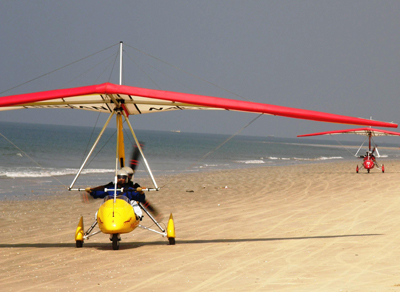
A microlite can take you to Mysore in less than an hour and cost just as little as a car

Since they don’t need a conventional runway, you can fly them almost anywhere

Some Bangaloreans are giving up long drives for flying in their own machines aka microlites. According to Directorate General of Civil Aviation (DGCA), microlites are defined as conventional two-seater planes that weigh less than 450 kg and are cleared for recreational flying and training.

Since they were introduced in 2000, the city has close to 50 microlite enthusiasts. Others are located in Coorg, Hassan and Mysore. City-based microlite trainer Javad Hassan travels to Mysore in less than an hour. All that he spends is 10 litres of petrol.
“In Bangalore, microlites are restricted to areas around Jakkur Flying School. There are no such restrictions in Mysore, Mangalore or Coorg,” explains Hassan.
Who can fly?

Flying a microlite requires a licence called PL(M) from the DGCA, which costs Rs 4 lakh. The eligibility criteria is 40 hours of flying experience. Candidates need to undergo a medical test and police verification, explains Hassan. Aero sports centres in Bangalore and Mysore offer 50-hour flying training programmes.
“Pricewise, there is no difference between a car and a microlite. For a good one, prices start at Rs 8 lakh. For those costing less, you do not even require a licence. Currently, close to 20 Bangaloreans own microlites while some prefer to take them on rent,” explains Hassan. 

‘They are sheer thrill’

These flying machines do not need a runway. They can take off or land even on a mud track, says an enthusiast.
Powered by petrol, they can take you to a height of 10,000 feet. “Alternatively, you can also fly just a metre above the ground or sea at 110 km/hr, which is more adventurous than flying at a higher altitude,” says Javad Hassan.
source: http://www.BangaloreMirror.com / Home> News> City> Story / by Niranjan Kaggere / Monday, March 05th, 2012


New President for MCCI


Mysore, Feb.28

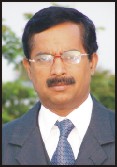
Industrialist Sudhakar S. Shetty was unanimously elected as the President of Mysore Chamber of Commerce and Industry (MCCI) at the Annual General Body meeting held here on Sunday.

The other office-bearers are A.S. Satish (Vice-President), Bhansali (Secretary), R.M. Satish (Joint Secretary) and Subramanya (Treasurer).


Sudhakar Shetty, previously the Vice-President of MCCI, has also served as President of Mysore Hotel Owners Association.


Profile: Born at Koppa Taluk in Chikmagalur District, Sudhakar Shetty settled down in Mysore after his high school education and started his business with a small hotel called ‘Sharada Lunch Home.’

Shetty has served as member of various associations including Hotel Association Trust, Federation of Dakshina Kannada Zilla Sangha and of many educational institutions. He also entered the field of journalism through the evening newspaper ‘Sankranti’.

Awards: He is a recipient of the ‘Man of the year’ award (2001) from the American Bio-graphical Institution; Aryabhatta award (2006); Shikshana Thajna award (2005-06) from the Independent Schools’ Federation of India; The Global Man of the year award (2006) from Vishwa Kannada Sammelana, Bahrain.

He is also an Advisory Board Member of Vidya Vikas Engineering College and Founder Chairman of Jnanasarovara International Residential School, which was established in the year 2004 and President of CBSE, ICSE & State Private Schools Management Association, Mysore Division (CISPMAM).

He is married to Sukalatha and the couple is blessed with two children — Pavan Shetty and Sheetal Shetty.

source: http://www.StarofMysore.com / General News / February 28th, 2012

‘I was fine with becoming blind, but not when asked to give up running’

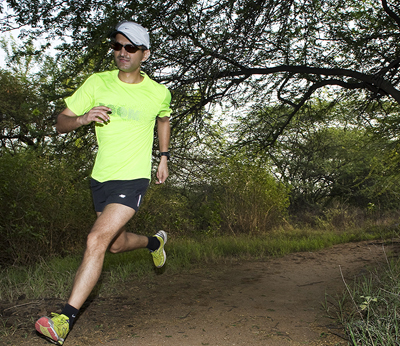
Living out loud with Dr Rajat Chauhan, (37) Marathoner, sports medicine doctor

Dr. Rajat Chauhan (37), Matathoner, Sports Medicine Doctor

The world’s highest ultra marathon, La Ultra, is his brainchild. But there was a time when this sports medicine doctor was asked to forsake his dreams because he was losing his vision


I started running when I was nine. I was studying at Wynberg Allen School, Mussorie. All the boarders had to run every Sunday morning for four kms; it was quite a distance for a nine-year-old and that too in the mountains. The one who finished last would be caned. That’s how it all started. Back then it was more of something I was expected to do. Later, the school started giving mango juice to the first six boys at the finishing line. 

There was no way I was going to miss that! I was pretty useless at other sports, so I thought why not running. I was in 9th standard when I got into the cross country team and that is when I realised how much I was hooked to running. I ran my first half marathon (the Rath half marathon in Delhi) at 16 in 1 hour 29 minutes.

My parents didn’t object to my obsession with running, but when I told them that I wanted to be a runner, they flipped. They wanted me to be a doctor. In the first year of med school I suffered from retinal detachment in my right eye. The doctors forbade me to do physical activities. I was completely fine with the idea of becoming blind; it wasn’t an issue with me, but being told that I can’t run was a huge blow. I got operated in 1994 and after that my power jumped to -6.
For the next four years, I’d run for just 30 minutes once a week. And that’s when I decided to study sports medicine in the University of Nottingham in the UK. Peter Gregory, the chief medicine officer of the English cricket team, was my immediate supervisor. He had a huge impact on me. I went to South Africa in 2004 during the World Cup; it was my first on-field exposure. That’s where I realised that the guys behind the scenes really impact the activities on the field.
I also ran my first ultra marathon from Paris to London covering 200 miles. I worked in the UK as a sports medicine doctor before moving to Bangalore in mid 2006 when my wife was expecting our second son.
I conceived La Ultra, the world’s highest ultra marathon, by chance. In 2010, I asked a friend of mine whether he wanted to go to Manali to run in the Rohtang Pass. He agreed. We couldn’t run beyond 30kms in four hours. Luckily, for our egos, there was a landslide! In Manali, we saw an altitude map from Manali to Leh in an internet café. It reminded me of the Badwater ultra marathon in Death Valley, California. Manali to Leh is 500 odd kms. I thought we could run 222 kms because I wanted to do a run that was longer than Badwater (which covered 217 kms). This route is far more difficult than Badwater! On our way back to Delhi, my friend and I charted a plan for La Ultra on the back of a newspaper. But we were told that at high altitude runs, you need to rest at 13,000 feet. But I wanted to do an uninterrupted one.  So I thought, why not descend from a higher altitude to a low altitude so that the body gets acclimatised to that condition. People thought I’d lost it and said it’s not doable because of the lack of oxygen. But we did it! We started the run from Leh. ‘La’ stands for Tibetan mountain passes. The track required us to cross four mountain passes, including the world’s highest pass, Khardung La and that’s where we got the name from. So it’s the Ultra of passes.
There was five of us, two from the UK and two from the US who got to know of the run from Facebook. A lot of strangers from Mumbai, Hyderabad and Bangalore volunteered to help, and not all of them had running backgrounds. But only one person, Mark Cockbain, finished the run. The biggest thing that this run, which has now become an annual event, taught me was discovering human nature. Out in the open, people become unpredictable.
Both my boys (one is six and the other 10) run. The older one started when he was three years old and the younger one did his first mile nonstop when he was 18 months old. I don’t push them; they love it as they find it pretty cool. But I have not been able to convert my wife into a runner, maybe I haven’t tried hard enough. She just goes to the gym. I have been running for the last 28 years and it’s a way of life. It means the life to me. When I don’t run, I am pretty miserable. In hindsight, I am grateful to the man with the stick for giving me a reason to run. It gave me so much more than just that mango drink. 

As told to Piali Dasgupta

source: http://wwww.BangaloreMirror.com / Home> Sunday Read> Special > Story / by Piali Dasgupta / Sunday, March 04th, 2012

These ‘gurls’ love their rides

It’s all about passion for a classic bird, say the biker girls in the city. They take Bhavya Thimmaiah for a spin on their bikes and share with her stories of their obsession

The distinctive thump of a long-stroke, single-cylinder engine reverberates, amid the cacophony of Bangalore traffic. It’s a 1970, Classic 350cc Royal Enfield Bullet weighing 180 kgs plus and measuring 2120 mm (millimeter) length, 780mm width and 1080 mm in height. It’s a beauty. As she thunders down the road on a Sunday afternoon, people awaken not to her beauty, but to the damsel straddling it- Bhavya Srinivasan, 5.4” tall and weighing 65kgs. A speeding car making its way through the traffic slows down a wee bit; the passenger window rolls down and a gentleman gives Bhavya a ‘thumbs up’. “Great job, ma’m. Keep going,” he says. That’s the kind of attention Bhavya gets every time she goes for a ride on her Bullet.

Left to right: Shilpa Thoudam, Bhavya Srinivasan, Bindu Reddy, Vinutha P G and Swathi Reddy (pillion)
Bhavya, an entrepreneur, has been riding a Classic for the last nine years. What began as a curiosity “about bikes during college days” has now turned into passion. She’s now joined hands with HopOnGurls!, the only group in the city to teach women how to ride a Bullet.
HopOnGurls! is the brainchild of 25-year-old Bindu Reddy, a solutions engineer. “I can never forget my first experience on the Bullet; it started off as a bet that became a craving. I took my friend’s Thunderbird and rode away with my friend running behind to catch his birdie,” she says, giggling at the memory. “A memorable day that made me go crazy about this machine.”
Bindu’s friends taught her to ride a Bullet. “I always wondered why isn’t there an instructor to teach girls to ride a Bullet.” Why not start a riding club for girls? She asked herself. As a birthday gift, she asked her college friends – Lionel, Mrudul and Raghunandan – to help start HopOnGurls! in 2011. Bindu’s first students were a mother-daughter duo – Kusum, 56, and Roshini, 25. “The mother was more enthusiastic than the daughter,” recalls Reddy. The mother took about 4 weeks to master the bike. Bindu had another student, Jayanthi Kalyanaraman, a 34-year-old business analyst, who would come from Chennai every weekend to learn to ride the Bullet. “I wanted to learn to ride for a long time but was unable to find a willing teacher in Chennai despite being ready to learn from a male one,” says Jayanthi. She completed the course in 3 weekends. For Jayanthi, it all began with her father challenging her to ride the Bullet in “front of him and then, only then, he said that he’d allow me to buy one,” says Jayanthi, smiling at the memory. Today, there are 60 women Bullet riders in the city and more than 80 associated with HopOnGurls!
Come every Sunday, you will see a bunch of girls learning how to ride a Bullet in a peaceful lane in Koramangala. Spread over 8 sessions, the classes are conducted every Sunday for an hour or so. Apart from teaching to ride, technical sessions are also conducted which include servicing of the bike and knowing your bike better. “We are the only ones to provide bikes to the learners unlike other places where they ask you to bring your vehicle. We also give an opportunity to those girls who have learnt from us to come back and teach others,” says Bindu.
A woman Bullet rider in the city roads always makes heads turn. There have been instances where people have placed bets to know if it is a girl riding a Bullet, encouraged them, challenged them and tested them if they are capable of handling this mean machine.
Bhavya recalls her trip to Chickmagalur in December 2011 where the villagers clad in dhoti and turban stood in a row watching the women ride past them. “There were men calling each other and pointing towards  us,” recalls Bhavya. Interestingly, nobody teases a girl riding a Bullet but they are put to test or challenged. There are some who provoke them to race with them, but “there is a lot of respect shown to the women riders”. When Shilpa went to get her driver’s licence, the RTO officer was impressed when he came to know that she rides a Bullet. “There are times when I’m not charged a parking fee; the attendants take my helmet and say, ‘Ma’m, I will take care of the bike and the helmet’,” says Bhavya. But, not all have the same outlook towards woman riders. “Once a cop asked, ‘Is it necessary that you ride such a vehicle? Can’t you get a smaller size vehicle for yourself?’ When we offered them a ride, they quietly slipped away.” At times, the men on the road also get protective about the women riders. “There have been instances when they’d wave to bus drivers asking them not to overtake us. We have the confidence. Wonder why they get so worried?,” asks Shilpa.
Riding bikes boosts the confidence level. “Mine has shot through the roof since I started riding,” says Shilpa. “I have realised I can handle such a mean machine.” But there are some who are still struggling to convince their parents about letting them ride a bike or even buy one. The girls say they are not feminists. To them, riding a bullet is not about being macho. They enjoy wearing a sari and attending a function as much as they do wearing jeans and riding a Bullet. It’s all about passion for a majestic bird.
source: http://www.BangaloreMirror.com / Home> Sunday Read> Special> Story / by Bhavya Thimmaiah / Sunday, March 04th, 2012