Category Archives: Uncategorized

Ugandan children recieve heart surgery in India

Kampala, Uganda:

Six Ugandan children will receive life-saving heart surgeries at the Narayana hospital in Bangalore India last week.


Chairman of the Indian Association of Uganda (IAU) Shalendra Kundra said the operations will be conducted by Dr. Devi Shetty a cardiologist.
“The operation has been made possible by IAU through donations from the Indian community that totaled to Ushs 200 million as charity,” said Shalendra.
Before the first decision to take the children to India, there was a possibility for the surgery to be conducted in Uganda at a lower cost but experts discovered that the facilities were insufficient to carry out such a complicated operation.
The Indian High Commissioner to Uganda S.N Ray said that the move by the Indian society in Uganda is part of the commitment to help Uganda’s vulnerable children.
“Many parents cannot afford the high costs of medication and facilitation to India for the operation and so the association resolved to give a helping hand,” Ray said.
Ray referred to the 19 year old Arinaitwe Emily who had been struggling with the heart problem for such a long time since birth because the patients could not afford the high charges.
Arinaitwe had to forego UACE exams for the surgery because it was scheduled during the same time. Shalendra added that they have embarked on consultation with the heart consultants in India to extend the screening services to Uganda.
“Screening will ease selection of worst conditioned patients because there were over 400 applications which made selection costly,” Shalendra added.
Veronica Busingye a parent of Lukuba Jeremiah aged three is optimistic that the surgery will improve the health of her child that has been complicated over the years.
The association has helped over 20 heart patients undergo heart surgery since the initiation of the project in 2008.
The surgeries that are expected to run for a month will see the patients accompanied by their guardians.

source: http://www.busiweek.com / East African Business Week / Home> Science & Technology> Health / by Eriosi Nantaba / Sunday, December 04th, 2011

Bird-Lovers Throng LINGAMBUDI Lake


Mysore, Nov. 28 :

Braving the incessant drizzle and chilly weather, over a 100 bird- lovers including many children had assembled at 7 am yesterday at Lingambudi Lake in Ramakrishnanagar here for the bird-watching programme organised by Arivu Balaga.

Suprisingly, a few people had arrived from Bangalore and other places to have a glimpse of the exotic migratory birds.

All the bird-lovers lined up on the banks of the lake and stood in hushed silence to listen to the twitter of the birds.

Environmentalists K.B. Sadanand, Mohan Kumar, P. Guruprasad, Ravi Kumar, Rajkumar, Dr. Abhijit and Sahana were present as Resource Persons providing needed information on the birds, their habitats and food habits to the bird-watchers. An interaction was also held on the vagaries of weather at the birds’ habitats and their migratory routes.

Among the migratory birds were also seen local species of birds like cranes, owls, hornbills and bee-eaters.

ACF D

source: http://www.starofmysore.com / General News / November 28th, 2011


Cisco’s New Healthpresence Focuses on Rural India


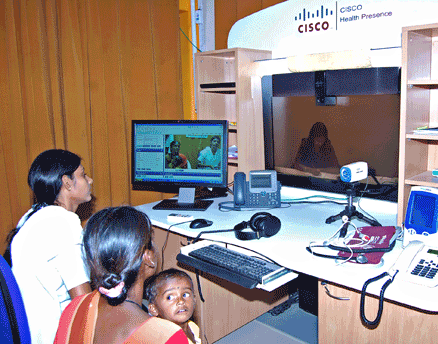
A village woman in K’taka is shown using Cisco’s HealthPresence. (photo courtesy of Cisco)

U.S. technology giant Cisco Nov. 14 unveiled the second generation of its platform for telemedicine, known as Healthpresence, focusing its efforts on India where at least 175 million rural dwellers lack access to any health care services.

Healthpresence allows physicians in several countries to remotely conduct consultations with patients who may be hundreds of miles away. In India, private hospitals, the defense sector and state governments in Karnataka and Madhya Pradesh have signed on to use Healthpresence; the service is already available in 11 districts and can be accessed by up to one million people.

“In India, there’s a huge mismatch between the availability of doctors and where they’re needed,” Vishal Gupta, vice president and general manager of Cisco Global Healthcare Solutions, told India-West by teleconference from Bangalore, where he is based. Patients must often travel hundreds of miles to see a physician, he said, noting that the need for doctors and specialists is most acute in rural India.

“We want to be the ATM of healthcare services,” said Gupta, envisioning Healthpresence kiosks in a variety of rural and semi-urban settings, such as malls.

An earlier version of the product, which was released two years ago, required Cisco’s Telepresence, a high bandwidth platform. But the version of Healthpresence rolled out by Cisco last week can be used on low bandwidth platforms, including desktop computers.

Healthpresence 2.0 features the flexibility to be used across several platforms, from a high-end Telepresence-based system, to a low bandwidth version which is portable and can be used in a mobile medicine van, said Gupta, noting that bandwidth is still an issue in many remote parts of India.

The new version of Healthpresence can be maintained on a server by a service provider who provides repairs and updates to the system, eliminating the need for an in-house IT specialist and lowering the overall cost, said Gupta.

Healthpresence patients sit in a special consulting room – known as a primary health care center – which has a screen allowing them to see their doctor, and specialized diagnostic equipment including a digitized stethoscope which allows a doctor to listen to his patient’s heart and lungs remotely.

A digitized torch and otoscope allow the physician to remotely examine a patient’s ears, nose and throat.

Healthpresence can also be used by specialists.

Sunita Maheshwari, a Bangalore-based pediatric cardiologist and founder of RxDx, which uses Healthpresence to connect to patients in the low-income district of Raichur in northen Karnataka, said Cisco’s product works very well in telemedicine.
“We were skeptical at first, wondering will rural India’s villages accept such technology. But they’re really thrilled because they have a doctor out there for the first time,” the Indian American Maheshwari, who was trained at Yale, told India-West.

RxDx remote clinics provide primary care doctors from 9 a.m. to 5 p.m. on a walk-in basis, and appointments can be made for consultations with specialists. The clinic has a staff of 70 physicians, with a mix of specialties, including pediatrics, and serves about 600 patients a month in Raichur, which is an overnight train journey from Bangalore.

Maheshwari – dubbed the “Queen of Hearts” by India Today magazine – said she hopes to next hook up with practices in remote states such as Bihar to provide Healthpresence services there. She estimated that one-quarter of India’s 700 million village dwellers – 175 million people – currently lack access to any healthcare services.

The Osmania University alumnus said the desktop version of Healthpresence was very scalable and could be used anywhere. “I could be sitting anywhere and treating patients not just in Raichur, but also in Tanzania,” she asserted.

The need for access to healthcare in India has gone up phenomenally with the advent of chronic diseases in the population. The country accounts for 60 percent of the world’s heart disease patients, according to data released last year by the World Health Organization, and is home to 35 million diabetics, the largest number on the globe.

Cancer is also on the rise with almost 400,000 people in India dying each year from various types of the disease. The overall oncology market is growing at about 20 percent per annum, Pradeep Jaisingh, founder and CEO of New Delhi-based International Oncology, told India-West in June.

Gupta stated that the Indian government has shown its commitment to telemedicine, promising to increase funding to public health care.

And in September, Sachin Pilot, India’s young Minister of Communications and Information Technology, unveiled a plan that would lay out 500,000 miles of optical fibre throughout the country, bringing high-speed connectivity to every remote area of India within the next two years.

source: http://www.indiawest.com / News> US Indian / by Sunita Sohrabji, Staff Reporter / December 01st, 2011

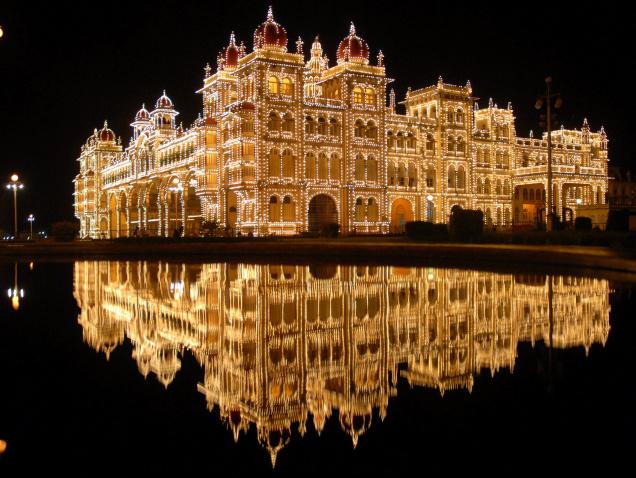
In regal splendour

Twilight wonder: The illuminated Mysore Palace. Photo: M.A.Sriram

Magnificent and historical, the Mysore Palace is protected by the Karnataka Archaeology Department. The royal residence would mark a century next year.

Reckoned to be the most popular monument in the country after the Taj Mahal (in terms of the number of visitors), the Mysore Palace draws close to three million tourists every year and the numbers are increasing.

Constructed to house the royal family of Mysore as the earlier wooden palace was ravaged and destroyed in a fire in 1897, the existing palace will complete 100 years in 2012 to mark which the State Archaeology Department plans to have a series of events and have it declared as a protected monument.

There are references to the maharajas of Mysore living in a palace in some of the texts belonging to the Mysore royal family such as Srimanmaharajaravara vamsavalli (annals of the Mysore Royal Family) while a description of the wooden palace has been provided in the Mysore Gazetteer, which notes that it was a constructed in the Hindu style with little or no trace of European influence, according to Dr. M.S. Nagaraja Rao, the former Director General of Archaeological Survey of India, and who has authored a book on the Mysore Palace for the benefit of tourists.

But it is the new palace whose construction started in October 1897 and was completed in 1912 that beckons the tourists and beggars description. It was designed by Henry Irwin who was the consulting architect of the Government of Madras and also went on to design the Viceregal Lodge at Simla.

The palace is an example of the Indo-Saracenic style of architecture and is a three-storeyed structure whose façade comprises nine impressive arches — three on each side flanking the giant central arch that is supported by two smaller arches.

The central portion has a dome that towers to a height of 145 feet and the entire palace facing east, is surrounded by a fort. The main gate of the Fort leading to the palace is Jayamartanda Gate which is massive in proportion and is sublime despite its size.

As one walks into the interiors, the visitors are ushered into the Kalyana Mantapa which is embellished with 26 murals capturing the glory of Mysore Dasara, and further on the visitors enter the durbar hall called the diwan-e-aam which is about 155 feet in length and 42 feet wide.

The Diwan-e-khas is also called Amba Vilas and is lavishly embellished with inlay work, intricately carved designs filled with ivory. The then Maharaja Krishnaraja Wadiyar IV who reigned from 1902 to 1940 entrusted the responsibility of beautifying the Amba Vilas section to the renowned artist K. Venkatappa, according to Nagaraja Rao.

The palace has an impressive collection of objects of art including the model of the original wooden palace but the most famous of the exhibits is the golden throne and the golden howdah. The golden throne is, however, not open to the public throughout the year and is exhibited only during the Dasara. In addition, there is the armoury containing an exhaustive collection of weapons of the ancient and the medieval times but this is not open to the public at present.

In view of its magnificence the palace is a must-see in the tourists’ itinerary and for those who wish to savour its grandeur, the official website www.mysorepalace.tv provides a 360 degree panoramic images to whet the appetite.

The Mysore Palace is illuminated on Saturdays, Sundays and during public holidays and presents a majestic sight like no other. The palace is embedded with 96,000 to 100,000 bulbs for the illumination purpose and was installed in the early 1920s, according to the palace authorities. The cost of illuminating the palace for one hour is about Rs. 25,000 to Rs. 30,000 at the current power tariff.

The throne

The golden throne which is exhibited only during the Dasara, is among the prized possessions of the Palace. Its origins are steeped in mystery and there are beliefs that the golden throne belonged to the Pandavas and it was Vidyaranya — the preceptor of Harihara I, one of the founders of the Vijayanagar empire in the 14th century A.D. — who retrieved it from Penugonda in Andhra Pradesh. It passed on from the rulers of Vijayanagar to the Wadiyars who were the feudatories of the Vijayanagar rulers. There is another theory that it was gifted by the Mughal Emperor Aurangazeb to Chikkadevaraja in 1700 A.D.

Fort gates

Of all the gates to the fort surrounding the palace, the Jayamartanda Gate is architecturally sublime. The central arch is about 60 feet in height and has a width of 45 feet. Made of concrete and granite, it provides a panoramic view of the front portion of the palace. The other gates are named as Balarama, Jayarama, Brahmapuri, Karikal Thoti and Varaha.

source: http://www.thehindu.com / Life & Style> Kids / by R KrishnaKumar / November 28th, 2011


Guv presents ‘Prathibha Puraskar’ to Mysore city skater

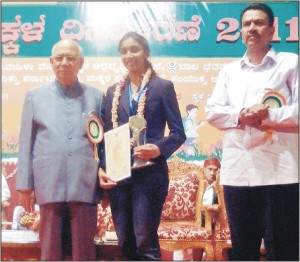
City skater Reethu Dinesh seen with Governor H.R. Bhardwaj and Women and Child Welfare Minister C.C. Patil in Bangalore yesterday.


Mysore:

City skater Reethu Dinesh received the State-level Prathibha Puraskar in sports category (multi-talended) by Governor H.R. Bhardwaj at a function organised by the Women and Child Welfare Department as part of Children’s Day at Bal Bhavan in Bangalore yesterday.

A 10th std. student of JSS Public School in Siddartha Layout, Reethu is the first artiste to have performed Bhara-tanatya Rangapravesha on skates.

She secured 7th position in the 14th Asian Roller Skating Championship held at Kaohsiung Chinese Taipei in July 2010. She also won two silver medals in Asian ice skating championship at Taipei, Taiwan during Oct. 2007.

She is the daughter of R.N. Dinesh, a resident of Siddhartha Layout in city.

source: http://www.starofmysore.com / General News / November 15th, 2011


Rangayana to open ‘SCRIPT BANK’: Dr. Rajaram

This year’s Bahuroopi theatre fest to stage plays by Jnanpith awardees


Mysore:

City’s theatre repertoire Rangayana will create a ‘Script Bank’ in which manuscripts relating to nearly 3,000 dramas would be posted on its website for the convenience of those interested, said Dr. B.V. Rajaram, Director of Rangayana, here this morning.

Participating in an interaction programme organised at Pathrakarthara Bhavan in city by Mysore District Journalists Association (MDJA), Dr. Rajaram said this year’s Bahuroopi National Theatre Festival would be held on the concept ‘Jnanpeetha Rangotsava’ in which dramas scripted by Jnanpith awardees would be staged.

The Rangayana Director also said that a huge collection of scripts and books by B.V. Karanth and his wife Prema Karanth would be preserved at Rangayana and added that the Karanth family had agreed to hand-over the literature treasure in the form of CDs and cassettes.

Dr. Rajaram, who said that this year’s Bahuroopi would be held in a grand manner even if it came to accepting private participation, added that the National School of Drama (NSD) and Rangayana should be incorporated for staging dramas in the State.

Seminar: Stating that Rangayana had plans to conduct a seminar on ‘Media-Rangabhoomi’ during Bahuroopi festival, Dr. Rajaram added that Rangayana’s activities were not limited to the city. He also said that dramas would be organised at taluk and district levels to identify and nurture talent among rural people.

MDJA President C.K. Mahendra, General Secretary K. Deepak, City Unit Secretary M. Subramanya and Rural Secretary Kukke Mahadevaswamy were present.

source: http://www.starofmysore.com / General News / November 03rd, 2011

Natural farming: Lifeline for Farmers

Intl. seminar on zero-budget farming by La Via Campesina


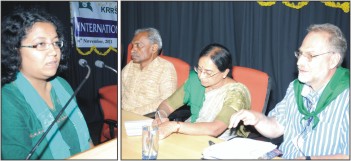
Caption: KRRS General Secretary Chukki Nanjundaswamy speaking at the seminar on natural farming held in city this morning. Picture right shows the pioneer of zero-budget farming Subhash Palekar, Nandini Jairam and Peter Rosset of La Via Campesina on the dais.

Mysore:

An international seminar on self-sustainable, zero-budget natural farming, propounded by international organisation La Via Campesina, was held under the aegis of Karnataka Rajya Raitha Sangha (KRRS) at Rani Bahadur auditorium in B.N. Bahaddur Institute here this morning.

Speaking on the occasion, Subhash Palekar, popularly known as Krishi Rishi, an exponent of natural farming and promoter of the concept of Zero Budget Natural Farming (ZBNF), said that the State Government’s Organic Farming Mission must be closed as it is against the interests of farmers and favours multinationals. He urged the government not to confuse the farmers between natural farming, organic farming and the conventional method of farming.

Pointing out the drought prevailing in north Karnataka region and the continued spells of rain in southern region of the State even during November, Palekar said that it was due to changes in the environment which if unchecked, would lead to disastrous implications.

KRRS General Secretary Chukki Nanjundaswamy, delivering the inaugural address, expressed regret that those in power were least bothered about the farmers resorting to suicide throughout the nation and said that there was a need for authorities to contemplate on why the farmers became entangled in debts and how to bail the Annadatha out of the severe financial constraints which force them to take the extreme step.

Deploring the conventional method of farming, she said that it required huge investments by way of seeds (from company brands claiming to be of superior quality and high-yielding), chemical fertilisers, weedicides, insecticides etc., but fetched no profit either because of crop failure due to vagaries of nature or crash in prices caused by over-production or other reasons.

Chukki termed the State Government’s Organic Farming Mission as capitalist agriculture and called upon farmers to take up pro-farmer agri-practices.

Peter Rosset, a member of La Via Campesina, addressing the gathering, said that the agri-scientists who work within the labs lack first hand experience of farming in the field and hence, their research works go waste.

They need to be practical, keeping in mind the farmers’ limitations and must ensure that their research works reach the farmers and properly implemented. He also deplored the use of hybrids and advocated for natural farming using original breeds. He also spoke in favour of polyculture (mixed farming).

KRRS President K.S. Puttannaiah, Nandini Jairam and farmer delegates from Sri Lanka, Indonesia, Combodia, Scotland, Philippines, Mexico, Korea, Nigeria and Nepal were present.

Natural Farming: It needs no tilling, no fertilisers, no pesticides and no weeding. For about 60 years, Fukuoka Masanobu, Japan’s authority on natural farming, honed methods based on his theories. His book One-Straw Revolution addresses not only natural farming but also causes of environmental deterioration.

Intl. campaign for natural farming

Via Campesina is an international movement which co-ordinates farmers’ organisations of small and middle-scale producers, farm workers, rural women, and indi-genous communities from Asia, Africa, America and Europe.

It is a coalition of over 148 organisations, advocating family-farm-based sustainable agriculture and was the group that first coined the term “food sovereignty” which refers to the right to produce food on one’s own territory. Via Campesina has carried out a Global Campaign for Agrarian Reform since 1999.

Organised worldwide into nine regions, the group has members in 69 countries, with about 150 million members globally. The organisation was founded in 1993 by farmers’ organisations from Europe and Latin America. Its headquarters is in Jakarta, Indonesia. Henry Saragih is the General Secretary.

source: http://www.starofmysore.com / General News / November 06th, 2011


‘Ekikarana’ movement: A timeline

The regions that make up for today’s Karnataka were under as many as 20 different administrative units with the princely state of Mysore, Nizam’s Hyderabad, the Bombay Presidency, the Madras Presidency and the territory of Kodagu being some of them.


* Under such circumstances, a need was felt among Kannadigas living in these various administrative units to form one state, which would unify all Kannada-speaking people in the various regions. This movement called the Ekikarana movement was led by litterateurs and thinkers.

* The Karnataka Vidyavardhaka Sangha was established in Dharwad in 1890. This was an important phase in the history of the unification movement. The Sangha was started by R H Deshpande who strove for the revival of Kannada in a region which was part of the Bombay Presidency where Marathi was the language of administration.

* It was later that the Kannada Sahitya Parishat (Bangalore) was set up (1915), which was another driving force in the unification movement.

* Alur Venkata Rao was the leading light of the unification movement. The publication of his Karnataka Gatha Vaibhava in 1912 gave a huge push in terms of a mass movement. He was known as the Kannada Kula Purohita or the ‘High priest of the Kannada family.’

* The States Reorganisation Commission was constituted by the Central government under the States Reorganisation Act and consisted of Hon. Fazal Ali, Kavalam Madhava Panikkar, and HN Kunzru.

* The recommendations of the Fazal Ali Committee was ratified by the Parliament, which meant that several disparate Kannada-speaking regions would now come under the Mysore State.
n The State was formed on November 1, 1956.

n It was on November 1, 1973, under Devaraj Urs as chief minister that the Mysore State was renamed as Karnataka.

source: http://www.deccanherald.com /by DHNS / Home> Supplements> Spectrum / Tuesday, November 01st, 2011


‘I SALUTE YOU SIR’ book on Pharma Science released


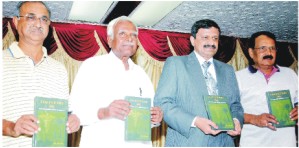
Jayadeva Institute of Cardiology Director Dr. C.N. Manjunath releasing the book ‘I Salute You Sir’ at The Paradise in Yadavagiri on Sunday. Andolana Editor Rajashekar Koti, former Assembly Speaker Krishna and author of the book Dr. Basappa are seen.

Mysore, Oct. 25 (KCU)

– A book on the history of phamaceutical science ‘I Salute You Sir,’ which also throws light on the effort of scientists in discovering medicines, written by Dr. Basappa, Consultant Doctor at Apollo BGS Hospital, was released at The Paradise hotel in Yadavagiri on Sunday by Dr. C.N. Manjunath, Director, Jayadeva Institute of Cardiology, Bangalore.

Speaking on the occasion, Dr. Manjunath lauded Dr. Basappa for throwing light on the invaluable service of scientists to society and pointed out that the book would motivate doctors and medical students to pursue research in medicine.

Andolana Editor Rajashekar Koti, who unveiled a portrait of Louis Pasteur, opined that medical profession was truly dedicated to society and suggested to publish the book in Kannada also.

Presiding over the programme, former Assembly Speaker Kris-hna pointed out that scientists toiled almost their whole lives pursuing research in medicine at the cost of their personal comforts. Contrary to that, a few doctors were more engrossed in making money with no humanity, he regretted.

Dr. Basappa observed that se-veral scientists had entered into deep depression and ended their lives while being deeply engrossed in research work foregoing social life. He pointed out that his book showcased the usage of scientist’s invaluable inventions in society and the struggle and sacrifice behind that.

Dr. Lakshman welcomed. Arun proposed a vote of thanks.

source: http://www.starofmysore.com / General News / October 25th, 2011


Celebrity Speak….: ‘Journey from nothing to something and something to everything’


Shree Bose, an Indian-origin US-based high school girl, won an award for her research on why a certain drug was resistant to chemotherapy and for finding a solution for it. Remember it was a research done by a high school girl. This was her dedication towards it. When you have dedication, you can go from nothing to something and from something to everything.”

This is how Sahasramukhi Raghavendra Rao (popularly called as Ragi Rao) describes his life. A high school graduate, who worked as a stenographer at the University of Mysore (UoM), went on to become a much-sought-after expressionist in India and abroad. He has been a dramatist, a marriage and party photographer, a percussionist and today, with all his past experience, he is teaching people how to handle stress by altering expressions of past experience.

Ragi Rao is in city on vacation and had a chat with Star of Mysore during which he spoke about his different faces, on and off stage.

It all started with Oliver Hardy Born on Nov. 23, 1937, Ragi Rao worked at University of Mysore (UoM) from 1958 to 1978. His life took a different turn in 1970s. “Apart from my job, I was also a dramatist. But one day while I was shaving, I was twisting my face and at one point it resembled that of Oliver Hardy. With practice and change of expression, I was able to alter that face into Adolf Hitler and Charlie Chaplin. I started entertaining people with this new-found talent and within two years came to limelight. The UoM recognised my talent and granted leave of absence for eight years. I started travelling across the country and earned the title ‘Sahasramukhi’ (Man of thousand faces). You need guts to make faces which will make others laugh,” he says.

Over the years, Ragi Rao has changed his face to resemble national personalities like Indira Gandhi, Swami Vivekananda, Sarvepalli Radhakrishnan, Kuvempu etc., to international figures like Hitler, Hardy, Martin Luther King and Max Muller among others.

Ragi Rao’s first big performance was at the Indian Institute of World Culture in Bangalore. In 1978, Ragi Rao immigrated to the US. “It was difficult for me to get along in the US because of the language and accent. But I didn’t give up,” says Ragi Rao who is today a renowned expressionist in the US.

“You can play the role of Rama and Krishna because no one has seen how they look. But to imitate a non-fictional character is very difficult. A writer writes the character and an actor portrays the character. But an expressionist not only portrays but resembles the character,” he adds.

With his experience as an expressionist, Ragi Rao worked for three years as Counselling Assistant at Mid Columbia Mental Health Centre, where he had to recognise if the patient was psychotic, neurotic or manipulative.

Face behind the lens

“When I was around 13 years old, I got a Kodak box camera. That is when my interest in photography started. Later, my brother got two good cameras for me with which I improved my skills. After I started earning, I got around eight film cameras and made my hobby a profession. With the introduction of digital photography, I sold all my film cameras to buy digital ones. I practiced professional photography for the past 25 years. But now I have stopped as it is difficult for me to carry the weight,” says Ragi Rao.

With this skill, Ragi Rao had organised a photography exhibition on the religious sculptures from India at US to collect money for installing idols at a temple there. The photographs showcased the sculptures from Belur and Halebid temples.

Expressing through drums

“Devotion and intelligence are one and the same. If I get interested in something, I will do it with complete devotion,” says the expressionist who is also a self-trained percussionist. He plays the tabla, mrudanga, ghata, and a host of other percussion instruments along with vocal percussion which, he says, he learnt by seeing and plays by mere knack. He had also given a performance ‘Drums of India’ to raise fund for the victims of 2001 Gujarat earthquake.

And finally…

“Now after portraying so many faces and getting tired of it, I am teaching how to face different faces of life with the appropriate face. This is stress language. It teaches you how to tame and tune your emotions. And unless you know this language, you cannot live with stress,” he says. But what is this stress language? Here is Ragi Rao’s answer…

“You should know 26 alphabets to read, write and understand English. Likewise, the nine emotions — serenity, fury, disgust, pathos, terror, eroticism, heroism, comic and wonder — are like letters. By combining these nine, you can create more emotions. We have heard of anger management and laughter therapy. But I thought why just two expressions? Why not combine all?

“For this you will have to think of a situation that triggers the emotion. Then think of a prefix and suffix relating to good or bad. Good reminds you to do the same to handle such situations. Bad tells you not to repeat the same. For example, in case of anger — think of a situation which made you angry and what you did to tackle it. If the situation was handled well with your expression then do the same in future, or else, alter it for better results. Use the same method for all the nine emotions and you will be taming thousands of other emotions. This will help you control your facial and verbal expressions, thereby helping you overcome tough situations in life.

“With common sense, an individual can make his/her personal tools to express and act with appropriate degree of verbal and facial expression to win situations.

“Physiognomy is not just an art but a science as well. Your facial and verbal expressions should match. If not, what you are telling may be a lie. Hence you should always live with the reality. You should not hide what you are. Ten persons may laugh at you for it but 990 will laugh with you.

“My main motto is not just to make faces to make others laugh and get away with it, but to show with this laughter, how to tame your face and live life better.”

source: http://www.starofmysore.com / Feature Articles / by M.S. Apuurva / October 28th, 2011