Category Archives: Science & Technology

US varsity honours Narayana Murthy

Tampa (Florida) May 16

The University of South Florida has honoured Infosys founder N.R. Narayana Murthy with the Global leadership and Free Enterprise Awards for his leadership and contributions to the international business world.

Presenting Infosys chairman emeritus Murthy with the awards at the Patel Centre for Global Sustainability here Monday, USF President Judy Genshaft praised him for his entrepreneurial spirit, according to a university press release.

Earlier, in an informal conversation with past and present students, Murthy said because of his middle class background, it was not as difficult for his company to maintain its values as it might be for the mass of people eking out a living.

‘You need a spirit of sacrifice and you need to have trust,’ he said.

Murthy explained how the company’s ethos has its roots in the very first meeting held at his house in Mumbai with his six fellow founders. Their discussion was focused on profitability.

Murthy focused their attention on ‘seeking respect’, ‘living in harmony with society’ and making sure ‘you don’t shortchange your customers,’ he said. When you do those things, ‘revenue will come. Profit will come’.

In response to a question from about the chances of Murthy entering politics, he mentioned his preference for ‘rational discussion’ and the difficulty the political world offers for such and expressed some hesitation.

Kaushal Chari, chair of the USF information systems and decision sciences department, said Murthy’s story is inspiring for students.

‘He’s a world-class business leader,’ said Chari, who leads a study abroad trip to India every year for business students.

IANS

source: http://www.india.nydailynews.com / Home> News> Desi News / Wednesday, May 16th, 2012

City-based Graduate launches new company in US

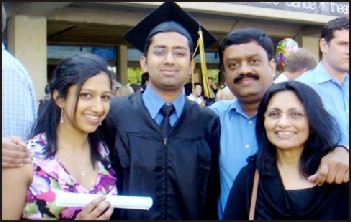
Caption: Siddarth is seen with his parents Padma & Satish and sister Anitha.

Mysore, May 11

Success does not see age or education, instead it sees hard work and enthusiasm to succeed in one’s endeavour. This is true in case of a graduate who, while most of his peers are working at entry-level jobs or in graduate school, is the Chief Technology Officer (CTO) of a medical device startup company.

Siddarth Satish, who has his roots in Mysore, started Gauss Surgical just after finishing Master of Translational Medicine (MTM) programme of Bioengineering Department at University of California, Berkeley, USA.

Siddarth has raised about $1 million in venture funding, hired several full-time staff, recruited a veteran entrepreneur as CEO, and is submitting designs to the US Food & Drug Administration (FDA).

His transition from ChemE undergrad to CTO of his own company in just under two years was due to hard work, brains, ambition and MTM programme. The MTM programme is a one-year master’s degree offered jointly by UC Berkeley and University of California, San Francisco (UCSF), aimed at accelerating the translation of cutting-edge research into advances in patient care.

Finishing up his 2010 Berkeley B.S. in Chemical Engineering, Siddarth joined MTM. He was partnered with fellow students Amer Abdulla and Charles Zhao to work with Professor in Bioengineering Dr. David Rempel. Although not all MTM graduates go on to startups or to work in industry, the unique experience helps students with ambition pursue their passion. The team explored several different projects with collaborators at Stanford Medical Center, including one on virtual instrument pedals that resulted in a patent filing and presentation at the American Academy of Pediatrics. All three decided to focus on another operating room problem: estimating surgical blood loss.

The team completed prototyping to accurately diagnose blood loss before graduating in Summer 2011, and then decided to take their work all the way and form a company: Gauss Surgical.

Siddarth is the son of Padma & Satish, residing in the US since 17 years. City’s industrialist and art patron K.V. Murthy is his maternal grandfather while late Dr. M.S. Nagaraja Rao (former Director General of ASI) was his paternal grandfather. Siddarth has a sister Anitha who will be entering medical school soon.

source: http://www.StarofMysore.com / General News/ May 11th, 2012

Bitten by the B’lore bug

LEGENDARY CONNECTION

It was in Bangalore that Ronald Ross first became interested in mosquitoes. Ross would go on to make the crucial discovery of plasmodium, the malarial parasite, in a mosquito, and win the Nobel too. Bangaloreans can truthfully say that the seeds of that great discovery were sown in our City, writes Meera Iyer

In September 1883, a British doctor named Ronald Ross was appointed the Acting Garrison Surgeon in the Bangalore Civil and Military Station. The doctor initially stayed in a bungalow close to today’s MG Road. He records in his memoirs that this was when he first became interested in mosquitoes. “They devoured me,” he writes, “until I discovered that they were breeding in a tub just outside my window.” Ross got rid of the wee beasties by the simple expedient of tipping the tub. So began a series of experiments and observations on mosquitoes that eventually led to a Nobel Prize for Physiology and Medicine in 1902.

Ronald Ross was born in Almora, Uttarakhand, on May 13, 1857, three days after the Indian Mutiny or the First War of Independence began. He grew up in Almora, Nainital and Benares and was sent to England for his education when he was eight.

The future scientist and Nobel Prize winner displayed no interest whatsoever in science but took wholeheartedly to painting, literature and the arts. He wrote poetry while still at school and at 17, decided he wanted to be a writer. But his father wanted him to join the Indian Medical Service, and so Ross resignedly joined St Bartholomew’s Hospital Medical School in London to study medicine. Ross wrote more poetry and even some short plays while at St Bartholomew’s but remained quite indifferent to medicine. He failed a qualifying exam for the Indian Medical Service, cleared it a year later on his second attempt, and then joined the Service. Ross came to India in 1882, stayed in Madras briefly and then had the first of many stints in Bangalore when he was given medical charge of a unit of the Madras Infantry for a few weeks.

Like many others before and after him, Ross loved Bangalore. He describes how he used to go for long walks every day among “rocky crests of mountains, fir woods, dells with beautiful little trickles of streamlets”. The sun and the breeze, he says, “were those not of earth but of heaven.” In a complaint that sounds all too familiar to us today, Ross says that when he looked for these same places ten years later, he found they had all been swallowed by development.

Over the next few years, Ross returned to Bangalore several times and also served in Quetta, Burma and the Andamans. He churned out more plays, novels and dramas, became very interested in mathematics, played a lot of tennis, whist and golf, but remained a completely ordinary doctor. It was only when he was on leave in England in 1888 that something ignited a spark in him: “I determined now to interest myself much more in my profession,” he writes, and he returned to India with renewed vigour.

Back to Bangalore

Ross was posted in Bangalore once again in 1890, as Staff Surgeon of the Civil and Military Station. Now married, he and his family lived in High Grounds, “in a delightful house facing the golf ground, called Uplands”. (Incidentally, this very house was where Sir M Visvesvaraya stayed for a time after his retirement in 1908). According to his Nobel lecture, it was during this 1890-1893 period in Bangalore that Ross made his first studies of malaria.

He also wrote his first research papers on the disease, including some that rejected the ‘bad air’ theory but speculated (wrongly, of course) that malaria might have an intestinal cause.

In the 1890s, scientists had begun to realise that parasites in blood caused malaria, but no one had any idea how these parasites moved from sick people to healthy people. In 1894, while on leave in England, Ross sought out Patrick Manson, a tropical disease expert who had recently discovered that mosquitoes spread the disease filariasis.

Manson told Ross he believed mosquitoes also spread malaria. This was the beginning of a long association between the two scientists.

Ross returned to India, and plunged into research, determined to prove Manson’s ‘Grand Induction’ as he called it.

Within a few months, Ross became an expert on dissecting mosquitoes, identifying parasites and diagnosing malaria. In his memoirs, Ross states that from April 1895 to February 1899, he wrote 110 letters to Manson about his research, “containing almost exactly 1,000 words each, or about one word to every ten people killed by malaria in India alone every year.”

At West End

But another disease also killed hundreds in India in those days. In 1895, Ross was called to Bangalore on special sanitary duty to contain the frequent cholera outbreaks here, especially in Shivajinagar, Ulsoor and parts of the pete.

Ross took up residence in a tent on the grounds of the (now Taj) West End Hotel. Over the next two years, he organised an overhaul of refuse-cleaning systems, suggested improvements in drainage, mapped the locations of wells and had them disinfected, and posted hospital assistants at stations to detect cases. He also frequently accompanied scavengers in their early morning work. “These experiences are not easily forgotten,” he writes.

Of the scavengers, “the poor men themselves, the last pariahs and outcasts of society, toiling while others slept,” says Ross, “None shall know of your labour, no one shall thank you, you shall die forgotten,” and yet, “the civilisation of the thronged cities was based upon their labour.” Though occupied by his sanitary work, Ross still eked out time for malaria. Until then, both he and Manson had thought that when malarial mosquitoes died, they somehow infected the water they bred in, which when ingested, caused malaria in humans. It was in Bangalore that Ross came up with another hypothesis that later proved correct: In May 1896, he wrote to Manson, “…the belief is growing on me that the disease is communicated by the bite of the mosquito. She always injects a small quantity of fluid with her bite — what if the parasites get into the system in this manner.”

Ross set out to test this hypothesis by the decidedly questionable method of getting mosquitoes to bite volunteers, mostly ‘natives’ of course, including the Assistant Surgeon of the Bowring Civil Hospital.

But as Ross had yet to discover that only the Anopheles mosquito carried the malarial parasite, his results remained negative. It wasn’t until 20 August 1897 (now commemorated as World Mosquito Day), when Ross was posted in Secunderabad, that he made the crucial discovery of a Plasmodium, the malarial parasite, in a mosquito. He came back to Bangalore on short leave a month later, staying at the West End once again (in a room this time, and not a tent!), and wrote up his exciting discovery. The paper, “On some Peculiar Pigmented Cells found in two Mosquitoes fed on Malarial Blood,” appeared in the British Medical Journal in December 1897.

In Secunderabad, the building where Ronald Ross made his landmark discovery is now called the Sir Ronald Ross Institute, and bears a plaque in appreciation of Ross’s work. But Bangaloreans can truthfully say that the seeds of that great discovery were sown in our City.

ROSS, THE POET

* Ronald Ross was known to be a poet, novelist and painter.
* His collection of poems include: ‘psychologies’, ‘Poems’, and ‘Fables and Satires’. He composed this verse about his first impressions of malaria that killed millions:

In this, O Nature, yield I pray to me.I pace and pace, and think and think, and takeThe fever’d hands, and note down all I see,That some dim distant light may haply break.The painful faces ask, can we not cure?We answer, No, not yet; we seek the laws.O God, reveal thro’ all this thing obscureThe unseen, small, but million-murdering cause.

(Courtesy: malariasite.com)

source: http://www.DeccanHerald.com / Home> Supplements> Spectrum / by Meera Iyer / May 07th, 2012
Innovation award for Skanray

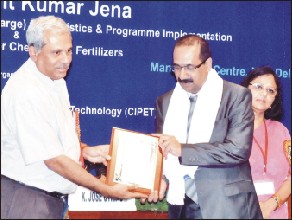
Caption: Balasubramaniam, Director & CTO, Skanray Technologies, receiving the award from K. Jose Cyriac, Secretary, Dept. of Chemicals & Petrochemicals, at New Delhi recently.

Mysore, May 3

Skanray Technologies Pvt. Ltd. won an award for innovation in polymeric products at the 2nd National Awards ceremony for technology innovation in various fields of petrochemical and downstream plastics processing industry held in New Delhi recently. The award is instituted by Ministry of Chemicals & Fertilisers, Govt. of India.

Skanray Technologies won the award for developing ‘Use of Engineering Plastics for Diagnostic X-ray equipment.’

Balasubramanian, Director & CTO, Skanray Technologies, received the award from K. Jose Cyriac, Secretary, Dept. of Chemicals & Petrochemicals.

Skanray was founded in 2007 by a team of reputed engineering and business professionals with decades of experience in industrial and medical devices sectors and having global exposure. Skanray moved into its state-of-the-art manufacturing facility in Hebbal, Mysore and commenced commercial business in 2011.

source: http://www.StarofMysore.com / General News / May 03rd, 2012

Karnataka awards contracts for 80 MW of photovoltaic and Concentrating Solar Power

Karnataka Renewable Energy Development Ltd. (KREDL, Bangalore, India) has allocated the first 80 MW of solar photovoltaic (PV) and concentrated solar power (CSP) projects through the Karnataka Solar Energy Policy.


Karnataka awards contracts for 80 MW of photovoltaic and Concentrating Solar Power

Karnataka Renewable Energy Development Ltd. (KREDL, Bangalore, India) has allocated the first 80 MW of solar photovoltaic (PV) and concentrating solar power (CSP) projects through the Karnataka Solar Policy, following a delay due to legal complications.Contracts for 20 MW of CSP and 60 MW of PV projects were awarded in this first round of bidding. The lowest bid came in at INR 7.94/kWh (USD 0.152/kWh) by Helena Power Pvt. Ltd. for a 10 MW PV plant and the highest successful bid at INR 8.50/kWh (USD 1.63/kWh) by Welspun Solar AP Pvt. Ltd. for a 7 MW PV plant. 

Other successful bidders include Sunborne Energy Services India Pvt. Ltd. and Atria Power Corporation Ltd., each with 10 MW CSP plants, and Jindal Aluminum Ltd., GKC Project Ltd. and Sai Sudhir Energy Ltd. each with 10 MW PV plants.

Additionally, ESSEL Infrastructure Ltd. – Gulbarga and ESSEL Infrastructure Ltd. – Badami will build 5 MW PV plants, with United Telecoms Ltd. finishing off the batch with a 3 MW PV plant.

Under the terms of the program, CSP projects must be commissioned within 30 months of signing a power purchase agreement, and PV projects within 18 months.

The total amount of CSP allocated was shifted from 30 MW to 20 MW due to insufficient interest. Bridge to India states that this is due to project sizes being limited to 10 MW under the program, which is a less economically viable size for CSP plants.

www.kredltest.in

source: http://www.evwind.es / Inicio> Home> Wind and other RE / April 20th, 2012

Cost-effective liver transplant treatment soon

Bangalore:

Health Care Global (HCG) enterprise is planning to bring cost-effective liver transplant treatment to Bangalore soon.

According to doctors, most patients travel to Delhi, which is the hub of liver transplant. In a year, less than 30 liver transplants have been done in Karnataka, in comparison to 300 in Delhi.

Despite HCG starting the service in Bangalore in September last year, not many have come forward for the treatment.

The group plans to bring down the cost of the treatment to `14 lakh, which now ranges between `18 lakh and `30 lakh.

“The need of the hour is to create more awareness on organ donation in Karnataka, which could save many lives,” said Dr B S Ajaikumar, Chairman of HCG.

Dr Subash Gupta, Liver Transplant Surgeon, HCG, said, “In liver transplantation, the failure rate is 20 per cent because of the disease recurrence and the patient’s indiscipline in sticking to strict medication.”

Dr Gupta, said, “Liver transplant is done in anticipation of liver failure, unlike in kidney failure where people can be on dialysis for a longer time. People need to understand this difference and come out to donate liver.”

source: http://www.ibnlive.in.com / South> Southern News> Bangalore / The New Indian Express , Express News Service / Bangalore, April 18th, 2012


Industrialist donates Rs. 48 lakh for research on Cotton

Mysore, Apr.13


M. Jagannath Shenoi, Managing Partner of Mangalore Ganesh Beedi and Chairman of Silent Shores Resort, Mysore, today donated the first instalment of Rs. 9 lakh to the University of Agricultural Sciences (UAS) in Dharwad for conducting research on cotton, specifically to create a hybrid variety. He will be donating a total of Rs. 48 lakh in installments for the purpose.

Speaking to Star of Mysore this morning, Rampriyadas, Chartered Accountant of Jagannath Shenoi said that only BT cotton seeds were available in the market and no research had been done in the past 35 years on the indigenous varieties of cotton.

He said that the UAS had come up with the idea of doing research on Indian cotton for which Shenoi agreed to fund the resea-rch programme and added that once the research is completed, cotton seeds would be distributed to the farmers free of cost.

He also said that this variety could be grown using organic manure, without any artificial fertilisers and pesticides.

A cheque for Rs. 9 lakh was handed over to Dr. S.S. Patil, Senior Cotton Breeder, UAS, who is deputed by the VC. Rampriyadas said this was the endeavor of Shenoi to encourage use of desi variety of cotton, thus making farmers self-sufficient.

source: http://www.StarofMysore.com / General News / April 13th, 2012

Karnataka Govt to pilot remote healthcare in Chitradurga

The Government of Kartanaka in collaboration with Cisco has launched some pilot program to enable remote healthcare for one primary healthcare center and one community healthcare center from Chitradurga District of Karnataka.

With the intiative that aims to bridge the urban- rural gap, the residents of Chitradurga can get access to essential urban services like healthcare, education, a marketplace and access to public services.The healthcare solution creates an environment where patients and doctors can meet each other virtually through video without having to commute long distances.

In the Chitradurga pilot, the healthcare solution will link Chitradurga District Hospital to one community healthcare centre at Bharamasagara in Chitradurga Taluk and one primary healthcare centre (PHC) at Mathode in Hosadurga Taluk. Patients visiting these two centers will have their vitals checked by the paramedic/nurse at the centre while the doctor at the district hospital provides consultation and diagnosis in real time. Leveraging Cisco technology and medical services provided by RxDx’s multi-specialty hospital in Bangalore,  remote consultation for over 1700 patients has been rendered.

Aravind Sitaraman, President, Inclusive Growth, Cisco” said” We are happy to collaborate with visionary governments like Karnataka in implementing the new wave of growth and enablement. This project marks significant progress towards the Inclusive Growth goal of using technology as the enabler to bridge urban-rural gap and Cisco’s vision of changing the way people work, live, play and learn.”

The proactive initiatives of the government of Karnataka to use Cisco technologies to provide remote healthcare is a positive step to leapfrog these challenges and bring about inclusive grow.

source: http://www.VoicenData.ciol.com / News and Views / Thursday, April 12th, 2012

Mangoes that smell like apples

Mangoes in Sayed Ghani Khan’s farm do not merely smell like mangoes. They have the fragrance of sweet lime, apple, jeera and even fennel seeds. This 36-year-old farmer has been innovating his farm in Mandya, by organically growing over 116 varieties of mangoes.

The tale of mangoes started when Khan was 14. When his father fell sick, Khan took to farming. A few years later, he joined college and pursued BCom. However, he discontinued and studied BA in archaeology and museums at Maharaja College in Mysore.

“My grandparents used to narrate stories of Tipu Sultan, who had a small but strong army in Mandya. The ruler was highly in gardening and had ordered mango trees from all over the world. Most of these trees are now dead, but I have conserved around 116 varieties. All the trees I have are close to 200 years old,” he said.

Khan had also registered many of his mango trees with the National Bureau of Plant Genetic Resource and has code-numbered them. “I have also registered it with Indian Institute of Horticulture so that these trees are conserved,” he said.

Interestingly, all his crops are grown with absolutely no insecticide or pesticides.

However, this innovative farmer has been facing the wrath of expensive organic manure; Khan is looking out for options to help conserve his collection. “I have 450 varieties of rice. I like to collect and exchange seeds with other farmers. This way, I have collected 450 varieties of organic rice,” he said.

source: http://www.dnaindia.com / Daily News & Analysis / Home> Bangalore> Report / by Deepthi MR / Place: Bangalore, Agency: DNA / Saturday, April 07th, 2012

Over a cup of evening tea: My journey of love & gratitude

By Javeed Nayeem

Guru-Sishya reunion: Author Dr. Javeed Nayeem seen with his revered teacher Dr. VRR at a momentous event in Salem.

Last Sunday I was at Salem in Tamil Nadu with my family. We were there just for a day and it was a journey of only about 270 kilometers each way. But for me it was actually a long voyage back in time, spanning over more than thirty-five years. It was a journey back to the era of my days as a young medical student in distant Gulbarga, then and sometimes even now, considered by all those in government service as the most befitting punishment posting.

The year was 1975 and it was Monday the eighteenth of August, perhaps the best time of the year, after the soothing rains had cooled and greened the place a little, to introduce the unwary and the unini- tiated to the vagaries of a land that is famous for having only two seasons: summer and very hot summer. We were a batch of sixty-seven students who were all seated well in time for our first class of the MBBS course.

It was a bright sunny morning and all of us were at the peak of our happiness and eagerness, as only those who become medical students will perhaps know. At the stroke of eight, a dark, bespectacled man in a long white coat, looking every inch a professor, entered the hall, automatically muting every one of us and sending the hall into pin drop silence. He introduced himself as Dr. Vissa Ramachandra Rao (VRR), the professor and head of the Department of Anatomy and from his language and bearing it was not difficult for me to quickly surmise that he had acquired much of both in Britain. He had served in many medical colleges in Andhra Pradesh and had joined our college after retirement from government service.

He was so impressive that what he said in one hour on that day is still so deeply etched in my mind that I can reproduce it verbatim even today although many things which I learnt much later have faded from my memory. Fortunately for us, we had many very great teachers almost in all subjects who were all able stalwarts in their fields to whom we owe all our learning and professional abilities. But Dr. VRR, as we all affectionately called him, perhaps by being the first one of them to teach us a difficult subject like Anatomy for a full eighteen months, soon became our favourite. Beneath his stern exterior he was a very warm and understanding person who was always very sensitive to our problems which he tried to set right with great concern.

Trip to Ajanta-Ellora

Once, while on a college trip to Ajanta and Ellora we happened to reach Aurangabad early in the morning after an overnight journey. We stopped for breakfast at a hotel where the prowess of the cooks somehow could not match the appetite of a busload of hungry youngsters. I decided to do my bit to ease developing tensions by becoming the self-appointed coordinator between the two groups.

Unnoticed by me, Dr. VRR, who had been accompanied by his wife Smt. Lalitha and his daughter Usha, was watching me closely and after all the students had had their fill he asked me to join them at their table for breakfast. He then asked me where I was from and appreciated my patience and helpful nature. After our return to Gulbarga he recommended my name for nomination to the students’ council as the representative of the pre-clinical batch. With this beginning, my relationship with him became very close and he would always turn to me whenever some responsibility had to be entrusted to someone.

In the darkroom

With my interest in writing and photography he used to be very happy to ask for my help in preparing scientific presentations for seminars and conferences. In those days our college could get this done only by approaching M/s Vaman & Dastur, a firm of photographers on Mouledina Road in Pune which was a rather long and cumbersome process. I used to then process Ekta-chrome slide film along with black and white film in my bathroom which on weekends would do double duty as my darkroom! With the strong and lingering odours of Metol, Hydroquinone and Sodium Thiosulphate overpowering those of my soap and shampoo, all my friends used to say that on Mondays I would always smell very strange!

Unforgiving taskmaster

Dr. VRR although quite friendly with me was always a very unforgiving taskmaster whenever it came to academics and would always keep himself and my parents too updated about my progress as a student. His classes used to be both sessions for the learning of anatomy and also for the inculcation of the essential values required for leading a good life. During my frequent periods of personal interaction with him he used to tell me all about his life including the time he spent in England in the company of some of the most well- known stalwarts of medical science, especially the trio of embryology: Hamilton, Boyd and Mossman. I still have a picture of him standing with them which he gave me.

He was invited by the Royal College when he along with his assistant at the Guntur Medical College, Dr. G. R. K. Hari Rao discovered a new blood vessel in the heart which was later named the Rao & Rao Artery. While working at Kakinada he was the man who dissected and preserved the body of the noted British Geneticist J. B. S. Haldane who donated his body for the advancement of science when he died in the year 1964. He was instrumental in creating and developing anatomy museums in most of the medical colleges where he worked. When I completed my MBBS and it was time for me to leave Gulbarga, Dr. VRR invited me home for lunch which his wife and daughter had very painstakingly prepared taking into consideration my favourite dishes. He then gave me a bundle of manu-scripts which were his most important notes and his trusted German camera saying, “I think I have no use for them now but I know you will value these.” He could not have been more right. I have preserved them among my most treasured thing

s even to this day.

Birthday greetings

We were always in touch over the years after that and I would never fail to send him a birthday card every year on the 21st of March. After he lost his wife he settled down at Salem with his daughter Dr. Usha Sri who has done a commendable job of looking after him through the ups and downs of old age. About five years ago when I had to attend a seminar at Yercaud, the hill station near Salem, I called her up and informed her that I would visit them in a couple of days. It appears he was so eager to meet me that he was constantly asking her exactly when I was expected and had insisted that she should prepare my favourite custard which her mother used to prepare and which I used to relish as an young boy.

I visited him with my family and for both of us it was a very emotional reunion. When we were about to part he smiled and said, “I have taught thousands of students over the years but I cannot expect every one of them to remember me or be in touch with me. But now that one Javeed has come and spoken to me so many years after my retirement, this Ramachandra Rao can die in peace and happiness.”

We visited him a second time a couple of years later with my brother’s family and my mother accompanying us and this time too he was overjoyed. At both these meetings I discovered how much joy a teacher gets when he meets his old students and I think this holds true for every teacher on this earth.

As usual, this year too I called him up on the 21st of March to wish him on his 95th birthday. He felt very happy talking to me but this time it was a one sided conversation because his already bad hearing had deteriorated so much that he could not understand what I was saying. His daughter Usha said she would convey my good wishes to him and said that the Tirupathi Temple authorities in recognition of the contribution of his father Sri. Vissa Appa Rao and his father-in-law Sri. Veturi Prabhakara Shastri to the field of classical music and Telugu literature would be honouring Dr. VRR on the 1st of April at a function in Salem. She said it was his desire that I should be there on that occasion.

His Master’s voice

Three days later there was another phone call and this time the grand old man himself was on the line. He said, “Javeed, I am already 95. I do not know if I will live long enough to see you again. So I want you to be here for this function with your family. It will make me very happy. I cannot hear what you are going to say but I am sure you have heard what I had to say. Thank you.” I had heard him right but I had nothing to say. He was my guru and I was his sishya and this is how the relationship had to be between us.

His wish was my command and so I went. It was a very touching occasion. A few other old students who had come there like me narrated their experiences of his generosity and greatness. A few friends had sent me messages on my cell phone which I read out. The Tirupathi Devasthanam Board had sent two representatives with a citation and a shawl to honour him and much to our surprise he rose to the occasion by making a brief but most impressive speech in reply. Then turning to me, he clasped both my hands in his and said, “Ah, my favourite student from Gulbarga is here. I feel so proud and happy.”

e-mail: kjnmysore@rediffmail.com

source: http://www.StarofMysore.com / Feature Articles / April 06th, 2012