Category Archives: Science & Technology

Safal Fasal: This App helps sugarcane farmers detect five diseases in crop

The idea came to fruition when Dr Omkar interacted with farmers and was told about the difficulty in identifying crop disease.

A farmer works in his sugarcane field (File | Reuters)

Bengaluru :

With just a click, sugarcane growers will be able to identify as many as five diseases in their crop using the app ‘Safal Fasal’.

The app is being developed by Dr SN Omkar, chief research scientist, Department of Aerospace Engineering, Indian Institute of Science (IISc), Bengaluru, who has finished programming the algorithm that identifies diseases. A database of remedial measures is also being put in place, in case a disease is detected.

The idea came to fruition when Dr Omkar interacted with farmers and was told about the difficulty in identifying crop disease.

While many farmers would be adept at assessing the health of their crops, newcomers in the sector would benefit the most from this app.

“There are young agriculturalists, who may not be acquainted with crops and diseases. This will help them immensely. Also, since a few farmers whose crops have been affected by diseases, could visually inspect their crops because of experience, there are many farmers who would benefit immensely by the democratisation of this information. This can even prevent the large scale loss of crops due to disease,” Omkar told The New Indian Express.

Experts, including those from the biotechnology sector, have helped pick five popular diseases prevalent in the region and ways to identify them with certain characteristics. This has helped in programming the apps’ algorithm that analyses pictures through image processing in the cloud. With just five pictures of the yield, one can know the state of the sugarcane. The app will provide health reports as well.

At present, the team is working on increasing the precision of identifying diseases through pictures. “We are trying to get a larger database of pictures of more healthy and unhealthy crops. Currently, the precision of the app is at 86%,” said Dr Omkar.

source: http://www.newindianexpress.com / The New Indian Express / Home> Good News / by Pearl Maria D’Souza / Express News Service / December 10th, 2019

Thanks to this new technology, you can now build your home in just 72 hours

Building can be erected using light steel and assembled on-site

The buildings, assembled with light steel, can withstand the vagaries of weather and natural disasters | Express

Bengaluru :

Imagine having your house constructed in just three days! Too cool to be true? Well, the National Real Estate Development Council (NAREDCO) has launched a new housing technology wherein a building can be erected using light steel and assembled on-site and readied within 72 hours flat.

The building can withstand vagaries of weather as well as natural disasters, besides the shrunk time to build it ground up.

The recent floods which affected North Karnataka have left several stranded. In such circumstances, finding an alternative home can be a tedious affair both mentally and physically. Keeping that in mind, NAREDCO decided to bring a quick and qualitative approach to the rehabilitation of victims.“Right now, people are being placed in nearby schools which are the most accessible, but how long can they stay there?” says M Sathish Kumar, president of NAREDCO (Karnataka chapter).

“Here, the material used is light steel, drywalls and only 20 per cent of cement as compared to conventional homes. The material is readily available and the shape and size can be altered using advanced light steel technology.”NAREDCO is now looking at looping various government departments for mass housing in different parts of the state. “We have just launched it and are yet to take orders. But we had a similar project of 70 hospitals in 60 days in North Karnataka in 2017-18.

The life expectancy of these homes is expected to go up to 100 years as opposed to 50 years for conventional homes,” Kumar explained during a demo conducted at the Society for Development of Composites Technology Park, Kengeri.“The builders for conventional homes also struggle with resources and their alternatives due to National Green Tribunal (NGT) bans. It is difficult to get resources during a natural calamity and hence our building standards are pressured. We need to think out of the box,” said Dr Sujit Kumar, Secretary, NAREDCO.

Interestingly, the cost is the same as conventional homes, but it is to be eco-friendly with no burnt bricks, M-sand or river sand. However, thermocol and plywood are used as a replacement.The Council also claims that the technology can build 20,500 sqft houses within a week’s time during emergency situations. The weight of this type of house is also 1/10th the conventional houses.

source: http://www.newindianexpress.com / The New Indian Express / Home> Good News / by Preeja Prasad / Express News Service / November 30th, 2019

Bengaluru-origin cardiologist performs path-breaking heart surgery in US

Dr Aditya Bharadwaj inserted a heart pumping device and a stent through the axillary artery in the shoulder instead of the femoral artery in the groin.

Cardiologist Dr Aditya Bharadwaj with his 70-year-old patient


Bengaluru :

In a path-breaking move, an interventional cardiologist from Bengaluru, Dr Aditya Bharadwaj, has opened new options for stent surgery and other cardiac procedures.

He inserted a heart pumping device and a stent through the axillary artery in the shoulder. Traditionally, a heart pumping device is inserted through the femoral artery in the groin and a stent through a separate artery. Dr Bharadwaj has opened up an optional access point to the affected parts of the heart for cardiologists across the world. Axillary artery is a much closer access point to the heart than the femoral artery, which is through the groin.

The procedure was carried out at Loma Linda University and Heart Institute in California, on a 70-year-old Vietnam war veteran who had recently suffered a cardiac arrest. Doctors found that he had severe coronary artery calcification, a condition where there is a build-up of calcium in the arteries causing blood vessels to shrink, leading to heart diseases.

A press statement by the university stated that surgeons were unable to insert interventions in the vascular entry points because of calcification. Due to the patient’s condition, there were no viable traditional arterial access points. With no options left, Dr Bharadwaj, a medical graduate from Bangalore Medical College and Research Institute, used the axillary artery to insert the stent and the pumping device. This, however, came with risks as working with arteries near the neck could lead to stroke.

However, Dr Bharadwaj carried on with the procedure and the patient was up and walking a few hours after the surgery. He was discharged two days later. “The success of this procedure opens the door for patients to have more viable cardiovascular intervention surgeries. Physicians have conducted single-access procedures through the femoral artery near the groin but never through the axillary artery,” Dr Bharadwaj said.

source: http://www.newindianexpress.com / The New Indian Express / Home> Cities> Bengaluru / by Express News Service / November 18th, 2019

Bengaluru’s Sindhu Gangadharan is first woman to head German tech giant

While she’s often asked about work-life balance, the mother of two – who relocated to Bengaluru after spending 18 years in Germany – feels that it is “so last century.

Sindhu Gangadharan
Sindhu Gangadharan

Bengaluru :

When Sindhu Gangadharan walks into a meeting room, she is used to the audience anticipating the entry of a man. “There’s initial apprehension conveyed through their body language, but they soon realise she knows what she’s saying,” says Gangadharan, managing director of SAP Labs India, the first woman at the top of the German tech giant, leading an 8,000-plus team.

Despite that distinction, Gangadharan, who took charge in September, feels it’s what you bring to the table, articulating what you know, and bringing your best self to work that takes you to the top, gender not being a consideration. While there have been times she has been overlooked, she chooses to move on without dwelling upon it. “People in Germany used to ask if it was any different for me, growing up in India, and I always said it wasn’t. Growing up in Bengaluru, my mother had the same expectations from me that she had of my two brothers. Women are evolving away from compartmentalisation. Our focus is on achieving a flow between all aspects of our lives,” says Gangadharan, who studied in Bangalore University and started her career with SAP Labs India in 1999 when it was located in ITPL.

While she’s often asked about work-life balance, the mother of two – who relocated to Bengaluru after spending 18 years in Germany –  feels that it is “so last century.” For her, it’s about enjoying every part of the journey and learning from it. “These were often discussions on this in Germany, and I always felt there’s nothing like work-life balance. Work is also a significant part of one’s life,” says Gangadharan, adding that as a young girl on the debating team in school, she learned skills that she uses every day in her current product management role, making innovations easily understandable for people.

A lesson she learnt early on in her career is something she holds close. In 2001, when she moved to Germany, she would always enter discussions with a clear idea that everyone would speak English. “When I was on my maternity break, I came across many who would make an effort to speak in English. At that point I realised that when others were making an effort to make me feel comfortable, I should also be doing the same.

When I made that mental switch, it was like embracing the culture,” she says. She soon realised how it could break barriers and create a sense of inclusion. “It’s about overcoming inhibitions within yourself,” says Gangadharan, whose focus is on collaboration with a customer-centric approach, thought leadership and building a culture of inclusion.

Gangadharan is often spotted with a diary in hand, capturing her thoughts. With work keeping her busy, she admits that she doesn’t get as much time as she would like to for writing, which she eventually hopes to pursue soon.

source: http://www.newindianexpress.com / The New Indian Express / Home> Good News / by Vidya Iyengar / Express News Service / October 31st, 2019

Noted physicist B.V. Sreekantan dead

He was a former Director of the Tata Institute of Fundamental Research

Cosmic ray physicist B.V. Sreekantan, a former Director of the Tata Institute of Fundamental Research, passed away at his home in Malleswaram on October 27 at the age of 94.

He was recipient of several distinguished awards, including Padma Bhushan, the Homi Bhabha Medal, C.V. Raman Award for Physical Sciences, and the R.D. Birla Memorial Award of the Indian Physics Association. He was a visiting professor at the National Institute of Advanced Studies, Bangalore.

The BLIC (Bangalore Life Science Cluster) communications office noted Prof. Sreekantan’s contribution to the setting up of what was then called, Field Stations of TIFR (later on called National Centres), the Giant Meterwave Radio Telescope, and the National Centre for Radio Astrophysics – both in Pune, and the Homi Bhabha Centre for Science Education in Mumbai.

source: http://www.thehindu.com / The Hindu / Home> Cities> Bengaluru / by Special Correspondent / October 30th, 2019

Bengaluru youth lights up vendors’ lives with solar lamps

Aakarsh Shamnur, an urban professional, along with other like-minded people have been providing solar lamps for the daily use of street vendors in the city.

Bengaluru :

In this festive season, when a myriad number of lights are seen in the city, a solar lamp devised specially for street vendors stands apart. In an initiative started on Deepavali three years back, 30-year-old Aakarsh Shamnur, an urban professional, along with other like-minded people have been providing solar lamps for the daily use of street vendors.

Aakarsh is an architect who studied B Arch from RV Engineering college and did his masters in Urban Management and development from the Netherlands. Through the year he designs buildings and engages himself in other architect-related work. However, during Deepawali, he supplies solar lamps to street vendors.

“Every time I saw street vendors working in the dark, I wanted to do something for them, that is when this idea came up. They contribute a lot to the urban economy and help us get fresh items at our doorstep,” he said.

A stall is lit up with the solar lamp that was gifted by Aakarsh Shamnur; (inset) Shamnur gives a solar lamp to a vendor | Express

The solar lamp can run for ten hours and these lamps were first distributed in Jayanagar. With the help of crowdfunding, Aakarsh started making more lamps and helped vendors work in the light.

At present, street vendors use petromax or kerosene lamps, which cost them more. Solar-charged lights can help save cost and is a healthy alternative. “So far we have distributed around 250 lamps in Karnataka. We are also distributing such lamps in Chennai and Kolkata this year. All the lamps manufactured in Bengaluru,’’ he said.

Earlier, we used to give one lamp which would cost Rs 1,500, now we are giving two such lamps per vendor, which cost Rs 3,500.

This Deepavali, he insists people come forward and provide financial aid to this endeavour, “I am allergic to crackers and these days many prefer cracker-free Deepavali. So instead of buying crackers if they give us money, it can be used to make solar lamp and help vendors,’’ he added.

source: http://www.newindianexpress.com / The New Indian Express / Home> Cities> Bengaluru / by Express News Service / October 27th, 2019

ISRO-Bangalore University to help in better mapping of rural areas

Researchers, geologists, environmental scientists, civil engineers, architects and representatives of government establishments will soon be able to analyse geographical data with ease.

Bengaluru :

Researchers, geologists, environmental scientists, civil engineers, architects and representatives of government establishments will soon be able to analyse geographical data with ease.

ISRO will be organising a workshop at Bangalore University on November 18, that will train 20 people on how to use GIS, IRNSS and remote sensing technologies. “The aim is to take these technologies to rural areas,” said ISRO training programme director Dr Ashok D Hanjagi, in a letter recently.

Customised maps of taluks, using GPS, will soon be a reality. With this, one can map the land and even analyse water availability. These tools will help analyse the amount of water available, by amalgamating the data from the water in streams, lakes and wells, according to Hanjagi. In one instance, he remembered how the lake authority benefitted from these tools to analyse catchment areas and watershed areas.

source: http://www.newindianexpress.com / The New Indian Express / Home> Cities> Bengaluru / by Pearl Maria D’Souza / Express News Service / October 07th, 2019

Brothers come up with visionary app to detect lazy eye

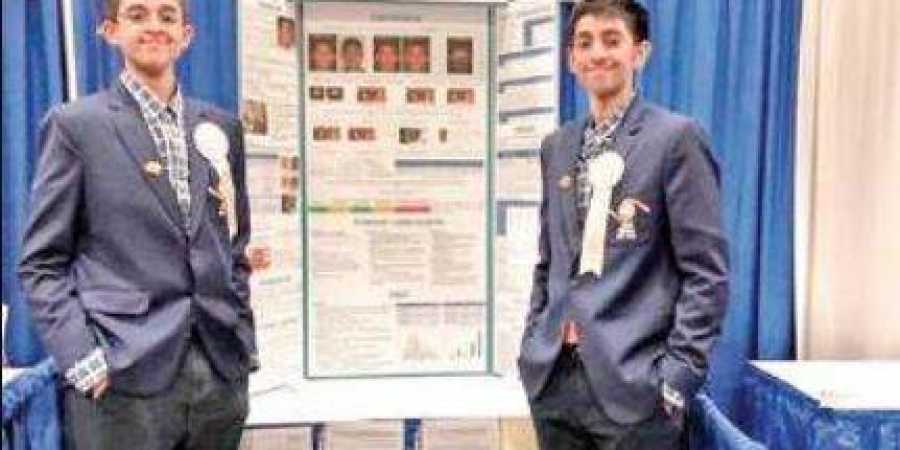
In a bid to detect amblyobia faster in children, 16-year-old Vrishab Krishna and his 18-year-old brother, Biswesh Krishna from Bengaluru, have come out with an app called Kanna.

KannaBF03oct2019

Bengaluru :

In a bid to detect amblyobia faster in children, 16-year-old Vrishab Krishna and his 18-year-old brother, Biswesh Krishna from Bengaluru, have come out with an app called Kanna. Amblyopia, also known as lazy eye, is a visual development disorder where a person slowly loses vision leading to partial blindness. It affects almost 16 million children in India and over 103 million children from all over the world.

Vrishab used to suffer amblyopia as a child, and would have difficulty while climbing down stairs. Even while playing, he would have difficulty catching the ball. But Vrishab was lucky since his mother noticed his problem when he was four years old and got him tested. The diagnosis revealed his lazy eye condition. Having received treatment in time, Vrishab has been able to see perfectly with both his eyes.
A year ago, the duo decided to study amblyopia and come up with a solution. As they worked on the project, they came up with an app wherein a child affected with the condition will just have to click two images and upload it onto the app to determine whether they have a lazy eye or not. “We wanted an accessible way to help people figure out if they have the condition. And what better than a smart phone which everyone uses,” said Vrishab.

Using patent pending image processing and machine learning algorithms, they calculate one’s risk of having a lazy eye. “After testing, we found that our algorithm to calculate amblyopia is accurate. The child will have to click one image in low light and the other in ambient light. After uploading the images, the results will be out immediately,” said Vrishab.

The duo even reached out to Sankara Eye Hospital and performed a pilot test, and the hospital is now using the device. “Three years ago, we had carried out a survey on amblyopia in Bengaluru and it showed that six percent of children in the city were at a risk. Detecting amblyopia during the critical period – that is before the age of eight – is crucial as complete treatment can be done. After that, it gets difficult as they don’t respond to visual acuity tests,” said Dr Kaushik Murali, Medical President, Quality & Education, Sankara Eye Hospital.

He added with this app will be useful for many. “Since this technique only requires access to a smartphone camera, it can be used both in rural and urban areas, and even allows for screening by untrained people,” Dr Murali added.The app is under clinical validation at Sankara Eye Hospital.

What is amblyopia?
Amblyopia, also known as lazy eye, is a visual development disorder where a person slowly loses vision leading to partial blindness. It affects almost 16 million children in India and over 103 million children all over the world.

source: http://www.newindianexpress.com / The New Indian Express / Home> Cities> Bengaluru / by Iffath Fathima / Express News Service / October 02nd, 2019

IISc: Trapping, moving nanoparticles with light

NanoparticlesBF29sept2019

Plasmonic tweezers are limited by the fact that they are fixed in space and can therefore only trap objects that come close to them.

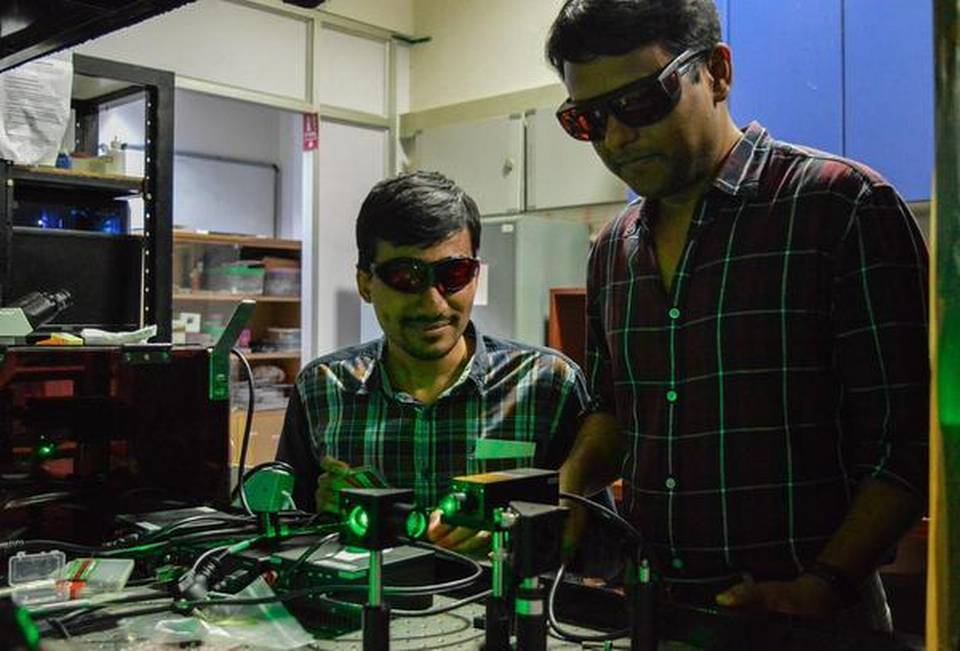
Researchers at the Centre for Nano Science and Engineering at the Indian Institute of Science (IISc), Bengaluru, have developed a technique to trap and move tiny objects in the nanoscale using optical “tweezers” employing light. This is a tool that can be used to pick and move small suspended particles even including cells. This research has been published in Nature Communications.

Optical tweezers have been known for about thirty years now and are used in biology to hold and manipulate particles; however, they have a limitation when it comes to nanosized particles. This was partly solved with the development of “plasmonic tweezer” which works on the principle that when a disc of noble metal, like gold, is illuminated with light, it creates an electromagnetic field around the disc. This field can attract and hold on to tiny particles.

Plasmonic tweezers are limited by the fact that they are fixed in space and can therefore only trap objects that come close to them. Though the team, in an earlier work, showed that such plasmonic tweezers could be manoeuvred with a combination of light and magnetic fields, they could not apply the technique to some types of colloids.

Tweezer-in-a-tweezer

In the present work, they overcome this limitation by developing a method that uses only optical force. They integrate a silver nanodisc with a microrod made of glass and the combination can be manipulated using laser beams alone. This “tweezer-in-a-tweezer” approach can trap objects of about 40 nanometres in size, using a single laser beam. This is the typical size of a virus or DNA. “The optical tweezer holds the plasmonic tweezer and the plasmonic tweezers trap our target nanoparticles, therefore tweezer (plasmonic) in tweezer (optical),” says Souvik Ghosh, first author of the paper.

As the size of any colloidal particle decreases, for instance from micro-scale to nano-scale, the movement due to Brownian motion or random fluctuation increases. “Therefore, holding a single silver nanodisc with a focused laser beam (the optical tweezer) is challenging and needs high laser intensity to generate enough force to overcome the fluctuations,” explains Ghosh. If, in order to reduce the required laser intensity, the size of the disc were reduced, the plasmonic properties would be lost. Therefore, the team attached a dielectric microrod made of glass which while preserving the plasmonic property, reduces the thermal fluctuations by an order of magnitude. “The intensity required is about 100 times lower that what a regular optical tweezer typically uses to hold an object of similar dimensions,” he explains.

“The technique is ready for real world applications,” says Prof. Ambarish Ghosh, in whose lab the research was carried out. “Simplicity and ease of implementation are the biggest USPs for this device. It is patented and we are already in discussion with a company for licensing.”

source: http://www.thehindu.com / The Hindu / Home> Sci-Tech> Science / by Shubashree Desikan / September 28th, 2019

Vijayapura Zilla Panchayat launches YouTube channel

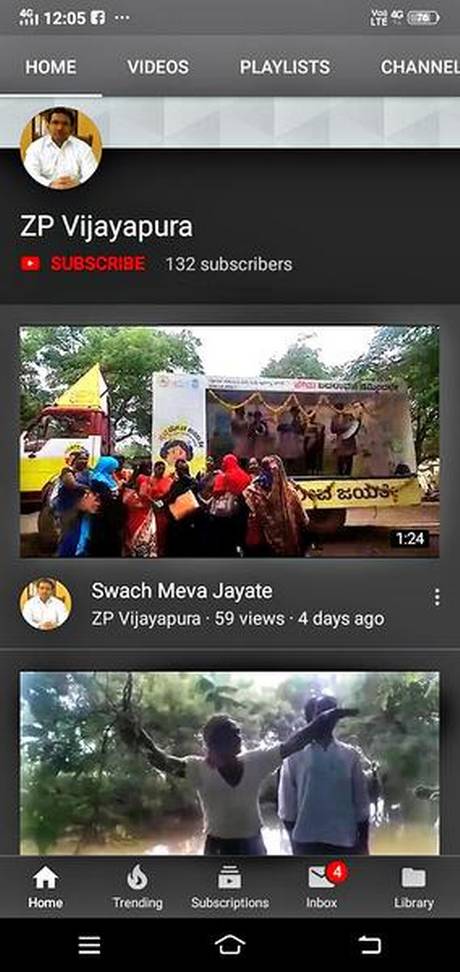
Using technology to bring efficiency and transparency in the administration, the Vijayapura Zilla Panchayat created a YouTube channel to upload videos and share information about its activities.

VijayapuraBF26sept2019

Vikas Suralkar, CEO, ZP, who got the channel ‘ZP Vijayapura’ created about over a fortnight ago, said it was aimed at disseminating people-centric information of the ZP.

Initiated on a pilot basis, the channel has already uploaded some programmes and videos of success stories, events organised through the ZP, and government programmes launched for rural development Some of these include Jalamrut scheme, construction of checkdam/ bunds, Kisan Scheme, MGNERGA, sapling plantation, rainwater harvesting, etc. The channel already has 132 subscribers and hundreds of people have watched the videos uploaded on it.

Mr. Suralkar, elated with the success and response, said the project is first of its kind to highlight government schemes and encourage the people to make use of them. He said the channel was created by local technical staff of the ZP who are also maintaining it. He said that a video of Gram Sabhas would also be uploaded. The government has made holding Gram Sabhas mandatory in selection of beneficiaries or implementing of certain schemes in rural areas. Since it is also mandatory to make the names of the beneficiaries public, the channel could be used to read out the names. This will help in maintaining transparency in selection of the beneficiaries.

“We have several plans to upgrade and update the channel to make it more comprehensive, educational and attractive for the common people. Since today, almost everyone holding a smart phone and with access to the Internet can visit the channel and get information about schemes. They can also replicate success stories in their villages and farms”, Mr. Suralkar said.

Shivayougappa Nedalgi, ZP president, said that since Mr. Suralkar was doing a good job, all the members were supporting him.

source: http://www.thehindu.com / The Hindu / Home> News> States> Karnataka / by Special Correspondent / Vijayapura – September 25th, 2019