It is a knowledge sharing platform where users can get replies to queries
The Kannada version of Vokal, a knowledge sharing platform in vernacular languages, was formally launched in Mysuru on Wednesday.
Speaking to reporters on the occasion, the platform’s founders Aprameya Radhakrishna and Mayank Bidawatka said Vokal, which seeks to provide answers from experts to questions by users, is aiming to serve vernacular Internet users.
It is also available in 10 other Indian languages including Hindi, Bengali, Tamil, Telugu, Malayalam, Gujarati, Marathi, Punjabi, Odiya, and Assamese.
With most information on the Internet is available in English, Vokal seeks to serve the requirement of vernacular audience in the country, which has begun accessing Internet through smartphones.
“Anyone who doesn’t know English in India has a huge problem of accessing relevant answers to their questions. Their Internet experience is poor with a dearth of meaningful content,” said Mr. Aprameya.
“The smartest minds in the country answer the questions. This gives unparalleled access to a common man to the best minds that have subject matter expertise,” said a statement issued by Vokal.
Vokal is also the first Indian question-and-answer platform to enable audio and video answering.
A statement claimed that the platform has 2 million monthly users. The founders chose to formally launch the Kannada version in Mysuru, which is also the cultural capital of the State.
“Users get to choose from 10 or more interests and can follow creators around these. Users ask a question: in their local language, either through a voice message or a text. This is then answered by an expert. Experts are vetted, verified, and approved before they can start answering questions on the platform. Experts can also conduct live video sessions, allowing for greater interaction and knowledge dissemination,” the statement said.
More details can be obtained form their website https://getvokal.com
source: http://www.thehindu.com / The Hindu / Home> News> Cities> Karnataka / by Special Correspondent / Mysuru – May 09th, 2019
Around 20 students painted two walls at Whitefield Railway Station; they chose to paint a mural of Ada Lovelace, since this area is the IT hub of the city.
While one wall was dedicated to both Ada Lovelace and Charles Babbage, the other displayed just the first IT programmer Nagaraja Gadekal
Bengaluru :
Around mid-April, Susan Thomas, campus director at National Institute of Fashion Technology (NIFT), received an unexpected call from an engineer from an IT firm in the city. The engineer had just come back from a six-day trip to Tamil Nadu and returned to find something amiss at Whitefield Railway Station. The usual apricot-toned walls now displayed paintings of two figures, some gears and mechanical parts and some flowers. A closer look at the wall told her the figures were Ada Lovelace, the first IT programmer, and Charles Babbage, the father of computers. While one wall is dedicated to both, the other displays just Lovelace.
“The engineer was so happy to see women in the IT space get recognition and was thrilled to see Lovelace and women programmers being acknowledged in a public space like this,” says Thomas. This, in turn, thrilled Thomas and her team of 25 students who had worked on the murals earlier last month.
The idea, she says, came from the strong mural culture at the institute’s campus, where many artworks created by students adorn its walls. But this time, the institute wanted to use their students’ talent to beautify a public space and dispel the notion that government buildings are always dull and monochrome. “But we didn’t want to produce art just for art’s sake. We wanted to present a larger political context and message,” explains Thomas.
Finding a muse
After a consultation with railway officials, the institute was given a choice between KR Puram, Banaswadi and Whitefield stations. Once the IT hub was decided upon, Thomas and her students knew technology would be the central theme of their mural. “While brainstorming, students came up with names of Sundar, Zuckerberg and Gates. But no one mentioned any woman’s name. I asked them about Ada Lovelace and none had heard about her. That’s when I elaborated the story of how Babbage and Lovelace collaborated, but history was unkind to not give any credit to her,” said Thomas. While the paints and scaffolding were provided by the railway ministry, the rest of the mural was done pro-bono by the institute.
The idea was approved by April 6 and over the next week, 25 students worked in shifts to bring the idea to life on their 20-something feet high canvas. Though fun, the work wasn’t entirely easy all the time, says Rayna Arora, a second-year student who worked on the murals. Being approached by inebriated men was always a threat and since the team involved many girls, either a police officer or the railway caretaker were always around. “It was too hot in the afternoon so we would work from 4pm onwards and some nights, this went on till 3am. Scaling up an idea on a wall has its own challenges, you think you’re painting an eye but when you step back, it might just look different. And it’s never easy to get straight lines when you project an idea onto a wall,” says Arora.
The work was finally unveiled mid-April and though ecstatic that their work is on display in public, the students do harbour one concern: People dirtying the wall again. An official from the Railway Ministry CE spoke to, however, said that since the walls had been beautified, this would deter people from littering or spitting around the premises.
source: http://www.newindianexpress.com / The New Indian Express / Home> Cities> Bengaluru / by Simran Ahuja / Express News Service / May 06th, 2019
Higher uptake: Iodine forms a stronger halogen bond with the receptor, say Surendar Jakka (sitting) and Govindasamy Mugesh.
The team achieved nearly sixfold increase in protein uptake by cells
In a breakthrough that might have huge medical implications, researchers at Bengaluru’s Indian Institute of Science (IISc) have used a novel strategy to directly deliver proteins into mammalian cells. Proteins are big molecules and so cannot enter the cells on their own. So a team led by Govindasamy Mugesh from the institute’s Department of Inorganic and Physical Chemistry substituted a hydrogen atom of the protein with an iodine atom to achieve a nearly sixfold increase in protein uptake by cells.
The increased protein uptake was seen even when the molecular weight of the protein was 28,000 dalton, meaning the protein was much bigger in size than most of the therapeutic small molecules.
The researchers also tried replacing a hydrogen atom with an atom of bromine and chlorine but the uptake was way lower than when iodine was used.
In the case of bromine, the uptake of proteins increased by only about two times, while the uptake increased only marginally when chlorine was used. The results were published in the journal Angewandte Chemie.
Other researchers have tried tagging the protein with cell-penetrating peptides, supercharged proteins and even used virus-like particles to ferry the proteins into cells. But these approaches have severe limitations including altering the protein function inside the cell. For this reason, most of the applications involving proteins are directed to extracellular targets. Proteins inside the cells get impaired during diseased conditions such as neurodegenerative and cardiovascular disease. Supplementing the cellular protein in such cases becomes important and this is where the method used by the IISc team will come in handy.
The team had to first synthesise a green fluorescent protein with one hydrogen atom being replaced with an iodine atom. “To introduce iodine at a specific site on the protein, we had to use an iodinated amino acid. Since the iodinated amino acid used is unnatural (not genetically coded), protein synthesis machinery does not accept it. So we had to expand the genetic code of the organism to accept and incorporate the iodinated amino acid into the proteins during the biosynthesis in the cells,” says Prof. Mugesh.
Since the iodinated amino acid is introduced on the surface of the protein, the secondary structure is not altered and so the protein remains functionally intact.
Strong bond
Iodine forms a halogen bond with a specific receptor (caveolin) that transports the protein from the cell membrane surface to inside the cells. “Compared with bromine and chlorine, iodine is heavier and so it forms a stronger halogen bond with the receptor. This might be responsible for more proteins getting into the cells when we substitute a hydrogen with an iodine atom,” says Surendar R. Jakka from IISc’s Department of Inorganic and Physical Chemistry and first author of the paper.
To be functionally useful, the proteins must enter the cytoplasm of the cell. However, the moment proteins are ferried into the cell by the receptor they are trapped inside the endosomes and transported to lysosomes, where the proteins are degraded. Significant decrease in protein concentration as measured by the fluorescence intensity was seen by the researchers after 24 hours.
To overcome the problem of protein degradation, the team treated the cells with a peptide (ppTG21). “The peptide also gets into the endosomes along with the protein and changes the pH of the endosomes. The endosome gets ruptured due to pH change leading to release of the proteins into the cytoplasm. In this case, there was no decrease in the protein concentration even after 24 hours,” says Prof. Mugesh.
No toxicity
“We are substituting only one hydrogen atom with an iodine atom in the entire protein. So the toxicity is similar to native protein,” says Prof. Mugesh. “We tested the cell viability by treating the cells with different concentrations of the proteins for 90 minutes. The cells were healthy after taking up the protein. The morphology of the cells that had taken up the proteins did not change even at the end of 24 hours,” says Jakka.
source: http://www.thehindu.com / The Hindu / Home> Sci-Tech> Science / by R. Prasad / April 20th, 2019
Apartment complexes put to test a new filtration system that allows residents to store up to 30k to 4 lakh litres of water.
Inline filters used in an apartment complex | express
Bengaluru :
The heavy rains on Wednesday (April 17) brought much cheer to the residents of apartment complexes in Chinnapannahalli, Doddanekundi, Alpine Eco Road and Tubarahalli. It was not that it rained after a long time to bring some relief to the city, but it successfully put to test a new filtration system that allowed them to store rainwater in clear water form, ranging from 30,000 litres to 4 lakh litres. For instance, the resident welfare association of the Adithya Elixir apartment complex on Alpine Eco Road, which has more than 90 houses, has a sump with a capacity to store rainwater up to 70,000 litres.
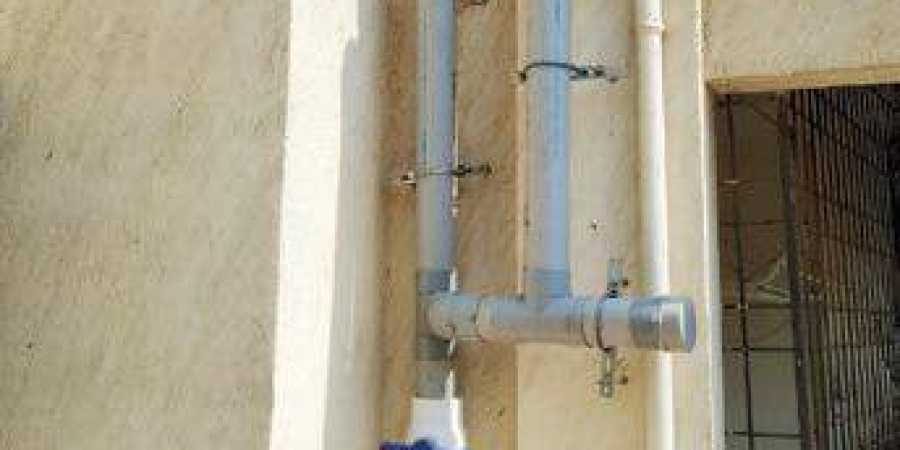
During the rains, the apartment dwellers saved 50,000 litres of water. When it starts raining, the water from the terrace goes to the PVC pipes with a new inbuilt filtration system. The incoming water to the inline filters settle the sediments, allowing only clean water to the sump. The sump then distributes water to the head tank from where the residents get the water supplied.
“Using an inline filter removes dirt and particulates, reduces chlorine taste and odour,” said Mohit Garg, resident of Aditya Elixir. Another apartment complex which serves 438 apartments, called Bren Unity off Chinnapannahalli Main Road, saved close to 2 lakh litres of water during the April 17 rains. This apartment has a pre-treatment and post-treatment tank.
“The water gets collected from the terrace, which takes it to the sump located in the group, after which the water is taken to pre-treatment plant, also located in the complex. It treats the water and then takes it to the post-treatment tank, which is the main tank from where the water gets supplied,” said Nirmal Kumar Behera, a resident of Bren Unity.
source: http://www.newindianexpress.com / The New Indian Express / Home> Cities> Bengaluru / by Iffath Fathima / Express News Service / April 22nd, 2019
Placing India among an elite league of countries with a comprehensive and sophisticated knowledge bank, the Indian Society of Hip and Knee Surgeons on Saturday launched the Indian Joint Registry (IJR) in Bengaluru.
The registry was launched by Corin Wilson, Acting British Deputy High Commissioner, in the presence of 400 orthopaedic surgeons from across the globe at the 13th edition of the National Congress of Indian Society of Hip and Knee Surgeons (ISHKS) that began on Friday.
The registry has been put together by ISHKS along with Northgate Public Services – who also set up the National Joint Registry for the U.K. government. The IJR will serve as a highly secure platform to store data on hip and knee surgeries across India and will churn out focused reports for surgeons and patients to access, thereby helping them make more informed choices and better implant selection as well as post-surgery monitoring, said H.P.C. Khincha, organising chairman of the congress.
“The Indian Joint Registry is an initiative run by ISHKS in the interest of patients. Thousands of hip and knee replacement procedures are undertaken in India every year, bringing great benefit to many patients. The success of these procedures has resulted in greater numbers being undertaken each year,” he said. “IJR collects information on patients undergoing hip and knee replacement in India, to monitor the performance of implants,” he added.
source: http://www.thehindu.com / The Hindu / Home> News> States> Karnataka / by Special Correspondent / Bengaluru – April 13th, 2019
The helmet will be able to send alert GPS location of rider to rescue personnel and has a multi-directional impact protection system.
Smart helmet
Bengaluru :
Available in the market soon will be a motorcycle accompanied by a smart helmet which will alert riders of emergency situations while also sending out messages to emergency rescue personnel with the location of the rider, in case of an accident. The e-motorcycle and smart helmet is the invention of a group of 3rd year engineering students of the MVJ College of Engineering from the city. Though not a part of a compulsory class project, they worked on it considering how increasingly, two-wheeler riders were becoming victims of accidents.
Talking about their invention, Saivenkat Patro, an Electronics and Communcations (E&C) student said, “We have applied for patents and also have to conduct trials for the vehicle and helmet. Once this is complete, we will work on permissions from authorities to release these in the market for sale.”
The team plans on selling both products as a package instead of as standalone products. “The cost is going to be quite less. We plan to sell both between Rs 7,000 to Rs 10,000,” he said. The team has named the helmet ‘KAWACH’. Other students in the team are Nikitha, Megha S of Electronics and Communication and Surva Pratim Roy of the Computer Science department.
The team is also working on a helmet for construction and mining site workers and will name it Kawach M&C. Another product is a helmet for children named Kawach Junior. “The sensors placed on the helmet alert the supervisor that an accident has occurred and help needs to be sent immediately. Along with the alert message it also sends the location of the accident to make it easier for the help to locate the victim. This helmet also comes with a mechanical SOS button which the person can use when in need.
The advantage of this technology is that the connection between the supervisor and worker is not lost even in adverse conditions like being underground or in a remote area of the site.” explained the members of the team. “Kawach Junior is a variant specially designed for kids. The smart features included in the helmet are the accident alert system, SOS alert and GPS tracking system.”
source: http://www.newindianexpress.com / The New Indian Express / Home> Cities> Bengaluru / by Express News Service / April 06th, 2019
The app mfine connects patients with doctors almost instantly, cutting down on the time spent in-clinic and money spent in-transit
Imagine you are stuck in traffic and you have a doctor’s appointment. You have either missed it and are going to have to reschedule or just see another doctor. It is these kind of bumps that mfine aims to conquer, through their app, with a back-end system that runs on Artificial Intelligence.
Front-end functions
The app has tie-ups with about 375 doctors, 80 hospitals, across 20 specialisations, with on-ground services in Bengaluru, Hyderabad, Chennai, Pune, and Delhi. You log in and put in the symptoms. This will lead you to the doctors’ listing page, where you can opt for a particular specialist, if you like. This choice may depend on experience, testimonials, and place of operation (in case you need offline help). The idea is to put you in touch with a doctor in a minute. If you are unsure though, the system will assign a specialist to you.
Ajit Narayana, co-founder of mfine app and Chief Technology Officer
Alternatively, you may be very specific about which doctor you’d like to see, especially if you’re coming back to check about something. “Most often, you’ll get connected within 30 to 40 minutes,” says Ajit Narayanan, a co-founder and the Chief Technology Officer, based out of Bengaluru. “The whole idea is that you access care when you need it,” he says. Once you enter the symptoms or even return with a doubt, the query goes to a ‘care team’ of doctors that looks at it before a senior specialist does.
You get an appointment and pay up — every service is payable, and every interaction is seen as a consultation, though follow-up treatment within a week, whether online or offline (if you choose to visit the doctor at his location) is not charged.
A shot of the mfine app
Prescriptions may be given, even conditions diagnosed, unless the doctor feels he needs to see you. Dosages may be tweaked, uncomfortable questions answered, and a second opinion offered. “It’s better than Dr Google, because you can reach a doctor just to clarify what to do for a headache, rather than popping pills or assuming you have a particular problem,” says Dr Manjula Anagani, Managing Director and Chief Gynaecologist, MaxCure Suyosha Hospital, Hyderabad, who is one the senior-most doctors on the app. Gynaecology, dermatology, and general medicine are the three specialisations that see the most traction.
If the doctor asks you to take a test or some medication, the system will remind you to do so. You can then upload the reports. Past medical records too can be uploaded, so it is all consolidated.
There is now a medicine delivery service in Bengaluru and Hyderabad (they deliver within 60 minutes), as well as a lab-test service that ensures someone comes home.
The anatomy
The app runs on artificial intelligence (AI), which means that it is learning as it goes along. For starters, when the app went live in December 2017, data was fed in from publicly-available medical literature. There was some tweaking to incorporate customisation with doctors’ inputs. Then, as conversations are had, prescriptions made, and more medical research fed into the system, the system keeps evolving. “The quality (of advice) improves, because the knowledge is built up,” says Ajit.
So when you key in your symptoms, say cold, sore throat, low-grade fever, the AI system will auto-suggest to the care team what the possibilities are. This ensures that human error is minimised.
“In a month or so, the system will be able to read and capture information from lab reports,” says Ajit. There will be a photo snippet of the key findings, in case the doctor wants to refer to it. The company is also working on the system’s ability to ‘read’ X-rays as well.
All this cuts down on commute time to the doctor and cost per doctor visit. The app generally charges ₹450 for a consultation, which may be what you pay when you make an in-person visit in Hyderabad and Bengaluru; if you’re accessing it from say, Delhi, it is a huge difference. You can also subscribe at ₹2,000 for six months, for upto six family members.
It also helps bust myths during pregnancy (women can reach out to the doctor without a family member). Baby- and child-related doubts can be quickly addressed, especially if you don’t have a paediatrician who is easily available.
source: http://www.thehindu.com / The Hindu / Home> Sci-Tech> Health / by Sunalini Mathew / March 18th, 2019
The Indian Space Research Organisation (ISRO) on Wednesday presented awards to 96 individuals at a ceremony held at Antariksh Bhavan.
Bengaluru :
The Indian Space Research Organisation (ISRO) on Wednesday presented awards to 96 individuals at a ceremony held at Antariksh Bhavan. ISRO awards are in recognition of the unique contributions made by individuals and teams towards the success of projects and programmes of ISRO. The ‘ISRO Awards’ were distributed by former ISRO chairman Dr K Kasturirangan and current chairman Dr K Sivan.
The scheme was first introduced in 2007, making this the 12th edition of the ceremony. Speaking at the occasion, Dr Kasturirangan said, “ISRO Awards have, over the years, become prestigious among the space fraternity.”
This year, the awards were distributed in four categories – Young Scientist Award (50), Merit Award (20), Performance Excellence Award(10) and Team Excellence Award(16). “The recipients were selected taking into account their outstanding contributions in 2017. The selection panel comprised officials from various ISRO centres,” the agency said in a statement.
source: http://www.newindianexpress.com / The New Indian Express / Home> Cities> Bengaluru / by Express News Service / March 14th, 2019
Silk lovers in the city can walk into any of the nine silk testing centres opened in the main retail hubs of the city, to check the purity of their product.
The test will take 5-10 minutes to ascertain the product’s purity.
Bengaluru :
Silk lovers in the city can walk into any of the nine silk testing centres opened in the main retail hubs of the city, to check the purity of their product. Last week, the Silk Mark Organisation of India established nine consumer testing centres to help customers conduct purity tests with the help of personnel trained by Central Silk Board.
“The staff will take a strand from the material without damaging it and put it through two checks – under the microscope and flame tests. Much like how customers are cheated when it comes to buying gold, we found during our national expos that several people were cheated with impure silk,” said T Sivakumar, assistant director of Central Silk Board. Within five to 10 minutes, the test which costs `20, will ascertain the product’s purity.
“Several retailers mix polyster, cotton, nylon, viscose with silk and sell it at a cheaper price. For example, a pure silk saree would cost `2,000 but retailers who mix it with other materials, sell it for anywhere between `500 and `1,000. When we conducted free testing at expos, customers were shocked to know they had been cheated. This will affect the overall business of silk itself,” Sivakumar said, adding that based on the response to these centres, they plan to set up 100 more across the country.
The centres were inaugurated on March 8 by K M Hanumantharayappa, Chairman of Central Silk Board and Silk Mark Organisation of India and other officers. The centres are in BTM layout, Chickpet, Cubbonpet, Tank road, Jayanagar, Gandhi Nagar, M G Road, Okalipuram and R V Road.
source: http://www.newindianexpress.com / The New Indian Express / Home> Cities> Bengaluru / by Express News Service / March 12th, 2019
The new facility will start functioning at Devanahalli in a few months
Bengaluru, home to the country’s space headquarters, looks set to also host the country’s first spacecraft production facility in the private sector.
The new facility, designed for building 2,000-kg communication and Internet broadband spacecraft, is slated to start functioning in a few months at Devanahalli here.
“Our satellite and systems unit is getting ready at Bengaluru and we plan to formally inaugurate it in the second quarter [fiscal] of 2019, that is during the June-September period,” said Anurup Pavuluri, Director of Ananth Technologies Ltd.
The Hyderabad-based family-run company has put up the satellite centre at an estimated cost of ₹150-200 crore. The facility is being built on 3.5 acres of land at Bengaluru’s aerospace park north of the city.
The State Government is developing a 1,000-acre hub at Devanahalli to promote aerospace, defence and high-technology industries and has earmarked 252 acres there as an export-focussed special economic zone for these sectors.
“We want to be the first full-fledged private sector player in assembly integration and testing of satellites in the country,” Mr. Pavuluri told The Hindu recently. “Today, there is demand for satellites from within the country and outside. The government-run ISRO is the sole player in this niche,” he said.
Systems for missiles
An immediate deal is in the process for providing a set of Internet broadband satellites, he said. Besides space systems and satellite imagery services, Ananth also manufactures systems for missiles such as Akash and BrahMos that are made in the country.
Mr. Pavuluri said Ananth’s entry into making full spacecraft was an extension of its space-related activities of many years. It supplies systems for spacecraft, launch vehicles and spacecraft command systems of the Indian Space Research Organisation ISRO.
About 150 employees are already working in its space programme activities in Bengaluru and some more staff would be recruited. Initially the new Space Systems Facility centre would take up assembly of satellites on the ‘i2k’ or 2,000-kg platform. The facility was designed to make four such satellites at a time or two satellites of 4,000-kg category.
About the expertise needed for a niche activity, he said Ananth already has a pool of employees who either worked for or retired from ISRO; his father and company’s founding CEO P.Subba Rao, he said, was also with ISRO for over a decade.
source: http://www.thehindu.com / The Hindu / Home> News> Cities> Bengaluru / by Madhumathi D.S. / Bengaluru – March 07th, 2019