Category Archives: Science & Technology

Meet ‘Walking God of Davangere’, a doctor who gives to the poor

Patients don’t get tired of talking about how he distributes, for free, medicines that he gets as samples from pharma companies, or recommends free tests for the poor at his diagnostics centre.

Dr Siddalingappa Murugeppa Yeli.

Davangere :

It’s around 2.30 pm when Dr Siddalingappa Murugeppa Yeli walks in. The faces of his patients, who have been waiting for him at his clinic, light up as they catch sight of his entry. The 80-year-old general physician has just returned to his clinic at MCC B Block in Davanagere after conducting rounds at the JJM Medical College Hospital. The patients flock around their favourite doctor. Yeli patiently hears their complaints before prescribing medicines.

While some offer him Rs 10, Rs 20 or Rs 30 as consultation fee, a few don’t pay anything. Those who pay more than Rs 30 are returned the excess amount, with Yeli telling them, “Keep it with you. This is more than enough.”

As patients wait for their turn, they don’t get tired of praising him, talking about how he distributes, for free, medicines that he gets as samples from pharma companies, or recommends free tests for the poor at his diagnostics centre, or even gives bus fare to those in need. Reasons enough for local people to call him ‘The Walking God of Davanagere’.

People outside the clinic | Express

“While Dr Shivakumara Swamiji of Siddaganga Mutt, who offered free education, food and shelter, was a Walking God, our Dr Yeli is the Walking God of Davanagere,” says K M Kuberayya, a resident of Shagle, who has been consulting the doctor for 25 years. He adds that Yeli has solved his nerve weakness problem successfully.

Laxmi, who has been consulting Yeli for 15 years, says, “He has charged me a maximum of Rs 20 or sometimes nothing at all.” Dr Yeli has been serving the poor in Davanagere for 50 years. Patients say he also conducts free medical camp at Shivayogi Mandira once a year. “It is my duty to serve the society as I have benefited from it greatly. There is nothing special in this,” the doctor says in the midst of examining his patients. “I am honestly doing my duty. I decided about this long ago,” he adds.

When asked about his low consultation fee, he explains, “Many people cannot afford medical services. We should not burden patients who are already suffering from diseases that incur expensive treatments. We must give them mental support.”

Dr Yeli, who lives next to the clinic, begins his daily duty at 8 am. He attends to his patients at the clinic till 11 am, after which he goes to JJM Medical College Hospital to check the in-patients there. He returns to his clinic around 1.30 pm, and examines patients till 5 pm.

He again goes to the hospital at 5.30pm for rounds and returns to his clinic at 7.30pm, seeing patients till 11 pm. He makes two rounds a day at JJM Hospital, taking only Rs50 per round. Even if he makes an additional trip if required, he charges for only two rounds.

The diagnostic centre, owned by Yeli’s son, also conducts free tests for the poor patients referred by him. It, however, collects a fee from other patients. Dr Yeli also urges budding doctors to serve everyone without expecting much in return. He welcomes the one-year compulsory medical service in rural areas for medical students. “When they can take help from the government, they must render service for at least one year at government hospitals,” he says.

HIS JOURNEY
Dr Yeli was born in 1939 in a poor family at Hamsabhavi in Dharwad district. He completed his school education at Hamsabhavi and intermediate science education at Karnataka College Dharwad. He pursued MBBS at Karnataka Medical College in Hubballi in 1962 and earned his MD (General Medicine) from Topiwala National Medical College in Mumbai in 1968.

He joined JJM Medical College as a lecturer, and worked at the institute as professor and head of the department. He retired in 2005 but continues to visit the hospital for rounds. Yeli has two sons — Dr Vinay Yeli and Dr Suman Yeli — who are also doctors. He treats nearly 100 patients at his clinic every day. He has a Maruti Zen car which he bought 15 years ago.

FOR THE POOR
Dr Yeli’s compassion for the poor was there for everyone to see when he was conferred the honorary doctorate by Davangere University this year. The function got over at 1.30pm, and all the dignitaries were requested to have lunch. However, Yeli politely refused, saying his patients were waiting for him at the clinic. He then rushed to the clinic to examine them.

source: http://www.newindianexpress.com / The New Indian Express / Home> States> Karnataka / by Arpitha I / Express News Service / March 10th, 2019

The women who keep Karnataka’s buses going

Women mechanics at a KSRTC depot in Bengaluru. | Photo Credit: G_P_Sampath Kumar

The number of women signing up as technical staff is on the rise

Depots and workshops of Karnataka State Road Transport Corporation (KSRTC) and Bangalore Metropolitan Transport Corporation (BMTC) may be labour intensive work places, but that has not deterred women from signing up as technical staff. Along with their male colleagues, they are responsible for maintenance and electrical work, repairing engines and working on the exterior of the bus.

Deepa Dinesh, who works at the premier AC bus depot of KSRTC at Shantinagar is in charge of inspecting vehicles, fixing technical issues raised by drivers and clearing the vehicles to ply on roads.

“When I joined the corporation 18 years ago, I had my doubts about surviving in this work environment. But the support I received from my colleagues helped me to stay in the profession for all these years.” Today, she oversees maintenance of 32 AC buses, including the high-end Club Class buses. “After attending to technical issues raised by drivers, I sometimes drive the buses inside the depot to check whether problems have been rectified,” she added.

Her colleague, Chaitra, says there is no discrimination in the work done by male and female employees, except when it comes to heavy lifting. Usually, maintenance work of an AC bus is done every 30,000 km. “There are women technical staff who have also got expertise in exterior work [including paint jobs], which gives brand value for the buses,” she added.

KSRTC operates more than 8,700 buses across Karnataka. It has been recruiting women for technical support work since 1999. There is, however, room for more women as the ratio is skewed towards male employees. Currently, the corporation has 5,068 technical staff of which 826 are women.

A similar trend is seen among BMTC’s technical staff. At its Indiranagar depot for instance, of the 80 technical staff, 24 are women.

“I was the first woman technical staff to join this depot 21 years ago,” said Rangamma. “Over the years, the number of women joining this profession has been on the rise. We don’t just do repair work, but also contribute to maintaining the interior of the bus,” she said.

The BMTC has 338 women technical staff out of which 80 are working in central workshops.

source: http://www.thehindu.com / The Hindu / Home> News> Cities> Bengaluru / by Special Correspondent / March 07th, 2019

How this small group of women at NAL has been critical to the Saras programme

Some of the scientists who work on the Saras programme. | Photo Credit: Sudhakara Jain / The Hindu

Nearly 10 years after a crash seemed to have ended the Saras dream, the turbo-prop plane soared over the crowds at Aero India. The sorties of the 14-seater twin-engine propeller aircraft were perhaps overshadowed by the roar of jet fighters. But for the women of National Aerospace Laboratory (NAL), the anticipation was thick, and their pride soared higher with each sortie.

“Saras is like our second child,” says Manju Nanda, Principal Senior Scientist, Aerospace Software and Information Systems Division (ASISD), NAL.

Following the crash, when funding for the project stopped in 2013, the scientists felt a sense of betrayal.

“We have seen each and every component being developed, every hurdle being crossed. After the crash, we were angry. We did not avail the passes for the aero show… but our passion remained, and now it has risen from the ashes,” says Akshatha H.T., a senior scientist at NAL’s Centre for Civil Aircraft Design and Development who was part of the team that designed the structure of the plane.

The small group of women — as per their estimates, women form just 17% of NAL’s staff — has been critical to the Saras programme. Among them are J. Jayanthi, Chief Scientist, ASISD, and Dr. Nanda who led the team that developed India’s first Stall Warning System software that has been approved for use in aircraft. Lakshmi Devi, Senior Scientist, C-CADD, plays an important role in the team that looks after the electrical systems and their indigenisation while Sivasakthi M., who has worked her way up from a trainee intern to a scientist, is a part of the flight test instrumentation team that keeps an eye on telemetry.

Ms. Jayanthi was among five girls in the B.Tech course in Madras Institute of Technology. By 1989, she was at NAL when there were less than 10 women scientists in the two divisions she was associated with. “More women have joined since then. NAL and other defense PSUs give equal opportunity for women, but the society’s mindset is such that women do not apply in the numbers we desire,” she said.

Over the years, though more women have completed engineering, it is still the private sector that beckons. The prevalent mindset is that aviation is a place suited for men. But, the women at NAL are determined to change that, whether it is an electrical technician who hauls 200kg batteries, or Sivashakti M. who has to climb 20 feet to check tracking antenna as part of her job.

Women in defence

By rough estimates, women now constitute 24% of the armed forces and defence PSUs. However, this is not evenly spread out, with women having lower representation as pilots or technicians.

The International Women’s Pilots Association, which has over 1,000 members across the country, had opened a Bengaluru chapter last week. The chapter is headed by Tessy Thomas, Director General of Aeronautical Systems at Defence Research and Development Organisation, and the first woman to head a missile programme in India.

“In the coming weeks and months, there will be more collaboration with women professionals from DRDO. We want to highlight opportunities not just as pilots, but as mechanical engineers, flight safety officers and the technical side of aviation,” Harpreet A. De. Singh, President of IWPA had told The Hinduduring Aero India 2019.

source: http://www.thehindu.com / The Hindu / Home> News> Cities> Bengaluru / by Staff Reporter / March 07th, 2019

TEDx event at Ramaiah Institute of Technology today

Anuradha Vikranth believes that dance enhances the personality and helps to connect with oneself and will be attending the TEDxMSRIT event as a speaker.

Ramaiah Institute of Technology (Photo | RIT Website)

The talks at the conference, called TED Talks, are then made available on TED.com. Ramaiah Institute of Technology, Bengaluru is organising an independent TEDx event on March 2, 9am to 5pm. Renowned speakers will be joining the event. Anuradha Vikranth is a danseuse who has incorporated dance into every aspect of her life. She believes that dance enhances the personality and helps to connect with oneself and will be attending the TEDxMSRIT event as a speaker.

Other speakers include Archana Timmaraju, who has a hearing impairment, and Daniel Sundaram.
Through sheer grit and hardwork, Timmaraju embarked on a journey called ‘Silent Expedition’  with her partner Sundaram to empower the community across India. Dr Prabha Chandra will also be present at the talk.  He is the Head of Psychiatry at NIMHANS and has spent the larger part of her career exploring and unravelling the intricacies of the mind and will enlighten the audience with a talk on the complexities of the mind.  Cohan Sujay Carlos is a researcher and the CEO of Aiaioo labs. The speaker’s brainchild, Mechanical Chef, is a robot that can cook more than 100 Indian dishes.

Kim Sain Jidung will also be joining the panel and is actively involved in the drive against prevention of sex trafficking and empowering survivors to lead a transformed life. Girish Badragond is the son of a farmer and is currently a partner at Santepp Systems, a fast-growing technocrat proprietary firm in the field of agricultural technology manufacture. N M Prathap will also speak at the event and is well-known for being the epitome of a small-town boy from Mandya making it big in the world. He won a gold and silver medal and $1,0000 in International Robotics Exhibition held in Tokyo in 2017.

The event will be held at Ramaiah Institute of Technology, Bangalore, on March 2, 9 am – 5pm. Tickets are priced at `800 and available on http://bit.ly/TEDx_Tickets.

source: http://www.newindianexpress.com / The New Indian Express / Home> Cities> Bengaluru / by Express News Service / March 02nd, 2019

Creators of robotic arm and Braille printer win first Aarohan awards

The winners of Aarohan Social Innovation Award in Bengaluru on Tuesday. | Photo Credit: Special Arrangement

A 26-year-old engineering school dropout who designed a robotic arm for those without limbs and a team of fresh-of-out-college students who developed from scratch cheap Braille printers took the top honours at the first-ever Aarohan Social Innovation Awards, instituted by Infosys Foundation, on Tuesday.

As many as 906 innovators in the social sector had applied for the awards. The field was narrowed down to 12 finalists, who were awarded ₹1.7 crore in cash prizes cumulatively.

When Prashant Gade, a resident of Khandwa in Madhya Pradesh, encountered a person without limbs, he knew he had to use his passion for robotics to come up with a solution to help out. He dropped out of college, and by 2015 had started the Inali Foundation to develop a robotic prosthetic arm.

Three years of research and eight iterations later, his myoelectric arm costs barely ₹50,000. “It can lift up to 10 kg and can clasp and unclasp at a thought. It senses the pulses in the nerves and activates the fingers,” said Mr. Gade, who was one of the two winners of the platinum Aarohan award of ₹30 lakh.

Khushwant Rai, 23, was in college when he saw the difficulties of a visually-challenged teacher. Braille printers were expensive, costing up to ₹1.5 lakh, and so even question papers were manually written in Braille for students. While he worked on creating a Braille printer, his batchmate from Punjab Engineering College Anjali Khurana, 22, coded a software to convert multiple languages into Braille for printing. “We built the printer from scratch to reduce the number of expensive solenoids. This way, we reduced the printer cost to ₹30,000. [We] have already tried it in four schools,” said Mr. Rai.

The awards were handed in four other categories, recognising people who have worked to find solutions to various social problems.

Sudha Murty, chairperson of Infosys Foundation, said: “There are also those who left offers of cushy jobs abroad to come to work for solutions here. They fit the criteria of being able to scale up and have tremendous impact,” she said, adding that the awards would now become an annual feature.

source:http://www.thehindu.com / The Hindu / Home> News> Cities> Karnataka / by Staff Reporter / Bengaluru – February 26th, 2019

‘Kalaburagi is fast developing into a healthcare hub’

Vikram Siddareddy, general surgeon and director of United Hospital, counselling a patient during a free health check-up camp at United Hospital in Kalaburagi on Tuesday. | Photo Credit: ARUN KULKARNI

Referring to expanding healthcare facilities in Kalaburagi, Superintendent of Police N. Shashikumar on Tuesday said the city will become a healthcare hub in the Hyderabad Karnataka region. He was speaking on United Hospital premises after inaugurating a free health check-up camp organised to mark the seventh anniversary of the hospital here on Tuesday.

“With five medical colleges and a dozen private facilities, Kalaburagi is fast developing as a healthcare hub of Hyderabad Karnataka region, just as Manipal in coastal Karnataka and Davangere in central Karnataka regions. Several private players, such as United Hospital, are augmenting healthcare facilities in the region by offering quality services,” he said.

Commending the hospital for maintaining high standards of service and hospitality, the officer said he had not come across any instance of medical malpractice and resultant mass outburst against the hospital and its doctors. He called upon people to adopt a stress-free and healthy lifestyle to avoid visiting hospitals.

Managing director of the hospital Vikram Siddareddy spoke about how he started the venture from scratch seven years ago and developed it as one of the most sought after super-speciality centres for accident trauma and critical care in the region. “We have successfully performed 9,000 surgeries in the last seven years. The commitment and expertise of our team of doctors have earned us a special place in the field of accident trauma and emergency care,”he said.

Around a thousand people were screened and medicines were distributed to the needy for free during the camp.

State Bank of India’s divisional general manager A. Hussein, regional manager Prakash, United Hospital director Veena V. Siddareddy, doctors Mohammed Abdul Baseer, Raju Kulkarni, and Prashant R. Kulkarni, and manager Dawood Ali were among those present.

source: http://www.thehindu.com / The Hindu / Home> News> State> Karnataka / by Staff Reporter / Kalaburagi – February 20th, 2019

HAL-L&T consortium to start making PSLVs for ISRO soon

Shekhar Srivastava said discussions were under way to assess the exact cost of each PSLV.

Army chief Gen Bipin Rawat gets into the cockpit of the Light Combat Aircraft Tejas during the Aero India show on Thursday | Nagaraja Gadekal

Bengaluru :

Soon, Hindustan Aeronautics Limited (HAL) will start manufacturing the Polar Satellite Launch Vehicle for the Indian Space Research Organisation (ISRO). Recently, the public sector unit formed a consortium with Larsen and Tourbo for this purpose.

Speaking to Express, Shekhar Srivatsava, Chief Executive Officer of HAL’s Bengaluru Complex, said they were in the process of finalising an agreement with ISRO to start manufacturing the launch vehicles. “It is one of the prestigious projects we are associated with,” he said. To a question, he said that they were expecting to start production of the launch vehicles soon.

One of the primary objectives of outsourcing the manufacture of PSLVs to companies like HAL was to decrease their manufacturing costs. “ISRO still has to give us requirements on the number of launch vehicles they might require,” he said.

Considering the number of launches ISRO has every year, HAL is expecting an order of 12 PSLVs every year,he said.

Shekhar Srivastava said discussions were under way to assess the exact cost of each PSLV. HAL sources added that discussions were on and was expected to be finalised soon.

Earlier this year, ISRO chairman K Sivan had revealed that a consortium of HAL and L&T had approached ISRO after the space agency sought assistance from the public sector to manufacture PSLVs, in a bid to concentrate ISRO’s efforts towards research.

While Sivan had said that consortiums consisting of other companies too had approached the agency, HAL sources said they had all the required equipment and partners to produce the launch vehicles as per ISRO’s schedule and requirements.

The history of PSLV launchers in the country has been ISRO’s success story with the rocket emerging as the workhorse of India’s space programme. Chandrayaan-1 too was launched on a modified PSLV launcher in October 2008. Many low-earth orbit remote sensing and earth observing satellites have been launched on board the PSLV, which made its maiden launch in 1993.

source: http://www.newindianexpress.com / The New Indian Express / Home> States> Karnataka / by Akram Mohammed / Express News Service / February 22nd, 2019

IIM-B students’ bio-degradable innovation wins them national contest

The team won a cash prize of `4.5 lakh and have reached out to various scientists to develop it further.

Jinit Dharia, Mit Parekh and Yash Parekh also won a cash prize of `4.5L

Bengaluru  :

In a mission to combat the issue of waste disposal faced by India, three Master of Business Administration (MBA) students from Indian Institute of Management – Bangalore (IIM-B) have developed a bio-degradable packaging material. This is to substitute single-use plastic.Jinit Dharia, Mit Parekh and Yash Parekh won the national finals of ‘The Ultimate Pitch 4.0’, a competition organised by Reliance Industries Limited.

“Our product is a packaging material made from agricultural waste and Mycelium, which is the vegetative part of mushroom. It will act as a glue and bind the substrate together. It is fully bio-degradable as compared to thermocol packaging, which take years to decompose,” said Yash.

The team won a cash prize of `4.5 lakh and have reached out to various scientists to develop it further. “We will take the help of two national incubation centres and scientists to create a commercially viable product. The incubators will help us source raw material to create it. Developing a product prototype will take another three months,” he said.  Once they scale it up, the students plan to promote the product among microentrepreneurs in rural areas surrounding industrial belts in the country.

source: http://www.newindianexpress.com / The New Indian Express / Home> Cities> Bengaluru / by Express News Service / February 19th, 2019

City-based service bridges gap between paediatric oncologists and patients

The current situation in the field of paediatric cancer care looks quite grim.

Bengaluru  :

The current situation in the field of paediatric cancer care looks quite grim. The number of cancer experts who specialise in paediatric cancer is limited. Furthermore, paediatric cancer experts are located only in tertiary referral centres in metropolitan cities and thus, have limited time and availability to treat children with cancer. All hope, however, is not lost. Paediatric cancer specialists anywhere in the world can now share their experience in guiding the treatment plan of children with cancer through Navya Care, a Bengaluru-based clinical informatics system and online expert opinion service.

GitikaBF26feb2019

“Most childhood cancers are curable and enabling infrastructure to deliver care to the children of our country, is of prime importance. Therefore, parents and social support systems should expedite to receive expert treatment plans and evidence-based care at the earliest instead of introducing any procedural delays,” said Gitika Srivastava, founder, Navya. She added that since time is essential, the service enables online reviews by cancer experts in 24 hours.

There are three million cancer patients in India and only 1,500 oncologists, and the number of experts specialising in a specific type of cancer is likely few tens or hundreds, she said. Over 28,000 patients have reached out to Navya, and 75 per cent of these patients are from India.

“There are 300 oncologists on board. Faculty oncologists at Tata Memorial Centre routinely use the Navya system for patients worldwide. Additionally, they are one of the flagship programmes of the National Cancer Grid, which comprise all of the leading tertiary care cancer expert centers from AIIMS in North India to Adyar Cancer Institute in South India,” stated Srivastava.

At their recent presentation at the San Antonio Breast Cancer Symposium and the National Comprehensive Cancer Network Conference, Srivastava spoke about how 97 per cent patients in an international sample confirmed that even a day’s delay in knowing the treatment plan mattered to them. “They experienced significant anxiety relief because of the 24-hour turnaround of Navya.”

Challenges in paediatric cancer
Access to care:
Out of 100 oncologists, probably less than 10 treat paediatric cancers
Access to informed evidence-based expertise:
Treating paediatric cancer patients based on published medical evidence that pertains specifically to pediatric patients, is complex
Access to centres that can provide such care:
There are only a few tertiary care centres with dedicated paediatric disease management groups
Resource constraints:
In India, lack of resources prevents exploration of treatments available to cure children.

source: http://www.newindianexpress.com / The New Indian Express / Home> Cities> Bengaluru / by Akhila Damodaran / Express News Service / February 21st, 2019

An UAV that not only flies, but also remains under water

UAVbf26feb2019

It has been developed by students of Bengaluru’s Sir M. Visvesvaraya Institute of Technology

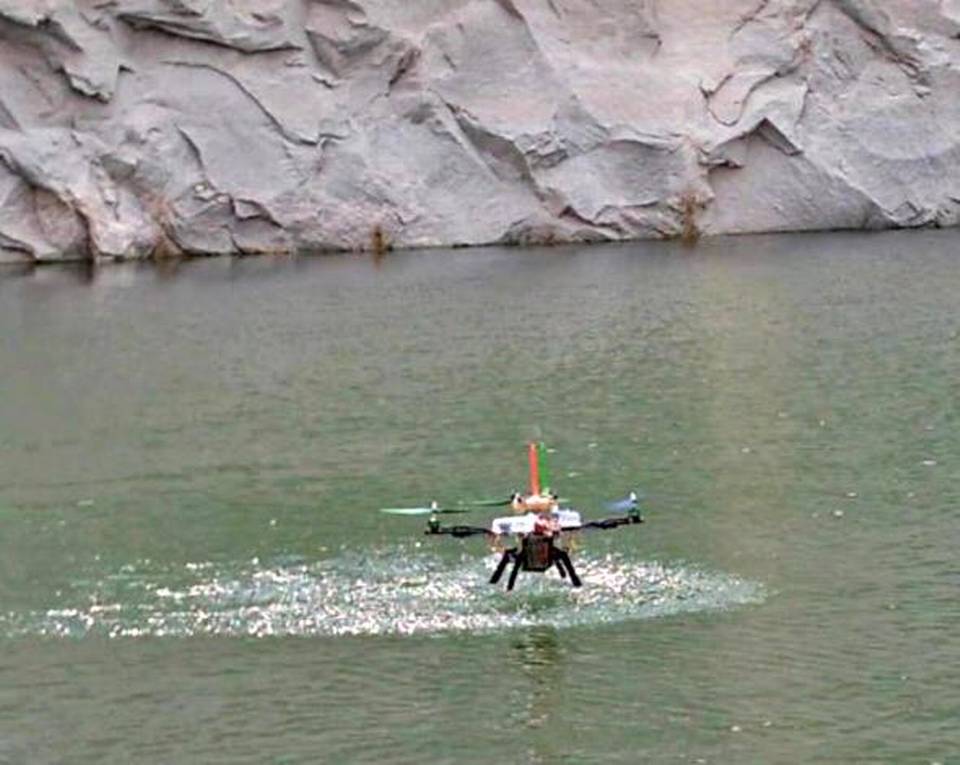
Gannet, a sea bird, is known to pursue its prey under water and is capable of hunting fish by diving into the sea. This Gannet, however, is an unmanned aerial vehicle that is capable of remaining under water like a submarine.

Developed by students of Bengaluru’s Sir M. Visvesvaraya Institute of Technology, the UAV called Gannet on Sunday won the best college project award at Aero India 2019 and students walked away with a cash prize of ₹2 lakh. The UAV can not just fly, but also remains under water and does not require much power.

“It has a separate propeller to move under water and also has navigational wings for the autonomous mode,” said Shiv Varun Singh Rajput, a third year mechanical engineering student of MVIT. He along with D. Revanth, an electronics and communication student, and Aman Singh, student of electrical and electronics, have jointly developed Gannet. The vehicle, which weighs 2.6 kg, can go to a depth of up to 20 metres and can remain under water for months. When required, it can be triggered to move. It can fly for 14 to 20 minutes while can be operated under water for four to five hours.

Currently, Gannet is being incubated at the Indian Institute of Technology-Bombay to scale it up for commercialisation. “We are the first in the country to do an underwater vehicle. We do not want to keep this as a project but want to commercialise the product. It may take about four months to make it market ready,” he added.

Among others, the camera equipped Gannet has civilian application in fisheries industries and pollution monitoring of rivers. “You don’t require divers in many aspects. Instead, the UAV can be operated.”

source: http://www.thehindu.com / The Hindu / Home> News> States> Karnataka / by Special Correspondent / Bengaluru – February 24th, 2019