Category Archives: Science & Technology

inStem scientists’ research prevents, treats colitis

The synthetic metabolite was more stable and more effective in treating and preventing colitis in mice model than the natural metabolite, say Sandeep Chandrashekharappa (right) and Praveen Vemula.

Inflammatory bowel diseases like colitis occurs when the integrity of the gut lining is compromised

Researchers have successfully isolated a microbial metabolite (Urolithin A or UroA) responsible for protecting the integrity of the gut lining. Leakage of toxins and bacteria leading to inflammatory bowel diseases such as colitis occurs when the integrity of the gut lining is compromised.

However, not everyone has the gut microbes essential for converting the polyphenols present in berries and pomegranates into UroA metabolite. Besides isolating the metabolite, a multi-institutional team co-led by Dr. Praveen Kumar Vemula from the Institute for Stem Cell Biology and Regenerative Medicine (inStem), Bengaluru, synthesised an analogue by chemically modifying the naturally occurring metabolite.

The integrity of the gut barrier is maintained by tight junction proteins. Colitis and other inflammatory bowel diseases cause a significant reduction in the levels of the junction proteins, leading to leakage of microbes and toxins from the gut causing acute or chronic inflammation. Restoring the integrity of the gut barrier is therefore essential for treating colitis.

The natural and synthetic metabolites have anti-inflammatory property and also increase the production of tight junction proteins. “But the synthetic metabolite was more stable and more effective in treating and preventing colitis in mice model than the natural metabolite. It was able to prevent and repair the damaged gut barrier and reduce inflammation. Synthetic metabolite even in nanomolar range was sufficient to treat or prevent colitis,” says Dr. Sandeep Chandrashekharappa from inStem and a co-author of a paper published in Nature Communications.

The metabolite (both natural and synthetic) repairs the gut barrier by activating a particular pathway (AhR-nrf2) leading to excess production of the tight junction proteins.

In vitro studies

Two different cell lines of the colon and another of immune cells (macrophages) were used for the study. A monolayer of colon cells mimicking the gut lining was treated with lipopolysaccharide to induce inflammation and breakage of the monolayer. While lipopolysaccharide destroyed the integrity of the monolayer, there was only minimal inflammation. Both metabolites were able to repair monolayer leakage with the synthetic one being more efficient than the natural metabolite.

In the case of immune cells, lipopolysaccharide treatment caused inflammation and excess production of inflammatory cytokines. Treatment with the metabolites stopped cytokine production and reduced the inflammation. Again, the synthetic metabolite outperformed the natural one.

Animal studies

The researchers induced acute colitis in mice by using a chemical (dextran sodium sulphate). There was increased inflammation and gut barrier leakage. Metabolites given orally led to complete reduction in inflammation and gut leakage repair. To mimic chronic colitis, the chemical was given to the mice for a prolonged period of ten weeks with two weeks of break after each week of chemical exposure. “The animals treated with the metabolites showed no inflammation and gut leakage even during the course of the treatment. We saw the leakage being repaired after two cycles of chemical treatment,” says Dr. Vemula.

Acute colitis in mice was produced by using a single dose of a different chemical followed by metabolite treatment. There was much lower inflammation and leakage after treatment. “The colon which had shrunk in length due to colitis regained its original length after treatment,” says Dr. Vemula.

Prophylactic property

To test the prophylactic property of the metabolite, mice were given one dose of the metabolite each day for seven days and a chemical was used to cause colitis on the seventh day. The ability of the metabolite to render protection was tested on day 11. “The animals did not develop colitis while the mice in the control group showed full-blown colitis,” says Anikita A. Hiwale from inStem and one of the authors of the paper.

“We are now making a library of analogues to come up with a synthetic metabolite that is even better than the one currently tested. We are planning for a start-up company for clinical development,” says Dr. Vemula.

source: http://www.thehindu.com / The Hindu / Home> Science /  by R. Prasad / January 12th, 2019

From daily wage earner to head radiographer

If you meet the general manager of the radiology department at Columbia Asia Hospital, it’s hard to imagine that Anto Ramesh Selvi D started out as a daily wage labourer.

Anto Ramesh Selvi D completed the radiography course in 1994

Bengaluru  :

If you meet the general manager of the radiology department at Columbia Asia Hospital, it’s hard to imagine that Anto Ramesh Selvi D started out as a daily wage labourer. Hailing from Ranipet, Tamil Nadu, he lost his father to a heart attack when he was 10 years old. “My mother was a nursing assistant at a hospital. She raised my younger sister and me with great difficulty. I wasn’t a great student. I dropped out of my college when I was in the third year of my BSc,” recalls the 50-year-old.

He couldn’t find a clerical job due to his low academic score and started working as a daily wage worker at an electronics repair shops and at construction sites. This went on from  1989 to  1992. Later, with help from his uncle, he came to Bengaluru with his friend to write an examination at the CSI Hospital, for an admission in a radiography course.

He says, “I didn’t get through. Since it was a mission hospital, my uncle requested people to give me the job since my mother was the sole earner in the family.” His uncle’s request bore fruit and Selvi joined the 1992 batch. This period was full of doubts as he wasn’t sure if he could survive staying in a hostel and manage expenses. Luck, however, was on his side and he passed out as ‘the best outgoing student’.

Despite completing the course in  1994, he wasn’t able to find a job. He took up a part-time job at Jain Hospital for a salary of `300 a month. During his time there, he continued to apply for different jobs until he finally got the job of a technician at Jindal Charitable Hospital. He worked there with an earning of `1,000 a month, before he resigned to pursue further studies in CT/MRI, through a six-month course in Salem. “When I completed the course, Jindal Hospital called me back and increased my salary to `3,500. They had also provided a 2BHK flat in their quarters,” he says.

In  2000, Selvi married his childhood friend and moved to Bengaluru. During this time, he applied for a position at Columbia Asia Hospital. This was in 2005 but all the vacancies were filled. Selvi was told to try again the next year. The following year, he eventually got selected, and now earned a salary of `12,000 a month.

While he was confident about his technical knowledge, Selvi faltered in his computer and communication skills. Over time, he widened his computer, management and also communication skills. “The hospital helped a lot too. They would go through my draft e-mails before I sent them,” he says. Interestingly enough, though Selvi struggled with academics in school, he now holds degrees in BSc (Physics), DTT, MRIT and MBA.

He also ran a hospital in Doddaballapura, Bengaluru rural, from 2011 to 2013 where he was in charge of all aspects of operations and management. However, Columbia Asia asked Selvi to return as the general manager of the radiology department. It has now been five years since he took over as the general manager of the department for all branches of the hospital in India. “My biggest takeaways are to keep trying and the importance of giving people a chance,” he says.

source: http://www.newindianexpress.com / The New Indian Express / Home> Cities> Bengaluru / by Akhila Damodaran / Express News Service / January 07th, 2019

CAD initiative donates 100 ECG machines in remote areas

An ECG machine being handed over to a remote Primary Health Centre in Kodagu district.

The PHCs in Guthigar, Bellare and Aranthodu in Sullia taluk can now boast of well-equipped ECG machines thanks to the efforts of like-minded doctors led by Dr Padmanabh Kamath, HoD of Cardiology and professor at KMC, Mangaluru.

Dr Kamath, who started CAD (Cardiology at doorsteps), a crusade against coronary artery disease initiative— a WhatsApp network of over 450 like-minded doctors across eight doctors in Coastal Karnataka and Malnad region, is engaged in screening poor patients for cardiac problems in remote areas for free. The group was set up in February 2018 and has installed 100 ECG machines in the PHCs of interior villages with the help of donors. “When a patient visits with a symptom of a heart attack, an ECG is immediately carried out and the results are shared on WhatsApp. If it’s a heart attack, then the patient is referred to the nearest hospital for treatment,” Kamath told DH.

He said, “We want to instal 250 ECG machines by 2020 and cover three more districts including Hassan and Kasargod. The PHCs in Humcha, Koppa, Muniyala, Shikaripura, Sajipanadu will get ECG machines next week. In fact, one of the pilgrims who suffered a cardiac arrest, supported the CAD initiative to instal ECG machine at Humcha,” Kamath added.

ECG machines are already installed at PHCs in Gonikoppa, Suntikoppa and Siddapura in Kodagu. The CAD initiative wanted to instal it in 15 places in Kodagu. Owing to natural calamities that wreaked havoc in Kodagu district, the initiative saw a setback, he said.

So far, cardiac diagnosis was achieved in more than 1,000 patients and 985 cases of ischaemic heart disease and 345 of unstable angina have been detected. About 124 heart attack patients were picked up and 95 angioplasties have been conducted, said Dr Kamath.

Dr Kamath said 71-year-old Leelavathi, a resident of Sullia and a heart patient, responded to Kamath’s mission of installing ECG machines and donated money from her pension to instal the ECG machine at Guthigaru. Sri Veera Venkatesh Charitable Trust has paid for five ECGs to be installed in village PHCs recently.

source: http://www.deccanherald.com / Deccan Herald / Home> States> Mangaluru / by Naina J A / DH News Service / Mangaluru / June 05th, 2018

Snazzy, tech-savvy solutions, thanks to Bengaluru students

Installing close circuit television cameras might just be a thing of the past.

The device can alert users of unusual activity

Bengaluru :

Installing close circuit television cameras might just be a thing of the past. Imagine getting alerts on your phone for every person — known and unknown — that enters your house. This might soon be a reality, said Roshan Fernandes, Anisha Rodrigues and Sudeepa KB, from Nitte Mahalinga Adyantha Memorial Institute of Technology, who recently presented a paper on facial recognition systems that improvise on the existing ones in the market.

The trio were among the 150 delegates present at the three-day international conference on Information Processing, organised by Bangalore University.According to Fernandes, a face is detected in a live video and the system tries to extract features for facial recognition. “This system also secures homes from theft by instantly detecting unusual activity, as well as allowing users to view the theft details.

The system then transmits the face details over IoT, to be viewed by users on their phone or tablet anywhere. Thus, it can recognise whether he is a known or unknown person,” he added, in his presentation. Users will also be notified when the person comes home. “The proposed work can be useful to the differently-abled as the system includes voice recognition to help and guide them,” read their paper.

Automatic spring cleaning
Chores like sweeping and mopping are droll-worthy tasks for anyone. SWAKSH, an automatic vacuum cleaner, offers a solution for this at `2,000. The device has been developed by Siddharth Srivastava of IIT Kanpur, Ayushi Nigam of Rama University, Kanpur, Monika Arya of PES Institute of Technology, Bengaluru, and Shalini Lamba of Lucknow’s National PG College.

“This version currently uses a simple concept of image depth recognition. It basically uses two cameras to monitor the area under consideration and finds the distance where unclean patches are present,” said Srivastava.

Professor KR Venugopal, vice chancellor, Bangalore University, said, “It is not easy to translate papers into prototypes and get patents for the same. At the every least, this conference, held for the 14th year now provides a platform for brainstorming and so many ideas have been generated.”

source: http://www.newindianexpress.com / The New Indian Express / Home> Cities> Bengaluru / by Suraksha P / Express News Service / December 26th, 2018

Karnataka Cooperative Milk Producers Federation launches Nandini buffalo milk

Nandini, the well known milk brand of Karnataka Cooperative Milk Producers Federation (KMF), has introduced buffalo milk.

File Photo of a buffalo (PTI)

Belgavi :

Nandini, the well-known milk brand of Karnataka Cooperative Milk Producers Federation (KMF), has introduced buffalo milk. Speaking to reporters, KMF chairman Vivekrao Patil said buffalo milk is considered ‘A2 milk’ that has high content of calcium and vitamin D which help burn calories effectively.

“We have released half litre packs… One litre of buffalo milk will cost Rs 60 for consumers while farmers are being paid Rs 38 per litre including the incentive of Rs 5”, Patil said.

About 60,000 litres buffalo milk is being collected every day from 35,000 farmers in various parts of the district. As much as 35,000-litre milk packed in flexi packets is being supplied to Bangaluru and local markets while the remaining milk is used to make kunda, penda, paneer and other products, he said. “We have also got orders for buffalo milk from Goa, Sangli and Pune”, he added.

There are several private milk organisations which indulge in adulteration and the Deputy Commissioner should take action against them, he urged.

source: http://www.newindianexpress.com / The New Indian Express / Home> States> Karnataka / by Express News Service / December 23rd, 2018

Aquaponics model proves a hit at exhibition

The aquaponics model that was developed by the University of Agricultural Sciences, Bengaluru | Photo Credit: H.S. Manjunath

Vegetables are grown over an aquarium in it

One can grow vegetables without soil in three separate trays kept on top of an aquarium using the water drawn from below. The water from these vegetable trays goes through pipes back to the aquarium.

This model of aquaponics — a form of aquaculture — developed by the Inland Fisheries Unit of University of Agricultural Sciences, Hebbal, Bengaluru, was among the exhibits that drew attention of people at the exhibition held on Friday at the College of Fisheries as part of its golden jubilee celebration.

Chief Scientific Officer of UAS’s Inland Fisheries Unit B.V. Krishnamurthy said they developed the model to popularise aquaponics in Karnataka. This form of aquaculture was popular in Kerala, he said. Mr. Krishnamurthy said seven different types of fishes, including Nile Tilapia, which is available in the unit, can be used in the acquarium. Lettuces and other high value short duration leafy vegetables can be grown in the trays, he said.

Among the others exhibits that attracted attention included the estuarine cage farming model developed by Central Marine Fisheries Research Institute, Mangaluru.

Scientist Purushottama G.B. said their cage farming model developed in 2009 has been adopted by several fishermen to harvest snapper (locally called Kemberi) and few other fishes available near estuaries. “Such harvesting helps fishermen earn income during the off season when they do not go to the sea for fishing,” he said.

The exhibition was inaugurated by in-charge Vice-Chancellor of Mangalore University Ishwar P. He also inaugurated the two-day All India Fisheries Colleges Cultural and Sports meet.

Speaking on the occasion, Mr. Ishwar said the Mangalore University was among the few universities in the country that has a separate sports policy. A separate sports and culture policy was necessary to support younger generation, he said.

Dean (Fisheries), College of Fisheries, H. Shivananada Murthy, said it was the first time that a sports and culture meet of the 30 fisheries colleges in the country was being held. Because of short notice of the event, only eight colleges were attending the meet. Mr. Murthy said the sports and culture meet of fisheries colleges would be an annual feature.

source: http://www.thehindu.com / The Hindu / Home> News> Cities> Mangaluru / by Special Correspondent / Mangaluru – December 15th, 2018

Another milestone for HAL’s light utility helicopter

The light utility helicopter (LUH) of Hindustan Aeronautics Limited (HAL) took another step towards being inducted in the Armed Forces after its third prototype completed its maiden flight recently.

The Light Utility Helicopter (LUH). (File Photo)

Bengaluru  :

The light utility helicopter (LUH) of Hindustan Aeronautics Limited (HAL) took another step towards being inducted in the Armed Forces after its third prototype completed its maiden flight recently.

According to HAL, the flight was completed on December 14. “With this achievement, LUH is now close to production clearance and HAL is confident of meeting requirements of the Armed Forces,” said R Madhavan, Chairman and Managing Director of HAL.

According to Arup Chatterjee, Director (Engineering, R&D), the successful flight was a step towards replacing the fleet of Cheetah/Chetak helicopters.

source: http://www.newindianexpress.com / The New Indian Express / Home> States> Karnataka / by Express News Service / December 18th, 2018

The good doctor

DrHebbi01BF12dec2018

Dr Sunil Kumar Hebbi is embarking on a right to health yatra across the country in his mobile car clinic

Dr Sunil Kumar Hebbi’s humanitarian deeds have earned him name and fame. Last month, he was awarded Sri Sathya Sai Award for Human Excellence. Hebbi, however, is not one to rest on his laurels.

After some 700 medical camps across Karnataka and seeing 35,000 patients, he has a new goal in sight — the right to health. In January 2019, the health practitioner is embarking on a health yatra across the country by his car.

“Health is a fundamental human right but is it really so in countries like ours?” Hebbi asks. “According to the National Health Policy 2015, 63 million people face poverty every year. Two million slum children die every year in India. We have one of the highest disease index in the world. What development are we talking about when basic needs such as health is not accessible to people?

DrHebbi02BF12dec2018

Hebbi says Article 21 of the Constitution of India guarantees right to life and education but not health. “A country like Philllipines guarantees right to health to its citizens.”

So, when he travels pan India in his mobile car clinic with just an aide and driver, Hebbi intends to campaign for the right to health. After launching it at the Bengaluru Press Club, Hebbi will go to Kanyakumari from where he will travel to Kashmir by car.

He will go to schools, colleges and universities to spread awareness and also hold medical camps where he will conduct general check-ups.

“Through local activists and NGOs, we are tying up with schools and colleges for venues and the like.

“When we do these check-ups, we will give a health card to people with basic details on it such as blood group, blood pressure, drug allergy, illness, and age.

“These details can come in handy and save time in crisis situations,” says Hebbi, who upon reaching Delhi will hand over a report of his findings collated during the journey to the concerned people in the Ministry of Health.

“We spend 1.25% of our GDP on health but according to WHO, we should be spending 5% of our GDP on health. You make a temple, mosque, anything, I have no issue but also provide us healthcare.”

Born to a farmer in Bijapur, Hebbi was practising on Hosur Road in Bengaluru, until he rescued the life of an accident victim on the road.

“I gave him first aid and took him to hospital. His family called me and said, ‘we want to thank you and feed you’. Their emotions made me realise how badly people need healthcare.”

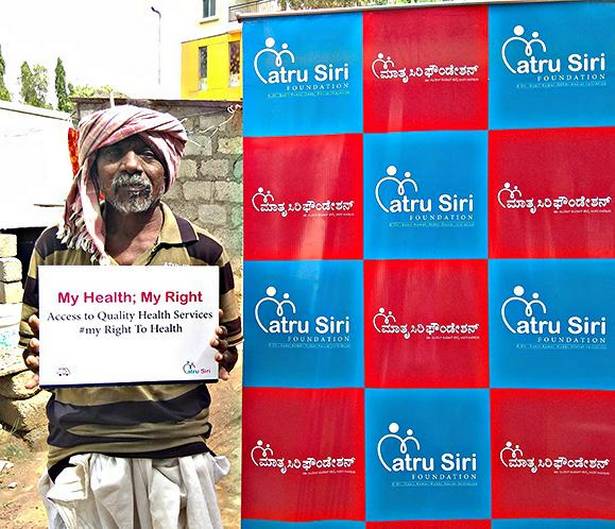
In 2007, he started Matru Siri Foundation and connected with old age homes, government schools and slums. Since then, every Saturday and Sunday, Hebbi conducts medical camps in these places.

While he treats patients with problems that come under his ambit, patients with serious health concerns or needing surgery are referred to specialised doctors in government hospitals.

Hebbi invites senior doctors to join him voluntarily on the camps. “I first assess the area and the concerns. Once or twice the local MLA has appropriated the camp and made it his show. My doctor friends gave me feedback. We felt disappointed and have tried to steer clear of politicians ever since. We want to make a difference. We are not doing it for effect. Doctors join us voluntarily without any monetary compensation.”

With the help of volunteers, his network of doctors and the money generated from his regular practice, Hebbi says, he manages to run things smoothly. “But even here, I don’t charge more than ₹ 100 to ₹150. I see about 40 to 50 patients daily.”

Health on wheels

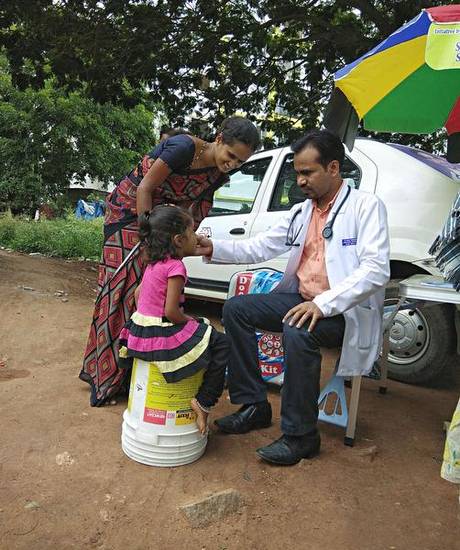
Dr. Hebbi’s car operates as a mobile clinic. The project is called Mobile Dr Clinic started in 2010. With a folding chair, table, basic health apparatus and umbrella, Hebbi can set up a temporary clinic anywhere.

source: http://www.thehindu.com / The Hindu / Home> Sci-Tech> Health / by Shailaja Tripathi / December 12th, 2018

Bengaluru Tech Summit: Pune man wins drone race

The second and third place went to Bengalureans

A first of its kind ‘Night Drone Racing’ contest was conducted at the Bengaluru Tech Summit on Friday night. Over 26 drone pilots aged from 12 to 28 years, from across the country, competed in the race.

Ritvik Suneel Nesargi from Pune emerged the winner in the racing competition and was awarded a cash prize of ₹1 lakh.

Aaradhya Kulshrestha and Pravesh T.M., both from Bengaluru, won second and third spots in the contest. Aaradhya was awarded a cash prize of ₹50,000 and Pravesh ₹25,000.

The contest took place in the specially-built arena at the Bengaluru Palace grounds. The event was organised by the State government in association with Indian Drone Racing League.

Each unmanned aerial vehicle weighed about 300 gram and required a special licence from the aviation regulator — Directorate General of Civil Aviation (DGCA) — to fly. Each drone had its own unique identification number.

Officials at the summit said that drone technology is getting popular among racing and tech enthusiasts, and it is finding many uses in the mainstream as well as for recording events or making movies.

source: http://www.thehindu.com / The Hindu / Home> News> Cities> Bengaluru / by Special Correspondent / December 01st, 2018

Bengaluru Tech Summit: Netherlands keen to collaborate on cyber security

A visitor looks at one of the exhibits, on the second day of Bengaluru Tech Summit at Palace Grounds in Bengaluru on Friday. | Photo Credit: V Sreenivasa Murthy

Dutch companies have been very active in India

The Netherlands is partnering with the government of Karnataka to bring in Dutch expertise in cyber security, IT and healthcare, said Gert Heijkoop, Consul-General of the kingdom of the Netherlands, at the Bengaluru Tech Summit.

“We value our partnership with Karnataka in the area of cybersecurity,” he said. The Netherlands said both the countries are working together on reducing the increasing number of cyber attacks and assessing their impact on economies. Dutch companies, including Fox-IT and Group2000, have been very active in India. Indian companies, including E2Labs, Skillcube, Cloud4c and KrypC Technologies, have established a concrete presence in the Netherlands.

“We look forward to collaborating with the Netherlands and strengthen our partnership for a safe and secure cyber presence,” said Gaurav Gupta, Principal Secretary, Department of Commerce and Industries and Department of IT, BT and Science & Technology.

Healthcare

At the summit, Netherlands pitched healthcare projects to stakeholders from academic institutes, hospitals, IT and med-tech companies and startups for partnerships. This includes ‘point of care tool’ for fast diagnosis of conditions such as urinary tract infection and development of ‘generic toolbox’ to create health literacy application for use in both countries.

The other project is a framework for identification of biomarkers for mass screening of population at risk of development of neurodegenerative disorders.

After the memorandum of understanding was signed between The Hague and the State of Karnataka in 2016, Mr. Heijkoop said the two sides have worked diligently over the last few years in building partnerships for societal impact. He said ‘Living Lab’ is one such example, which will result in creating affordable solutions for sustainable healthcare in both India as well as the Netherlands.

source: http://www.thehindu.com / The Hindu / Home> News> Cities> Bengaluru / by Special Corespondent / November 30th, 2018