Category Archives: Science & Technology

A journey from NASA to acting for Rupa Sridhar

RupaBF30nov2018

Meet Rupa Sridhar, who worked with NASA, and is now making her debut as an actor in Mataash

Rupa Sridhar describes herself as “an out and out IT professional” with 24 years experience. She has “worked in the US for many years at NASA. I was a software scientist, into research and enjoyed my work.

After having worked abroad for years, we decided to return for personal reasons,” says Rupa, who adds that she was at the peak of technology while working “amidst geeks and interesting people in the US”.

After 17 years with NASA, Rupa started working in Bengaluru, till she decided to take a break. “Working 16 hours a day in different time zones takes its toll on your health and mind.”

Hence, she started her own software company. “In spite of all this, I felt there was a tiny creative aspect hiding in a corner of my heart. Even in the US, I was a part of theatre. There I took it up as a hobby.”

Rupa also acted in an American short film, “which never was released I think,” she says with a laugh. It was chance meeting with director SD Arvind, that landed her in a role in his film Mataash, which will release in the first week of December.

“We had an audition and I was selected for the role. We were also given a short workshop where we were taught the nuances of acting and before I knew it, we had completed the shoot of Mataash.” Rupa plays a modern mother in the film and says she felt comfortable in the role as she could identify with it. She is also all praise for the director.

“Arvind stands out as a true professional. When I met him, I felt he is a brilliant combination of education and creativity and will surely go far ahead.”

Any initial jitters facing the camera? “I was awkward the first few minutes, but Arvind made it look like a piece of cake. Soon, we were all comfortable in front of the camera.”

If Rupa was offered a film and an invitation to return to NASA, which would she choose? She laughs and says, “I better zip my mouth. Actually, a second stint at NASA is always welcome; but if films also come up, I am open to that too.”

source: http://www.thehindu.com / The Hindu / Home> Entertainment> Movies / by Shilpa Sebastian / November 27th, 2018

Azim Premji conferred highest French civilian award

Wipro Limited Chairman Azim Premji receives the highest French civilian distinction, Chevalier de la Legion d'Honneur (Knight of the Legion of Honour), from Ambassador of France to India Alexandre Ziegler, in Bengaluru on Thursday.
Wipro Limited Chairman Azim Premji receives the highest French civilian distinction, Chevalier de la Legion d’Honneur (Knight of the Legion of Honour), from Ambassador of France to India Alexandre Ziegler, in Bengaluru on Thursday.

Azim Premji, philanthropist and Chairman of Wipro Limited, on Wednesday received the highest French civilian distinction, Chevalier de la Legion d’Honneur (Knight of the Legion of Honour) from Ambassador of France to India Alexandre Ziegler.

Speaking on the occasion at the Wipro campus, Ziegler said the award was bestowed on Azim Premji for his outstanding contribution to developing the information technology industry in India.

“Also, for his economic outreach in France, and his laudable contribution to society as a philanthropist through the Azim Premji Foundation and Azim Premji University,” he said.

TheLegion d’Honneur , instituted in 1802 by Napoleon Bonaparte, is the highest civilian award given by the French Republic for outstanding service to France, regardless of the nationality of the recipients.

The President of the French Republic is the Grand Master of the Order of the Legion of Honour.

In his acceptance speech, Premji said he is extremely honoured by the award bestowed on me. “The vibrancy of the French democracy and its diversity is an inspiration to all across the world,” he said.

Wipro’s association with France spans over 15 years and the company enjoys a close relationship with several French organizations. Nearly 65% of Wipro’s employees in France are locals.

France is a key market for Wipro and the company is committed to continues investments there. Large French digital companies already have a strong footprint in India, employing over 1.3 lakh people at their R&D centres and facilities.

source: http://www.deccanherald.com / Deccan Herald / Home> Business> Business News / by N.V. Vijayakumar / DH News Service, Bengaluru / November 28th, 2018

Kolar boy’s long and successful search for bone marrow exposes its less number in the country

Sam, a 10-year-old boy from Kolar was recently evaluated for bleeding from the nose and gums.

Now 18 years old, Tarun (left) underwent a bone marrow transplant in 2004 as a four-year-old; Master Sam received bone marrow from a German donor last month | Express

Bengaluru :

A month ago, a 10-year-old boy, Sam, got a life-saving bone marrow transplant from a German donor after his parents had to scour the Indian bone marrow registry with no luck in finding a match. The number of donors on the Indian bone marrow registry is just three lakh compared to the German registry, which has 75 lakh, and the US, which has one crore donors registered. Due to such shortcomings, parents look up to their child’s siblings to donate or doctors resort to half-match donors where the parents themselves donate but are only a 50 per cent match.

Sam, a 10-year-old boy from Kolar was recently evaluated for bleeding from the nose and gums. Upon examining his bone marrow, doctors confirmed that he had aplastic anaemia and his only chance of survival was a bone marrow transplant. He did not have a matching donor available and he continued to have recurrent bleeding and fever.

Doctors frantically searched for a donor in all the Indian registries and finally found a donor in the German registry. This donor was willing to donate bone marrow (taken from the blood in the hip) rather than peripheral blood stem cells (taken from the vein of the forearm). Four weeks later the boy fully recovered and was discharged.

Suresh B, Sam’s father, a daily wager at Bharat Earth Movers Limited (BEML), a Kolar PSU, told The New Indian Express, “We have an ESI card and hence we could pay the bill worth `10 lakh. My wife is a homemaker and I am the sole breadwinner. Sam’s brother is only seven years old and is not a match. We would get Sam platelet infusions every week. According to the rules, after a year, we will be able to contact this German donor and thank him.”

source: http://www.newindianexpress.com / The New Indian Express / Home> States> Karnataka / by Express News Service / November 22nd, 2018

EURAXESS Science Slam India award for Bengaluru-based researcher

Prabahan Chakraborty is a graduate student of the National Centre for Biological Sciences in Benglauru. | Photo Credit: the hindu

Won contest for communicating science through theatre

Neuroscience is a complex subject, but Prabahan Chakraborty, a graduate student from National Centre for Biological Sciences in Bengaluru, has an entertaining and simple method to get his message across: musical theatre. The 28-year-old uses this art form to help people understand his research.

For this unique fusion of art and science, Mr. Chakraborty won the EURAXESS Science Slam India competition held in the city recently. The contest — organised in collaboration with the embassy of France, Alliance Francaise Bengaluru, India Bioscience, Global Innovation and Technology Alliance and Indo-German Science and Technology Centre — offers a platform for young researchers to showcase their work outside their labs in a way that can be easily understood by everyone. He competed with five other researchers from across the country in the finals.

As part of his PhD, Mr. Chakraborty has been researching the effects of stress on the brain. “My thesis is on what happens to the amygdala and hippocampus when a person is stressed. My research shows that during times of stress, the amygdala, which regulates anxiety and fear, becomes stronger. The hippocampus, which processes and stores short-term memory, becomes weaker. As a result, a person suffers from mental health issues, including depression and memory impairment. But, communicating this to everyone is not that easy,” he said

When he got to know about the contest, he saw a perfect opportunity to combine two of his passions. “It is a challenge to communicate science in a fun way. But, theatre is an effective tool. My presentation on stress and ways to combat it was in the form of multiple songs and enactments,” he said.

He enacted a scene involving a patient suffering with clinical depression caused due to stress. As he told the audience about his condition, his anxieties and memory loss, he broke into a song to explain what was happening in his brain — in the amygdala and hippocampus. He then went back to dialogue form to talk about solutions. “I presented the topic in a musicial theatre format, which combines words, music and movement,” he said.

As part of winning the contest, Mr. Chakraborty will be going on a trip to Europe, where he will interact with other researchers in top institutes.

source: http://www.thehindu.com / The Hindu / Home> News> Cities> Bengaluru / by Staff Reporter / Bengaluru – November 22nd, 2018

Yediyur to become city’s first BESCOM power-free ward, solar plant to be inaugurated today

Bengaluru :

As part of the mission to make Yediyur Bengaluru’s first Bengaluru Electricity Supply Company (BESCOM) power-free ward, Bruhat Bengaluru Mahanagara Palike (BBMP) has set up a roof-top solar power plant. In a press statement, Poornima Ramesh, corporator of Yediyur ward in Jayanagar, South Bengaluru, said the solar plant, and quarters for gardeners and pourakarmkas who maintain 13 parks in the area, will be inaugurated on Monday.

“An amount of `15 lakh has been spent on the rootftop solar power plant, which will be the first-of-its-kind by BBMP. It will generate 10 kilo watt of electricity per day. We will save ` 38,000 per month by not having to pay for BESCOM power. The power generated through solar energy will power the streetlights within Sanjeevini Vana and Dhanavantari parks,” Poornima said.

The solar power plant will bring light to 150 streetlights within the two parks, and the quarters for workers, which are within a radius of less than one kilometre from the plant, BBMP said. The corporation has spent `50 lakh on the quarters. “The solar power plant will be expanded in the next three months to generate 25 kilo watt of power. The biogas plant, which is already in place, will expand to generate 250 kilo watt of power by the end of this month. With all these measures, we will save `3.10 lakh per month, and don’t have to purchase power,” she said.

CE had previously reported on the bio-gas unit generating electricity in the same ward, which powers several government buildings, including an anganwadi, the primary health center, a tailor training center, the ward office, a school, a computer training centre, a dialysis centre, the Samudaya Bhavan, the Yediyur shopping complex and seven parks, all of which are within a radius of three kilometres from the unit. This initiative has saved BBMP `1.75 lakh per month.

source: http://www.newindianexpress.com / The New Indian Express / Home> Cities> Bengaluru / by Express News Service / November 18th, 2018

Bengaluru boy beats the world to win science prize, Rs 2.9 cr

Samay Godika.
Samay Godika.

Bengaluru boy Samay Godika (in picture) has emerged as the winner of the Breakthrough Junior Challenge with $400,000 (over Rs 2.9 crore) as the prize money.

While Samay, 16, a student of National Public School-Koramangala, will receive a $250,000 (over Rs 1.8 crore) college scholarship, his ninth and tenth grade science teacher, Pramila Menon, who encouraged his interest in life sciences and tutored him after school to encourage his curiosity about scientific ideas, will win a $50,000 (over Rs 36 lakh) prize.

In addition, his school will receive a state-of-the-art science lab valued at $100,000 (over Rs 72 lakh).

The Breakthrough Junior Challenge is a global science video competition designed to inspire creative thinking about fundamental concepts in the life sciences, physics, and mathematics. Students between 13 and 18 years are invited to create original videos (up to three minutes) that illustrate a concept or theory in the physical or life sciences. The submissions are evaluated on the students’ ability to communicate complex scientific ideas in the most engaging, illuminating, and imaginative ways. Samay’s video, submitted in the life sciences category, focused on circadian rhythms, the 24-hour biological processes that can affect simple daily experiences such as waking up for school or jet lag.

As he has family members who suffer from Parkinson’s and other neurological diseases, Samay is particularly interested in the correlation between circadian rhythms and the effectiveness of medical treatments.

Samay was, on Sunday, recognised alongside some of the world’s top scientists and mathematicians Speaking to Bangalore Mirror, Samay said, “It feels amazing and unbelievable. I’m very happy to be among these great scientists. Our school is very science-centric and laid the foundation right from the beginning, shaping and guiding me to be the person I am today.”

“Participating in and now winning the Breakthrough Junior Challenge is life-changing, thrilling and such an honour. I’m so grateful for this opportunity to be recognised. I thank my teachers and family, and my little sister Sia, for shaping me,” he added.

Nikhiya Shamsher, 16, a student of Greenwood High school won this year’s Popular Vote. Her video on space-time and gravity garnered more than 25,000 likes, shares and positive reactions on the Breakthrough Facebook page. She received automatic entry into the final round of judging. Last year, Samay had won the Popular Vote contest. “I didn’t win last year, but I came back this year, and I am fortunate to be here,” he said, crediting sheer perseverance for his success.

source: http://www.bangaloremirror.indiatimes.com / Bangalore Mirror / Home> Bangalore> Others / by Bangalore Mirror Bureau / November 05th, 2018

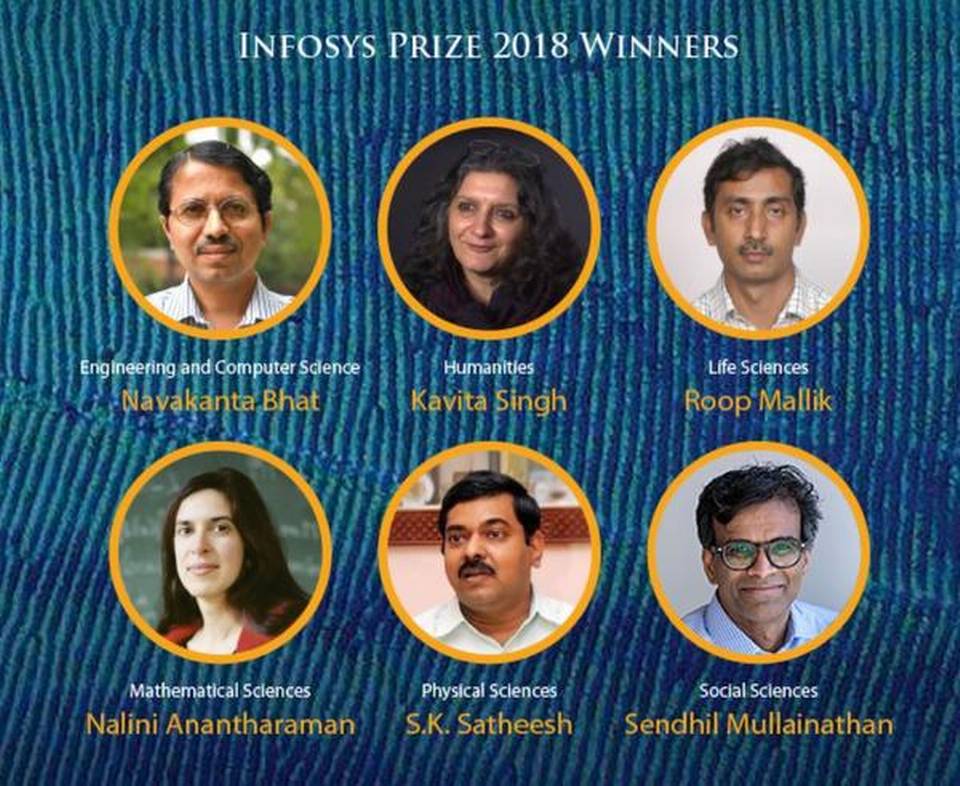
Six professors win Infosys Prize 2018 for science and research

InfosysPrizesBF13nov2018

Navakanta Bhat, Kavita Singh, Roop Mallik, Nalini Anantharaman, S.K. Satheesh and Sendhil Mullainathan are the winners out of the 244 nominations received in six categories

Six eminent professors have been awarded the Infosys Prize 2018 across different categories of science and research the software major’s science foundation announced on Tuesday.

The annual award includes a pure gold medal, a citation and a prize purse worth $100,000 (or its equivalent in Indian rupees), the Infosys Science Foundation (ISF) said in a statement.

“India needs to cement its place as a hub for innovations across various fields of science,” said Narayana Murthy, Trustee ISF and Founder, Infosys.

“The Infosys Prize seeks to honour the efforts of some of the brightest scientists and researchers and highlight the country’s ongoing quest for science excellence,” Mr. Murthy said.

A six-member jury of renowned scientists and professors selected the winners from 244 nominations received in six categories, ISF said.

By recognising these researchers and celebrating their achievements, the Infosys Prize aims to inspire young minds to explore science as a career option and advance innovation in the country, the foundation said.

“With improving synergies between the scientific community and industry we are poised for cutting-edge science and research innovation. The science of today is, after all, the technology of tomorrow,” said K. Dinesh, President of ISF.

Engineering and Computer Science

In the field of Engineering and Computer Science, Navakanta Bhat, Professor, Indian Institute of Science, Bangalore was awarded for his work on the design of novel biosensors based on his research in biochemistry and gaseous sensors that push the performance limits of existing metal-oxide sensors.

Mr. Bhat has devised gas sensors with ultra-precise detection accuracies necessary for space and environmental monitoring, especially useful for India’s growing space, atomic energy and security programmes, ISF said.

Humanities

In the Humanities category, Kavita Singh, Professor and Dean, School of Arts & Aesthetics, Jawaharlal Nehru University, New Delhi was awarded for her study of Mughal, Rajput and Deccan art.

Ms. Singh’s work shows the significance of museums in highlighting the social impact of art, and thereby relates visual culture to large contemporary questions of secularity, modernity, and political conflict, the foundation said.

Life Sciences

The prize for Life Sciences was awarded to Roop Mallik, Associate Professor, Department of Biological Sciences, Tata Institute of Fundamental Research, Mumbai for his work on molecular motor proteins, which are crucial for the functioning of living cells.

Mr. Mallik has identified and measured forces needed to transport large particles inside cells, and demonstrated their role in fundamental processes such as targeting pathogens for their destruction and moving lipid droplets for fatty acid regulation in the liver.

Mathematical Sciences

Nalini Anantharaman, Professor and Chair of Mathematics, Institute for Advanced Study, University of Strasbourg, France was awarded the prize in Mathematical Sciences for her work related to “Quantum Chaos”.

The quantum world is the one of the deepest secrets of the universe and mathematics is the language that helps us understand this world, ISF said.

Mathematicians and physicists have been trying for decades to unravel the mysteries of this subatomic world.

Physical Sciences

In the field of Physical Sciences, S.K. Satheesh, Professor, Centre for Atmospheric & Oceanic Sciences, Indian Institute of Science, Bangalore, was awarded for his pioneering scientific work in the field of climate change.

His studies on black carbon aerosols, the dark, light absorbing, microscopic particles in air which greatly influence the energy balance of the atmosphere over the Indian subcontinent, have enabled a better understanding of the role of these particles on climate change, precipitation, and, human health in the Indian subcontinent.

Social Sciences

The Infosys Prize 2018 for Social Sciences is awarded to Sendhil Mullainathan, Professor of Computation and Behavioral Science, the University of Chicago in the U.S. for his path-breaking work in behavioural economics, ISF said.

Mr. Mullainathan’s research has had substantial impact on diverse fields such as development, public finance, corporate governance and policy design.

A significant part of this work is relevant to India, ISF said.

“We hope the work of all our winners bears fruit and helps improve societies and economies across the world,” said Mr. Dinesh.

source: http://www.thehindu.com / The Hindu / Home> Science / by PTI / Bengaluru – November 13th, 2018

Seva Rathna awarded to Bhujang Shetty

The award was presented by Kadamba Cultural Association for the Disabled as part of their state level cultural programme.

Bengaluru :

Recognising his significant contribution to the field of ophthalmology and eye donation, Dr. K. Bhujang Shetty was conferred with the Seva Rathna award in memory of Helen Keller by drama writer Dr. K. Marulasiddappa. The award was presented by Kadamba Cultural Association for the Disabled as part of their state level cultural programme.

Dr. K. Bhujang Shetty, Chairman and Managing Director, Narayana Nethralaya, said, “There are two types of blindness – curable and incurable. We as doctors cannot do much for incurable blindness. But if there is even a single person with curable blindness, it will be our fault. Our vision is to work towards eradicating curable blindness. As Helen Keller once said ‘If there is anything worse than blindness it is to have sight and no vision’.”

“In the last two years, Narayana Nethralaya has given over `9.35 crore in subsidy and free surgical care for the poor throughout the state. Our KIDROP programme, a Public Private Partnership with the National Health Mission (NHM), Government of India, is a telemedicine programme to prevent and treat blindness in infants caused by Retinopathy Of Prematurity in rural areas,” Shetty added.

In less than a decade, the hospital has screened over 1 lakh infants and prevented blindness in over 1,900 pre-term babies, saving `450 crore in blind-person-years. Narayana Nethralaya has an eye bank with over 65,000 donors who have pledged their eyes.

“In the past five years, over 750 camps have been conducted across the state, close to 1.75 lakh people screened and over 8,000 free surgeries have been performed. In the same period, over 250 camps have been conducted in schools,” added Shetty.

source: http://www.newindianexpress.com / The New Indian Express / Home> States> Karnataka / by Express News Service / November 12th, 2018

Tulsi herbal drinking water creator wins Young Scientist Award

Harishchandra S. Bidnoorkar with his students in the laboratory at Sharnbasva University in Kalaburagi.

Harishchandra S. Bidnoorkar received the award in Goa recently

Harishchandra S. Bidnoorkar, a young scientist who works as an associate professor at the Faculty of Business Studies at Sharnbasva University, Kalaburagi, is a man with multiple talents. In recognition of his recent contributions in science and research– developing Tulsi Herbal Drinking Water and a Healthcare App – he has been honoured with Young Scientist Award – 2018 by the International Association of Research and Development Organisation (IARDO).

The award was presented at the International Award Conference on Multidisciplinary Research and Latest Innovation – 2018, at the International Centre, organised in Dona Paula, Panjim, Goa, recently.

Tulsi Herbal Drinking Water, developed in 2017, is a simple and multipurpose drinking water concentrated basil (Tulsi) content. Mr. Bidnoorkar obtained a patent for the process of the preparation of the herbal drinking water.

“This Tulsi water formula comprises an active amount of an extract and/or at least one bioactive fraction from Ocimum Tenuiflorum [basil/Tulsi]. That makes this non-toxic drinking water special as it has rich medicinal qualities. There are absolutely no side-effects. This special water with added Tulsi has been tested in the laboratory and has proved to be active in addressing or treating 15 common diseases,” Dr. Bidnoorkar told The Hindu.

Now, Bidnoorkar is getting offers from businessmen and establishments who want to use his patented formula to produce packed drinking water for commercial purposes.

He has, however, turned down the offers to establish his own packed drinking water production plant and sell the product to the people of Hyderabad Karnataka region.

“If I sell my patented formula to any business firm, it will produce packed drinking water bottles in a big scale using my formula and sell it at not less than ₹100 a litre. My invention will then serve only the rich and remain inaccessible to large sections of the poor. My plan is to establish my own plant with financial assistance from the government and to sell this water at the cheapest possible price, even cheaper than normally packed drinking water presently available in the market so that large sections of the poor can benefit,” he said.

He is now planning to cultivate Tulsi plants on a massive scale in Kalaburagi and Bidar districts and produce the packed water in plants he will establish in the same region.

The problem is the capital. He had approached the Union government for funds under Prime Minister’s Employment Generation Programme scheme. It sanctioned ₹25 lakh as the non-refundable amount. “But, I am yet to receive the money that is in Corporation Bank’s zonal branch in Belagavi. I hope the bank authorities fasten the process and release the money soon. I can start producing Tulsi drinking water on a small scale with this amount,” he said.

A writer

Mr. Bidnoorkar had published as many as 78 articles on management studies, business development and the modern education system. He has presented as many as 32 papers in various international conferences held in the country.

He is also the author of four books, including The Massive Successful Modern Education System, an ISBN certified book that caught the attention of former President of India Pranab Mukherjee who wrote to him in appreciation of his concerns on modern education.

source: http://www.thehindu.com / The Hindu / Home> News> States> Karnataka / by Kumar Buradikatti / Kalaburagi – November 06th, 2018

Mphasis ties up with IIMB’s incubation centre

Mphasis, an IT services and solutions provider, has partnered with NSRCEL, the start-up incubation centre at Indian Institute of Management Bangalore to support early-stage social venture.

The programme aims to incubate and support ‘for profit’ social ventures and startups that have been in operation for one to three years, said a press release.

Over 550 applications were received for this programme and 16 of them were shortlisted for the three-month pre-incubation. They were then given an opportunity to pitch before an advisory council for selection to the programme which will be for 12-18 months, the release said.

TAXSHE Services Pvt. Ltd., ECONUT Coconut Producer Company Ltd., Blink Research and Services Pvt. Ltd., ThinkZone, and Rural Caravan Pvt. Ltd. are the selected ventures. They will receive an entrepreneurial grant and will be supported through a series of events and workshops aimed at addressing specific challenges.

source: http://www.thehindu.com / The Hindu / Home> News> Cities> Bengaluru / by Staff Reporter / Bengaluru – November 01st, 2018