Category Archives: Science & Technology

Wrongly accused in ISRO spy case, SK Sharma dies of cancer in Bengaluru

SK Sharma was in palliative care being treated for stage-4 oesophagus cancer.

SK Sharma had been trying for compensation for the last 20 years. (Photo: Facebook Screengrab/ S K Sharma)

Bengaluru: 

Sudhir Kumar Sharma, one of the men falsely accused in the Indian Space Research Organisation (ISRO) ‘spy’ case of 1994, has died early on Thursday.

SK Sharma was in palliative care being treated for stage-4 oesophagus cancer.

Sharma was 62-year-old. He is survived by wife and three daughters.

Sharma was hoping to be compensated for the allegations after former ISRO scientist, Nambi Narayanan, was cleared of espionage charges and awarded Rs 50 lakh compensation for “unnecessary harassment” by the Kerala Police.

Labour contractor from Bengaluru, SK Sharma, who was tortured and harassed by the Kerala Police, was also cleared of all charges, but only after a difficult time in custody.

Socially ostracised and labelled as a traitor even when he fought to clear his name, it was a long battle for Sharma, who kept fighting tooth and nail as he wanted his reputation to be restored.

Sharma was trying for compensation for the last 20 years.

Sharma was just 34-year-old when he was first illegally detained for two days – November 21 and 22 in 1994 – from a DRDO lab in Bengaluru.

Sharma was good friend of Chandrashekhar, another person who was falsely accused in the case, who recently passed away.

In early 1994, Chandrashekhar had contacted Sharma seeking his help to get daughter of one of the two Maldivian women he had met at the Thiruvananthapuram airport admitted to a school.

Sharma was unaware that months later he would be detained, his family put under surveillance, or that he would be associated to what at the time was country’s biggest scandal.

In custody, Sharma was physically tortured. ‘They hit me. Slapped and kicked. Then with cane. After half an hour, this person would vanish. Another person would come. They said, ‘you passed ISRO and defence information to Pakistan’. I cried and cried but they were unrelenting. They didn’t let me sit on the ground for three days,” Sharma told NDTV earlier.

His reputation was damaged. And it hurt not just him but his family too.

Sharma had told NDTV, “My daughters were thrown out from the school. My daughters were humiliated. They were told, ‘You people are agents, deshdrohis (anti-nationals). The teachers also said hurtful things.”

His social life was affected as well and people who were close to him started avoiding him.

source: http://www.deccanchronicle.com / Deccan Chronicle / Home> Nation> Current Affairs / by Deccan Chronicle / November 01st, 2018
Osmo-dried products from fruits, vegetables

The Mysuru-based CSIR-CFTRI has a technology for producing osmo-dried products from fruits and vegetables.

At a cost of ₹80-180 per kg, such products come with a production capacity of 500 kgs a day. Mango, papaya, jackfruit, pineapple, carrot and amla can be osmo-dried with the technology.

“Osmo dried products are a good source of nutrients and energy as they have high calorific value. They are microbiologically safe and stable products with longer shelf lives. The technology helps retain the colour and flavour of the fruits or veggies,” said A.S. Chauhan, senior principal scientist, FVT, CFTRI.

The process involves slicing the fruits or vegetables, subjecting them to osmotic treatment and drying them at optimum temperature to avail an osmo-dried product.

source: http://www.thehindu.com / The Hindu / Home> News> States> Karnataka / by Special Correspondent / Mysuru – October 29th, 2018

Bengaluru: Security guard’s son wins gold, heads to world championship

Sumant will be now representing India at the World Skills 2019 in Kazan, Russia next year.

SumantBF27oct2018

Bengaluru :

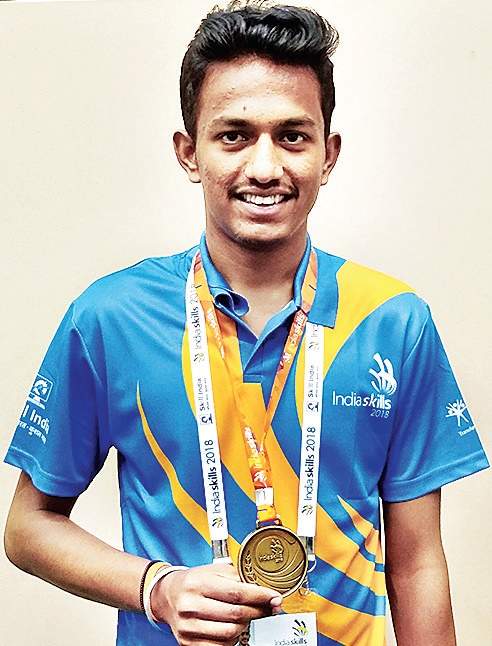
Sumant SC becomes the only Bengalurean to win a gold medal and cash prize of Rs 1 lakh in the mechatronics category at the IndiaSkills National competition 2018 held in New Delhi recently. Mechatronics is a technology that combines electronics and mechanical engineering.

Sumant, a class 10 pass out, could not continue his studies as his parents could not afford his education. His father Chikkabettaiah is a security guard and mother Jayalakshmi a homemaker. After his SSLC from a government school, Sumant enrolled for a free three-year training programme in mechatronics at a renowned car company, following which he took a job at the same company. “The competition was difficult because we did not know what to expect and what models, we’ll have to assemble,” said Sumant who started training for the competition six months ago.

Sumant said that he had been training every day for 10 hours, 8.30 am to 6.30 pm, under the guidance of his trainer J Bhagyashree Patil. “When I returned, my parents were excited that I had won a gold medal for the first time in my life. They called my relatives and informed them.”

The four-day event included six tasks – known, maintenance, two unknown and optimisation task. The unknown task was the toughest, said Sumant, as they were asked to assemble models based on a picture with the kits provided to them.

Sumant will be now representing India at the World Skills 2019 in Kazan, Russia next year. He is currently undergoing training for the same. “I am hoping to win the world competition and bring back a gold again. I want to make my parents proud,” he said.

He was one among 14 participants from six states and different companies to participate in the event. Karnataka won a total number of 16 medals – 7 gold, 5 silver and 3 bronze medals at the competition. The state has also secured one Medallion for Excellence.

source: http://www.newindianexpress.com / The New Indian Express / Home> Cities> Bengaluru / by Preeja Prasad, Express News Service / October 27th, 2018

PHWRs: Kaiga station’s Unit-1 creates world record

Unit-1 of KGS has been generating electricity continuously since May 13, 2016.

It completed 895 days of continuous operation on Thursday

The Kaiga Generating Station, which is already on India’s Nuclear Power Programme, has created a world record for the longest uninterrupted operation of units having pressurised heavy water reactors (PHWRs).

The earlier record for PHWRs was held by Unit-7 of Pickering Nuclear Generating Station at Ontario, Canada, which operated continuously for 894 days and a few hours. That record was set on October 7, 1994.

In an official release on Thursday, Nuclear Power Corporation of India Ltd. (NPCL) announced that Unit-1 of Kaiga Generating Station (KGS-1) completed 895 days of continuous operation.

Kaiga now stands first in the world for continuous operation with regard to PHWRs and second among all nuclear power reactors. The Advanced Gas Cooled Reactor (AGR), Heysham II-8 of the United Kingdom, holds the overall record of 940 days of continuous operation.

KGS-1 in Kaiga, located 56 km from Karwar, has been generating electricity continuously since May 13, 2016. KGS-1, an indigenously built pressurised heavy water reactor run by domestic fuel (uranium), began its commercial operation on November 16, 2000. This June, KGS-1 set a national record for continuous operation of 766 days and it reached the second position among PHWRs in the world.

Official sources informed The Hindu that KGS-1 was in good condition and was capable of continuing the power generation. As NPCL authorities want to continue the operation of KGS-1, the required procedures, as and when required, would be followed, sources said.

source: http://www.thehindu.com / The Hindu / Home> News> States> Karnataka / by Special Correspondent / Hubballi – October 25th, 2018

Bengaluru-based Trashonomics wins international waste educators award

Bengaluru-based Trashonomics, representing India at the Waste Education Awards,won the first prize, beating Greece and USA.

Trashonomics session in progress at a government school

Bengaluru :

Bengaluru-based Trashonomics, representing India at the Waste Education Awards, won the first prize, beating Greece and USA. They were one of the shortlisted teams for The International Solid Waste Association Young Professionals Group’s (ISWA YPG) ‘Waste Education Award’.”We were awarded at the ISWA World Congress 2018 in Kuala Lumpur, Malaysia. This was part of their global campaign #WhatHappensToMyWaste. We are happy to represent our country. We sent them all our work at Trashonomics, including the illustrative guide for children, our trainer programmes and workshops,” said Archana Prasad Kashyap, co-author of Trashonomics.

“We sent a presentation of our impact as well. For example, we have reached out to 20,000 students in government schools across Bengaluru, Mysuru and Delhi. As a part of training of trainers (TOT) programme, we have trained 300 people to in turn train other volunteers and conduct classes at other schools. This competition had waste educators participating from across the globe,” Archana added.

Of all the applicants, three were shortlisted. PCAI Junior from Greece and The Six R’s from USA, grabbed the second and third place respectively. People could vote for these organisations by sending an e-mail or voting on polls conducting on social media. The five-chapter guide titled Trashonomics, describes itself as a simple guide on solid waste management. It is used to teach children how to manage their waste in the above cities, with Bhubaneswar joining the list recently.

The idea behind Trashonomics is to make children relate to the concept of waste management. They learn to dispose of all kinds of waste – wet, dry, biomedical, electronic – in a responsible manner. The volunteers use hands-on activities in the classrooms such as asking the kids to bring dry waste from their homes and segregate them in the school.

The project is supported by The Anonymous Indian Charitable Trust (TAICT) and has recently received a grant from Millenium Alliance to train 150 government school teachers on the subject, so that they can take it forward without depending on volunteers. Their illustrative guide will soon be available in Tamil and Bengali as well.

source: http://www.newindianexpress.com / The New Indian Express / Home> Cities> Bengaluru / by Ranjani Madhavan, Express News Service / October 23rd, 2018

Muscular Dystrophy: Rare diseases find a cure at the nerve centre

India sees about 3,000 to 5,000 cases of Muscular Dystrophy.

PrasannaBF23oct2018

Bengaluru  :

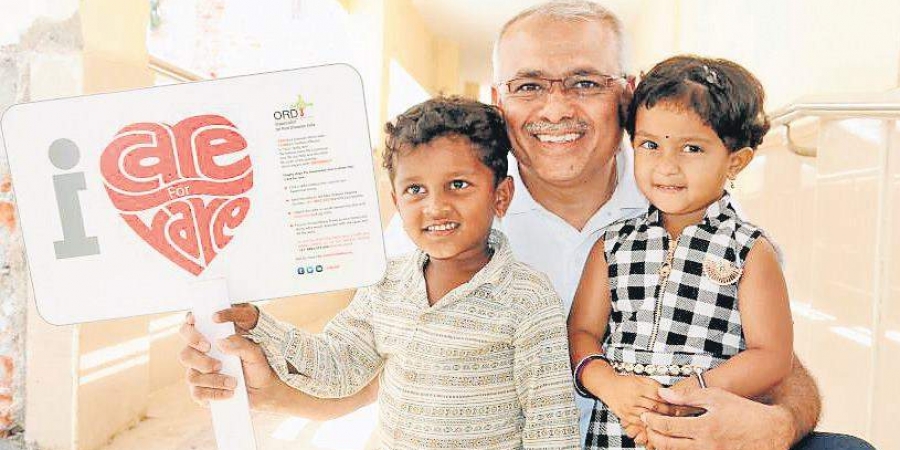
India sees about 3,000 to 5,000 cases of Muscular Dystrophy. While England has about five specialised centres to handle such cases, India has none. This has given rise to India’s first paediatric neuromuscular service, called, ‘The Muscle and Nerve Clinic’. The initiative is for patients who suffer from rare diseases that affect their muscles and nerves, and was launched by Bangalore Baptist Hospital, in association with Organisation For Rare Diseases India (ORDI).

Prasanna Shirol, founder, ORDI, is the father of a girl who suffers from a rare disease, and knows first-hand of the plight one can face in such situations. “People suffering from rare diseases run from pillar to post to find appropriate help and treatment.

We started a rare disease care coordination centre in Indiranagar two years ago. This clinic provides care specialised in neuromuscular diseases and we hope to alleviate the struggle of families and young people dealing with it.”

The Muscle and Nerve Clinic was set up with an aim to provide treatment to families suffering from rare diseases. Some of the conditions treated here include Duchenne Muscular Dystrophy, Spinal Muscular Atrophy, Congenital   Myopathies, Congenital Neuropathies, Congenital and Acquired Myasthenias and Limb Girdle Muscular Dystrophy. These cause weakness in muscles and the affected may not be able to jump, run or even sit without any support.

The clinic is open every Thursday at the Baptist Hospital. Prasanna says, “There are 7,000 rare diseases and the majority of cases that we have observed  are related to muscle and nerves.

The challenge with a rare disease is its proper diagnosis. The symptoms can be visible at any age. Once these symptoms are identified and diagnosed, a treatment or support plan can be prepared. Prognosis can be identified and parents can also be mentally prepared to deal with it.” As many symptoms could be similar to other diseases, doctors might often miss out on these signs or wrongly diagnose them, he says. “This needs care from experts in multiple specialities such as paediatrics, nutrition and diet,” he adds.

Dr Ann Agnes Mathew, paediatric neurologist and neuromuscular specialist, said, “Many of these diseases may have a cure one day soon. But until then, we need to care for them so that children suffering from rare diseases can have a better quality of life. With a proper treatment plan, children who currently need support to sit may be able to do so without any help.”

Prasanna and others are also fighting for the implementation of the National Policy for Treatment of Rare Diseases. “We are filing a PIL. There is no clarity in the policy. It says `100 crore will be provided but the proper demarcation is not available. The treatments have also not begun. They say the treatment would be provided only to below poverty line patients but above poverty line patients may also not be able to afford treatment as costs could run into crores,” he says, adding that even insurances don’t cover rare diseases.

For emergencies contact: 080 22024700 For appointments contact: +91 8892555000 (ORDI helpline), Baptist OPD:080 22024322

source: http://www.newindianexpress.com / The New Indian Express / Home> Cities> Bengaluru / by Akhila Damodaran, Express News Service / October 23rd, 2018

Student’s device to detect eye issues shortlisted for Accenture Innovation Challenge

Students of two engineering colleges in Bengaluru have had their projects shortlisted for the Accenture Innovation Challenge.

Bengaluru :

Students of two engineering colleges in Bengaluru have had their projects shortlisted for the Accenture Innovation Challenge. Under the theme ‘Innovate for Societies’, Nihal Konan and Pujari Kiran Sai of Visvesvaraya Institute of Technology, as well as Sabari Prabaaker R, Pranith H, Priyanka S and Deivanai A of Nitte Meenakshi Institute of Technology, have been chosen from the city, among 16 other teams across India.

Participants were expected to demonstrate their tech skills by applying disruptive and emerging tech in areas such as advanced analytics, automation, artificial intelligence, big data, blockchain, crowdsourcing, digital ethics, cybersecurity, immersive reality, and Internet of Things (IoT).

The team from VIT developed a ‘cost-effective, ingestible, battery-less electronic health pill’ to predict and prevent sudden heart attacks. The data from the pill alerts family members or caretakers of an impending heart attack nine to 11 minutes before it happens.

EyeBF21oct2018

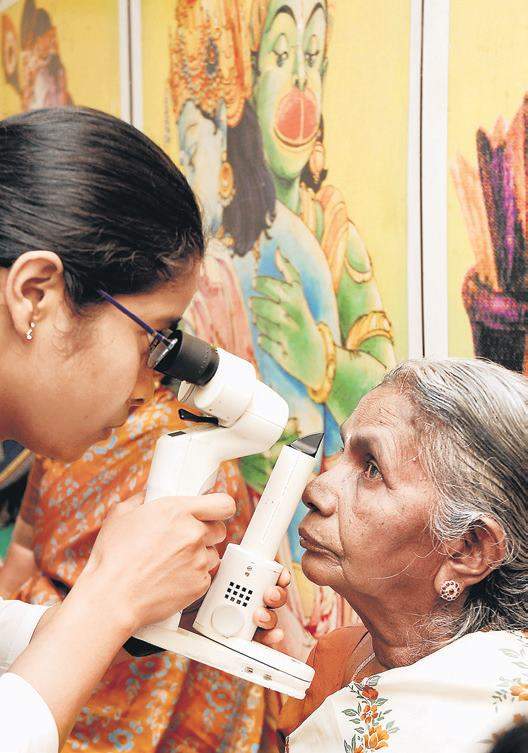
The team from NMIT developed a device that will detect eye problems such as blindness or glaucoma using a virtual reality app.

Mohan Sekhar, senior managing director and lead for Accenture Advanced Technology Centers, said, “Such challenges can help students transition to the industry seamlessly, as it gives them the opportunity to demonstrate their knowledge of new technologies and spark their innovation potential.”

The two themes for this year’s event were innovate for business and innovate for society. “Prizes will be given to all the winning entries on October 24, which will be the grand finale. This will include prizes worth Rs 1,50,000 and Rs 75,000 to each member of the winning team and winners of the two themes respectively. Accenture will also setup a fast-track recruitment process for all eligible finalists,” Mohan added. There are six categories of prizes, including ‘grand prize winners’, ‘theme winners’, ‘best all-women’s team’, ‘jury’s choice and accenture employee’s choice’.

source: http://www.newindianexpress.com / The New Indian Express / Home> Cities> Bengaluru / by Express News Service / October 20th, 2018

Bengaluru astrophysicists go on quest for rare herbs across the city

Team spots rare and endangered species of medicinal plants

Eight researchers from Indian Institute of Astrophysics cycled all the way from Koramangala to The University of Trans-Disciplinary Health Sciences & Technology in Yelahanka to explore rare and endangered species of ancient medicinal plants. The tour started at 6 am on Sunday.

The researchers reached their destination in three hours and their excursion proved to be worth the pain. They encountered rare medicinal plants that find mention even in Ayurveda and other Vedic texts.

Binu Kumar Nair, postdoctoral researcher at IIAP, says, “The campus has all those plants that can grow in the South Indian climate. Being an Astrophysics scholar, it was interesting to come across and know about so many plant species. These are plants that we come across every day, but we don’t know about their value.”
Since TDU also has a hospital on the campus, the patients are treated using the herbs and medicinal plants found here.

HerbsBF10oct2018

The university campus has about 1,600 species of medicinal plants and 600 of them available at their nursery for people to take at minimal costs. Of the 1,600 species available, 200 are endangered species.

When Ganesh Babu, Senior Research Officer, visited IIAP a couple of days ago to identify and name the plants available in IIAP, he had invited the researchers to come and explore a variety of species at the Trans-Disciplinary University. He explains, “We have a cure for almost all diseases through our medicinal plants. PterocarpusMarsupium is used for diabetes, Syzygium Caryophyllatum gives nutricious fruits like jamuns which are very sweet, and Wild Moringa helps in joint pains. There are 10 such trees with such rots that are used in medicines. We have 45 tree gardens in all demarcated according to the medicinal uses for example one for treating fever, one for diabetes, one that enhances water quality and so on.”

The researchers also came across the Seetha Ashok tree which helps with female infertility and is endangered, the Rudraksha tree which cures blood pressure, and the Camphor tree and four different types of incense stick trees.

source: http://www.bangaloremirror.indiatimes.com / Bangalore Mirror / Home> Bangalore / by Reya Mehrotra, Bangalore Mirror Bureau / October 09th, 2018

Kidwai Memorial Institute of Oncology becomes first Karnataka hospital to go digital

The project aims at integrating and managing all aspects of a hospital’s operations such as medical, financial, administrative, legal and compliance, health records online.

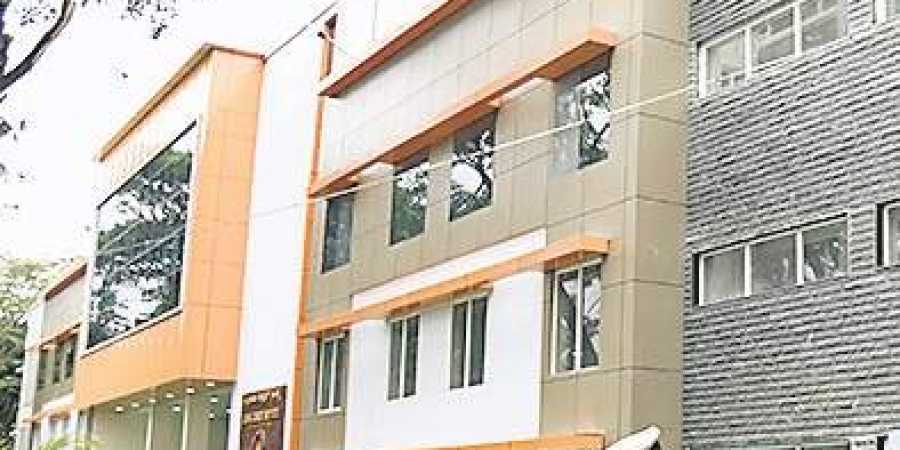
The Kidwai Hospital in Bengaluru.

Bengaluru :

Kidwai Memorial Institute of Oncology (KMIO) has become the first government hospital in Karnataka to execute the Central government’s e-hospital project, the first round of implementation for which started last week. The project aims at integrating and managing all aspects of a hospital’s operations such as medical, financial, administrative, legal and compliance, health records online.

“This system will also ensure that people coming from rural areas across the state need not wait for hours or struggle with losing files,” said Dr C Ramachandra, Director, KMIO.

How will it work?

E-hospital Kidwai will register the patient in the hospital system at the OPD (out patient department) on entering. A patient identification number and a patient-specific barcode will be generated, after which the patient will be given a ‘health card’. At the electronic queue management centre, they will be issued a token which will tell them where to go and which doctor to see.

A senior doctor from KMIO explained that a doctor will scan the patient’s barcode to receive information about the patient, such as medical history, allergies, and demographic data. After the consultation, he will then enter the diagnosis, prescription, and any further tests which should be taken into the system. “For instance, if you were to take a blood test, then you would be directed to the lab and the technician will have already received information about you. The blood sample will then be labelled with a barcode, enabling the technician to retrieve vital information before recording the test results,” he explained.
Digital healthcare

A team from Infosys Foundation is helping the doctors at Kidwai to streamline the data and also link the departments.

On the benefits of digital health care, the director said, “It is one of the answers to our disorganized, overcrowded state hospitals, and the inconsistent quality of hospital services. It is also instrumental in managing information more efficiently.”

He explained that it improves connectivity within healthcare institutions, so there is better coordination between healthcare personnel and also recorded data. Individuals from disadvantaged or low-income backgrounds, who do not manage their health due to poverty or lack of awareness, will be able to have the hospitals manage their health for them, he said.

Dr C Ramachandra also added that Kidwai was the first hospital to ensure that the OT was operational even on holidays.

source: http://www.newindianexpress.com / The New Indian Express / Home> States> Karnataka / by Chetana Belagere / by Express News Service / Ocotober 09th, 2018

Skin bank richer by 85 donations, 1,500 pledges

SkinBankBF07oct2018

With increasing awareness, State’s first such storage is seeing a rise in donors

With organ donation picking up in the State, awareness on the concept of skin donation is also catching up. The State’s first skin bank set up in the government-run Victoria Hospital has had 85 donations ever since its inception in March 2016. Donated skin has been used for grafting in nearly 40 patients, with skin damage due to burns.

One among the beneficiaries is an eight-year-old boy, who recently suffered third-degree burns after he tried to imitate a stunt that he saw during a Muharram procession.

The son of a driver from Tilaknagar in the city, the boy had burns on his chest, feet, and upper limbs, and was rushed to the Mahabodhi burns ward in Victoria Hospital. Skin grafting and it was done on him 10 days ago.

K.T. Ramesh, head of the department of plastic surgery in Bangalore Medical College and Research Institute (BMCRI), told The Hindu, “Although some patches of skin from his thigh area were used, it was not enough. We used donated skin on a major portion of his chest, and the boy is doing well now. He will be discharged in a few days.”

A great help

With the burns ward in the hospital getting nearly 220 admissions (of which over 70% are serious cases), the skin bank is of great help to patients who deal with the trauma of disfigurement. Hospitals from across the State are placing requests for the facility.

“The skin bank is a boon for patients as there is no blood-group matching required in skin grafting. Anyone over 18 years, who does not have skin disease or infections can donate,” Dr. Ramesh said.

The bank, set up in association with Rotary Bangalore Midtown and Ashirvad Pipes (Rotary Ashirvad BMCRI Skin Bank), did not get a good response in the first year. BMCRI then roped in Kannada cine stars — Prem and Kumar Bangarappa — to popularise the concept of skin donations. “While the actors participated in a few awareness programmes, our skin bank team comprising of paramedics — Nagaraj, Prasanna, and Lakshmikanth — have been doing yeoman service. Apart from visiting colleges and public functions to create awareness, the team also accompanies grief counsellors from Jeevasarthakathe, the State-run body that facilitates the cadaver organ transplantation programme, to hospitals where brain deaths are declared,” said Dr. Ramesh.

‘People call us’

Earlier, despite counselling, relatives of patients who breathe their last in Victoria Hospital (where the bank is located), were not ready to come forward. “Now, we are glad that people call us when there is a death in the family and say they are interested in donating skin. This apart, we have received over 1,500 pledges so far,” the doctor added.

source: http://www.thehindu.com / The Hindu / Home> News> States> Karnataka / by Shan Yasmeen / Bengaluru – October 05th, 2018