Category Archives: Science & Technology

Rs 85L Space Gallery comes up in Bengaluru

Former ISRO Chairman K Kasturirangan and incumbent  A S Kiran Kumar at the gallery
Former ISRO Chairman K Kasturirangan and incumbent A S Kiran Kumar at the gallery

It is located in Visveswaraya Industrial Technology Museum

A Space Technology Gallery set up in an area on 700 square meters at the Visvesvaraya Industrial and Technological Museum (VITM) will be an added attraction for visitors.

The gallery, the first of its kind in the country, will give a glimpse of space technology, especially India’s space programme. From Aryabhata, India’s first satellite, up to the indigenous shuttle, the air breathing Scramjet engine, till the yet to be launched solar mission Aditya, the gallery has an impressive interactive display showcasing the variety of satellites developed by ISRO.

Inaugurated on Tuesday by ISRO Chairman AS Kiran Kumar, the gallery, set up at a cost of Rs 85 lakh, brings the various facets of space technology in an easy to comprehend way through several interactive and impressive exhibits. There is an interactive display of India’s most popular and successful space programmes – the Chandrayaan-1 and Mars Orbiter Mission.

Also on display is a peep into the life of Wing Commander Rakesh Sharma, the first Indian to go into space, along with a glimpse of the life and works of Kalpana Chawla and Sunita Willams, two Indian-origin women astronauts. Food items like space idli mission developed by the Mysuru-based Defence Food Research Laboratory and which will be consumed by Vyomanauts during India’s human space endeavour are also on display.

Visitors, especially students, can catch a glimpse of how ISRO carries out its launch from its spaceport in Sriharikota as there is a spectacular exhibit of both the launch pads that demonstrates how a rocket is used to launch satellites.

The mission control room explains the way rockets and satellites are controlled and tracked. Major milestones in space technology starting from the Mysorean Rocket to Voyager, which has now reached interstellar regions in outer space, find a place in the gallery. At the satellite imagery station, one can explore images taken by satellites like the glaciers of the Himalayas, Bengaluru Metro Station and many more by waving one’s hand on air.

source: http://www.bangaloremirror.indiatimes.com / Bangalore Mirror / Home> Bangalore> Others / by Bangalore Mirror Bureau / November 29th, 2017

Bengaluru company’s bracelet helps save premature babies

Bengaluru :

Divya Sharavana delivered her second baby, Ritiksha, 20 days early. After 10 days in the neonatal wing of St Philomena’s Hospital, the child was discharged with a bracelet around her wrist.

“One night, the orange light on the bracelet started flashing with an alarm and we rushed the baby to the doctor. She was suffering from hypothermia —a condition when body loses heat faster than it produces — and gastrointestinal infection. She could be saved because of the device,” says Divya, who lost her first baby to complications.

Ritiksha is two years old now, and healthy. She owes it to Bempu, the bracelet that saved her by beeping when her temperature plummeted. The brain behind the innovation is Ratul Narain, 33, a Stanford University alumnus with a master’s degree in biomechanics. The device is manufactured by Bempu Health in Bengaluru.

Team Bempu's device was recognized as one of the 25 best innovations in 2017 by Time magazine
Team Bempu’s device was recognized as one of the 25 best innovations in 2017 by Time magazine

10,000 Bempus have been used across the world

In India, one in three newborns suffers from low birth weight or is under 2.5kg. This is one in 12 in developed countries,” Ratul Narain says.

A made-in-India hypothermia alert device for newborns, Bempu has been recognized as one of the 25 best innovations in the world in 2017 by the Time magazine. Invented and manufactured by Bempu Health in the bylanes of Langford Road in Bengaluru, Bempu weighs 8gm. Worn by a newborn with low birth weight, it flashes blue light if the temperature is normal. If the temperature goes below 36.5-degree Celsius or 97.7

Fahrenheit, it flashes orange and rings an alarm alerting it’s time for immediate attention, either warming the child up or giving Kangaroo mother care.
Some 10,000 Bempus have been used across the world and 1,000 of them donated to government hospitals ever since it entered the market in early 2016.

Before developing the device, Ratul spent a year at hospitals in Karnataka, Uttar Pradesh, Rajasthan and Gujarat to understand neonatal complications. “Among babies with low birth weight, infections can occur at home. Up to 15% of low-weight newborns discharged from government NICU would die at home due to complications like infections and hypothermia. The significant cost of facility care for the baby was, therefore, lost at home. That’s what made me work on a lowcost solution,” says Ratul.

The device priced Rs 2,500 can be used for four weeks without replacing its battery. To avoid cross-infections, it is suggested not to pass it on to a second user. Ratul’s research was facilitated by grants from various countries and institutions, including USAID, UKAID, Bill and Melinda Gates Foundation. Bempu is now being used in Pakistan, Papua New Guinea, Togo and Ghana through Unicef initiatives.

source: http://www.timesofindia.indiatimes.com / The Times of India / News> City News> Bangalore News / by Sunitha Rao  R / November 27th, 2017

Scientist patents target chemo delivery system

Bengaluru :

An Indian scientist has claimed a breakthrough in reducing the side-effects of chemotherapy by creating a drug delivery system that will target only cancer cells and leave healthy cells unharmed.

DrRajahBF26nov2017

The patented system – contained in a whole-body device called Cellular Focused Resonance Nano-Permeabilisation or Cellforn – says Dr Rajah Vijay Kumar, can deliver chemotherapeutic molecules directly to the cancer cells. Dr Kumar, who has more than 30 inventions to his name, is the director and chief scientific officer at Bengaluru’s Centre for Advanced Research and Development.

Chemotherapy is one of the best options available for treating cancer but its severe side-effects are a separate battle. “Actually the cargo is good but the delivery is bad. That is where my team decided to intervene,” he said.

 Cellforn could make drugs 10 to 70 times more effective’

We decided to do something about the transportation and delivery system of molecular cancer treatment. Our work began in 2008 and now we have Cellforn,” Kumar said.

Cellforn creates temporary nano pores that can receive drugs, allowing delivery to the cell membrane of the cancer tissue, identified with pretreatment proton density evaluations. “All drugs contain hydrogen atoms that bond with other molecules. The nucleus of the hydrogen atoms (containing only protons) in the drug are like bar magnets, they have specific alignments. Tissues too have protons that have the same alignment as the drug. Cellforn reverses the alignment of the hydrogen protons in the tumour tissue, spins it opposite to that of the drug molecule, attracting it to the sensitized tumour tissue,” Kumar explained.

Simultaneously, Cellforn creates temporary receptors or holes induced by fast radio bursts(FRB) that is timed and delivered to target lesions. Concentrations of target drugs like carboplatin and paclitaxel, for example, are delivered based on their molecular weight. The whole body device that delivers the precisely planned FRB houses specialized antennae and delivery mechanisms.

“Almost the entire drug payload is delivered to the tumour, and minimal to the healthy tissue. Hence, there will be very little or no adverse side-effects,” he said.

Having got a US patent in April this year, Kumar claims his precision-targeted drug delivery system is market-ready. “A few regulatory formalities are still pending. I think we will go into production in nine months,” he said.

Kumar claimed that Cellforn could make drugs 10 to 70 times more effective as they can be highly localized and used in vivo (on tissues and organs inside the body) and noninvasively.

Cellforn also prevents the cancer tissue from developing immunity to the drug. “Cellforn also controls chromatin, a group of macromolecules that holds the genetic information within cells. Chromatin can make cancer cells resistant to treatment. But chemotherapy administered with Cellforn will not make the cancer tissue develop resistance to the cancer cytotoxic drug,” he said.

source: http://www.timesofindia.indiatimes.com / The Times of India / News> City News> Bangalore News / by Chethan Kumar / TNN / November 26th, 2017

Sankalp Semiconductor receives STPI Highest Exporter award

Sankalp wins the award third time in a row as the Highest Exporter in ITES – Hubbali Region

Bengaluru :

Sankalp Semiconductor, a design service company offering comprehensive digital & mixed signal SoC services and solutions, today received an award from Software Technology Parks of India (STPI) for being the Highest Exporter – ITES in the Hubballi Region award. Sankalp Semiconductor has consecutively third time won the award. According to STPI, the state of Karnataka has touched Rs 1,41,846 Cr worth of exports from STPI member units during 2016-17. Karnataka contributes 40% of the total software export from the country.

“The award is validation of our contribution to the worldwide customers in the technology semiconductor domain. We thank STPI for recognizing our contribution and achievements for more than 12 years. We very excited since Sankalp Hubbali is a great success story for creating and scaling excellent semiconductor talent from tier-II cities. Our model has been successful due to our ability to build teams grounds up by leveraging well-planned technical and soft skill in-house training.” said Nagaraj Azhakesan, COO, Sankalp Semiconductor.

Sankalp Semiconductor was founded from Hubbali in 2005, with a focus to serve the semiconductor companies primarily offering analog & mixed signal design services. Today, Sankalp with a team of 650+ engineering professionals has design centers in Hubli, Bengaluru, Kolkata and Ottawa, Canada. The company provides unique advantage to its semiconductor customers by enabling them at any point of semiconductor services life cycle with the ability to provide end-to-end solutions.

source: http://www.design-reuse.com / Design & Reuse / Home / Bengaluru – November 16th, 2017

IISc. team wins gold at iGEM 2017

Triumphed over 300 other teams from around the world

With a new device to measure the growth of microbes as well as a novel method to purify proteins, a team of undergraduates from the Indian Institute of Science (IISc) took home the gold medal at the International Genetically Engineered Machine (iGEM) competition held in Boston, U.S.A. from November 9-13.

The team triumphed over 300 others from around the world who participated in the competition, which encourages students to build genetically-engineered biological systems.

The six-member core team from IISc. developed a new method to purify recombinant proteins — that is, a protein enclosed in a gene — by using naturally-occurring gas vesicles isolated from Halobacterial species of bacteria, which thrives in salt-rich environments. In liquids, gas vesicles help bacteria float to the surface, and using biotechnology and gene cloning, the team was able to purify protein by tagging them to these vesicles.

Similarly, the team designed a device, Growth Curve and Optical Density Device (GCODe), to ascertain microbial growth through real-time optical density measurements that can even be read through a smartphone. The device, said IISc., is less than a fourth of the price of a commercially-available spectrophotometer.

The team — comprising Raj Magesh, Sai Padma Priya, Kunal Helambe, Rajas Poorna, Sharath K. Menon and Rohith K.M.S. — worked on the projects for over six months. They were mentored by Dipshikha Chakravortty, Utpal Nath from Department of Microbiology & Cell Biology, and Akshay Datey from Biosystems Science & Engineering at IISc.

source: http://www.thehindu.com / The Hindu / Home> News> Cities> Bengaluru / by Staff Reporter / November 16th, 2017

MIT students devise GreenBoard for purification of air, obtain IPR

Students Dhruv Suri, Rahil Nayak and Priyanshi Somani have developed the billboard

Mangaluru :

The air quality in India is deteriorating by the day and to tackle this problem, a group of students from the Manipal Institute of Technology, Manipal University, have devised a green billboard. Conceived by a budding aeronautical engineering student and his team, GreenBoard incorporates an air purifier into an ordinary billboard and purifies the air flowing through it.

The team obtained the Intellectual Property Right for it on Thursday. Dhruv Suri and Rahil Nayak, both aeronautical engineering students, and Priyanshi Somani, a computer science engineering student developed the billboard. Dhruv said carbon is one of the most important building blocks of life. Industries, automobiles, power houses, exhaust vents — all produce carbon dioxide and increase its concentration in the air.

source: http://www.timesofindia.indiatimes.com / The Times of India / News> City News> Mangalore News / by Kevin Mendonsa / TNN / November 12th, 2017

Bengaluru beats San Francisco in confidence to go digital

HIGHLIGHTS

  • Bengaluru has been ranked first, ahead of San Francisco, for the confidence of businesses in their ability to do digital transformations.
  • Business leaders in Bengaluru expressed the highest confidence in their digital environment based on innovation and entrepreneurship.

_______________________________________

Bengaluru :

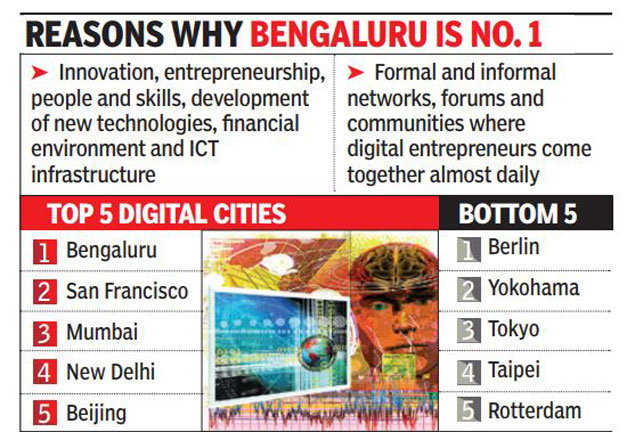
India’s Silicon Valley – Bengaluru -has been ranked first, ahead of San Francisco, for the confidence of businesses in their ability to do digital transformations based on the skills and infrastructure  available in their immediate environment.

According to a study by The Economist Intelligence Unit, three Indian cities bagged top 4 ranks. San Francisco is ranked at No. 2, followed by Mumbai and New Delhi. Business leaders in Bengaluru expressed the highest confidence in their digital environment based on innovation and entrepreneurship, people and skills, development of new technologies, financial environment, and ICT infrastructure. In each of these categories, the city ranked No. 1.

“Indian cities may suffer more from infrastructure deficits, pollution, poverty and other ills, but when it comes to the environment for digital transformation, their executives are remarkably optimistic. This is particularly true of Bengaluru, where business leaders express the highest levels of confidence in their digital environment than in any other city in the study,” the report authored by Denis McCauley says.

ChartBF10nov2017

It goes on to say: “Their compatriots in Mumbai and New Delhi are only slightly less bullish, and they are not alone in the emerging world: seven of the 10 highest confidence levels in the survey are recorded in emerging Asian cities. Among rich-world cities, only San Francisco (2nd) registers in the top five and two others (London, 9th, and Madrid, 10th) made it to top 10. By contrast, developed cities account for eight of the 10 lowest readings in the barometer, with executives in Berlin, Yokohama, Tokyo and Taipei the least confident of all.”

The report notes that across geographies and industries, businesses are embarking on, or preparing for, a mission to put digital technology at the heart of everything they do, an exercise that has come to be known as digital transformation. It can be an enormously difficult and complex un dertaking, requiring not just the deployment of advanced technologies but also the overhauling of business processes and a large degree of cultural change.In most cases, firms’ existing internal resources will not be enough to pull transformation off, and they need to look outside their own four walls for additional support,” the report says.

For this reason, EIU decided to check which cities provide the best environment for their businesses.The analysis in the report is based on a survey of 2,620 executives in 45 cities conducted in June and July this year.

Almost half of surveyed executives (48%) say their firm has considered relocating operations to a city with a more favourable external environment.

Alpesh Shah, senior partner in Boston Consulting Group India, is quoted as saying he is only slightly surprised at the bullishness that executives in Bengaluru, Mumbai and New Delhi display toward their local digital environments.

He notes that these cities’ educational institutions consistently churn out large numbers of quality technology graduates. The report says the three cities also boast a multitude of formal and informal networks, forums and communities where digital entrepreneurs, technology managers and others come together almost daily.

Shah, the report says, reserves particular enthusiasm for Bengaluru’s digital entrepreneurship environment. It is the “closest thing to Silicon Valley” in Asia, he is quoted as saying.

source: http://www.timesofindia.indiatimes.com / The Times of India / News> City News> Bangalore News / TNN / November 09th, 2017

Haveri-born CEO wants to give it all back to society

Prabhu Patil, CEO of Prolim Global Corporation, addressing a gathering after being felicitated by Karnataka Chamber of Commerce and Industry in Hubballi on Tuesday.

He recalls how an article in The Hindu opened avenues for his growth

A native of Haveri and now CEO of a global company, Prabhu Patil, plans to create job opportunities for another 100 professionals from the region in the next two years for his unit in Hubballi.

Speaking to presspersons after a being felicitated by the Karnataka Chamber of Commerce and Industry (KCCI) here on Tuesday, Mr. Pabhu Patil, who is now CEO and president of Prolim Global Corporation, said that they have hired 70 persons for his Hubballi unit and have now drawn up plans to add another 100 in two years.

Mr. Prabhu Patil said that Hubballi had a lot of talent and they want to not only train and recruit young graduates but also guide them to become entrepreneurs.

Memorandum

He said that to begin with, they would like to take engineering graduates for internship and train them and for the purpose, they want to have a tie-up with the KLE Institute of Technology in Hubballi. Prolim Global Corporation now has offices in the U.S., Canada, Bengaluru and Hubballi and it recently acquired Ally PM Solutions Inc. of North America.

Mr. Prabhu Patil said that on the social front, they would like to adopt more children under Akshaya Patra midday meal programme and also associate with the Deshpande Foundation in taking up social initiatives.

Earlier, narrating his life story, he recalled how an article in The Hindu took him to Coimbatore for pursuing a research with the Defence Research and Development Organsiation (DRDO) and subsequently, to the U.S. and other nations to work with various companies.

“Now, I have started working for my organisation and also want to contribute a little bit to my region,” he said.

KCCI president Ramesh Patil, secretary Siddeshwar Kammar and other office-bearers felicitated him.

source: http://www.thehindu.com / The Hindu / Home> News> States> Karnataka / by Special Correspondent / Hubballi – November 08th, 2017

MESCOM bags 27 awards

The awards were in recognition of MESCOM’s strides in power supply.

Mangalore Electricity Supply Company (MESCOM) bagged 27 awards in the recently held Power Awards 2017 organised by the State Energy Department.

A release from MESCOM said the awards were in recognition of the company’s strides in power supply and various innovations. Chief Minister Siddaramaiah and Energy Minister D.K. Shivakumar presented the awards.

MESCOM Managing Director bagged first place in minimum commercial loss and third places in effective implementation of Hosa Belaku programme, reduction in failure of transformers and uniform rating of ESCOMs conducted by the Central government.

Kadur, Puttur and Kundapura divisions of MESCOM bagged the first three awards in effective implementation of Ganga Kalyana project in rural areas. Similarly, Udupi, Sagara and Kadur Divisions bagged three awards in rural drinking water projects.

Kavoor, Kundapura and Udupi divisions stood in first three places in handling minimum revenue backlog in rural areas.

While Shree Jayadeva Electrical, Udupi repair centre, was judged the best transformer repair centre, Mangaluru Division I was declared the best transformer bank. Bantwal Division was judged the best in augmenting basic infrastructure for Akrama-Sakrama programme. Thomas Gomes, Malpe branch and M. Nagesh, Kulashekara branch, were judged best linesmen.

Customers felicitated

As many as 10 MESCOM customers were felicitated in the solar roof top electricity project under renewable energy sector. They were M. Balakrishna Nayak, Bannanjep; Raghu Hegde, Mavinakoodlu; Chandramathi Shetty, Koni; John D’Silva, Kuntalpady, Karkala; Harishchandra, Gandhi Hospital, Udupi; Ananth Nayak, Lakshmi Textiles, Thekkatte; Veerendra Nayak, VKR Hollow Blocks, Thirthahalli; Ryako Industries, Bhadravati, and Ganapathi Hegde, Padutirupathi Petrol Pump, Sanur.

source: http://www.thehindu.com / The Hindu / Home> News> States> Karnataka / by Special Correspondent / Mangaluru – November 06th, 2017

Israel Centre opens at IIMB

‘The centre will bring together like-minded individuals in academic knowledge and research’

The Indian Institute of Management Bangalore (IIMB) opened its campus to an Israel Centre on Sunday which is aimed at becoming a “bridge of academic collaboration” between India and Israel. The centre will be largely based on research by faculty and will also include faculty and student exchange programmes.

The Consul General of Israel to Bengaluru, Dana Kursh, during the inauguration of the centre, said the initiative was spearheaded by the heads of IIMB and Coller School of Management. “Both our countries have a similar ecosystem in terms of business, academia supported by the government, and research. Previously, the Karnataka Israel Research and Development agreement facilitated research with state-funding from both Israel and Karnataka. For any economy, startups are very important,” she said.

Speaking about the Israeli startup ecosystem, which is based on three factors — government, industry and academia — Ambassador of Israel to India Daniel Carmon said the collaboration will strengthen the ecosystem of both the countries. “Bengaluru is an ideal centre for startups, and this collaboration is an excellent idea. This is further highlighted by the fact that currently, a Bengaluru startup is representing India in Start Jerusalem programme back in our country. This centre will bring together like-minded individuals in academic knowledge and research.”

G. Raghuram, Director, IIMB, said the centre will act as a hub for research, technological innovations, business strategy, government policies, and culture. “Through this centre, we will also support exchange programmes, host seminars, discussions, and nurture entrepreneurial spirit,” he said.

source: http://www.thehindu.com / The Hindu / Home> News> Cities> Bengaluru / by Staff Reporter / Bengaluru – November 06th, 2017