Category Archives: Science & Technology

Students from Mysuru win hackathon in Bengaluru

Third-year computer science and engineering students of JSS Science and Technology University (Sri Jayachamarajendra College of Engineering) have won the first prize in a hackathon titled #Hackabout 2017, conducted by Royal Philips, Bengaluru.

The winners — Shashank R., Ashwin B.S. and Ajay B. and Amogha Subramanya D.A. — were mentored by Anil Kumar K.M.

Philips, which provides technology for health services and has an innovation campus in Bengaluru, conducted the hackathon based on its data science platform (DSP). Participants were given an opportunity to experience the Philips DSP to create solutions to real-world problems. The two-month-long competition concluded only recently.

#Hackabout 2017 had multiple rounds and the finale was conducted at the Philips Innovation Campus. Seventy teams, with around 300 students from colleges across India, participated.

According to a release from the college, in round one, a problem related to semantic similarities was issued. Based on the solutions, the top 20 teams were selected for the next round. In round two, the teams were given access to the Philips DSP to propose a way to predict the length of a patient’s stay in ICU.

Based on this round, the top 10 teams were selected. They included teams from IIT Madras and Manipal Institute of Technology. The final 10 were invited to the innovation campus for the final presentation.

In the final round, each team made their presentation and answered questions posed by the jury and the audience. The jury comprised Srinivas Prasad, CEO of Philips Innovation Campus, Vijayananda J., senior director, Philips Healthcare, and John Huffman, business lead, Data Science and Artificial Intelligence, Philips.

source: http://www.thehindu.com / The Hindu / Home> News> States> Karnataka / by Special Correspondent / Mysuru – October 31st, 2017

AppDynamics founder Jyoti Bansal to open research centre in Bengaluru for his startup incubator

San Francisco :

Silicon Valley-based entrepreneur Jyoti Bansal, an IIT-Delhi graduate who sold his company AppDynamics to Cisco for $3.7 billion earlier this year has floated a startup incubator BIG Labs which will research ideas and spin off a select few into full fledged companies. Bansal is committing $50 million to his new venture and is also setting up an R&D centre for BIG Labs in Bengaluru, he told TOI in an exclusive interaction.

The first company to come out of BIG Labs is Harness, a delivery-as-a-service platform leveraging artificial intelligence which has received $20 million in Series A funding led by Menlo Ventures and BIG Labs. Bansal, will head the company as its CEO along with co-founder Rishi Singh, a former DevOps platform architect at Apple, who is the CTO.

“After selling AppDynamics I could have opted to be a passive investor in companies but that didn’t appeal to me. I like to build companies. With BIG Labs, the aim is to build multiple billion dollar companies along with co-founders, what you call parallel entrepreneurship,” Bansal, 38, told TOI at the BIG Labs office situated in San Francisco’s Financial District.
While Bansal himself pocketed about $500 million from the sale of AppDynamics, he said as many as 350 employees (out of the 1100 workforce) at his nine-year-old firm scooped up $1 million and more emphasizing the role played by ESOPs in distributing wealth. Building startups is very hard, you have to let employees reap the rewards when liquidity events happen. If you want to build a successful and sustainable company, as founders one has to make all of the employees, shareholders and draw up a mission together, he said.

Having already invested in two Indian startups Leadsquared and Funds Tiger, Bansal said he will look to back more local founders in his personal capacity going forward, along with holding mentoring sessions with the local community there on his forthcoming India trip. As for Indian startups, Bansal said he wants to get more involved with them but has found it difficult to get the real picture of the ecosystem being in the Valley.

“There is still a lot of noise in India. Some companies don’t seem like they are real businesses and may not have a path to getting there,” he said.

Bansal wants to help bring about the natural convergence between India and Silicon Valley especially in B2B businesses where his expertise lie. “I would love to share my experiences on how to build a sales force. Selling products globally is a hard skill but as important, if not more, than just building a product,” Bansal said. Because of companies like Flipkart, Indian talent has been able to gain experience around product development but that’s not the case when it comes to selling products in global markets. This is where I can help along with talking about how to build your startup’s culture, which is another important issue.

AppDynamics, which develops application performance management solutions, had raised $250 million from the likes of Lightspeed Venture Partners, Goldman Sachs, Kleiner Perkins, among others, and was slated to go public before the last minute decision to sell to Cisco was finalised. “I’m a big believer in IPOs as it brings transparency and the right business rigour despite having to produce quarterly results and targets publicly. We decided to accept Cisco’s acquisition call as it was better for all shareholders coming at a higher price compared to what the company was being valued in its IPO. This was a far better outcome for everyone including the employees,” he said.

source: http://www.timesofindia.indiatimes.com / The Times of India / News> Startups> People / by Samidha Sharma / TNN / October 25th, 2017

DK college all set to create its own nano satellite soon

Mangaluru: Alva’s Education Foundation, Moodbidri, has been working with Planet Aerospace, a group of retired ISRO scientists, to manufacture a nano satellite.

Dattatreya, dean and senior professor (planning), department of electronics and communication, Alva’s Engineering College, told TOI that the main intention of creating the nano satellite is to find a solution to the core issues concerning the district.

“We are mainly focussing on soil fertility and what crops could be grown here and the availability of groundwater. Usually, farmers here try to cultivate crops without knowing about the quality of the soil and other aspects and burn their hands. We are coming up with a solution to such issues through the proposed satellite. We also intend to study the Western Ghats and the amount of deforestation,” he said.

According to Dattatreya, plans are afoot to learn about atmospheric pressure, humidity, wind direction, duration of sunshine and rainfall among others with the help of the satellite.

Vivek Alva, trustee of the institute, said a cursory session had recently been held where experts from Planet Aerospace gave a fair idea to about 350 students from the institute on creating a satellite and the working of its various components.

A team of 30-40 students will be formed to create the nano satellite. A few senior faculty members, too, will join these batches.

“There are as many as 10 components such as payload, camera, power required, communication and ground handling among others, we need to work on. We will assign the programming part to select students from computer science, power system analysis to electronics students and structural aspects to mechanical engineering students among others,” Dattatreya added. The intention is also to give students hands-on experience in research as many students of late are resorting to readymade research materials, he added.

Once the nano satellite is ready and approved by ISRO, the space organisation will provide the institute a bus for the launch, Dattatreya said.

Rajangam, former deputy director, ISRO Satellite Centre, Bengaluru, who is now a part of Planet Aerospace, said his team will provide technical guidance to Alva’s institute throughout the process and will keep visiting the facility in Moodbidri as and when required. The project is expected to be completed in three-four years.

source: http://www.timesofindia.indiatimes.com / The Times of India / News> City News> Mangalore News / TNN / October 16th, 2017

Mangalore University VC elected as Fellow of Royal Society of Chemistry

ByrappaBF22oct2017

Mangaluru :

K Byrappa, Vice-Chancellor, Mangalore University has been elected as Fellow of the Royal Society of Chemistry (FRSC), London, UK. This is a prestigious fellowship awarded through election in recognition of academic contribution to the field of Chemistry.

Byrappa is the first academician from Mangalore University to receive this honour from the Royal Society of Chemistry, London.

A renowned researcher and academician, Byrappa has been honoured with many fellowships. Earlier in April, Byrappa was elected as the Fellow of the Asia Pacific Academy of Materials, in the annual meeting held in Japan. In the same meeting he was also elected as the Secretary General of Asia Pacific Academy of Materials.

Byrappa is the first Indian to become the Secretary General of the Asia Pacific Academy of Materials.

During January, Prime Minister honoured Byrappa with Sir C V Raman birth centenary Gold Medal in recognition of his contribution to science and technology in India. He is the second Kannadiga to get this honour after C N R Rao.

In 2010, Byrappa was elected as a Fellow of the World Academy of Ceramics, in the biennial convention held in Italy. He was the 4th Indian to get that honour.

source: http://www.timesofindia.indiatimes.com / The Times of India / News> City News> Mangalore News / by Jaideep Shenoy / TNN / September 28th, 2017

Karnataka boys shine at skills contest

Bengaluru :

A Kiran Sudhakar from Karnataka bagged bronze for prototype modelling and his state-mates Anant Kumar and Varun Gowda got medallions for excellence in mechatronics category at the 44th World Skills competition, which concluded in Abu Dhabi on Friday.

Team India created history by winning a silver, a bronze and nine medallions of excellence at the global competition. This is India’s best performance ever since it started participating in these competitions in 2007. The Indian team was competing with candidates from 59 other World Skills member-countries. Mohit Dudeja from Delhiwon a silver in patisserie and confectionery trade/skill. He also won the best of nation award for the highest marks among the Indian contingent .

The Indians won medallions of excellence in skills like brick-laying, restaurant service, automobile technology, jewellery, graphic design technology, mobile robotics, beauty therapy and car painting.

source: http://www.timesofindia.indiatimes.com / The Times of India / News> City News> Bangalore News / TNN / October 21st, 2017

Nobel boost to Bengaluru’s link to LIGO

Elated lot A team from Bengaluru-based International Centre for Theoretical Sciences has been deciphering data from Laser Interferometer Gravitational-wave Observatory.   | Photo Credit: By Special Arrangement
Elated lot A team from Bengaluru-based International Centre for Theoretical Sciences has been deciphering data from Laser Interferometer Gravitational-wave Observatory. | Photo Credit: By Special Arrangement

City scientists play significant role in project pioneered by this year’s Nobel laureates

As Rainer Weiss, Barry C. Barish and Kip S. Thorne take the stage later this year to accept the Nobel Prize for Physics, they will be standing on the shoulders of hundreds of collaborators from across the world, who collectively made it possible to sense gravitational waves that “shook the world” in 2016.

Of these, more than 35 scientists from India, including a team of seven from Bengaluru-based International Centre for Theoretical Sciences (ICTS), played a significant role in understanding and deciphering the data from the Laser Interferometer Gravitational-wave Observatory (LIGO), an international collaboration pioneered by the three Nobel laureates.

At Hessarghatta, the seven-member team — led by Parameswaran Ajith from ICTS — works on modelling the sources of gravitational waves, among others; their LIGO Tier-3 grid computing centre tests Einstein’s famous Theory of Relativity with the data thrown up by the detectors in the U.S. and Europe. “The laureates associate themselves with the LIGO/Virgo collaboration rather than their individual academic institutions. They have even said the award would be received on behalf of the collaborators. It’s heartening to see this,” says Dr. Ajith.

The team, after all, finds a place amongst the thousand authors, including the three laureates, of the paper ‘Observation of Gravitational Waves from a Binary Black Hole Merger’, which announced the experimental proof of gravitational waves in 2016.

India and LIGO

Indian scientists have a long, often unacknowledged presence in the fledgling field. For instance, the works of C. V. Vishveshwara, who died in the city earlier this year, in the 1970s continues to remain highly relevant.

And, it is perhaps these initial forays that has seen India do better in this field of research than others. “A few decades ago, it was just two of us in gravitational waves,” says Bala Iyer, chairperson of IndIGO (Indian Initiative in Gravitational-wave Observations) consortium and also associated with ICTS. “Now, there is a community of over 200 and we are struggling to keep up with the interest.”

With the ₹1,500-crore Indian LIGO detector expected to be operational by 2024, India is expected to play a key role in utilising the discovery that many scientists say is bigger than X-ray or microwave radiation that gave unparalleled views of the universe.

source: http://www.thehindu.com / The Hindu / Home> News> States> Karnataka / by Mohit M. Rao / Bengaluru – October 05th, 2017

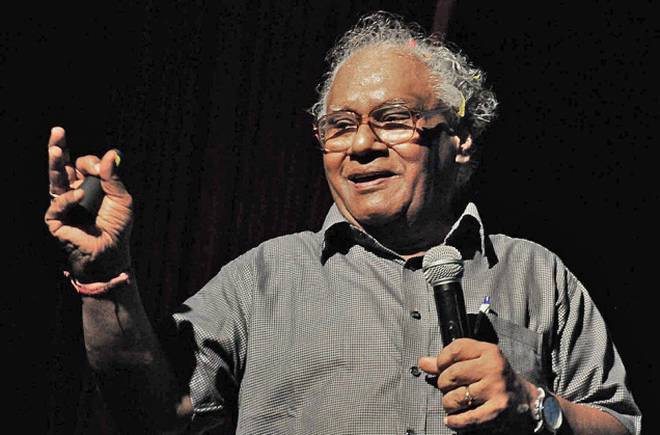
C.N.R Rao chosen for international honour for materials research

cnrRaoBF27sept2017

The Bharat Ratna awardee is the first Asian to be chosen for the prestigious Von Hippel Award

Eminent scientist, Professor C.N.R Rao, has become the first Asian to be chosen for the prestigious Von Hippel Award for his immense contribution in materials research.

The award is the US-based Materials Research Society’s (MRS) highest honour.

It recognises “those qualities most prized by materials scientists and engineers – brilliance and originality of intellect, combined with vision that transcends the boundaries of conventional scientific disciplines,” according to the MRS.

The award citation noted Mr. Rao’s immense work on novel functional materials, including nanomaterials (having particles of nanoscale dimensions), graphene (the strongest and thinnest material) and 2D materials, superconductivity, and colossal magnetoresistance (change in electrical resistance of a material in a magnetic field).

The award will be presented in Boston on November 29, during an MRS meeting, according to a release issued by the Jawaharlal Nehru Centre for Advanced Scientific Research here of which Mr. Rao, a Bharat Ratna awardee, is the founder president.

The award includes a cash prize, trophy and a diploma.

source: http://www.thehindu.com / The Hindu / Home> Sci-Tech> Science / by PTI / Bengaluru – September 23rd, 2017

Bengaluru gets new Boeing engineering centre

New Delhi :

Union minister of state for civil aviation Jayant Sinha inaugurated Boeing’s additional new facility at the Boeing India Engineering and Technology Center (BIETC) in Bengaluru on Friday. This facility will enable Boeing to focus on state-of-the-art technology areas such as data analytics, internet-of-things, avionics, aerospace design, manufacturing, testing and research, to support Boeing products and systems. The centre also includes laboratories for research to support next-gen innovations in aerospace.

“Boeing’s commitment to growth of capability and capacity in the Indian aerospace sector is commendable. I congratulate the team on this brand new addition to the Boeing India Engineering and Technology Centre and am proud that Boeing is leveraging India’s engineering talent and its expertise for some of the most advanced aerospace products in the world, and developing complex solutions for the world,” said Jayant Sinha.

This expansion comes soon after Boeing opened its engineering centre in January 2017. “As a source for innovative and cutting-edge engineering, India offers us tremendous growth potential. This is a winning formula for India and our own global growth strategy for improved productivity, enhanced engineering efficiency and cost advantage, while focusing on quality,” said Pratyush Kumar, president of Boeing India.

Recently Boeing announced a partnership with aviation ministry and Air India Engineering Services Ltd (AIESL) to develop an aircraft maintenance engineers accelerated apprenticeship program. The key objective of the program is to improve the employability of AMEs through training and hands-on experience with actual aircraft.

source: http://www.timesofindia.indiatimes.com / The Times of India / News> India News / by Saurabh Sinha / TNN / September 22nd, 2017

U.R. Rao, genial genius of ISRO

URRaoBF26jul2017

He gave the country its first spacecraft

Udupi Ramachandra Rao, former chairman of the Indian Space Research Organisation, acclaimed space scientist acknowledged as the father of Indian satellite technology, is no more.

The celebrated cosmic ray scientist with an MIT scholarship and experience with early NASA projects in the 1960s is best remembered as the man who gave the country its first spacecraft Aryabhata from out of modest un-space-like industrial sheds of Peenya in Bengaluru.

His demise at age 85 somewhat brings the curtain on the starry era of pioneering space troika of Vikram Sarabhai, Satish Dhawan and U.R. Rao.

Regulars at Antariksh Bhavan, the headquarters of ISRO and the Department of Space, will miss the gentle genius. A workaholic, Dr. Rao was active until about two weeks back in his office at Antariksh Bhavan, recalled ISRO Publications and Public Relations Director Deviprasad Karnik.

Guided by Sarabhai

When Dr. Rao returned in 1966 to India from stints in the US, the Americans and the Russians were flying their spacecraft of their rockets and had reached Moon. Over here, they were the days of low budgets, small human resource but high spirits and goals.

Dr. Rao’s space journey blossomed under the tutelage of Vikram Sarabhai, his doctoral guide and later boss at ISRO: in 1972, Sarabhai tasked the young Rao — fresh from MIT and the only Indian then who had worked on NASA’s Pioneer and Explorer satellite projects — with building an Indian satellite.

Then Prime Minister Indira Gandhi had come down to see the assembled satellite — Aryabhata — which was launched on a Russian rocket in 1975. Indian satellites had started sprouting.

As the first director of what is now called ISRO Satellite Centre, Dr. Rao was responsible for 18 early satellites including the landmark Bhaskara, APPLE, the Indian Remote sensing Satellites or IRSs. His mantra was – ‘If others can do, we can do better’.

In 1984, Dr. Rao succeeded Satish Dhawan as ISRO Chairman and Secretary, Department of Space, going on to have the second longest tenure in the high post – ten years. (Dr. Dhawan headed it for 12 years.) Dr. Rao was the chairman of the governing council of Physical Research Laboratory until the end, apart from many science ad technology bodies.

Shaped many a project

At ISRO, there has not been a planetary mission that has not been touched or tweaked by Dr. Rao. As the chairman of overseeing body ADCOS or the Advisory Committee on Space Sciences, he finalised, shaped, refined or designed the Chandrayaan-1 lunar mission of 2008; the Mars Orbiter Mission of 2013; and the upcoming Chandrayaan-2 set for 2018.

“I look for excitement in any field,” he had said. One of the current unfinished projects of the cosmic ray scientist is Aditya L1 mission – India’s upcoming solar observatory, so to say. Aditya was earlier planned as a near-Earth mission looking at Sun. However, Dr. Rao – close associates say – convinced ISRO to greatly enlarge its feature and scope. For him, the spacecraft must gaze at Sun from an apparently stable point called L1 or Legrangian point. He prevailed and now Aditya-L1, as it is now renamed, will travel million km to do its job from a point undistubed by either Earth or Sun.

Associates recall that he was always updated of developments in his field and related sciences. He was forthright, had a “sharp, analytical mind, enormous intellectual ability and [could] quickly make back of the envelop computations for complex solutions,” recalled V.Jayaraman, his doctoral student and erstwhile Director of ISRO’s Earth Observation Systems and later National Remote Sensing Agency, in an article in Current Science titled Living legends in Indian Science.(Vol. 106, No.. 1588 11, 10 June 2014.)

The same article recounts how Dr. Rao ensured that a remote sensing satellite was launched from a Soviet spaceport amidst extraordinary conditions: “Even as [then Soviet] President [Mikhail] Gorbachev resigned as general secretary of the Communist Party of Soviet Union on 24 August 1991, and the mighty Soviet Union collapsed in the next few days, IRS-1B was launched without any hitch on 29 August 1991 from Baikonur. The presence of Rao [in spite of advices to stay back] served as a balm, not only for the ISRO team at the launch pad and helping them to stay focussed and keep a high morale, but also as a great relief for their families back home. For us associated with that historic event, it will remain as [a] lesson as to how a leader should behave in times of crisis and to be with his team, … whatever be the hurdles.”

Two years back, he was down with cough and fever, yet drove 15 km to his ISRO office to keep his engagements – one of them an appointment with this reporter. When he was told that he could have postponed the meeting, Dr. Rao typically said, “Some people prefer to rest, I prefer to work.

All through my life I have worked when I am sick – to forget the sickness. Or else I will be a nuisance to others.”

As chairman, Dr. Rao accelerated the rocket development programmes but with mixed luck. He presided over the fruition of the ASLV early rocket, much of the development of the now-famous PSLV. He laid the foundation for the GSLV by signing a pact with the Russians in 1991 for the cryogenic engine technology for its third stage. Dr. Rao’s joy was blunted as the PSLV clicked after his tenure while the Russians reneged on the cryogenic pact.

The credit for kickstarting the now working GSLV, however, is undeniably Dr. Rao’s, say ISRO oldtimers.

U.R.Rao was born on March 10, 1932, to Lakshminarayana Acharya and Krishnaveni Amma in Adamaru near Udupi – a small town that hosts one of the eight famous `Madhwa math’s sacred to Kannada Brahmins. He studied in Udupi’s Christian High School and later did his intermediate course in Bellary’s Veerashaiva College. A B.Sc at the Government Arts and Science College, Ananthapur, then under Madras University. He completed his M.Sc in Physics from Banaras

Hindu University 1953 and briefly taught in Ahmednagar and Mysore. But space sicence was beckoning and he enrolled for a PhD under none other than Vikram Sarabhai at the Physical Research Laboratory, Ahmedabad, and got the doctoral degree in 1960 from Gujarat University.

The article by Dr. Jayaraman says the story of a small-town boy’s rise “to a lofty position as Chairman of ISRO, a prestigious organisation and of international fame, should be a motivational force to many young aspirants in our country.”

source: http://www.thehindu.com / The Hindu / Home> Sci-Tech> Science / by Madhumathi D.S / Bengaluru – July 24th, 2017
Google acquires Bengaluru-based Artificial Intelligence startup Halli Labs

The firm “was founded with the goal of applying modern artificial intelligence and machine learning techniques to solve old problems.”

Google has acquired Bengaluru-based artificial intelligence startup Halli Labs for an undisclosed sum. The firm said it was founded with the goal of applying modern artificial intelligence and machine learning techniques to solve old problems.

“Well, what better place than Google to help us achieve this goal,” said the company in a blog post on Medium. It said the company would be joining Google’s Next Billion Users team to help get technology and information into more people’s hands around the world. “We couldn’t be more excited,” said the company.

Halli Labs was co-founded early this year by Pankaj Gupta, former chief technology officer of online homestay aggregator Stayzilla, which recently closed down its services. An alumnus of Stanford University, Mr.Gupta has also worked as a senior data scientist at Twitter.

Caesar Sengupta, Google’s vice-president for product management tweeted about the acquisition on Wednesday on his Twitter handle.

source: http://www.thehindu.com / The Hindu / Home>  Business> Industry / by Special Correspondent / Bengaluru – July 12th, 2017