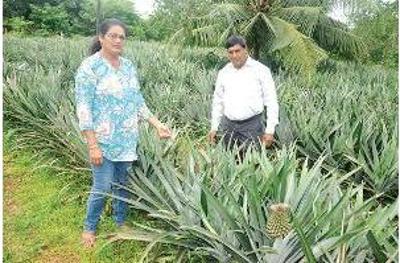
Last year, when 56-year-old Ronald Mark D’Souza decided to set up a pineapple farm in Shirva about 18 kilometres from Udupi, the biggest challenge before him was the water supply – a farming essential that suffered because of electricity fluctuation, as well as labour .
D’Souza, though, was determined to find a solution to the problem. After reading up a lot on the GSM-based irrigation system, he decided that that was what suited his farm the best. Speaking to Bangalore Mirror, he said, “I have implemented a very simple mechanism. One need not be in the farm while waiting for the supply of electricity in order to switch on the pump. We have in place a system that provides the farmer the flexibility to regulate and control the operations of their irrigation systems. The GSM sim-based control system has a registered sim inserted in it. The system can control the pump set operations (on and off) from a mobile number with which it has been tuned. The user just needs to make a call to start the pump. It has been programmed to receive commands from only one mobile number. It also sends an SMS whenever there is an interruption in the power supply. I just need to recharge it with an SMS pack.”
D’Souza has developed a pineapple farm called Ronjus garden. “Even when I am not in station, I can control the sprinklers in our farm,” he said. After working in Abu Dhabi for 10 years, he returned to India to work as a financial consultant. In about 3.5 acres of land that he owns, he has grown about 40,000 pineapple plants. He plans to develop a papaya farm as well as a full-fledged organic vegetable farm. His wife Jacintha, a beautician, assists him in the farming. “My dream is to develop a model organic garden. In the west, the support for farming is excellent. Labour is one of the biggest problems haunting the farming community,” he added.
source: http://www.timesofindia.indiatimes.com / The Times of India / News Home> City News> Bangalore / Bangalore Mirror Bureau / October 10th, 2016
Project will be implemented at livestock breeding and training centre at Koila, says Manju
The government has taken up a project to conserve and promote the Malnad Gidda cow breed, according to A. Manju, Minister for Animal Husbandry and Veterinary Services.
Addressing a gathering at a function organised to lay the foundation stone for a veterinary college at Koila, he said that the project would be implemented at the livestock breeding and training centres at Koila in Dakshina Kannada and at Koodige in Kodgadu district.
“The government has sanctioned Rs. 5 crore for the project,” he said adding that 50 cows had been selected now for breeding.
Maland Gidda is an indigenous breed of cow whose numbers are on the decline.
The veterinary college at Koila would be opened in 2018. The Minister said that the State’s milk production had touched 75 lakh litres a day now. He said that the government would recruit 650 veterinary doctors within a month.
Mr. Manju said that the government had constituted Karnataka Sheep Federation with 260 cooperative societies attached to it.
U.T. Khader, Minister for Food and Civil Supplies, urged the Minister to open a dairy unit of Dakshina Kannada Cooperative Milk Union Ltd. at Koila.
source: http://www.thehindu.com / The Hindu / Home> News> Cities> Mangaluru / Special Correspondent / Koila (Puttur Taluk) / October 10th, 2016
Noted psychiatrist, chairman of the state’s mental health task force and award-winning film producer, Dr KA Ashok Pai, died of a massive heart attack in Scotland in the early hours of Friday. The 69-year-old was at an international conference with his wife Dr Rajani Pai.
According to his family, Pai, who landed in Scotland three days ago, had a heart problem on Thursday night and was rushed to hospital where he passed away. His body is expected to reach Shivamogga on Saturday or early Sunday.
Pai was committed to promoting mental health among people and set up the Manasa Trust, which treated lakhs of patients suffering from mental diseases. He would produce films which highlighted the problems of mental health. His films Prathama Ushakirana and Kadina Benki and tele-serial Antarala bagged awards.
Pai was a writer, brilliant orator, TV presenter on psychoanalysis, environmentalist/filmmaker Suresh Heblikar said. Pai felt psychiatry shouldn’t be restricted within the confines of a counselling chamber… he wanted to popularize it as a treatment available to all, he added.
source: http://www.timesofindia.indiatimes.com / The Times of India /News Home> City News> Bangalore / TNN / October 01st, 2016
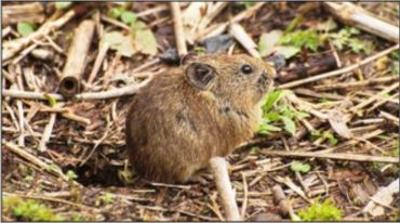
When PhD student Nishma Dahal embarked on her first trip to east Sikkim, little did she know it would lead to a stunning discovery in the eastern Himalayas . The efforts of Nishma and other researchers from National Centre for Biological Sciences (NCBS) have led to the identification of a new species of pika, a mammal which resembles a tailless rat.
The new species, Ochotona sikimaria, is an important part of the ecosystem and is vulnerable to climate change. Members of the rabbit family, pikas have been in the news in North America for their sensitivity to increasing temperature, which has caused several populations to go extinct. Pikas live on high altitudes in mountianeous regions, which makes them more susceptible to habitat loss due to the increasing global temperature.
The discovery was a great challenge for Nishma as most pika species closely resemble one another. She started her work by collecting pika pellets to extract the DNA and identify the species.
Though the pellets are puny, Nishma was successful in amplifying the mammal’s DNA from them. When Nishma compared these DNA sequences to those of other pika species in the world, she found them to be quite different. But this was only the beginning of her mission.
To prove it was indeed a new species, Nishma had to compare the Sikkim pika to its close relatives, which are found in China. It took Nishma and Uma Ramakrishnan, whose laboratory at NCBS led the study, two years to build collaborations with researchers from the Chinese Academy of Sciences, Zoological Museum of Moscow and Stanford University to get detailed data on the sister species.
The NCBS research reveals while Ochotona sikimaria appears similar to the Moupin pika (found in China), they are quite distinct from a genetic and ecological perspective. So far, the new species seems to be limited to Sikkim. The NCBS team searched for the Sikkim pika in other Himalayan regions, including Arunachal Pradesh, central Nepal (Annapurna and Langtang), Ladakh and Spiti but to no avail.
All is not well for this tiny mammal, says Nishma. “Unlike other mammalian species inhabiting such harsh environments, Pikas do not hibernate. They prepare for winter by collecting and storing hay piles. We must investigate their vulnerability to increasing global temperatures, and to do so we must better understand their ecology and population dynamics. Such information is lacking in the case of Asian Pikas,” she said.
“The opportunity to work on Himalayan biodiversity has been amazing, and I have learned how little we know about our own species. Pikas are ecosystem engineers, and we must understand more about them to protect them,” said Uma. The study has been published in the journal Molecular Phylogenetics and Evolution.
source: http://www.timesofindia.indiatimes.com / The Times of India / News Home> City News> Bangalore / TNN / September 27th, 2016
Dr. Devi Shetty and Sudha Murty unveiling the plaque at the launch of ‘Infosys Institute of Robotic Surgery.’
Bengaluru :
Narayana Health (NH), Bengaluru, has launched the Institute of Robotic Surgery supported by Infosys Foundation at its flagship unit at Narayana Health City.
The da Vinci Robotic Surgical System will be used primarily for prostate, kidney, gynaecological, colorectal and select head and neck cancer surgeries.
Symbolically unveiling the plaque, signifying the launch of ‘Infosys Institute of Robotic Surgery,’ Sudha Murty, Chairperson, Infosys Foundation said, “The need to adopt and continually update treatment protocols that reduce errors is crucial for a country like India, which sees high patient volumes and a wide spectrum of complex diseases. Robotic surgery, with its high degree of precision and faster recovery time, has the potential to address this efficiently. Our partnership with Narayana Health, incontestably a pioneer in delivering world-class healthcare, is aimed at encouraging rapid adoption of robotics in healthcare in India. Through this endowment, we also intend to provide impetus for further research in this area, and enable the masses to reap the benefits of affordable and high-quality treatment.”
“Technique of surgical intervention on the human body is undergoing dramatic change. It took over 30 years for laparoscopic surgery to replace open abdominal operation. World is on the threshold of a major transition from laparoscopic surgery to robotic surgery,” said Dr. Devi Shetty, Chairman, Narayana Health.
Robotic surgery has proved that inaccessible areas of the human body like deep in the pelvis where a prostate surgery needs to be done for a patient with cancer of the prostate can easily be accessed. Robotic surgery has proven beyond doubt its supremacy.
“It is a matter of time before most procedures on the human body will be done better with robotics. However, for the large scale technical adoption of robotic surgery major hitch is the surgeon’s skill,” informed Dr. Devi Shetty. Today surgical robots are available in very few centres across the world and the training programme to train an experienced surgeon as a robotic surgeon is expensive and inaccessible.
Explaining further on the need for such training programmes, Dr. Devi Shetty said, “Infosys Foundation always believed in the power of technology to transform the world and address the human sufferings. With that objective, Infosys Foundation donated ‘da Vinci Surgical Robot’ to develop Infosys Institute of Robotic Surgery to train robotic surgeons for the future. The philosophy of creating the institution is to train any surgeon with a passion to learn robotic surgery and certify them to start robotic surgical programme in different parts of the country. NH Foundation along with Infosys Foundation believes that this is the only way robotic surgery services will be available to the common man of this country.
source: http://www.starofmysore.com / Star of Mysore / Home> General News / August 19th, 2016
Prof. Ram Rajasekharan (right), Director, CSIR-CFTRI and Kadrigowda, MD, KSMD&MCL, seen exchanging the MoU.
Mysuru :
CSIR-Central Food Technological Research Institute (CFTRI) signed a Memorandum of Understanding (MoU) with Karnataka State Mango Development and Marketing Corporation Ltd. (KSMD&MCL) under Department of Horticulture, Government of Karnataka recently for establishing a Mango Development Centre (MDC) at ChintamaniTaluk, Kolar.
As per the agreement, CFTRI will function as a technical consultant for creating infrastructure for post-harvest handling of mangoes. The plant with unit operations such as washing, sorting, pre-cooling, cold storage, pulp extraction and processing will be commissioned by CFTRI under the agreement.
The Institute has developed number of technologies on mangoes which include, Technology protocols for shelf-life extension that enable export of mango var. Alphonso by ship, Fortified mango bar, osmo-air dried mango slices, Ready-To-Serve fruit beverages, fruit syrups and squashes, pickles & chutneys, Jam and jellies. A few of these technologies will be transferred to MDC.
MDC personnel will be trained on processing and quality analysis of products. In turn, the MDC will also impart training to farmers and entrepreneurs.
It may be noted that CSIR-CFTRI has been working with various State government departments for catalysing the growth in the nascent sector such as Nutraceuticals with Karnataka Biotechnology & Information Technology Services (KBITS), skill development in association with Karnataka Council for Technological upgradation (KCTU), Department of Industries and Commerce, ensuring nutritious meal to Hostelmates with Department of Social Justice and providing nutritional supplements to Anganwadis with Department of Women and Child Development.
The MoU documents were exchanged between Prof. Ram Rajasekharan, Director, CFTRI and Kadrigowda, Managing Director, KSMD& MCL, at a simple function held at CFTRI.
source: http://www.starofmysore.com / Star of Mysore / Home> General News / August 12th, 2016
The Indian Institute of Science (IISc), Bangalore had the lion’s share of medals with five of its faculty members being awarded the Indian National Science Academy (INSA) Medal for Young Scientists 2016, making it the institute with more awardees than any other, a release said.
The winners from IISc this year are: Prabeer Barpanda, Sai Siva Gorthi, Praveen Kumar, Anshu Pandey and Chandan Saha.
The INSA annually presents the Young Scientist Award to distinguish young scientists who have made notable research contributions in science and technology. Started in 1974, about 760 scientists have been recognised so far. A maximum of 30 awards are given each year.
Terming it a matter of pride for its faculty, Anurag Kumar, Director, IISc said: “These awards have recognised work that cuts across boundaries of basic research and applied research, and of science and engineering. Their conferral on our faculty is testament to the success of the rich and varied, interdisciplinary intellectual atmosphere of the institute.”
The winners
Praveen Kumar, Assistant Professor at the Department of Materials Engineering: Awarded for his discovery of electric-field induced changes in the mechanical behaviour of Carbon Nanotube (CNT).
Prabeer Barpanda, Assistant Professor at the Materials Research Centre: Awarded for his work on the development of new classes of Lithium and Sodium cathode materials for next generation battery and storage application.
Sai Siva Gorthi, Assistant Professor at the Department of Instrumentation and Applied Physics: Awarded for his contribution to the field of Innovative Optofluidic technologies, an area that combines the advantages of microfluidics and optics. His recent work includes research and development of in-vitro diagnostic tools, biomedical instrumentation and microfluidic nanotechnology.
Chandan Saha, Assistant Professor at the Department of Computer Science and Automation: His work on arithmetic circuit lower bounds, polynomial identity testing and reconstruction of arithmetic circuits has led to the discovery of new mathematical techniques and substantial progress on these problems.
Anshu Pandey, Assistant Professor at the Solid State and Structural Chemistry Unit: Made it to the list with his contributions in the area of low threshold quantum dot lasers.
Praveen Kumar, Assistant Professor at the Department of Materials Engineering:
“In our work, we discovered that the strength and the energy absorption capacities of CNT cellular structures could be dramatically enhanced by applying an electric field. In addition, we also studied how we can manipulate the stress relaxation and creep behaviours, which are important for knowing the long-term applications of these samples.”
Chandan Saha, Assistant Professor at the Department of Computer Science and Automation:
“Understanding computational efficiency is a great challenge in theoretical computer science. Our work in the last eight years has revealed new insights into the behaviour of low-depth circuits that capture highly parallel computations. Low-depth circuits also form a gateway to understanding the intricate nature of general arithmetic computations. So, there is hope that some of the ideas and proof techniques introduced in our work will continue to generate exciting new research in the area.”
source: http://www.thehindu.com / The Hindu / Home> National> Staff Reporter / Bengaluru – August 12th, 2016
Dr. Narasanagi in his scrub suit in the year 1981.
by Dr. K. Javeed Nayeem, MD
Being constantly by his side, Dr. Shivashankar Halkai and I naturally used to get many chances to assist Prof. Narasanagi during operations as our college then did not have post-graduate students who now do most of the minor surgical work and assist their professors in all major operations. During our free time, Dr. Shivashankar and the senior operation theatre nurse, Saramma would teach me how to tie the different kinds of surgical knots which they had mastered exceedingly well under the training imparted by our mentor. With our constant association and practical interaction, a stage soon came when Prof. Narasanagi would ask Dr. Shivashankar, Saramma and me to start ‘opening up’ as soon as we called him over the phone to inform him about the need to come for an emergency operation.
He would then arrive and take over the main part of the operation after finishing which he would again ask us to ‘close up’ while he watched our work with an eagle’s eye. Whenever one of us was a little apprehensive about doing some tricky part of a surgical procedure, he would say “Useless fellow, don’t hesitate. I’m watching you closely. You need to have a lion’s heart. Be bold and go ahead, it’s not so easy to kill a man!” He was such a committed teacher that he would not let any of us go home after his classes until everyone in the group answered every one of his questions to his full satisfaction. The result of this insistence was that we would all interact and help each other to meet his expectations thus ensuring that even the dullest members of our group mastered the subject which was actually the man’s game plan!
Once we had a situation where a truck driver had been very badly injured with much blood loss. Prof. Narasanagi examined the man and advised us about the treatment protocol although he expressed much doubt about the man’s survival. Upon my request he allowed me to do a Venesection on this patient independently. This is a procedure where a peripheral vein is surgically exposed and a cannula is inserted into it to allow intravenous fluids to be transfused quickly to maintain blood pressure and circulation. The nurses quickly put up a screen across the waist of the patient while I seated myself on a stool at his foot end and started working on his ankle. The other doctors were busy managing the head end of the patient, inserting a tube into his wind pipe and giving him artificial respiration with a bladder-like device called an Ambu Bag. Assisted by an experienced nurse I took my time with my first independent attempt at such a procedure and I managed to do a pretty neat and surprisingly bloodless job of inserting the cannula into the vein.
Once it was over, hiding my sense of elation, I looked at my professor who was standing behind me and watching my work and asked him if the procedure was satisfactory. He smiled and thumped my back hard and said “Congratulations my boy, you’ve done a great job. The only problem is that although it has given you valuable experience it will serve no useful purpose for your patient because he has been dead for the past forty-five minutes! Did you not notice that he had stopped bleeding long ago?” That is when I realised that the reassuring absence of blood loss was not because of my proficiency and skill but simply because the patient’s heart was not beating at all! All the others in the room, especially the young student nurses, had a hearty laugh at my expense while I looked like a stupid fool.
The great teacher that he was, my professor had quietly instructed all the others in the room to remain silent and allow me to work without interruption to keep my morale high! While we were interns we used to do many odd jobs in the emergency room including suturing injuries and bandaging wounds. And, when it came to bandaging it was no big deal except when the part to be bandaged happened to be the patient’s head. Now because the head is a round object, no matter how well we did it, the bandage would not stay for long and it would simply slip off even before the patient reached his home, entailing a return to the hospital!
Our repeat attempts would only make us look like fools in the eyes of the patients’ relatives who would ridicule us at our lack of competence. But very soon through the hospital grapevine I gathered that there was a retired ward boy called Narayan who was an expert in bandaging the head. With a great deal of effort I soon located this elusive man who naturally was no longer a ‘boy’ and with much greater effort I persuaded him to teach me the art and science of bandaging the head. I spent an evening with him in my room being his pupil having persuaded my errand boy, Syed to be the dummy patient. And, lo and behold, in less than an hour I found that my bandages were staying put on Syed’s head no matter how violently he shook it. Elated beyond expression, I thrust a ten Rupee note into each of their hands and I packed Narayan and Syed off to have a sumptuous dinner!
I kept this project top secret from all my classmates and teachers but soon they began to notice the vastly better quality of my work and all the patients whose heads needed to be bandaged a second time would naturally be referred to me. I had suddenly become Narayan Junior! One day Dr. Narasanagi saw me at work seemingly with a look of admiration and asked me how I had mastered the art. “By much practice Sir,” I replied very humbly. He nodded his head and said “Very good, you’re doing a good job. Keep it up.” I felt like a hero in front of all my class mates.
Then he put his arm around my shoulders and walked with me up to his car and stopped there. With his arm still around me he smiled and asked me “Rascal, now tell me honestly how much you paid Narayan?” And, I told him. He then said “My son, you can learn things only when you conquer your ego. You have done it and that is why you are learning things which although seemingly very small will yet make a very big difference in your life. I feel very happy that you have this attitude and humility to learn from people as ordinary and humble as Saramma and Narayan!”
Contrary to my plans and although I had a great desire to become a surgeon, I ended up qualifying as a Physician later on in my life. The reason for this is that although I had got a seat for both the specialties, one at Mysore and the other at Davangere, while choosing between Surgery and Medicine I chose the latter because I felt that I would be happier working alone rather than with a well-organised team all through my life. The need to look after our coffee estate, located in a very remote area, also influenced my choice to a certain extent. However, this very unusual decision of mine made Prof. Narasanagi feel very sad and disappointed with me. It took him much time and effort to come to terms with it but the intensity of his love and affection for me thankfully remained the same for the rest of his life.
But although I became a physician, the ‘hands on’ surgical experience that I had gained during my under graduate days with Prof. Narasanagi helped me to independently manage almost all surgical and gynaecological cases even in the absence of the respective specialists when I had a long stint in the remote Holy Cross Mission Hospital in what was then considered the notorious ‘Veerappan Territory’ for many years. It was a place where my colleagues and I used to see and treat the poorest of the poor patients with no means to go to cities for the treatment of even their most serious problems. I used to at times be physician, surgeon, gynaecologist, orthopaedician, anaesthetist or dentist, depending on what problem the patient had. I also used to maintain and repair all the hospital equipment, pumps, generators and jeeps!
My wife and I used to stay in a solitary house in the middle of nowhere on a thirty acre plot of land, completely cut off from civilisation. But we enjoyed our stay and I enjoyed my work and that is what mattered most. Our humble abode served as holiday home for dozens of our relatives and friends who would lose no chance to come down and spend many happy days with us. The years I spent there were the most fulfilling years for me both professionally and personally.
[To be continued]
e-mail: kjnmysore@rediffmail.com
source: http://www.starofmysore.com / Star of Mysore / Home> Feature Articles / August 05th, 2016
__________________________________
Part II contd..
Over a cup of evening tea : My last meeting with my Mentor
by Dr. K. Javeed Nayeem, MD
In the year 2000 when I had been to Gulbarga with my family for the Silver Jubilee reunion of our batch, Prof. Narasanagi had retired and settled down at Bijapur. To pay my respects to him, I decided to return via Bijapur although it would entail a fairly long detour and so I called him up a day earlier from Gulbarga to say that I would be dropping in to see him. He was very excited to hear my voice and said that he would be very happy to see me after such a long time. When I met him the next morning, although he said that he was overjoyed to see me and my wife and children too, I could not help noticing that he was not at ease with himself.
During the course of our conversation he asked me if there was anything he could do for me. When I told him that the sole purpose of my visit was to meet him and pay my respects to him, he seemed visibly relieved and happy. He then became silent for a long time before saying “Javeed, I’m touched by your gesture and overjoyed to meet you and your family but let me confess that when you called me up yesterday to say that you were coming to see me you really gave me a sleepless night. From the moment you called me up I was wondering what the reason for your visit could be and whether I would be able at this age to fulfill your request if you had any. I even wondered whether you would be asking for my help in getting your daughter a medical seat here or at Gulbarga. I would have been heart-broken if you had asked for some help which I couldn’t extend to you!”
Once when my father visited Gulbarga to see me I took him to meet almost all my senior professors. When he met Prof. Narasanagi and asked him what impression he had of me my professor looked down, paused for a long while and then raising his eyes he said, “Sir, you have left a diamond in Gulbarga and I’m only polishing it. But mind you, polishing a diamond is very hard and slow work but don’t worry, I’ll do it to perfection!”
Talking of diamonds brings to my mind one more interesting incident about Prof. Narasanagi. As the time for our final year examination neared there was a strong rumour that he would become our internal examiner. Naturally all the students of our batch were happy that he would protect our interests if any of us ran into rough weather with any of the difficult clinical cases. But when the examination started we found that he was nowhere around. Thankfully, everything went very well with all of us and I in particular scored very high marks in all subjects including surgery.
While my close friend Ravi Dhaded scored the highest marks in surgery I stood second. When I went to meet Prof. Narasanagi after the results he congratulated me and said that he was very happy and satisfied that I had fared exceedingly well. He then revealed to me that he was supposed to be our examiner but he had turned down the offer of examiner-ship because the closeness he shared with me would seem unfair to the other students if he became our examiner! He then said, “You see, I am very particular that the diamonds that I polish should be absolutely flawless! No one should cast aspersions on their quality!”
Another lucky break in surgery
Having narrated the special relationship I had with Prof. Narasanagi, who was a really great surgeon and teacher, I feel I should tell about another chance encounter that introduced me to another great soul and enriched my life. Life is full of such serendipitous incidents and my life in particular seems to be richly endowed with them which are a great boon to the fledgling writer in me. This one is about how another very great surgeon took a liking for me and took me under his care and guidance due to a most unexpected turn of events.
Once very early during the course of my first posting in surgery I was among a group of students who were waiting to watch Dr. S.S. Hussain perform an operation. I just happened to be there in the operation theatre although I was never attached to his unit having been posted to his second-in-command, Prof. Narasanagi’s unit. Now, Prof. Hussain was the Head of the Department of Surgery and he was the person who held the record of having performed the highest number of Gastro-Jejunostomies in the country during his time. This operation was a kind of bypass that used to be done to overcome the narrowing of the duodenum and cure ulcers in the stomach at a time when specific drugs to suppress acid secretion were not yet on the scene. The arrival of this class of drugs has almost wiped out this operation which is now done only as a last resort to prolong the life of patients with stomach outlet cancer.
Prof. Hussain was a grey haired, stocky man and his most striking feature were his short stubby fingers which seemed completely out of place on a surgeon’s hands. An age old adage in surgery is that a good surgeon should have an eagle’s eyes, a lion’s heart and a lady’s fingers! While he certainly had the first two, Prof. Hussain certainly did not have the last of these three attributes. But he was a wizard when he picked up his operating knife and it was a joy to watch him at work especially when he was performing his favourite operation. Even as one saw him stitching layer after layer of tissues and wondered what was happening the net result of his handiwork would suddenly become evident as if by magic.
That day as Dr. Hussain emerged from the scrubbing room with his arms held aloft he seemed to be upset and furious about something. He looked around gravely and asked if anyone wanted to assist him in the operation that he was about to do. Seeing his angry countenance all those endowed with better judgment and common sense held their ground while I impulsively raised my hand and stepped out of the tightly huddled group of students. Being in the first clinical year I was actually among the junior-most ranks present there and my adventurism would have been seen as the most rash and disaster-inviting act by all my seniors of two years who were also in attendance there.
So when Prof. Hussain asked me which year I was from and I answered that I was from the first clinical year, they could not hold back their laughter despite their best efforts. He then pointed to the scrub room and said “Good, if you are sure that you want to assist me, for a start you can begin by cleaning all the three wash basins in the scrub room by the time I finish this operation. They are in a disgusting state and I hate it. And, mind you this too is very much a part of assisting me in this operation! Now that you have volunteered, please get to work.”
This time none of the others in the room made any effort to suppress their laughter which echoed around the room. After the commotion died down, Prof. Hussain and all the others entered the operation theatre and I entered the scrub room, alone. Yes, the wash basins there were indeed in a disgusting state, thanks to a lack of commitment in whoever was committed to keep them in a usable state. Wasting no time I pulled on a pair of surgical gloves and got down to work with a stiff brush and plenty of soap and in less than an hour I had them as sparkling clean as they had perhaps been when they were installed years ago.
When Prof Hussain emerged out of the operation theatre he walked into the scrub room and came out immediately with his blood stained hands still clasped together tightly. He looked at me long and hard and asked “Young man, what does your father do?” “He is a coffee planter and a former professor of Psychology Sir” I replied. “Ah, a coffee planter and a professor of Psychology! Very interesting, Very very interesting. Well, you may just be a first year clinical student but from now onwards, whenever I happen to be operating and whenever you happen to be free from your classes, you can scrub and join me as my second assistant. Young man, I’ll teach you how to operate!”
e-mail: kjnmysore@rediffmail.com
source: http://www.starofmysore.com / Star of Mysore / Home> Feature Articles / August 17th, 2016
Dr. B.S. Mahanand, Associate Professor, Department of Information Science and Engineering, JSS Science and Technology (JSS S&T) University, has received the Raman Fellowship from University Grants Commission, Government of India, to pursue post-doctoral research at the prestigious Harvard Univer- sity, USA. He left for Harvard University today.
His research at Harvard University focuses on identifying imaging biomarkers responsible for Alzheimer’s disease and other dementias. He will be developing advance procedures for tracking of Alzheimer’s as well as towards understanding of the mechanisms that cause the disease. Dr. Mahanand has researched on a unique amalgamated area of engineering and medicine; the detection of Alzheimer’s disease using machine learning approaches.
In his previous achievements, Dr. Mahanand was awarded with Visiting Research Fellowships at Helsinki University of Technology, Finland (2007); Nanyang Technological University, Singapore (2012) and Visiting Scientist at National Magnetic Resonance Research Centre, Bilkent University, Turkey (2015).
He is also conferred with Best Ph.D Thesis Award (2012-13) from Karnataka government’s Board for IT Education Standards. His visit to Harvard will help JSS S&T University in creating avenues for interdisciplinary and user-oriented research, development of joint research and faculty exchange programmes.
source: http://www.starofmysore.com / Star of Mysore / Home> General News / July 30th, 2016
IISc scientists develop new bio-molecule to treat cancer using light as a source for burning away malignant cells
Conventional cancer treatment methods of surgery, chemotherapy and radiation — known as cut, slash and burn for the brutal side-effects they cause on patients — are largely unsuccessful in differentiating between healthy non-cancerous cells and tumour-causing cells.
A team of scientists from the Indian Institute of Science have developed a new bio-molecule that can help treat cancer using light as a source for burning away malignant cells, a method which is more successful at targeting only cancerous cells.
This bio-molecule can be used in a relatively new form of cancer treatment known as photodynamic therapy, where a chemical (called a photosensitiser) is used kill small groups of cells. Put simply, the new molecule acts as a photosensitiser, which when exposed to a specific wavelength of light, gets triggered and kills nearby cancerous cells, leaving healthy cells intact, according to an IISc release.
Akhil R. Chakravarty, professor at the Department of Inorganic and Physical Chemistry, IISc, and his team are behind the development. The major benefit is that medical professionals have more control over which cells are targeted in the patient’s body. “Photodynamic therapy kills off cancer cells selectively, meaning toxicity to healthy cells can be reduced,” Dr. Chakravarthy told The Hindu.
Multiple methods
The bio-molecule, a vanadium (chemical element) containing complex molecule, targets cancerous cells through multiple methods: it carries a separable chloride ion due to which it caused cross-linking in DNA, leading to cell death. Cross-linking occurs when chemical agents react at two different positions in the DNA.
The molecule, when exposed to visible light, also generates a form of oxygen which can kill nearby cells. The team found that this bio-molecule was non-toxic in normal cells. This has major implications in the field of cancer treatment as existing treatments cause indiscriminate harm to healthy living cells, along with cancerous cells.
“Photodynamic therapy is an emerging field of cancer treatment. It may take some time for doctors in India to start using it,” said Dr. Chakravarthy. Their research was published in the July edition of peer-reviewed journal MedChemComm, produced by the Royal Society of Chemistry, United Kingdom.
source: http://www.thehindu.com / The Hindu / Home> News> Cities> Bengaluru / by Staff Reporter / Bengaluru – August 05th, 2016