Category Archives: Science & Technology

Oral health without tears

Dr Srivats Bharadwaj talks to children and teachers of Brindavan School in JP Nagar

Bengaluru :

A public-spirited dentist is taking oral health care to the doorsteps of people. Dr Srivats Bharadwaj and his team of 15 doctors are also on a mission to make people aware of the importance of paying attention to oral health.

At Vatsalya – Centre for Oral Health, experts have been providing care to individuals with no access or awareness about the same. Over the years, the team has conducted campaigns, workshops and camps in the villages, towns and cities of Karnataka. Vatsalya focuses on three areas — home care, clinical care and community health.

“We are on a mission to give world class treatment on a par with the West or even better,” explains Dr Srivats.

Recently, the team treated 450 children at government schools in Bengaluru. Its community initiatives began at Chittadhama near Kabini in H D Kote, at a centre for the mentally ill, where patients needed urgent help in oral health care.

. A girl at Government School in Manjunathnagar receives treatment | Express

The team carried a portable dental unit that fits into a suitcase and can do everything, including scanning and drilling. Similar camps took the team to Chikkamagaluru and Tumakuru, besides old age homes and orphanages in Bengaluru.

In 2013, the team adopted Kudur village in Tumakuru district to run a regular oral health care programme. Socare, an organisation that looks after indigent children of convicts, roped the team for a camp.

Dr Srivats has been treating children with cardiac problems for the past 5 years who need dental care, and the initiative is supported by ENR Foundation, Germany. The 41st group of children visited Vatsalya this month and over 25 children were treated before their heart surgery. More than 500 under privileged children have got a new lease of life under this initiative.

“Oral health is a window to one’s overall health, and my idea is to drive home this point. Our focus is on prevention as tooth decay and other problems can lead to multiple organ failure and 120 other health conditions,” he explains.

Drilling, filling and billing is what dentists do today, Dr Srivats says. “Dentists are seen in a poor light when they advocate procedures that are unnecessary and expensive. They don’t advise sealant medicine for children below 18 for the prevention of tooth decay. I am launching a Seal India prevention and interventional programme as it can keep the problem at bay for 20 years,” he adds.

Vatsalya has two centres in Bengaluru and is opening the third in Rajajinagar. In the coming days, the team hopes to spread its activities to Nepal, Bhutan, Bangladesh and Pakistan.

“We are not aligning with venture funds but are definitely looking at contributors with a social commitment,” says Dr Srivats.

The aim is to set up community health centres not funded by the government “We hope to make a huge difference in the coming years,” he says.

source: http://www.newindianexpress.com / The New Indian Express / Home> Cities> Bengaluru / by Meera Bharadwaj / July 31st, 2016
Travel Fellowship for City Doctor

DrHanumanthacharBF28jul2016

Mysuru :

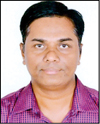
Dr. Hanumanthachar Joshi (in pic), Principal, Sarada Vilas College of Pharmacy, Mysuru, has been awarded the prestigious Travel Fellowship Award by Alzheimer’s Association, USA. Travel Fellowships are awarded to young scientists who make exceptional contributions to Neuroscience Research, especially Alzheimer’s disease.

He has been invited by the Association to present a research paper on “Cerebro-protective effects of Gangetin alkaloids on sodium nitrite induced hypoxia and ethanol induced neurodegeneration” at Alzheimer’s Association International Conference at Toronto, Canada, from July 24 to 28.

Dr. Joshi is working in the areas of drug discovery for management of neuro-degenerative disorders, particularly for Alzheimer’s disease. He is also invited by Department of Psychology, Ryerson University of Toronto, Canada, to deliver a guest lecture on management of Alzheimer’s disease and associated complications.

source: http://www.starofmysore.com / Star of Mysore / Home> General News / July 22nd, 2016

DFRL Director inaugrates Instant Idli Sambar and Chutney production unit in Hebbal

InstantIdliBF26jul2016

Mysuru  :

Dr. R.K. Sharma, Director, Defence Food Research Laboratory (DFRL), Mysuru, inaugurated the Instant Idli Sambar and Chutney Production Unit of Rajaganapathy Agro Food Industry in Hebbal here on July 11.

DFRL transferred the technology and know-how of Instant Idli Sambar & Chutney to Rajaganapathy Agro Food Industry.

The inventors Dr. G.K. Sharma, Sc. ‘G’, Dr. A.D. Semwal, Sc. ‘G’, Padmashree, Technical Officer, Govindaraj, Technical Officer, Neha Negi, Sr. technical Assistant, Dr. M. Pal Murugan, Scientist ‘D’, Technology Transfer Team and Managing Partners of Rajaganapathy Food Industries were present on the occasion.

Rajaganapathy Food Industries is a joint venture company making entry into food industry by adopting the food technology from DFRL to serve the Indian Armed Forces and the civilian population.

Idlis, a fermented steam cooked south Indian delicacy, is relished all over the country due to better digestibility with unique textural and sensory attributes. However, idlis are highly perishable in nature and get spoiled within 24 hrs of preparation. To overcome the above problem, instant idlis along with sambar and chutney was developed by DFRL using combination drying technology.

The products are capable of reconstitution by mere addition of hot water within 4-5 minutes. The shelf life of the product is 12 months at ambient conditions.

source: http://www.starofmysore.com / Star of Mysore / Home> General News / July 20th, 2016

DRDO finds way to keep meat fresh sans fridge for one week

MeatBF25jul2016

A Defence Research & Development Organisation (DRDO) laboratory has a pleasant surprise for meat-eaters and the meat industry to reduce storage costs. It has developed a simple technology to extend the shelf-life of mutton to up to a week without cold storage facilities.

Normally, mutton after being cut remains fresh for only six hours without refrigeration, and up to two days with refrigeration. According to meat stall owners and cold storage managers at supermarkets, after that period unsold meat is wasted.

But scientists from the animal products division at the Mysuru-based Defence Food Research Laboratory (DFRL) of DRDO have developed a special extract from pomegranate peels that can be injected or applied to the meat and kept out without bothering about the meat rotting due to harmful bacterial action. And it can remain fresh for a week without affecting the meat’s natural taste or flavour.

_________________________________________

HIGHLIGHTS

  • A Defence Research & Development Organisation (DRDO) laboratory has developed a simple technology to extend the shelf-life of mutton to up to a week without cold storage facilities.
  • DFRL addressed the problem by identifying and applying a natural edible preservative – the pomegranate peel extract – and carried out sustained experiments
  • ______________________________________

DFRL scientists said while the research was mainly focussed on mutton, the beneficial effects of the pomegranate peel extract could similarly protect chicken meat and pork too.

At present no technology is available for the preservation of fresh mutton without any chemical preservatives that can improve the shelf life beyond 20 hours, claimed DFRL scientists.

DFRL addressed the problem by identifying and applying a natural edible preservative – the pomegranate peel extract – and carried out sustained experiments. They discovered that it significantly enhanced the shelf life of fresh mutton to seven days at ambient conditions.

PE Patki, head, food preservation, DFRL, informed Bangalore Mirror that pomegranate peels are powerful antioxidants (substances that inhibit oxidation that supports bacterial action and are used to counteract the deterioration of stored food products) with antimicrobial properties.

This prevented bacterial action on the meat even when kept out at room temperature.

Generally, meat kept out of cold storage for long periods are attacked by one or few of a whole range of harmful bacteria – Escherichia coli, salmonella, campylobacter jenuni, Clostri-dium botulinum, Clostridium perfringens, to name a few. Ingesting meat affected by these bacteria can cause severe symptoms like abdominal cramps, headache, fever, diarrhoea (sometimes with blood), and even death (if untreated).

Patki said to prevent these bacteria the meat industry generally used artificial chemicals-based additives for preservation. “These are toxic and not consumer-friendly, which necessitated finding plant extracts to raise the shelf life of meat at room temperature,” he said.

Primarily, the research aimed at finding a way to use natural preservatives to extend the shelf life of meat supplied to Indian Army jawans posted at the forward posts. “It takes a long time for the meat supply to reach them from the base camps; which is why we conducted this research and came out with this new technique, which we found was the best suited to extend the shelf life of mutton,” he said.

Senior DFRL scientists said the technology was ready to be transferred to the industry so the common people could avail of it.

The DFRL’s pomegranate peel extract is awaiting technology transfer and has been listed with the DRDO-Federation of Indian Chambers of Commerce and Industry Initiative on Accelerated Technology Assessment & Commercialisation, of which the centre’s Technology Develop-ment Board is a part.

source: http://www.timesofindia.indiatimes.com / The Times of India / News Home> City> Bangalore / by Nirad Mudur / Bangalore Mirror Bureau / July 25th, 2016

Bengaluru students develop gloves for speech impaired

The team of engineers with their mentor H R Nandi Vardhan

Bengaluru :

A team of engineering students has developed a glove that converts sign language into voice, helping people with speech impairment communicate better.

The smart glove, named Mudra ,converts gestures recognised under Indian sign language into spoken English.

The prototype that can convert gestures into speech

The prototype was developed by the students of Amrita School of Engineering — Abhijith Bhaskaran, Anoop G Nair, Deepak Ram and Krishnan Ananthanarayanan — as part of their final year project.

“In Sanskrit, mudra means gesture,” says Krishnan.

The idea for the project was born when the students were discussing the problems faced by the differently-abled. “As engineers, we wanted to give back to society. That is how we came up with this idea,” says Anoop.

Explaining how the device works, he says, “The flex sensor in the glove predicts the orientation of the fingers. The gyrometer, accelerometer and magnometer predict the movements of the hand in a 3D space. The sensor processes this data and produces audio output through the speaker.”

“We will start developing the device in two to three weeks,” he adds.

The team took 16 weeks to build the prototype and spent Rs 7,500. The glove can currently recognise numbers 1 to 10, and gestures corresponding to words such as morning, night, goodbye and thank you.

It can detect four different positions of each finger, and as many as 70 gestures can be configured. “We have begun validating its social feasibility. The preliminary results are very encouraging,” says Abhijith.

A lot of research went into the project, chips in Deepak. “We didn’t know how to go about it at first. We then studied about various sensors, their uses and the materials that can be used.”

The team claims that there are no side effects of using this glove and it is as comfortable as a riding glove.

H R Nandi Vardhan, assistant professor, Department of Electronics and Communication Engineering, mentored the team. “Initially, we thought of using a camera. But we realised that the cameras would be expensive and non-portable.”

While the gloves are only in the prototype stage, the team is looking for people to invest in the product. Once the cost is minimised, it can hit the markets.

source: http://www.newindianexpress.com / The New Indian Express / Home> Cities> Bengaluru / by Akhila Damodaran / July 23rd, 2016

Kolkata Metro to chug on Bengaluru-made wheels

Rail Wheel Factory gets nod to supply wheels to Kolkata Metro

Bengaluru :

The Rail Wheel Factory (RWF) in Yelahanka has been given the green signal to supply wheels to Kolkata Metro Rail Corporation. This marks the first time any Metro Rail in the country has opted for cast wheels for coaches, opening up a whole new market for the factory.

The clearance was given on Monday by the Research Design and Standards Organisation, Lucknow, an organisation under the Ministry of Railways, Rajeev Gupta, General Manager of RWF, told Express.

“We will be providing wheel sets (wheels and axles) for the coaches of the Kolkata Metro, which are being readied at the Integral Coach Factory in Chennai. They will initially be supplied for the trial runs of three coaches of a Metro train, which would be 24-wheel sets,” the GM said.

This followed three months of negotiations and paper work between the Kolkata Metro and RWF. The trial runs could take place over a year since it is a whole new experiment being undertaken of using cast iron wheels for Metro coaches. “When it is successful, we will be permitted to supply wheels. We could bag an order to supply between 500 and 1000 wheels,” Gupta said.

When asked about the chances of it passing the trial runs, he said, “We will sail through it. We have successfully conducted the Finite Element Analysis test, which is a simulation test done emulating a train running at high speed.” The fastest Metro trains run at a speed ranging between 60 to 70 kmph. “Our wheels run at 110kmph regularly and all Rajdhani trains have them. They can touch up to 130 kmph,” Gupta said.

RWF, the country’s largest manufacturer of wheels sets, had approached Delhi Metro Rail Corporation and Bangalore Metro Rail Corporation in connection with the supply of wheels. “However, since Metro trains only use forged iron wheels which are imported, RWF was not able to convince them to make it a wheel-supplier.” It has the capacity to manufacture nearly 2 lakh wheels and 72,000 axles by casting technology.

source: http://www.newindianexpress.com / The New Indian Express / Home> States> Karnataka / by S. Lalitha / July 22nd, 2016

IISc. to prepare biodiversity mapping of Permude GP area

T. V. Ramachandra
T. V. Ramachandra

The Centre for Ecological Sciences at the Indian Institute of Science (IISc.), Bengaluru, will prepare the biodiversity mapping of Permude Gram Panchayat area soon, according to T.V. Ramachandra, a scientist at the centre.

Speaking at a workshop on ‘Biodiversity and natural resources’ organised by St. Aloysius College here on Saturday, he said that a survey of biodiversity under the jurisdiction of the panchayat would be conducted for two days from Sunday.

Mr. Ramachandra said that there was a proposal to set up industries covering the Permude Gram Panchayat area under the Mangaluru Special Economic Zone. The government could take a call based on the study report by the IISc.

He said that gram panchayats should prepare a people’s biodiversity register under the Biological Diversity Act, 2002. It is a gram panchayat-level register that documented local biodiversity and the local community’s traditional knowledge on biodiversity including its conservation and traditional uses. But most gram panchayats in the country did not prepare it. The register helped gram panchayats take decisions.

Replying to a question from a participant, Mr. Ramachandra disagreed with the government’s claim that the tree cover in the country was increasing.

“They [some government officials] are considering even area under paddy as tree cover,” he said adding that independent researchers should come forward to conduct a field study and prove how some of the claims of government officials were misleading.

Unless independent researchers proved the reality with accurate data, the government believed the data provided by its officials.

“They [government officials] are giving wrong data. There is a need to counter it with facts,” Mr. Ramachandra said adding that tree cover in many districts was coming down. “For example, it was down by 45 per cent in Shivamogga district,” he said.

Mr. Ramachandra said that there should be seven trees per person.

The three-day workshop organised by the college included field study for its students. A team of resource persons from the IISc. spoke on different aspects of biodiversity.

They spoke on documentation of biodiversity, data management and publication. The students and faculty of the college were informed about the methods of assessing village biodiversity, undertaking biodiversity studies of terrestrial and aquatic ecosystems.

Swebert D’Silva, principal of the college, was present.

source: http://www.thehindu.com / The Hindu / Home> News> Cities> Mangaluru / Special Correspondent / Mangaluru – July 24th, 2016

Kidwai first govt hospital to get machine for robotic surgery

KidwaiBF14jul2016

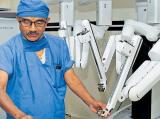
Kidwai Memorial Institute of Oncology has become the first government hospital in Karnataka to set up a robotic machine to perform critical oncological surgeries.

The Centre has contributed Rs 12 crore for the Rs 16-crore machine known as Da Vinci Xi Surgical System, with the institute bearing the rest of the cost.

“This machine can perform critical surgeries in sensitive parts of the body including stomach, without causing any pain or infection. Since it does not involve any side effects, patients are cured soon,” said institute director Dr K B Lingegowda.

Head of the surgery department, Dr Krishnamurthy said, “All kinds of surgeries can be performed with ease using the robotic machine including oesophagus, rectum, prostate and uterus cancer.”

Cost not an issue

Dr Krishnamurthy added that the cost of the surgery was very high with the tools used in the surgery alone costing between Rs 80,000 and Rs 1 lakh.

“However, the cost is not an issue for patients getting treatment at our hospital under various government schemes,” he said. Dr Krishnamurthy said doctors will visit Korea to train on the machine and added that on an average, the machine can perform two surgeries a day.

source: http://www.deccanherald.com / Deccan Herald / Home> City / DHNS – Bengaluru, July 14th, 2016

Two Bengaluru based researchers bag Gandhi Award in London

 ResearchersBF11jul2016

_____________________________________

Highlights

  1. Dr Ratnavalli Ellajosyula and Nidhi Dev get the prestigious Gandhi International Fellowship Award.
  2. The CNC has been working on research projects in the fields of dementia.
  3. The Gandhi Fellowship Award was set up by a UK based neuropsychologist Dr Narinder Kapur

________________________________________

Bengaluru :

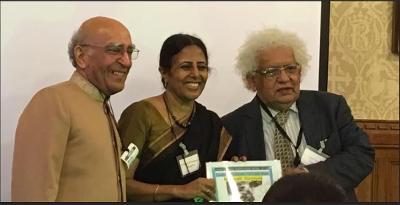
Two researchers from Bengaluru have been awarded with the prestigious Gandhi International Fellowship Award by Lord Meghnad Desai in the House of Lords, London, recently.

Dr Ratnavalli Ellajosyula, founder, Cognitive Neurology Clinic (CNC), and Nidhi Dev, Neuropsychologist, CNC, were among the ten doctors and researchers who were honoured. The team was awarded this fellowship for their outstanding research in the fields of dementia.

The CNC has been working on research projects in the fields of dementia that was presented at the mid-year Meeting of the International Neuropsychological Society in London.

Dr Ratnavalli Ellajosyula, a senior consultant neurologist, did her medical and neurological training in New Delhi. She was faculty, Department of Neurology at the National Institute of Mental Health & Neurosciences (NIMHANS), Bangalore for a decade. She started the behavioural neurology clinic there. She has a fellowship in Cognitive Neurology from the University of Cambridge, UK. She was also a research fellow at the University of North Carolina, Chapel hill. Currently, she heads the Memory Clinic at Manipal hospital.

She has more than a decade’s worth experience in cognitive neurology and neuropsychology. Her clinical interests are stroke, neuroinfections and dementia. Her research interests are multilingualism and dementia, breakdown of memory and mechanisms and neural substrates of language. She has several research projects and has published in the area of stroke and cognitive neurology.
Nidhi Dev is a Consultant Neuropsychologist at CNC with her areas of interest being epilepsy, dementia and children with neurological disorders. Her core research emphasis has been on epilepsy in children and in adults.
Dr Ratnavalli and her team study patients with stroke, dementia, head injuries, and encephalitis as well as healthy adults. Their research focuses on the neural underpinnings and mechanisms of cognitive functions like memory, language, and executive functions. Their work primarily involves doing detailed clinical and neuropsychological assessments that aid in accurate diagnosis of neurological conditions, treatment and designing of rehabilitation plans.
The Gandhi Fellowship Award was set up by a UK based neuropsychologist Dr Narinder Kapur in the memory and spirit of Mahatma Gandhi, to promote neuropsychology in India. Dr Kapur is currently visiting Professor of Neuropsychology at University College London.

source: http://www.timesofindia.indiatimes.com / The Times of India / News Home> City> Bangalore / by Sunitha Rao R / TNN / July 08th, 2016

City doctor receives national honour

DrHarinarayananBF08jul2016

Bengaluru :

Exposing your face and forearms to 30 minutes of sunlight between 11 am and 4 pm will get you sufficient Vitamin D for a day, says Dr C V Harinarayan of Sakra World Hospital, Bengaluru.

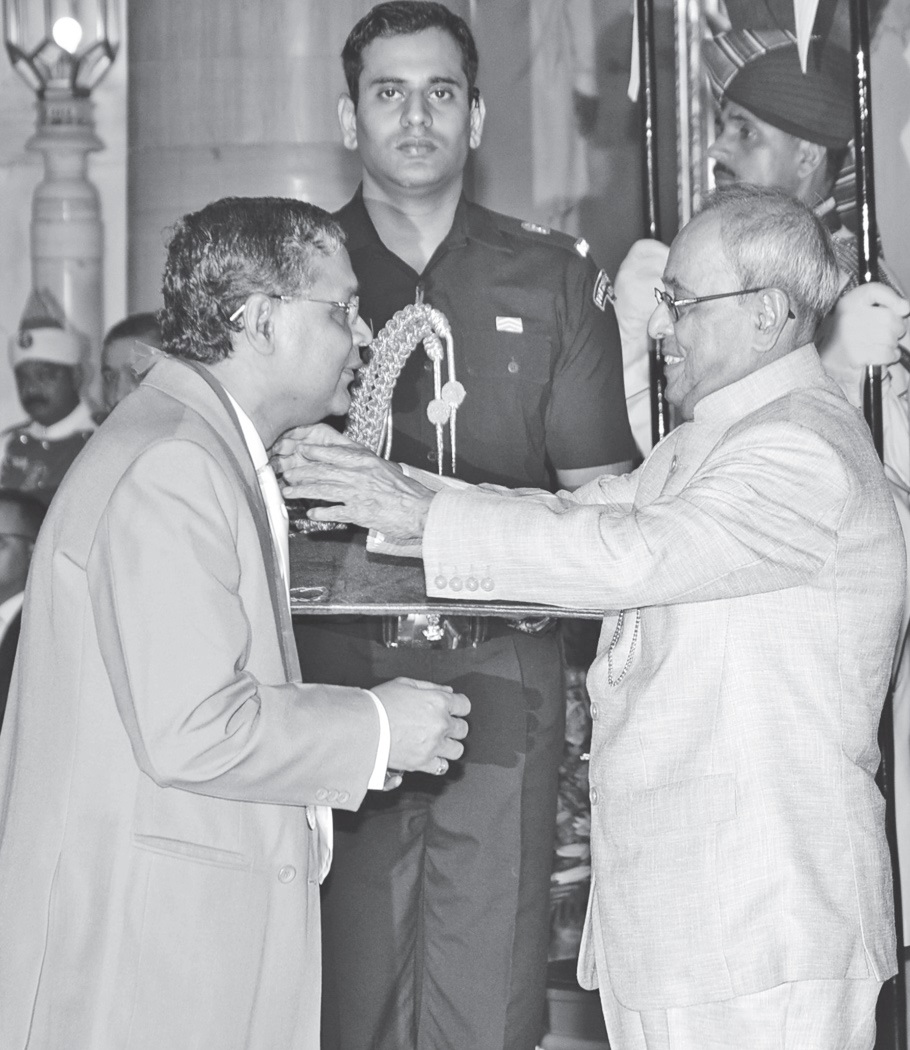
The Medical Council of India recently conferred him with the BC Roy Award for his work in the field of endocrinology and metabolic bone diseases.

Twenty-five other doctors of various fields also received the honour from President Pranab Mukherjee on World Doctors’ Day.

Despite India being a hot country, most of the population is affected by Vitamin D deficiency.

In 1990, a team led by Harinarayan conducted a study among the people of villages surrounding Tirupati in Andhra Pradhesh. The doctor was working with Sri Venkateswara Institute of Medical Sciences then.

“We found that the agricultural labourers of the region, despite exposing 80 per cent of their bodies to the hot sun for over eight hours a day, suffered from a deficiency of Vitamin D. The reason, research revealed, is that they don’t include sufficient calcium in their diet, which prevents the Vitamin D from being synthesised,” he explains.

The human body requires 1,000 mg of calcium a day. The labourers of the villages were found to consume only 260 mg, the study showed.

The urban population, on the other hand, consumes 600 mg a day. Vitamin D deficiency and bone diseases were found to be common among them too.

“People in metropolitan cities work in air-conditioned offices all day. Lack of exposure to sun makes them vulnerable to bone ailments,” Harinarayan says.

The doctor explains, “When the body faces a calcium deficiency, the parathyroid hormone – which makes the bones release more calcium into the blood – is released. Patients with hyperparathyroidism and calcium deficiency are prone to bone diseases as excess secretion of the hormone weakens the bones.”

He advises the urban youth to take a half-hour walk post lunch. “Besides speeding up your metabolism, it will expose you to sunlight and get you your daily dose of Vitamin D,” he says.

Children too should be allowed to play in the sun for an hour every day, he adds. “Milk and dairy products can be natural sources of calcium. Supplements are also advisable.”

While at SVIMS, Harinarayan and his team of doctors developed a IRMA radioimmunoassay with financial aid from Baba Atomic Research Centre, Mumbai.

“It is a kit that is used to deduce the parathyroid hormone levels in the blood. Earlier, we used imported kits. Under Prime Minister Modi’s Make in India intiative, we’re trying to develop the technology here,” he says.

The imported technology that costs Rs 35,000 will be available for Rs 3,500 once the indigenous kits gain popularity, he adds.

Currently the director of the Institute of Endocrinology, Diabetes, Thyroid and Osteoporosis Disorders at Sakra World Hospital, Harinarayan is working on a research project on Vitamin D deficiency in children.

source: http://www.newindianexpress.com / The New Indian Express / Home> Cities> Bengaluru / by Express Features / July 07th, 2016