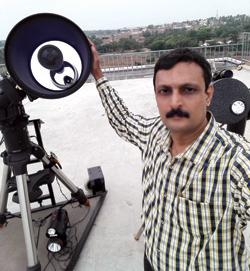
Vishal Vasmate, a student of aerospace programme at University of Southern California, in Bidar. —Photo: Gopichand T.
It is easy to tell whether Vishal Vasmate is in town. His motorcycle will be parked outside the madrasa of Mahamud Gawan and he will be sitting quietly on a model of the solar system carved atop the 15th century university.
He sits for hours contemplating on the medieval era institution of higher learning that attracted international students and keeps dreaming of jumping to the sky in a rocket.
“It is a matter of pride and unbelievable amazement that my home town had such an academic centre,” he says with a smile. “What is more, the teachers taught astronomy from a classroom on the ceiling, open to the air. They used as teaching aids, models of stars and planets made of lime mortar. The effort behind this is so inspiring that it makes my dream of travelling in space commonplace and doable,” he said. The student of the aerospace program at University of Southern California has come to Bidar to visit his parents.
His fascination with space started with a chapter on Kalpana Chawla in his school textbook. A visit to a planetarium made him addicted to novels and books about space. “I began idealising space walkers like Rakesh Sharma,” Vishal says.
His physics professor Jithesh Babu recognised his interest in physics and mathematics and nurtured him. Participation in a workshop for astronomy and astrophysics where he interacted with scientists from the Indian Institute of Science and the mission head of Indian Space Research Organisations’ Chandrayaan programme. “They gave me a firsthand account of the mission and the issues concerning space navigation,” he said.
Vishal went to the U.S. after a computer science degree from RV College, Bengaluru. He cleared the graduate record examination and chose USC. “I was attracted by its star alumnus Neil Armstrong and teachers like Mike Gruntman and Gerald Hintz, whose publications on design, spacecraft systems, and flight operations have led the way in space explorations,” he said.
“It is wrong to say that space science is only for scientists who lock themselves up in high security laboratories. Astronautics is an intellectually challenging, economically important, and an exciting field. It has brought unthinkable changes in the way communicate. Some of the by products of space research like artificial legs have revolutionised healthcare. It has touched several facets of our lives,” he said.
“Vishal was mad about astronautics. We tried it shake it off initially, but realised it was an obsession beyond control. We let him follow his heart,” says Chandrakant Vasmate, his father. Mr. Vasmate, a Bidar-based industrialist, supported his son’s studies, despite snares from neighbours and family friends whose children had joined well paying IT jobs.
source: http://www.thehindu.com / The Hindu / Home> National> Karnataka / by Rishikesh Bahadur Desai / Bidar – July 04th, 2016
Smart Cradle’ developed by students of NIE College placed at Bapuji Children’s Home in Mysuru | Express
Mysuru :
Though many orphanages have cradles for ‘unwanted babies,’ there is no guarantee that the babies will be safe if they are not picked up within a short time.
To overcome this, students of Industrial Automation & Robotics at the Department of Mechanical Engineering of the National Institute of Engineering (NIE) have developed a ‘Smart Cradle.’
The cradle was donated to Bapuji Children’s Home at Gokulam here on Saturday.
When a newborn is placed in this cradle, the system senses the presence of the baby and sends alarms through wireless technology. It also sends an SMS to the authorities concerned to take immediate action.
The completely automated system has a smart baby bed designed to detect the presence of a baby on it. It has a spring supported moving platform, which goes down when a baby is placed and comes up when the baby is taken back. Below the platform is a switch system and battery- powered electronic hardware.
The hardware is housed inside an ingress protected box making it weather proof. The alarm system placed in the orphanage office, which can be at the distance of around 50-60 metres from the cradle, gets an alarm through wireless technology. The alarm goes on until action is taken. An SMS module is placed which sends an SMS to the authorities within a few minutes.
Ajit N N, Rakesh K M and Keshava Prakash V who have developed the cradle under the supervision of K S Lakshmikanth and Dr K R Prakash, said there is always a risk of even stray dogs eating the baby.
This smart baby bed is designed to protect the infant from the environment and animals. This indigenously designed product can be placed in front of government hospitals and privately run orphanages to help save infants from any probable harm from animals, insects and the weather.
source: http://www.newindianexpress.com / The New Indian Express / Home> States> Karnataka / by Express News Service / June 27th, 2016
Kharif agricultural activities in Ballari district is going on with a digital touch, with farmers using their mobile phones for information on improved agricultural practices, steps to be taken before sowing, importance of crop insurance scheme, among other things.
“As per instructions of Agriculture Minister Krishna Byre Gowda, we have created a group of progressive farmers in each one of the 27 hoblis in the district.
Agricultural Officer manning the Raitha Samparka Kendras will pass on all required information about crop insurance, suitable crop to be cultivated, precautionary measures to be taken to protect crops from pests and diseases, among other things, through social media (WhatsApp). The use of social media has been very easy and helpful to convey the message to farmers. Gradually, we would include more number of farmers in the group,” Sharnappa Mudagal, Joint Director of Agriculture, told The Hindu .
T. Satyanarayan, a farmer and a member of the group, said that farmers can now access the required information with much ease.
Shantala, Agricultural Officer, Raitha Samparka Kendra, Ballari, said that the response from farmers to messages/information sent has been very encouraging.
source: http://www.thehindu.com / The Hindu / Home> National> Karnataka / by Special Correspondent / Ballari – June 30th, 2016
About 20 volunteers turned up at the hackathon on Sunday
Bengaluru :
An app that would help the visually impaired catch buses on their own was the highlight of a hackathon held in the city this weekend.
This was one of three hacks that 20 members of Random Hacks of Kindness (RoHK), a Bengaluru-based community, started working on Saturday. The team designing it hopes to help the visually impaired find bus stops, and identify buses that take them to their destination.
“Google Maps is only accurate up to 100 metres,” says 22-year-old engineer Yashaswi Bharadwaj, who is part of the team. “We are working on a code to help them find the exact location using a Bluetooth beacon. It should also have a text-to-voice and voice-to-text interface.”
The hack that he and his teammates come up with can be integrated with an existing source code. “We will also need data about the number of buses to a particular destination, the route numbers, and their expected time of arrival,” he said.
The second phase of the project would involve working on an image recognition system to inform users of the arrival of buses at their destination.
The theme of this edition of the hackathon — perhaps the 14th in the city and 20th in the country, according to RoHK managing trustee Chinmayi S K — was disability.
While the community gets together twice a year for two-day hackathons to work on tech-based solutions to various civic problems — including disaster management and gender-related issues — accessibility and disability have been recurring themes.
“Muthuraj, who works with the NGO Enable India, is here for most of our events,” says Chinmayi. “And we often partner with the organisation that works towards empowering the disabled.”
Yashaswi’s team is counting on the NGO’s cooperation to take the bus stop project forward. “We can’t integrate our hack with the BMTC app because we don’t have their source code,” he says. “But if Enable pitches it as one of their projects, the data will be made available.”
source: http://www.newindianexpress.com / The New Indian Express / Home> Cities> Bengaluru / by Express News Service / June 20th, 2016
Budding science superstars of the city outshone themselves at the Science Olympiad as six of them secured international ranks in the exams conducted by the Science Olympiad Foundation (SOF). 45 lakh students from over 34 thousand schools across 1400 cities in India as well as 22 other countries took part in the ultimate science challenge for the academic year 2015-16.
The SOF conducts four Olympiad exams – National Cyber Olympiad (NCO), National Science Olympiad (NSO), International Mathematics Olympiad (IMO) and International English Olympiad (IEO).
Chinmayi Ramasubramanian was the star of the night when she was awarded the first rank in the National Science Olympiad (NSO). The class 4 student of Sri Kumaran Children’s Home English Nursery & Primary School was the only one among the Bengaluru achievers to secure a gold medal.
Securing second rank in the same exam was Nithilan Ravikumar, a class 3 students from Delhi Public School, South Bengaluru.
Among those securing the second rank and being awarded the silver medal in the National Cyber Olympiad (NCO) were Tvisha Chandra, a class 4 student, studying in Inventure Academy; Garg Shali of class 5, Vibgyor High School and Aryan Srivastav of class 7, studying in Sri Kumaran Children’s Home.
Pranjali Srivastav of class 6, National Public School, Koramangala achieved the second rank in International Mathematics Olympiad (IMO).
While the first ranker was given a cash prize of Rs 50,000, those who stood second, were given the same of Rs 25,000. Also, ten principals and 40 teachers from the awarded schools were felicitated as well for motivating their students to shine bright in the Olympiad exams.
source: http://www.timesofindia.indiatimes.com / The Times of India / News Home> City> Bangalore / Deepika Barli / TNN / June 16th, 2016
Dr. N.G. Malleshi (centre), retired Scientist G and Head, Department of Grain Science and Technology, CFTRI and a resident of CFTRI Layout in Bogadi II Stage, seen receiving the citation from Prof. Hegade, retired Director of Research, UAS, Bengaluru, at the Millet Conference held at Bengaluru recently as Dr. Vilas Tonapi, Director, ICAR-Indian Institute of Millet Research, Hyderabad, looks on.
Mysuru :
The Indian Institute of Millet Research (ICAR-IIMR) and Society for Millets Research, Hyderabad, honoured Dr. N.G. Malleshi, former Sr. Scientist and Head, Department of Grain Science and Technology, CSIR-CFTRI, Mysuru, for his contributions in the area of Millet Nutrition and Post-Harvest processing of Millets for their nutritional upgradation and value addition.
The occasion was a brain-storming conference on ‘Leveraging Small Millets for Food, Fodder, Nutrition, Livelihood Security and Economic Prosperity in the 21st Century and Beyond’ held at Bengaluru last month.
Dr. Malleshi has 35 years of Research experience at CSIR-CFTRI and had opportunities to undertake advanced R&D activities on Millets in world renown Institutes like Kansas State University, Carlsberg Research Laboratory, Copenhagen, Denmark, Oxford Brookes University, Oxford, UK and The National Research Institute of Brewing (NRIB), Higashihirosima, Japan, while in service.
His noteworthy contributions are Malting of millets and development of Malted Weaning Food, Infant food, Enteral Food (medical foods), Ragi-rice, Hypoglycemic and Geriatric foods, Millet polyphenols, Quality Jaggery and cereal carbohydrates.
He also served as visiting faculty to MS University Vadodara, University of Agricultural Sciences (UAS), Dharwad, UAS Bengaluru and JSS Arts, Commerce and Science College, Mysuru.
After superannuation in Dec. 2008, Dr. Malleshi is actively associated as Scientific Adviser to a few food processing industries engaged in Millet processing, Fast Moving Consumer Goods, Supplementary nutrition, Breakfast cereals and Health foods. Besides, he has served as short-duration International Food Processing Consultant to FAO, USAID and UNIDO at Laos PDR, Zambia and Sri Lanka.
source: http://www.starofmysore.com / Star of Mysore / Home> General News / June 05th, 2016
India has been named among the top five global locations for innovation centres, with Bengaluru emerging as the most favourite destination within the country having four such facilities.
According to a Capgemini report titled Digital Dynasties: The Rise of Innovation Empires Worldwide, India is becoming a new innovation destination of choice, doubling the number of innovation centres since July 2015 and seeing brands such as Apple, Airbus and Visa locate there.
Silicon Valley, London and Paris, were named as the top three locations for innovation centres, followed by Singapore and Bengaluru in the fourth and fifth place, respectively.
“India has been rising in the ranks of favorite destinations to open innovation centres. Our previous research identified eight innovation centres in India in July 2015. India has since seen eight more innovation centers open their doors,” the report said.
Bengaluru has been the most favoured city with four new innovation centres. Bengaluru is home to several billion- dollar Indian startups such as: Flipkart, InMobi and Mu Sigma, and attracts world-class technology talent and investments.
Among the new innovation centres opened in Bengaluru are: Airbus’ BizLab, which intends to bring together startups and Airbus’ internal entrepreneurs; and Visa, whose new technology center will house 1,000 developers accelerating development of next generation payment solutions.
“Global firms are showing interest in other Indian cities as well,” the report said adding that TriMas Corporation – a diversified global manufacturer of engineered and applied products – opened an innovation centre in Delhi to focus on driving innovation across its range of packaging solutions, while Puratos, a leading global food ingredient company, launched an innovation centre in Mumbai.
The report noted that though Silicon Valley still remains the hub of the world’s most dominant innovation “empire”, the innovation centre phenomenon has continued to spread globally, a number of new ’empires’ have emerged.
“Over the last year, we witnessed the rapid rise of Asia as a destination for innovation centres. Compared to our previous research, Asia has seen a 29 per cent rise in the number of innovation centres being launched,” the report said.
source: http://www.deccanherald.com / Deccan Herald / Home> You may also like / PTI / New Delhi – June 02nd, 2016
The Astronomical Observatory at Excel Public School in Hootagalli has been active since two years in observing the heavens effortlessly. It is an encomiastic endeavour by the institution in establishing an observatory to impart excellent astronomy education.
Amateur astronomer Kiran Prasad
Most of the people take at least a passing interest in astronomy; after all, the skies are all around us, and not even the most myopic observer can fail to appreciate the Sun, the Moon and the Stars! But astronomy as a serious hobby is quite another matter. Sky is always the limit. ‘Sky Watching’ is one of the most fascinating, enjoying and thrilling experience. If we witness the sky on a dark, clear night we can see billions of stars.
The sky is the laboratory, observation is the experiment, and eyes are the equipment. A significant amount of basic astronomical science can be accomplished without any observing device other than the human eye. The Astronomical Observatory at Excel Public School (EPS), Mysuru, provides us an opportunity to understand the grandeur of astronomy or essence of sky-watching.
EPS, a part of Excelsoft Technologies Private Limited, a multinational educational E-software solution development organisation, was started in 2009 in the campus of this software company. The School is the brain child of Dhananjaya, Chairman, Excelsoft Technologies and Sudhanva, Chief Executive Officer, Excelsoft Technologies, Hootagalli, Mysuru.
The school has focused on being a state-of-the-art facility with varied field in imparting education to the children from the onset. An Astronomy division was started for the benefit of the children of EPS under the K12 division, which is an extended education based programme that goes beyond the regular text book curriculum.
The idea was to provide quality education to the students and to augment the diverse interests of the individual.
The Astronomy division began to function during the opportune moment of ‘International Year of Astronomy’ in 2009, a worldwide programme where in amateur and professional astronomers from around the world took to their telescopes to watch the celestial wonders of the sky to commemorate Galileo’s 400th year anniversary of observation of Jupiter and its satellites.
For this purpose, as a long term investment at a cost of about Rs. 10 lakh, EPS installed the state-of-the-art 14 inch CGE PRO XLT Starbright equatorial mount Celestron GOTO Schmidt Cassegrain telescope with focal length of 3910 mm/ F11 for the school observatory for regular sky-watching programmes for the children and for occasional public viewing.
Open for general public on a regular basis, it had a huge impact on the minds of the people. The initial Galilean night sky-watching programme proved a definitive platform and impetus for us to reach huge number of enthusiasts in the astronomy field and added value to our approach of providing the best in all fields of education. During that time, it was greatly assisted by Dr. S.N. Prasad, a retired professor of Physics, Regional Institute of Education.
The 14-inch observatory class computer operated telescope is a fully multicoated Schmidt – Cassegrain telescope with multi-coated Plossl eyepieces accessory, which is a very high resolution powered instrument just perfect to see very faint celestial objects up to 14 magnitudes. It has the light gathering power of 2560 times the naked eye limit. The 8-inch Altazimuth CPC 800 GPS integrated telescope being smaller and more portable with focal length of 2032 mm/F10 is quite powerful and has the light gathering power of 850 times the naked eye limit. Both the telescopes can be mounted on a super sturdy steel tripods and dampers and preloaded with 40000 objects in its memory, like NGC, Caldwell, IC, Messier and Abel catalogues. With plenty of interchangeable lenses to go with, the sky is not the limit and with magnification extending more than 400 times, objects such as galaxies, as far as millions of light years, is clearly visible.
The best way to enjoy the beauty of the star-studded night sky is to use our eyes only, without being encumbered with optical aids like binoculars and telescopes. In fact, the wide angle of vision that observation with unaided eye allows is not available if we look through a pair of binoculars or a telescope. Astronomical observations, like any other walk of life today, have been profoundly revolutionised by the “silicon chip.” The CELESTRON 14” is a computer controlled reflecting telescope, where the computer is controlled by an Intel 8052, 12 MHz microprocessor. The Compustar Computer displays the co-ordinates, type, magnitude, size and visual quality of each astronomical object being observed. It incorporates Celestron’s acclaimed Schmidt – Cassegrain optical system. The system has three elements; the Schmidt corrector, a concave primary mirror and a convex secondary mirror. The corrector plate lens looks like a flat window at the front of the telescope. The curved concave primary mirror is situated at the back, and fastened to the centre of the Schmidt corrector plate is the secondary convex mirror which faces the primary mirror. The rugged heavy duty castings used for mechanical components provide vibration free performance.
All this would amount to nothing if there would not have been a dedicated full-time staff to handle the department and conduct all the programmes related to Astronomy. Amateur astronomer Kiran Prasad is the person responsible for this extended education training and regular sessions of in-class lesson and sky-watch is being conducted at the school premises under him. Due to phenomenal growth of the school, the school has now been shifted from its old Excelsoft premises to its own sprawling new campus with its roof top observatory, which is a ideal setting since it is a little out of limits of urban light pollution.
The institution also provides an extensive programme for visual and photographic studies. Visual studies include lunar, planetary and deep sky observations, and intend to lay particular emphasis on near planets and their features like the cloud belts of Jupiter and the rings of Saturn. The photographic studies with their Digital Single Lens Reflex (DSLR) couples to the COMPUSTAR, have found from the past experience with the CELESTRON 8” telescope that the quality of photographs are both superior and aesthetic. On occasion of special astronomical events, many important and useful photographs have been captured by amateur astronomers and student enthusiasts. The telescope is serving not only the cause of school students, also for the student community of other institutions in the city and rural areas.
Over 2000 students and amateur astronomers have availed the facility of the observatory. As the eternal unconquered regions of space beacon man with a challenge, it is the cherished desire of Excel Public School that the students who pass through its portals, gaze in wonder at the breathtaking creations of nature and develop a quest for knowledge and exploration of the unknown.
For those whom the cosmos serves as a source of inspiration, CELESTRON 14” will be the first step of satisfaction to reveal the opulence of astronomy. For further details, contact Mob: 97415-16348 or visit Excel Public School, annex BEML Engine Division, Mysuru.
—Prof. S.A. Mohan Krishna, Amateur Astronomer
source: http://www.starofmysore.com / Star of Mysore / Home> Feature Articles / June 01st, 2016
“With drug-discovery pipelines drying out, a new molecule that can be deployed against pathogens has become the holy grail in the pharmaceutical arena.” PHOTO: SPECIAL ARRANGEMENT
Bengaluru-based labs and start-ups are attempting to design molecules that can be developed into broad-spectrum drugs to combat drug-resistant bacteria.
The sugar-loving Klebsiella pneumoniae, that resembles a squished-up earplug, can strike fear into the hearts of surgeons and scientists. The bacterium can repel even the most powerful antibiotics. It has pumps that can eject most antibiotics that breach its cell wall. More worryingly, this pathogen has begun producing an enzyme that renders a sophisticated class of antibiotics called carbapenems useless.
Healthy people usually don’t get Klebsiella infections, but its presence in an ICU can be a harbinger of death for immune-compromised patients. “When the bacteria enter the bloodstream, doctors stand by helplessly as a patient dies of multiple organ failure,” says microbiologist Dr. V. Balasubramanian.
The holy grail of pharma
A project commissioned by the U.K. government recently announced that drug-resistant bacteria — or their more evocative moniker, superbugs — will cause 10 million deaths per year by 2050. With drug-discovery pipelines drying out, a new molecule that can be deployed against pathogens such asKlebsiella pneumoniae has become the holy grail in the pharmaceutical arena.
Dr. Balasubramanian is on one such mission. The founder of Bugworks, a Bengaluru-based start-up, is attempting to design molecules that can effectively be developed into broad-spectrum drugs, which work on bacteria like Klebsiella. The team at Bugworks claims to have made some headway in overcoming the challenges presented by gram-negative bacteria, a group of bacteria (includingKlebsiella) with greater resistance to drugs. “The biggest challenge in gram negatives has been efflux pumps, which basically throw out anything that comes in. We think we have cracked a methodology by which we can overcome the pumps,” says Dr. Balasubramanian.
Bugworks operates out of the Centre for Cellular and Molecular Platforms (C-Camp) — a not-for-profit Department of Biotechnology start-up incubator — and shares a campus with the National Centre for Biological Sciences. Both organisations are part of the Bangalore Life Sciences Cluster.
Long-drawn-out war
Several scientists at NCBS like Dr. Aswin Sai Narain Seshasayee, who heads a computational research lab, Bugbears, are on the bacterial trail. “In a lab setting, I have seen bacteria develop resistance to a new molecule in a few hours,” says Seshasayee, likening the situation to a long-drawn-out war that “will have us look to the future for new ways to win the battle”.
The team at Bugworks sees itself on the frontline of this war. But can a start-up play in an arena dominated by big pharma? “Our focus is on designing the molecule. Everything else is done through a network of contracts,” says CEO and MD of Bugworks, Anand Anandkumar.
Perhaps pared-down start-ups, free of red tape, may just have that disruptive edge. “We can do it. Bacteria have been producing antibiotics for three billion years,” says Dr. Mukund Thattai, physicist-turned-biologist at NCBS.
In the microbial world, bacteria often develop molecules against each other. This is the source of the antibiotics we use. “But just because you’ve made a new antibiotic, it doesn’t mean it’s going to be useful forever,” says Dr. Thattai. He suggests that instead of copying the molecule, we copy the process that bacteria use to make that molecule. “Bacteria have developed a sort of protein assembly line, like a factory. The pathways were not designed to make a single product, but different products,” he says, using the analogy of an assembly line that can make a car and also be turned around to make a toaster with minimal effort.
Now that would be a better weapon in a war with no permanent solution. Where all gains are temporary and where, as Dr. Thattai puts it, only evolution can be pitted against evolution.
anjali.thomas@thehindu.co.in
source: http://www.thehindu.com / The Hindu / Home> Opinion> Comments / by Anjali Thomas / May 29th, 2016
‘Nammuru Banuli’, a community radio station of the non-governmental organisation Women’s Welfare Society was inaugurated on its premises atop a hillock in Yellapur village of Hukkeri taluk recently.
Minister for Small Scale Industries and district in-charge Satish L. Jarkiholi inaugurated the station.
Important role
Mr. Jarkiholi said that the station could play an important role in spreading awareness on various issues like literacy, health, women and child development and agricultural practices, provide weather information and cultural programmes to villagers.
The former general manager of BCL, Bengaluru, N. Narasimha Swamy, said more NGOs should come forward to set up such stations in rural areas.
Amarsiddeshwar Swami of Adavisiddeshwar Mutt, Kundargi, was present.
‘Nammuru Banuli’ director Keerti S. Chougala briefed about the efforts put in to set up the station and highlighted its salient features and said more than a lakh people living in about 65 to 70 villages of Belagavi, Hukkeri and Gokak taluks falling in the radius of 15 to 25 km from the station would be able to access the radio programmes.
Topics
The Nammuru Banuli CRS will air programmes on various topics from 7 a.m. to 8 a.m. and from 7 p.m. to 8 p.m. at FM 90.8MHz every day, where the evening schedule would be repetition of the morning programme.
Programmes
The programmes to be aired in Kannada language during the week are — Devotional and Spiritual – Shubhodaya; Agriculture – Raitharagagi Bitthona Beliyona; Women – Akka Kelavva; Children – Chinnara Mela, Health – Arogya Mitra; Education – Kaliyona Banni; Folklore – Janapara Jagatthu; Laughter – Nage Mallige; Environment – Parisara Premi; Employment – Namma Udyoga Namma Ayake; Legal literacy – Kanoon Samaya and Music – Raga Ranjani.
source: http://www.thehindu.com / The Hindu / Home> National> Karnataka / by Special Correspondent / Belagavi – May 25th, 2016