Category Archives: Science & Technology

Bengaluru scientists find drug which could cure malaria with one dose

The Bengaluru solution – Triaminopyrimidine (TAP) comes with many advantages over existing drugs

Bengaluru :

Three scientists from Bengaluru, who led a team of global reserchers looking for an antimalarial drug, have found a fast-killing solution.  After completing some tests, it’ll go in for clinical trials on humans. That this drug has the potential to cure the dreaded disease in one dose makes it more attractive to healthcare providers.

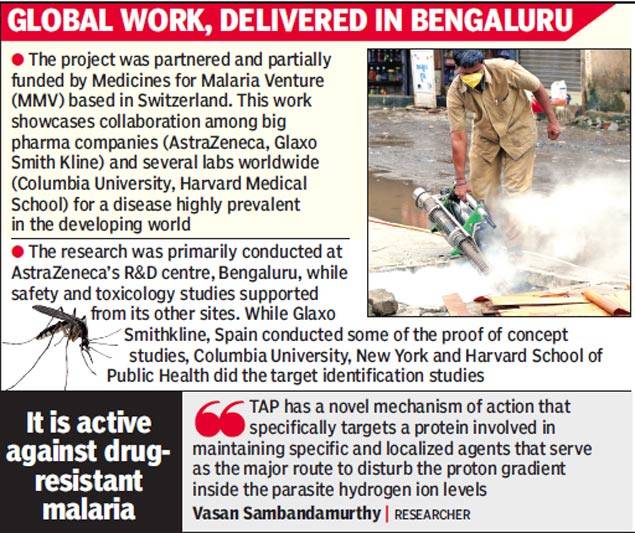
The Bengaluru solution — Triaminopyrimidine (TAP) — comes with many advantages over existing drugs. Vasan Sambandamurthy, one of the senior authors of the research paper, said: “It’s a fast-killing and long-acting antimalarial clinical candidate. TAP acts exclusively on the blood stage of Plasmodium falciparum (the stage responsible for clinical symptoms) in a relevant mouse model. This candidate is equally active against causative agent Plasmodium vivax.”

He added, “The compound has shown good safety margins in guinea pigs and rats. With a predicted half-life of 36 hours in humans, TAP offers potential for a single dose combination.”

The rapid spread of Plasmodium falciparum, the parasite which causes malaria in humans, has left nations battling it with a weakened arsenal and coping with thousands of deaths every year. This parasite has gradually become resistant to available medication.

The World Health Organisation (WHO) estimates that 3.2 billion people in 97 countries, including India, are at risk of being infected with malaria. In 2013, WHO reported an estimated 198 million cases and the disease was responsible for an estimated 5.84 lakh deaths, including 4.53 lakh children less than five years old.

Every person infected with malaria has to deal with millions of parasites and existing drugs have a limited effect in humans. “The half-life, which isn’t more than 2 hours, means it allows parasites to bounce back. Existing drugs are not fast-killing, which means that not only does a human need more doses but each dose is capable of only killing a few parasites,” he said.
GlobalWorkMPOs26dec2015

Besides, a potential side-effect of existing drugs is liver damage. “This doesn’t happen all the time, but the possibility does exist. Also, the parasites have become resistant to these drugs. With TAP, there are now known side-effects and the parasites are unable to develop resistance at the same pace as they do for existing drugs,” he said.
TAP was discovered by a team at pharmaceutical company AstraZeneca. “The main research happened in its R&D centre in Bengaluru between 2011 and 2014, which has since been shut down. It took us three years of rigorous work by teams across the globe. Today, we confidently nominate TAPs as a clinical candidate to treat drug-resistant malaria,” Vasan said. Shahul Hameed and Suresh Solapure were the two other team leaders.

Times View
The discovery of a malaria drug, yet again, highlights Bengaluru’s leadership in scientific research. The promise that the new medicine can kill the virus in a single stroke and act for a long time is good news for malaria patients. While the scientists deserve compliments on working towards a remedy free of side-effects, the companies that will eventually massproduce the drug should look at making it affordable to the aam aadmi. For their part, public health administrators must renew their battle to prevent vector-borne diseases, which cause untold suffering.

source: http://www.timesofindia.indiatimes.com / The Times of India / Home> City> Bangalore / by Chetan Kumar, TNN / April 01st, 2015

Science fiction comes alive as Indian startup grows human liver in lab

Liver team at Pandorum Technologies: Dr. Abdullah Chand, senior scientist (left); Arun Chandru, co-founder and managing director (centre); and Dr. Sivarajan T., senior scientist / @ABHINAV_MAURYA

Pandorum Technologies, a Bengaluru-based biotech startup, has developed an artificial tissue that performs the functions of the human liver.

Pandorum said these 3D printed living tissues made of human cells would enable affordable medical research with reduced dependence on animal and human trials. It will also eventually lead to full scale transplantable organs.

Arun Chandru, 30-year-old co-founder of Pandorum, said liver toxicity and drug metabolism are the key hurdles, and contributors to failed human trials.

Pandorum’s 3D bio-printed mini-livers that mimic the human liver will serve as test platforms for discovery and development of drugs and vaccines. The firm said these drugs would have better efficacy, less side-effects and be developed at lower costs.

“We developed everything here in India,” said Mr. Chandru. “We can grow thousands of these tissues in the laboratory and test the efficacy of drugs on them for diseases including cancer.”

He said large pharma companies on an average spend about $10 billion (Rs. 66,290 crore) and 10 years on research and development to get a single new drug to the market.

Tuhin Bhowmick (34), another co-founder of Pandorum, said development of artificial organs has numerous clinical uses. The cell-based miniature organs can be used to develop bio-artificial liver support systems for preserving life in patients who have developed liver failure.

“In the near future, such bio-printed organs will address the acute shortage of human organs available for surgical transplantation,” said Dr. Bhowmick, who holds a Ph.D. from the Indian Institute of Science.

Pandorum was founded by a group of friends in 2011 who were pursuing their higher studies at IISc. They came together to work on the development of artificial human organs after winning a business competition.

Surviving initially on money from friends and family, the team approached the Department of Biotechnology with their vision. The company was awarded funding support by the Biotechnology Industry Research Assistance Council in 2012. The same year, the company got incubated by the Centre for Cellular and Molecular Platforms in Bengaluru.

Mr. Chandru said they created the innovation with a funding of about Rs. 1 crore, more than half of which came from the government.

Scientists and startups across the globe are growing artificial organs made of human cells to better study diseases and help test drugs. A team of researchers led by Hebrew University professor Eduardo Mitrani is growing pancreas in a petri dish to better regulate blood sugar in diabetic patients.

The global artificial organ and bionics market is expected to reach $38.75 billion (Rs 2.5 lakh crore) by 2020 at an estimated CAGR of 9.3% from 2014 to 2020, according to a study by Grand View Research.

Pandorum’s ultimate aim is to make personalised human organs such as lungs, liver, kidney and pancreas on demand, according to Mr. Chandru.

Pandorum’s innovation takes the area of making artificial organs to the next level. Bengaluru-based bioinformatics firm Strand Life Sciences founded by IISc. professors had earlier developed a virtual liver that mimics the functions of liver through software simulation. It is a predictive method that integrates data and insights for deeper understanding of the impact of a drug on the liver. The platform can predict the toxicity of several known drugs and toxins and explain the mechanism.

source: http://www.thehindu.com / The Hindu / Home> Sci-Tech / by Peerzada Abrar / Bengaluru – December 23rd, 2015

DBS surgery a boon for Parkinsons’ patients

Bengaluru :

In 2009, when Hari Prasad, in his early 50s first felt increased tremors in his left hand and associated slowness in his movements on the left side, it was Parkinson’s disease that was slowly creeping in. His passion to travel took a back seat. But six years on, he is back on road and travelling from Bengaluru to Bhutan and back for over a period of 41 days, covering 6000 km.

Though the onsite of Parkinson was seen in 2009, by 2011, the tremors had progressed to the right sided limbs with further worsening of body movements. “I could not work properly or sit for long meetings. It was difficult for me to drive. Even for day-today activities like shaving or dressing I required help,” said Hari Prasad.

Dr Raghuram G, Consultant Neurosurgeon and Spine surgeon, Columbia Asia Hospitals said Hari developed involuntary movement of his upper trunk and neck during the effect of the medication. “That is when we suggested DBS surgery and explained to Hari about the benefits it will bring in his condition,”said Dr Raghuram.

Hari underwent in Deep Brain Stimulation (DBS) surgery in March, 2015 and since then, life changed for good. DBS is a procedure used to treat various neurological disorders in which medical device called a neurostimulator is implanted in brain to induce electrical impulses, through implanted electrodes, to specific parts of the brain.

Hari responded well to the surgery and the post DBS programming was initiated after a week. It took two weeks for the parameters to settle and he responded to the stimulation really well. His symptoms of Parkinson’s diseases including tremors, slowness and stiffness stopped and his gait improved significantly,” said Dr Guruprasad Hosurkar, consultant neurology, Columbia Asia Referral Hospital.

source: http://www.timesofindia.indiatimes.com / The Times of India / News Home> City> Bangalore / Sunitha Rao R / TNN / January 22nd, 2016

PSLV bags two more US launch orders

To lift weather company PlanetiQ’s first two satellites next year.

Two more U.S. satellite launch contracts have come the way of ISRO’s PSLV rocket, this time from commercial weather satellite company PlanetiQ.

A couple of space industry observers noted this as an inevitable trickle of business, if not a flow yet, from a top space market such as the U.S. to the now proven Indian player.

PlanetiQ, the Colorado-based commercial weather satellites operator, recently signed a deal with Antrix Corporation, ISRO’s marketing arm, for launching its first two weather satellites. Its final fleet totally will have 12 to 18 satellites.

Secondary passengers

The two spacecraft, just 10 kg each and carrying a special sensor to glean weather data globally, are planned to be put in space in the last quarter of 2016 as secondary passengers of a PSLV, according to the company.

PlanetiQ quoted its Chairman and CEO Chris McCormick mentioning “the stellar track record of the PSLV” in its Thursday night’s announcement of the contract.

The global launch market scene for small satellites and PlanetiQ’s keenness for the Indian launcher may well bring its remaining weather fleet also to the PSLV, said ISRO Chairman A.S. Kiran Kumar on Friday.

Antrix has bagged nine such U.S. launch orders for 2015-16.

The PlanetiQ satellites are small bites for the PSLV, which can launch up to 1,200 kg to medium distances (36,000 km) and 1800-kg satellites to low-Earth (below 2,000 km) orbits.

Until about a year ago, U.S. satellite operators could not conceive of launching from India because of a longstanding U.S. policy bar. In recent years, established U.S. launch companies have moved on to lifting far heavier satellites [ten tonnes and beyond], leaving a demand for launchers that can put smaller satellites in space.

In September, US operator Spire Global became the PSLV’s first US customer by getting four 4-kg-each Lemur satellites from Sriharikota. Antrix, which has won around 55 foreign launch orders to date, a bulk of them small ones, prefers to get bigger foreign satellites to launch from here.

Lobbying works

Susmita Mohanty, co-founder and CEO of Earth2Orbit, the country’s first space start-up, who is familiar with the Indian and U.S. space industry scenes, said: “[US] companies can benefit tremendously now that PSLV has been added to their portfolio of international launch options. This has been made possible by the companies themselves lobbying for access to the PSLV, the export control reforms introduced by the Obama administration and the efforts of “NewSpace companies” such as hers.

Russia’s converted missile launcher, Dnepr, Soyuz and the newer European vehicle Vega are in the same category as the PSLV.

Space industry tracking agency Euroconsult estimated in February this year that by 2020, governments and private operators would launch a total of 510 small satellites. The biggest number of small satellites is foreseen to come from the U.S. in the next five years. That country has also launched almost half of 600-plus smallsats in the last decade, the report says.

This article earlier mentioned PlanetiQ as a Maryland-based company. It is a Colorado-based firm.

source: http://www.thehindu.com / The Hindu / Home> National / by Madhumathi D.S. / Bengaluru – December 06th, 2016

Udupi man generates power from tidal waves

Udupi :

Even as the world looks to generate power from alternative energy sources, environmentalist and engineer Vijay Kumar Hegde, head of the Susi Global Research Centre, Udupi has successfully generated power from tidal energy through his small projects after 30 years of dedicated effort. He recently got a patent for his power plant design.

Hegde said, “With government approval, a single commercial plant will be set up within two years to produce 10MW. The project costs around Rs 6 crore per MW and it’s the lowest compared to hydro, thermal or nuclear plants. It’ll be one of the world’s most cost-effective power project. Udupi has a 360-km coastal belt, of which 60km is a thickly populated area used for fishermen. However, a 300-km stretch is free and even if half of that,150 km, is used for tide plantation, 15,000MW can be generated. The state requires 3,000MW additional energy. The proposed plant will have the capacity to distribute power for less than Rs 5 per unit to the government.”

The sea waves are continuous in motion with no pause in their movement so expected power capacity is 100 plus. The proposed plant produces much greater amount of energy at a lesser cost. He has plans to set up five small plants with the same design. Two have already been installed and in January, a third plant will be installed, and the others will be installed within three months. A fifth plant will generate highest capacity of 100kW power.

It is a clean energy project, without artificial dam, turbines and minimal transmission loss.

source: http://www.timesofindia.indiatimes.com / The  Times of India / News Home> Hubballi / TNN / December 03rd, 2015

Mysore University faculty bags Dr. A.P.J. Abdul Kalam National Award

Dr. K.N. Amruthesh (right) is seen receiving the National Award from former Chief Minister of Goa, Digambar Kamat, at the awards ceremony held in Panaji, Goa, on Dec.6.

Mysuru :

Dr. K.N. Amruthesh, Senior Lecturer and Principal Investigator at Department of Studies in Botany and Co-ordinator, CSIR/UGC- NET Coaching Centre of University of Mysore, has been given the prestigious “Dr. A.P.J. Abdul Kalam National Award” by the International Institute for the Social and Economic Reforms, Delhi.

This award was conferred for his significant contributions in the field of major agricultural crops’ disease management strategies, especially for his extensive research work on pearl millet downy mildew host pathogen interaction and reporting of two new plant species to the Science, Research Publications and Teaching.

Dr. Amruthesh received the National Award from former Chief Minister of Goa, Digambar Kamat at the Entertainment Society of Goa, Panaji, on Dec.6. The award comprises a certificate, memento and a citation.

Dr. Amruthesh, who obtained his doctoral degree from University of Mysore with Government of India, ICAR Fellowship, completed his post doctoral degree research work at University of North Texas (UNT), Texas, United States of America (USA).

He started his professional career in 2002 as a Senior Scientist with the Danish Government, Copenhagen-funded collaborative research project at the Department of Biotechnology and subsequently was appointed as a faculty in 2004 to the Department of Botany of the Varsity.

Dr. Amruthesh has published more than 65 research articles in the national and international reputed journals and 3 book chapters so far on plant – microbe interaction and disease management strategies. He has successfully guided 7 Ph.D. scholars for their doctoral degree and currently 7 Ph.D. scholars are working under his guidance. He is the Principal Investigator for three research projects funded by DST, UGC and DBT. Dr. Amruthesh is also the recipient of Indian Science Congress Association (ISCA) & Department of Science & Technology (DST)- Young Scientists’ Awards among others.

source: http://www.starofmysore.com / Star of Mysore / Home> General News / Monday – December 14th, 2015

College develops kit for detecting chlorpyrifos residue in fish

‘It has been developed after a three-year research and will take a year for field trial’

College of Fisheries here has developed a kit for detecting residues of a particular pesticide in fish and shell fish.

It could detect residues of chlorpyrifos in fish and shell fish, according to K.M. Shankar, Dean (Fisheries) of the college.

Speaking to media following demonstration of the kit at the college on Thursday he said chlorpyrifos was extensively used in agriculture.

Its residues could join water sources such as ponds and rivers at any time, due to human activity. With this, fish cultured in ponds came into contact with this pesticide.

Those engaged in in-land fisheries, exporters, and fish consumers could use this kit for detecting the pesticide content.

He said the kit has been developed following a three-year research. It would take one more year for field trial. Using the kit, a sample could be tested with in 10 minutes.

Field trial

Mr. Shankar said that if the technology was to reach consumers it would have to be transferred to a company for developing the kits. The company would have to conduct the field trial. The college would have to take steps for technology transfer.

The kit, which is yet to be named, was developed with funding from the Department of Biotechnology, Delhi and European Union, Brussels.

Earlier, the college had developed a kit called RapidDot for field level detection of white spot virus in shrimp. It has been commercialised through M/s. Virbac Animal Health Care Ltd., Mumbai.

source: http://www.thehindu.com / The Hindu / Home> News> Cities> Mangaluru / by Raviprasad Kamila / Mangaluru – December 04th, 2015

First Bio-Diesel powered Train flagged off

Pradeep Kumar Saxena, General Manager, SWR, is seen flagging off the First Bio-diesel Powered Train at Hubballi on Dec.3 as S.S. Soin, Chief Electrical Engineer, SWR, Shyamadhar Ram, Chief Motive Power Engineer, SWR and others look on.

Mysuru :

The first Bio-Diesel Fuelling Loco, attached to Bio-Diesel Powered Train No.12080 Hubballi-Bengaluru City Jan Shatabdi Express, was flagged off on Dec.3 at Hubballi Railway Station by Pradeep Kumar Saxena, General Manager, South Western Railway (SWR).

Speaking on the occasion, Saxena said that bio-diesel blending powered loco consumes lesser diesel rate of 5% in the regular High Speed Diesel (HSD). The locos are filled bio-diesel blending oil at Railway Consumer Depot adjacent to Platform No.5 of Hubballi Railway Station situated adjacent to Hubballi Workshop.

He said about 50 Diesel Locomotives are fuelled daily with 100 Kilo litres of HSD at Hubballi Railway Station. These locomotives will hereafter be fuelled with the Biodiesel blended fuel.

He further stated that Biodiesel is an alternative to conventional diesel fuel made from renewable sources such as non-edible vegetable oil. Fuel extracted from plants are being mixed at the rate of 5% with normal High Seep Diesel. Hence, these organic fuel extracts biodiesel, have better lubricity when mixed with normal HSD, this B5 Diesel (5% biodiesel and 95% normal diesel) is reported to provide better engine life, Saxena said.

While briefing the advantages of biodiesel, he said that biodiesel produce less toxic pollutants than other petroleum products; it reduces foreign oil dependence; biofuels are produced locally and thousands of people are employed in biofuel production plants. Since biodiesel is produced from crops, an increase in demand for biodiesel leads to increase in demand for suitable biofuel crops. Besides, biodiesel is a renewable energy source unlike other petroleum products that will vanish in the years to come, he added.

P.A. Lamhare, Chief Mechanical Engineer, SWR, S.S. Soin, Chief Electrical Engineer, P. Ganeswara Rao, Chief Operations Manager, SWR, K. Harikrishnan, Chief Personnel Officer, Vishal Agarwal, Chief Commercial Manager, Shyamadhar Ram, Chief Motive Power Engineer, Swayambhu Arya, Deputy Chief Mechanical Engineer (Diesel), SWR and other Senior Railway Officials, staff of SWR and officials from Indian Oil Corporation (IOC) were present.

source: http://www.starofmysore.com / Star of Mysore / Home> General News / Saturday – December 05th, 2015

Karnataka hamlet is India’s 1st smokeless village

Lakshmidevamma in her clean kitchen in Vyachakurahalli village, Chikkaballapur district, Karnataka, on Thursday.

Gauribidanur (Chikkaballapur District) :

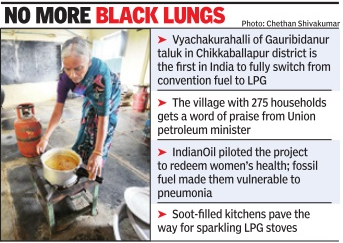
Until last month, Thimmakka had to blow her lungs out even to make a cup of coffee. And this has been her ritual for 40 years now . Not any more. Her kitchen is now fitted with an LPG stove. Like 274 other households in Vyachakurahalli of Gauribidanur taluk in Chikkaballapur district.

Cooking with firewood is passe in Vyachakurahalli since all households here have LPG. The Union petroleum ministry has officially declared it as India’s first smokeless village, owing to its conversion from conventional fuel to LPG. “My compliments to the residents of Vyachakurahalli which has been declared as the first smokeless village in India,” tweeted petroleum minister Dharmendra Pradhan.

Indian Oil Corporation (IOC) piloted the ‘Mission Smokeless village’ project here, about 77km from Bengaluru. “The idea was to redeem women’s health,” said Moti Sayi Vasudevan, general manager (smokeless villages) at IOC. “Due to the continuous inhalation of particles, women are more prone to pneumonia due to usage of firewood as a fuel.”

For over four decades, firewood had been the only fuel for the most of the village’s women. Wracked by bouts of cough caused by the soot-filled air in the blackened kitchens, cooking was an ordeal for them.

GasChartBF04dec2015

But that was until last week. Now, the kitchens have got swanky steel gas stoves and red cylinders. While a separate plank has been built to accommodate the new gas stove in Lakshmidevamma’s kitchen, Saraswathamma is looking forward to cooking these days. “I would frequently have bouts of cough due to the continuous use of firewood,” she said. “This is the best thing that has happened to women in the village.”

In drought-hit Gauribidanur, this recognition for clean fuel comes as a huge relief. As Ratnamma put it: “No more black roofs and black lungs.”

Learning safe handling of LPG

Gita Jayender sits with a group of women in a small thatched roof kitchen, telling them how to operate an LPG stove, how it is important to switch off the regulator at the end of the day, how not to leave utensils on the stove and go away, among other things. Shrenik Enterprises on Railway Station Road is buzzing with activity as entire families walk in to purchase new LPG stoves. “We had to first conduct an awareness campaign for villagers to tell them why it is important to go smokeless. Drought is staring at them. Why LPG, they asked,” said Shrenik R J, who is spearheading the smokeless movement in the village. The next project will be taken up at Gandhian Dr H Narasimhaiah’s birthplace, Hosur, in Chikkaballapur district, he said.

source: http://www.timesofindia.indiatimes.com / The Times of India / News Home> City> Bengaluru / by Seetha Lakshmi, TNN / December 04th, 2015

Homemade bicycle generator chosen for national expo

Disha Karigar demonstrating her bicycle generator.— Photo: VAIDYA

Event is an initiative of Ministry of Science and Technology

The project to generate electricity from a stationary bicycle developed by Disha Karigar, a class VII student of Mythri Higher Primary School at Shikaripur, has been selected for a national-level science exhibition, being conducted as part of Innovation in Science Pursuit for Inspired Research (INSPIRE) launched by the Ministry of Science and Technology.

The State-level exhibition (INSPIRE) was held at B.K. School at Belagavi, recently.

The model displayed by Ms. Karigar won the first place and thereby, she was chosen for the national-level event scheduled to be held at New Delhi on December 5.

The title of the project is Homemade bicycle generator. K.R. Dayanand, administrative officer of the school, said in a press release that the generator worked on Faraday’s law of electro-magnetic induction. The rim of the bicycle wheel is attached to the shaft of the DC motor of 12-volt capacity with a driving belt. When the bicycle is peddled, the belt and the shaft revolve concurrently, creating an electromagnetic field. With the effect of the electromagnetic field, electricity is generated. In this project, 150 Watts of power can be generated with 1,500 revolutions a minute (RPM).The electricity generated here could be used for domestic lighting and recharging of mobile sets. The stand and the rim of the bicycle has been fabricated to suit the purpose. Peddling of this bicycle is good for health, besides generating power through environment-friendly method, he said.

Ms. Karigar hails from Gagri, a village in Shikaripur taluk. Her father Nagaraj Karigar is a lecturer in a private Industrial Training Institute here and her mother is a homemaker.

source: http://www.thehindu.com / The Hindu / Home> National> Karnataka / Veerendra P M / Shivamogga – November 26th, 2015