Category Archives: Science & Technology

German honour for V K Nayak

Mangaluru :

V K Nayak, managing director of CNC Ball Screws and Bearing Co Pvt Ltd, was felicitated for being a good corporate citizen. Karl Neff of Neff Gewinderiebe Gmbh, Stuttgart Germany, presented the award to Nayak at MOTEK 2015, an automation trade fair held in Germany.

The award, in the form of a miniature Tata Nano car, was given to him, for his contribution to the welfare of his workmen in his industry at Mangaluru. It may be recalled that Nayak gifted Nano cars to his factory employees in March 2015.

Hartmut Wandell, managing director, NEFF, and Esther Leib, sales and marketing executive, were present on this occasion.

source: http://www.timesofindia.indiatimes.com / The Times of India / News Home> City> Mangaluru / TNN / October 24th, 2015

Isro receives 1st astronomer’s telegram

Bengaluru  :

The first astroronomer’s telegram (Atel no. 8185) from the Scanning Sky Monitor (SSM) observations on-board Astrosat – India’s first astronomy satellite – has been received by Isro.

The SSM was pointed to “GRS 1915+105”, an X-ray binary star system which features a regular star and a black hole, and caught it exhibiting the ‘beta’ class of variability on October 14, one of the many types of variability this source exhibits, some of which are associated with its spectral states.

“On October 15, the Soft X-ray Telescope (SXT) door was opened successfully and it will observe the sky after 10 days,” Isro has said.
Earlier in the month on October 9, Astrosat spotted the Crab Nebula using the Cadmium Zinc Telluride Imager (CZTI) instrument. The Crab Nebula is the brightest hard X-ray source in the sky.

Isro officials described the sighting of the Crab as significant and said that this furthers Isro’s chances of other celestial X-ray sources, aiding researchers. Astrosat has also spotted and viewed Cygnus X-1, a black hole source and now, the High voltage of Near UV, Visible channel and Far UV channel of the UV Imaging telescope (UVIT) has been switched on and detectors have been tested with low gain and found satisfactory and put back in off condition.

source: http://www.timesofindia.indiatimes.com / The Times of India / News Home> City> Bengaluru / by Chethan Kumar, TNN / October 21st, 2015

Hubballi youngster gets patent for three products

Hubballi  :

When Anup Vijapur, 26, was in his final year of mechanical engineering studies, he received three job offers. However, hepatitis affected his progress. He had to attend the examination, carrying a glucose bottle. He failed in one subject, but fortunately cleared it after applying for revaluation.

When Anup failed in the exam, it was Nanopix CEO Sasisekar Krish who recruited him and encouraged him to develop his innovative ideas into products. Thus started Anup’s success story. He now heads the innovation department of Nanopix, a startup. Anup aimed at social entrepreneurship when he was in college. Now he is realizing his dreams, emerging as an innovator to simplify the lives of farmers.

Recently, the youngster got three patents for his innovation. These innovations pertain to grading of cashew nuts. While a normal grading machine can probably classify cashew nut into three qualities, Anup three patents are more than a notch better. With his technology of installation of camera, pick and place mechanism for irregular object and conveyor and grading machine, one can classify cashew nuts into seven categories.

Though Anup pursued BE (mechanical) at Proudhadeveraya Institute of Technology, Hospet, he is well versed in computers and technology. Speaking to TOI, Anup said that he got opportunity to materialize his ideas at Nanopix. He has special words of gratitude towards Krish. “We have already got three international patents for our products. If we get all applications approved, it will be a pride for our company and a tier-2 city like Hubballi,” he said.

There is more in store as his 28 applications are waiting for patent. Anup said that he developing a technology to read the face of drivers. “To prevent road accidents, we are developing a camera that can recognize facial expressions of drivers. If the driver is sleepy, it will warn him immediately. If the vehicle is connected with some networks, corporations or companies, it will alert their control room so that the backend can intervene and avoid possible accidents,” he said.

Pramod Tonapi, public relation officer at Nanopix, said that Anup’s innovation has given a boost to the startup. “He is very passionate about science and even teaches engineering students at a private study centre during his leisure time. His innovations are going to change the food processing industry in the coming days. Because of his innovation, we have been able to apply for patent for 28 more products,” he said.

source: http://www.timesofindia.indiatimes.com / Times of India / News Home> City> Hubballi / by Sangamesh Menasinakai, TNN / October 21st, 2015

India has not leveraged Ayurveda treasure trove: Mazumdar-Shaw

Bengaluru :

India has not leveraged the treasure trove of Ayurveda in a scientific way, Biocon chief Kiran Mazumdar-Shaw said on Thursday.

“One of the big problems is that the outside world views us in a much better way than we view ourselves,” she said.

“This year’s Nobel Prize, for instance, went to number of scientists in medicine for malaria, river blindness, and one of them was none other than a Professor Youyou Tu who was really not a medical or PhD or any one of those people, but some one who was actually a great proponent of Chinese medicine….” Mazumdar-Shaw said.

“This should open up the opportunity for Ayurveda in a very big way. I think we as a country have not really leveraged the treasure trove of Ayurveda in a scientific way. This I hope will incentivise us and motivate us to to look at our own knowledge of Ayurveda and take it to a different direction”, she added.

“That’s the trend that we must create from India,” she added.

Mazumdar-Shaw, who is also the chairperson of Karnataka Vision Group on Biotechnology was speaking at an event organised to announce “Bangalore India Bio 2016” which is scheduled to be held from February 9 to 11 2016.

Tu (84) who is chief professor at the China Academy of Traditional Chinese Medicine, discovered artemisinin, a drug that has helped significantly reduce the mortality rates of malaria patients.

Noting that agri-biotech can play a very important role in this, Mazumdar-Shaw said “using modern techniques in agri-biotech to actually delve into our Ayurveda and see whether we can amplify some of these very very important aspects of Ayurveda by the use of new technologies and modern technologies of agri-biotechnology”.

“This is another area which we must create into a trend because we cannot afford to loose the advantage that we currently have”, she added.

source: http://www.timesofindia.indiatimes.com / The Times of India / News Home> City> Bengaluru / PTI / October 15th, 2015

Bengaluru hospital introduces world’s fastest German built vitrectomy machine

Bengaluru :

A centre of ocular oncology installed with the world’s fastest German built vitrectomy machine, along with electroretinogram (ERG) and Pascal laser has been inaugurated today in a city eye hospital to provide a comprehensive treatment in the field of vitreoretinal and ocular oncology.

One of the first of its kind in Asia, ‘megaTRON S4 HPS’will ensure safer and faster vitreoretinal surgeries with its double cutter and integrated laser translating into better outcomes, say the doctors of Sankara Eye Hospital, where it has been introduced today.

“This allows 12000 cuts a minute. Pascal laser with yellow 577 nm is the only laser in the county that allows effective treatment of diabetics with minimal collateral damage. This allows 16 simaltaneous laser shots, enhancing patient’s safety and comfort,” said Dr P Mahesh Shanmugam, head of Vitreoretinal and Ocular Oncology Services, Shankar Hospital.

“megaTRON S4 HPS helps to easily recognize the steps for programming and calibrating the equipment and to decide the type of surgery to be made. Different users can be programmed with the pre established parameters, offering more agility in the proceedings in case the machine is used by different surgeons,” he added.

UT Khader, minister for health and family welfare, said: “I am delighted that the state-of-the-art excellence begins from our state and I am sure that a similar centre enabling such technologies will; soon come up across India.”

source: http://ww.timesofindia.indiatimes.com / The Times of India /News Home> City> Bengaluru / by Sreemoyee Chatterjee, TNN / Octobter 01st, 2015

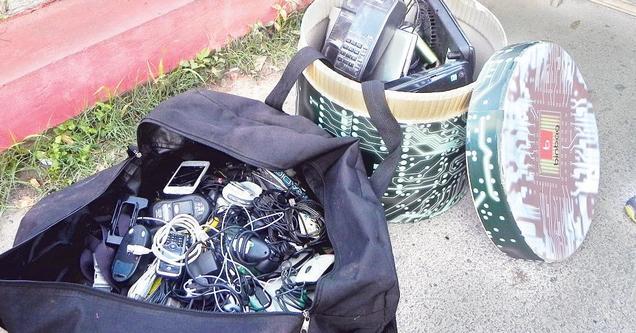
Discard your e-waste

EWASTEbf03sept2015

From October 2, four Namma Metro stations will be part of a mission to ensure toxic e-waste reaches the right destination.

Volunteers from Binbag – a startup being incubated at the Indian Institute of Management Bangalore’s N.S. Raghavan Centre for Entrepreneurial Learning – who specialise in collection and responsible disposal of e-waste, will ensure that the waste you get will reach a State-authorised recycler.

The logic behind an e-waste collection drive at metro stations is that those who use the metro bring waste that needs to be disposed off. These can be dropped in bags held by volunteers, explained Achitra Borgohain, founder of Binbag.

The volunteers will be present during the morning peak hours at the stations on Reach-1.

Binbag has already been offering doorstep pick-up services in the city. “In a year, we have collected nearly five tonnes of e-waste. The most discarded items are home appliances, bought three or four years ago and have turned obsolete,” Mr. Borgohain explained.

What was pleasantly surprising though was that those who used Binbag’s services did not expect anything in return. “99 per cent of my customers are happy about the doorstep pickup and the fact that the waste will reach a responsible recycler. Our gift vouchers (given away as incentives) are more of a thank you gesture than a selling point,” he added.

Binbag now has nearly 2,000 customers, mainly individuals. “Over a period of time, we have also served communities, such as apartments. We do not focus on B2B, as they have other options,” he said.

Trash for health

Who says slums are spared e-waste troubles? Dispelling this notion, Binbag is organising a unique ‘Trash for health’ campaign on October 4 for residents of Bismillah Nagar in south Bengaluru. To incentivise people into handing over waste such as batteries, music players and radio sets, children and their mothers will be provided a free dental check-up, Binbag representatives said.

Connect with scrap dealers

No one is ‘trashing’ the app-way, not even trash. Binbag is piloting an ambitious app in south Bengaluru that connects scrap dealers with potential customers. “We are creating a network of last-mile collection agents where the nearest dealer will get notified based on customer location,” Mr. Borgohain said.

source: http://www.thehindu.com / The Hindu / Home> News> Cities> Bengaluru / by K.C. Deepika / Bengaluru – September 30th, 2015

Post Offices to go paperless

Core System Integration (CSI) pilot project to be launched at 70 POs in Mysuru Division tomorrow

The staff of Central Post Office in Nehru Circle in city are seen upgrading for the CSI project to be launched in Mysuru Division tomorrow

Mysuru :

The Department of Posts (DoP), in its attempt to integrate all solutions implemented under the IT Modernisation Project across different channels, levels and locations, is all set to implement the Core System Integration (CSI), a pilot project, in Mysuru Division tomorrow — the first in the country.

A special software has been created by Tata Consultancy Services (TCS) for this project.

The objectives of CSI are: To lay down a robust IT infrastructure; Implement software applications for various business areas of the department like Mail Operations, HR, etc. and to provide IT-enabled services to the rural community among others.

It is envisaged that CSI will be responsible for overall integration of the solution and thus accountable for successful implementation of India Post-2012 project across channels, across various levels and locations, and for all business operations and supporting functions of DoP.

In addition to the overall responsibility as mentioned above, the CSI will have direct delivery responsibility for mail and logistics operations, enterprise wide human resources and payroll, finance and accounts, and customer interaction management services.

The CSI shall ensure that the components that are delivered to the end-users are seamlessly integrated onto a common front-end and are successfully deployed onto the client hardware. The pilot project will be implemented in all 40 Post Offices in the city and 30 in Mysuru Division.

Meanwhile, Senior Post Master of Mysuru HPO H.S. Hunagund, speaking to SOM this morning, said that in view of the implementation of the project tomorrow, all the Post Offices in the city remained closed today to upgrade to the new system.

With the launching of CSI, the customers will get good and speedy service, he said and added that almost all services of the Postal Department would go online from tomorrow.

source: http://www.starofmysore.com / Star of Mysore / Home> General News / Wednesday – September 30th, 2015

NITK students design virtual lab

Surathkal  :

A take-home lab complete with equipment, albeit in a virtual avatar. SOLVE (Students Online Lab for Virtual Experimentation), a virtual lab designed by students of National Institute of Technology (NITK), Surathkal, can be accessed using smartphones and computers which have internet connectivity.

“Students of four streams came together to make V-lab a reality and, that too, after two years of hard work. The lab was introduced with the primary objective of experiential learning of basic concepts in engineering technology and science. SOLVE makes the labs available as per the learner’s time, pace and place, and makes it easier to conduct experiments,” said Prof KV Gangadharan, HoD, mechanical department and the lab’s co-coordinator.

SOLVE’s website (solve.nitk.ac.in or vlab.co.in) has over 1 lakh active users across the world over. NITK is among the 12 institutions to set up the lab, eight among which are IITs. “We are essentially providing a take-home lab where we share costly laboratory equipment through remote-triggered lab infrastructure,” said Gangadharan.

Simulation labs related to chemical, civil, electrical and mechanical engineering are available at NITK, while other subjects are made available through IITs. “We have around 100 simulation labs on the virtual lab website (vlab.ac.in) and 30 remote-triggered labs. A remote-triggered lab is where an actual experiment at one location can be accessed by students anywhere, and they can make changes remotely while the experiment in on,” he said. The ambitious project is an initiative of human resource development ministry under the national mission on education through information and communication technology (ICT).

source: http://www.timesofindia.indiatimes.com / The Times of India / News Home> City> Bengaluru / by Kevin Mendonsa, TNN / September 26th, 2015

‘Nooru Rupayi’ made by city’s architects to be screened at fest in Washington DC

‘Nooru Rupayi’ is directed by architect Prashanth Raj.

Directed by Prashanth Raj, the 20-minute film with a budget of Rs. 2 lakh

Why do you think a group of young Bengaluru architects are rejoicing? Not an award for one of their best designed projects, but global appreciation for a well-made short film in Kannada, Nooru Rupayi(‘Hundred Rupees’) with English sub-titles.

The 20-minute film, directed by architect Prashanth Raj of Arch Venture in Sanjaynagar, has been selected to be screened at the Washington DC South Asian Film Festival on September 27, after bagging the Runner Up Award at the 5th Bangalore International Short Film Fest last month, and Special Awards at Mumbai, Calcutta, and UK Short Film Fests earlier.

Nooru Rupayi , with a budget of Rs. 2 lakh, was made by Prashanth Raj (director), Shilpa Patel (art director), Nitin (cinematographer), Guruswamy (Editor) along with the production team Raghav, Abhilash Pallaki, John Joseph, and Pramod Chandru (sound recording) and Abhijeet (music) — architects and engineering professionals who have a passion for films beyond their drawing board. The film, which revolves around a message to stand up against corruption and make a social change, was conceived and written by Prashanth, whose passion for “short films with a strong message” became easier after he took up a course at the Indian Institute of Moving Images.

The film took nearly four months to shape up, and has been entirely shot in the pastoral Thimmanahalli near Tumakuru, at the Chikkanayakanahalli hamlet, a four-hour drive from Bengaluru. “While I was raring to handle this subject of corruption revolving around a story of ‘puppy love’, a struggling village family and socially relevant issues of corruption that seem an accepted norm, it is the protagonist primary school boy Arvind’s (played by Srinivasa Murthy) early realisation of the gloom of dishonesty that makes him comprehend the power of the Hundred Rupees which sports Gandhi on it. When the young are made to realise that straightforwardness and sincerity maketh a good man, it’s a strong message,” says Prashanth.

The film’s endeavour is not just in its message, but the team’s effort in having the entire cast of 25 taken raw from the innards of Thimmanahalli. “We went to the village to uncover bundles of raw talent during child auditions. Finding a lady for the mother’s role was a challenge as local conservative women shied away from the camera. Our acting coach, John Joseph, helped them overcome inhibitions,” says Prashanth.

The film’s aesthetics also brings in Karnataka’s folk Veeragase showing intense energy-sapping dance movements to represent expressions of conflict and resolution for the young hero. That Prashanth is interested in his potent message is evident when you consider that his first short film Psycho’s Jury — which brings out the travails of an architect to practice what he preaches — bagged the Indian Institute of Architects Award.

source: http://www.thehindu.com / The Hindu / Home> News> Cities> Bengaluru / by Ranjani Govind / Bengaluru – September 24th, 2015

Manipal university team help discover four exotic atomic nuclei

Manipal :

Researchers from Manipal Centre of Natural Sciences (MCNS) at Manipal University in collaboration with GSI-Giessen, Germany have discovered four new atomic nuclei to be added to the chart of the nuclides. The study focuses on developing new methods of synthesis for super heavy elements. The newly discovered, exotic nuclei are one isotope each of heavy elements berkelium and neptunium and two isotopes of the element americium.

H M Devaraja, a PhD student at MCNS, participated in experimental work along with an international team of researchers at GSI Helmholtzzentrumfur Schwerionenforschung. Other participants included scientists from Justus Liebig University Giessen, Germany, Japan Atomic Energy Agency, Lawrence Livermore National Laboratory, USA and the joint Institute for Nuclear Research in Russia. The results are published in Physics Letters B.

Apart from discoveries themselves, first proof of the new technique for production of these exotic nuclides will pave way for a new generation of exciting experiments at the frontiers of experimental physics. It is a proud moment indeed for the team and the collaboration. I expect that continuing investigations will uncover many more surprises as our team explores previously unknown areas and extends the chart of the nuclides, Dr Bhat said.

Gottfried Munzenberg who initiated the Giessen-GSI-Manipal collaboration together with Mohini Gupta expressing happiness at the discoveries, said “Synthesis of new isotopes in nuclear transfer reactions is milestone in search for new methods for SHE synthesis, the principal research goal of our collaboration”. Mohini Gupta, director, MCNS said, “Now that we know this method is viable, interpretation and prediction is two other important aspects of the discovery.”

Newly discovered isotopes have fewer neutrons and are lighter than previously known isotopes of the respective elements. To date, the known Periodic Table comprises over 3,000 isotopes of 114 chemical elements. According to scientific estimates, more than 4,000 additional, undiscovered isotopes should also exist. “By using this method, we have succeeded in generating many different atomic nuclei at once,” says Dr Sophia Heinz who headed the experiment at GSI.

source: http://www.timesofindia.indiatimes.com / The Times of India / Home> City> Mangaluru / TNN / September 16th, 2015