Negilayogi Samaja Seva Trust celebrates Doctors’ Day
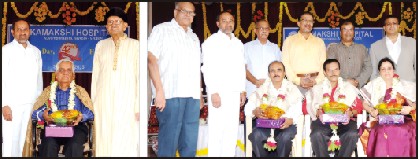
Six doctors — (sitting from left) Dr. B.C. Naveen, Dr. B.M. Rudresh, Dr. R. Latha, Dr. B.H. Manjunath, Dr. Sanjeev Murthy and Dr. G. Kempaiah — who have been rendering excellent service, were awarded best service awards by Negilayogi Samaja Seva Trust at a programme organised at a private hotel in city on Sunday to mark Doctors’ Day celebrations. They are seen with (standing) Y.R. Venkatesh, D. Ravikumar, L. Charanraj, Dr. T. N. Balakrishnegowda, Dr. Manjunath, Dr. Shivashankar, Darshan, Pushpa Shivaram, P. Vishwanath, Dr. L. Devegowda, Ravindra, Dr. M. Madaiah, Parameshwar, Dr. Mahadevaiah, M.B. Manjegowda, Kengegowda, Chandru, Papanna and P. Kempegowda.
Mysuru :
A programme organised by Negilayogi Samaja Seva Trust at a private hotel in city recently to mark Doctors’ Day cele- brations.
Six Doctors, who have been rendering excellent service, were awarded with best service awards on the occasion.
Dr. M. Madaiah, a Urologist from Bengaluru, who inaugurated the programme, said that late Dr. B.C. Roy, whose birthday (July 1) is observed as “Doctors’ Day,” had served the people despite being a freedom fighter, politician and Chief Minister of West Bengal. In recognition of his services, the Doctors’ Day is observed every year since 1991. Doctors should have concern while treating patients and see that their illness is cured, he added.
Parameshwar, Chief Conservator of Forests, Mysuru, who also spoke, said that people, who were aware of various diseases, should consume nutritious food and exercise for a healthy living.
Medical Council of India, New Delhi, Executive Committee Member Dr. H.N. Ravi- ndra said that more awareness programmes should be launched to create self-confidence among farmers. Doc- tors should not see the pati- ents as clients, instead they should respect their profession like they honour their parents, he added.
Later, Dr. B.C. Naveen of Madikeri received the Negilayogi late Dr. M.L. Mariswamy award for excellent service in private practice; Mandya’s Dr. B.M. Rudresh received Negilayogi late Dr. J.L. Javaregowda award for excellent ser- vice in Government service; Dr. R. Latha from city received Negilayogi Dr. Vidyamani award for excellent service among women doctors; Dr. B.H. Manjunath of Mysuru was conferred Negilayogi Dr. C.N. Manjunath award for excellent service among youth doctors, Dr. H. Sanjeev Murthy, also from city, received Negilayogi late Dr. K. Ramachandra award for excellent service among veterinary doctors and Dr. G. Kempaiah was conferred the Negilayogi Dr. Manjunath award for excellent service among Dental doctors.
Negilayogi Samaja Seva Trust President Dr. L. Devegowda, D. Ravikumar, Dr. Shivashankar and Manjula Bhadregowda were also present at the function.
source: http://www.starofmysore.com / Star of Mysore / Home> General News / Monday – August 03rd, 2015
Here we publish the full text of the convocation address delivered by Dr. A.P.J. Abdul Kalam, the then Scientific Adviser to Raksha Mantri and Secretary, Department of Defence, Research & Development, at the 75th Convocation of University of Mysore on Feb. 25, 1995. — Ed.
Dr. A.P.J Abdul Kalam (second from right) seen with the then Governor-Chancellor Khurshed Alam Khan, the then Higher Education Minister and Pro-Chancellor D. Manjunath and the then Vice-Chancellor Prof. M. Madaiah during the 75th Convocation of University of Mysore on Feb.25, 1995.
by Dr. A.P.J Abdul Kalam
Dare to Dream: I am indeed delighted and honoured to participate in this 75th Convocation of University of Mysore. I have been thinking about what to share with you on this important occasion when you are entering the most eventful phase of your life after years of learning. I know that for the past twenty-years or so you have been continuously taught various aspects by teachers. I am, therefore, not going to extend this process. Instead, I would like to share with you a few of my experiences, one at a place very close to you and others at Trivandrum and Hyderabad.
These are the experiences where people have dared to dream and met with success. Of course, we have to recognise that success is always the result of sweat of individuals and also coupled with many failures. The place close to you is the site of pilgrimage not only for me but for every one who practices rocketry in our country. Let me first tell you something about this.
First War Rocket: When I was studying in school and college, Srirangapatna interested me for two reasons — the place was the scene of battle against foreign rule and also there was a reference to a new weapon introduced. In 1960, when I visited Srirangapatna with my friends, we were thrilled to walk around this historical town. We searched for the Turukhan-hally Fort built during Hyder Ali – Tipu Sultan times and used for making rockets, way back in 1794. I had a tremendous disappointment when I did not see any permanent evidence or historical recordings in Srirangapatna regarding creation or development of first war rocket in the world.
Later, in 1963, I was at Wallop’s Island, the rocket launch facility of NASA in USA, in connection with a collaborative programme of launching of sounding meteorological rockets for research of upper atmosphere. In the lobby of their command-control centre, I saw a prominently displayed picture. The war dress and the colour of the soldiers’ skin attracted my attention. Some dark complexioned soldiers were firing rockets on their white skinned opponents. The label on the painting read, “The world’s first war rocket.” It was indeed a great pleasure to see an Indian feat acknowledged on the other side of the planet. I felt excited with happiness.
I started reading the history of rockets. I had a dream I must see Tipu’s rockets. Time continued to pass. Rocket technology engulfed me and India’s first Satellite Launch Vehicle SLV-3 was launched. In 1980, we had an opportunity to visit London. There, I saw two of the war rockets captured by British at Srirangapatna, displayed at Museum of Artillery at Woolwich in London with the heading “India’s War Rocket.” Probably, Europe learnt rocketry from our Srirangapatna rocket in the eighteenth century! It was a great thrill to see an Indian innovation on a foreign soil, well-preserved and with facts not distorted.
I got the performance of these 2 kg rockets, 50 mm in dia. and about 250 mm in length analysed by our designers. What a simple and elegant design, effectively used in war ! Surely, Hyder – Tipu Sultan would have had talented men who could look at propulsion, material, ignition and build rockets and fly them for war operations. In fact, when we look back to eighteenth century ambience, it is a technology marvel.
I would like to declare today that this land is the birth place of war rockets in the world and offer it my reverence and respect. The tradition continues.
Prof. Vikram Sarabhai – Man of Vision: Nations advance along the course charted by great dreamers. Let me narrate to you an incidence which occurred in 1968. We were working on the configuration of India’s satellite launch vehicle in Thumba. One day, Prof. Vikram Sarabhai, the then Chairman, Indian Space Research Organisation (ISRO), brought Prof. Curien, President, CNES, France, to our laboratory. France was developing Diamont satellite launch vehicles at that time. After focussing on our planned efforts, as an almost spontaneous reaction, Prof. Sarabhai proposed that we should fly India’s fourth stage of SLV-3 as the Diamont’s fourth stage. We had not flown even a meteorological rocket by that time, but Prof. Sarabhai was aware of the possibilities and trusted the capabilities of his team. His dream of SLV-3 fourth stage getting into a French launch vehicle finally came true in the form of apogee boost motor for APPLE satellite, flown by ARI
ANE, the European launch vehicle. This is the vision ! He gave us a 15-year jump in our efforts. With three experimental Indian Remote Sensing (IRS) Satellites in orbit and their images being received in the USA, Satellite Ground Stations with Indian Satellite Launch Vehicle PSLV launching our own satellite from our own land, his dream visualised in 1965 has taken form through the people born at different times. Nations are thus built by men of vision who dream and prepare ground for the coming generations.
Super Computer and Parallel Processing: In 1986, Dr. V.S. Arunachalam and myself went to US to buy a Super Computer with 400 mega flop speed. The Deputy Secretary in the Department of Defence at Pentagon first put us into long series of technical discussions and then regretted the sale on the pretext that we will use it to develop long range missiles detrimental to the security interests of the world. Travelling back disappointed, Dr. Arunachalam said, “Let us make our own Super Computer.” Today, India has a 32 node 1000 M Flops PACE SPARC 10 machine available for other countries to buy. Once we decide, we work and realise even tough dreams. That is what India expects from you.
A team of young scientists and engineers under the leadership of Dr.G.Venkataraman formed ANURAG, that is, Advanced Numerical Research and Analysis Group, to develop a parallel processing computer specially for aircraft design. At that time, AGNI also was taking shape. The payload of AGNI would re-enter the atmosphere at 15 times the speed of sound. Even at this speed, we had to keep the vehicle under control and while the payload outer temperature goes to 3000 degrees centigrade, inside of payload the ambient has to be less than 30 degrees centigrade. We have in India supersonic wind tunnel. We needed hypersonic wind tunnel for designing the AGNI payload. Various wind tunnel data could provide the loads experienced during the re-entry phase of the system. There were tunnels abroad but once they knew the application, they were refused.
This time our high-tech academic institutions rose to the occasion. Prof. S.M. Deshpande of Indian Institute of Science (IISc.) with five young bright fresh scientists from DRDL with background of mathematics and fluid dynamics, developed Computational Fluid Dynamics Software for Hypersonic Regimes in just six months. This software is the original contribution with minimum computational facility available in the world. No country would have given us this type of software. But it was done through optimum partitioning, sequencing and paralleling the task. This software solution has established that brain-power excels man-made machines, even super-computers.
I have seen that India can build her own super-computer; India can fly its own rocket system within and outside the country. Both the dreams have come out of visions. This convocation ambience, where hundreds of young graduates are entering their professional lives, is ideal for thinking about the need of visions for the next two decades. What could they be?
Vision for the Nation: With the growing population, increasing unemployment, unaffordable medical care and changing value system, our society is going through certain turbulent situation. The society looks forward to prosperity. In a decade or two, prosperity and good life is possible if the nation has the vision. Vision generates progress. As an example, we can study the period between 1857 and 1947; it was the vision of freedom which not only got us independence but during the same period in India, vision of independence generated many leaders of excellence in politics, philosophy, history, science and technology and industry. Again, can we dream for a vision to make this nation great — a nation with prosperity and peace?
Enlightened Citizens: The vision of “Enlightened Citizens” calls for a mission of integrating education, occupation and health care as one single entity. For development of self, society and nation, it is essential that hundreds of clusters of villages are divided into multiple blocks of 20,000 families. And each block can be considered as a progress group with certain number of hospitals, schools and agriculture farms which could be growing cash crops, aromatic plants or fish farms.
The experience in Kerala and Tamil Nadu indicates that integration of education and occupation resulted in small families, in addition to promoting self- sustained good life. This enlightened citizen package can be extended to the whole country.
Networking of Major Rivers: We recently conducted a workshop on the subject based on Dr. K.L. Rao’s report “National Water Grid” and Capt. Dastur’s proposal of “Garland Canal.” This has all the dimensions of becoming an important vision for the nation. Nation can aim at linking multiple rivers resulting in water distribution, flood and drought control, navigation and power generation.
Above all, this will bring together the country as it happened during the independence movement, with potential revolution in agricultural output and employment generation. Experts have indicated that this is the right time to take this as a major programme as technology exists today and the country has the capability to finance such a programme.
Today we have: satellite mapping of water resources and river flow aspects; capability to use nuclear energy for large tunnelling in mountains to direct the river flows and technological strength in mechanical, civil and communication engineering. It may be a 20-year programme for the nation.
Energy Everywhere: Similarly, the third area is “Energy Everywhere.” We believe by year 2000-plus, we will have to generate almost 50% more power. Probably, we will have to look for environment clean power. In addition to hydro and thermal energy, the non-conventional energy and nuclear energy has to contribute to power generation for which technological innovation is essential. Even hydro and thermal energy would need newer technologies so that they can provide affordable electrical energy.
Conclusion: Friends! Vision for the nation is in front of you. These dreams are bigger than the individual or group of people. Great things do not just occur; you have to dream about them and work to realise them. You can be a partner to the visions for the country and begin to experience dreams coming true. What you are is God’s gift to you. What you make out of yourself will be your gift to God. I wish you a challenging profession in your respective fields and recall the famous lines:
“The chances have just begun
The best jobs haven’t been started,
the best work hasn’t been done.”
source: http://www.starofmysore.com / Star of Mysore / Home> Feature Articles / Saturday – August 01st, 2015
It’s a portable washing machine, or rather, a washing drum. It needs no electricity, running on power generated by operating a pedal. It uses just 50 litres of water and detergent to wash 5kg of dry clothes, and best of all, can be ridden to the water source.
This invention by a team of three scientists -Amaresh Chakrabarti, Manish Kumar and Pulin M Raje -from the Centre for Product Design and Manufacturing (CPDM) of the Indian Institute of Science (IISc) – prom ises to be a boon to rural areas, where electricity is scarce and piped water is still a pipe dream. The CPMD is largely perceived to lack such innovations or inventions for the common man.
Conceived in 2008, the washing drum has gone through many processes and is patented. The Society for Innovation and Development (SID), within the IISc campus, is now liaisoning with industry to take it to the market.
A senior SID official told TOI: “The primary objective of IISc is research. We also have such products and technologies and the SID and incubation centre try to push them.”
He, however, conceded there is no aggressive marketing. “There are many companies that come scout ing for talent and ideas, we showcase these things to them. Otherwise, there is no advertising or media publicity for these inventions,” he said.
Amaresh Chakrabarti said: “I ideally wanted to find a startup partner, with students involved in the project. A patent has been granted, but the students left for other jobs. I’m seeking an appropriate person to in cubate the startup, as part of the MHRD-funded programme called Design Innovation Centre (or DIC) that was approved by the Sam Pitroda committee of the National Innovation Council. We hope to start incubation in the coming year.”
“Our invention is a substantial improvement over hand washing, which requires about 200 litres of water and takes two hours, while conventional machines also need 200 litres of water and take 65 minutes,” say the scientists, and claim that hand washing using similar brushes leads to greater damage to clothes.
11 inventions wait for funds
Eleven other inventions from IISc are ready and waiting for incubation. It’s a pointer to the fact that the institute is working to get its collective intellectual property to benefit the common man. Among the inventions is a mechanized harvest device specially suited for tea and herbs, which require meticulous selection of the shoot. Scientists claim this enhances productivity three-fold.
The list also has a device that enables visually challenged individuals to accurately construct geometric figures, like circular arcs and straight line segments, in a manner that can be equally understood by able individuals.
source: http://www.timesofindia.indiatimes.com / The Times of India / Home> News> City> Bengaluru / by Chethan Kumar, TNN / July 31st, 2015
With numerous research centres and educational institutes, Bengaluru was never far in the calendar of late A.P.J. Abdul Kalam.
With numerous research centres and educational institutes, Bengaluru was never far in the calendar of the former President late A.P.J. Abdul Kalam.
Whether it was the Aeronautical Development Establishment (ADE) or the Defence Research and Development Organisation (DRDO), the city was the home for Dr. Kalam when he started his career in the 1960s.
Eventually, he did leave a mark in a small part of the city. In an unassuming apartment complex for Central government employees besides the Airport Road in Yelahanka, the Bharat Ratna winner owned one of the 603 flats.
School and college students paying homage to the former President A.P.J. Abdul Kalam at a condolence meet in Mangaluru on Tuesday. Photo: K.S. Manjunath. / The Hindu
Roja, Dr. Kalam’s grandniece who lives in the complex, left for Rameswaram, Tamil Nadu, soon after learning about his demise on Monday night.
“It [Dr. Kalam’s death] is yet to register in my mind. The whole family is in shock. He was an active man, and since he stayed constantly in touch with me, I’m sure he had no ill health until the heart attack,” she told The Hindu over the phone.
Even after he became the President, his association with the city did not confine to just ribbon cuttings and inauguration speeches. In November 2005, Dr. Kalam addressed the joint sitting of the State legislature and urged the members to protect the greenery of Bengaluru and focus on metro railway (which was then only a proposal) to decongest the city.
On June 13 this year, he spoke at several events here, including at the inauguration of the National Oncology Conference, and Texas Instruments Innovation Challenge India Design Contest 2015.
Speech, hearing and visually impaired students, and children from tribal communities in Karnataka, who were on their maiden expedition to the Himalayas, interacting with the then President A.P.J. Abdul Kalam at the Rashtrapati Bhavan in Delhi in 2006. Photo: Special Arrangement
Meeting with budding trekkers
Shankar Bennur writes from Mysuru:
It was an unbelievable experience for over a dozen speech, hearing and visually impaired students and children from tribal communities in from Karnataka when Dr. Kalam spent over one-and-a-half hours interacting with them at the Rashtrapati Bhavan in 2006.
These students went to meet the ‘missile man of India’ before going on their maiden expedition to the Himalayas, which was called ‘Hope’.
It was one of the ambitious expeditions of the International Academy of Mountaineering and Allied Sports (IAMAS), Mysuru, and the organisers were keen to meet the eminent visionary since he was a great source of inspiration, especially to the youth. “Being the President of India, he spent his time inspiring the budding trekkers. Indeed, it was an unforgettable experience,” adventure enthusiast D.S.D. Solanki, founder-member of the IAMAS, who was part of the expedition, said on Tuesday.
On the occasion, Dr. Kalam spoke on ‘dreams, courage and vision’ and quoted a few lines from the English translation of an Assamese poem to encourage the special needs students, he recalled.
Dr. Kalam signed his autograph on the caps of the entire team — students and IAMAS volunteers, who wore them until they reached Yankar Pass, the summit.
Citing an instance of how Dr. Kalam read the young trekkers’ minds, Mr. Solanki said the participants were longing to take a group photo with the President but their cameras were not allowed inside the bhavan. “Sensing our feelings, Dr. Kalam asked his office photographer to take photographs. His office later shared the photographs on our request,” he recalled.
A packed schedule in Kolar in 2011
Vishwa Kundapura writes from Kolar:
Dr. Kalam had visited Kolar, Chickballapur and Malur to participate in programmes organised by educational institutions.
He inaugurated BGS Polytechnic at SJC Institute of Technology in Chickballapur on August 29, 2010. On December 28, 2011, the former President had a hectic schedule — he delivered the keynote address at the silver jubilee celebration of Sri Devaraj Urs Medical College at Tamaka, on the outskirts of Kolar town, inaugurated JSS Educational Institutions at Malur and participated in an interaction with students at C. Byregowda Institute of Technology at Toradevandahalli, near Kolar.
At all the programmes, he adhered to his favourite way of communication — interaction, during which he posed faith in the capacity of human beings. At the Malur programme, Dr. Kalam exhorted students to “set a goal and study hard”.
Lehanya, a class six student of Baldwin School in Kolar who interacted with Dr. Kalam a month and a half ago in Bengaluru, was upset on Tuesday. She was one of the students selected by Baldwin Group of Institutions to interact with the former President at an event in Bengaluru on June 12.
source: http://www.thehindu.com / The Hindu / Home> News> Cities> Bangalore / by Mohit M. Rao / Bengaluru – July 29th, 2015
Picture shows students and faculty of VVCE with the ‘Internationally Standardised number System for the Visually Challenged’ — a device to make the visually challenged learn international numerals. From left: P. Sushmitha; T.R. Daya Shankar; Sumukha S. Kowshik; HoD – E&C Dr. D.J. Ravi; Principal of VVCE Dr. B. Sadashive Gowda and R. Suhas.
Mysuru :
Have you ever thought about how difficult it is for the visually impaired to learn complex mathematical problems? Under the existing Braille system, students learn the numbers through a very cumbersome method which consumes a lot of time and involves a lot of paper work. This is perhaps one of the reasons why the visually impaired students are denied higher levels of mathematical learning.
This archaic problem seemed to have no solution until four students of Vidyavardhaka College of Engineering (VVCE), Gokulam — R. Suhas, Sumukha S. Kowshik, P. Sushmitha and T.R. Daya Shankar — came up with an innovative kit that can benefit the visually challenged.
After visiting and interacting with the visually challenged students at Government School for the Blind at Tilak Nagar, the four final year E&C students, under the guidance of HoD of E&C – VVCE Dr. D.J. Ravi have based their project on these interactions.
According to Sumukha Kowshik, the ‘Internationally Standardised number System for the Visually Challenged’ has brail numbers embossed on normal keypad. When one of the buttons is pressed, a pop-up system enables the visually impaired to feel the number they have pressed. “This is just the initial step,” says Sumukha adding, “The visually challenged has to get used to the international numerical system. Now, when they get used to it, they can use gesture writing mechanism to solve complex problems and can verify their actions via a voice modular system. In our kit, we have used a normal seven segment pop up system to get the visually challenged persons accustom themselves with the numerals. With the kit, the visually challenged students can easily perform mathematical operations much faster than earlier using Braille system.”
The kit was given to two students having different learning capabilities and both were able to operate the kit and recognise the numbers. The superintendent of the Government School for the Blind, Tilak Nagar, gave a certificate to the students for their efforts to help the visually challenged.
source: http://www.starofmysore.com / Star of Mysore / Home> General News / Thursday – July 16th, 2015
In Wipro’s annual report for the year ended March 2015, Premji said he has now allocated the equivalent of 39% of the company’s shares to a trust focussed on philanthropic initiatives, mainly primary education.
Bengaluru :
Wipro’s billionaire chairman Azim Premji, the first Indian to sign the Giving Pledge, has set aside more than half of his wealth for charity by allocating an additional 18% stake in the company to fund philanthropy.
Premji, who will turn 70 this month, controls a 73.39% stake in India’s third-largest software company, which is worth about Rs 99,500 crore ($15.7 billion). In Wipro’s annual report for the year ended March 2015, Premji said he has now allocated the equivalent of 39% of the company’s shares to a trust focussed on philanthropic initiatives, mainly primary education. The additional 18% stake forms the latest tranche of shares Premji has allocated for charity.
The Giving Pledge is an effort to invite the world’s wealthiest individuals and families to commit half of their wealth to philanthropic causes and charitable organisations. In his pledge in 2013, Premji said he believes that those who are privileged to have wealth should contribute significantly to try and create a better world for the millions who are far less privileged. “Over the past 15 years, I have tried to put this belief into action through my personal philanthropic work. Over these years, I have irrevocably transferred a significant part of the shareholding in WiproBSE -0.03 %, amounting to 39% of the shares of Wipro, to a trust (of which ownership of 21.14% was transferred and for the balance, the trust is entitled to the beneficial interest of dividends and sale proceeds),” Premji wrote in a letter to shareholders.
People close to Premji said he has been quietly and steadily been transferring wealth to fund philanthropy.
“Apart from the Tata Trust, nothing comes close to the commitment made by him on this front,” said a person who knows him well. “And now, he has two engines to carry on philanthropy—the Azim Premji Foundation, and the newly formed Philanthropic Initiatives formed to making grants to NGOs.”
Last year, Premji hired Amnesty India head G Anantha Padmanabhan to build an organization that will offer grants to external agencies.
“The new initiative of making grants to NGOs has just started under what we call Philanthropic Initiatives. We are continuing to look at various areas, e.g., nutrition, water — the only area that we have decided on is support to NGOs working with the most vulnerable people — eg, street children, urban homeless, teenage girls from disadvantaged communities, women at risk of violence,” said Anurag Behar, CEO of Azim Premji Foundation and vice-chancellor of Azim Premji University.
“The Foundation’s work continues to expand and deepen in helping improve public (government) school education across seven states, which have about 350,000 schools. The university that we run also continues to expand. This year, we have launched a Master’s in public policy and governance and also our undergraduate programme,” Behar added.
Philanthropy has been on the rise among the rich in India as Microsoft cofounder Bill Gates , the world’s richest person, and business magnate Warren Buffet urged the wealthy to give their fortunes to charitable causes.
According to the Hurun Research Institute, at least 50 individuals donated over Rs 10 crore to philanthropic causes in 2014.
Premji, Anil Agarwal, Shiv Nadar and Ratan Tata were the most generous givers in India, according to the Hurun India Philanthropy List 2014.
source: http://www.timesofindia.indiatimes.com / The Times of India / Home> Business> India Business / by Pankaj Mishra, ET Bureau / July 08th, 2015
Senior Surgeon Dr. C. G. Narasimhan and staff felicitated
Senior Surgeon Dr. C. G. Narasimhan, who was felicitated during the 42nd Anniversary celebrations of Kamakshi Hospital at Kuvempunagar in city yesterday, is seen with Mayor R. Lingappa and BSMS Trust’s senior Trustee M. Vinod Rao. Picture right shows (seated from left) Ashwini Kumar, Rajashekar Shastri and Poornima, who were felicitated on completion of 25 years service in the hospital, with (standing from left) Kamakshi Hospital Administrator Dr. K. R. Kamath, Mayor Lingappa, Trustee Vishwanath Rao, BSMS Trust Chairman Arun Shenoy, Joint Managing Trustee Ashok Shenoy and Managing Trustee Mahesh Shenoy.
Mysuru :
The Kamakshi Multi-Specialty Hospital celebrated its Founders Day (B. Madhav Shenoy and Sulochana Bai) and 42nd Anniversary at a function held in the hospital premises at Kuvempunagar in city yesterday.
Mayor R. Lingappa, who was the chief guest, felicitated Senior Surgeon Dr. C. G. Narasimhan, who has been serving in Kamakshi Hospital from the day of its opening.
Speaking on the occasion, the Mayor recalled his association with the hospital and lauded the yeoman service of hospital doctors and staff to the society. In times of difficulty, each one of us seek God’s blessings and God disguises himself in Doctor’s form to save us, the Mayor said.
On the occasion, Kamakshi Hospital staff Ashwini Kumar, Rajashekar Shastri and Poornima, who have been serving in the hospital for over 25 years, were felicitated.
Children of hospital staff, who have achieved distinction in SSLC and PUC examinations, were given prizes.
BSMS Trust’s senior Trustee M. Vinod Rao presided.
source: http://www.starofmysore.com / Star of Mysore / Home> General News / Tuesday – June 30th, 2015
Tipu Sultan’s notebook. Photo: Shiv Sahay Singh / The Hindu
The lovers of history and connoisseurs of artefacts are up for a treat as the Victoria Memorial Hall is going to display for the first time a notebook belonging to Tipu Sultan, the legendary ruler of Mysore.
The notebook written in Persian (Shikasta) touches on a variety of subjects but is mainly a treatise on the art of artillery. It is divided into eight chapters with introduction dealing with certain tenets of Islam and chapters dedicated to rules for horsemen and piyada (foot soldiers) of his army.
Each page of the notebook consists of nine lines of script. Some pages bear the stamp of the three royal seals while ten sketches explain the use of muskets with details on how to load and hold them.
Sahebzada Ghulam Mohammad, one of Tipu Sultan descendants, had donated the notebook to the trustees of Victoria Memorial in 1904.
“The notebook reflects his keen interest and the first hand information on the use of arms and artillery along with the fact that he was introducing modern equipment in his armoury. In fact Tipu Sultan was one of the few great kings who died fighting,” Gholam Nabi, head of VMH documentation and photography unit told The Hindu.
Mr. Nabi said the King of Mysore who wrote in Kannada, had dictated the contents of the note book to his calligrapher who wrote it in Persian. Historians believe that Tipu Sultan was one of the first kings to have made use of rockets in war as early as 1790s.
“The artefact is going to be part of an exhibition on ‘Life and Times of Tipu Sultan’ which we have been planning for quite some time. The exhibition is likely to be held at the end of this year,” Jayanta Sengupta, the secretary and curator of VMH told The Hindu.
source: http://www.thehindu.com / The Hindu / Home> National> Other States / by Shiv Sahay Singh / Kolkata – July 05th, 2015
To prevent illegal sale and for easy identification
Mysore :
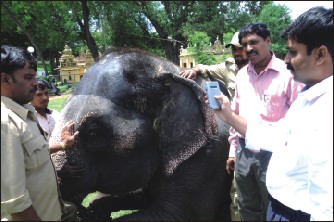
Hereafter identifying captive elephants in the State will be very easy as microchips are being implanted in them to help their identification and prevent illegal transportation of such elephants.
There are 42 elephants maintained by private players like Mysore Palace which has six (Chanchala, Ruby, Neeta, Preethi, Jamuna and Rajeshwari) Suttur Mutt which has two (Champa and Drona) and Nanjangud Srikanteshwara Temple has one (Gauri).
Elsewhere in the State, there are 188 elephants including 125 in Mysuru Division housed in elephant camps like Dubare,Thithimathi, Balle, Veeranahosahalli, Sakrebailu, Bandipura, K.Gudi and 26 in Mysuru and Bengaluru Zoos.
For the first time in the State, nine captive elephants coming under the jurisdiction of Mysuru Territorial Range got the chips implanted on Wednesday in the inner portion of the left inner lobe of their ears by Dr. Nagaraj, under the supervision of DCP Dr. V. Karikalan.
The microchip displays a 10-digit number read on a chip reader and the unique identification number will be recorded in the registry maintained by the Forest Department and linked to its server. Right now, the elephants are identified only through mahouts which are not fool proof as it widens the scope for illegal transportation.
It is said that 9 of the 10 chips, produced by an Indore (Madhya Pradesh) based company at Rs. 2000 per chip has been given to the Mysuru Zoo to be implanted to the main captive elephants there.
“Microchips will become mandatory for seeking licence to maintain captive elephants. The microchip implantation will be permanent and the licence should be renewed once in five years,” said DCF Dr. Karikalan.
source: http://www.starofmysore.com / Star of Mysore / Home> General News / Friday – June 26th, 2015
Eyeing a piece of land but unsure of buying it? Soon, finding out details of land records will be as easy as booking a cab on your smartphone — thanks to an app that will be unveiled in the next few weeks. All you need to do is key in your name and mobile number.
For instance, if you’re sipping a cuppa at an MG Road cafe and use the app, you will get the plot number of the place via SMS and know whether it’s a government or private property.
The government is in the final stages of testing the app, with officials at the survey, settlement and land records department already using it. The app is like an android application but the back-end work of syncing details of land records has been a mammoth task and is being verified.
Munish Moudgil, commissioner, survey, settlement and land records department, said: “The app will use longitude and latitude details from GPS coordinates and give citizens the requisite information. Not only will it benefit them during transactions, but also help government officials who now have to go back to dusty files to check records.”
The app is meant to serve a twofold purpose. “…One, to give government officials from various departments easy access to information on land so they can do their job without having to rummage through their desks. Second, it aims to help citizens,” he said.
It’ll come in handy for those looking at buying land — they’ll get to know if someone is trying to sell them government land or if it is the right survey number.
HOW IT WORKS
You have to enter your name and mobile number. Within minutes, you’ll get an SMS with details like survey number/plot number, whether it is a lake (as per records), forest land, rajakaluve, government or private land. “We are factoring a 30-metre error that could pop up because of the GPS coordinate of the person. If there is another plot with a survey number within 30 metres of the person’s location, details of that will also be sent to the user,” said Munish Moudgil, commissioner, survey, settlement and land records department.
source: http://www.timesofindia.indiatimes.com / The Times of India / Home> City> Bengaluru / by Chethan Kumar / July 01st, 2015