Category Archives: Science & Technology

Indian origin scientist to get Russia’s highest tech award

St Petersburg :

B Jayant Baliga, a US-based Indian-origin scientist, is being awarded Russia’s top technology award in recognition of his work as a major development in energy management which brought about huge increase in efficiency and major savings.

B Jayant Baliga, a US-based Indian-origin scientist, is being awarded Russia's top technology award. (Representative image)
B Jayant Baliga, a US-based Indian-origin scientist, is being awarded Russia’s top technology award. (Representative image)

The award will presented to Professor Baliga and Shuji Nakamura on Friday by Russian President Vladimir Putin at a ceremony here.

Nakamura, a Nobel Laureate, is being recognised for his work on blue light emitting diodes (LEDs). In Russia, the Global Energy Prize is known as the electronics equivalent of the Nobel Prize.

Professor Baliga invented the digital switch or the insulated gate bipolar transistor (IGBT) while working at General Electrical research & development centre in New York state in the US in 1983. The IGBT switches energy hundreds of thousands of times a second, raising the efficiency of any equipment manifold.

“Every equipment from your refrigerator to lights to motor vehicles has the need to use energy efficiently. If you take away the IGBT today, almost everything will come to a standstill,” Baliga told a visiting IANS correspondent on the eve of receiving the award.

Scientific American magazine called him among the ‘eight heroes of the semiconductor revolution’, and President Barack Obama awarded him the highest American technology prize last year and he is the 2014 recipient of the IEEE Medal of Honour, a rare distinction.

Professor Baliga, who now teaches to the North Carolina university as ‘distinguished university professor’, said that the IGBT that his invention combines two streams of electronics and electrical engineering and has possibly saved the world around $24 trillion dollars by raising efficiency, according to one detailed calculation.

“I got zero out of it. But then I did it all for humanity.”

Of course, says Prof Baliga, that he did make some money when he started three companies, but these were financed by venture capitalists who exited with enormous profits at the right time.

He says every motor today is at least 40 percent more efficient, the light bulb like the CFL better by almost 75 percent and a motor vehicle saves over 10 percent fuel because of his invention. He has written 19 books and over 500 papers in peer-reviewed journals.

Baliga passed out of IIT Madras before going to the US for his MS and PhD after electrical engineering after which he joined GE where he spent over 15 years.

After his ‘switch’ was invented, several of his colleagues told him that it would not work, and many scientists said he would fall “flat on his face”. But he said it stood the test of time.

The chairman of GE at that time, Jack Welch flew down especially to meet him when he heard what it could do. GE used the switch in the several of the equipments it sold, including medical devices.

A US citizen since 2000, he now has very little connection with India and does not travel to his home country much, especially after his parents and parents of his wife passed away. But, says Prof Baliga, an invention like his is unlikely in India, because it needs huge research infrastructure to be in place from universities to industries.

He feels, that India has a potential which has not been fully used, although in software “it has made great strides”.

Could a Nobel be on its way in the future? “I used to say no way,” but with so many recognitions and this “global prize where I am being feted with a Nobel Laureate, who knows”, he says. His regret though is that India does not know much about him.

“Top scientists that I meet always ask me, why has India not recognised your achievement?” And with characteristic modesty, Baliga told IANS, “I tell them that perhaps my country does not know about what I did.”

source: http://www.timesofindia.indiatimes.com / The Times of India / Home> NRI / IANS / June 18th, 2015
This Samaritan Contributes 5kW Solar Power to HESCOM

Sirsi :

A house in Gurunagar has become a solar power-generating station with the owner contributing power to HESCOM. ‘Shreyas’, the residence of Shrikant Hegde, an entrepreneur, has a 5 kW-capacity solar rooftop power unit, linked to the power grid.

The state’s solar energy policy encourages individuals, societies, institutions and companies to set up grid-connected rooftop solar units, and for ESCOMs to buy power from these units. The houses have to install a two-way meter to measure the flow of power in both the directions. The scheme is administered by respective ESCOMs, including registration, approval, metering protocols, standards and safety protocol.

Hegde has signed a 25-year agreement with HESCOM to export excess solar power to its grid. He is able to contribute a surplus of 500-600 units of power per month to the HESCOM grid at Rs 9.56 per unit.

In the first five years, HESCOM will purchase power at Rs 9.56 per unit (later at revised rates fixed by Karnataka Regulatory Energy Commission). “I will earn at least Rs 60,000 per annum,” Hegde said, adding that he will recover his investment in about seven years.

On the technical side, Hegde got the support from Apollo Power Systems Private Ltd, Bengaluru, and Tejas Energy,

Sirsi. The rooftop unit has been installed at a cost of about Rs 5 lakh. Gurucharana, executive, Apollo Power Systems Private Ltd, said the project was started in November 2014 by the state government on a power-purchase agreement (PPA) for 25 years.

Sunilkumar, head of the Renewable Energy of Appollo Renewable, said that even in rainy season like in Sirsi and Malnad area, 4-5 units of power could be generated daily.

Nagendra Honnalli, assistant commissioner of Sirsi, said that he would send a proposal to the government to provide finance through cooperative societies to farmers who want to take up this project. It costs about Rs 1 lakh per 1kW capacity.

He said this project would reduce transmission losses and dissemination costs. Panduranga Pai, general manager, Sirsi Urban Cooperative Bank, has offered to provide a loan of up to 75 per cent of the cost of the project at 2 per cent interest.

source: http://www.newindianexpress.com / The New Indian Express / Home> States> Karnataka / by Shripad Bhat / June 21st, 2015

Bescom’s solar generation reaches 1 MW

Nearly eight months after the launch of its ambitious solar rooftop project, the Bangalore Electricity Supply Company (Bescom) finally reached a milestone by generating 1,000 kW (1 MW ) of solar power.

Getting off to a slow start, the power utility now has 409 applications registered with an overall proposed solar generating capacity of 19 MW.

Among the major contributors to Bescom’s solar generating capacity are: the Karnataka State Cricket Association, which has installed a 400 kW rooftop solar power plant at M. Chinnaswamy Stadium, St. Joseph’s College and National Institute of Advanced Sciences (100 Kwp each).

A Bescom release said that process and technical committees have been formed to encourage solar rooftop power distribution generation.

A solar help desk has also been constituted (080-22340816 andsolarhelpdesk@bescom.co.in) for those interested in installing solar rooftop plants.

source: http://www.thehindu.com / The Hindu / Home> News> Cities> Bengaluru / by Staff Reporter / Bengaluru – June 16th, 2015

Unified remote-sensing centre launched in Bengaluru

The State government on Thursday launched a central remote-sensing centre that brings all remote-sensing data activity under one roof – different from the three centres that were handling the work previously.

Former chairman of Isro, K Kasturirangan, and ST, BT & IT Minister, S R Patil, inaugurated the centre – billed as the first of its kind – on Major Sandeep Unnikrishnan Road in Yelahanka.

Kasturirangan, a former member of the Planning Commission, said the centralised office would help people and institutions approach a single centre instead of three previously. All the remote-sensing data collected from Isro’s satellites would be processed here, making satellite data available at one location.

Karnataka was one among the first states in the country to use GIS-Data and remote-sensing data in planning. The technologies have been used in agriculture, farming, forestry and rural and urban development. The new centre which consolidates all technologies and data under one roof makes planning easier across sectors.

Minister Patil said Bengaluru and Karnataka were still ahead of all the cities and states in information technology. By 2020, Karnataka will have reached four lakh crore worth of IT exports. The government, he said, was ready to take measures to consolidate this lead and continue to be the number one IT destination in the country.

source: http://www.deccanherald.com / Deccan Herald / Home> State / DHNS – Bengaluru, June 12th, 2015

Bhramara lifetime achievement and lifetime services awards presented

to Prof. K. Vijay Raghavan and Dr. N. Chandrashekar

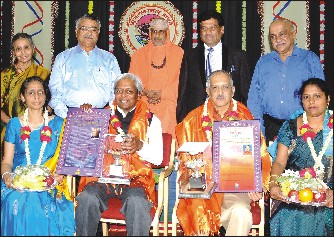
Sri Shivarathri Deshikendra Swamiji of Suttur Mutt (standing centre) presented Bhramara’s Lifetime Achievement Award to Prof. Krishnaswamy Vijay Raghavan (seated second from left), Secretary, Department of Biotechnology, Government of India and Bhramara’s Lifetime Service Award to Dr. N. Chandrashekar (seated second from right), Chairman and Director, Aadithya Adhikari Hospital, Mysuru, at a function held at Rani Bahadur Auditorium on Hunsur road in city yesterday. Usha Vijay Raghavan (seated extreme left) and Rani Chandrashekar (seated extreme right) were also felicitated on the occasion. They are seen with (standing from left) Madhuri Thathachari of Bhramara Trust of Y. T. & Madhuri Thathachari, Mysuru; K. B. Ganapathy, Editor-in-Chief, Star of Mysore and Mysooru Mithra; Prof. K.S. Rangappa, VC, University of Mysore and Prof. Desirazu Narasimha Rao, Divisional Chairman of Biological Sciences, Indian Institute of Science, Bengaluru.

 Mysuru :

The Bhramara’s Lifetime Achievement Award for Science-2015 was conferred on Prof. Krishnaswamy Vijay Raghavan, Secretary, Department of Biotechnology, Government of India and the Bhramara’s Lifetime Service to Humanity Award-2015 on Dr. N. Chandrashekar, Chairman and Director, Aadithya Adhikari Hospital, Gokulam, Mysuru, at a function held at Rani Bahadur Auditorium in Manasagangotri, Hunsur road here yesterday.

Sri Shivarathri Deshikendra Swamiji of Suttur Mutt presented the annual awards to Prof. Vijay Raghavan and Dr. Chandrashekar and delivered the benediction address.

Speaking on the importance of science and technology, Suttur Swamiji said we should not forget the roots of our spiritual needs.

Usha Vijay Raghavan and Rani Chandrashekar were also felicitated at the function.

In his acceptance speech, Prof. Vijay Raghavan said that more number of efficient Professors were required in the field of Biotechnology as the research work continued to grow.

Technology has been playing a key role in biological sciences, he said and added that education is important for every child in the country.

Prof. Vijay Raghavan pointed out that there was rapid progress in science and technology which has helped in reducing some of the problems in our society.

Dr. Chandrashekar, who also spoke, said that his first priority was social service as advised by his teachers and was grateful to his teacher Raghavendraswamy. He said that he would continue his service in the field of medical service, specially procuring of cornea from the eyes of the donors after death.

Prof. K.S. Rangappa, Vice- Chancellor, University of Mysore, who presided, said that Prof. Y.T. Thathachari was a great Scientist, Pandit and also a Visionary.

The VC congratulated the two eminent personalities who have distinguished themselves in their respective fields for being honoured with the prestigious awards by the Bhramara Trust.

A great offering to God

K.B. Ganapathy, Editor-in- Chief, Star of Mysore and Mysooru Mithra, who introduced Dr. Chandrashekar, said that he (Dr. Chandrashekar) has been rendering yeoman service to humanity, which indeed is a great offering to God. He recalled a saying and said that the birth of a man is God’s gift to mankind, but what that man becomes in life is man’s gift to God. One such gift of man to God is Dr. Chandrashekar.

Prof. Desirazu Narasimha Rao, Divisional Chairman of Biological Sciences, Indian Institute of Science, Bengaluru, introduced Prof. Vijay Raghavan.

Managing Trustee of Bhramara Trust Madhuri Thathachari, Trustee Prof. Srinivasan and others were present.

source: http://www.starofmysore.com / Star of Mysore / Home> General News / June 10th, 2015

Hubballi optometrist gets UK fellowship

Hubballi :

Kunal Shah , 35, a BS optometry graduate from BITS, Pilani-Sankara Nethralaya, and CEO of Hubballi-based startup Eyesavers has got a fellowship from the British Contact Lens Association (BCLA). He is the fourth India optometrist to receive the BCLA fellowship. Professor James Wolffsohn of Aston University honoured Shah in Pune recently.

Expressing joy on receiving the fete, Kunal told TOI that the adoption of technology has been instrumental in getting the fellowship.

“Our startup, floated two years ago, has been the first in India to adopt I-profiler technology by Zeiss and Visio Office Plus by Essilor from France which can calculate the position of eyes in front of the lenses at a precision of 1/10th mm at a click of a button. Now, 4-5 other optometrists have borrowed these technologies in India,” he said.

Kunal’s father Prakash Shah, who is also involved in optical business for the past five decades, said that he was worried when Kunal wanted to invest Rs 20 lakh on I-profiler and Rs 8.50 lakh on Visio Office Plus. “Now I am convinced by his innovations. Though we have Hubli Opticals since 1953, he floated separate brand at his own risk,” he said.

Kunal is offering free service using Visio Office Plus technology to avoid fitting errors. . “Usually, we don’t consider the size of nose, eyes and forehead while suggesting a frame for patients. This technology considers whether the wearer of the glass is head-mover or eye-mover while preparing the perfect frame,” he claimed.

Kunal is the only optometrist in North Karnataka to provide cosmetic eye to fill self-confidence among people who have only one eye by birth.

source: http://www.timesofindia.indiatimes.com / The Times of India / Home> City> Hubballi / by Sangamesh Menasinakai, TNN / June 10th, 2015

SIT students develop app that helps farmers plant diseases

Mangaluru :

Final year students of computer science and engineering of Srinivas Institute of Technology (SIT), Valachil – Shraddha, Krishnanad Bhat, Sowmya, Prajnashree, Supritha M – have developed an android based project “Agricultural Plant Disease Detection” under the guidance of Nagaraja Hebbar N. This project won first place in intra-collegiate competition conducted by the institute for its students, Shrinivasa Mayya D, principal, SIT said.

This project is useful to recognize the diseases that plants are affected using the image of the leaf. The major beneficiaries of the project are farmers for they will also get the medication details for the corresponding disease through this application. In the present day, agricultural plants are affected by different types of disease. This application helps farmer in obtaining details pertaining to disease afflicting their crop and the remedial steps they can take to mitigate it.

This application basically identifies diseases based on damage patterns observed in leaves of agricultural plants. The application also indicates prescribed medication according to the disease condition with which the plants are affected. This project will help farmers for taking quick decisions related to the yields. If proper medication is applied in the initial stage, farmers can protect their yields against further damage, Shrinivasa Mayya noted.

The application is blended with existing technology which will serve the farmers. A Raghavendra Rao, president of A Shama Rao Foundation and A Srinivasa Rao, vice-president congratulated and appreciated the efforts of the students’ in developing the app and also the faculty for guiding the students in the right direction with their academic endeavours. Srinivas Rao said education will be complete only when it translates in to some tangible benefit for end users.

source: http://www.timesofindia.indiatimes.com / The Times of India / Home> City> Mangaluru / by Jaideep Shenoy, TNN / June 08th, 2015

City teen selected for international chemistry Olympiad

Bengaluru :

Ameet Deshpande, a 17-year-old student from AECS Maruti Public School, has been selected for the International Chemistry Olympiad (ICO) to be held in Bratislava, Slovakia.

Of the 30 students who participated from India, four students were selected for the International Olympiad and Ameet is one of them. Ameet has also enrolled at FIITJEE Bangalore.

Ameet is also an avid footballer. The Olympiad consists of two sessions that run for five hours each and the winner will be decided by a scientific jury set up by the host nation.

“I enjoy chemistry because it is one of the most practical subjects, but I am undecided whether I will pursue it as a career. I am very happy and thankful to all my teachers who helped me to achieve this goal,” said Ameet.

source: http://www.timesofindia.indiatimes.com / The Times of India / Home> City> Bengaluru / TNN / June 07th, 2015

Hassan students win prize

A student, native of Hassan, has won a prize at the Intel International Science and Engineering Fair held at Pittsburgh, US recently.

S. Komal, a native of Nittur village near Hassan, participated in the fair with his classmate Aditya Bhargav. The device designed and displayed by the duo is used for knowing the carbon monoxide in air. The duo won the fourth award carrying $ 500. Both are class XII students at Sharada Vidyanikethana Public School in Mangaluru.

The fair was organised by the Society for Science and the Public in partnership with the Intel Foundation at Pittsburgh between May 10 and 15. Students were selected for the fair through competitions. Aditya Bhargav and Komal presented highly sensitive Nano-Ferrite meant for detection of carbon monoxide in air.

“Air pollution is a big problem in India. Vehicles have been contributing high rates of carbon monoxide to environment. We made efforts to develop a device to detect carbon monoxide content in the air, ” he told the media.

source: http://www.thehindu.com / The Hindu / Home> News> National> Karnataka / by Satish G.T, / Hassan – June 02nd, 2015

Now, an APP to count your Red Blood Cells

4 students from PESCE, Mandya, develop an app to count RBC on mobile phones

Seen in the picture are (from left) K.N. Pooja, H.S. Shwetha, Harshita Sinha and R. Parag of the Department of Information Science and Engineering, PESCE, Mandya, at the National Conference on ‘Recent Innovations in Information, Communication Technology and Management (RIICTeM-2015)’ organised at Visvesvaraya Technological University (VTU) PG Centre and Regional Office, Kalaburagi, on May 21 and 22 where the team presented a paper on ‘A Smart Phone Based Solution for Extracting and Counting of Red Blood Cells in a Blood Smear Image’ under the guidance of S.M. Bramesh, Assistant Professor of Dept. of Information Science and Engineering, PESCE, Mandya

by Kedar Koushik

Imagine a future where you neither have to visit a clinic nor have to depend on the laboratory specialist to count the Red Blood Cells (RBC). All you need is your Smart Phone and the app developed by the students of PES College of Engineering (PESCE), Mandya, to generate a RBC report, which means, you can detect leukemia, anaemia and other undetected heart and lung problems right at the comfort of your home.

At the recently concluded National Conference on ‘Recent Innovations in Information, Communication Technology and Management (RIICTeM-2015)’ organised at Visvesvaraya Technological University (VTU) PG Centre and Regional Office, Kalaburagi, R. Parag, Harshita Sinha, H.S. Shwetha and K.N. Pooja, all studying 8th semester at the Department of Information Science and Engineering, PESCE, Mandya, presented a paper on an app they have developed — RCB Counter, that could change the way RBC reports are generated.

Their paper titled ‘A Smart Phone Based Solution for Extracting and Counting of Red Blood Cells in a Blood Smear Image,’ presented under the guidance of S.M. Bramesh, Assistant Professor of Dept. of Information Science and Engineering, PESCE, Mandya, has been selected for the publication in International Journals.

Here is how the ‘RBC Counter’ app works. The microscopically magnified images of blood samples are captured by the smart phone and are enhanced using various techniques to get a sharper and detailed image. This pre-processed image undergoes Hough Transform — a digital image processing technique, which isolates the Red Blood Cells in the image. Later, the presence of RBC is counted and is further appropriated to a cubic millimetre of blood volume rendering the RBC count with an accuracy rate of 95.67 per cent.

Speaking to Star of Mysore, Parag, one among the four students who presented the paper, said, “This is perhaps the first time that one can count their RBC on their Smart Phone. We have had the same technology on the laptop, like MATLAB, but not on the Smart Phone.”

Parag said that the idea was provided by their mentor S.M. Bramesh and added, “Our main concern was with the poor and the people in rural areas. They cannot afford to spend a lot of money to come to urban areas for the tests, and even if they do, it’ll take an entire day to get their results. With our app — RCB Counter — they can make their own test and the results will be given instantly. There is also no need for secondary confirmation since the device is quite accurate.”

Parag also said that it took the team of four almost six months to complete the thesis and added, “When we presented the paper at the National Conference in front of the Vice-Chancellor of VTU, Prof. H. Maheshappa, told us that he would get us the patent rights after we are awarded the degree, so we are really looking forward to it.”

Parag said that another team in their college is working on counting WBC (White Blood Cells) on the smart phone, and that they are planning to combine both for a comprehensive app for smart phones.

source: http://www.starofmysore.com / Star of Mysore / Home> General News / Wednesday – June 02nd, 2015