
Category Archives: Science & Technology

State on a mission to set up world’s biggest solar park

SolarBF30may2015

2,000-MW park to come up in Pavagada taluk

Karnataka, which entered the global power map by setting up Asia’s first hydroelectric station, is now embarking on another milestone mission of setting up a mega solar power park, said to be the world’s biggest. The park, with a capacity of 2,000 MW, will come up on 10,000 acres of land in the parched Pavagada taluk of Tumakuru district.

Secretary, Union Ministry of New and Renewal Energy, Upendra Tripathy and Additional Chief Secretary, Karnataka Energy Department, Ravi Kumar, who announced this at a press conference here on Friday, said the work on the proposed park would start soon.

The 1,000 MW solar park being implemented in Andhra Pradesh is the biggest such project so far in the country. The Centre would support the park by offering a subsidy of Rs. 20 lakh per mega Watt, Mr. Tripathy said.

According to sources, Pavagada was chosen for the solar park because of a combination of various factors, including high sunlight exposure, backwardness of the area, and lesser demand for land. In addition to the park, Karnataka has bigger plans for the renewable energy sector as the State on Friday committed itself to setting up projects to tap green energy to the tune of 16,000 MW in the next five to seven years.

The commitment was made at a meeting with Ministry of New and Renewal Energy authorities here where the Centre wanted the States to take up the responsibility of executing green energy project proposals to the tune of 1,75,000 MW received by it during the renewable energy global investors’ meet.

To facilitate evacuation of such a massive quantum of renewable energy from the generation sites, the Centre has also decided to set up an exclusive pan-India green corridor at a cost of Rs. 36,000 crore, Mr. Tripathy said. To raise resources for renewable energy sector infrastructure, the Centre would float tax-free green bonds to the tune of Rs. 5,000 crore in about three months from now, he said.

source: http://www.thehindu.com / The Hindu / Home> News> Cities> Bengaluru / by B.S. Satish Kumar / Bengaluru – May 30th, 2015
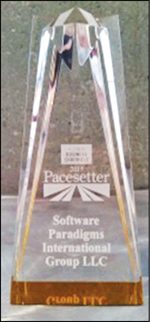
SPI among top 100 fastest growing Pvt. Cos in Atlanta

Receives Atlanta Business Chronicle Pacesetter Award-2015

SPIbf29may2015

Mysuru :

Software Paradigms International Group, (SPI) was honoured as one of the fastest growing private companies in Atlanta, Georgia, at the Atlanta Business Chronicle Pacesetter Awards ceremony held recently at the Georgia World Congress Centre.

The Atlanta Business Chronicle Pacesetter Award publishes the list of top 100 fastest growing privately held companies in Atlanta, Georgia. This year’s Pacesetter event saw participation of over 500 attendees.

“SPI is a technology provider of choice for Retailers worldwide. The firm’s growth has been driven by changes in the Retail industry particularly the rapid adoption of online and mobile channels by shoppers. SPI’s expertise in multi-channel planning and analytics as well as supplier management have helped our retail clients come out ahead in creating a world class experience for their customers across channels,” said Sid Mookerji, Global CEO, SPI

The 100 Pacesetter companies were announced in their index ranking order from 100 to 1. Top 5 companies included 1-800-COURIER, Castle Medical, SalesLoft, Ely Concrete Construction, and Priority Payment Systems. SPI ranked 44th in the top 100.

This is the second Pacesetter award for SPI.

Caroline Dunn, Head of Marketing, SPI, received the award on behalf of SPI.

source: http://www.starofmysore.com / Star of Mysore / Home> General News / Saturday – May 23rd, 2015

SJCE Professor bags best PH.D Thesis Award

Mysuru :

BITES Best Ph.D Thesis Award, one of the prestigious awards, was conferred on Dr. B.S. Mahanand, Associate Professor, Department of Information Science & Engineering at Sri Jayachamarajendra College of Engineering (SJCE), Mysuru, for the year 2012-13 by the Government of Karnataka’s Board for IT Education Standards (BITES).

Every year BITES gives away awards for the best Ph.D thesis. Dr. Mahanand’s thesis titled “Alzheimer’s Disease Detection from Magnetic Resonance Images Using Machine Learning Approaches” won the award in the category of Computer Science and Engineering Area.

Dr. Mahanand has extensively researched on the detection of Alzheimer’s Disease using computational intelligence approaches and has pursued research on Alzheimer’s disease as an incipient of the visiting research fellowship at Helsinki University of Technology, Finland, as Post-Doctoral Research Associate at Nanyang Technological University, Singapore in 2012. He has several peer reviewed research publication to his credit and has presented his research at National and International conferences.

Prof. B. S. Sonde, Chairman, Ph.D Thesis Evaluation Committee, presented the award to Dr. Mahanand at a function held at PESIT, Bengaluru on May 16 which carries a citation and a cash prize.

Dr. Mahanand is also visiting the National Magnetic Resonance Research Centre, University, Turkey as Visiting Researcher in June 2015.

source: http://www.starofmysore.com / Star of Mysore / Home> General News / Saturday – May 23rd, 2015

NIE Professor receives Research Award

ProfSureshaBF29may2015

Mysuru :

S. R. Patil, Minister for Infrastructure, Information Technology, Biotechnology, Science and Technology, Planning and Statistics, recently handed over the prestigious “Award for Best Research Publication” instituted by the Vision Group of Science and Technology (VGST), Karnataka government, at Vikasa Soudha in Bengaluru, to Prof. Suresha, Department of Mechanical Engineering, NIE, Mysuru. The award carries a cash prize of Rs. 25,000, a memento and a citation.

Prof. Suresha specialises in Polymer Composites Technology, Micro and Nano-based Polymeric Composites for automotive applications, non-materials and materials science. He has contributed 206 research articles to various international and national journals.

source: http://www.starofmysore.com / Star of Mysore / Home> General News / Saturday – May 23rd, 2015

Students develop rotating solar panel

Hubballi :

Students of electrical and electronics of SDM College of Engineering and Technology have developed a solar tracker solar panel that rotates in the direction of the sun and taps maximum energy.

While conventional solar panels fixed to face at one direction and hence capture limited energy, rotating panels can absorb energy all through the day as they move from east to west in the direction of the sun. Speaking to TOI, team member Vallabh Kulkarni said, “We noted that conventional panels do not absorb energy fully. If the panel is facing towards the east, it harvests minimum energy when the sun moves towards the west after 12 noon. This made us think of coming out with a rotating panel.”

The project, named as Harnessing Maximum Energy from Solar Panel took five months for completion. Another teammate Nikita Pinto said that they approached their faculty members and browsed internet for supporting information. “We found that there are hardly any attempts in adopting micro controller in the panel in the country whereas demand for solar energy is increasing by the day. Then we started working on the project,” she added.

Arun Chachadi noted that the new model would produce 25-30% more energy as compared to the conventional model.

Another team member Sushma G S said that they bought a micro-controller from the market and programmed it by using the flow code software, which is freely available on internet. “We used components like solar panel of 3 watt capacity, DC geared motor, LCD display and micro-controller. We spent Rs 2,100 for this project and a prototype is ready in our college,” she added.

Prof Mrutyunjay R Kappali, guided the team. Prof SB Vanakudri, principal, SDM College of Engineering and Technology, Dharwad, said the principle of the rotating panel is based on sunflower, the flower which tracks sun up to 180 degree.

“We will send a proposal to the Union government to consider the model in research and development works in its institutions. If Karnataka State Council of Science and Technology sanctions some aid, we will improve this model in coming years.”

source: http://www.timesofindia.indiatimes.com / The Times of India / Home> City> Hubballi / by Sangamesh Menasinakai, TNN / May 22nd, 2015

Matriculate develops borewell scanner system

Hubballi :

Clueless about the water level and expected flow, many a times, farmers are in a dilemma while planning to dig a borewell. Some resort to unscientific methods to detect “borewell points”. Having born in an agricultural family in Vijayapura, Girish Badragond was well aware of the problem. An electrician, who has studied till matriculation, he has developed a borewell scanner system, said to be the first of its kind in the country.

Now, the National Innovation Foundation (NIF), an autonomous body of department of science and technology, is helping Badragond patent the borewell scanner system.

Badragond says that poor and sporadic rainfall in Vijayapura district motivated him to come up with the innovation. “Vijayapura suffered drought in 2006. Farmers were in dilemma to install motor pumps. I tested the presence of water at different places using manual sound reflection. I realized that there is a need to carry out underground testing. Then, I thought of a device that could also withstand underground conditions like pressure, temperature and can be monitored from a remote place. This led me to design a borewell scanner system,” he says.

Currently, the device, which costs about Rs 2 lakh, is not for sale. Badragond, 36, takes it to fields when requested by farmers and issues a report on the water level. The Central Ground Water Board, south western region, has opined that the technology is innovative and can be used at a very low cost. “It is useful to know about the depth of well, depth of casing, water yielding zone/zones and depth of fractures, temperature, etc,” reads the board’s letter to NIF.

Badragond is now involved in research and development work in Bengaluru. “I have been making electrical gadgets since my childhood with the help of my father, who is a farmer and part-time electrician. When I was in class VII, I started reading the ‘Electronics For You’ magazine. I could make my first project of IR sensor in 1996, he recalls.

In 2005, Badragond was also involved in a road light saver project with financial support from friends. Then he developed automated agriculture products like bird repeller, energy saver, mobile phone and solar-controlled irrigation devices.

He was recently honoured with the state biennial award, instituted by NIF.

source: http://www.timesofindia.indiatimes.com / The Times of India / Home> City> Hubballi / by Sangamesh Menasinaka, TNN / May 06th, 2015

TechXpo to host Chinese delegates

Mangaluru:

Delegates from China will attend TechXpo 15 that gets under way at P A College of Engineering (PACE) on Friday.

The college’s mechanical engineering department will host an auto engineering show. Chinese delegate Schichun Tao, sales director, Asia Pacific, Middle East, North Africa and Latin America of Launch Tech Pvt Limited will be the chief guest .

A seminar will be conducted on technologies related to high performance lubricants, automobile diagnostics evolution and future trends.Indoor exhibits on latest technologies in the automotive industry, outdoor exhibits on modified and vintage cars and bikes will be open to public. Free auto diagnostic scanning for new generation cars with OBD 2 and Entice 15, a technical competition, will be held. Joy Yan, sales manager, Launch Tech, Sasi Menon, retail head, Mobil 1, and Shamnas Mohammd, managing director, Candour Auto Tech, will be present.

source: http://www.timesofindia.indiatimes.com / The Times of India / Home> City> Mangaluru / TNN / May 07th, 2015

IISc Professor Now a Royal Society Fellow

Bengaluru :
A physics professor from the Indian Institute of Science (IISc) has been elected as a Fellow of the Royal Society.

Ajay Sood, who has had a career spanning over four decades, was chosen for his work on nanotechnology and for initiating several contemporary researches and providing deep insights into some of physics’ long-standing questions.

The Royal Society is the United Kingdom’s national academy of science and includes several prominent scientists and engineers from the Commonwealth. So far, 42 Indians including Srinivasa Ramanujan, Sir C V Raman and C N R Rao have been elected Fellows of the Society.

This year, 47 new Fellows and 10 new foreign members were inducted. In its citation, the Royal Society has said “the originality, diversity and significance of Professor Sood’s contributions are truly remarkable and noteworthy”. It recognises him as “one of the important leaders of Indian science in general and physics in particular”.

Reacting to the honour, Prof Sood told Express, “I feel happy, honoured and humbled. It is humbling because of the other people elected as Fellows.”

He called this a recognition of Indian science. “I not only feel good for me, I feel good for my students, collaborators, department, the institute, and the country.”

In 2003, Sood and his team at IISc generated electricity by allowing liquid and gas flow over carbon nanotubes, thereby unveiling a new kind of physics. The discovery, often called the ‘Sood Effect’, finds application in many areas, from medical appliances like pacemakers to gas pipelines.

source: http://www.newindianexpress.com / The New Indian Express / Home> Cities> Bengaluru / by Express News Service / May 07th, 2015

K’taka doctors in Katmandu aiding quake survivors

Bengaluru:

Two teams of doctors from Karantaka have been working in the earthquake-hit Nepal conducting surgeries and offering counseling to the survivors.

Speaking to STOI, Dr Basavaraju KM, a general surgeon who is heading a team, said they have performed 15 surgeries in the past two days.

“We are largely seeing cases of brain injuries, spinal cord injuries and fractures among survivors rescued from under the debris,” said Dr Basavaraju, whose team of surgeons specializes in treating brain injury, spinal injuries, and fractures.

Every time the team rescued a survivor from under the debris, he or she is seen to have suffered various fractures. “Scans revealed pieces of wood in brains of some survivors, as they were almost buried under the debris,” said Dr Basavaraju, a general surgeon heading the BJP doctor’s wing in Nepal.

Meanwhile, officials of the health and family welfare department said the team of 10 doctors sent by the government has been doing an excellent job at the medical relief camps.

However, the doctors were not reachable due to lack of communication network in Nepal.

source: http://www.timesofindia.indiatimes.com / The Times of India / Home> City> Bengaluru / by Sunitha Rao, TNN / May 03rd, 2015

B’luru scientists find drug which could cure malaria with one dose

Bengaluru:

Three scientists from Bengaluru, who led a team of global researchers looking for an antimalarial drug, have found a fast-killing solution. After completing some tests, it’ll go in for clinical trials on humans. That this drug has the potential to cure the dreaded disease in one dose makes it more attractive to healthcare providers. The Bengaluru solution — Triaminopyrimidine (TAP) — comes with many advantages over existing drugs. Vasan Sambandamurthy, one of the senior authors of the research paper, said: “It’s a fast-killing and long-acting antimalarial clinical candidate. TAP acts exclusively on the blood stage of Plasmodium falciparum (the stage responsible for clinical symptoms) in a relevant mouse model. This candidate is equally active against causative agent Plasmodium vivax.” He added, “The compound has shown good safety margins in guinea pigs and rats. With a predicted half-life of 36 hours in humans, TAP offers potential for a single dose combination.” The rapid spread of Plasmodium falciparum, the parasite which causes malaria in humans, has left nations battling it with a weakened arsenal and coping with thousands of deaths every year. This parasite has gradually become resistant to available medication. The World Health Organisation (WHO) estimates that 3.2 billion people in 97 countries, including India, are at risk of being infected with malaria. In 2013, WHO reported an estimated 198 million cases and the disease was responsible for an estimated 5.84 lakh deaths, including 4.53 lakh children less than five years old. Every person infected with malaria has to deal with millions of parasites and existing drugs have a limited effect in humans. “The half-life, which isn’t more than 2 hours, means it allows parasites to bounce back. Existing drugs are not fast-killing, which means that not only does a human need more doses but each dose is capable of only killing a few parasites,” he said.

Besides, a potential side-effect of existing drugs is liver damage. “This doesn’t happen all the time, but the possibility does exist. Also, the parasites have become resistant to these drugs. With TAP, there are now known side-effects and the parasites are unable to develop resistance at the same pace as they do for existing drugs,” he said. TAP was discovered by a team at pharmaceutical company AstraZeneca. “The main research happened in its R&D centre in Bengaluru between 2011 and 2014), which has since been shut down. It took us three years of rigorous work by teams across the globe. Today, we confidently nominate TAPs as a clinical candidate to treat drug-resistant malaria,” Vasan said. Shahul Hameed and Suresh Solapure were the two other team leaders.
Active against drug-resistant malaria TAP has a novel mechanism of action that specifically inhibits targets a protein involved in maintaining specific and localised agents that serve as the major route to disturb the proton gradient inside the parasite hydrogen ion levels. Vasan Sambandamurthy | researcher

Global work, delivered in Bengaluru The project was partnered and partially funded by Medicines for Malaria Venture (MMV) based in Switzerland. This work showcases collaboration among big pharma companies (AstraZeneca, Glaxo Smith Kline) and several labs worldwide (Columbia University, Harvard Medical School) for a disease highly prevalent in the developing world. The research was primarily conducted at AstraZeneca’s R&D center, Bengaluru, while safety and toxicology studies supported from its other sites. While Glaxo Smithkline, Spain conducted some of the proof of concept studies, Columbia University, New York and Harvard School of Public Health did the target identification studies.

source: http://www.timesofindia.indiatimes.com / The Times of India / Home> City> Bengaluru / by Chetan Kumar, TNN / May 01st, 2015