Category Archives: Science & Technology

DRDO scientists develop device to track snipers

Bengaluru :

Defence scientists have developed a device that can identify snipers, providing a boost to security agencies. “This new-age device can detect passive or active optical threats like telescopes, binoculars or the telescopic sight of a sniper rifle, and has proven EFFECTIVE for VIP security,” a source said.

Not surp risingly, Delhi police, who protect the most NUMBER of the country’s VVIPs and VIPs, will be the first to equip itself with this new-age device. Called the Optical Target Locater (OTL), it has been developed by defence scientists at Laser Science and Technology Centre (LASTEC), primarily for the armed forces.

Sources in LAST EC, a DRDO lab, said: “It is a laser-based portable surveillance device which functions on the cat’s eye effect,” adding that the device releases a laser beam which scans a designated area and as soon as it hits any of the targets (anything optical) some bac k-scattered energy is RECEIVED and the target is detected.

“This retro-reflected energy helps in locating optical targets against a static background. Any surveillance device with front-end optics and a sensor at the focal plane, whether biological, like eye, or passive sensors like binoculars, day sight or night vision device (NVD), or electronic sensors as in Laser RANGE Finders (LRFs) can be detected by this approach,” he explained.

The threat could be in terms of a sniper equipped with a day sight or a NVD, or any other optical/electro optical surveillance device, like binoculars, surveillance cameras, LRF, designators, etc.

Confirming to TOI on Delhi police’s interest in the device, special commissioner (security) SBK Singh, said: “There is CERTAINLY a requirement for this and we’ve raised it.”

TWO variants

Sources in LASTEC said Delhi police are looking at procuring OTL 300. “It will have a range of 300 metres, which they will buy,” a source said. It is effective in scanning and monitoring of specific areas, VIP security and detection of pointed optics. Another long-range device, OTL 1500, is undergoing test and optimization process, and will be used by the Indian Army, National Security Guards and other agencies.

source: http://www.timesofindia.indiatimes.com / The Times of India / Home> City> Bengaluru / by Chethan Kumar, TNN / April 14th, 2015

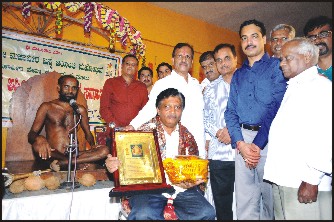
Fellowship award for Chauhan

O.P. Chauhan, scientist, Defence Food Research Laboratory, has secured the ‘Bioved Fellowship award 2015’ for his contribution in the field of food technology from Bioved Research Institute of Agriculture and Technology.

Mr. Chauhan’s research areas include post-harvest handling of fruits and vegetables, high pressure processing, pulsed electric field processing, microwave dehydration, vacuum frying and modified/controlled atmosphere packaging/storage of fruits and vegetables.

His research findings have appeared in over 60 international and national peer-reviewed journals and conference proceedings.

He has authored five international and six national book chapters.

Apart from this he has seven patents to his credit. — Staff Correspondent

source: http://www.thehindu.com / The Hindu / Home> News> National> Karnataka / Mysuru – April 12th, 2015

MIT solar flair will provide impetus to rural Karnataka

The Massachusetts Institute of Technology has roped in city-based Selco Foundation to run pilot project to ultimately benefit Karnataka

The MIT software will help minimise cost of installing solar micro-grids fo 10-50 kW to ensure uninterrupted power supply

​US-based Massachusetts Institute of Technology (MIT) and Selco Foundation in Bengaluru are sowing the seeds for large-scale rural solar electrification in Karnataka and Tamil Nadu. The aim is to pepper rural landscapes with well-placed 10-50 kW solar power micro-grids to directly supply uninterrupted power supply at minimal cost to small clusters of houses in villages.

The idea is to install solar power micro-grids in villages so that larger electric supply grids using conventional thermal/hydel power could more easily meet the growing urban demand for power in future.
Selco Foundation, a non-profit organisation focusing on enhancing quality of life and wealth creation in rural India through sustainable energy applications, is scheduled to run a pilot project in Munger district in Bihar to test an MIT-developed software tool that automatically analyses ideal locations for installing micro-grids.
According to MIT, a team of its graduate students and data scientists developed a software tool that identifies houses from readily-available satellite imagery and automatically analyses precise locations for setting up solar micro-grids in villages.
An MIT News Office release on the project said once the locations of houses are determined the computer runs thousands of combinations on where solar panels, battery packs, and distribution wires could be located.

This allows the team to pick configurations that provide power to the greatest number of houses with the least wiring to minimise costs.
Niraj Marathe, project lead, Selco Foundation, told Bangalore Mirror, “If proven accurate and effective, it can be used by project developers as an affordable planning tool as it will consider optimum costing as basis for planning and design of a (solar power) micro-grid system.”
In a pre-pilot trial run conducted by MIT in an unnamed Indian village, it was found that the process indeed saved considerable time and money otherwise spent in sending teams from village to village to identify locations.
The MIT findings have been published in the journal Big Data.
After the pre-pilot trial, MIT roped in Selco Foundation to conduct the pilot project in Munger.
Marathe said following the successful completion of the pilot in Munger, Selco plans to scout for villages in Karnataka and Tamil Nadu to install solar power-grids using the MIT software.
“We will work on two micro-grids simultaneously (in Munger). One will be planned and designed using the MIT tool, while the other will follow conventional planning and design methodology of Selco,” Marathe explained. “This will help us evaluate the effectiveness of the tool. Following the execution and detailed monitoring, we will evaluate the tool, incorporate necessary changes and use the tool again on planning different sets of micro-grids.”
MIT will select four more Indian villages for the next phase of testing: Two will have solar micro-grids installed using existing methods, and two installed by using patterns selected by the MIT software. These villages will then be compared for the actual costs and performance of the systems to determine the benefits.
This is the right time for installing micro-grids. In keeping with the state’s new solar power policy, the Karnataka State Pollution Control Board (KSPCB) earlier in April decided to keep only solar power units of more than 5 MW under the concerned acts for issuing licences. KSPCB chairman, Vaman Acharya, said this meant that public who installed solar power plants of capacity less than 5 MW need not get ‘No Objection Certificates’. Solar power comes under green category in the industry categorisation of Pollution Control Act.
“We’re hoping that public agencies eventually see the wisdom of mapping 100 million rural households…,” MIT News Office quoted Stewart Craine, chair of UN Foundation’s mapping group and head of DevelopmentMaps.org, a company offering satellite-based mapping services.

source: http://www.bangaloremirror.com / Bangalore Mirror / Home> Bangalore> Others / by Nirad Mudur, Bangalore Mirror Bureau / April 13th, 2015

Sci-fi writer Rajshekhar passes away

Dharwad :

Science fiction writer and physics professor Rajshekhar Bhusnurmath, 77, died at his Dharwad residence in the early hours of Sunday.

From Nidagundi in Ron taluk, Rajshekhar earned Master’s in physics and taught at Karnatak Science College in Dharwad. Son of noted writer SS Bhusnurmath, Rajshekhar was a popular sci-fi writer in Kannada and has produced several programmes for All India Radio.

Many of his novels were serialized in newspapers and magazines. Post retirement, he was guiding youngsters in astronomy. He is survived by his wife, two sons and two daughters.

source: http://www.timesofindia.indiatimes.com / The Times of India / Home> City> Bengaluru / TNN  / April 13th, 2015

The Indian-American dream – At 17, Indian-origin girl gets into all Ivy League schools

Pooja, the only daughter of two engineers who immigrated to the US from Bangalore, got a SAT score of 2390 out of 2400, a 4.57 grade point average and aced all 13 of her Advanced Placement exams.

At just 17, an Indian-origin girl has earned admission to 14 top US universities, including all eight Ivy League schools that are considered the most prestigious varsities worldwide.

Virginia-born Pooja Chandrashekar decided to apply to all eight colleges hoping to get into just one of them. But now she has the choice to get into Harvard, Yale, Princeton, Cornell, Dartmouth, Columbia, Brown, and the University of Pennsylvania besides six other elite universities in the US, including Stanford and MIT.

Pooja, the only daughter of two engineers who immigrated to the US from Bangalore, got a SAT score of 2390 out of 2400, a 4.57 grade point average and aced all 13 of her Advanced Placement exams.

The brainy teenager, who graduated from Thomas Jefferson High School for Science and Technology, a top-ranked magnet school in Virginia, has developed a mobile app that analyses speech patterns and predicts with 96 per cent accuracy if a person has Parkinson’s disease. She has also founded a organisation that encourages middle-school American girls to participate in science, technology, engineering and math (STEM) programmes. Pooja said that she decided to apply to all eight ivies hoping to get into just one of them, “because college admissions are really unpredictable.”

“They are all fantastic schools, so I couldn’t discount any of them…I wanted to make sure I could get into a really good school and have more choices,” she told The Washington Post.

She has narrowed her list to Harvard, Stanford and Brown, where she got into a programme that guarantees her admission to the university’s medical school. Pooja said that what sets her apart is her passion for promoting STEM among young girls. Her non-profit ProjectCSGirls, hosts nationwide computer science competitions, “dedicated to closing the tech gender gap.”

She wrote one of her college application essays about being a woman interested in a career in computer science, a field long dominated by men. She said she was often one of just a handful of girls in her high school technology classes. “I want to encourage diversity in the field,” she told the daily.

source: http://www.thehindu.com / The Hindu / Home> News> International / by PTI / April 12th, 2015

Biotech Forum Office-bearers Elected

Bengaluru :

The executive council of the Association of Biotechnology Led Enterprises (ABLE) has elected Kiran Mazumdar-Shaw, chairman and managing director, Biocon, as its first non-executive chairman in an honorary capacity.

Dr P M Murali, managing director and CEO, Evolva Biotech, has been re-elected president of ABLE for a second term. Shrikumar Suryanarayan, chairman of Sea6 Energy, has been elected vice-president, while Dr Goutam Das, Chief Operating Officer of ABLE, has been elected as secretary and will also hold the treasury portfolio. The term of the new office-bearers is from 2015 to 2018.

source: http://www.newindianexpress.com / The New Indian Express / Home> Cities> Bengaluru / by Express News Service / April 09th, 2015

Rajagopalan Award for IISc Scientists

Bengaluru :

IISc Alumni Association celebrated the birth centenary of eminent scientist Dr Srinivasa Rajagopalan here on Thursday. Dr Rajagopalan’s family has instituted a biennial cash award of `1 lakh to be given to an outstanding young Indian scientist. The first award ceremony was was shared between Dr Santanu Mukherjee of the Department of Organic Chemistry, IISc and Dr Govardhan Reddy of the Solid State Chemistry Unit, IISc. The award was given away by IISc Director Anurag Kumar.

Dr Shantanu Mukherjee is a young faculty at IISc. He works on chiral molecules that are mirror images of each other, their preparation and analysis. Dr Govardhan Reddy works on protein molecules, their folding and aggregation.

Dr Rajagopalan made a mark for himself in organic chemistry especially in the field of tropical medicine and early research on steroids. He began his scientific career as a research scholar at IISc in 1938.

source: http://www.newindianexpress.com / The New Indian Express / Home> Cities> Bengaluru / by Express News Service  / April 10th, 2015

Dr. Chandrashekar conferred Sri Mahaveer Ahimsa award

DrChandrasekharBF09apr2015

Mysuru :

Medical Practitioner and Social Worker Dr. Chandrashekar was conferred ‘Sri Mahaveer Ahimsa’ award at the Bhagawan Mahaveer Jayanti celebrations organised under the aegis of Sri Mahaveer Seva Samsthan at M.L. Jain Boarding Home on Chandragupta road in city yesterday.

Speaking on the occasion, Srirangapatna Court Judge Sushat Mahaveer Chowgule, who was the chief guest, said that he had previously listened to a discourse presented by Munimaharaj Swamiji, when the Swamiji had explained on how we had deviated from Jain religion’s philosophies and principles to suit out selfish ends. He stressed on the need for making a pledge on following Jain religion philosophies in our daily life. Digambar Jain Samaj President S.N. Prakash Babu presided.

Mahaveer Bhavan working President M.A. Sudhir Kumar, M.L. Jain Boarding Home Secretary Madan Kumar and others were present.

source: http://www.starofmysore.com / Star of Mysore / Home> General News / Friday – April 03rd, 2015

City Doctor chairs ‘Hip Session’ at US

Dr. B.R. Prashanth (right) and Dr. J. Marsh, Chairpersons for the ‘Hip Session,’ seen at the AAOS meet in Las Vegas recently.

Mysuru :

Dr. B.R. Prashanth, Orthopaedic Surgeon attached to Columbia Asia Hospital, Mysuru and Committee Member representing India, chaired a ‘Hip Session’ along with Dr. John Marsh from USA at the American Academy of Orthopaedic Surgeons (AAOS) 85th Annual Meeting that concluded on Mar. 28 at the Venetian Sands expo, Las Vegas, USA.

Scientific papers from US, Canada, Europe and Asia pacific were presented. The consensus on hip fracture treatment was that these patients should be operated upon with in forty eight hours to reduce the mortality and morbidity in these elderly, osteoporotic individuals. Also, the role of hip replacement surgery in these patients was also presented.

Dr. Prashanth also critically evaluated five Instructional Course Lectures (ICL) ranging from Knee replacement Surgery to knee sporting injuries. The ‘Metal free Replacement’ for patients with metal allergies, ‘Fast track’ knee replacements for faster recovery and the new generation computer-assisted knee replacements besides ‘Gel one,’ a non-operative treatment for knee arthritis, were the latest developments which were presented and will be introduced in India shortly, says Dr. Prashanth.

China was the guest nation at AAOS and the advancements in Orthopaedic Surgery from China were highlighted. Dr. Mihalko, Chair of Committee Members, appreciated the efforts of the International Committee Members contributing to the development of the prestigious AAOS at the inaugural event.

A total of over twenty thousand orthopaedic surgeons from around the globe attended this annual event.

source: http://www.starofmysore.com / Star of Mysore / Home> General News / Friday – April 03rd, 2015

New Tech in City Station to Help Seniors Climb Stairs

Bengaluru :

The City Railway Station is likely to become the first station in the country to get a stairlift, a mechanical device to carry people up and down stairs.

Essentially a chair mounted on rails, the stairlift helps the elderly, differently abled and those with knee problems. It is new in India, but has been around in the United States since the 1930s, helping victims of polio negotiate stairs.

Picture for representation

In Bengaluru, product testing is under way on Platform 1 since Thursday, and so far, no problems have been reported. A woman passenger, weighing 120 kg, was among those who volunteered to test the stairlift.

Dr Arun Kumar Manocha, chairman and managing director, Indian Railway Catering and Tourism Corporation (IRCTC), Delhi, is in town to demonstrate the technology to Railway Minister Suresh Prabhu.

“The stairlift is imported from the Netherlands from a reputed company with a long innings in manufacturing safety products. It meets European passenger safety standards,” Manocha said.

The company’s Indian franchisee is in Bengaluru and so the City Station emerged as a natural choice to test the technology.

IRCTC is only looking at Platform 4 as it is the only one that lacks a pedestrian subway, Manocha added. The staircase is ‘Z’-shaped with a flight of stairs followed by a landing and another flight of stairs.

“We are looking at introducing two stairlifts, one for each flight of stairs. The passenger will have to walk the one or two metres between the two,” he told Express.

The cost of the two stairlifts and the 15 metres of railing it needs will work out to around Rs 6 lakh, he said. “We initially planned installing a railing on the flat surface also so that the passenger need not disembark and all steps leading to Platform 4 could be covered in one go. But it worked out very expensive (Rs 16 lakh),” he said.

New Tech in Station to Help Seniors Climb Stairs

The equipment and the railings can be installed in just two hours. If trials succeed in Bengaluru, many stations across the country will have it.

It works out much cheaper than an escalator or a lift, which require more time and space for installation, Manocha said.

Simple Apparatus

The stairlift, which can carry a passenger load of 140 kg, runs on mains, but will also have a chargeable battery so that it does not stop midway in case of a power disruption.

Initially, an attendant will man the operations, but gradually, the public will be allowed to handle it, Manocha said, describing the procedure as simple. To ensure safety, it will have a seatbelt.

After being approved by Suresh, the stairlift has to be okayed by the directors of IRCTC.

The operation is likely to begin in three months. IRCTC is installing the stairlift as part of a corporate social responsibility initiative.

“The Delhi passport office introduced a stairlift recently, but it was not working when I checked it out a few days ago,” Manocha said.

At the City Station, the IRCTC has also donated flashlights and horns for golf carts, four sophisticated wheelchairs (Rs 12,000 each) and a superior filtration system that can purify 200 litres of water an hour.

source: http://www.newindianexpress.com / The New Indian Express / Home> Cities> Bengaluru / by S. Lalitha / April 04th, 2015