Category Archives: Science & Technology

Karnataka’s first silver industry park to come-up in Mangur village

Belgavi  :

The first silver industry park of the state will come up near Mangur village of Chikkodi taluk in Belagavi district. CM Siddaramaiah will lay foundation stone to the project on Saturday, participating in a South India’s largest agriculture summit ‘Agrovision South’ in Belagavi.

Karnataka Small Scale Industries Development Corporation (KSSIDC) will be implementing the project in 16 acres provided by the state government that generates around 10,000 employments for locals. “The park will be ready to use within next four months”, said B Gurappa Naidu, chairman of KSSIDC.

Border village Mangur is located around 28kms away from Chikkodi and 93kms away district headquarter. Village has around 1,400 families with 7,000 population. Almost all families in this village do the silver work, which is sub-profession for them. All family members including men, women and kids are well known about the art of making silver ornaments.

Another village Hupari, just 5kms away from Mangur falls in Maharashtra is also famous for silver jewellery making. The handmade silver foot chains for ladies designed in these villages do not made anywhere in the country, Gurappa Naidu says. Other silver ornaments like earrings, necklaces, chains, bracelets etc., also manufactures here. However, most of the jewellery artists of Mangur are depending on Hupari for marketing and raw materials.

Speaking to the TOI, Naidu said silver industrial park will be developed with concrete roads, drainages and chemical water treatment plants and facilities like water and electricity. “There is a plan to develop the silver park into silver industrial cluster with the help of central government aid. Already, I have written letter to union minister for micro- small and medium enterprises Giriraj Singh in this regard”, Naidu said.

source: http://www.timesofindia.indiatimes.com / The Times of India / Home> City> Hubballi / by Ravindra Uppar, TNN / February 20th, 2015

Between the seas and skies, Coast Guard’s fleet mesmerize

Indian Coast Guard put its best foot forward, giving select audience a peek into their multifarious capabilities as a force multiplier when four of the organization's ships, an air cushion vessel, a Dornier and a Chetak made the day for all those who attended a 'Family Day Out at Sea'.
Indian Coast Guard put its best foot forward, giving select audience a peek into their multifarious capabilities as a force multiplier when four of the organization’s ships, an air cushion vessel, a Dornier and a Chetak made the day for all those who attended a ‘Family Day Out at Sea’.

On board ICGS SAMUDRA  PRAHARI :

There was no high speed chase on the open sea against ‘terror boat’, and certainly no emergency to tackle vis-a-vis an oil spill. Yet, Indian Coast Guard put its best foot forward, giving select audience a peek into their multifarious capabilities as a force multiplier when four of the organization’s ships, an air cushion vessel, a Dornier and a Chetak made the day for all those who attended a ‘Family Day Out at Sea’.

With ICGS Samudra Prahari, India’s first pollution response vessel commanded by deputy inspector general Kailash Negi leading the way, Indian Coast Guard offshore patrol vessels ICGS Kasturba Gandhi, Savitribai Phule and Rajdoot and aircushion vessel H-196 displayed what the force can do to defend India’s national maritime interests. Dornier aircraft from Daman and Chetak helicopter from Goa thrilled the audience with their well-planned manoeuvres.

What set the tone for the four-hour long exercise was series of moves carried out by Coast Guard’s latest acquisition hovercraft H-196 commanded by Commandant Gulwinder Singh. Chetak that piggybacked on board Samudra Prahari from Goa then came in flying low to ‘distribute’ mail and other essential items to personnel on board the ship and other ships participating in the exercise. The other vessels soon lined up on port side of Samudra Prahari in Station keeping exercise.

Sight of the Dornier flying past Samudra Prahari emerging almost without any hint drew the ‘oohs’ and the ‘aahs’ from those on board. Very soon Chetak again came back on scene to perform a search and rescue mission of a diver having gone ‘overboard’.

The only disappointing moment for the gathering was when a live fire demonstration involving a heavy machine gun failed to blow up the target that H-196 had dropped a kilometer away on the starboard side of the ship. Almost as if to compensate for this, the personnel gave a sharp demonstration of light weapon firing with an Insas rifle Soon, the people were treated to a cross boarding operations with boarding party’s on board small boats launched from both Samudra Prahari and Savitri Bai Phule ‘boarding’ each other, inspecting them, and making a seizure of ‘contraband’. This operation gave people an exact idea about how the Coast Guard conducts similar missions on the High Seas. If the offshore vessels left New Mangalore Port first while sailing out, it was the turn of Samudra Prahari to lead them in on the return leg. The senior most ship in any such exercise is always given the honour, explained deputy inspector-general Rajmani Sharma, commander, Coast Guard, Karnataka.

The Coast Guard strives to hold such exercise every year to familiarize the constituents and stakeholders about its role, but is unable to do so for various reasons, he added.

source: http://www.timesofindia.indiatimes.com / The Times of India / Home> City> Mangaluru / by Jaideep Shenoy, TNN / February 23rd, 2015

Tragedy and Triumph … …An inspiring story

In Black & White

by Vikram Muthanna

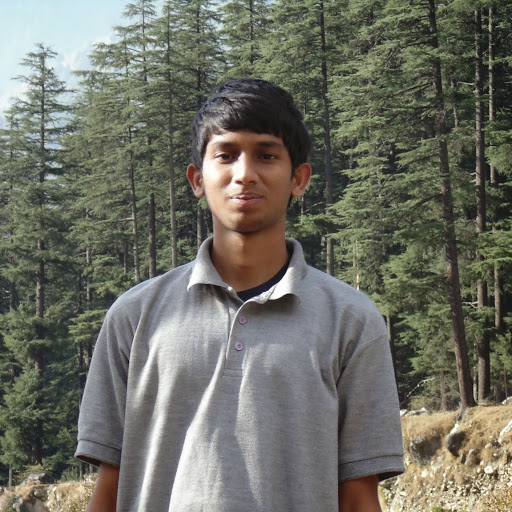
Recently, Mahesh Ballal, the owner of Rock Salad, was in SOM office to place an advertisement for his company’s 21st anniversary. Along with him was a boy, more noticeable for his oversized black thick-rimmed glasses, like from the 1970s. He seemed timid and geeky, yet confident and calm. The boy looked familiar, so asked Mahesh about him. It turned out his name was Nikhil Ravishankar. I immediately knew who he was. He was the son of Copywriter Ravishankar, who also ran an advertising agency. I also knew that Ravi had died a year ago of colon cancer at a young age. I expressed my condolences to the young boy and asked him how he was doing. What followed was a story that is a testament to the power of human spirit. A story of tragedy and triumph. A story that I had to share with my readers. So here it is:

NikhilBF22feb2015

Nikhil, from a poor Brahmin family, but enriched by priority for education, loves reading and words. Just like his father. By the time he was in the 6th, he had already become the National Junior Scrabble Champion. He won the championship twice. When he was in 10th, he participated in a competition called ‘Intel Iris,’ a science fair for high school students across India where they had to submit an original paper. Nikhil wrote a paper on a subject he enjoyed … words. His paper was called “Linguistic Impact,” brought about by new wave of technology. He won a gold medal for it! And was short-listed for the International Intel Iris. Unfortunately, he didn’t make it there. But this subject sparked in him an interest in Psychology and after his 10th, he chose to study in St. Aloysius College, Mangalore, as only they had a Psychology combination with the subjects he wanted.

Four months into his studies, a phone call would change the young boy’s life forever. Nikhil got a call informing him that his father was diagnosed with 4th stage colon cancer. He had to quit college and return home to care for his father as everyone else in his family had deserted them.

Soon they sold whatever they had left to raise money for the treatment. With no funds, Nikhil stopped going to college. But knowing well that education is the only way out, he registered to the ‘National Institute of Open Schooling’ (a government body that recognises home-schooled students) and began ‘home-schooling’ himself. This, he says, he did for three reasons — first, he didn’t have money for college fees; second, he could finish his studies in one year and get a job to support himself and three, he could stay home and take care of his father as no one else was there to.

But he also had another, fourth reason: home schooling gave him time to find a way to save his father — cancer research.

So apart from his formal studies, Nikhil started reading research materials on cancer. While doing so, he came across a book by the Indian-born American physician, Siddhartha Mukherjee’s Pulitzer winning book, ‘The Emperor of All Maladies: A Biography of Cancer.’ Inspired, Nikhil delved into information on cancer. After all, his father’s life was at stake.

Soon he found a mentor in Dr. Shreedatta Hebbar of Sai Guru Clinic and then Dr. Anil Thomas, who was treating his dad at Preethi Centre for Oncology where Nikhil shadowed the good doctor and collected more information about cancer patients.

He soon realised that his knowledge was not enough to understand all the research material he was reading. So Nikhil registered to study the free online course material from MIT (Massachusetts Institute of Technology) in Biology and Chemistry. But unfortunately, all the research did not help him save his dad and Ravi passed away in April last year leaving behind a 17-year-old Nikhil with no money and no home. Except a cycle, which is his primary mode of transport even now.

Luckily, one of his father’s relatives gave Nikhil a room on the terrace of the family home, which he shares with his older brother, who is studying at CAVA. Noticing Nikhil’s interest in research and academics, his father’s friend Mahesh Ballal bought the boy a laptop. Nikhil, to support himself and help his brother, got a job at The Hobby Place teaching scrabble and did some copywriting for his father’s old clients.

Soon self-schooled Nikhil’s PUC results came out and he had done well. He decided he wanted to be a doctor and started preparing for CET. But then still obsessing over his father’s death, Nikhil changed his mind. He says, “I realised doctors could not save my father. Only researchers can, so I decided that I wanted to be a research scientist.” So instead of writing his CET, Nikhil decided to go to the United States, where research is given high priority.

That’s when he remembered some boys he had met during the Intel Iris science fair talking about SAT, an exam taken after PUC to get admission in American Universities. He also found out that if he scored well he would get a full scholarship.

And so with the little money he had saved up, he paid his SAT exam fee and started studying. Study hard he did and it reflected in his scores. The maximum score in SAT is 2400 and Nikhil scored… 2400! A perfect score! The SAT exam is taken by over 20 lakh students across the world and Nikhil is one of the 400 who got a perfect score! All this from a boy with no one to care, no money and no formal schooling!

Yes, hard work and focus can make you achieve the impossible, but humble Nikhil says, “Sir, I had no other way, this was my only ticket out.” Now Nikhil has secured admission to the most elite Universities in the US. He has got admission to MIT, Stanford, Harvard, Princeton, Caltech and Brown.

Even better, all of them offered Nikhil a full scholarship and a monthly stipend. But MIT went one step further; they offered him an air ticket to fly to USA to study in their University. Americans sure know how to reel in talent.

So Nikhil didn’t have to spend a pie, all he had to do was pack up and leave. But he chose not to! Why?! He says, “earlier I did not know, but Columbia University has the best research programme. So I waited for one year to apply as I missed this University the first time round.”

In this gap year, inspired by an American High School boy, Jack Andraka, who had produced a research paper on ‘Pancreatic Cancer,’ Nikhil too wanted to write about his own research on ‘Colon Cancer.’ He also decided to work on a home screening kit for colon cancer. Which he says if his father had, his cancer could have been diagnosed earlier and treated.

Nikhil had read that people with colon cancer have blood in their stool but it is not visible. So when the patient comes in for a colon check, the cancer is so advanced that it’s too late to treat successfully. Now, Nikhil wanted to find a way to pick out blood in stool.

So once again from his meagre earning, he set up a small lab in his room with test tubes, beakers and a few chemicals. He began testing stools. When asked how he collected stool samples, he says with a grin, “I shat for science” and added, “I tested my own stool.” All the trying yielded no result until one day, when he was watching his favourite show CSI (Crime Scene Investigation) on his computer he saw that in the show, the Police were using a method called ‘Kastle-Meyer Test’ to find blood at a murder site. Nikhil adopted this test, tweaked it over and over again, so the test would not confuse animal blood and certain vegetable enzymes with human blood. Soon he realised that by adding a chemical called ‘Dimethyl Sulfoxide’ he could isolate only human blood.

He also found that this had met his three criteria for a home colon cancer screening test — specific, sensitive and cheap. It was specific to colon cancer, it was sensitive to human blood and it was indeed cheap, costing just Rs. 20 ! Nikhil causally mentioned about this kit to his friend, who replied “then may be you must patent it.” And so Nikhil did. He got three provisional patents on his home colon cancer screening kit!

Nikhil then sent his research paper on the screening kit to various authorities across the world and heard back from one Prof. Tyler Jacks, Head of Oncology at MIT, who was amazed by Nikhil’s research. Now, Nikhil has been invited to speak about his research at MIT in June this year. The conference has a few eminent speakers who are professors and physicians, Nikhil will be the youngest speaker there ! When asked if he is excited, he says “Yes, but I’m more excited that I will be meeting Siddhartha Mukherjee whose book inspired me, he too is a speaker at the conference.” Surely the boy from Mysore has come a long way in such a short time and in such demoralising circumstances. So obsessed is Nikhil about research that when he was trying to find information on cancer, he could not get enough as the hospitals throughout the world did not have a central information sharing system. So he came up with an idea called ‘HealtherNet.co’ an interface that connects hospital records from across the world. The idea was good but Nikhil did not know anything about computer programming. So, he put across the idea to a friend he had met in a discussion group about SAT exams. That boy was good with computers and he agreed to do the basic programming. The website was up and could run a few simple tasks. But they needed money to develop such a big idea and they put up their project on crowd funding sites. And behold one day he got a call. It was from none other than Eduardo Saverin! The man who partly owned Facebook with Mark Zuckerberg! Soon Eduardo had a video chat with Nikhil and expressed his desire to fund the project. As of yesterday, Nikhil has a very tempting offer letter from Eduardo. When as

ked if he will take it, Nikhil says, “it’s tempting, but I want to go to Columbia or MIT for research. And we may just keep our project open source so it’s free and benefits all.”

Now, while Nikhil is cycling all over our city for work and research, in June he’ll be flying business class to USA to present his paper at MIT and in August will be leaving for USA to pursue his dream of being a research scientist at Columbia or MIT. Yes, one more brain drains. But this story is truly inspiring especially in these times when parents obsess over expensive schools and tuitions as guarantee of excellence. It once again proves passion and focus beats all.

Nikhil’s story is a case of the triumph of the human spirit. The story of a young boy whose formal education was cut short by tragedy, a boy who was deserted by his close ones, a boy left orphaned and in penury, yet undeterred, he educated himself and with focus and passion pulled himself out of what would have buried most of us.

He did not sit on any excuses, he did not ask for compassion, he did not get any reservation, but he ran with his passion and now will fly high in his chosen profession, unfortunately it will be in another nation.

It is also a story of love. The love of a son for his father that inspired him and took him on a path to find a cure. A cure, that could, one day save the lives of millions of fathers, so they don’t end up with broken homes like Nikhil.

SOM has a column called ‘Mysureans Making Us Proud…’ We are sure, we’ll see Nikhil there soon. But then… he already has made us proud. Godspeed Nikhil. Your father would be proud of you…just as we are.

e-mail:vikram@starofmysore.com

source: http://www.starofmysore.com / Star of Mysore / Home> Feature Articles / Monday – February 16th, 2015
U.S. to help modernise Indian veterinary disease forecasting system

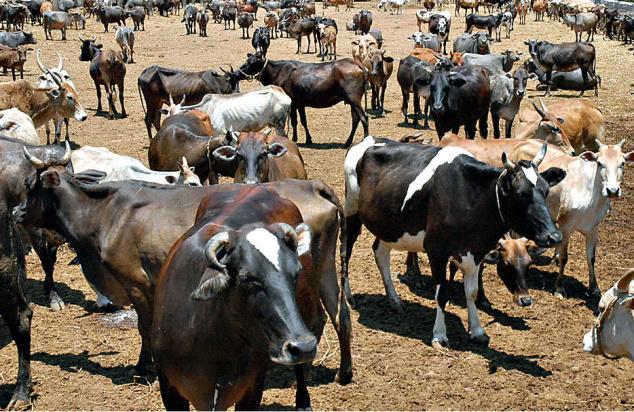
Veterinary diseases cause a huge impact on economy as the country suffered a loss ofRs. 23,000 crore owing to foot and mouth diseasealone in 2013–14.— File Photo M.A. Sriram

In a bid to prevent thousands of crores of losses being suffered due to veterinary diseases, the country is set to strengthen and modernise its veterinary disease surveillance and forecasting system with expertise from the United States of America, which has one of the best veterinary disease surveillance systems in the world.

Under this initiative, the U.S.-based Centre for Disease Control and Prevention (CDC) will train Indian veterinarians as well as medical doctors, according to H. Rahman, Director of Bengaluru-based National Institute of Veterinary Epidemiology and Disease Informatics, which is coordinating such efforts to strengthen and modernise the system.

Though a formal memorandum of understanding in this regard is expected to be signed in September, the preliminary rounds of training have already begun by the CDC. “The CDC has given preliminary training here to two batches of veterinarians and medicos from different States,” Dr. Rahman said. In all, the CDC will impart four rounds of trainings at different levels. This will cover a range of issues such as disease surveillance, collection of disease samples, validation, case studies, and epidemiology (the study of disease pattern and its health impact on population in certain geographical area), he said. Those who undergo the training would be used as trainers for imparting skills to others.

The training is being imparted to medical doctors also as some of the veterinary diseases impact the health of human beings too, he said.

The modernisation will help forecast the incidence of major diseases well in advance besides contributing to development of a strong infrastructure support for preventive measures, he said.

Veterinary diseases cause a huge impact on economy as the country suffered a loss of Rs. 23,000 crore owing to foot and mouth disease alone in 2013–14.


Center for Disease Control and Prevention to train veterinarians as well as medical doctors

source: http://www.thehindu.com / The Hindu / Home> News> Cities> Bengaluru / by B. S. Sathish Kumar / Bengaluru – February 15th, 2015

From a newspaper boy to a Sound Engineer…

A fascinating journey of Vijaykumar

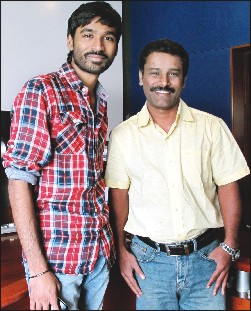
Vijay Kumar with renowned Tamil actor Dhanush.

by H.P. Naveen Kumar

Having come from a typical rural background, this person had no idea about his journey in life. After working hard for 14 long years, today he has become one of the most sought-after sound effects engineers in the country.

We are talking about Vijaykumar, a boy belonging to a poor family of Santhemarahalli in Chamarajanagar district, who braved all odds to become a successful sound engineer.

His journey began with him taking to distribute newspapers to households in his village. After suffering a loss in business, he headed to Mumbai and entered the film industry.

His latest movie ‘Roar: Tigers of the Sundarbans,’ directed by Kamal Sadanah, has been nominated for the prestigious 62nd Gold Reel Awards instituted by Motion Pictures Sound Editors.

Vijaykumar shared his experience in a brief teate-e-tete with Star of Mysore. Excerpts…

Star of Mysore (SOM): Your journey so far has been fascinating. Tell us something about your childhood?

Vijaykumar: I belong to Santhemarahalli in Chamarajanagar District but my native is Malavalli in Mandya district. Since my father worked in a silk yarn manufacturing company, we had to settle in Santhemarahalli and even today my parents are residing in the same village. I am the second son to my parents. After completing my primary education in Malavalli we shifted to Chamarajanagar. I attended high school and PU at Govt. PU College in Yelandur. I have completed B.Com from JSS College and later studied Diploma in Computer Science. Unfortunately, I did not get a suitable job for my qualification.

SOM: How did you enter into film industry?

Vijaykumar: After completing my education, I started a newspaper agency to help my family. Unfortunately, I had to suffer a huge loss and was unemployed for few months. Suddenly, I remembered one of my friends who had settled in Mumbai. I explained to him about the problems I was facing. Without much delay, he asked me to come to Mumbai and join ‘Aradhana Sounds Service’ studio.

After joining the studio as an office boy for a salary of Rs. 900, I used to attend to the students who visited the studio. While, the students were being explained about the sound engineering, I used to listen to the experts. This is when the diploma I has studied came handy. With things being explained in an unknown language (Hindi) I could only catch a few words. But, slowly I developed Hindi knowledge which helped in learning sound engineering.

SOM: Tell something about your journey from an office boy to a sound engineer?

Vijaykumar: While, I was working in the studio, Oscar winner Resul Pookutty who observed my eagerness to learn, took me as his technical assistant. Initially, my work was to arrange the computer system for him to work. While, he worked I stood behind him and observed his work. After his work was done I used to ask him questions to clear my doubts. It is because of his guidance and my hard work that I reached this level.

SOM: Share something about your relationship with Resul Pookutty

Vijaykumar: Resul Pookutty had a lot of affection for me. While he quit Aradhana Studio to setup his own, Resul sir took me along with him. I have worked in many Hollywood projects along with him as an assistant. He also received the Oscar award for ‘Slum Dog Millionaire.’ Now, ‘Roar: Tigers of the Sundarban’ has been nominated for Golden Reel Award.

SOM: For how many movies have you worked with Resul Pookutty?

Vijaykumar: I have worked for most of his movies. Slum Dog Millionaire, Ghajini, Kochadaiyaan, Robot are some of the movies that I have worked with Resul sir. I have worked in Sound Effects Department for the movie ‘Roar: Tigers of the Sunderban.’

SOM: Which are the other films vying for Gold Reel Awards?

Vijaykumar: There are four other films of foreign countries nominated for the award that is for technical excellence and the award will be presented at a function to be held in Los Angels in America on Feb. 14 and I am eagerly awaiting for the outcome.

source: http://www.starofmysore.com / Star of Mysore / Home> Feature Articles / February 08th, 2015

An evening of knowledge-sharing on dealing with diseases thru diet

BooksBF11feb2015

Release of two books

Mysuru :

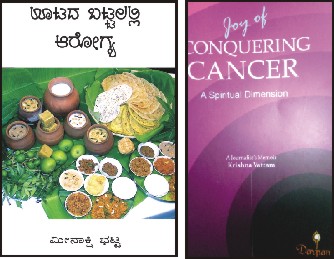
The city-based public-spirited duo Dr. Anil Sangli (Consultant Neuro and Spine Surgeon) and Sripad Sangli (Certified Financial Planner and Music Therapist), founders of Scientific Research Innovations in Advanced Neurosciences (SRIAN) have organised an event “Neuroscience and Art” at Veene Seshanna Bhavan, Kuvempunagar) here on Feb. 6 from 5.30 pm comprising release of two books — ‘Ootada Battalalli Aarogya’ by Meenakshi Bhat and ‘Joy of Conquering Cancer: A spiritual dimension – A Journalist’s Memoir’ authored by veteran journalist Krishna Vattam.

The first book in Kannada presents in simple language the regimen of diet based on traditional food and food habits for healthy living. The second book is the English version of the Kannada publication by Vattam presenting his years of battling with cancer and the delight of overcoming the scourge with a positive mindset and prompt treatment, with the message that cancer survivors owe a duty to educate and involve themselves in cancer awareness campaigns.

Dr. B.S. Ajay Kumar, Founder-Chairman, Healthcare Global Enterprises Ltd., will be the chief guest. Dr. Vasundhara Bhupathi, Secretary, Karnataka Rajya Vijnana Parishat and President, Karnataka Lekhakiyara Sangha, will be the guest of honour. Ravindra Bhat, Special Correspondent, Prajavani and Bharathi Hegde, Chief Sub-Editor, Vijayavani will be the special invitees. Dr. Anil Sangli and Sripad Sangli will speak on the theme ‘Neuroscience and Art’ based on their research in the field.

The programme will begin with an invocation by renowned playback singer Veena S. Pandit followed by musical delight by Shreyas Sai, Mansi Pai and Shilpa Srinath. The event will be compered by Vidu. Rajalakshmi G. Sridhar while snippets will be presented by Niranjan Nikam and Bharathi Hegde.

SRIAN Envisions, an organisation that works with the theme ‘Harmonising Health-Wealth-Wellness,’ has been offering inter-disciplinary professional complementary services. SRIAN Envisions highlights the benefits of Neuroscience by bringing the essenc eof mind-body interaction and the art of attaining youthfulness.

source: http://www.starofmysore.com / Star of Mysore / Home> General News /  Thursday – February 05th, 2015

An illiterate Farmer designs a Water Mill to generate Electricity

SidappaBF09feb2014

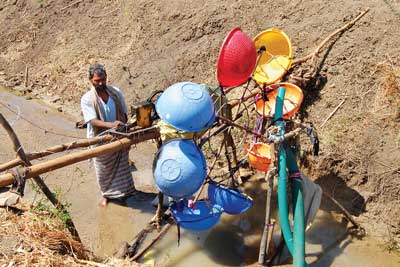
Siddappa, an illiterate farmer from Somapur village in Gadag district of Karnataka, has designed a water mill to generate electricity. Right from conceptualizing to materialisation, the farmer has done everything on his own. He operates the water mill in the canal near his house.

Using timbers, Siddappa prepared a giant wheel that joined at a central hub. There are eight arms, five feet each, extending from the central hub. A plastic bucket is dangled at the tip of each arm. When the water from two pipes gushes into one of the buckets, it generates the pressure that turns the 10-feet wheel in an anti-clockwise motion. The bucket could also be spun in the horizontal plane using a central steering wheel, similar to a teacup ride. As one after another bucket is driven by the flowing water, the first arm declines back to the ground while the other rises in the air. This process spins the black wheel attached to this giant wheel. The spinning black wheel rotates another wheel connected to a dynamo.

A converter converts the Direct Current from the dynamo into Alternating Current. Siddappa claims to have spent a mere Rs 5000 on building the entire apparatus. This is his second attempt to show the villagers that anybody can produce electricity for self-consumption using the resources at hand. “Many people who have canals flowing near their villages don’t know how to use that natural gift. I want to show them all practically that electricity problems can be solved by being creative. There is no need to beg to the government for everything,” he says.

He gets 150 watts of power from this water mill when water flows in the canal. Siddappa claims he can create electricity for the entire village through his machine. But the problem is that the canal in his village flows only for three months a year!

source: http://www.thebetterindia.com / The Better India / Home> Innovation / by N K Suprabha / April 08th, 2011

________________________________________________________________

This article originally appeared in The Sunday Indian (TSI) magazine and has been reproduced here as part of an arrangement between The Better India and TSI. The author, Suprabha Naik is a correspondent with the Kannada Bureau of TSI. Read previous article of this author here.

City boy’s space idea takes him to NASA

Sanjay will present a paper with a set of plans to explore the outer solar system and beyond

Sanjay Lakshminarayana

A 20-year-old Bengaluru boy is on his way to Texas to present a paper at the prestigious National Aeronautics and Space Administration (NASA). Sanjay Lakshminarayana, a mechanical engineering student, has been selected to present his ideas and attend conventions. These will study important observations made by recent planetary missions and emerging nuclear technologies for space exploration and travel.

The youngster, who has been interested in space since childhood, will present a set of plans to explore the outer solar system and beyond. The ideas will have a significant focus on nuclear systems as enabling technologies.

Sanjay said he would use this opportunity to discuss the knowledge gaps in exploration of extra-terrestrial environments and the most recent discoveries in this area.

The youngster, who also has an interest in car designing, told BM that his background in mechanical engineering provided a base for his interest in space exploration and his consistent research in the area.

Unexpected invite

The meetings on Sanjay’s agenda have been sponsored by NASA and the American Nuclear Society. Speaking on the unexpected invite, Sanjay said, “It was at a meeting in Russia, that a professor from NASA noticed my interest and sent me an invite for this year”.
Commenting on what this opportunity meant for him, he said, “I want to learn a lot about the latest developments and share my ideas with scientists from across the world. I am looking to gain immense knowledge, a sense of direction and meet people who will be able to help me in my research. ”

The meetings are scheduled between February 3 and March 16. These will be held at various locations including the Lunar Planetary Institute in Houston. Sanjay has also been invited to present his paper titled “The Magneto-Confined Fusion Ion Thruster” at the 2015 Nuclear and Emerging Technologies for Space (NETS-2015) conference to be held in Albuquerque.
Sanjay’s schedule

1. 2015 Nuclear and Emerging Technologies for Space (NETS-2015) conference, March 23rd-26th, Albuquerque

2.Workshop on Early Solar System Impact Bombardment III, February 4th-6th, Lunar and Planetary Institute in Houston.

source: http://www.bangaloremirror.com / Bangalore Mirror / Home> Bangalore> Others / by Apurva Venkat, Bangalore Mirror Bureau / February 03rd, 2015

Techies to help make digitised Kannada books accessible

WikiBF01feb2015

They will also create 5,000 Kannada Wiki pages based on these books

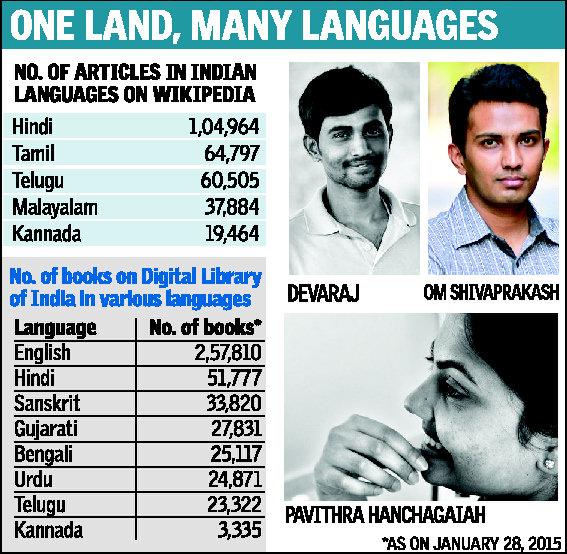
Hyderabad-based Osmania University Digital Library has 2,133 digitised Kannada books, but they are not easy to access because their titles are not listed in the Kannada script.

Three young techies from Karnataka — Om Shivaprakash H.L., Pavithra Hanchagaiah and Devaraj K. — are now setting right this anomaly by not only transliterating the titles and names of authors and publishers into the Kannada script, but also embarking on creating 5,000 Kannada Wiki pages related to these books. The trio has created a crowd-sourcing platform called ‘Samooha Sanchaya’ (http://samooha.sanchaya.net) to get help from people to transliterate, so that the work can be completed faster.

In the next phase, the team is planning to take up a similar project with 3,335 Kannada books in the Digital Library of India, a total of 7,19,327 pages.

“We hope to enhance the reachability of digitised books and also add value to Kannada Wikipedia by contributing Wiki pages,” says Mr. Shivaprakash, who heads the team. Along with this, the team is also launching its own book site ‘Pustaka Sanchaya’ (http://pustaka.sanchaya.net) in a few days which hopes to provide exhaustive bibliographic information.

Mr. Shivaprakash says that access is a problem across languages in digitised libraries. “In all existing digitised projects, they have not taken care of the accessibility of regional language books. They should have got the book names indexed in the respective languages,” he says. “We can help people do the same exercise in other languages if they need help in making books easier to search and find.”

The same team has put together Vachana literature of the 12th Century and Dasa literature on an online platform designed to help researchers.

source: http://www.thehindu.com / The Hindu / Home> News> National> Karnataka / by Bageshree S / Bengaluru – February 01st, 2015

A novel vehicle to deliver genes

Researchers at Indian Institute of Science (IISc) have developed a novel, controllable, extremely tiny vehicle to safely deliver genes into biological cells. The new vehicle, derived from a ‘lipopolymer’, is an improvement on known vehicles; it is more efficient and less toxic. Its unique structure also allows researchers to control the timing and site of gene delivery. Delivering specific genes inside cells to supplement missing and faulty genes or to silence disease-causing genes is a powerful tool in gene therapy.

Lipopolymers , as the name indicates, contain complex assemblies of fats and repeating chemical compounds. Prof Santanu Bhattacharya’s (chairman, Department of Organic Chemistry, IISc) group created the new vehicle by attaching ferrocene, a metallic compound that can switch between two chemical states, to a branched polyethylenimine (BPEI). This was then mixed with a ‘helper molecule’ – a naturally occurring lipid called 1,2-dioleoyl phosphatidyl ethanolamine (DOPE). Controlling ferrocene’s state allowed the researchers to control the vector’s structure, and in turn gene delivery. When they oxidised ferrocene, the vector’s structure became loosely packed and gene uptake by cells dropped dramatically. When they reduced ferrocenium by adding ascorbic acid (Vitamin C) to the cell culture, the vector became more compact and gene uptake by cells retained its original efficacy. This type of controlled ‘switch’ would allow researchers to pinpoint which population of cells should take up the desired gene, and when, by tweaking ferrocene’s oxidation state as needed.

“We could potentially deliver any therapeutic gene or molecule to the desired population of cells siRNA to silence mutations or p53 to stimulate cell death in cancer cells, for example,” explained Krishan Kumar and V Gururaja, IISc PhD students and joint first authors of the upcoming Journal of Materials Chemistry B paper.

Modified viruses are the most popular vectors, but they are not only expensive but also highly toxic to living cells. Recently, non-viral vectors have become popular, particularly lipopolymers. Lipopolymers are more stable, less harmful and cheaper to scale up than viral vectors. Such vectors may also be useful for gene transfer in agriculture or veterinary science, said Santanu Bhattacharya, senior author of the paper.

source: http://www.bangaloremirror.com / Bangalore Mirror / Home> Bangalore> Others / Bangalore Mirror Bureau / January 27th, 2015