Category Archives: Science & Technology

Hubballi womanpreneur makes a mark in e-commerce

Hubballi :

It’s the age of startups and e-tailing. And hopping on to this bandwagon is Deepali Gotadke. This computer science engineer has managed to carve a niche in an e-comm world where big players call the shots. Deepali’s ClickHubli.com helps deliver flowers, delicacies like Dharwad peda, jowar roti and cakes and traditional Ilkal and Kasuti sarees across the globe, sitting in Hubballi. Deepali has 18 techies working under her with several women from poor families also doing part-time jobs. She has also developed a network of 30 bakers/sweetmakers and 50 florists to ensure fresh flowers and food items are delivered.

The idea of becoming an entrepreneur took shape when she settled down in Hubballi after marriage. She found that while online services were well-entrenched in metros and big cities, their reach in smaller cities was minuscule. Initially, her website that was started in 2001 offered services in Hubballi-Dharwad. Later it extended its network in cities like Belagavi, Solapur, Mangaluru, Mysuru, Pune and Goa and finally had a global footprint too. The firm now has 12 e-commerce portals and a network of florists, sweetmakers and bakers across the country through which it delivers gifts of and flowers. However, durable items like Ilkal and Kasuti sarees are delivered across India and abroad.

“Now we deliver flowers and eatables all over India with the help of florists and bakers of respective area. For instance, If we receive an order of Dharwad pedha from Bengaluru, we will convey it to our network of sweetmakers in Bengaluru, who deliver the order to the door -step of the costumer,” she says.

ClickHubli also provides information on Kasuti, an embroidery typical of north Karnataka, and undertakes the responsibility of booking and delivering saris and dress material with Kasuti work. This has provided employment to rural Kasuti artisans.

Apart from this, Deepali also does web designing and development works and has developed over 500 websites for government agencies and business establishments.

Deepali has also been recognized for her efforts. She has won various awards including ‘High Performing Women IT Entrepreneurs’ by software technology parks of India and IT/BT, Karnataka government for 2010. She has also helped Hubballi-Dharwad police solve a cyber crime case involving misuse of credit cards on e-commerce sites in December 2009 and is also on the IT advisory committee of the HDMC.

Waiting for land:

Deepali, who launched the first e-commerce website in North Karnataka region, is struggling along with five other IT companies, to get a site at Aryabhata Technological park since 2010. “Though HDMC had recommended 10.5 acres of land for six IT companies, it was pending before the government. Without offeringany reason, now HDMC itself has taken U-turn and called for fresh applications. This is a hurdle for the growth of IT sector in NK region,” Deepali said.

source: http://www.timesofindia.indiatimes.com / The Times of India / Home> City> Hubballi / Sangamish Menasinakai, TNN /January 07th, 2015

Malpe UHC switches to solar power in a first for India

Manipal :

Urban Health Centre in Malpe, about 10 kilometres from here, became a solar powered clinic on Wednesday. Srinivas Prasad, CEO Philips Innovation campus, Bengaluru inaugurated the solar facility provided by Philips at a simple function. It is a first of its kind in India. Started in 1967 by Dr T M A Pai, the Centre provides maternal and child health services and also takes care of general ailments of people in the region.

The centre under administrative care of department of community medicine, Kasturba Medical College, Manipal recently started screening activities for oral, breast and cervix cancers with support from Kasturba Hospital, Manipal. With ever-increasing work at the clinic, need for uninterrupted power supply became imperative.

The solar energy which became operational on Wednesday will greatly help to improve patient care.

In view of urgency and importance of having uninterrupted power in the clinic, Manipal University and Philips signed a memorandum of understanding for the pilot project. The Centre will henceforth not depend on electricity to run appliances. This innovation by Philips is a centralized solar DC grid, which reduces dependency on grid power and contributes towards green energy. The solar solution provided in Malpe Clinic consists of 6 KWp solar panels.

It is expected to generate on an average nearly 12 units per day, and the consumption of the Malpe clinic is around 8 units per day presently. Srinivas Prasad, a former Karnataka Ranji Trophy player said, “We are associated with Manipal University for over a decade now. So we decided to do this project with the University first. This initiative can serve as a model solution which can be replicated in tier 2 and tier 3 cities and rural areas across the country.”

Pramod Madhwaraj, Udupi MLA said he was extremely happy that Philips has decided to have the pilot project in his constituency. He urged Prasad to provide solar facilities to entire state. Even Dr Vinod Bhat, Pro Vice-Chancellor urged Philips CEO to use Technology to improve villages across India, “Because we cannot depend electricity alone to fulfill the needs,” he said. Dr Veena Kamath, head of department of community medicine welcomed the gathering.

source: http://www.timesofindia.indiatimes.com / The Times of India / Home> City> Mangaluru / by Jaideep Shenoy, TNN / January 22nd, 2015

Anatomy Prof Preserves Bodies of Mother, Sister in College Lab

Mysuru :

An anatomy professor has chosen a unique way of educating people about the need to donate bodies as well as ways to preserve them.

Dr N M Shama Sundar of JSS Medical College has preserved his mother’s body in the anatomy lab ever since she passed away five years ago. Now, he has preserved his sister’s body too. His sister, N M Nagamani (74), a

retired KSRTC employee, died some months ago, and her body now lies in an adjacent room. Sundar has used a method called plastination to preserve the bodies longer. Plastination is a technique of tissue preservation developed by Dr Gunther von Hagens in Heidelberg, Germany, in 1977.

Sundar, who is also secretary of the JSS Body Donation Association, said Nagamani and other members of his family had donated their bodies to research.

He said preserving the bodies also allowed his relatives settled abroad who could not come to India at the time of his mother’s death to later “see her”. One of Sundar’s brothers, who lives in Australia, flew down two months after the death and saw his mother’s body.

Murali Mohan, another of Sundar’s brothers and a retired deputy chief engineer at Kolar gold mines, said he visits the lab whenever he feels like seeing his mother and sister.

Six of Sundar’s nephews and nieces who live abroad could not make it when his mother died. They came after many months, he said.

The Brahmin family did not perform any death rites for the two bodies. “My mother was against religious rituals,” Sundar told Express.

He said the proximity of two bodies of close relatives does not affect his work in the lab. He said his gesture had inspired several others to pledge their bodies.

source: http://www.newindianexpress.com / The New Indian Express / Home> States> Karnataka / by Vincent D’Souza / January 25th, 2015

Artificial waterfall to bring magic to Jog round the year

Bengaluru :

The world famous Jog, the second highest plunge waterfall in the country, will soon enthrall visitors round the year.

All the four cascades of the 252 metre-high falls — the majestic Raja, the graceful Rani, the swift Rocket and boisterous Roarer — will be in full splendor through the year as the Jog Management Authority (JMA) plans to re-circulate its water during non-rainy seasons.

Two companies have come forward to take up the project following a global tender and work is expected to start before this rainy season. Once installed, it will be world’s tallest feature of its kind, JMA officials claim.

“The full view of Jog is available to tourists only for four months (July to October) during rainy season. With Jog lacking other features required for a popular tourist destination, the number of foreign and local tourists is considerably less in the year. This is why we approached experts for a solution,” a senior JMA official told TOI.

HR Viswanath, consultant for JMA and the brain behind the project, said the magic of artificial waterfall will be realized through re-circulation method. “Using a reversible pump, the water will be pumped up through a 1,200 mm diameter pipe from the storage pond constructed at the bottom of the falls. A 3-mtr high anicut (dam) constructed upstream the Sitakatte Bridge will receive the pumped water. Then 200 cusecs of water will be let out the four sluice gates of the anicut in off seasons,” he explained.

Asked about the electricity requirement and cost of pumping water upstream, Vishwanath said the water cascading down will generate electricity with the help of a mini power station installed at the bottom of the falls. The pump will get power from the station, and the system won’t need extra power supply unless it is emergency.

Viswanath, who is former principal of BMS College of Engineering, said the technology is of double advantage as the project will be able to generate excess electricity during rainy season from the same pump by letting the waste water down. There will be no pumping up of water from the bottom during rainy season.

“The electricity produced will be surplus after meeting the required quantity for pumping purposes which can be used by the Sharavathi power grid. The project manager can also make profits by selling the excess power,” he added.

Another JMA official said two companies — National Buildings Construction Corporation, New Delhi; and an Abu Dhabi-based company owned by BR Shetty, an NRI businessman and Padma awardee — have come forward to take up the project under the build-operate-transfer model. “Once the detailed project report is ready, we will finalize the company for project implementation. The estimated cost of the project is Rs 350 crore and we are expecting the ground work to begin before July this year,” he added.

How it works

A sump to hold 23,000 cubic ft water will be built at the bottom of 252 mtr (820 ft) fall.

Using a reversible pump, water will be lifted via 1200 mm diameter pipe to a 3 metre tall anicut (dam) constructed upstream. A power pump of 20 kilowatt per hour is necessary for the purpose.

200 cusecs water let out from the four sluice gates of the anicut to create the normal beautiful jog falls.

The water cascading down will also generate electricity with the help of a mini power station installed at the bottom of the falls. The power is sufficient to pump back the water and mechanism will keep the system round the clock. Water lost in evaporation is negligible say experts.

During rainy season, power generated is an advantage as there will be no need to pump the water upstream.

source: http://www.timesofindia.indiatimes.com / The Times of India / Home> City> Bengaluru / by Rohith B R, TNN / January 26th, 2015

Danish Architect Mogens Thiesen in city

Mysuru :

The Danish Architect Mogens Thiesen will be in Mysuru from Dec. 22 to Dec. 30. Mogens Thiesen was working for the Danish Government during The Danish Mysore Project in the early sixties. He was the Architect at the project between the Indian Government and the Danish Government.

Mogens Thiesen will be visiting The Danish Mysore Project and his former staff living in Mysore.

Mogens Thiesen will also celebrate his 80th birthday together with his old friends in Mysore and his oldest son, daughter-in-law and four grand-children.

source: http://www.starofmysore.com / Star of Mysore / Home> General  News /  Monday , December 22nd, 2014

Award for DFRL Scientist

A. Ramakrishna (second from right), Scientist ‘F’, Defence Food Research Laboratory, is seen receiving Dr. M. Mahadevaiah Award-2013 from Krishnendu Narayan Chowdhury, Minister of Food Processing & Horticulture, West Bengal, at the 70th Annual Conference of AIFPA at Kolkata on Dec.12.

Mysuru :

A. Ramakrishna, Scientist ‘F’, Defence Food Research Laboratory (DFRL), Defence Research & Development Organisation (DRDO), Siddharthanagar, Mysuru has been conferred with Dr. M. Mahadevaiah Award-2013.

The award, comprising a silver plate and a citation, was presented to him by Krishnendu Narayan Chowdhury, Minister of Food Processing & Horticulture, West Bengal on Dec.12 at the 70th Annual Conference of AIFPA at Kolkata.

About the Award: The award was instituted by Dr. M. Mahadevaiah, a renowned Food Scientist & Technologist in 2009, to be given to any industry or a person for significant contribution to the development of ‘Food Packaging Technology’ or ‘Food Processing Technology’.

About the awardee: A. Ramakrishna is a M.Tech graduate from University of Mysore. He has vast experience of 30 years at DFRL and has contributed significantly for the development of food packaging and processing industries through his R&D work.

He has got eight patents and nine awards for developing packaging and processing machineries. He has published and presented 52 research papers in reputed Indian and International journals and conferences. He was also recognised as Outstanding Ajmer Best Scientist.

source: http://www.starofmysore.com / Star of Mysore / Home> General  News  /  Friday , December 19th, 2014

This Bangalore based startup has recycled 500kg of e-waste in two months

With e-commerce evolving, buying an electronic gadget is only a click away at any time. All you have to do is select the preferred product and order; and the product is at your door step within no time. But have you wondered about the disposal of that same electronic gadget? More than 90 per cent of e-waste ends up in land fillings.

Bangalore generates around 86,000 tonnes of e-waste and 15 per cent is generated from homes. We make sure we dispose off all other wastes, but not knowing what to do about e-wastes, we generally tend to hoard it or simply give it to scrap dealers. Though giving e-waste to scrap dealers is easiest, we should know that they are not equipped enough to dispose it off appropriately. Achitra Borgohain, Founder of BinBag, provides a solution to manage your e-waste in the best possible way.

BorgohainBF25dec2014

After completing his schooling from Sainik School in Assam, Borgohain did his engineering and MBA from Gujarat University. He worked with an infrastructure advisory group in Bangalore and also spent a few years with a venture capital firm in Ahmedabad. “May be the Gujarati entrepreneurial nature rubbed onto me,” says Borgohain, explaining how BinBag was born.“I could not find a quick and safe disposal mechanism for my e-waste. And when I looked at the problem in the larger context, everyone was struggling to dispose off household e-waste,” he explains.

The two-month-old startup is incubated at NS Raghavan Centre for Entrepreneurial Learning (NSRCEL), IIM Bangalore. BinBag picks household e-waste from people’s doorstep and sends it to authorized recyclers.

At the backend, BinBag works with certified recyclers. The startup also rewards and recognizes those who dispose-off their e-waste responsibly. Borgohain aims to create a frictionless disposal mechanism through which customers can request pick-up on call or even email or walk-in into partner outlets to drop their e-waste.

Recently, the startup experienced a happy day when a Bangalore resident drove from one corner of the city to the BinBag office to upload his e-waste for authorized recycling.

“Our differentiation is that we are a focused e-waste company and are addressing a segment of the market which has been completely ignored by recyclers. We also reward people for responsible disposal,” adds Borgohain.

Within a few days of operation, the company has helped in recycling more than half tonne of e-waste. The company was also awarded at the Unconvention|L, an initiative by Villgro.

Under the current model, BinBag works with individuals- apartments and communities; institutions- schools, colleges, and NGOs; and micro enterprises. Borgohain is solely handling and managing the company, but he plans to build a team.

Customers reach out to the company via telephone calls, email or social media. The received order is then aggregated for a week or so and vehicles are scheduled for picking up the e-waste.

“We award green points to customers who dispose off their e-waste with us, we reward out customers with ‘green points’ which could be redeemed with our shopping partners,” says Borgohain. “We are also placing bins across various outlets in Bangalore and people can dispose their e-waste there; we pick them up on a regular basis,” adds Borgohain.

The startup is also evolving a model with NGOs where they conduct a joint program and part of the proceed goes back to the respective NGOs.

The founder has faith in using word of mouth to create awareness. “We have recycled 500 kg of e-waste in the last two months without spending a single marketing dollar,” says Borgohain.

The company’s revenue model known as ‘green point’ follows the concept of a credit card. Under the green point model, customers are linked to green and sustainable brands. Institutions can redeem the green points for something interesting.

“Credit card has been the single biggest innovation in financial services since World War II. It linked consumers and merchants. Our green point model follows a similar strategy,”Borgohain explains.

Borgohain is optimistic about the future and wishes to scale the model pan-India by leveraging technology and building a professional team. He aspires to bring in people from the informal sector and providing them with a better standard of living by training and deploying them.

Borgohain’s not the only one desiring an anti-e-waste earth, there are other players in the sector too. Eco Recycling Ltd, Attero Recycling and Karma Recycling are a few front runners in this field.

source: http://www.social.yourstory.com / Social Story-YourStory.com / Home / by Pallavi Sinha / December 22nd, 2014

Srinath Batni is new President of NIE

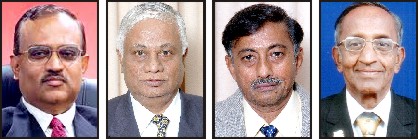
Srinath Batni, N. Ramanuja, Lakshminarayana, Chittaranjan

Mysuru :

Srinath Batni, Trustee, Infosys Science Foundation and former Board Member of Infosys, was elected as the President of the National Institute of Engineering (NIE) Society, Mysuru, while N. Ramanuja, former Chairman and Managing Director of HMT and Chairman of Bharatiya Vidya Bhavan, Bengaluru, was elected Vice-President.

S.K.Lakshminarayana and T.K.Chittaranjan were elected as Hon. Secretary and Hon. Treasurer respectively.

The other five directors, who got elected in the Society elections held on Dec. 14 are: S.L. Ramachandra, Partner, Gopika Perfumery Works; H.N. Ramatirtha, Proprietor, Aravinda Parimala Works; Dr. T.R.Seetharam, former Principal of NIE; R.S.Rajkumar, Head, Bosch India Foundation; V. Sivagopal, former Scientist, ISRO; G.S. Ramachandra, former Dy. General Manager, BHEL. The tenure of this newly constituted Managing Committee is five years.

Sixteen candidates, including M. Sreepada Rao, M.N. Shivaram, Prof. A.T. Bhashyam, Shantamurthy and Prof. C.K.N. Raja contested the elections.

The voters included N.R.Narayana Murthy, Founder, Infosys Ltd., cricketer Anil Kumble, renowned writer Dr. S.L. Bhyrappa and Ravishankar, Banker in London.

NIE, started in the year 1946, today stands at the 29th position among India’s top 100 Engineering Colleges that include IITs and NITs and 2nd in Karnataka. It is one of the 14 colleges in Karnataka that has been recognised and given autonomous status under Ministry of Human Resources Development-World Bank sponsored Technical Education Quality Improvement Programme (TEQIP). NIE is a recognised QIP Research Centre of AICTE, New Delhi.

source: http://www.starofmysore.com / Star of Mysore / Home> General  News  /  Thursday , December 18th, 2014

‘There is no place better than Karnataka for Tourism,’ says Dr. B.R. Shetty

DrShettyBF21dec2014

by S. Kenneth Shishir

SOM met Dr. Shetty on Friday, who was on a brief visit to the residence of former Secretary (Forests) to the State Government A.C. Lakshmana, on KRS Road in city who is the friend of Dr. Shetty’s brother Sachidananda Shetty, a resident of Mangaluru and had a short talk about his visit and projects he has taken up here. Excerpts…

SOM: Sir, is Karnataka a place for tourism?

Dr. Shetty: Of course, there is no better place than Karnataka for tourism.

SOM: Have you taken up any projects here?

Dr. Shetty: Yes, I have given a proposal to the Government of Karnataka for a project to supply water to Jog falls near Sagara in Shivamogga, especially during summer when the volume of water is reduced and the falls does not attract tourists. I have plans to supply water under his project on all 365 days to attract more tourists there. Speaker Kagodu Thimmappa has taken interest in the project and if the government approves the proposal, I will go ahead with it.

SOM: Have you planned to open a hospital in India?

Dr. Shetty: Yes, I have acquired a 220-bed hospital in Trivandrum in Kerala State and will be doubling its capacity. In central Raipur I have acquired a majority stake in an orthopaedics hospital as I want to expand it across India to serve Indians. My plan is to offer affordable health care in smaller cities and create a 12,000-bed hospital infrastructure in five years.

SOM: How is the medical sector doing in India?

Dr. Shetty: The medical sector in India is doing very well. The country can be developed as a medical tourism place also. We have the best doctors here.

SOM: How are Indian workers doing and being treated in UAE?

Dr. Shetty: Indian workers in UAE are doing good, well paid and well respected.

SOM: You have taken up many missions to help the downtrodden and the poor. What is your mission in life?

Dr. Shetty: My mission in life is to serve the community, by way of my professional ventures and personal pursuits.

Going from clinic to clinic selling drugs to doctors, loading cartons, hoisting barrels on his shoulder and climbing staircases was the first idea of Dr. Bavaguthu Raghuram Shetty popularly known as Dr. B R Shetty, Chief Executive Officer of NMC Healthcare, UAE Xchange and Neopharma, while working in the UAE in the early days.

Born in Kaup, Udupi in 1942, Dr. Shetty served as the Vice-Chairman of the Municipal Council in Udupi, where he worked towards the cause of providing proper sanitary facilities, building concrete roads, schools, underground drainage and septic tanks for people to lead a better and healthier life.

In 1973, he set foot in the desert land of the United Arab Emirates (UAE) to pursue his ambitions armed only with a clinical degree in Pharmacy and was able to start, build and succeed at multiple businesses over the years and today, his business empire is spread across the globe.

In UAE, Dr. Shetty who noticed the deficiency for basic clinics in the region, established New Medical Centre (NMC), a small pharmacy cum diagnostic clinic and became successful. Today, Dr. Shetty is the proud visionary behind 15 healthcare facilities which cater to more than one million patients annually. He has also come to the aid of regions hit by natural calamities and other adversities.

Dr. Shetty who is also interested in the tourism sector has taken up many projects to develop certain places as tourist destination with extraordinary infrastructure.

Some of the awards Dr. Shetty has won in recognition of his service are: the Padma Shri by the Government of India, Pravasi Bharatiya Samman Award, Order of Abu Dhabi, by the Government of Abu Dhabi and Forbes Middle East Top Indian Leaders in the UAE award to name a few.

source: http://www.starofmysore.com / Star of Mysore / Home> General  News  /  Sunday , December 21st, 2014

He will grow with a remote-controlled leg

Bengaluru  :

This 10-year-old cancer patient from Sri Lanka has his limb remote-controlled. To ensure that he doesn’t undergo surgical procedures often, doctors have increased the length of the magnetic metallic implant on his left leg through remote-control. The implant was placed after a cancerous tumour was removed from his knee.

Binura Lakvindu from Colombo, who was diagnosed with bone cancer, underwent surgery at BGS Global Hospital, Bengaluru, recently.

“For Binura, we have implanted the expandable prosthesis that has an in-built magnetic disc, gear box and a telescoping rod. The growth anticipated from that bone was calculated and the prosthesis was designed accordingly. He has to visit the hospital once in three months and place his leg in a magnetic coil, and the limb will be lengthened by 1 mm in 4 minutes. The required length will be achieved without additional surgeries. Binura will have limb growth up to 14 to 15 years,” said explains Dr Srinivas C H, consultant, orthopaedic onco-surgeon, who operated on Binura.

He developed pain in the knee in July, 2014. “We noticed him limping and avoiding cricket, his favourtite sport. We consulted a local physician who prescribed him medicines for pain. But the pain didn’t subside and a month later, we noticed swelling above his knee. An orthopaedic surgeon in Colombo suggested that this could be a tumour in his thigh bone and advised treatment in Bengaluru,” says Mallikarachchige L R, Binura’s father.

HOW DOES IT WORK

When the prosthesis is placed in the magnetic field, it leads to rotation of the magnetic disc at 16,000 rpm (revolutions per minute). The telescoping rod moves, resulting in expansion of the prosthesis. The tailor-made implant was imported from the UK to suit the unique specifications of Binura. This technique is tried only on paediatric cases with bone cancer.

source: http://www.timesofindia.indiatimes.com / The Times of India / Home> City> Bengaluru / by Sunitha Rao, TNN / December 19th, 2014