Category Archives: Science & Technology

HAL bags PSE Excellence award

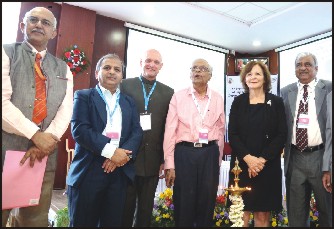
Hindustan Aeronautics Limited (HAL) has been conferred the PSE Excellence Award 2014 for ‘Corporate Governance & Innovation in Business’ by the Indian Chamber of Commerce (ICC) at the 5th Summit on “India: Public Sector Agenda” organised by the Indian Chamber of Commerce with the support of Department of Public Enterprises and Ministry of Heavy Industries.

HAL Chairman, R. K. Tyagi, received the award from Uttar Pradesh Ram Naik in New Delhi on Wednesday.

PSE Excellence Awards constituted in 2010, is an initiative to salute the industry game changers and recognise contributors to the Indian economy in view of the positive role played by the PSEs in addressing global demands.

A conclave was also organised to take view of PSEs space from a global perspective, highlight the achievements and check readiness of PSEs in global supply chain.

On the occasion, Dr. R K Tyagi said “although PSEs are a force to reckon with, there is an impending need to re-energise the public sector and focus on diversification to tap new markets.” He reiterated that HAL is committed to making Government’s ‘Make in India’ initiative a reality and help transform India as a manufacturing leader, said a press release issued by HAL.

Dr. Tyagi outlined an agenda on improving competitiveness of PSEs and also stressed on unshackling the potential wherein enterprises can contribute significantly to the GDP of our country. It is highly imperative that the PSEs be accorded with commensurate autonomy and flexibility for addressing technological, policy/operational, export and human resource related issues effectively.

Dr. Tyagi mapped out HAL’s future roadmap and highlighted that a major portion of India’s defence capital expenditure in future will be attributed to Air Defence platform modernisation. He stressed that HAL is making efforts to build strategic partnerships and boost our indigenisation efforts and has already developed a supplier base of over 2,400 business partners across the country, the release said.

source: http://www.thehindu.com / The Hindu / Home> Business / by Nagesh Prabhu / Bengaluru – December 08th, 2014

ZCCK marks its 100th organ donation

Four donations on December 12 and 13 saved the lives of 16 patients

There is a huge potential for cadaveric organ donations in Bangalore and organ donations are slowly catching up in the city. The Zonal Coordination Committee of Karnataka (ZCCK) for Transplantation, the nodal agency to facilitate organ transplantation in the State, has coordinated 100 donations so far since its inception in 2007.

Four of these donations were on December 12 and 13, wherein vital organs from donors helped save the lives of 16 others.

According to ZCCK authorities, ten kidneys, five livers, one heart and three pairs of corneas were harvested and transplanted in 16 patients registered with ZCCK.

Three pairs of corneas were donated to different eye banks in Bangalore. Although ZCCK has been able to facilitate 100 multi-organ donations so far, cadaveric organ donation programme has not picked up at a fast pace because of delay in certifying brain deaths by hospitals.

Kidney transplants

Of the 1,500 persons registered with the ZCCK for organ transplants, 1,300 are waiting for kidney transplants and 209 for liver transplants.

The number could be more as not all patients waiting for organ transplants may have registered with the ZCCK.

source: http://www.thehindu.com / The Hindu / Home> News> Cities> Bengaluru / by Special Correspondent / Bengaluru – December 16th, 2014

Counting sheep, literally

A farmer tending to the ‘Nari-Suvarna’ breed of sheep at Veerapura in Tumakuru district of Karnataka.

Sheep farmers in Tumakuru have agri-scientists in Maharashtra to thank for a breed that has, quite literally, doubled their profits.

The new breed, developed by scientists at Nimbkar Agricultural Research Institute, Phaltan, called ‘Nari-Suvarna’ has turned out to be a boon for farmers. While the local breed of sheep gives birth to one lamb at a time, the new breed gives birth to two or three.

Cost of the sheep

The State government is trying to promote the Nari-Suvarna breed. It plans to offer subsidy to purchase the sheep, which costs Rs. 8,000 each, in the future. The local breed in Tumakuru —both Hassan and Bellary breeds — cost Rs. 6,000 per sheep.

With the guidance of the Karnataka Sheep and Wool Development Corporation (KSWDC), a farmer in Sira taluk in Tumakuru district has bought 10 sheep and they have given birth to 23 lambs. Farmers at Sidlaghatta in Chickballapur district and Chitradurga district are now eager to follow suit.

The new breed, according to the Agriculture Department, is a combination of three Indian breeds – Deccani and Madgyal breeds of Karnataka and Garole of West Bengal.

Doddaraju of Veerapura in Sira taluk, who bought the 10 sheep, told The Hindu that people in his village were making advance payments for Nari-Suvarna sheep. He said the sheep had adjusted to the climate and environment of his village and could be reared along with the local breed.

Mirza Basheer, Assistant Director, KSWDC, Tumakuru, said the new breed would help meet the demand for meat and would be beneficial to farmers. Nagaraja G.M., Assistant Director, Special Livestock Breeding Programme, Tumakuru, said the government would identify farmers in Belagavi, Vijayapura and Kolar districts and would introduce them to the new breed.

Scientists have developed a new breed of sheep, Nari-Suvarna, that gives birth to two or three lambs at a time

source: http://www.thehindu.com / The Hindu / Home> National> Andhra Pradesh / by S. Bhuvaneshwari / Tumakuru – December 14th, 2014

Karnataka citizens can now access over 4,000 services on their smartphones

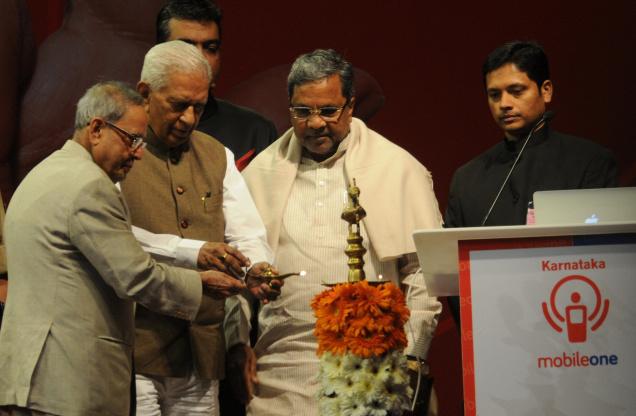
President Pranab Mukharjee, Chief Minister of Karnataka Siddaramaiah and Governor of Karnataka Vajbhai R. Vala at the launch of the Unified Mobile Governance Platform for citizens "Karnataka MobileOne" in Bengaluru on Monday. Photo: G.R.N. Somashekar.
President Pranab Mukharjee, Chief Minister of Karnataka Siddaramaiah and Governor of Karnataka Vajbhai R. Vala at the launch of the Unified Mobile Governance Platform for citizens “Karnataka MobileOne” in Bengaluru on Monday. Photo: G.R.N. Somashekar.

The country’s and the world’s largest multi-mode mobile governance platform – Mobile One – will offer 4,000 services. A unified mobile platform will enable services to citizens from both the government and private sector.

President Pranab Mukherjee will launch the initiative at BIEC in the presence of Chief Minister Siddaramaiah and Governor Vajubhai Vala.

These anytime, anywhere, anyhow services will be available round the clock throughout the year at any location in the state on any mobile device.

Through this initiative citizens can now pay utility bills, property tax, book bus and railway tickets, file income tax returns, m-passport, driving licenses and many other activities with their smartphones. Over 4000 services including G2C, B2C and G2B services can be availed through this mobile governance initiative.

Citizens can even take a simple picture of road potholes or street lights and send it automatically to the concerned officials for redressal.

This initiative named as “ICARE”, is one of a kind government-citizen engagement model.

The app is available for download on android and iOS platforms and all major mobile service providers such as Airtel, BSNL, Vodafone, Aircel, Idea, Reliance among others. Citizens can access services through this platform by dialling unique 3-digit number 161.

The Karnataka ‘Mobile One’ will integrate digital media and advertising going forward to enable it to be a self-sustaining model for some select services via advertising revenue, user fees and subscription models. Payments through a variety of modes including debit, credit cards, online wallet, PayGov are enabled.

source: http://www.thehindu.com / The Hindu / Home> News> Cities> Bengaluru / by Nagesh Prabhu / Bengaluru – December 08th, 2014
Indian scientists find key to PTSD

Bengaluru-based researchers have found that a tiny almond shaped region in the brain is responsible for post-traumatic stress disorder, a discovery that could lead to a potential cure

Post-Traumatic Stress Disorder (PTSD), a condition of persistent mental and emotional stress occurring as a result of injury or severe psychological shock, typically involving disturbance of sleep and constant vivid recall of the experience, with dulled responses to others and to the outside world.

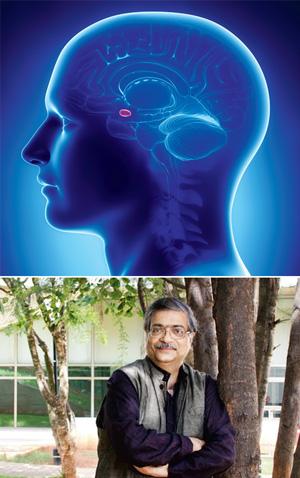
For the first time in the history of neuroscience, two scientists from National Centre for Biological Sciences (NCBS) in Bengaluru have conducted a detailed study on why and how one suffers from PTSD. They have pinpointed precise roles played by certain neurons in the part of the brain called amygdala, an almond-shaped structure located deep inside the brain, which acts as the centre that controls emotions and stores memories of fearful experiences.

Top: An illustration showing the location of the amygdala in the human brain/  Below: Sumantra Chattarji lead author of the Nature Neuroscience study
Top: An illustration showing the location of the amygdala in the human brain/
Below: Sumantra Chattarji lead author of the Nature Neuroscience study

In doing so, they have unraveled the so-far mysterious reasons behind the fear and precisely how that fear develops to make way for PTSD. The research, which appeared on Nature Neuroscience Web site, has paved the way for scientists the world over to study ways to reverse PTSD or even develop medical aids to cure the condition – a boon for many victims of sexual or child abuse, accidents, or soldiers/ combatants who are commonly afflicted by this condition.

NCBS neuroscientist, Sumantra Chattarji and his student Supriya Ghosh, discovered that PTSD sets in when individual neurons in the amygdala lose their capability to discriminate between dangerous and safe stimuli. They found that this happens when the danger stimuli is particularly intense, as in a life-threatening situation.

In normal circumstances, they found, most of the neurons are able to detect the safe signals; but when the danger levels are much increased they lose their capability to discriminate between danger and safety. This results in such neurons sending danger signals even when faced with a safe stimulus.

They also identified the precise biochemical signaling mechanism inside the amygdala neurons which caused fear and PTSD – cyclic adenosine monophosphate (cAMP)/protein kinase A (PKA) signaling. This potentially serves as a target for designing new treatments against PTSD, said Chattarji.

Chattarji and Ghosh conducted experiments on live rats, the amygdala and the neural functioning of which are similar in humans.

The two neuroscientists now plan to conduct research on the mechanism of reversing PTSD, apart from hoping that researches are undertaken to develop drugs, having identified the precise biochemical signaling mechanism that causes PTSD.

source: http://www.punemirror.in / Pune Mirror / Home> Others> Scitech / by Nirad Mudur / December 02nd, 2014

City neuroscientists decode the anatomy of fear

Discovery by NCBS could help find therapy for post traumatic stress disorder

Decades after the Vietnam war, a US army veteran recounts the intense flashbacks he still gets of the battlefield, triggered by something as innocuous as a thunderclap: “I am back in Vietnam. It is the middle of the monsoon. My hands are freezing and yet I am sweating… Suddenly I see my buddy Troy, his head on a platter, sent to our camp by Viet Cong,” he says in a well-documented case study.

Now, two city-based neuroscientists have decoded the anatomy of fear and show how sometimes this vital and primal response to danger can go completely awry, morphing into post-traumatic stress disorder (PTSD) seen often in soldiers and also in people who have been in near-fatal situations: sexual assault, natural disaster or accidents.

A study published in Nature Neuroscience, by Sumantra Chattarji and Supriya Ghosh, neuroscientists at National Centre for Biological Sciences, reveals how a certain set of neurons in the amygdala (the brain’s emotional hub), which once distinguished between safe and dangerous stimuli, begin responding even when there is no sign of threat.

For the experiment, the researchers trained rats to distinguish between two sound frequencies. One frequency was accompanied by a foot shock and the other was not. “When the shock was elevated, we found that one set of excitatory neurons that once responded only to the sound associated with a shock now began firing indiscriminately even to sound not accompanied by a shock,” said author Prof. Chattarji.

The scientists also found that a certain bio-chemical pathway — cAMP–PKA — was activated during this process of generalised fear. “This opens up neuronal and biochemical targets for therapies for PTSD, and this will be our next stage of research,” Prof. Chattarji said.

source: http://www.thehindu.com / The Hindu / Home> News> Cities> Bengaluru / by Divya Gandhi / Bengaluru – December 02nd, 2014

IAF Chief Arup Raha to inaugrate Computerised Pilot Selection System in city tomorrow

Air Chief Marshal Arup Raha, Chief of Indian Air Force Staff

Mysuru :

Air Chief Marshal Arup Raha, Chief of Indian Air Force Staff, will be visiting Mysuru tomorrow for the inauguration of advanced Computerised Pilot Selection System (CPSS) developed jointly by the DRDO and IAF.

The new CPSS, originally conceived by Dr. A.P.J. Abdul Kalam, the then Scientific Advisor to the PM in 1997, has come a long way in terms of Research and Development. Primarily intended to address the long standing demand of IAF to having a more modern and scientific selection system for pilots that can screen candidates to meet the demands of the latest and advanced aircraft being inducted into the IAF, the CPSS was jointly developed by the DRDO and the IAF through a decade long research.

The new system is on par with the best selection systems available with the developed nations and fully meets its operational requirements. The system will be used to screen pilots for the Indian Air Force, Indian Army, Indian Navy and the Coast Guard. The test can be taken only once in a life time by any candidate and focuses on the aptitude of the individual to meet the high demands of the modern cockpits.

The CPSS caters simultaneously to the physical as well psychological profiling requirements of the candidates through a series of computerised cognitive and psycho motor tests that can be administered on more than 50 candidates at a time. The system apart from the computer based tests also has cockpit tests to extract accurate and complete details of the candidate’s abilities for this challenging job.

The system being launched at Mysuru is first-of-its kind in India and will soon be replicated at the other Air Force Selection Boards across the nation.

Air Chief Marshal Arup Raha will arrive at Mysuru Airport by a special IAF jet at 11 am and then proceed to the No. 2 Air Force Selection Board in Siddarthanagar to dedicate the new CPSS to the nation.

This is the first visit of the Chief of Indian Air Force Arup Raha to Mysuru after taking over the command of the Indian Air Force. Air Chief Marshal Raha was commissioned into the IAF in 1974 as a fighter pilot and has vast experience in various kinds of military aircraft. He has been an instructor in the Flight Instructor’s School and the Tactics and Combat Development Establishment of the IAF.

He has held several key operational commands and staff appointments prior to taking over as the Chief of the Air Force. Currently, he also heads the Joint Chief of Staff Committee of all the three services.

source: http://www.starofmysore.com / Star of Mysore / Home>  General  News  / Thursday , November 27th, 2014

Intl. Conference on Contemporary Computing begins at SJCE

Dr. V. Prakash, Director R&D with Innovation, JSS Mahavidyapeetha, Dr. B.G. Sangameshwar, Joint Director (Academic), JSS Mahavidyapeetha, Gerd Hoefner, Managing Director and CEO of Siemens Technology and Services, B.N. Betkerur, Executive Secretary of JSS Mahavidyapeetha, Prof. Nadia Magnenat, Director, Institute for Media Innovation School of Computer Engineering, Nanyang Technological University, Singapore and Dr. Syed Shakeeb-ur-Rehman, Principal, SJCE are seen at the three day International Conference on ‘Contemporary Computing and Informatics’ that began at SJCE this morning.

Mysuru :

Prof. Nadia Magnenat, Director, Institute for Media Innovation School of Computer Engineering, Nanyang Technological University, Singapore, this morning inaugurated the 3-day International Conference on ‘Contemporary Computing and Informatics’ at the Golden Jubilee Hall of SJCE organised under the aegis of SJCE and the Department of Master of Computer Applications of SJCE.

Gerd Hoefner, Managing Director and CEO of Siemens Technology and Services was the chief guest. The keynote address was delivered by Dr. V. Prakash, Director R&D with Innovation, JSS Mahavidyapeetha.

B.N. Betkerur, Executive Secretary of JSS Mahavidyapeetha presided. Dr. B.G. Sangameshwar, Joint Director (Academic), JSS Mahavidyapeetha, Dr. Syed Shakeeb-ur-Rehman, Principal, SJCE and Dr. M.P. Pushpalatha, Head, Department of MCA, SJCE were present.

source: http://www.starofmysore.com / Star of Mysore / Home>  General  News  / Thursday , November 27th, 2014

Forensic fair held

A volunteer at the Forensic Fair is seen explaining to a visitor about the methods used in the detection of fake currency.

Mysuru :

More than 500 people including children from JSS Baljagat School, Teresian School, JSS High School and other schools along with their teachers are participating in the day-long Forensic Fair organised by the The Department of Forensic Medicine, JSS Medical College in association with Karnataka Police Academy, Mysuru City Police, Karnataka Medico Legal Society, Department of Criminology (Mahajana First Grade College and University of Mysore) and Regional Forensic Science Laboratory at JSS Medical College premises in Bannimantap here.

The unique fair is organised to create awareness among public about the crime and its investigation in order to have knowledge about day-to-day happenings in crime manifestation.

The Fair also includes orientation to various sections of Forensic medicine like traffic awareness, firearms, trauma, dental evidence, approach to crime scene, analytical procedures used for detection of poisons, fingerprints and examination of questioned documents (handwriting analysis) and tests to detect food adulteration.

The main attraction was the stall set up by Poison Information Centre, Mysuru located at the Department of Clinical Pharmacy, JSS Hospital, MG Road, Mysuru which gave information on first aid during poison.

Public can contact 1800-425-0207 if they need any information on first aid for poison.

A live demonstration on awareness about snakes presented by Snake Shyam was an additional attraction at the fair which benefited people of all walks of life including students, teachers and general public.

The fair was inaugurated by Dhananjaya, Asst. Director, Karnataka Police Academy, Mysuru

About 10 stalls were put up at the venue to provide information on topics such as Annihilation through Alcoholics, autopsy, causes of sudden death, identification of gender using skulls, cyber crimes among others.

Dr. Arun, HOD of Forensic medicine, JSS Medical College speaking to Star of Mysore said that this fair was the first of its kind in Karnataka. He said “Forensic Science is reconstruction of crime scene”

M.G. Ramesh, Traffic Head Constable explained about traffic rules violations and asked the public to follow traffic rules.

Demonstrations were given on food adulteration, finger prints identification and how to identify fake currency.

source: http://www.starofmysore.com / Star of Mysore / Home> General News / Sunday , November 16th, 2014

MUP to release its 32nd publication on Saturday

Manipal :

Manipal University Press, completing its third year, will release its 32nd publication “Biomedical Spectroscopy” on November 22 in the counselling hall at Manipal Edu building here. The book is authored by Dr Vasudevan Bhaskaran Kartha and Dr Santhosh Chidangil. The book consists of over 500 pages and the contents are compilation of research done for years at the department of atomic and molecular physics, Manipal University.

Dr H S Ballal, Pro Chancellor, Manipal University will release the book. Dr H Vinod Bhat, pro VC will preside over the function. The event will also be streamed live through YouTube. Biomedical Spectroscopy is the output of intensive discussions of authors and medical professionals of KMC. The Centre for Laser Spectroscopy, a Centre for developing biomedical applications of laser spectroscopic methods, was established at the University in 1997.

Scientists of the Centre, together with physicians, surgeons, and pathologists of KMC initiated a number of research programs in this area. Main aim of the Centre is to develop spectroscopic methods for early detection, screening, monitoring therapy and identification of disease markers, with special emphasis on various cancers, so that these techniques can be applied for routine healthcare applications. Outcome of these research activities are covered in the book.

source: http://www.timesofindia.indiatimes.com / The Times of India / Home> City> Mangaluru / by Jaideep Shenoy, TNN / November 20th, 2014