With 25 years of experience, this doctor has established herself as one of the city’s foremost IVF experts. She recounts her early days
Dr Kamini Rao (60), Medical director of Milann- The Fertility Centre
When Dr Kamini Rao headed to Bangalore after 10 years in the UK, armed with degrees in gynaecology, pediatrics and in vitro fertilisation (IVF), not everyone was as gung ho as her. It was 1990. Even as naysayers suggested that she settle down in Mumbai or Delhi, she insisted that she would not test the waters with just her feet. “I knew I wanted to take the plunge,” she says about her vision — to make in vitro fertilisation a reality in India.
In fact, even her father, Dr PR Desai, who was Bangalore’s first male gynecologist, expressed concern. “He told me I was going to be experimenting in an over-populated country,” she recalls. Nonetheless, he gave her a building on rent — within the now Dr P R Desai Hospital (previously known as Desai Nursing Home) at Kumara Krupa Road — to start her practice. Armed with a loan of Rs 35 lakh from Karnataka State Finance Corporation and a single incubator, she began operations.
It wasn’t easy. “When the incubator broke down, six weeks would go by without anything happening,” she says. She often slept in the room next to the incubator, and spent sleepless nights fretting over all that she had taken for granted in the UK. Adapting to the Indian environment after a break of 10 years, she found herself grappling with problems of pollution and electricity shortage. “I had to teach the staff how to scrub the floor. That’s because embryos are very sensitive to dust and will not fertilise,” she says. It was a nightmare for the doctor when the power went off and the incubator had to run on the generator. “I even used to import water from the United Kingdom,” she reveals. “I was trying to establish myself and deal with a medico-socio problem at that point in time, without making any money.”
Her first big break came at the end of 1990 when the first IVF pregnancy was successful. In February 1991, the number became six. In October the same year, she found herself beaming when three boys and three girls were born. Today, the staff of five has gone up to 215, and her success rate has gone up from 10 per cent to over 50 per cent. The biggest satisfaction is when people come up to her saying that they light a candle in their house and remember her. “Some of those I “saw” as an embryo are now in medical and engineering college. Often they come up and call me ‘Mamma’,” she says, gratified.
Today, she has four centres in the city — at Indiranagar, Koramanagala, Jayanagar and MS Ramaiah College. Last month, she opened a centre in Delhi while she is currently working on two others — one in Dubai and another in Ahmedabad. Besides, she also runs a two-year programme — Fellowship in Reproductive Medicine. “My students are all over the country,” she beams.
Even with several competitors, Rao only looks at bettering her own record.
source: http://www.bangaloremirror.com / Bangalore Mirror / Home> Columns> Work / by Vidya Iyengar, Bangalore Mirror Bureau / Augutu 02nd, 2014
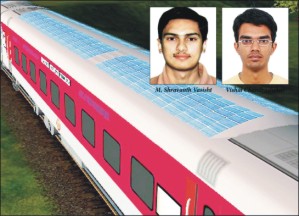
The students of The National Institute of Engineering (NIE) in city always come up with innovative ideas, keeping in mind their contribution to sustainable development. A young engineering graduate from NIE,M. Shravanth Vasisht, had designed Solar-Assisted Power Supply System for rail coaches as part of his academic project in the year 2010, which is now being implemented by the Indian Railways.
Young engineers from city M. Shravanth Vasisht, an Electrical and Electronics Engineering graduate from NIE, Mysore and Vishal Chandrashekar, a Mechanical Engineering graduate from PES College of Engineering, Mandya, have designed Solar-Assisted Power Supply System for Linke Hofmann Busch (LHB) Rail Coaches such as Rajdhani, Shatabdi Express, etc.
Speaking to SOM, Shravanth said that in 2010, as an academic project during the course of engineering at NIE, he had designed this System under the guidance of Dr. B.S. Sridhar, Scientist, Food Engineering Department, CFTRI, Mysore and A. Dhanyavathi, Associate Professor at NIE.
He said that this project was now initiated by him at the Indian Institute of Science (IISc.), Bangalore, along with another Mysorean, Vishal Chandrashekar, under the guidance of Prof. J. Srinivasan and Dr. Sheela K. Ramasesha and added that this would give a boost for the improvement of Railways, about which he had been very keen since 2010.
He said that the idea of installing solar panels on a car was given by Dr. Sridhar and the same was then extended for the conventional rail coach manufactured by ICF, Perumbur in Chennai. He said that this was written as a thesis and submitted to CFTRI and NIE.
A technical paper on the same subject by three authors (Shravanth, Dr. Sridhar and Dhanyavathi) was published in Electrical India in 2011.
When asked, Shravanth said that they found the implementation of solar PV system for a LHB rail coach to be more beneficial as they use EOG (End on Generation) System and added that EOG Scheme of power supply for rail coaches use two diesel generator cars on either ends of the train and their diesel consumption raised their eyebrows.
Coincidentally, a train consisting of LHB hybrid coaches was flagged off between Indore and Yeswantpur which was the first of its kind for South India and second train in India, he said and added they found LHB coaches were of a superior technology and felt that all the conventional rail coaches in India could be replaced by LHB coaches.
Elaborating further, Shravanth said that they felt that these were going to be the next diesel sucking culprits for the country which made us re-initiate this project at our workplace in IISc., where they spoke to their guides Prof. J. Srinivasan, Chairman, Divecha Centre for Climate Change, IISc. and Dr. Sheela K. Ramasesha, Research Scientist, IISc., who then provided a lot of inputs.
He said that spending time on this involved a lot of risk as they were not sure that the Railways would support them, mainly because of lack of encouragement in research fields and pilot projects.
Coincidentally, Union Railway Minister Sadananda Gowda quoted on this idea and we were recognised by the Indian Railways and the work was examined by the Chief Administrator of Indian Railways Organisation for Alternate Fuels, Ministry of Indian Railways, he said and added that they are very much interested in involving us to implement the same.
He said implementation of this scheme may not be possible immediately, as it involves step by step analysis on various experiments like aero-dynamics, vibration analysis, performance of the system in various locations during the transit, reliable control system design, protection from the impact of stones thrown at trains, etc. and expressed confidence that it will be a success if there is cooperation from public.
When asked, he said implementation of this idea is not an impossible dream and neither a novelty and added that probably they would be provided with a coach to carry out experiments.
Speaking about the cost of installation, he said that once the project becomes a success through pilot projects, there would be too many players in the market who can provide better engineering solutions for the challenges that will be faced for implementation which would also reduce the cost of installation and operation costs. If this pilot project becomes a success, one will be able to see Solar Panels mounted on all trains, which will be saving around 90,000 litres of diesel per train per year.
Shravanth has been invited to give a presentation on the same at an International Conference at USA in September this year.
Shravanth is the son of V. Murali Madhav of CFTRI and M. Lakshmi while Vishal is the son of Arun Chandrashekar, a retired Scientist from CFTRI and Lalitha Rangarajan, Associate Professor at University of Mysore. Both Shravanth and Vishal, residents of CFTRI Layout in city, are working as research fellows on Solar energy at IISc.
source: http://www.starofmysore.com / Star of Mysore / Home> General News / August 04th, 2014
This innovator made the solar lamp a vehicle not just for electricity, but for education and independence.
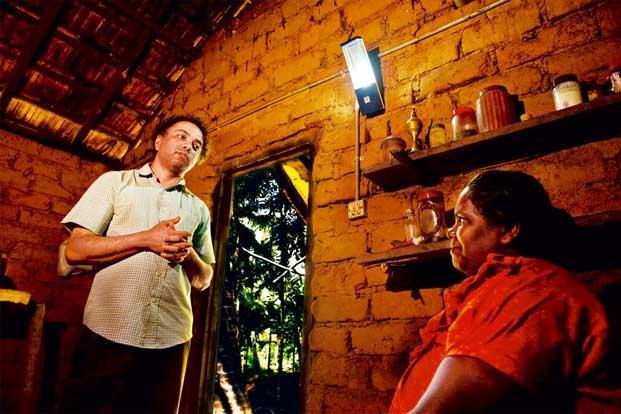
Harish Hande visits Rosamma Vergies in Vandse village, Karnataka. Her home is fitted with a two-light solar system. Photo: Gireesh GV
Freedom from darkness | Harish Hande
Harish Hande doesn’t care about electrifying India, he wants the solar lamp to transform this country. Of course he was pleasantly surprised when newly appointed Prime Minister Narendra Modi said he would back the growth of solar power so that every household in India has at least one lamp by 2019, but Hande has also observed, for the last 15 years or so, that the ministry of new and renewable energy unfailingly gets a new secretary every six months. “Some don’t feel it’s an attractive post, some are quickly shifted, some retire,” he says with the air of a veteran who has figured out how to make things work despite policymakers.
But these are all relatively minor niggles. Hande, 47, won the Ramon Magsaysay Award in 2011 because the ideas at Selco (Solar Electric Light Company—India), the solar energy equipment supplier company he co-founded in 1994, shine brighter than the lights it sells to the poor.
Take, for instance, Selco’s Light For Education project whose participants include around 30,000 children in Karnataka. Solar panels are installed on school premises and the battery, about the weight of a lunch box, is given to children. Children charge the batteries when they come to school. If they don’t come to school, there’s no light at home. “We stole the idea from the midday meals scheme,” says Hande. Stole and innovated.
Or the way Selco tackled the unique problem faced by a community of poor drum-makers in Bangalore. They were willing to pay for solar power, but they had one condition. They were often evicted, with only 15-20 minutes to gather their belongings. Could Selco design a system they could run with? No problem, a design school graduate who works at Selco conjured up a solar system on a cart.
Around 1.2 billion of the world’s population doesn’t have access to reliable electricity, and 400 million of these people live in India. Hande, who jokes that while growing up, his bread and butter came from a coal-fired plant in Rourkela (his father worked in power distribution at the Steel Authority of India), understood early that coal and gas wouldn’t be enough to meet India’s growing energy needs.
Yet, as an energy engineering student at the Indian Institute of Technology, Kharagpur, and a doctoral student at the University of Massachusetts, US, Hande’s interest in solar was restricted to its supply security dynamic (the sun as a source of energy is limitless) and its environmental impact. Until a visit to the Dominican Republic in 1991 taught him a new lesson in thermodynamics. He saw the poor paying for solar lights and realized that renewable energy could be a catalyst for social change. So he spent the next two years in Sri Lanka and India—in darkness.
He took time off to see how communities in both these countries lived without electricity. “I realized I didn’t know what happens after 6pm. We were just making decisions based on Excel sheets,” he says. He learnt a few things: The moment you don’t know a language (Sinhalese), the artificial hierarchies of a formal education crumble and you are treated like anyone else; none of his formal education was useful, except perhaps the confidence he had gained by living in a hostel. In Sri Lanka especially, communities came together after dark, usually in Buddhist temples, to vent their frustrations; in India, the lost time was usually spent in isolation and the kerosene lamp made people even more depressed. “It was my most efficient period of time, I joke,” he says. That’s also probably when he realized that the poor don’t want sympathy. They want partners and collaborators.
He worries about the hierarchies he believes English-speaking India imposes on the rest of the country. He knows he may not be able to influence the thinking of a top dog at a Bangalore-based research firm who asks him how he ever manages to have “intellectual discussions” in rural India. Or the suit who eagerly shares that his children “teach” their rural counterparts every weekend. But he hopes he can someday convince urban children to partner with fellow Indians who don’t speak their lingo. “How do I tell kids that we are all part of the same society? That they need to learn from each other to create some sort of social equity? How to make kids interested in solving problems?”
Selco gets hundreds of internship applications from masters’ and PhD students every year but very few are Indians. Of the 300 applications last year, five were from this country. “I’ve now resorted to guilt-tripping parents and students when I speak to them. In the next 10 years if you complain that Americans and Europeans know more about India than you do, then you are to blame, I tell them,” Hande says.
____________________________________________
“How do I tell kids that we are all part of the same society? That they need to learn from each other to create some sort of social equity?” _____________________________________________
At Selco at least, they try to break these barriers. Nearly 85% of Selco’s employees, including chief operating officer Mohan Hegde (a practising folk artist on weekends), come from rural India. Hegde and K. Revathi, president, have been running the company since 1 June when Hande retired as managing director to take charge of the Selco Foundation, the company’s think tank. All the brainstorming for solutions and innovations to help fight poverty takes place at the foundation. The business side executes the ideas and the company’s incubation cell teaches entrepreneurs how to replicate these successes across India (four projects are already under way in Manipur, Rajasthan, West Bengal and Madhya Pradesh; Selco is helping 25 more entrepreneurs raise funds).
Formal qualifications are not a prerequisite for any job at Selco. Twenty-eight-year-old Raghu, who greets me when I arrive and gets us tea at the Selco office in Bangalore, started out as a driver and now handles administrative duties. “He’s going to be a branch manager by the time he’s 32. That’s our goal for him,” says Hande. In rural areas they joke about Selco’s hires: Are you part of the laptop or the non-laptop crowd?
Hande checks all the boxes of someone who truly believes in sustainability. He doesn’t own any asset, he says he has about three-four pants and shirts, he borrows his father’s 1994 Maruti 800 when he needs a car, and his daughter Adhishri was 8 when she first started saying: “Is it needed or is it wanted?”
He got his cues from mentors like Neville Williams, his co-founder and a solar energy pioneer who made it to the CIA watch list after a trip to Vietnam to protest the “American War”; from photographer Jon Naar, who was a British spy in World War II; and from Paul Maycock, who predicted way back that the cost of producing solar energy would plunge by 2015. “These are guys who talked about sustainability in a very different manner. I miss their passion. Now you go to a meeting and it’s all about ties and suits.”
Hande sees the poor as asset creators, and not as a bottom of the pyramid sales opportunity. “Don’t sell to the poor. That’s our fundamental rule. And if you’re selling to the poor, make sure that the value you’re giving to the poor is much more than the monetary value they give you back,” he says.
So when Selco representatives found that 32 Sidi families in rural Karnataka spent more money annually on candles, kerosene and to charge their mobile phones than it would cost to set up a simple solar system, they had to fix this. No bank was willing to lend the money to these families, so Selco offered a 100% guarantee on their behalf. Six months later, the bank reduced this guarantee to 20% as the payments were regular. “The best response was from the Sidis,” says Hande. “They said, light is great but once the solar loan is done, I will take a loan for a sewing machine.” They had become bankable.
source: http://www.livemint.com / Live Mint & The Wall Street Journal / Home> Lounge> Business of Life> Indulge / Home -Leisure / Priya Ramani / Saturday – August 09th, 2014
Dr. Thomas Chandy has a collection of over 400 musical instruments from around the globe.
Meeting Dr. Thomas Chandy is not easy. The chance to see the orthopaedic surgeon’s collection of over 400 musical instruments was cancelled twice as the good doctor is called away for emergency operations. Finally when we do meet up, the musician-doctor takes us through his collection, which is arresting not just for its variety, but also for the insight it offers into Dr. Chandy’s interests. Walking through his house, is like stepping back in time.
A range of antique swords are on the ground floor and a host of musical instruments, including an ancient harp, occupy vantage points in his drawing room.
“I would advise everyone to be associated with music from a young age,” says Dr. Chandy, who first sang in a church choir when he was barely seven. He was later trained to play the guitar, saxophone and the piano. “Learning an instrument is a bonus for surgeons. Like musicians, brain-eye-hand co-ordination is vital for us.”
Dr. Chandy is Chairman and Managing Director of HOSMAT, and has done 30,000 operations in 30 years. After graduating from St. John’s Medical College, Bangalore, he moved to the U.S. in 1976 for his residency and returned to India in 1993 to start an orthopaedic, neuro and accident-trauma hospital.
“I am spiritual and worship my music,” says Dr. Chandy as he leads us into the humidity-controlled space that houses his instruments. Neatly stacked and labelled, he picks up each to play and explain. As he plucks on the strings of the harpsichord, he explains that it usually has two keyboards with two or more strings for each note. The concert harp and the 100-year-old lute from Germany have their sounds intact.
The U.S-based Society of Musical Instrument Collectors has recognised his collection as the biggest in Asia. Amongst his priced possessions are the South American Marimba (a large wooden percussion instrument with resonators;) a pedal steel guitar, a Steinway piano; a vibraphone; the stringed Chinese koto and the oldest 14th century keyboard clavichord from Germany. “I also made an electric guitar while I was in PUC.”
Thomas Chandy. Photo: Bhagya Prakash K. / The Hindu
Plucking on the psaltery that looks a giant violin, the doctor says: “I have nearly 70 guitars, more than a dozen saxophones and western flutes, several clarinets and host of percussion instruments including drums, marimba, xylophone and the Indonesian Anklung.”
Dr. Chandy, is a jazz vocalist, and heads the 14-year-old ensemble, Jazz Revival Band. The deep-toned native Australian Didgeridoo is an aboriginal wind musical instrument that looks like a straight wooden trumpet. Dr. Chandy remembers the instrument being confiscated by airport authorities as it looked like a missile!
He has travelled 15 times around the globe for his instruments that are from the U.S., Africa, China, Japan, S. America and Europe. Growing up in a family interested in music, young Thomas was warned by his strict father that music could be pursued, but not at the cost of studies. St. Germain High School at Frazer Town provided opportunities for weekly jam sessions at 3 Aces and Gaylords restaurants. “The pocket-money we earned made us enjoy our singing much more,” says Chandy, who nurtured his vocals and tried his hand on the guitar during his college days at St. Joseph’s College days. “Being part of music groups helped me develop team-spirit apart from being noticed by girls!”
Chandy moved from rock to folk music during his third year at St. John’s Medical College forming the Barbershop Harmony group. Later moving over to the U.S. was a boon not just for his post-graduate studies, but for his formal study of Western music at the Brooklyn Conservatory of Music in New York. On his return to India, Dr. Chandy joined the Bangalore School of Music and built the Cecilian Choir. “Music is therapeutic and invigorating.”
source: http://www.thehindu.com / The Hindu / Home> Features> MetroPlus> Society / by Ranjam Govind / Bangalore – August 05th, 2014
A great forum to meet and share knowledge. Photo: K. Murali Kumar / The Hindu
The free online encyclopaedia has many contributors in Bangalore
Apart from the everlasting enslavement to Google, another website that netizens cannot do without is Wikipedia, the free online encyclopaedia that allows users across the world to post entries and carry out edits on the articles posted on the site. Right from challenging and getting your facts checked in a bet with friends, to getting last-minute nuggets of information before a research paper, Wiki is the go-to resource. Didn’t ‘Lungi dance’ in Chennai Express, have the lines urging you to read up about thalaiva on Wikipedia? The resource is also used to check the authenticity of information and wild rumours that inundate the net at regular intervals. Being the tech capital of the country, Bangalore leads the way as far as wikipedians in India are concerned. Metroplus talks to a few prominent wiki contributors for the lowdown on how they joined and participated in the wiki movement.
K.Ravichander
IT professional
There were many Wikipedians in Bangalore. Some of us were born and brought up in Bangalore while many others made it home since our jobs were based in the city. The Centre for Internet and Society based in Bangalore helped us organise various wiki meet-ups that helped build relationships and extend the wiki community online. I contributed articles on South Indian history, politics and culture.
I used to debate regularly in Orkut communities and found people referring to Wikipedia articles to prove their point. That’s how I first came across Wikipedia. It was in September 2006 that I started to write for Wikipedia and I have spent many years as a Wikipedia editor.
From my childhood, I’ve always loved to write and Wikipedia gave me an opportunity to be read. For a good Wikipedian, all you need is passion and perseverance. Common folk like me could write for Wikipedia, interact with other Wikipedians, some of whom were experts in the field and gain expertise ourselves. It has been a fulfilling experience
Ramesh NG
IT professional
I have been active in Malayalam Wikipedia (ml wiki) since 2008. I have made some 16K + edits in ml wiki.
I learnt about ml wiki from blogs and friends, I started with making some minor edits in 2006 but became active only in 2008 after I discovered new tools that made it easy to work in Malayalam.
Tinu Cherian
PR and digital media consultant
I am one of the most active Wikipedians in India and one of top six Indian editors on English Wikipedia by number of edits.
I am one of very few Indian administrators on English Wikipedia and have over 53,000 edits. I have started more than 2,000 articles.
I am very passionate of building Wiki communities in India and have been very successful in starting various Wikimeetups across the country. I am a member of Wikimedia Foundation Communication Committee and have worked as a volunteer for media relations for Wikimedia for more than six years. I have represented India in various Wikimania and Wikimedia Conferences in Poland, Germany, Israel and Hong Kong. Bangalore has a large Wikipedia community Almost till a year and half ago, we used to have regular Wikimeetups in Bangalore.
It is great that apart from English Wikipedia, there are 20 other Indian language Wikipedias and another 20 are in incubation.
source: http://www.thehindu.com / The Hindu / Home> Features> MetroPlus / by Nikhil Varma / Bangalore – August 04th, 2014
A front view of Bangalore City Railway Station some time before it was completed in April 1968.
It has been 150 years since Bangalore appeared on the railway map of India. It was on August 1, 1864 that Jolarpet was connected to Bangalore Cantonment.
According to information provided by South Western Railway, the first train journey in south India took place on May 28, 1856 from Royapuram to Wallajah Road. Eight years later, Madras Railway Company opened the Jolarpettai-Bangalore Cantonment branch line. The Madras-Bangalore Mail was launched the same year.
In 1862, the line reached Renigunta and then to Raichur in 1871.
The Yeshwanthpur-Doddaballapur Meter Gauge line was opened in 1892.
In 1944, the rail network was nationalised. On April 14, 1951, the three major networks administered by the erstwhile Madras and Southern Maratha Railway, the Southern Indian Railway and Mysore State Railway were joined to form Southern Railway.
Due to historical reasons, the headquarters of the erstwhile Mysore State Railway was located in Mysore though Bangalore was the hub of operations. To improve administration and enhance monitoring, Bangalore Division was inaugurated on July 27, 1981.
No rail museum
The city does not have a museum to showcase its rail journey. Till a few weeks ago, memorabilia was being exhibited on Platform One of Bangalore City Railway Station. At present, visitors can go to Platform Five where two galleries exhibit cartoons and paintings related to trains.
The galleries had no visitors on Friday. Staff in both galleries said that visitors show up only when trains are delayed.
source: http://www.thehindu.com / The Hindu / Home> News> Cities> Bangalore / by Renuka Phadnis / August 02nd, 2014
Anticipating policy support from the Modi government at the Centre, Tata Solar Power (TSP) announced expansion of its manufacturing facility from 125 MW TO 200 MW at Bangalore.
The TSP officials also praised the Commerce Ministry’s initiative of levying Anti-Dumping Duties (ADD) and Domestic Content Requirement (DCR) of solar cells on US, Malaysia and China, as a positive move to level the playing field for the domestic producers.
Ajay Goel, the CEO of TSP, said, “This substantial expansion, in an extremely competitive and price-sensitive sector, is a testimony to the superior quality and global competitiveness of our products. Though the Jawaharlal Nehru National Solar Mission (JNNSM) originally intends to promote domestic producers in the Solar power manufacturing industry, there are barely few takers for such schemes as the cost of capital will still remain high in the presence of cheap flowing from the Chinese market,” he said.
Incidentally, the company officials maintained that it has not received any expression of interest from the Karnataka government, which in recent day has been actively in news for promoting roof-top solar panels for domestic users under Karnataka Solar policy.
source: http://www.indianexpress.com / The Indian Express / Home> Cities> Bangalore / Express News Service / Bangalore – May 28th, 2014
Budding danseuse Anoosha Sri’s story is special for reasons way too many. A dancer, actor, singer, swimmer and a pianist that she is, Anoosha is aptly gifted, well-trained and highly intelligent. She has several good endowments all in the bag and no wonder; her feats are big as the girl is still all of 12!
Though lass of many hats, we wish to tell you about one special feat of Anoosha’s today. The girl is all set to present her Bharatanatyam Rangapravesha. Wondering what is special about it, as way too many of them often present Rangapravesha performances? Anoosha’s Rangapravesha is an achievement in itself as the girl has been tutored through Skype — the widely used voice-over-IP service and she has gained expertise to reach up to the stage of performing a Rangapravesha in the beautiful traditional Indian dance form in just a year’s time. Having decided to learn it this unique way as she happens to be a resident of Louisville, USA, Anoosha’s classes began through online training by noted city-based dancers Badari Divya Bhushan and Dr. Anjana Bhushan last July.
“It wasn’t easy at all,” says Bhushan, talking of his favourite Skype student who is here to meet him in person for the first time, ever since he began training her last year. “My academy has been tutoring students via Skype since a few years now. We tutor about 16 students from countries like Berlin, USA, Dubai and Australia of whom, Anoosha is one who is excellent and my favourite. I never agree to teach students via Skype easily as it’s strenuous for the student as well as us tutors since we need to adjust to each other’s country’s timings,” explains he, “But before I decide to say yes, I interview the student over phone. And when I did it with Anoosha, I found that she is really interested in learning and had perfectly done her homework about the art and was not wanting to learn the dance just for the sake of gaining a so called degree in Bharatanatyam, which many receive but do nothing than simply add it to their personal bio-data.”
According to him, Anoosha who was already trained in the basics of Bharatanatyam by tutors Akila Iyer and Smitha Paily at the US seemed to be really interested in learning it with momentousness and they thus began her classes and that too in Tamil (their mother tongue) during weekends since July last year. Such was her keenness that in just a few months’ time, Anoosha requested Bhushan to tutor her for more hours, jut to expertise the skills better, says the tutor. And slowly with time, she picked up several skills to perfection all by Skype which was amusing to watch and she even performed at a couple of events in the US by learning exclusive moves for different dance shows, he adds.
But how is it that she developed such keen interest in this Indian art though born and brought up in the USA? “I love this dance form the most as I believe it is the hardest one to learn as well as to be executed,” explains the little girl who is getting all geared up to present performances at several places in India after her Rangapravesha in Bangalore this weekend. Anoosha is here exclusively for these performances along with her parents Srinivasa and Mayura, both engineers at the USA.
Talking of her achievements, they explain: “It was at the age of 3 that she first performed on stage. She sang at an event. But we always saw that she loved dancing as she used to dance for every music that played on TV. And we thus decided to get her trained. However, we wanted her to learn the same more precisely under more able guidance and that is when we came across this online training by Bhushans which we took to. We are extremely happy she has learnt so much from them in such a short period of time.”
And their happiness about their child’s achievements knows no bounds as dance is not the only thing she excels in. Apart from this, Anoosha is a talented pianist who has been part of an International Piano Composition Contest and was rated excellent for her composition, she is well-trained in both Karnatak and Hindustani Classical music, is excellent at academics because of which she skipped two grades once she joined school and she is a prize-winning essayist and the 12-year-old is a member of the National Junior Honour Society, Donna Wilkinson Chapter, too. “All her teachers at her schools too are extremely proud of her back in the US, which makes us feel wonderful about her,” gushes Anoosha’s mom who can go on and on about her little daughters achievements with excitement brimming in her eyes.
You can watch her sway in the traditional dance form at the Guruvandana programme to be held at Jaganmohan Palace in Mysore on July 25 from 6 pm onwards. —AN
Anoosha’s feats: 2012-2014: Member of the National Junior Honour Society, Donna Wilkison Chapter
2014: Won Daughters of the American Revolution Essay Contest; Participated in the Tuttle Memorial Music Competition at Cleveland, USA.
2013 and 2014: Won an honourable mention and rated superior for her composition in International Piano Composition Contest.
2013: Value of Life Award Essay Contest winner; Invited to the grand recognition ceremony at Duke University USA, based on ACT Test Scores as part of the Duke Talent Identification (TIP) programme.
2010-2013: National Piano Playing Auditions – National Member.
2010: Won Kentucky Tamil Sangham Tamil Competition.
source: http://www.starofmysore.com / Star of Mysore / Home>Feature Articles / July 20th, 2014
The CBR at the IISc was set up earlier this year with funding from a charitable trust set up by the former Infosys CEO. (Source: PTI photo)
SUMMARY
Carnegie Mellon University is a world-renowned leader in many areas of research and education.
_________________________________________________
Infosys co-founder and former CEO Kris Gopalakrishnan has announced a donation of USD 1.8 million for the Carnegie Mellon University in the US to establish a research tie-up with the Centre for Brain Research (CBR) at the Indian Institute of Science (IISc) in Bangalore for studying aging related disorders of the brain like Alzheimer’s and Parkinson’s.
“Carnegie Mellon University is a world-renowned leader in many areas of research and education. I am very pleased to support President Subra Suresh’s strategic vision for the collaboration between CMU and IISc through this gift so that we can address one of the grand challenges of our times by understanding the human brain,” Gopalakrishnan said.
The CBR at the IISc was set up earlier this year with funding from a charitable trust set up by the former Infosys CEO.
The partnership between the Carnegie Mellon Universoty, one of the foremost in brain research and the Centre for Brain Research at the IISc aims to leverage the research strengths of the two premier research institutions.
“This partnership will provide opportunities for applying new technologies from fields ranging from imaging to machine learning to address critical questions about neuro-degeneration and one of the most pressing challenges facing humanity is to understand the human brain. Our hope is that this new research collaboration will lead to discoveries about neuro–degenerative diseases that afflict the aging population, and that those findings help improve our diagnostic and treatment capabilities for such diseases,” Carnegie Mellon University president Subra Suresh said.opalkrishnan who was instrumental in taking Infosys from a start up in 1981 to a USD 8 billion revenue company, has a personal wealth valued at USD 1.4 billion and is among the top 1500 billionaires in the world at present.
source: http://www.indianexpress.com / The New Indian Express/ Home> Cities> Bangalore / by Express News Service / Banglaore – July 17th, 2014
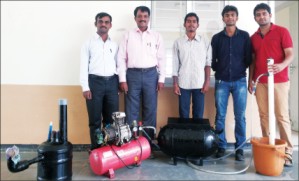
The 8th Semester students of ATME College of Engineering — Syed SuhailKadri, Pradeep and Suhas of Mechanical Engineering Department — under the guidance of K. Srinivasa, Head of the Department and Raghu, Asst. Professor, Department of Mechanical Engineering, have developed a technology to convert Raw Biogas to Enriched biogas, which has the potential to replace Compressed Natural Gas (CNG).
In present times, it is necessary to pay attention towards renewable energy sources such as solar energy, wind energy, biogas etc., due to fast depletion of conventional fuels like petrol, diesel and coal. In this regard, number of research works are going on in development of biogas technology. Biogas consists of 50-60% of methane and 20-30% of carbon dioxide. Due to this high percentage of carbon dioxide, the calorific value of fuel decreases and also affects the environmental pollution. In this project, the technology of enriching of biogas involves increasing the methane content in biogas from 50-60% to 70-80% by reducing the carbon dioxide content using Water Scrubbing process. On doing this, the calorific value of the fuel increases and environmental pollution reduces. This technology can be used for CNG also.
The students thanked the college for their support and facilities provided. The students were congratulated by Chairman of the institution, L. Arun Kumar, college Principal Dr. L. Basavaraj and teaching, non-teaching and management staffs.
source: http://www.starofmysore.com / Star of Mysore / Home> General News / July 17th, 2014