Category Archives: Science & Technology

DC Special: Govt doesn’t do enough for science, but we try to, says Bharat Ratna awardee CNR Rao

Prof. C.N.R. Rao with wife Indumathi in Bengaluru —DC/R. Samuel

Bengaluru: 

Professor C.N.R. Rao’s office at the Indian Insti­tute of Science in Bengaluru received a steady stream of visitors all through Sunday morning. Chief Minister Sidd­aramaiah was the first to arrive, at 8.30 am, followed by a brief interaction with the media.

A visibly exhausted Prof. Rao then retired to his study, where friends and well-wishers continued to drop by.

“I even got a phone call from someone at 1 am,” he told us, later. Why the rush? On Saturday afternoon, Prof. Rao, one of the foremost authority on solid states and materials chemistry, was conferred the Bharat Ratna, India’s highest civilian honour, felicitating decades of breakthrough research, 1,600 papers and 45 books.

In came Dr Roddam Narasimha, one of the country’s most prominent aerospace scientists and a dear friend to Prof. Rao. Dr Govindarajan Padmanabhan, Pr­of. Balram’s predecessor as the director of the Indian Institute of Science, the AGP and Prof. Kumar, and former director, Raman Research Institute, were also among the elite list of visitors.

Meanwhile, we were ushered into another room to speak with Prof. Rao’s wife, Indumathi, about the CNR Rao Educational Foundation.

The Foundation was formed back in 2005, the year Prof. Rao won the prestigious Dan David Prize for Science, a million-dollar grant. “We decided to use that money to give back to society,” said Mrs Rao.

The CNR Rao Hall of Science, Madan Mohan Mal­viya, was funded by the Ambani Trust. Each year, the Foundation honours two teachers, one from Karnataka, usually from a Kann­ada medium school and one from across the country.

“It’s not just what they do in class, but what they do outside of it, to enthuse their students,” Mrs Rao expla­ined.

Prof. Rao celebrates his birthday each year (June 30) by organising a Teachers’ Day, of sorts, with lectures and a music concert. “Music is very important to us,” Mrs Rao added, with a smile. Why? “It’s so beautiful, don’t you think?” she replied.

The Foundation has remained, with intent, a tiny organisation, run on very low funding. “We don’t want to ask anybody for money and besides, I’m the one who has to manage it, which I really can’t do anymore,” Mrs Rao admitted. The couple is nearing eighty now and although they do seem full of beans, age has undoubtedly taken its toll.

The Foundation has worked with over 60,000 children since it was formed, with an average of about 2,000 students each year. “We work with rural children in particular, because they are so motivated and talented, but have no opportunities,” she said.

Prof. Rao, who was born into an educated middle-class family, attributes his success entirely to education. “We had no godfathers,” he remarked.

Nearly an hour later, we are allowed in to Prof Rao’s office. His little study is piled high with bouquets, hiding a most eclectic collection of books. Being of the firm belief that you are what you read, I rummaged only to find books on Persian poetry, music and art lying side by side with heavy volumes on Science.

I’d learned, through the grapevine at the Institute, that Prof. Rao had a green thumb.

“I’m the official tree planter,” he agreed, happily, saying he’s planted over 20,000 trees in his lifetime. Not too long ago, four trees on the border of the IISc campus were uprooted because the branches got in the way of a high-voltage wire.

“All they needed to do was trim the branches, but they cut down the trees. I was outraged and nobody said anything!” he said.

“I created a forest here, but they’ve gone and put a road there and done all kinds of foolish things,” he added crossly. “The JNCASR campus is beautiful. I don’t allow vehicles to drive through either. I like to stay in harmony with nature.”

We return to a question that first arose the evening before — should the government do more to bridge the gap between industry and research? “The industry isn’t interested in funding research,” said Prof. Rao. “In other parts of the world, nearly 60 per cent of the research being done is funded by private companies.” It is a little known fact that Prof.

Rao received a $5 million grant from Sheikh Saud of Saudi Arabia. “We met at a conference once and he really seemed to like me,” Prof. Rao explained. “Soon after, he flew down to JNCASR and gave me a grant, with no strings attached!” The Sheikh paid him another visit only last month.

“Wealthy Indians are more interested in funding universities abroad. Ratan Tata has done nothing for IISc yet, for instance. Give me three or four million dollars,” he said suddenly, “I’ll set up a university as good as Harvard.”

It doesn’t take him long to meander towards his second favourite thing in the world — music. “I listen to Hindustani classical music,” he said, delving into the small mountain of bouquets to locate his music collection —which includes cassettes, by the way! It has become customary for Prof. Rao to bring well-known musicians down to the institute, the most recent being Pt Amjad Ali Khan.

The conversation slowly veers back to science and the Bharat Ratna award. Will the award give careers in science and research a touch of glamour? Prof. Rao dismisses the idea. “Science doesn’t involve glamour for me,” he said at once. “All that matters is asking the right questions.” Prof. Rao is currently working on artificial photosynthesis, which he hopes to recreate in his lab. “I want to create material that is ordinarily useless, but which can be made to absorb sunlight.”

At the age of 80, Prof. Rao still manages to publish an astounding 30 papers each year, more than most scientists still in their prime. “I work all the time, I’m always writing something. I actually dream about how I’m going to phrase a particular sentence,” he said.

Back in 2007, Prof. Rao raised many eyebrows, by saying that IT employees are like coolies who work for wages without producing any significant intellectual material. Did Narayana Murthy call to congratulate him? “No,” he said. “I don’t call him; he doesn’t call me.” The Infosys Foundation has started giving out a Science Prize, we ventured helpfully.

“That’s not a very good prize,” Prof. Rao retorted. “There are far more deserving scientists. Besides, the Infosys Foundation tends to laud Indian scientists who are working abroad. They don’t need the help, while scientists in this country do,” he said angrily. “Narayana Murthy’s committees are full of nepotistic relationships.”

Prof. Rao then wades into an ocean of nostalgia for a little while, talking about Rajiv Gandhi, whom he served as Chair­man of the PM’s Advisory Cou­ncil from 1985 to 1989. “He was a wonderful man,” he said, staring glassily into the distance. “People would portray him as a party person, but he was a teetotaller.

He was also quite the moralist. The day he was assassinated was one of the saddest in my life,” he said, adding, quite succinctly, “I really admired Indira Gandhi too. She had class,” he said. Does that mean today’s politicians don’t have class? “Today’s politicians are a bunch of crazy guys,” he replied.

“Just look at the sort of language they use and the way they talk about women. The mindset in our political class today is that women are merely sex objects,” he said, a look of disdain marring his otherwise smiling face for a moment.

As the conversation drifted in and out of a plethora of issues, science, it seemed, was foremost on Prof. Rao’s mind. Funding science, he remarked, is last on the government’s priority list. “At best, we get about 20 per cent of the funding we require. I’ve never had political patronage and I’ve never sought it either. Politicians are here today and gone tomorrow.”

Prof. Rao’s Foundation does try to fill this void by promoting scientists from some of the least developed nations.

“We do offer grants of up to Rs 5 lakh each year,” he said. His family has been sending urgent messages to his study, beckoning him for lunch at once, so we take our leave too. What we did get, in the end, was a glimpse of the man behind the science – a remarkable man he is, too. All that’s left to say is this, “Professor Rao, you’ve done India proud.”

source: http://www.deccanchronicle.com / Deccan Chronicle / Home> News> Current Affairs / DC / by Darshana Ramdev / November 18th, 2013
Highest IT exporter award for SPI

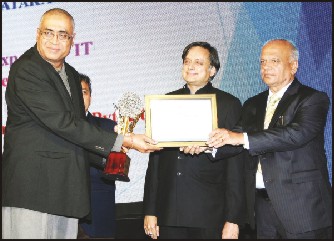
SPI CEO Sid Mookerji is seen receiving the award from S.R. Patil, Minister for IT, BT, Science and Technology as Shashi Tharoor, Union Minister of State for Human Resources, looks on.

Mysore :

Software Paradigms Infotech Pvt. Ltd. (SPI) has received the coveted ‘Highest IT Exporter-IT Services’ award for Mysore region (2012-2013). This award is conferred by Government of India and Department of IT, BT & ST, Government of Karnataka, in association with STPI.

The ‘Highest IT Exporter-IT Services’ Award is one of the most prestigious recognitions received by software companies for making a significant contribution to the total software exports of the country.

The award was presented to SPI CEO Sid Mookerji at Bangalore IT Biz-2013 recently. The trophy and certificate were presented by Shashi Tharoor, Union Minister of State for Human Resources and S.R. Patil, Karnataka Minister for IT, BT, Science and Technology, Planning and Statistics.

SPI was declared the Highest IT Exporter from the region in 2009-10, 2010-11 and 2011-2012. SPI had also received the Certificate of Excellence Award in IT exports 2003-04 and 2004-05.

“We are delighted to have won the Highest IT Exporter award for the fourth consecutive year. This establishes us as a leading IT player in tier II cities. SPI has been growing steadily both organically and inorganically; we have made two acquisitions this year. We will continue to deliver best of breed solutions that address the evolving business needs of our customers,” said Sid Mookerji.

source: http://www.starofmysore.com / Star of Mysore / Home> General News / November 27th, 2013

Mandya-origin Vivek H Murthy next US Surgeon General

President Barack Obama plans to nominate Dr. Vivek Hallegere Murthy, the Indian-American head of a doctors group that promotes his signature healthcare law to be the next US surgeon general.

DrVivekBF02dec2013

Murthy is a hospitalist at the Brigham and is co-founder and president of Doctors for America, a Washington, DC-based group of 16,000 physicians and medical students that advocates for access to affordable, high quality health care.If confirmed by the Senate, Murthy will replace Regina Benjamin, who was appointed by Obama in 2009 and left her post last summer.

The job focuses heavily on public health issues.Murthy was appointed to the President’s Advisory Group on Prevention, Health Promotion, and Integrative and Public Health in 2011. The prevention group was created as part of the Affordable Care Act health reform law.

His group, Doctors for America, was originally called Doctors for Obama and helped to campaign for Obama’s election.

Murthy co-founded VISIONS Worldwide in 1995, a non-profit organization focused on HIV/AIDS education in India and the United States, where he served as President from 1995 to 2000 and Chairman of the Board from 2000 to 2003.

Murthy received a BA from Harvard University, an MBA from Yale School of Management, and an MD from Yale School of Medicine.

“I am confident that these outstanding individuals will greatly serve the American people in their new roles and I look forward to working with them in the months and years to come,” Obama said in announcing Murthy’s appointment along with three other key posts.

The announcement came shortly after Obama acknowledging that his administration “fumbled” in the troubled rollout of his healthcare law offered a fix that would allow insurers to keep for another year people on plans that were to be cancelled for not meeting minimum standards under the new law.

In the midst of mounting criticism of the troubled healthcare website, former President Bill Clinton had Tuesday suggested that Obama should make sure Americans can retain their current health insurance plans, even if it means revamping the Affordable Care Act.

“I personally believe, even if it takes a change to the law, the president should honour the commitment the federal government made to those people and let them keep what they’ve got,” Clinton told OZY, a news website.

Murthy, though was born in London and shifted base to the US later, he has links with the Hallegere village of Mandya district.

source: http://www.deccanherald.com / Deccan Herald / Home> International / by Agencies / Washington – November 15th, 2013

Unani regimen offers hope to mishap victim

Imran Khan, a resident of Tumkur, had been bedridden for the best part of 12 years after nearly 200 kg of steel fell on his back when he was visiting a construction site.

The 28-year-old lost all hope of walking again till he found out about Ilaj bit Tadbeer (regimental therapy), a little-known system of unani medicine involving massage, cupping and leeching using herbs. Imran underwent 14 months of continuous treatment at the National Institute of Unani Medicine (NIUM), which falls under the Ministry of Health and Family Welfare. Now, he has started walking with support.

The story of Tousif Ahmed from BTM Layout is similar to Imran’s. Tousif injured his spine in an accident in Andhra Pradesh in January 2012 in which his uncle died.

“I was told by a private hospital that I would not walk again and would be bedridden for the rest of my life. But with intervention from NIUM, I am moving in a wheelchair and also walking with crutches,” he said.

Tousif has been receiving treatment at the Institute for the past four months. He is currently shooting videos of recovering patients at NIUM in order to make a short film.

“I had wanted to set up a call-centre after getting my BCA, but the accident crippled my dream. But as I can move again, I have set a target of five months to walk out of this hospital,” he said.

Dr D A Muzzaffar Bhat, resident medical officer of NIUM, said the centre was focusing on neuro-rehabilitation. This included attending to patients who suffered from stroke, myopathy, epilepsy, motor-neuron disease, Parkinson’s disease, hemiplegia and paraplegia. He said NIUM takes up cases referred from other hospitals like NIMHANS.

He referred to the successful treatment of Mohammed Farooq, who was admitted to Victoria Hospital after meeting with an accident. He was bedridden for eight months with no sensation in his lower-back. Farooq started treatment at NIUM in January and is now walking with the help of crutches.

“No surgeries are done here and our approach is to develop cells and strengthen nerves and muscles,” Dr Bhat said .

Options for Cerebral Palsy Aditya Kholi greets you with a smile and offers a chair to those who approach him and only when he tries to walk, do people notice a problem.

Aditya is a child who was born with cerebral palsy and could hardly move his legs. His father Mahesh Kohli, an IT professional, had quit his job in Dubai to research treatment options for Aditya, when a friend told him about Ilaj bit Tadbeer.

After five months of treatment, Aditya can now sit comfortably and also fold his legs and walk.

source: http://www.newindianexpress.com / The New Indian Express / Home> Cities> Bangalore / by Mohammed Yacoob – Bangalore / November 18th, 2013

Pursue contemporary science, says C N R Rao

“A global index to measure the contemporariness of science shows most of India’s research dates back to the 1950s and 60s. The yesterday and today of science cannot be the same; we must do contemporary science,” Bharat Ratna-designate Prof C N R Rao said on Monday.

At the silver jubilee inaugural lecture of an in-house symposium at Jawaharlal Nehru Centre for Advanced Scientific Research he regaled the audience with anecdotes and scientific insight.

“Time is catching up with India and we cannot say we have a lot of time. India is 66th among 140 nations in innovation.  India has only 20 years to catch up with science for self-preservation, and no day is a holiday for science,” he told a gathering of young students and  scientists.

To buttress his argument, he said India contributed about one per cent of the top research papers in the world annually compared to China (5 per cent) and the US (10 per cent). Referring to worries over water resources and waterborne diseases, Rao said work must be done on energy and water in the country.

He spoke about the experiences of scientists he called the ‘Gods’ of science.

He described how Excelsior magazine carried out a smear campaign to keep Madame Marie Curie out of the French Academy of Sciences only because she was a woman even though she had won two Nobel Prizes in 1903 and 1911.

Declaring that no one could equal the contributions of Michael Faraday, Rao said the beauty of his work lays in the simplicity of his thinking and experiments.

However, he did not get a Nobel Prize as he died in 1867 before the Nobel Prizes were instituted.

He also spoke of Ernest Rutherford and his Nobel Prize in 1908 for the chemistry of radioactive substances.

Rutherford took to mentoring students in his lab and under his leadership, Chadwick discovered the neutron in 1932.

Following this, John Cockcroft and Ernest Walton performed experiments to split the nucleus in a controlled environment, he added.

Rao also referred to the spiritual realm, quoting Swami Vivekananda and Rabindranath Tagore, to stress how science was a great means to make Indians selfless.

He said, “It is important that we criticise and question science. But it must be in an open process and not to belittle others. Daily trifles kill most people. Let us not pay too much attention to small things.”

Rao showed his lighter side as he spoke of the wrongs suffered by material and structural chemists at the hands of organic chemists.

source: http://www.newindianexpress.com / The New Indian Express / Home> Cities> Bangalore / by Express News Service – Bangalore / November 19th, 2013

Infosys and BT win outsourcing award

The National Outsourcing Association has presented Infosys and BT with the 2013 award for excellence in telecommunication, utilities and hi-tech outsourcing.

The project has made it easier for BT’s 20,000-strong field engineers to work on the move and has led to significant productivity improvements.

The solution addressed the inefficiencies and costs associated with traditional ways of coordinating, managing and tracking the workload of a mammoth field force.

Infosys and BT collaborated to improve the field engineer’s experience and accelerated response rates by taking a transformational approach to field management.

source: http://www.stockmarketwire.com/ StockMarketWire / November 21st, 2013

CNR Rao, a high priest of pure science gets Bharat Ratna

New Delhi:

Eighty-year-old Prof. Chintamani Nagesha Ramachandra Rao has been chosen for India’s highest civilian honour, the Bharat Ratna. The world renowned chemist was named for the top civilian award along with Cricket legend Sachin Tendulkar.

However, both Rao and Tendulkar share nothing in common. Sachin is a national sporting icon, India’s most famous Cricketer while Rao is an icon in the field of science, the most famous scientist of the country, a renowned Chemist in the World.

A press release from the government of India describes CNR Rao as an eminent scientist and Sachin as an eminent sportsperson. It is a very banal description of the two geniuses.

Unlike the Cricketers, scientists won’t retire. Sachin has got the highest honour, the day he has retired. Rao is still very much active. As they say “once a scientist, always a scientist”.

It is sad that the entire focus is only on Sachin and not on CNR Rao. Unlike Cricket, the science is not flamboyant. Scientists spend most of their life in unglamorous environments away from limelight and people.

The demand for Bharat Ratna for Sachin had been there for at least 6-7 years. It had polarized the public opinion. Cricket is a great entertainment. If the people from the field of entertainment can get Bharat Ratna, there is nothing wrong in Sachin also getting it. After all, he has entertained the Cricket lovers all over India for 24 years.

Rao, a Kannadiga and Sachin, a Maharashtrian have got India’s highest civilian award together. After engineering genius Sir M Vishweshwaraiah and the Hindustani music great Pt. Bhimsen Joshi, CNR Rao is the third Kannadiga to get Bharat Ratna. Sachin is the 6th Maharashtrian to get the same honour.

CNR Rao is undoubtedly a mega star among the scientists. His path breaking research in Nano science is a well known fact. His aversion to Information Technology (IT) is also a well known.

Rao is an admirer of his home town Bangalore’s science city environment and its science city tag. He feels that the undue importance given to IT has killed other forms of science, mainly the scientific research. A few years ago speaking to ‘Outlook’ magazine he famously said “‘If IT Is Going To Take Away Our Values, Burn Bangalore, Burn IT. I am a real Bangalorean. I was born in Basavangudi. The greatness of Bangalore was that it allowed simplicity and enjoyment-a cup of coffee and a masala dosa at Vidyarthi Bhavan kept you happy. I don’t see that Bangalore anymore. It is now an awful city. There was more poetry and music here before the IT boom. The city we have created in recent years is rotten-highly polluted, garbage strewn everywhere, including the intellectual garbage dumped on this city by the IT industry”.

Attacking modern icons of Bangalore, CNR Rao had said “Our society has created a bunch of icons and role models who are distorting not just the future of this city but of all India, and of our sense of values. Our people have lost respect for scholarship. Money and commerce has taken over. If IT is going to take away our basic values, then you can burn Bangalore and burn IT.”

Rao is known for his outspokenness. He is not a typical scientist. He is a man of many interests. A lover of literature, music, Kannada language, history, cinema, pure science, Bangalore’s weather and of course research.

He has been advocating more money and importance for the scientific research in India. Even at the age of 80, CNR Rao attends several seminars and symposiums stressing on the need for a scientific temperament. According to the people close to him, he works for more than 16 hours a day.

Rao, who was born in Bangalore in 1934, has received more than 40 Honorary Doctorates from various prestigious Universities across the World. A world authority on structural Chemistry, Rao taught at the IIT Kanpur, Indian Institute of Sciences (IISc) Bangalore, Oxford, Cambridge and University California in an illustrious career spanning over 50 years. He is also the foremost solid state and materials chemists in the World. Author of over 45 books on science, Rao has held various prestigious government posts. He has been the chairman of Indian scientific advisory council to the Prime Minister since 2005. He earlier held the same position between 1985-89, when Rajiv Gandhi was the Prime Minister.

He has got almost all high honours within and outside the nation including Padma Vibhushan to Karnataka Ratna Awards. His name was nominated for the Nobel Award in Chemistry several times in the past. Circles and flyovers have been named after CNR Rao in Bangalore.

Undoubtedly, CNR Rao has been one of the greatest scientists of our times and a true national icon. Good luck and best wishes to both CNR Rao and Sachin Tendulkar. Country is grateful to you.

source: http://www.ibnlive.in.com / IBN Live / Home> IBN Live> India / by DP Satish, CNN IBN / New Delhi – November 17th, 2013

NITK all set to patent IPR

Off late, National Institute of Technology (Karnataka), Surathkal, is all set to protect the intellectual properties that have been originating in the institute. The Intellectual Property Rights (IPR) cell set up in the institute will formulate its policy soon and thereafter will exclusively look into patenting the ideas and new technologies of the faculty and students of the institute, said NITK Director Prof Swapan Bhattacharya. He was speaking to media persons in the backdrop of the 11th annual convocation held at NITK campus in Surathkal on Saturday. 

Prof M B Saidutta, who is in-charge of the IPR Cell explained that already six patent applications have been sent. These are from Chemical Engineering, Electronics and Communications and Chemistry departments. More students and faculty are preparing for patenting their intellectual properties, he said. To a query, he said that it was found that some new ideas or technologies that were originated at NITK Surathkal and put in public domain were patented by some others elsewhere. Also, off late, it has been realised that most of the innovations developed here have commercially high significance but unfortunately not capitalised, said Saidutta.

He hinted that in many a cases, one’s ideas in public domain were patented by someone else.

MoU with Michigan University

Prof Swapan Bhattacharya briefed that as a part of the MoU NITK inked with Michigan State University, US, a host of facilities are made available. Conducting joint workshop in the field of fire safety construction technology is the significant one.

The executive Vice President of the Graduates School of Sciences and Technology, Michigan University, Prof Satish Udupa who was the chief guest of the convocation said that post 9/11, the US has been brain storming on research activities on constructing fire resistant buildings. It has been found that the collapsed twin buildings of World Trade Centre was hardly fire resistant.

Faculty exchange programme, sending under graduates of NITK to Michigan University on summer vacation with stipend, conducting joint research and development projects, organisation of international seminars, symposia at NITK are also planned as a part of MoU.

The director said that as per the MoU signed with Larson and Toubro (L&T), 30 students will be admitted in NITK out of which 15 will be  L&T employees. All the study expenses will be borne by  L&T and the company will also absorb them after the successful completion of the course.

‘Wait for delayed gratification’

The Executive Vice President of the Graduates School of Sciences and Technology, Michigan University, Prof Satish Udupa in his convocation address called upon students to overcome the temptation of instant gratification with delayed gratification. Instant gratification is for short term only. Delayed gratification will bring wonders in your professional and personal life.

He also exhorted students to do their bit to balance the bridge between have’s and have not’s. There is nothing as wrong like the notion that a single person can not make a difference in society, he pointed. Later, at press meet,  Prof Udupa maintained that India has started focussing on research just five years back and it will take time to reap the benefits.

At the convocation programme, NITK Surathkal Chairman Sushil Chandra Tripathi, Dean (Administration) Prof Suman David, Registrar K Ravindranath among others also spoke.

source: http://www.deccanherald.com / Deccan Herald / Home> District / DHNS / Surathkal – November 16th, 2013

A tablet to help detect pesky pests

(The next time you find your…)

Bangalore :

The next time you find your favourite plants infested with pests or diseased, don’t lose heart. Technology will come to your rescue.

Electronic Solutions Against Agricultural Pests (e-SAP), an innovative tablet device, promises to be of much help in the field of agriculture. It helps people get instant information about the kind of pest that’s ruining the plants, with suggestions on how to fight it.

“The hand-held device is easy to use. Even a layman can navigate to find the problem in his crop. A single tablet costs Rs 25,000. Prices are likely to come down if there’s a large-scale demand,” said Nageshwar Rao of Tene Agricultural Solutions, Bangalore. The company provided a platform called Triptolemus for University of Agricultural Sciences (UAS), Raichur to design the tablet and hold its copyright.

The device works on a web-based application system, which facilitates flow of information from the grower to the farm scientist at the click of a button. It also has a voice-based application that guides the farmer in the local dialect. The tablet can also recommend so lutions based on geography and agro-climatic con ditions of the area where the crop is being grown.

Just a click away: As soon as you notice a pest in your garden or farm, capture images of the same using the device. “e-SAP captures high-quality images of pests and their symptoms, and then guides the user on how to identify them. It also provides instant solutions on how to get rid of them,” explained Rao.

Following its first successful trial in Raichur, Tene Agricultural Solutions and UAS, Raichur have entered into an MOU to make e-SAP available to the larger market. “We have sent a proposal to the government to implement this solution in other states too,” said Rao.

The other two prominent agriculture universities of Karnataka – Bangalore and Shimoga have decided to promote the green tab among farmers.

source: http://www.articles.timesofindia.indiatimes.com / The Times of India / Home> Tech> Tech News> Hardware> Tablet / by Manu Aiyappa, TNN / November 18th, 2013

Breathe fresh and healthy air at Oxybar

(Left)  Oxybar at Mall of Mysore. ( Right) Dr. Srikanth seen with a Oxygen dispensing machine.
(Left) Oxybar at Mall of Mysore.
( Right) Dr. Srikanth seen with a Oxygen dispensing machine.

by S.N. Venkatnag Sobers

People often say they are stressed out or suffering from migraine or a hangover after a party. Such persons would be in need of fresh air to rejuvenate themselves and de-stress. There are many medicines available in the market which act as relieving agents. While some have positive results, there are a few that have side effects too.

For those who have such hangovers or stress, a Mysore based doctor has all the solutions sans medicines. The Oxybar…now, don’t think that it is something related to alcohol, in fact, it is something which solves the issues related to alcohol.

Everyone knows that oxygen is a lifesaving agent ever since man came into being. But, do you know that the oxygen we breathe has 21 percent concentration and the one given in hospital is 99 percent pure??? The Oxybar provides oxygen at 80 percent to 90 percent concentration using a portable Oxygen Concentrator. No cylinder or any hazards is involved in the process. The oxygen present in the atmosphere is sucked and concentrated by the machine.

The Oxybar is the brain child of Dr. Srikanth, who is an Orthopaedic Surgeon at Nanjangud. He started the Oxybars about three years ago. He has also been manufacturing portable Oxygen cans and machines through his company G.S. Enterprises.

Speaking to Star of Mysore, Dr. Srikanth said that the concept of Oxygen bar was not new as it was started by Japanese in 1996 after a research which found that oxygen given at a lesser concentration than that required for the patient, helps detoxify the body and boost stamina.

According to Dr. Srikanth, oxygen at this concentration helps boost stamina and increase strength in athletes, improves memory and concentration for children during exams, relieves stress and fatigue among professionals, provide a sound sleep & prevent snoring, improves and productivity of the labourers, relieves migraine and cleanses the body through detoxification and rejuvenation.

The Process

It takes just a few minutes to get relieved from all pollution, stress and fatigue through oxygen which is delivered with a nasal cannula in a flavour of your choice. The aroma therapy is given different flavours. The aroma is mixed with oxygen as the effect is more before it is given to the customer. Each flavour has its own relevance.

Flavours: Vanilla flavour for slimming, Lemon for mood swings, Orange for body ache, Peppermint for hangover, Lavender for rejuvenation, Basil for migraine , Eucalyptus for sinusitis, Block Nose and Arthritis, Ylang Ylang for sexual libido. Aroma therapy is also available in cocktail of flavours. Currently, the company is charging Rs. 50 for a five-minutes session.

The Oxybar machines are installed in various clubs, pubs, spas, resorts, clinics, hospitals, gyms and even at homes for personal use. The machines are available in variety of designs and are also customised as per the requirement of each customer.

Dr. Srikanth has also come out with portable Oxygen cans which can be used during hiking, mountaineering and long distance travelling.

“Oxygen Cans given best results when used with aroma-chew, aromatic powder which are available in sachets in different flavours. By using it, one can feel immediate boost of energy and alertness, which is beneficial during long drives in the night,” said Dr. Srikanth.

Oxybars outlets are available on Kalidasa Road and Mall of Mysore in Mysore, Bangalore, Mumbai, Philippines, Singapore and UAE with franchises at Hyderabad, Nasik, New Delhi and other cities in the country.

Dr. Srikanth has also invented a Naval Brush. The brush is used to clean the naval to avoid infections. “The naval, commonly known as Belly Button, is one of the sensitive parts of the body which has high risk of infection. Umbilical region needs to be kept clean for the various reasons mentioned above, and using proper instruments. The necessity is for a properly designed, adequately aligned and flexible brush with a globular head and nylon bristled tip to cater to the needs of the masses, giving rise to cleaner and healthier people,” he added.

Ozone Therapy

Dr. Srikanth is also an expert in the Ozone therapy. Ozone is provided as a gas, which reacts with water and dehydrates the area it is pointed at. Ozone injections given to the fat layer, shrinks the fat cell making it easy to come out of the body through sweat. It helps clear a non healing diabetic or neuropathic foot ulcer by a superficial method called bagging. Also helps in anti-aging, rejuvenation and detoxification purposes due to its scavenger free radical methodology.

Dr. Srikanth also conducts training workshops for doctors in various parts of India in association with Ozone Forum of India. Dr. Srikanth can be contacted at his hospital in Nanjangud with consultations at Adithya Clinic, Kalidasa Road in Mysore and CRMC at Infantry Road in Bangalore.

For appointments and details, contact Mob: 98865- 33345.

source: http://www.starofmysore.com / Star of Mysore / Home> Feature Articles / by S. N. Venkatnag Sobers  / November 22nd, 2013